REFRACTIVE
ERRORS
SHYAM BHATEWARA
LECTURER
INDEX NURSING COLLEGE
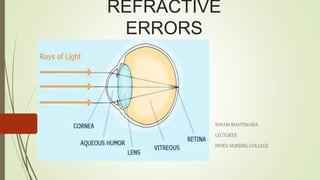
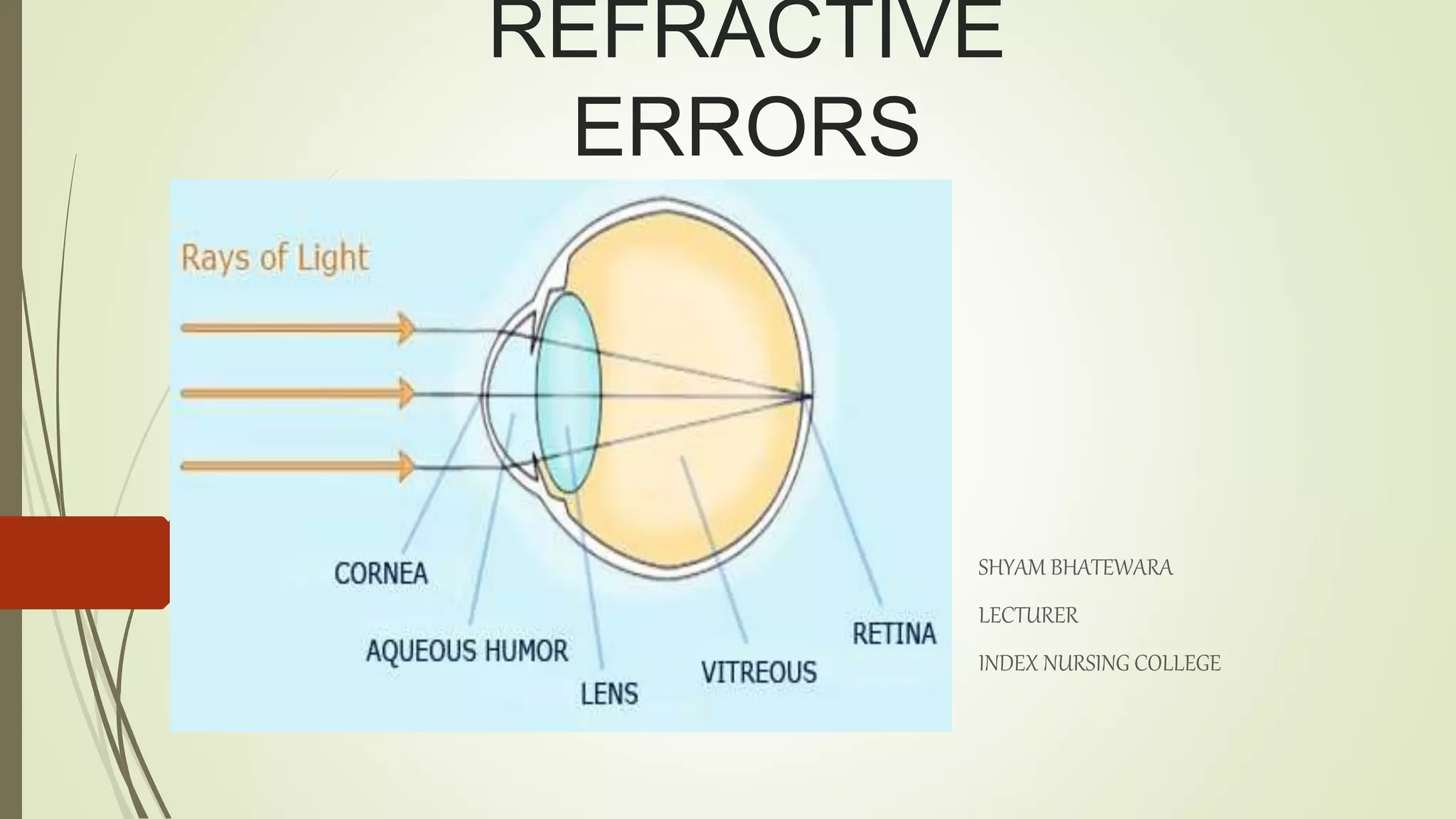
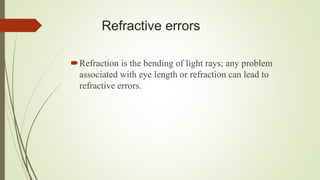
Refractive errors
Refraction is the bending of light rays; any problem
associated with eye length or refraction can lead to
refractive errors.
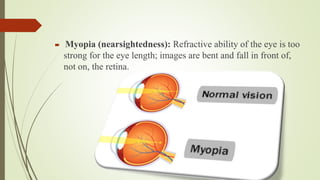
 Myopia (nearsightedness): Refractive ability of the eye is too
strong for the eye length; images are bent and fall in front of,
not on, the retina.
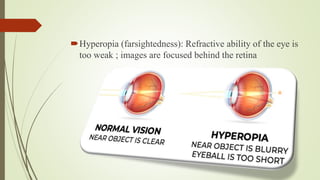
Hyperopia (farsightedness): Refractive ability of the eye is
too weak ; images are focused behind the retina
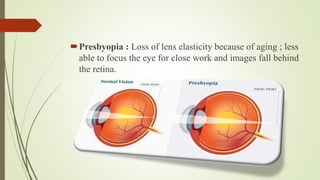
Presbyopia : Loss of lens elasticity because of aging ; less
able to focus the eye for close work and images fall behind
the retina.
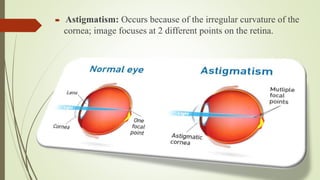
 Astigmatism: Occurs because of the irregular curvature of the
cornea; image focuses at 2 different points on the retina.
Diagnostic evaluation
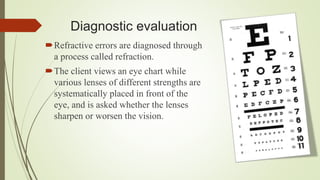
Refractive errors are diagnosed through
a process called refraction.
The client views an eye chart while
various lenses of different strengths are
systematically placed in front of the
eye, and is asked whether the lenses
sharpen or worsen the vision.
management
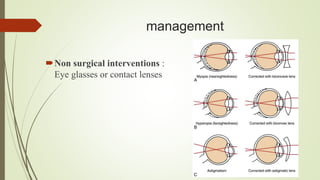
Non surgical interventions :
Eye glasses or contact lenses
Surgical interventions
Radial keratotomy: Incisions are made through the
peripheral cornea to flatten the cornea, which allows the
image to be focused closer to the retina; used to treat
myopia.
Photorefractive keratotomy: A laser beam is used to
remove small portions of the corneal surface to reshape
the cornea to focus an image properly on the retina; used
to treat myopia and astigmatism.
Laser-assisted in-situ kerato mileusis (LASIK): The
superficial layers of the cornea are lifted as a flap, a laser
reshapes the deeper corneal layers, and then the corneal
flap is replaced; used to treat hyperopia, myopia, and
astigmatism.
Corneal ring: The shape of the cornea is changed by
placing a flexible ring in the outer edges of the cornea;
used to treat myopia.
Refrective error

Refrective error

  • 1.
  • 2.
    Refractive errors Refraction isthe bending of light rays; any problem associated with eye length or refraction can lead to refractive errors.
  • 3.
     Myopia (nearsightedness):Refractive ability of the eye is too strong for the eye length; images are bent and fall in front of, not on, the retina.
  • 4.
    Hyperopia (farsightedness): Refractiveability of the eye is too weak ; images are focused behind the retina
  • 5.
    Presbyopia : Lossof lens elasticity because of aging ; less able to focus the eye for close work and images fall behind the retina.
  • 6.
     Astigmatism: Occursbecause of the irregular curvature of the cornea; image focuses at 2 different points on the retina.
  • 7.
    Diagnostic evaluation Refractive errorsare diagnosed through a process called refraction. The client views an eye chart while various lenses of different strengths are systematically placed in front of the eye, and is asked whether the lenses sharpen or worsen the vision.
  • 8.
    management Non surgical interventions: Eye glasses or contact lenses
  • 9.
    Surgical interventions Radial keratotomy:Incisions are made through the peripheral cornea to flatten the cornea, which allows the image to be focused closer to the retina; used to treat myopia. Photorefractive keratotomy: A laser beam is used to remove small portions of the corneal surface to reshape the cornea to focus an image properly on the retina; used to treat myopia and astigmatism.
  • 10.
    Laser-assisted in-situ keratomileusis (LASIK): The superficial layers of the cornea are lifted as a flap, a laser reshapes the deeper corneal layers, and then the corneal flap is replaced; used to treat hyperopia, myopia, and astigmatism. Corneal ring: The shape of the cornea is changed by placing a flexible ring in the outer edges of the cornea; used to treat myopia.