




Publication Ethics
Kishor Patwardhan
Professor, Department of Kriya Sharir, Faculty of Ayurveda, Institute of Medical
Sciences, Banaras Hindu University, Varanasi
Where to Publish your research work?
2
What is a ‘Good’ journal?
(Minimum essential requirements)
 Must be available online
(Searchable/Easy to locate/share)
 Must be ‘Peer-reviewed’ (Refereed)
 Must be indexed with some widely consulted
database (e.g., PubMed Central, Medline, Web of
Science, Scopus)
 Google Scholar is NOT an indexing database
3http://the-aps.org/trainees/Symposia/2010%20talks/Barrett-web.ppt
‘Better’ journal
(Optional requirements):
 Has got a good Impact Factor
 ‘International’ (Editorial Board must be of International
character)
 Has got good SNIP/SJR ranking/Cite-Score
 It is an ‘Open Access’ journal (Sometimes a requirement)
4
‘Convenient’:
 Takes minimum time for editorial decision
 Provides easy online submission process, /manuscript tracking
facility
 Known Acceptance Rate
 No article processing fee / color printing charges/ reprint
charges / submission fee
5
Be careful with
 Fake Impact Factors / Fake Journal Metrics
 ‘Author Pays’ model of Open Access
 Fake Peer-Review process
 Don’t fall prey to ‘Call for papers’
 Claims such as ‘Under the process of PubMed indexing’
 Claims such as ‘Indexed in Elsevier’
6
www.scholarlyoa.com
7
Bogus journal metrics (Examples)
 Advanced Science Index
 Directory of Journal Quality Factor
 International Scientific Indexing
 International Impact Factor Services
 GISI Impact Factor
 Global Impact Factor
 Universal Impact Factor
 SJIF Impact Factor
8
Authorship
9
Responsibilities of an author
 Originality
 Good record keeping
 Integrity, Honesty, Objectivity
 Openness / Transparency
 Respect for IPR
 Declaring Conflict of interest/ Disclosures
 Submitting Copyright Agreements
 Obtaining Consent to reuse published content
 Responsibility (Corrections/ Withdrawing/ Retracting)
10
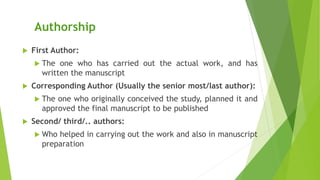
Authorship
 First Author:
 The one who has carried out the actual work, and has
written the manuscript
 Corresponding Author (Usually the senior most/last author):
 The one who originally conceived the study, planned it and
approved the final manuscript to be published
 Second/ third/.. authors:
 Who helped in carrying out the work and also in manuscript
preparation
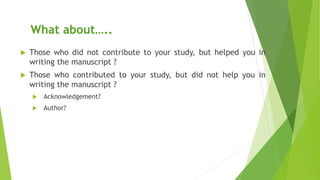
What about…..
 Those who did not contribute to your study, but helped you in
writing the manuscript ?
 Those who contributed to your study, but did not help you in
writing the manuscript ?
 Acknowledgement?
 Author?
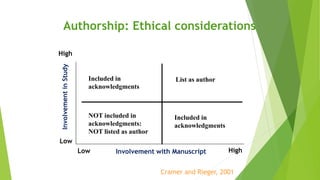
Authorship: Ethical considerations
Included in
acknowledgments
InvolvementinStudy
Involvement with Manuscript
High
High
Low
Low
Cramer and Rieger, 2001
Included in
acknowledgments
NOT included in
acknowledgments:
NOT listed as author
List as author
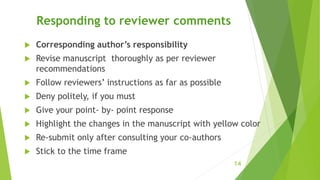
Responding to reviewer comments
 Corresponding author’s responsibility
 Revise manuscript thoroughly as per reviewer
recommendations
 Follow reviewers’ instructions as far as possible
 Deny politely, if you must
 Give your point- by- point response
 Highlight the changes in the manuscript with yellow color
 Re-submit only after consulting your co-authors
 Stick to the time frame
14
What if reviewers fail to detect some
errors?
 Errors may be detected after the publication
 Authors are encouraged to write to the editor if they find errors
after publication
 Communicate the sufficiently detailed Erratum to rectify the
errors.
 http://www.nlm.nih.gov/pubs/factsheets/errata.html
15
Violations of Research Ethics
16
Falsification: German cancer research case
 In 1998, German research funding agency looked at 347 papers
published by two researchers, F.Herrmann and M.Brach.
 It concluded that 29 of these contained falsified material and found
evidence of data manipulation leading to a suspicion of fraud in a
further 65 papers.
 In most cases the falsification of illustrations of blood and other cells
was noted.
17
https://www.parliament.uk/documents/post/pn182.pdf
18
Fabrication: The Pearce case
 In August 1996, Malcom Pearce, published a paper in the British
Journal of Obstetrics and Gynaecology.
 He claimed to have rescued an ectopic pregnancy by transferring it
into the uterus.
 The ‘patient’ did never exist!
 Four other fraudulent papers were discovered after investigation,
two of which had been published in the BMJ.
 Pearce was struck off by the General Medical Council.
19
https://www.parliament.uk/documents/post/pn182.pdf
Plagiarism: US National Science Foundation
 A researcher was asked to peer review a proposal for research,
which was later rejected on the basis of his comments.
 This reviewer subsequently submitted his own research proposal
to another funding body, which was accepted for funding.
 This proposal was found to have plagiarised the original
proposal.
 The researcher had submitted a number of other research
proposals plagiarised from proposals he had been asked to peer
review.
20
https://www.parliament.uk/documents/post/pn182.pdf
Other forms of Violation of research ethics:
 Failure to disclose conflicts of interest: A study conducted in 1986
found that 96% of studies had financial relations with the drug
manufacturer.
 Multiple Submissions: Simultaneous submission of same paper to
multiple journals
 Redundant / Duplicate publication (Duplicate publication/
undisclosed publication)
 Authors publish the same paper in a number of different
journals
Suggesting Bogus Reviewers: Giving an alternative email id of the
author so that the author himself becomes a reviewer 21
Guest authorship:
 Including an author only because it may improve the chances of
acceptance
 The senior author (Geoffrey Chamberlain) on the ‘ectopic pregnancy’
paper had to resign from a number of senior positions.
 Ghost Authorship: Actual author’s name not included
 Anonymous Authorship: Publishing with pseudonym
 Surrogate authorship: Publishing someone else’s work in one’s
own name
 Gift Authorship: Adding the name of the spouse/ friend as
author
22
Salami Slicing
 Publishing the same data in different forms in different journals
 Effect of Indian gooseberry on hyperglycemia in type-2 DM
 Biomedical journal
 Effect of Amalaki in Madhumeha with special reference to Prakriti
 Ayurveda journal
 Interferes in meta analyses as the same cases will be duplicated
 Ethical only if the data is too huge and each paper addresses substantially
different questions
 Editors must be informed in all such cases regarding prior publications
23
 Editors’ Responsibilities
 Journal Owners’ Responsibilities
 Publisher’s Responsibilities
 Reviewers’ Responsibilities
24
Further Reading:
 https://publicationethics.org/
 https://pubpeer.com/
 https://retractionwatch.com/
 http://www.icmje.org/
 http://www.wame.org/

Publication Ethics

  • 1.
    Publication Ethics Kishor Patwardhan Professor,Department of Kriya Sharir, Faculty of Ayurveda, Institute of Medical Sciences, Banaras Hindu University, Varanasi
  • 2.
    Where to Publishyour research work? 2
  • 3.
    What is a‘Good’ journal? (Minimum essential requirements)  Must be available online (Searchable/Easy to locate/share)  Must be ‘Peer-reviewed’ (Refereed)  Must be indexed with some widely consulted database (e.g., PubMed Central, Medline, Web of Science, Scopus)  Google Scholar is NOT an indexing database 3http://the-aps.org/trainees/Symposia/2010%20talks/Barrett-web.ppt
  • 4.
    ‘Better’ journal (Optional requirements): Has got a good Impact Factor  ‘International’ (Editorial Board must be of International character)  Has got good SNIP/SJR ranking/Cite-Score  It is an ‘Open Access’ journal (Sometimes a requirement) 4
  • 5.
    ‘Convenient’:  Takes minimumtime for editorial decision  Provides easy online submission process, /manuscript tracking facility  Known Acceptance Rate  No article processing fee / color printing charges/ reprint charges / submission fee 5
  • 6.
    Be careful with Fake Impact Factors / Fake Journal Metrics  ‘Author Pays’ model of Open Access  Fake Peer-Review process  Don’t fall prey to ‘Call for papers’  Claims such as ‘Under the process of PubMed indexing’  Claims such as ‘Indexed in Elsevier’ 6
  • 7.
  • 8.
    Bogus journal metrics(Examples)  Advanced Science Index  Directory of Journal Quality Factor  International Scientific Indexing  International Impact Factor Services  GISI Impact Factor  Global Impact Factor  Universal Impact Factor  SJIF Impact Factor 8
  • 9.
  • 10.
    Responsibilities of anauthor  Originality  Good record keeping  Integrity, Honesty, Objectivity  Openness / Transparency  Respect for IPR  Declaring Conflict of interest/ Disclosures  Submitting Copyright Agreements  Obtaining Consent to reuse published content  Responsibility (Corrections/ Withdrawing/ Retracting) 10
  • 11.
    Authorship  First Author: The one who has carried out the actual work, and has written the manuscript  Corresponding Author (Usually the senior most/last author):  The one who originally conceived the study, planned it and approved the final manuscript to be published  Second/ third/.. authors:  Who helped in carrying out the work and also in manuscript preparation
  • 12.
    What about…..  Thosewho did not contribute to your study, but helped you in writing the manuscript ?  Those who contributed to your study, but did not help you in writing the manuscript ?  Acknowledgement?  Author?
  • 13.
    Authorship: Ethical considerations Includedin acknowledgments InvolvementinStudy Involvement with Manuscript High High Low Low Cramer and Rieger, 2001 Included in acknowledgments NOT included in acknowledgments: NOT listed as author List as author
  • 14.
    Responding to reviewercomments  Corresponding author’s responsibility  Revise manuscript thoroughly as per reviewer recommendations  Follow reviewers’ instructions as far as possible  Deny politely, if you must  Give your point- by- point response  Highlight the changes in the manuscript with yellow color  Re-submit only after consulting your co-authors  Stick to the time frame 14
  • 15.
    What if reviewersfail to detect some errors?  Errors may be detected after the publication  Authors are encouraged to write to the editor if they find errors after publication  Communicate the sufficiently detailed Erratum to rectify the errors.  http://www.nlm.nih.gov/pubs/factsheets/errata.html 15
  • 16.
  • 17.
    Falsification: German cancerresearch case  In 1998, German research funding agency looked at 347 papers published by two researchers, F.Herrmann and M.Brach.  It concluded that 29 of these contained falsified material and found evidence of data manipulation leading to a suspicion of fraud in a further 65 papers.  In most cases the falsification of illustrations of blood and other cells was noted. 17 https://www.parliament.uk/documents/post/pn182.pdf
  • 18.
  • 19.
    Fabrication: The Pearcecase  In August 1996, Malcom Pearce, published a paper in the British Journal of Obstetrics and Gynaecology.  He claimed to have rescued an ectopic pregnancy by transferring it into the uterus.  The ‘patient’ did never exist!  Four other fraudulent papers were discovered after investigation, two of which had been published in the BMJ.  Pearce was struck off by the General Medical Council. 19 https://www.parliament.uk/documents/post/pn182.pdf
  • 20.
    Plagiarism: US NationalScience Foundation  A researcher was asked to peer review a proposal for research, which was later rejected on the basis of his comments.  This reviewer subsequently submitted his own research proposal to another funding body, which was accepted for funding.  This proposal was found to have plagiarised the original proposal.  The researcher had submitted a number of other research proposals plagiarised from proposals he had been asked to peer review. 20 https://www.parliament.uk/documents/post/pn182.pdf
  • 21.
    Other forms ofViolation of research ethics:  Failure to disclose conflicts of interest: A study conducted in 1986 found that 96% of studies had financial relations with the drug manufacturer.  Multiple Submissions: Simultaneous submission of same paper to multiple journals  Redundant / Duplicate publication (Duplicate publication/ undisclosed publication)  Authors publish the same paper in a number of different journals Suggesting Bogus Reviewers: Giving an alternative email id of the author so that the author himself becomes a reviewer 21
  • 22.
    Guest authorship:  Includingan author only because it may improve the chances of acceptance  The senior author (Geoffrey Chamberlain) on the ‘ectopic pregnancy’ paper had to resign from a number of senior positions.  Ghost Authorship: Actual author’s name not included  Anonymous Authorship: Publishing with pseudonym  Surrogate authorship: Publishing someone else’s work in one’s own name  Gift Authorship: Adding the name of the spouse/ friend as author 22
  • 23.
    Salami Slicing  Publishingthe same data in different forms in different journals  Effect of Indian gooseberry on hyperglycemia in type-2 DM  Biomedical journal  Effect of Amalaki in Madhumeha with special reference to Prakriti  Ayurveda journal  Interferes in meta analyses as the same cases will be duplicated  Ethical only if the data is too huge and each paper addresses substantially different questions  Editors must be informed in all such cases regarding prior publications 23
  • 24.
     Editors’ Responsibilities Journal Owners’ Responsibilities  Publisher’s Responsibilities  Reviewers’ Responsibilities 24
  • 25.
    Further Reading:  https://publicationethics.org/ https://pubpeer.com/  https://retractionwatch.com/  http://www.icmje.org/  http://www.wame.org/