Publication and Research …………………….. Need
A publication is defined as anything that has been published: a book. a
research paper, a news article. A research paper describes the output of
research. If it is published in a Journal or conference, then it is a published
research paper, or a publication.
 Without Research and publications, science cannot progress
 Without Research and publication, you may not get a placement or promotion
Academic/Industry/market
 You may not get your project sanctioned if you have no Research in concern area
 Publications AND Research keep you ahead of your Community / colleagues: publication and
Research makes you ‘Immortal’ (Remarkable) .
Meaning of Ethics
ETHICS-Greek word: ethos=custom or convention, or the spirit (Inner Soul) of community
Oxford dictionary (2014): Moral principles that govern a person’s behavior or the conducting of
an activity of people.
The American Dictionary of Cultural Literacy (2005)
The branch of philosophy that deals with morality. Ethics is concerned with distinguishing
between good and evil in the world, between right and wrong human actions, and between
virtuous and non virtuous characteristics.
• Good and Right …………
Philosophy/Objective of Research Ethics
PHILOSOPHY :
 The term has been derived from two Greek words, ‘Philos’ means love and ‘Sophia’ means wisdom. Philosophy
means love for knowledge or passion for learning.
Philosophy help to understand Research Ethics-How can maintain criteria of ethics in research and publication with
Wisdom…………..
• To have a basic understanding of Research Philosophy.
• To Help to understand Wisdom but concern with original facts in research.
• To relate it with wisdom in writing and Publication for present comprehensive
Knowledge of the universe
• To understand the all-comprehensive character of philosophy;
• To know the importance of philosophy both at the theoretical and practical levels
Meaning of Research Ethics
Term of the ethics it is generally define as a set of principles and acceptable and unacceptable behavior
or way of conducting any task. One of the most common code “The Hippocratic oath “ are used in any area of
the research.
The Hippocratic oath is a formal promise made by recently try to preserve resources and grow something beneficial
for the concern area………. -qualified researcher that they will follow the standards set by their profession and try to
save resources and develop beneficial things /concept in concern area.
In area of research ethical policies (REC) addressing issues related to Plagiarism, Fabrication, Conflict of interest etc.
 Research ethics code mainly help to maintain scientific integrity and maintain safeguard in primary research.
 REC promote trust, respects in research environment by avoiding conflicts authorship, copyrights etc.
 REC maintain the safety and human appropriate care of animal ,clinical laboratory, sustainability etc.
 REC makes researchers accountable ,maintain quality research, beneficial outcomes & direct indirectly affect
the human health.
Principles of Research Ethics
 Being honest about the findings and methodology of the research. Being honest with other
direct and indirect with beneficiaries and respondents.
 Ensuring about integrity maintain honesty and sincerity, Fulfilling agreements and promises.
Do not create false expectations or make false promises.
 Clear real Objectivity Avoiding bias in experimental design, data analysis, data interpretation,
peer review, and other aspects of research.
 Informed consent means
• Respondent knowingly, logically gives consent to participate in a research.
• Informed consent is related to the autonomous right of the individual to participate in the
research.
• Informing the respondents about the research objective, their role, benefits/harms (if any) etc.
Conti…………………
 Respect for person/respondent
• Autonomy, which requires that those who are capable of deliberation about their personal
goals should be treated with respect for their capacity for self-determination.
• protection of persons with impaired or diminished autonomy, which requires that those who
are dependent or vulnerable be afforded security against harm or abuse
 Maximize the benefits of the participants. Ethical obligation to maximize possible benefits
and to minimize possible harms to the respondents.
 Do no harm. Minimize harm/s or risks to the human. Ensure privacy, autonomy and dignity.
 Responsibly publishing to promote and uptake research or knowledge. No duplicate
publication.
 It means keeping the participant anonymous. It involves not revealing the name, caste or any
other information about the participants that may reveal his/her identity.
 Protecting confidential information, personnel records. Introduction and objective of the
research, Purpose of the discussion, Methodology etc.…………
Conti……….
 Avoid discrimination on the basis of age, sex, race, ethnicity or other factors that are
violation of human rights and are not related to the study.
 Openness concern with to sharing results, data and other resources. Also accept encouraging
comments and constructive feedback.
 Be careful about the possible error and biases during research.
 Give credit to the intellectual property of others, Always paraphrase while referring to
others article, writing. Never plagiarize.
 Justice The obligation to distribute benefits and burdens fairly, to treat equals equally, and to
give reasons for differential treatment based on widely accepted criteria for just ways to
distribute benefits and burdens.
Ethical Principal & Research
ETHICAL PRINCIPLES
 Beneficence
 Respect for human dignity
 Justice
 Plagiarism Checker
ETHICAL CONCERNS IN QUALITATIVE RESEARCH :
 Distress
 Misinterpretation
 Identification
 Inconvenience
ETHICAL CONCERNS IN QUANTITATIVE RESEARCH
 Related to the stage of research
 Formulating the research questions
 Designing the study
 Collecting data
 Analysis
 Reporting
CONCLUSION
If research is based on a
robust design and in a
safe and ethical
manner, it can be of
benefit to all
Professional codes, laws,
regulations, and ethics
committees can provide
guidance but ultimate
determinant rests with
researcher’s value
Ethical Principal & Research
Purpose of peer review:
 Technical: Quality of science
 Subjective: Interesting, important, and relevant
 Influences what science enters the public domain
 Assists authors and editors in publishing quality research
Good /Better Journal
Good journal
 (Minimum essential requirements)
 Must be available online (Searchable/Easy to locate/share)
 Must be ‘Peer-reviewed’ (Refereed) Must be indexed with some widely consulted database (e.g., PubMed
Central, Medline, Web of Science, Scopus)
 Google Scholar is NOT an indexing database 8 http://
the-aps.org/trainees/Symposia/2010%20talks/Barrett-web.ppt
Better’ journal
 Has got a good Impact Factor
 ‘National’ / ‘International’
 Has got good SNIP/SJR ranking/Cite-Score
 It is an ‘Open Access’ journal (Sometimes a requirement)
Before Publication Check Points
 Fake Impact Factors / Fake Journal Metrics
 ‘Author Pays’ model of Open Access
 Fake Peer-Review process
 Don’t fall prey to ‘Call for papers’
 Claims such as ‘Under the process of PubMed indexing’
 Claims such as ‘Indexed in Elsevier 'or another standered indexing
Before writing a manuscript, ensure:
 You have followed all the standard guidelines while planning your study
 You have executed the study according to the protocols
 You have ethical clearance / all the original case sheets / duly signed consent forms /
investigation reports / photographs /Evidence's with you.
Eligible Authorship
Authorship : Responsibilities of an author
 Originality (No Plagiarism)
 Good record keeping
 Integrity, Honesty, Objectivity,
 Openness / Transparency
 Respect for IPR
 Declaring Conflict of interest/ Disclosures
 Copyright Agreements
 Consent to reuse published content
 Responsibility (Corrections/ Withdrawing/ Retracting)
First Author: The one who has carried out the actual work, and has written the
manuscript.
Corresponding Author :(Usually the senior most/last author): The one who originally
conceived the study, planned it and approved the final manuscript to be published .
Second/ third/.. authors: Who helped in carrying out the work and also in manuscript
preparation
Acknowledgement: Those who did not contribute to your study, but helped you in
writing the manuscript ?
Author : Those who contributed to your study, but did not help you in writing the
manuscript
Prof. Smriti Agarwal
School of Design
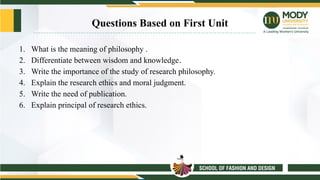
Questions Based on First Unit
1. What is the meaning of philosophy .
2. Differentiate between wisdom and knowledge.
3. Write the importance of the study of research philosophy.
4. Explain the research ethics and moral judgment.
5. Write the need of publication.
6. Explain principal of research ethics.


Unit-I Resarch Ethics and Publication.pptx

  • 2.
    Publication and Research…………………….. Need A publication is defined as anything that has been published: a book. a research paper, a news article. A research paper describes the output of research. If it is published in a Journal or conference, then it is a published research paper, or a publication.  Without Research and publications, science cannot progress  Without Research and publication, you may not get a placement or promotion Academic/Industry/market  You may not get your project sanctioned if you have no Research in concern area  Publications AND Research keep you ahead of your Community / colleagues: publication and Research makes you ‘Immortal’ (Remarkable) .
  • 3.
    Meaning of Ethics ETHICS-Greekword: ethos=custom or convention, or the spirit (Inner Soul) of community Oxford dictionary (2014): Moral principles that govern a person’s behavior or the conducting of an activity of people. The American Dictionary of Cultural Literacy (2005) The branch of philosophy that deals with morality. Ethics is concerned with distinguishing between good and evil in the world, between right and wrong human actions, and between virtuous and non virtuous characteristics. • Good and Right …………
  • 4.
    Philosophy/Objective of ResearchEthics PHILOSOPHY :  The term has been derived from two Greek words, ‘Philos’ means love and ‘Sophia’ means wisdom. Philosophy means love for knowledge or passion for learning. Philosophy help to understand Research Ethics-How can maintain criteria of ethics in research and publication with Wisdom………….. • To have a basic understanding of Research Philosophy. • To Help to understand Wisdom but concern with original facts in research. • To relate it with wisdom in writing and Publication for present comprehensive Knowledge of the universe • To understand the all-comprehensive character of philosophy; • To know the importance of philosophy both at the theoretical and practical levels
  • 5.
    Meaning of ResearchEthics Term of the ethics it is generally define as a set of principles and acceptable and unacceptable behavior or way of conducting any task. One of the most common code “The Hippocratic oath “ are used in any area of the research. The Hippocratic oath is a formal promise made by recently try to preserve resources and grow something beneficial for the concern area………. -qualified researcher that they will follow the standards set by their profession and try to save resources and develop beneficial things /concept in concern area. In area of research ethical policies (REC) addressing issues related to Plagiarism, Fabrication, Conflict of interest etc.  Research ethics code mainly help to maintain scientific integrity and maintain safeguard in primary research.  REC promote trust, respects in research environment by avoiding conflicts authorship, copyrights etc.  REC maintain the safety and human appropriate care of animal ,clinical laboratory, sustainability etc.  REC makes researchers accountable ,maintain quality research, beneficial outcomes & direct indirectly affect the human health.
  • 6.
    Principles of ResearchEthics  Being honest about the findings and methodology of the research. Being honest with other direct and indirect with beneficiaries and respondents.  Ensuring about integrity maintain honesty and sincerity, Fulfilling agreements and promises. Do not create false expectations or make false promises.  Clear real Objectivity Avoiding bias in experimental design, data analysis, data interpretation, peer review, and other aspects of research.  Informed consent means • Respondent knowingly, logically gives consent to participate in a research. • Informed consent is related to the autonomous right of the individual to participate in the research. • Informing the respondents about the research objective, their role, benefits/harms (if any) etc.
  • 7.
    Conti…………………  Respect forperson/respondent • Autonomy, which requires that those who are capable of deliberation about their personal goals should be treated with respect for their capacity for self-determination. • protection of persons with impaired or diminished autonomy, which requires that those who are dependent or vulnerable be afforded security against harm or abuse  Maximize the benefits of the participants. Ethical obligation to maximize possible benefits and to minimize possible harms to the respondents.  Do no harm. Minimize harm/s or risks to the human. Ensure privacy, autonomy and dignity.  Responsibly publishing to promote and uptake research or knowledge. No duplicate publication.  It means keeping the participant anonymous. It involves not revealing the name, caste or any other information about the participants that may reveal his/her identity.  Protecting confidential information, personnel records. Introduction and objective of the research, Purpose of the discussion, Methodology etc.…………
  • 8.
    Conti……….  Avoid discriminationon the basis of age, sex, race, ethnicity or other factors that are violation of human rights and are not related to the study.  Openness concern with to sharing results, data and other resources. Also accept encouraging comments and constructive feedback.  Be careful about the possible error and biases during research.  Give credit to the intellectual property of others, Always paraphrase while referring to others article, writing. Never plagiarize.  Justice The obligation to distribute benefits and burdens fairly, to treat equals equally, and to give reasons for differential treatment based on widely accepted criteria for just ways to distribute benefits and burdens.
  • 9.
    Ethical Principal &Research ETHICAL PRINCIPLES  Beneficence  Respect for human dignity  Justice  Plagiarism Checker ETHICAL CONCERNS IN QUALITATIVE RESEARCH :  Distress  Misinterpretation  Identification  Inconvenience ETHICAL CONCERNS IN QUANTITATIVE RESEARCH  Related to the stage of research  Formulating the research questions  Designing the study  Collecting data  Analysis  Reporting CONCLUSION If research is based on a robust design and in a safe and ethical manner, it can be of benefit to all Professional codes, laws, regulations, and ethics committees can provide guidance but ultimate determinant rests with researcher’s value Ethical Principal & Research
  • 10.
    Purpose of peerreview:  Technical: Quality of science  Subjective: Interesting, important, and relevant  Influences what science enters the public domain  Assists authors and editors in publishing quality research
  • 11.
    Good /Better Journal Goodjournal  (Minimum essential requirements)  Must be available online (Searchable/Easy to locate/share)  Must be ‘Peer-reviewed’ (Refereed) Must be indexed with some widely consulted database (e.g., PubMed Central, Medline, Web of Science, Scopus)  Google Scholar is NOT an indexing database 8 http:// the-aps.org/trainees/Symposia/2010%20talks/Barrett-web.ppt Better’ journal  Has got a good Impact Factor  ‘National’ / ‘International’  Has got good SNIP/SJR ranking/Cite-Score  It is an ‘Open Access’ journal (Sometimes a requirement)
  • 12.
    Before Publication CheckPoints  Fake Impact Factors / Fake Journal Metrics  ‘Author Pays’ model of Open Access  Fake Peer-Review process  Don’t fall prey to ‘Call for papers’  Claims such as ‘Under the process of PubMed indexing’  Claims such as ‘Indexed in Elsevier 'or another standered indexing Before writing a manuscript, ensure:  You have followed all the standard guidelines while planning your study  You have executed the study according to the protocols  You have ethical clearance / all the original case sheets / duly signed consent forms / investigation reports / photographs /Evidence's with you.
  • 13.
    Eligible Authorship Authorship :Responsibilities of an author  Originality (No Plagiarism)  Good record keeping  Integrity, Honesty, Objectivity,  Openness / Transparency  Respect for IPR  Declaring Conflict of interest/ Disclosures  Copyright Agreements  Consent to reuse published content  Responsibility (Corrections/ Withdrawing/ Retracting)
  • 14.
    First Author: Theone who has carried out the actual work, and has written the manuscript. Corresponding Author :(Usually the senior most/last author): The one who originally conceived the study, planned it and approved the final manuscript to be published . Second/ third/.. authors: Who helped in carrying out the work and also in manuscript preparation Acknowledgement: Those who did not contribute to your study, but helped you in writing the manuscript ? Author : Those who contributed to your study, but did not help you in writing the manuscript
  • 15.
  • 16.
    Questions Based onFirst Unit 1. What is the meaning of philosophy . 2. Differentiate between wisdom and knowledge. 3. Write the importance of the study of research philosophy. 4. Explain the research ethics and moral judgment. 5. Write the need of publication. 6. Explain principal of research ethics.

Editor's Notes