Principles of Maximum
Social Advantage
Dr. T. AASIF AHMED
DEPT. OF ECONOMICS
MAZHARUL ULOOM COLLEGE
AMBUR-635802
TAMIL NADU
M. NO: 9944029901
E-MAIL ID: AASIFAHMED.T@GMAIL.COM
Principle of MSA
• The 'Principle of Maximum Social Advantage (MSA)' is the
fundamental principle of Public Finance.
• The Principle of Maximum Social Advantage states that public
finance leads to economic welfare when public expenditure &
taxation are carried out up to that point where the benefits
derived from the MU (Marginal Utility) of expenditure is equal to
the Marginal Disutility or the sacrifice imposed by taxation.
• Hugh Dalton explains the principle of maximum social advantage
with reference to Marginal Social Sacrifice (MSS) and Marginal
Social Benefits (MSB).
• Prof. Pigou describe as principle of Maximum Aggregate Welfare.
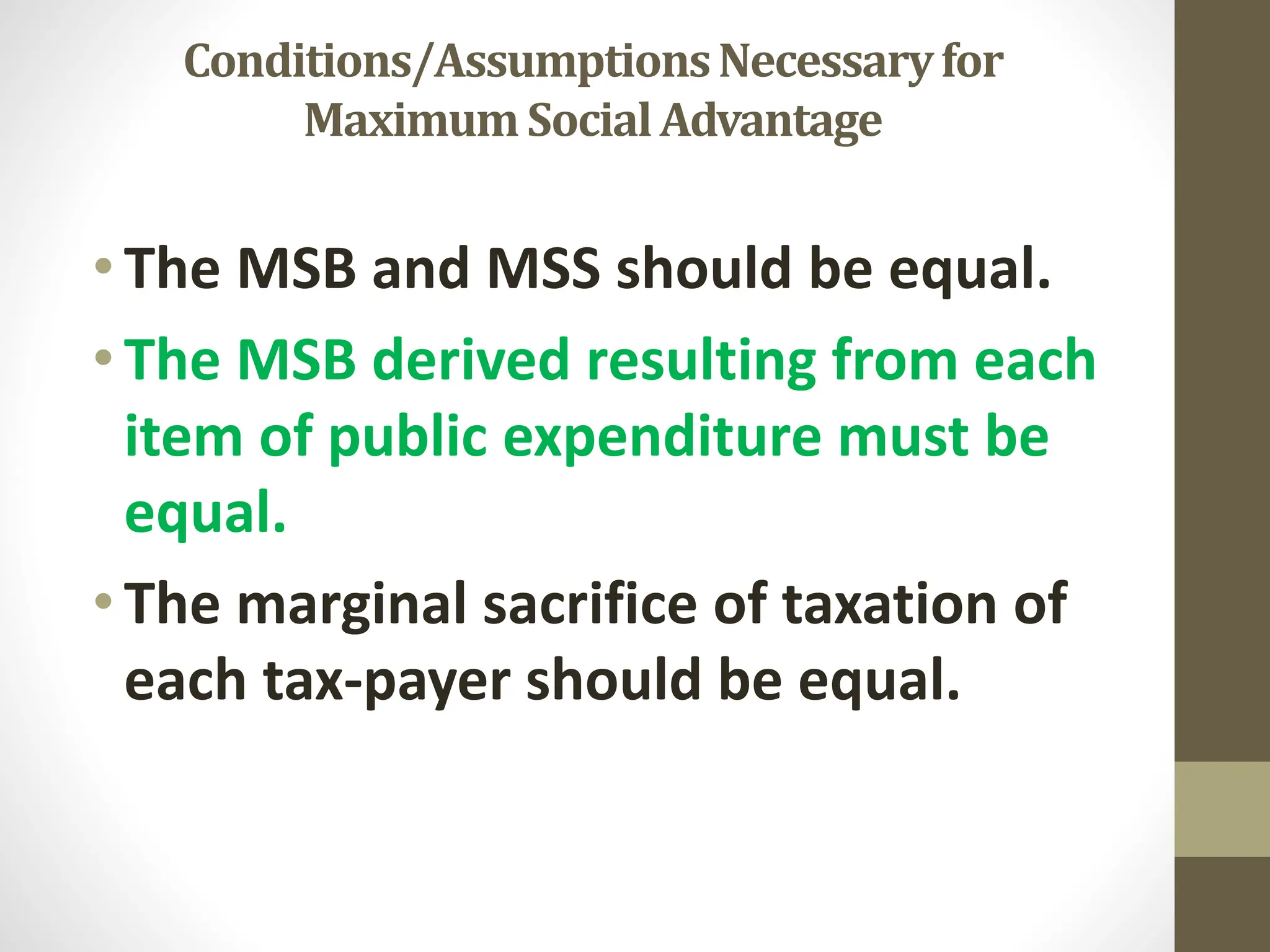
Conditions/AssumptionsNecessaryfor
MaximumSocialAdvantage
•The MSB and MSS should be equal.
•The MSB derived resulting from each
item of public expenditure must be
equal.
•The marginal sacrifice of taxation of
each tax-payer should be equal.
Objective Tests of Social Advantage
• Political stability is the basic condition of attainment of
maximum social advantage.
• Improvement in production is a necessary condition which
requires increase in productive power in order to obtain large
product with minimum effort and improvement in
organization of production.
• Improvement in distribution which implies reduction in
income inequality
• Economic stability indicating less fluctuations and a stable
atmosphere for economic agents
• Attainment of full employment as it favors increase in
production and promotes greater equality of income
Musgrave’s View
Cont.
• Musgrave has explained the situation of maximum social
advantage with a different diagram.
• Maximum social advantage is achieved at where nsb is zero.
• The NSB is the difference between MSB and MSS.
Mrs. Hicks Optima of Public Policy
• Public policy is the framework of laws, regulations, and
actions governments implement to achieve social and
economic goals.
• Mrs. U.K. Hicks has also suggested two sets of criteria for
judging whether a particular public finance operation or
policy would add to the net social benefit (NSB) or not. They
are called the production optimum and utility optimum
respectively.
References
• Cambridge University Libraries, Shirras, George Findlay, 1885–
1955 (economist), accessed 4 June 2023
• "Budget transparency - OECD". www.oecd.org. Archived from
the original on 28 November 2022. Retrieved 28
November 2022.
• Muley, Ritika (29 January 2016). "Public Expenditure: Causes,
Principles and Importance". EconomicsDiscussion.net.
Retrieved 25 April 2021.
• Irvin, Tucker (2012). Macroeconomics for Today (8th ed.).
Mason, OH: Cengage
Learning. ISBN 9781133435051. OCLC 830731890.

Principles of Maximum Social Advantage.pptx

  • 1.
    Principles of Maximum SocialAdvantage Dr. T. AASIF AHMED DEPT. OF ECONOMICS MAZHARUL ULOOM COLLEGE AMBUR-635802 TAMIL NADU M. NO: 9944029901 E-MAIL ID: AASIFAHMED.T@GMAIL.COM
  • 2.
    Principle of MSA •The 'Principle of Maximum Social Advantage (MSA)' is the fundamental principle of Public Finance. • The Principle of Maximum Social Advantage states that public finance leads to economic welfare when public expenditure & taxation are carried out up to that point where the benefits derived from the MU (Marginal Utility) of expenditure is equal to the Marginal Disutility or the sacrifice imposed by taxation. • Hugh Dalton explains the principle of maximum social advantage with reference to Marginal Social Sacrifice (MSS) and Marginal Social Benefits (MSB). • Prof. Pigou describe as principle of Maximum Aggregate Welfare.
  • 4.
    Conditions/AssumptionsNecessaryfor MaximumSocialAdvantage •The MSB andMSS should be equal. •The MSB derived resulting from each item of public expenditure must be equal. •The marginal sacrifice of taxation of each tax-payer should be equal.
  • 5.
    Objective Tests ofSocial Advantage • Political stability is the basic condition of attainment of maximum social advantage. • Improvement in production is a necessary condition which requires increase in productive power in order to obtain large product with minimum effort and improvement in organization of production. • Improvement in distribution which implies reduction in income inequality • Economic stability indicating less fluctuations and a stable atmosphere for economic agents • Attainment of full employment as it favors increase in production and promotes greater equality of income
  • 6.
  • 7.
    Cont. • Musgrave hasexplained the situation of maximum social advantage with a different diagram. • Maximum social advantage is achieved at where nsb is zero. • The NSB is the difference between MSB and MSS.
  • 8.
    Mrs. Hicks Optimaof Public Policy • Public policy is the framework of laws, regulations, and actions governments implement to achieve social and economic goals. • Mrs. U.K. Hicks has also suggested two sets of criteria for judging whether a particular public finance operation or policy would add to the net social benefit (NSB) or not. They are called the production optimum and utility optimum respectively.
  • 9.
    References • Cambridge UniversityLibraries, Shirras, George Findlay, 1885– 1955 (economist), accessed 4 June 2023 • "Budget transparency - OECD". www.oecd.org. Archived from the original on 28 November 2022. Retrieved 28 November 2022. • Muley, Ritika (29 January 2016). "Public Expenditure: Causes, Principles and Importance". EconomicsDiscussion.net. Retrieved 25 April 2021. • Irvin, Tucker (2012). Macroeconomics for Today (8th ed.). Mason, OH: Cengage Learning. ISBN 9781133435051. OCLC 830731890.