The National Trust for the Welfare of
Persons with Autism, Cerebral Palsy,
Mental Retardation and Multiple
Disabilities.
1999
By NIDHEESHA CK
INTRODUCTION
The National Trust is a statutory body of
the Ministry of Social Justice and
Empowerment, Government of India, set
up under the “National Trust for the
Welfare of Persons with Autism, Cerebral
Palsy, Mental Retardation and Multiple
Disabilities” Act (Act 44 of 1999).
Vision of The National Trust
An inclusive society which values human diversity and
enables and empowers full participation of Persons with
Disability to live independently with dignity, equal rights
and opportunities.
The National Trust’s vision statement reflects a very
changed India for all Indians and is based on a human
rights, i.e. UNCRPD, approach. The vision statement
focuses NT as being a leader in the disability sector in
India.
As laws focusing on Persons with Disability are
changing, focused leadership needs to be
established.
Working through local and regional
registered organizations and local level
committees, the National Trust must make
its vision and focus clear throughout the
country.
Mission of the National Trust
The National Trust works towards providing
opportunities for capacity development of Persons
with Disability and their families, fulfilling their
rights, facilitating and promoting the creation of an
enabling environment and an inclusive society.
The National Trust’s mission, or
fundamental purpose, is to create an
enabling environment, i.e. providing
opportunities for Persons with Disabilities
through comprehensive support systems
which can also be done by collaborating
with other Ministries, etc., which will lead
towards development of an inclusive
society.
OBJECTIVES
The objectives of the National Trust in particular are
a. to enable and empower persons with disability to
live as independently and as fully as possible within
and as close to their community as possible;
b. to facilitate the realization of equal opportunities,
protection of rights and full participation of persons
with disability;
d. to extend support to its registered
organisations to provide need based
services; and
d. to evolve procedures for appointments
of guardians and trustees for persons with
disabilities.
OBJECTIVES
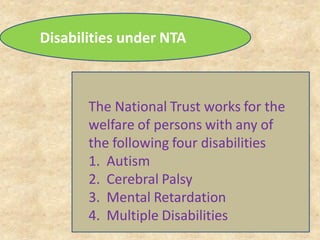
The National Trust works for the
welfare of persons with any of
the following four disabilities
1. Autism
2. Cerebral Palsy
3. Mental Retardation
4. Multiple Disabilities
Disabilities under NTA
OUR SCHEMES AT A GLANCE
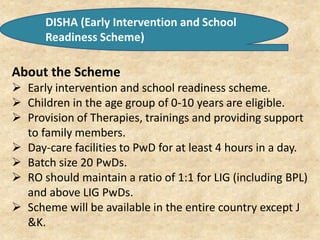
DISHA (Early Intervention and School
Readiness Scheme)
About the Scheme
 Early intervention and school readiness scheme.
 Children in the age group of 0-10 years are eligible.
 Provision of Therapies, trainings and providing support
to family members.
 Day-care facilities to PwD for at least 4 hours in a day.
 Batch size 20 PwDs.
 RO should maintain a ratio of 1:1 for LIG (including BPL)
and above LIG PwDs.
 Scheme will be available in the entire country except J
&K.
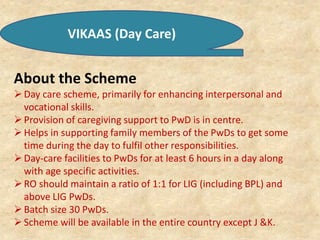
VIKAAS (Day Care)
About the Scheme
Day care scheme, primarily for enhancing interpersonal and
vocational skills.
Provision of caregiving support to PwD is in centre.
Helps in supporting family members of the PwDs to get some
time during the day to fulfil other responsibilities.
Day-care facilities to PwDs for at least 6 hours in a day along
with age specific activities.
RO should maintain a ratio of 1:1 for LIG (including BPL) and
above LIG PwDs.
Batch size 30 PwDs.
Scheme will be available in the entire country except J &K.
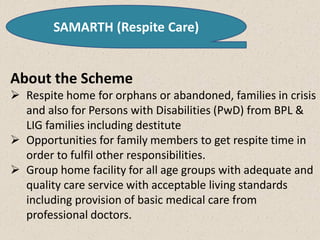
SAMARTH (Respite Care)
About the Scheme
 Respite home for orphans or abandoned, families in crisis
and also for Persons with Disabilities (PwD) from BPL &
LIG families including destitute
 Opportunities for family members to get respite time in
order to fulfil other responsibilities.
 Group home facility for all age groups with adequate and
quality care service with acceptable living standards
including provision of basic medical care from
professional doctors.
GHARAUNDA (Group Home for
Adults)
About the Scheme
 An assured home and minimum quality of care services
throughout the life of the PwD.
 Adequate and quality care service with acceptable living
standards including provision of basic medical care from
professional doctors.
 Vocational activities, pre-vocational activities and
assistance for further training.
 Batch size 20 PwDs.
 RO should maintain a ratio of 1:1 for LIG (including BPL)
and above LIG PwDs.
 Scheme will be available in the entire country except J
&K.
NIRAMAYA (Health
Insurance Scheme)
About the Scheme
Affordable Health Insurance to PwDs.
Health insurance cover of up to Rs. 1.0 lakh.
Facility for OPD treatment including the medicines,
pathology, diagnostic tests, etc, Regular Medical checkup
for non-ailing disabled, Dental Preventive Dentistry, Surgery
to prevent further aggravation of disability, Non- Surgical/
Hospitalization, Corrective Surgeries for existing Disability
including congenital disability, Ongoing Therapies to reduce
impact of disability and disability related complications,
Alternative Medicine.
No pre-insurance medical tests required.
The scheme will be available in the entire
country except J&K.
Transportation costs.
SAHYOGI (Caregiver
training scheme)
About the scheme
 Setting up Care Associate Cells (CACs).
 Provide training and create a skilled workforce of care
associates to provide adequate and nurturing care for
Person with Disabilities (PwDs) and their families who
require it.
 It also seeks to provide parents an opportunity to get
trained in caregiving if they so desire.
 Provide a choice of training through two levels of
courses primary and advanced.
GYAN PRABHA (Educational
support)
About the scheme
 Encourage PwDs for pursuing educational/
vocational courses like graduation courses,
professional courses and vocational training leading
to employment or self-employment.
 Provide a specific amount per course to a PwD
which will generally cover fees, transportation,
books, out of pocket expenses (OPEs) etc.
PRERNA (Marketing
Assistance)
About the scheme
 Prerna is the marketing assistance scheme with an
objective to create viable and widespread channels
for sale of products and services produced by PwDs.
 This scheme aims at providing funds to participate in
events such as exhibitions, melas, fairs, etc. to sell
the products made by PwDs.
 The scheme also provides an incentive to the
Registered Organisation (RO) based on the sales
turnover of the products.
 At least 51% of employees of these work
centres should be PwDs covered under
National Trust Act.
 The National Trust shall fund RO
participation in national, regional, state
and district level events such as fairs,
exhibitions, melas etc. for marketing and
selling products and services prepared by
PwDs.
SAMBHAV (Aids and Assisted Devices)
About the scheme
 Setup an additional resource centre, in each city of the
country.
 Collate and collect the Aids, software and other form of
assistive devices developed with a provision of display
and demonstration of the devices.
 Maintaining information, pertaining to aids and assistive
devices present at Sambhav centre, on the National Trust
website.
 Provide information and easy access to devices,
appliances, aids, software etc.
BADHTE KADAM (Awareness
and Community Interaction)
About the Scheme
Badhte Kadam aims at community awareness,
sensitisation, social integration and mainstreaming of
Persons with Disabilities. It has below mentioned
objectives:
 Raise awareness in the public, regarding Person with
Disability (PwD) covered under the NationalTrust Act
and encourage their inclusion in the society, social
integration and participation of persons with disabilities
in all aspects of life.
 Disseminate information on preventive strategies for
the disabilities under the National Trust Act,1999
 Sensitize community stakeholders
Publicize and maximize benefits of the
National Trust schemes for Registered
Organization(RO),PwDs and for families of PwDs.
Increase representation in remote areas and in
areas where the National Trust is under
represented
Spread awareness about myths and
misconceptions about disability, disability
etiquette etc.
The national trust-1999

The national trust-1999

  • 1.
    The National Trustfor the Welfare of Persons with Autism, Cerebral Palsy, Mental Retardation and Multiple Disabilities. 1999 By NIDHEESHA CK
  • 2.
    INTRODUCTION The National Trustis a statutory body of the Ministry of Social Justice and Empowerment, Government of India, set up under the “National Trust for the Welfare of Persons with Autism, Cerebral Palsy, Mental Retardation and Multiple Disabilities” Act (Act 44 of 1999).
  • 3.
    Vision of TheNational Trust An inclusive society which values human diversity and enables and empowers full participation of Persons with Disability to live independently with dignity, equal rights and opportunities. The National Trust’s vision statement reflects a very changed India for all Indians and is based on a human rights, i.e. UNCRPD, approach. The vision statement focuses NT as being a leader in the disability sector in India.
  • 4.
    As laws focusingon Persons with Disability are changing, focused leadership needs to be established. Working through local and regional registered organizations and local level committees, the National Trust must make its vision and focus clear throughout the country.
  • 5.
    Mission of theNational Trust The National Trust works towards providing opportunities for capacity development of Persons with Disability and their families, fulfilling their rights, facilitating and promoting the creation of an enabling environment and an inclusive society.
  • 6.
    The National Trust’smission, or fundamental purpose, is to create an enabling environment, i.e. providing opportunities for Persons with Disabilities through comprehensive support systems which can also be done by collaborating with other Ministries, etc., which will lead towards development of an inclusive society.
  • 7.
    OBJECTIVES The objectives ofthe National Trust in particular are a. to enable and empower persons with disability to live as independently and as fully as possible within and as close to their community as possible; b. to facilitate the realization of equal opportunities, protection of rights and full participation of persons with disability;
  • 8.
    d. to extendsupport to its registered organisations to provide need based services; and d. to evolve procedures for appointments of guardians and trustees for persons with disabilities. OBJECTIVES
  • 9.
    The National Trustworks for the welfare of persons with any of the following four disabilities 1. Autism 2. Cerebral Palsy 3. Mental Retardation 4. Multiple Disabilities Disabilities under NTA
  • 10.
  • 11.
    DISHA (Early Interventionand School Readiness Scheme) About the Scheme  Early intervention and school readiness scheme.  Children in the age group of 0-10 years are eligible.  Provision of Therapies, trainings and providing support to family members.  Day-care facilities to PwD for at least 4 hours in a day.  Batch size 20 PwDs.  RO should maintain a ratio of 1:1 for LIG (including BPL) and above LIG PwDs.  Scheme will be available in the entire country except J &K.
  • 12.
    VIKAAS (Day Care) Aboutthe Scheme Day care scheme, primarily for enhancing interpersonal and vocational skills. Provision of caregiving support to PwD is in centre. Helps in supporting family members of the PwDs to get some time during the day to fulfil other responsibilities. Day-care facilities to PwDs for at least 6 hours in a day along with age specific activities. RO should maintain a ratio of 1:1 for LIG (including BPL) and above LIG PwDs. Batch size 30 PwDs. Scheme will be available in the entire country except J &K.
  • 13.
    SAMARTH (Respite Care) Aboutthe Scheme  Respite home for orphans or abandoned, families in crisis and also for Persons with Disabilities (PwD) from BPL & LIG families including destitute  Opportunities for family members to get respite time in order to fulfil other responsibilities.  Group home facility for all age groups with adequate and quality care service with acceptable living standards including provision of basic medical care from professional doctors.
  • 14.
    GHARAUNDA (Group Homefor Adults) About the Scheme  An assured home and minimum quality of care services throughout the life of the PwD.  Adequate and quality care service with acceptable living standards including provision of basic medical care from professional doctors.  Vocational activities, pre-vocational activities and assistance for further training.  Batch size 20 PwDs.  RO should maintain a ratio of 1:1 for LIG (including BPL) and above LIG PwDs.  Scheme will be available in the entire country except J &K.
  • 15.
    NIRAMAYA (Health Insurance Scheme) Aboutthe Scheme Affordable Health Insurance to PwDs. Health insurance cover of up to Rs. 1.0 lakh. Facility for OPD treatment including the medicines, pathology, diagnostic tests, etc, Regular Medical checkup for non-ailing disabled, Dental Preventive Dentistry, Surgery to prevent further aggravation of disability, Non- Surgical/ Hospitalization, Corrective Surgeries for existing Disability including congenital disability, Ongoing Therapies to reduce impact of disability and disability related complications, Alternative Medicine.
  • 16.
    No pre-insurance medicaltests required. The scheme will be available in the entire country except J&K. Transportation costs.
  • 17.
    SAHYOGI (Caregiver training scheme) Aboutthe scheme  Setting up Care Associate Cells (CACs).  Provide training and create a skilled workforce of care associates to provide adequate and nurturing care for Person with Disabilities (PwDs) and their families who require it.  It also seeks to provide parents an opportunity to get trained in caregiving if they so desire.  Provide a choice of training through two levels of courses primary and advanced.
  • 18.
    GYAN PRABHA (Educational support) Aboutthe scheme  Encourage PwDs for pursuing educational/ vocational courses like graduation courses, professional courses and vocational training leading to employment or self-employment.  Provide a specific amount per course to a PwD which will generally cover fees, transportation, books, out of pocket expenses (OPEs) etc.
  • 19.
    PRERNA (Marketing Assistance) About thescheme  Prerna is the marketing assistance scheme with an objective to create viable and widespread channels for sale of products and services produced by PwDs.  This scheme aims at providing funds to participate in events such as exhibitions, melas, fairs, etc. to sell the products made by PwDs.  The scheme also provides an incentive to the Registered Organisation (RO) based on the sales turnover of the products.
  • 20.
     At least51% of employees of these work centres should be PwDs covered under National Trust Act.  The National Trust shall fund RO participation in national, regional, state and district level events such as fairs, exhibitions, melas etc. for marketing and selling products and services prepared by PwDs.
  • 21.
    SAMBHAV (Aids andAssisted Devices) About the scheme  Setup an additional resource centre, in each city of the country.  Collate and collect the Aids, software and other form of assistive devices developed with a provision of display and demonstration of the devices.  Maintaining information, pertaining to aids and assistive devices present at Sambhav centre, on the National Trust website.  Provide information and easy access to devices, appliances, aids, software etc.
  • 22.
    BADHTE KADAM (Awareness andCommunity Interaction) About the Scheme Badhte Kadam aims at community awareness, sensitisation, social integration and mainstreaming of Persons with Disabilities. It has below mentioned objectives:  Raise awareness in the public, regarding Person with Disability (PwD) covered under the NationalTrust Act and encourage their inclusion in the society, social integration and participation of persons with disabilities in all aspects of life.  Disseminate information on preventive strategies for the disabilities under the National Trust Act,1999
  • 23.
     Sensitize communitystakeholders Publicize and maximize benefits of the National Trust schemes for Registered Organization(RO),PwDs and for families of PwDs. Increase representation in remote areas and in areas where the National Trust is under represented Spread awareness about myths and misconceptions about disability, disability etiquette etc.