Intro
Chapter 14:
Psychological
Disorders
•Psychopathology—scientific study
of the origins, symptoms, and
development of psychological
disorders
•Psychological disorder or mental
disorder--A pattern of behavioral and
psychological symptoms that causes
significant personal distress, impairs
the ability to function in one or more
important areas of daily life, or both
Diagnosis
Diagnostic and Statistical Manual of Mental
Disorders (DSM-IV-TR)—describes specific
symptoms and diagnostic guidelines for
psychological disorders
– Provides a common language to label
mental disorders
– Comprehensive guidelines to help
diagnose mental disorders
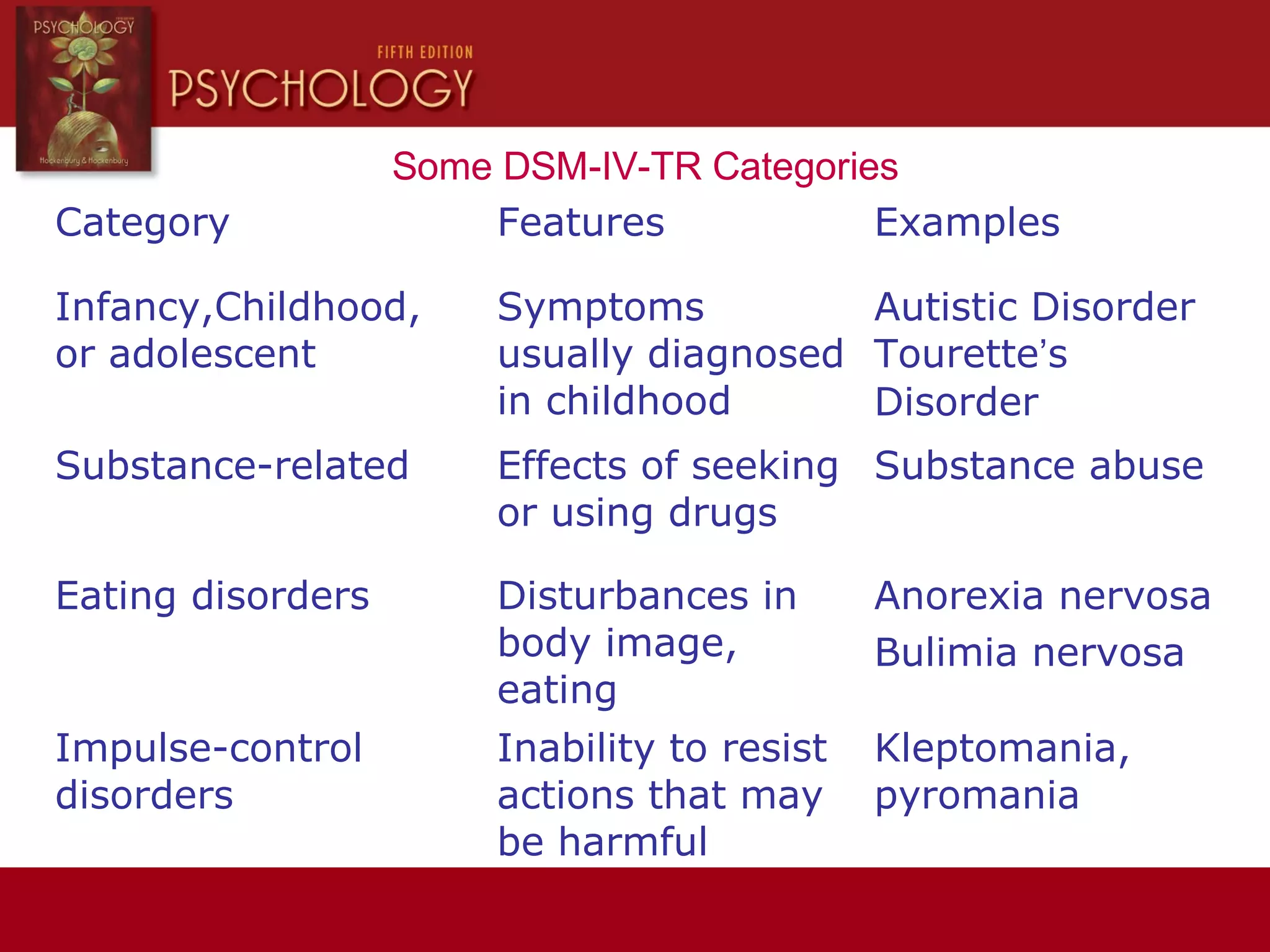
Some DSM-IV-TR Categories
Category Features Examples
Infancy,Childhood,
or adolescent
Symptoms
usually diagnosed
in childhood
Autistic Disorder
Tourette’s
Disorder
Substance-related Effects of seeking
or using drugs
Substance abuse
Eating disorders Disturbances in
body image,
eating
Anorexia nervosa
Bulimia nervosa
Impulse-control
disorders
Inability to resist
actions that may
be harmful
Kleptomania,
pyromania
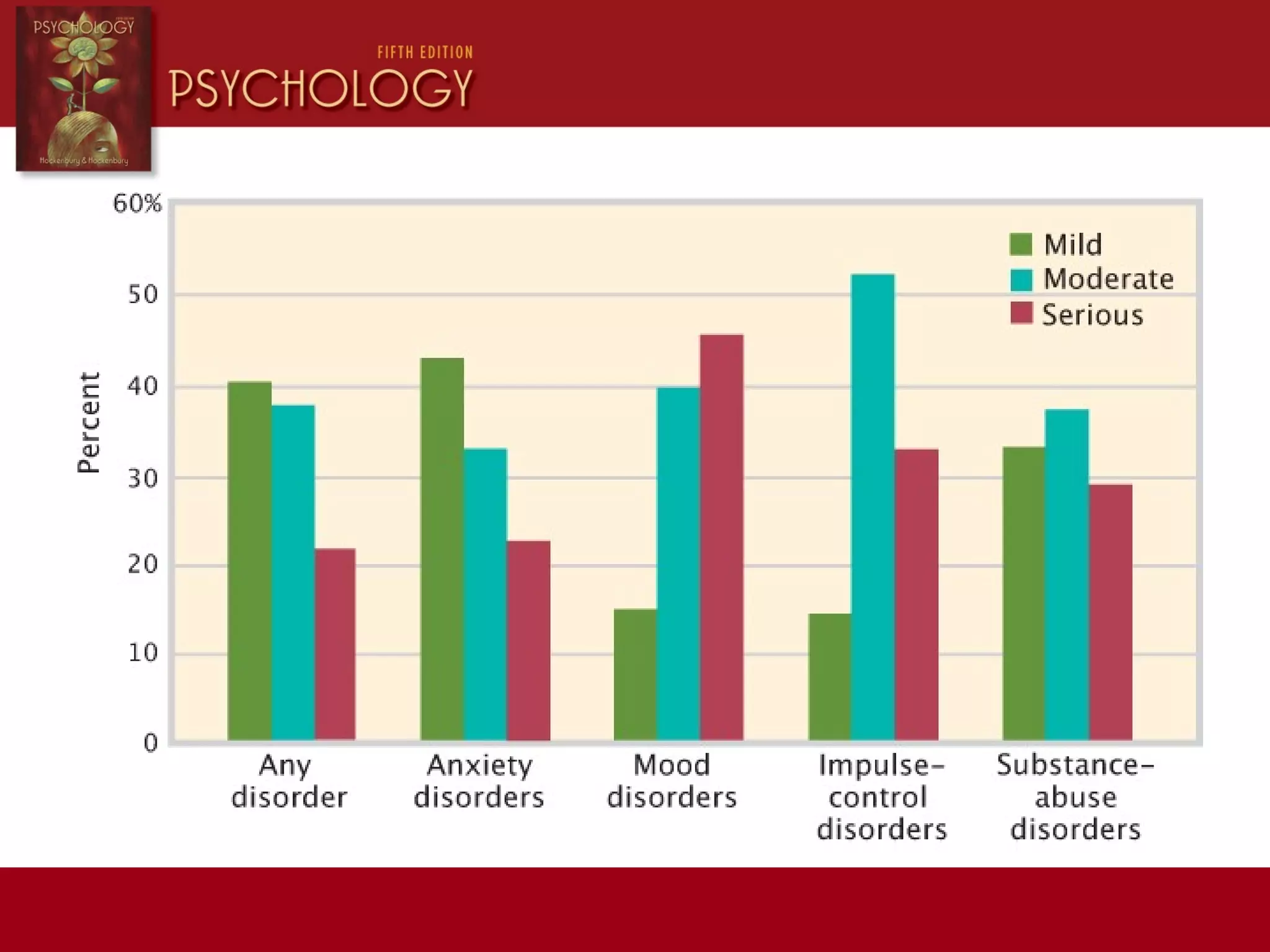
Prevalence of Psychological
Disorders
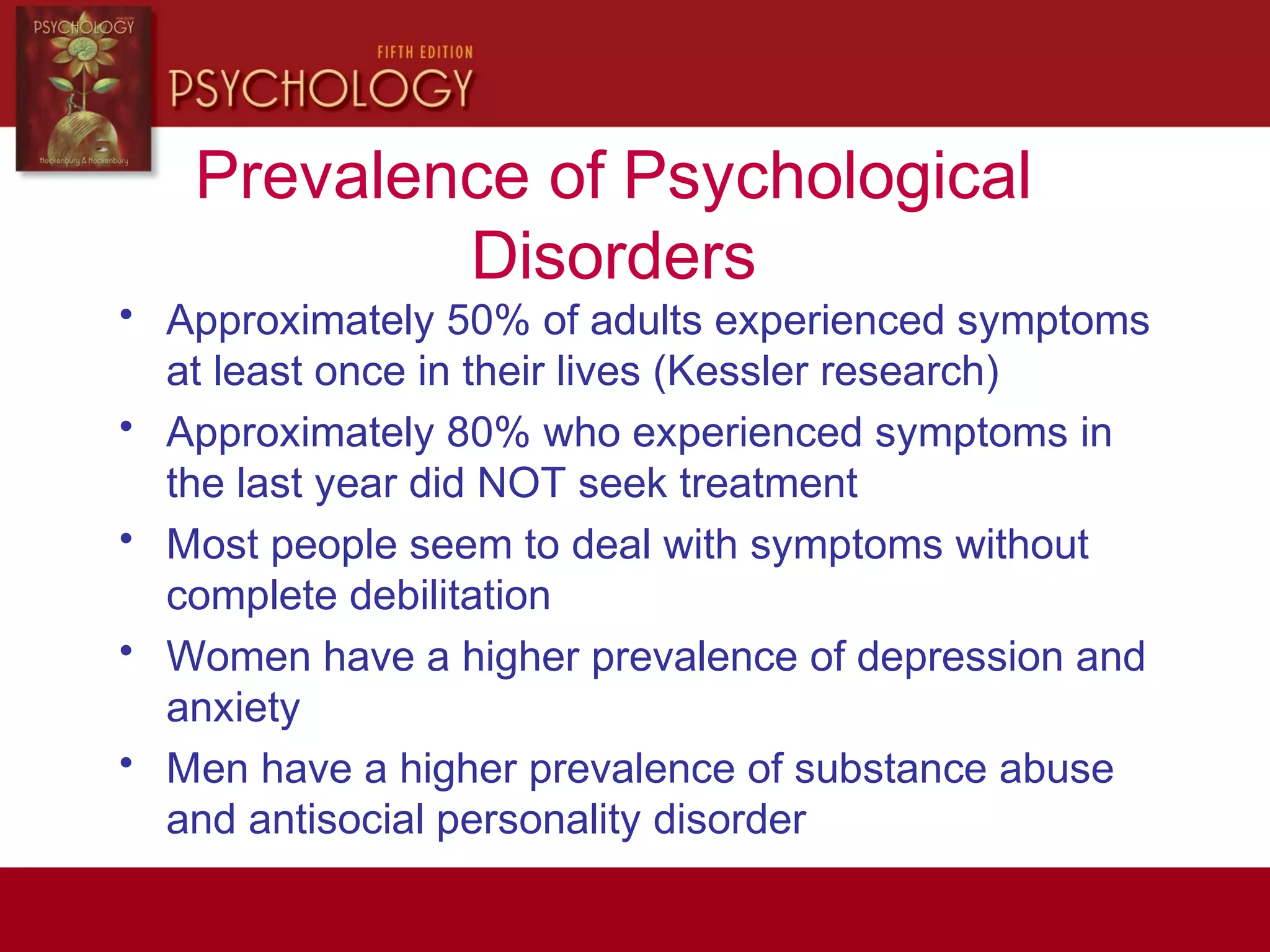
• Approximately 50% of adults experienced symptoms
at least once in their lives (Kessler research)
• Approximately 80% who experienced symptoms in
the last year did NOT seek treatment
• Most people seem to deal with symptoms without
complete debilitation
• Women have a higher prevalence of depression and
anxiety
• Men have a higher prevalence of substance abuse
and antisocial personality disorder
Anxiety Disorders
• Primary disturbance is
distressing, persistent anxiety or
maladaptive behaviors that reduce
anxiety
• Anxiety—diffuse, vague feelings
of fear and apprehension
Generalized Anxiety Disorder
(GAD)
• More or less constant worry about
many issues
• The worry seriously interferes with
functioning
• Physical symptoms
– headaches
– stomach aches
– muscle tension
– irritability
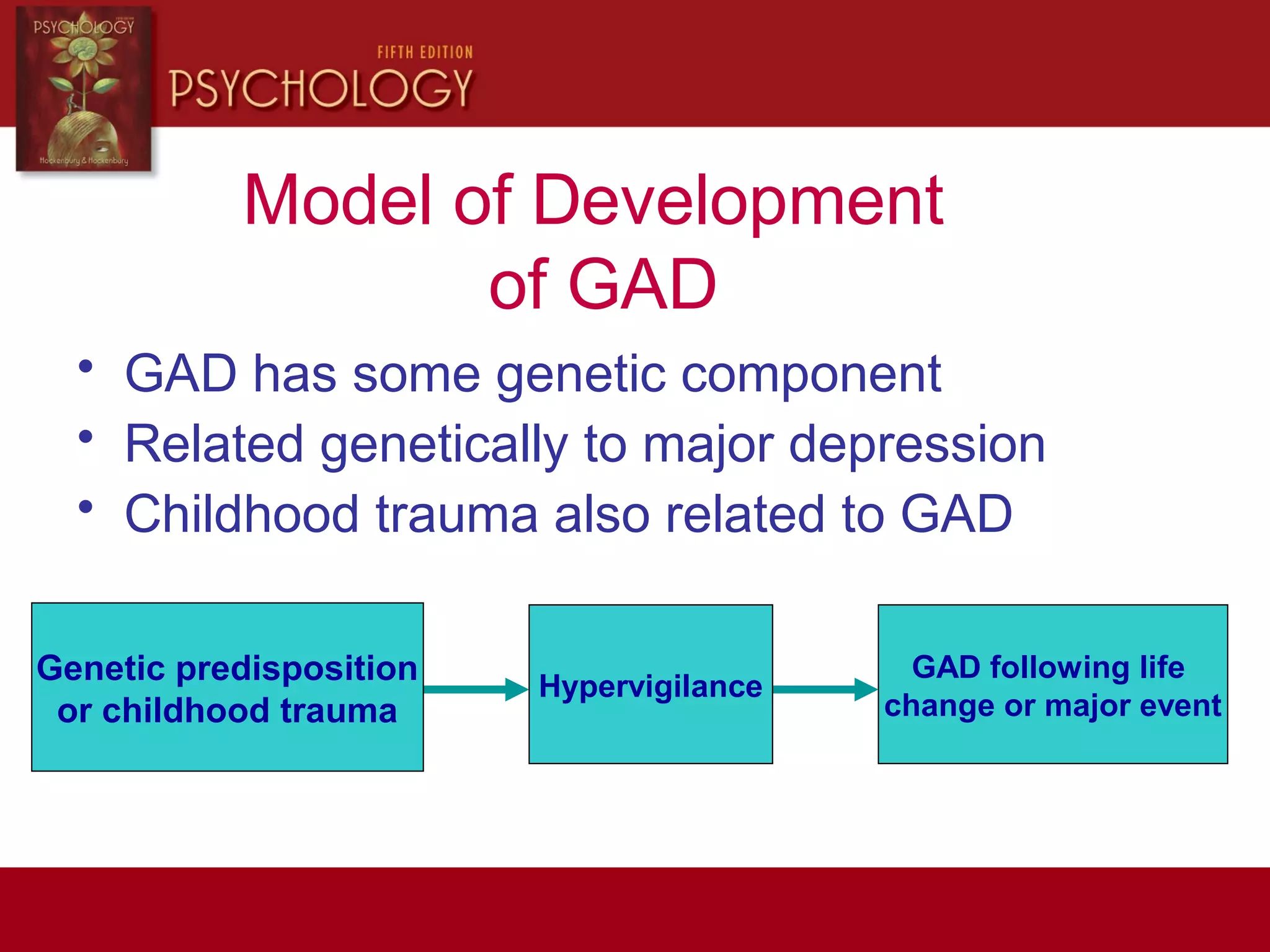
Model of Development
of GAD
• GAD has some genetic component
• Related genetically to major depression
• Childhood trauma also related to GAD
Genetic predisposition
or childhood trauma
GAD following life
change or major event
Hypervigilance
Panic Disorder
• Panic attacks—sudden episode of helpless
terror with high physiological arousal
• Very frightening—sufferers live in fear
of having them
• Agoraphobia often develops as a result
Cognitive-behavioral Theory of Panic
Disorder
• Sufferers tend to misinterpret the
physical signs of arousal as
catastrophic and dangerous
• This interpretation leads to further
physical arousal, tending toward a
vicious cycle
• After the attack the person is very
apprehensive of another attack
Phobias
Intense, irrational fears that may focus on:
• Natural environment—heights, water, lightening
• Situation—flying, tunnels, crowds, social
gathering
• Injury—needles, blood, dentist, doctor
• Animals or insects—insects, snakes, bats, dogs
Some Unusual Phobias
• Anemophobia: fear of wind
• Aphephobia: fear of being touched by
another person
• Catotrophobia: fear of breaking a
mirror
• Gamophobia: fear of marriage
• Phonophobia: fear of the sound of
your own voice
Agoraphobia
• Fear of panic attacks in public places
• Avoid situations that might provoke a
panic attack or where there may be
no escape or help if a panic attack
were to come
• Not everyone with panic disorder
develops agoraphobia
Social Phobias
• Social phobias—fear of social situations. Also called
social anxiety disorder. Stems from irrational fear of
being embarrassed or judged by others in public
– public speaking (stage fright)
– fear of crowds, strangers
– meeting new people
– eating in public
• Considered phobic if these fears interfere with normal
behavior
• More prevalent among women than men
Development of Phobias
• Classical conditioning model
– problems:
• often no memory of a traumatic
experience
• traumatic experience may not produce
phobia
• Preparedness theory—phobia serves
to enhance survival
Posttraumatic Stress Disorder
(PTSD)
• Follows events that produce intense horror or
helplessness (traumatic episodes)
• Core symptoms include:
– Frequent recollection of traumatic event, often
intrusive and interfering with normal thoughts
– Avoidance of situations that trigger recall of the
event
– Increased physical arousal associated with stress
Obsessive-Compulsive
Disorder (OCD)
• Obsessions—irrational, disturbing thoughts that
intrude into consciousness
• Compulsions—repetitive actions performed to
alleviate obsessions
• Often accompanied by an irrational belief that failure
to perform ritual action will lead to catastrophe
• Checking and washing most common compulsions
• Deficiency in serotonin implicated and heightened
neural activity in caudate nucleus
Mood Disorders
A category of mental disorders in which
significant and chronic disruption in
mood is the predominant symptom,
causing impaired cognitive, behavioral,
and physical functioning
–Major depression
–Dysthymic disorder
–Bipolar disorder
–Cyclothymic disorder
Major Depression
A mood disorder characterized by extreme
and persistent feelings of despondency,
worthlessness, and hopelessness
– Prolonged, very severe symptoms
– Passes without remission for at least 2
weeks
– Global negativity and pessimism
– Very low self-esteem
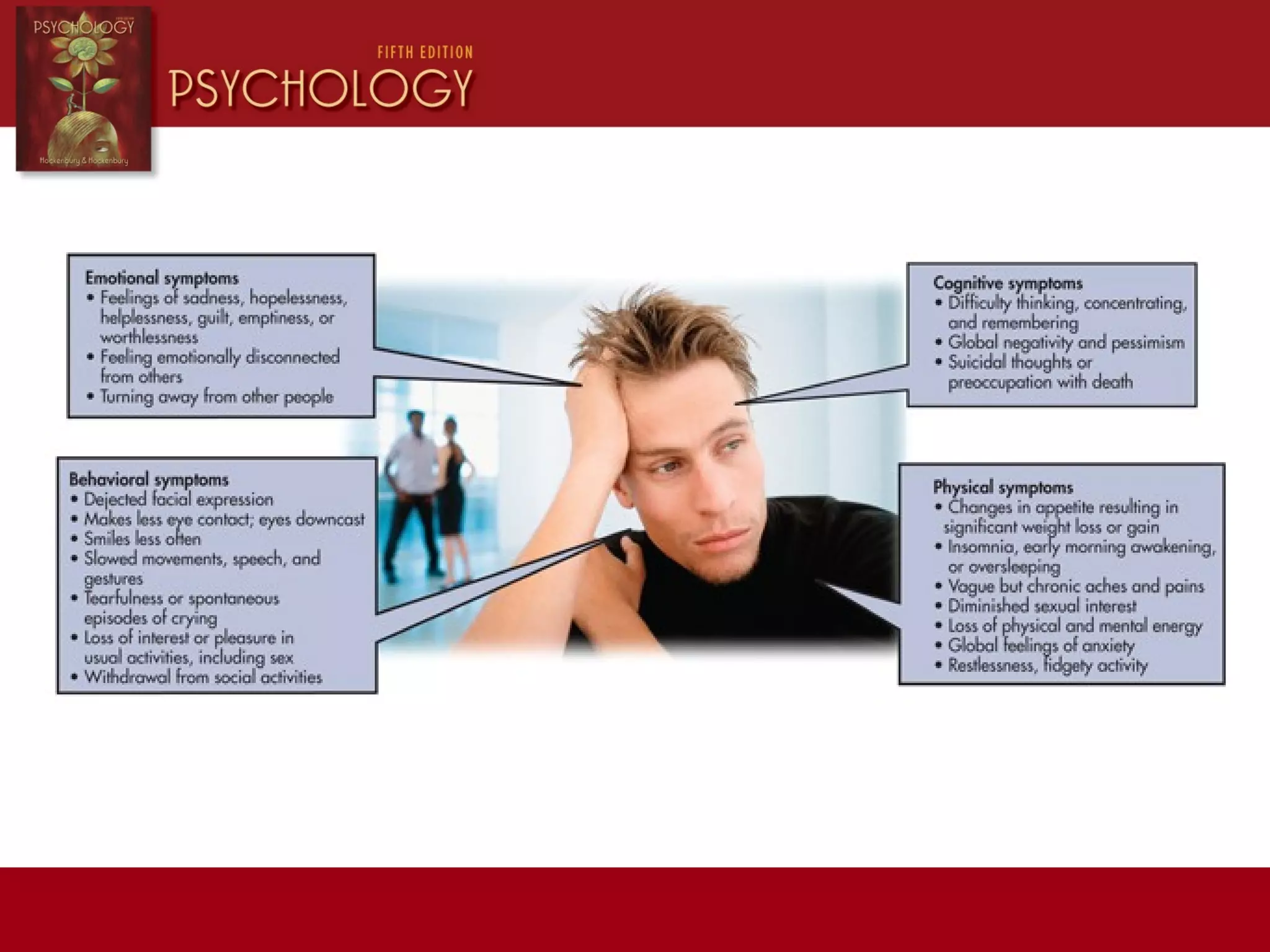
Symptoms of Major Depression
• Emotional—sadness, hopelessness, guilt, turning away
from others
• Behavioral—tearfulness, dejected facial expression, loss
of interest in normal activities, slowed movements and
gestures, withdrawal from social activities
• Cognitive—difficulty thinking and concentrating, global
negativity, preoccupation with death/suicide
• Physical—appetite and weight changes, excess or
diminished sleep, loss of energy, global anxiety,
restlessness
Prevalence and Course of Major
Depression
• Most common of psychological disorders
• Women are twice as likely as men to be
diagnosed with major depression
• Untreated episodes can become recurring
and more serious
• Seasonal affective disorder (SAD)—onset
with changing seasons
Dysthymic Disorder
• Chronic, low-grade depressed feelings
that are not severe enough to be major
depression
• May develop in response to trauma, but
does not decrease with time
• Can have co-existing major depression
Seasonal Affective Disorder
• Cyclic severe depression and elevated mood
• Seasonal regularity
• Unique cluster of symptoms
– intense hunger
– gain weight in winter
– sleep more than usual
– depressed more in evening than morning
Bipolar Disorders
• Cyclic disorder (manic-depressive disorder)
• Mood levels swing from severe depression to
extreme euphoria (mania)
• No regular relationship to time of year (SAD)
• Must have at least one manic episode
– Supreme self-confidence
– Grandiose ideas and movements
– Flight of ideas
Cyclothymic Disorder
Cyclothymic—mood disorder
characterized by moderate but
frequent mood swings that are not
severe enough to qualify as bipolar
disorder
Prevalence and Course
• Onset usually in young adulthood (early twenties)
• Mood changes more abrupt than in major
depression
• No gender differences in rate of bipolar disorder
• Commonly recurs every few years
• Can often be controlled by medication (lithium)
Explaining Mood Disorders
• Neurotransmitter theories
– dopamine
– norepinephrine
– serotonin
• Genetic component
– more closely related people show similar
histories of mood disorders
Situational Bases for Depression
• Positive correlation between stressful life
events and onset of depression
– Does life stress cause depression?
• Most depressogenic life events are
losses
– spouse or companion
– long-term job
– health
– income
Cognitive Bases for Depression
• Aaron Beck: depressed people hold
pessimistic views of
– themselves
– the world
– the future
• Depressed people distort their experiences in
negative ways
– exaggerate bad experiences
– minimize good experiences
Eating Disorders
• Involve serious and maladaptive
disturbances in eating behavior,
including reducing food intake, severe
overeating, obsessive concerns about
body shape or weight
Two Main Types
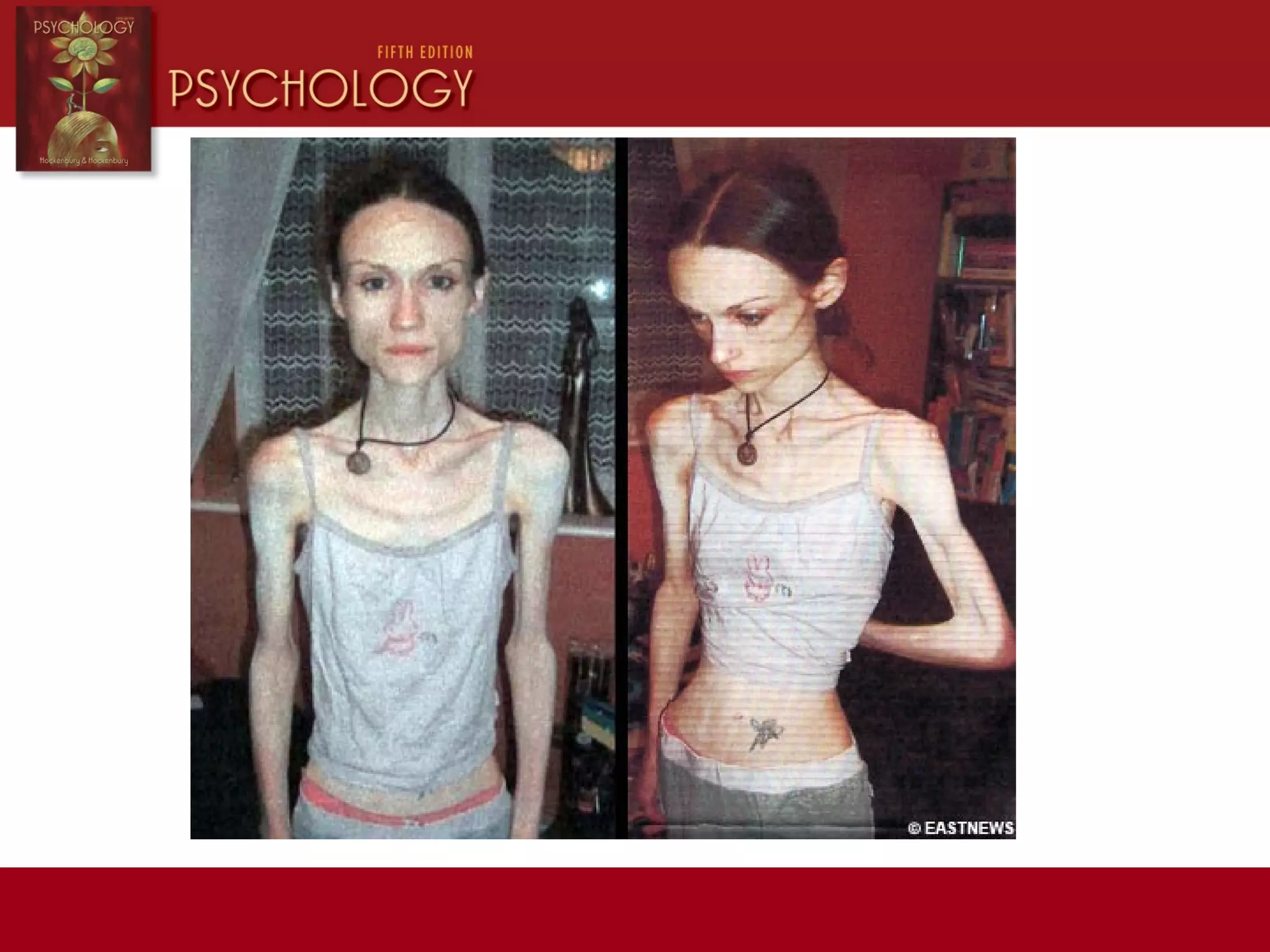
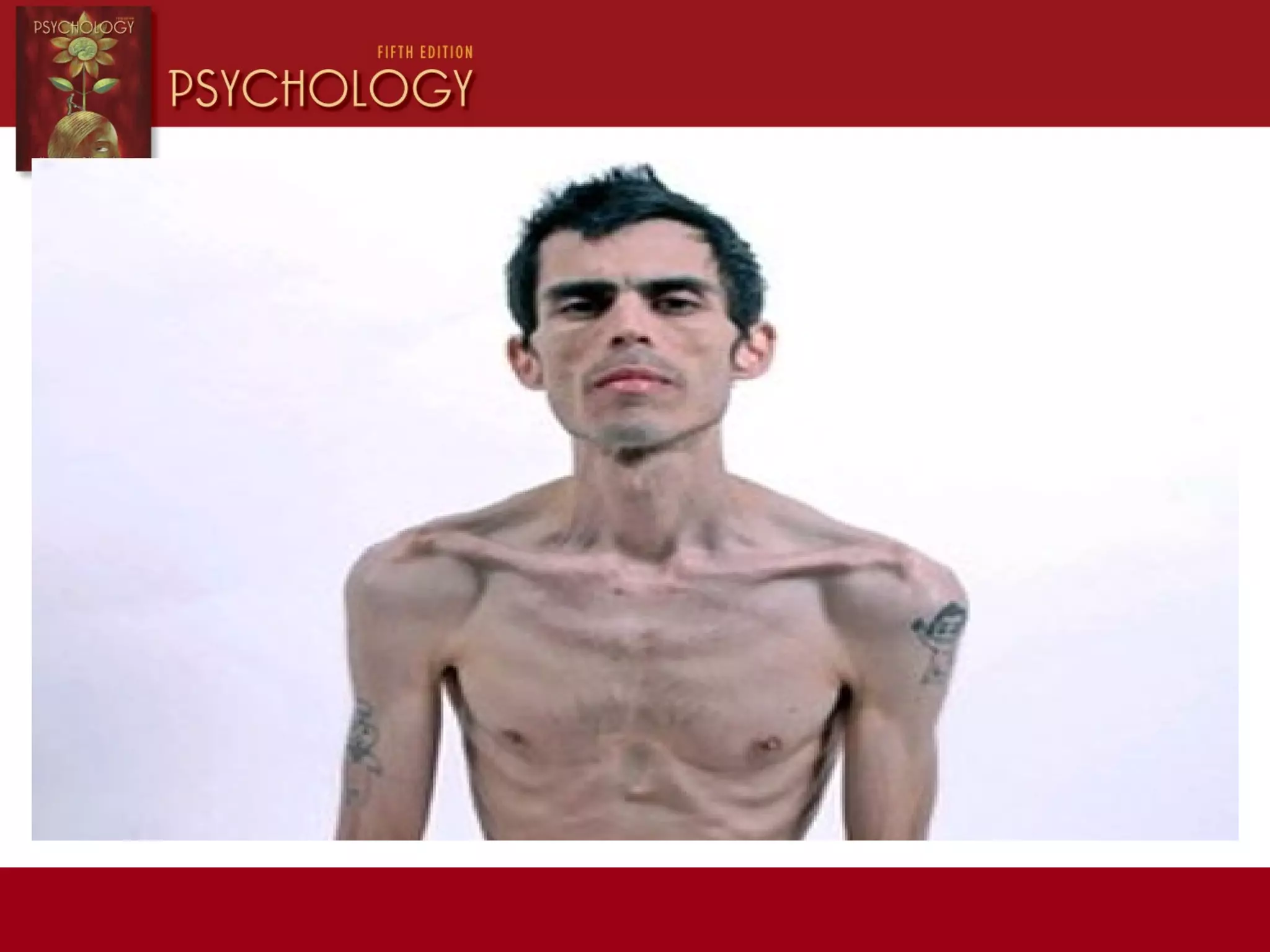
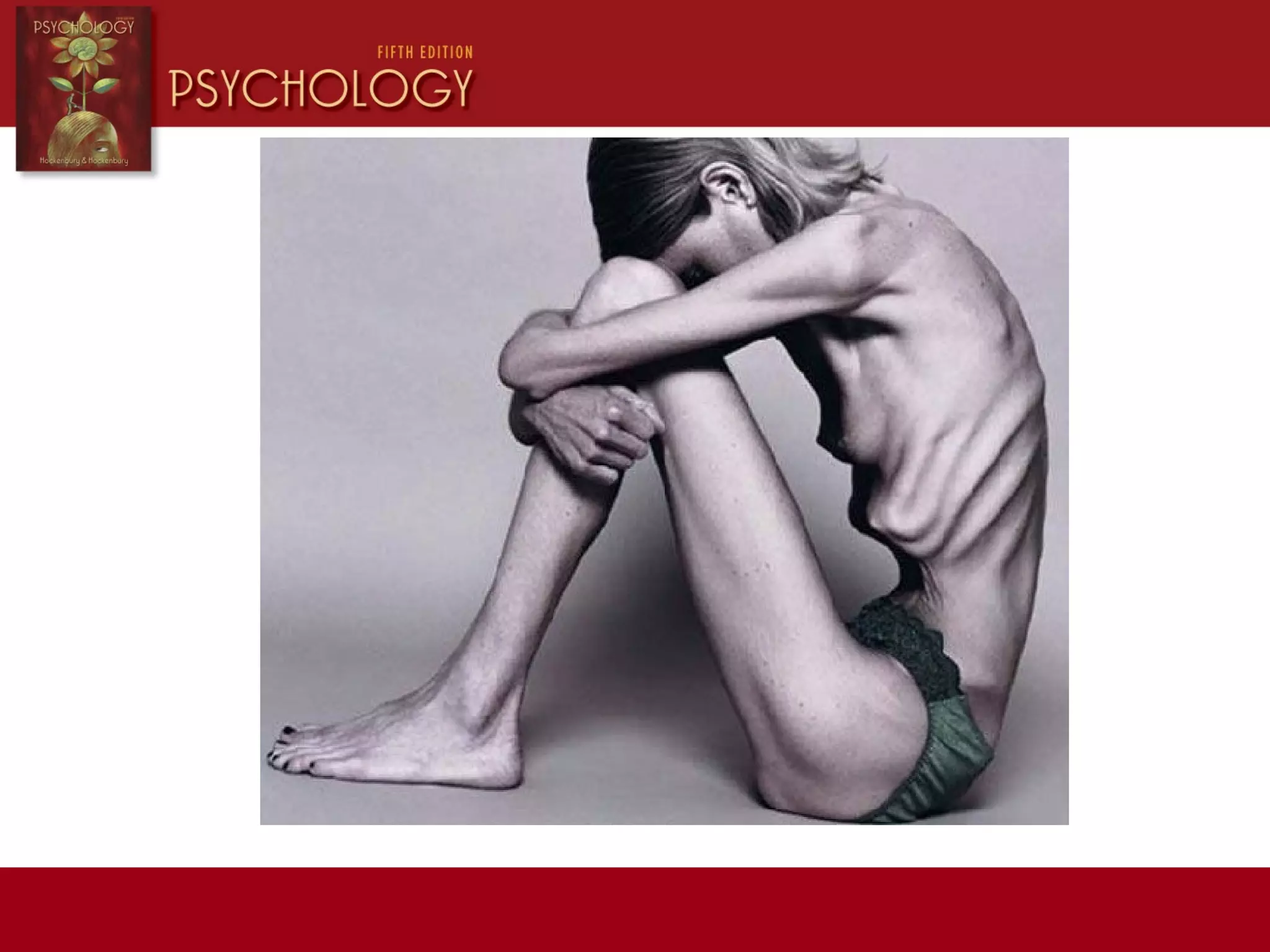
• Anorexia Nervosa-characterized by
excessive weight loss, irrational fear of
gaining weight, and distorted body self-
perception
• Bulimia Nervosa-characterized by binges
of extreme overeating followed by self-
induced vomiting, misuse of laxatives, or
other methods to purge
Causes of Eating Disorders
• Perfectionism, rigid thinking, poor peer
relations, social isolation, low self-
esteem associated with anorexia
• Genetic factors implicated in both
• Both involve decrease in serotonin
Personality Disorders
Inflexible, maladaptive pattern of
thoughts, emotions, behaviors, and
interpersonal functioning that are stable
over time and across situations, and
deviate from the expectations of the
individual’s culture
Paranoid Personality Disorder
• Pervasive mistrust and suspiciousness of
others are the main characteristics
• Distrustful even of close family and friends
• Reluctant to form close relationships
• Tend to blame others for their own
shortcomings
• Occurs in about 3 percent of population,
more frequent in men
• Pathological jealousy seen in intimate
relationships
Antisocial Personality Disorder
• Used to be called psychopath or sociopath
• Evidence often seen in childhood (conduct
disorder)
• Manipulative, can be charming, can be
cruel and destructive
• Seems to lack “conscience”
• More prevalent in men than women
Borderline Personality Disorder
• Chronic instability of emotions, self-image,
relationships
• Self-destructive behaviors
• Intense fear of abandonment and
emptiness
• Possible history of childhood physical,
emotional, or sexual abuse
• 75% of diagnosed cases are women
Dissociative Disorders
• What is dissociation?
– literally a dis-association of memory
– person suddenly becomes unaware of some
aspect of their identity or history
– unable to recall except under special
circumstances (e.g., hypnosis)
• Three types are recognized
– dissociative amnesia
– dissociative fugue
– dissociative identity disorder
Dissociative Amnesia
• Margie and her brother were
recently victims of a robbery.
Margie was not injured, but her
brother was killed when he resisted
the robbers. Margie was unable to
recall any details from the time of
the incident until four days later.
Dissociative Amnesia
• Also known as psychogenic amnesia
• Memory loss the only symptom
• Often selective loss surrounding
traumatic events
– person still knows identity and most of their past
• Can also be global
– loss of identity without replacement with a new
one
Dissociative Fugue
Jay, a high school physics teacher in New
York City, disappeared three days after his
wife unexpectedly left him for another man.
Six months later, he was discovered
tending bar in Miami Beach. Calling
himself Martin, he claimed to have no
recollection of his past life and insisted that
he had never been married.
Dissociative Fugue
• Also known as psychogenic fugue
• Global amnesia with identity replacement
– leaves home
– develops a new identity
– apparently no recollection of former life
– called a ‘fugue state’
• If fugue wears off
– old identity recovers
– new identity is totally forgotten
Dissociative Identity Disorder
(DID)
Norma has frequent memory gaps and cannot
account for her whereabouts during certain
periods of time. While being interviewed by a
clinical psychologist, she began speaking in a
childlike voice. She claimed that her name was
Donna and that she was only six years old.
Moments later, she seemed to revert to her adult
voice and had no recollection of speaking in a
childlike voice or claiming that her name was
Donna.
Dissociative Identity Disorder
• Originally known as “multiple personality
disorder”
• 2 or more distinct personalities manifested by
the same person at different times
• VERY rare and controversial disorder
• Examples include Sybil, Trudy Chase, Chris
Sizemore (“Eve”)
• Has been tried as a criminal defense
Dissociative Identity Disorder
• Pattern typically starts prior to age 10
(childhood)
• Most people with disorder are women
• Most report recall of torture or sexual
abuse as children and show symptoms
of PTSD
Causes of Dissociative
Disorders?
• Repeated, severe sexual or physical
abuse
• However, many abused people do not
develop DID
• Becomes a pathological defense
mechanism to cope with intense feelings
of rage and anger
The DID Controversy
• Some curious statistics
– 1930–60: 2 cases per decade in USA
– 1980s: 20,000 cases reported
– many more cases in US than elsewhere
– varies by therapist—some see none, others
see a lot
• Is DID the result of suggestion by therapist
and acting by patient?
What is Schizophrenia?
• Comes from Greek meaning “split” and “mind”
– ‘split’ refers to loss of touch with reality
– not dissociative state
– not ‘split personality’
Symptoms of Schizophrenia
• Positive symptoms
– hallucinations
– delusions
• Negative symptoms
– absence of normal cognition or affect (e.g., flat
affect, poverty of speech)
• Disorganized symptoms
– disorganized speech (e.g., word salad)
– disorganized behaviors
Symptoms of Schizophrenia
• Delusions of persecution
– ‘they’re out to get me’
– paranoia
• Delusions of grandeur
– “God” complex
– megalomania
• Delusions of being controlled
– the CIA is controlling my brain with a radio signal
Symptoms of Schizophrenia
• Hallucinations
– hearing or seeing things that aren’t there
– contributes to delusions
– command hallucinations: voices giving orders
• Disorganized speech
– Over-inclusion—jumping from idea to idea without
the benefit of logical association
– Paralogic—on the surface, seems logical, but
seriously flawed
• e.g., Jesus was a man with a beard; I am a man
with a beard, therefore I am Jesus.
Symptoms of Schizophrenia
• Disorganized behavior and affect
– behavior is inappropriate for the situation
• e.g., wearing sweaters and overcoats on hot days
– affect is inappropriately expressed
• flat affect—no emotion at all in face or speech
• inappropriate affect—laughing at very serious things,
crying at funny things
– catatonic behavior
• unresponsiveness to environment, usually marked by
immobility for extended periods
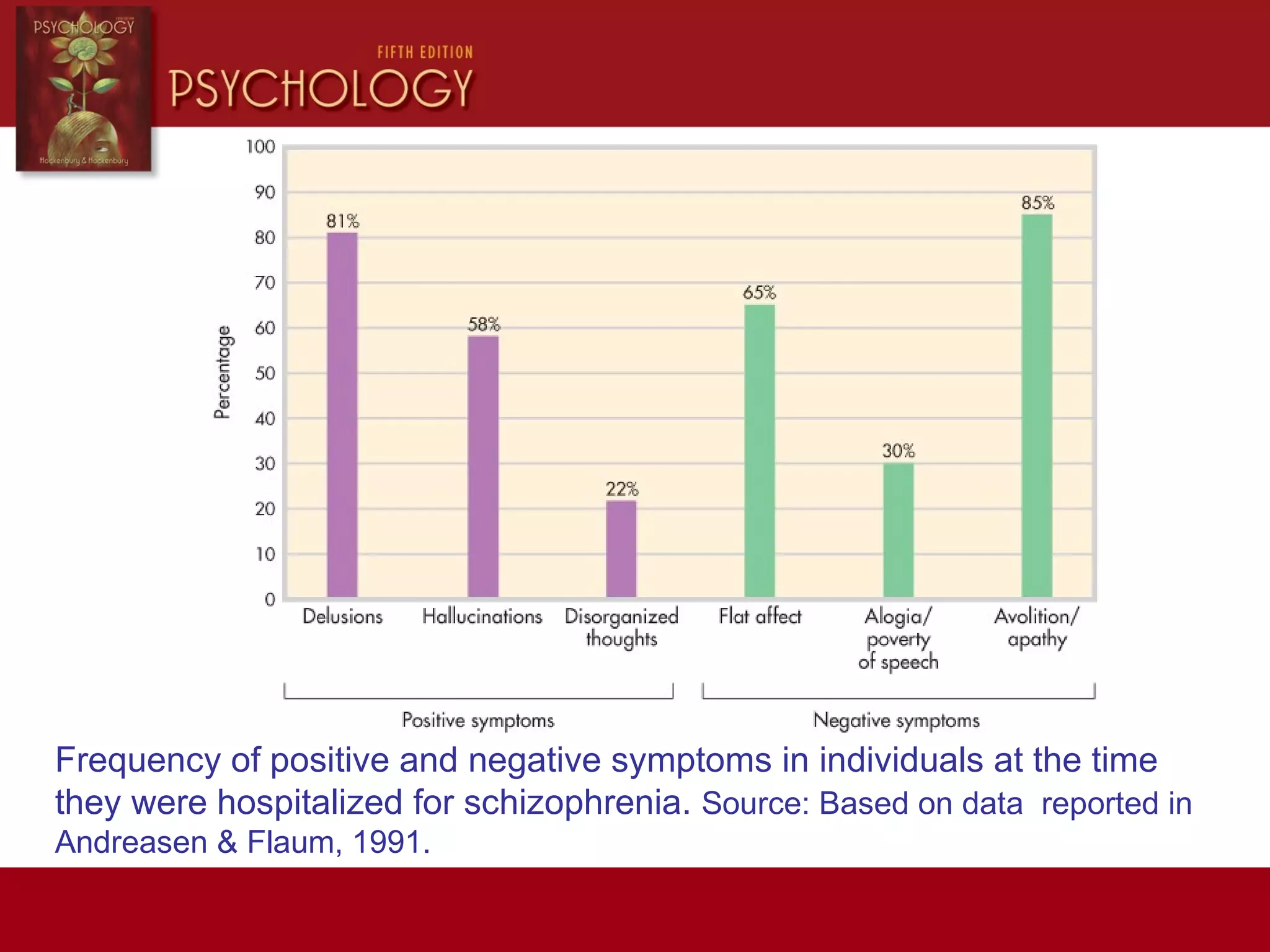
Frequency of positive and negative symptoms in individuals at the time
they were hospitalized for schizophrenia. Source: Based on data reported in
Andreasen & Flaum, 1991.
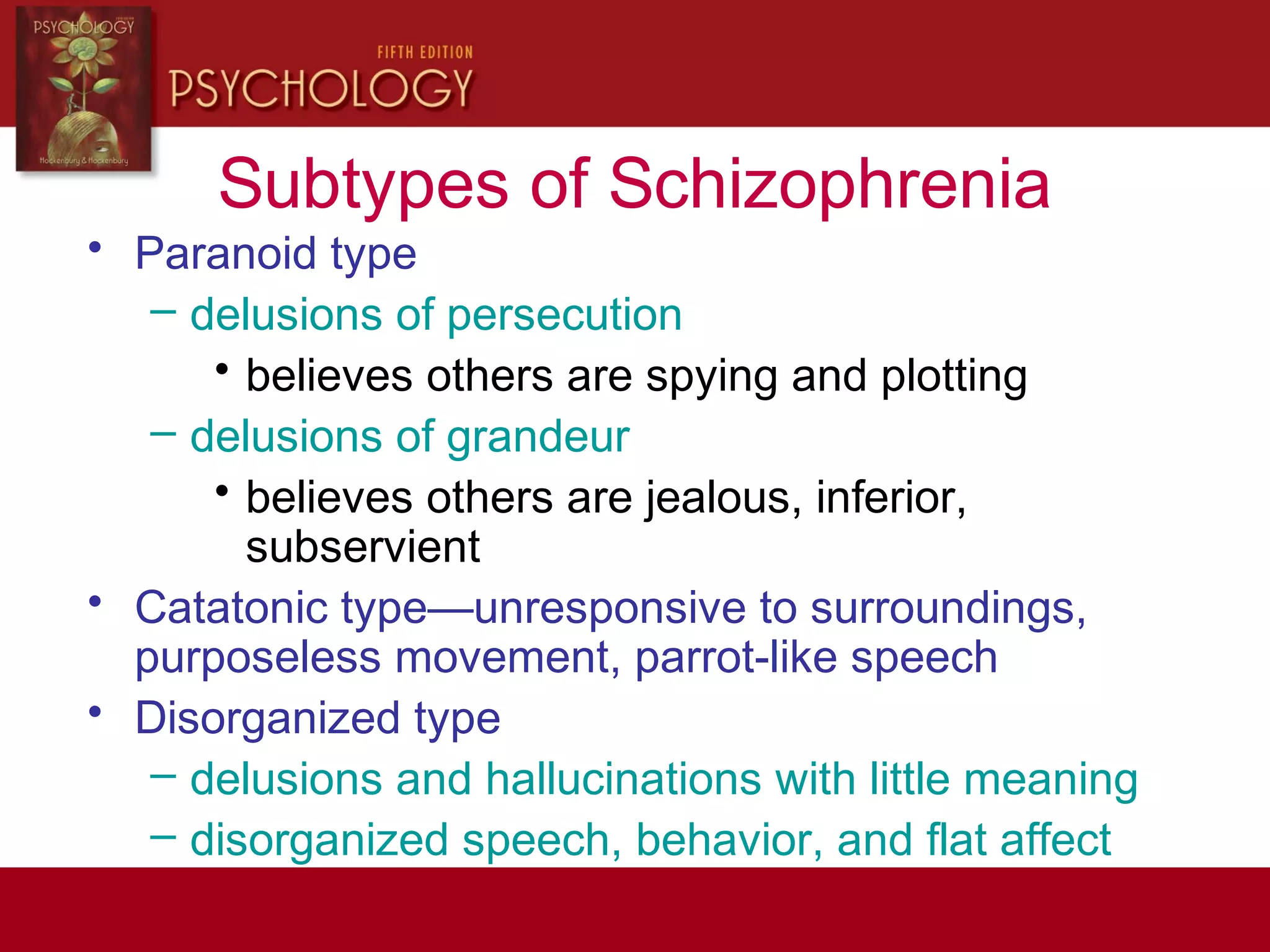
Subtypes of Schizophrenia
• Paranoid type
– delusions of persecution
• believes others are spying and plotting
– delusions of grandeur
• believes others are jealous, inferior,
subservient
• Catatonic type—unresponsive to surroundings,
purposeless movement, parrot-like speech
• Disorganized type
– delusions and hallucinations with little meaning
– disorganized speech, behavior, and flat affect
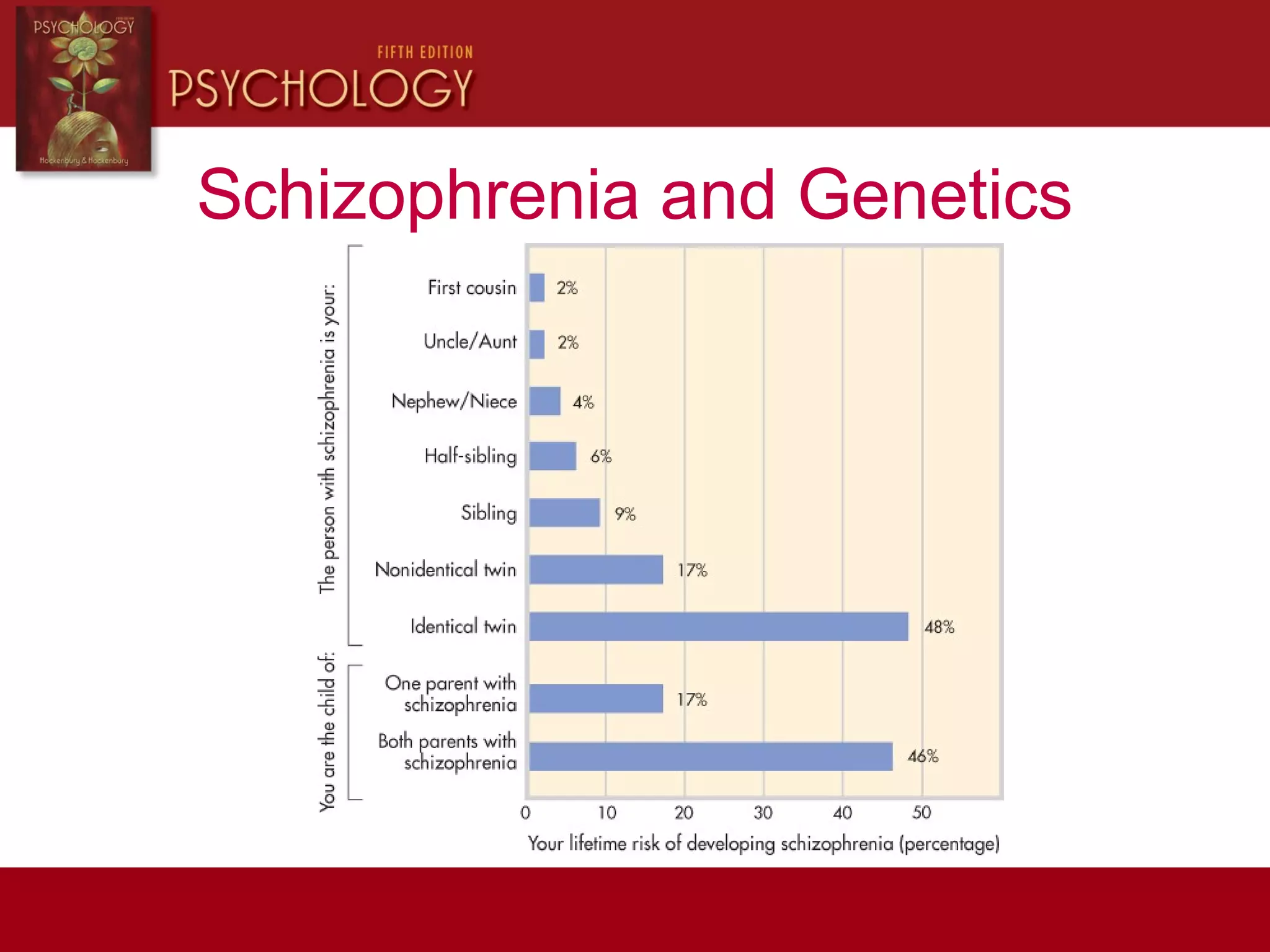
Schizophrenia and Genetics
The Dopamine Theory
• Drugs that reduce dopamine reduce
symptoms
• Drugs that increase dopamine produce
symptoms even in people without the
disorder
• Theory: Schizophrenia is caused by excess
dopamine
• Dopamine theory not enough; other
neurotransmitters involved as well
Biological Bases of
Schizophrenia
• Other congenital influences
– difficult birth (e.g., oxygen deprivation)
– prenatal viral infection
• Brain chemistry
– neurotransmitter excesses or deficits
– dopamine theory
Other Biological Factors
• Brain structure and function
– enlarged cerebral ventricles and reduced neural
tissue around the ventricles
– PET scans show reduced frontal lobe activity
• Early warning signs
– nothing very reliable has been found yet
– certain attention deficits can be found in children
who are at risk for the disorder
• Father’s age—older men are at higher risk for
fathering a child with schizophrenia
Family Influences on
Schizophrenia
Family variables
–parental communication that is
disorganized, hard-to-follow, or highly
emotional
–expressed emotion
• highly critical, over-enmeshed
families
Summary of Schizophrenia
• Many biological factors seem involved
– heredity
– neurotransmitters
– brain structure abnormalities
• Family and cultural factors also important
• Combined model of schizophrenia
– biological predisposition combined with
psychosocial stressors leads to disorder
– Is schizophrenia the maladaptive coping behavior
of a biologically vulnerable person?

PSYC 1113 Chapter 14

  • 1.
  • 2.
    •Psychopathology—scientific study of theorigins, symptoms, and development of psychological disorders •Psychological disorder or mental disorder--A pattern of behavioral and psychological symptoms that causes significant personal distress, impairs the ability to function in one or more important areas of daily life, or both
  • 3.
    Diagnosis Diagnostic and StatisticalManual of Mental Disorders (DSM-IV-TR)—describes specific symptoms and diagnostic guidelines for psychological disorders – Provides a common language to label mental disorders – Comprehensive guidelines to help diagnose mental disorders
  • 4.
    Some DSM-IV-TR Categories CategoryFeatures Examples Infancy,Childhood, or adolescent Symptoms usually diagnosed in childhood Autistic Disorder Tourette’s Disorder Substance-related Effects of seeking or using drugs Substance abuse Eating disorders Disturbances in body image, eating Anorexia nervosa Bulimia nervosa Impulse-control disorders Inability to resist actions that may be harmful Kleptomania, pyromania
  • 5.
    Prevalence of Psychological Disorders •Approximately 50% of adults experienced symptoms at least once in their lives (Kessler research) • Approximately 80% who experienced symptoms in the last year did NOT seek treatment • Most people seem to deal with symptoms without complete debilitation • Women have a higher prevalence of depression and anxiety • Men have a higher prevalence of substance abuse and antisocial personality disorder
  • 7.
    Anxiety Disorders • Primarydisturbance is distressing, persistent anxiety or maladaptive behaviors that reduce anxiety • Anxiety—diffuse, vague feelings of fear and apprehension
  • 8.
    Generalized Anxiety Disorder (GAD) •More or less constant worry about many issues • The worry seriously interferes with functioning • Physical symptoms – headaches – stomach aches – muscle tension – irritability
  • 9.
    Model of Development ofGAD • GAD has some genetic component • Related genetically to major depression • Childhood trauma also related to GAD Genetic predisposition or childhood trauma GAD following life change or major event Hypervigilance
  • 10.
    Panic Disorder • Panicattacks—sudden episode of helpless terror with high physiological arousal • Very frightening—sufferers live in fear of having them • Agoraphobia often develops as a result
  • 11.
    Cognitive-behavioral Theory ofPanic Disorder • Sufferers tend to misinterpret the physical signs of arousal as catastrophic and dangerous • This interpretation leads to further physical arousal, tending toward a vicious cycle • After the attack the person is very apprehensive of another attack
  • 12.
    Phobias Intense, irrational fearsthat may focus on: • Natural environment—heights, water, lightening • Situation—flying, tunnels, crowds, social gathering • Injury—needles, blood, dentist, doctor • Animals or insects—insects, snakes, bats, dogs
  • 13.
    Some Unusual Phobias •Anemophobia: fear of wind • Aphephobia: fear of being touched by another person • Catotrophobia: fear of breaking a mirror • Gamophobia: fear of marriage • Phonophobia: fear of the sound of your own voice
  • 14.
    Agoraphobia • Fear ofpanic attacks in public places • Avoid situations that might provoke a panic attack or where there may be no escape or help if a panic attack were to come • Not everyone with panic disorder develops agoraphobia
  • 15.
    Social Phobias • Socialphobias—fear of social situations. Also called social anxiety disorder. Stems from irrational fear of being embarrassed or judged by others in public – public speaking (stage fright) – fear of crowds, strangers – meeting new people – eating in public • Considered phobic if these fears interfere with normal behavior • More prevalent among women than men
  • 16.
    Development of Phobias •Classical conditioning model – problems: • often no memory of a traumatic experience • traumatic experience may not produce phobia • Preparedness theory—phobia serves to enhance survival
  • 17.
    Posttraumatic Stress Disorder (PTSD) •Follows events that produce intense horror or helplessness (traumatic episodes) • Core symptoms include: – Frequent recollection of traumatic event, often intrusive and interfering with normal thoughts – Avoidance of situations that trigger recall of the event – Increased physical arousal associated with stress
  • 18.
    Obsessive-Compulsive Disorder (OCD) • Obsessions—irrational,disturbing thoughts that intrude into consciousness • Compulsions—repetitive actions performed to alleviate obsessions • Often accompanied by an irrational belief that failure to perform ritual action will lead to catastrophe • Checking and washing most common compulsions • Deficiency in serotonin implicated and heightened neural activity in caudate nucleus
  • 19.
    Mood Disorders A categoryof mental disorders in which significant and chronic disruption in mood is the predominant symptom, causing impaired cognitive, behavioral, and physical functioning –Major depression –Dysthymic disorder –Bipolar disorder –Cyclothymic disorder
  • 20.
    Major Depression A mooddisorder characterized by extreme and persistent feelings of despondency, worthlessness, and hopelessness – Prolonged, very severe symptoms – Passes without remission for at least 2 weeks – Global negativity and pessimism – Very low self-esteem
  • 21.
    Symptoms of MajorDepression • Emotional—sadness, hopelessness, guilt, turning away from others • Behavioral—tearfulness, dejected facial expression, loss of interest in normal activities, slowed movements and gestures, withdrawal from social activities • Cognitive—difficulty thinking and concentrating, global negativity, preoccupation with death/suicide • Physical—appetite and weight changes, excess or diminished sleep, loss of energy, global anxiety, restlessness
  • 23.
    Prevalence and Courseof Major Depression • Most common of psychological disorders • Women are twice as likely as men to be diagnosed with major depression • Untreated episodes can become recurring and more serious • Seasonal affective disorder (SAD)—onset with changing seasons
  • 24.
    Dysthymic Disorder • Chronic,low-grade depressed feelings that are not severe enough to be major depression • May develop in response to trauma, but does not decrease with time • Can have co-existing major depression
  • 25.
    Seasonal Affective Disorder •Cyclic severe depression and elevated mood • Seasonal regularity • Unique cluster of symptoms – intense hunger – gain weight in winter – sleep more than usual – depressed more in evening than morning
  • 26.
    Bipolar Disorders • Cyclicdisorder (manic-depressive disorder) • Mood levels swing from severe depression to extreme euphoria (mania) • No regular relationship to time of year (SAD) • Must have at least one manic episode – Supreme self-confidence – Grandiose ideas and movements – Flight of ideas
  • 27.
    Cyclothymic Disorder Cyclothymic—mood disorder characterizedby moderate but frequent mood swings that are not severe enough to qualify as bipolar disorder
  • 28.
    Prevalence and Course •Onset usually in young adulthood (early twenties) • Mood changes more abrupt than in major depression • No gender differences in rate of bipolar disorder • Commonly recurs every few years • Can often be controlled by medication (lithium)
  • 29.
    Explaining Mood Disorders •Neurotransmitter theories – dopamine – norepinephrine – serotonin • Genetic component – more closely related people show similar histories of mood disorders
  • 30.
    Situational Bases forDepression • Positive correlation between stressful life events and onset of depression – Does life stress cause depression? • Most depressogenic life events are losses – spouse or companion – long-term job – health – income
  • 31.
    Cognitive Bases forDepression • Aaron Beck: depressed people hold pessimistic views of – themselves – the world – the future • Depressed people distort their experiences in negative ways – exaggerate bad experiences – minimize good experiences
  • 32.
    Eating Disorders • Involveserious and maladaptive disturbances in eating behavior, including reducing food intake, severe overeating, obsessive concerns about body shape or weight
  • 33.
    Two Main Types •Anorexia Nervosa-characterized by excessive weight loss, irrational fear of gaining weight, and distorted body self- perception • Bulimia Nervosa-characterized by binges of extreme overeating followed by self- induced vomiting, misuse of laxatives, or other methods to purge
  • 34.
    Causes of EatingDisorders • Perfectionism, rigid thinking, poor peer relations, social isolation, low self- esteem associated with anorexia • Genetic factors implicated in both • Both involve decrease in serotonin
  • 41.
    Personality Disorders Inflexible, maladaptivepattern of thoughts, emotions, behaviors, and interpersonal functioning that are stable over time and across situations, and deviate from the expectations of the individual’s culture
  • 42.
    Paranoid Personality Disorder •Pervasive mistrust and suspiciousness of others are the main characteristics • Distrustful even of close family and friends • Reluctant to form close relationships • Tend to blame others for their own shortcomings • Occurs in about 3 percent of population, more frequent in men • Pathological jealousy seen in intimate relationships
  • 43.
    Antisocial Personality Disorder •Used to be called psychopath or sociopath • Evidence often seen in childhood (conduct disorder) • Manipulative, can be charming, can be cruel and destructive • Seems to lack “conscience” • More prevalent in men than women
  • 44.
    Borderline Personality Disorder •Chronic instability of emotions, self-image, relationships • Self-destructive behaviors • Intense fear of abandonment and emptiness • Possible history of childhood physical, emotional, or sexual abuse • 75% of diagnosed cases are women
  • 45.
    Dissociative Disorders • Whatis dissociation? – literally a dis-association of memory – person suddenly becomes unaware of some aspect of their identity or history – unable to recall except under special circumstances (e.g., hypnosis) • Three types are recognized – dissociative amnesia – dissociative fugue – dissociative identity disorder
  • 46.
    Dissociative Amnesia • Margieand her brother were recently victims of a robbery. Margie was not injured, but her brother was killed when he resisted the robbers. Margie was unable to recall any details from the time of the incident until four days later.
  • 47.
    Dissociative Amnesia • Alsoknown as psychogenic amnesia • Memory loss the only symptom • Often selective loss surrounding traumatic events – person still knows identity and most of their past • Can also be global – loss of identity without replacement with a new one
  • 48.
    Dissociative Fugue Jay, ahigh school physics teacher in New York City, disappeared three days after his wife unexpectedly left him for another man. Six months later, he was discovered tending bar in Miami Beach. Calling himself Martin, he claimed to have no recollection of his past life and insisted that he had never been married.
  • 49.
    Dissociative Fugue • Alsoknown as psychogenic fugue • Global amnesia with identity replacement – leaves home – develops a new identity – apparently no recollection of former life – called a ‘fugue state’ • If fugue wears off – old identity recovers – new identity is totally forgotten
  • 50.
    Dissociative Identity Disorder (DID) Normahas frequent memory gaps and cannot account for her whereabouts during certain periods of time. While being interviewed by a clinical psychologist, she began speaking in a childlike voice. She claimed that her name was Donna and that she was only six years old. Moments later, she seemed to revert to her adult voice and had no recollection of speaking in a childlike voice or claiming that her name was Donna.
  • 51.
    Dissociative Identity Disorder •Originally known as “multiple personality disorder” • 2 or more distinct personalities manifested by the same person at different times • VERY rare and controversial disorder • Examples include Sybil, Trudy Chase, Chris Sizemore (“Eve”) • Has been tried as a criminal defense
  • 52.
    Dissociative Identity Disorder •Pattern typically starts prior to age 10 (childhood) • Most people with disorder are women • Most report recall of torture or sexual abuse as children and show symptoms of PTSD
  • 53.
    Causes of Dissociative Disorders? •Repeated, severe sexual or physical abuse • However, many abused people do not develop DID • Becomes a pathological defense mechanism to cope with intense feelings of rage and anger
  • 54.
    The DID Controversy •Some curious statistics – 1930–60: 2 cases per decade in USA – 1980s: 20,000 cases reported – many more cases in US than elsewhere – varies by therapist—some see none, others see a lot • Is DID the result of suggestion by therapist and acting by patient?
  • 55.
    What is Schizophrenia? •Comes from Greek meaning “split” and “mind” – ‘split’ refers to loss of touch with reality – not dissociative state – not ‘split personality’
  • 56.
    Symptoms of Schizophrenia •Positive symptoms – hallucinations – delusions • Negative symptoms – absence of normal cognition or affect (e.g., flat affect, poverty of speech) • Disorganized symptoms – disorganized speech (e.g., word salad) – disorganized behaviors
  • 57.
    Symptoms of Schizophrenia •Delusions of persecution – ‘they’re out to get me’ – paranoia • Delusions of grandeur – “God” complex – megalomania • Delusions of being controlled – the CIA is controlling my brain with a radio signal
  • 58.
    Symptoms of Schizophrenia •Hallucinations – hearing or seeing things that aren’t there – contributes to delusions – command hallucinations: voices giving orders • Disorganized speech – Over-inclusion—jumping from idea to idea without the benefit of logical association – Paralogic—on the surface, seems logical, but seriously flawed • e.g., Jesus was a man with a beard; I am a man with a beard, therefore I am Jesus.
  • 59.
    Symptoms of Schizophrenia •Disorganized behavior and affect – behavior is inappropriate for the situation • e.g., wearing sweaters and overcoats on hot days – affect is inappropriately expressed • flat affect—no emotion at all in face or speech • inappropriate affect—laughing at very serious things, crying at funny things – catatonic behavior • unresponsiveness to environment, usually marked by immobility for extended periods
  • 60.
    Frequency of positiveand negative symptoms in individuals at the time they were hospitalized for schizophrenia. Source: Based on data reported in Andreasen & Flaum, 1991.
  • 61.
    Subtypes of Schizophrenia •Paranoid type – delusions of persecution • believes others are spying and plotting – delusions of grandeur • believes others are jealous, inferior, subservient • Catatonic type—unresponsive to surroundings, purposeless movement, parrot-like speech • Disorganized type – delusions and hallucinations with little meaning – disorganized speech, behavior, and flat affect
  • 62.
  • 63.
    The Dopamine Theory •Drugs that reduce dopamine reduce symptoms • Drugs that increase dopamine produce symptoms even in people without the disorder • Theory: Schizophrenia is caused by excess dopamine • Dopamine theory not enough; other neurotransmitters involved as well
  • 64.
    Biological Bases of Schizophrenia •Other congenital influences – difficult birth (e.g., oxygen deprivation) – prenatal viral infection • Brain chemistry – neurotransmitter excesses or deficits – dopamine theory
  • 65.
    Other Biological Factors •Brain structure and function – enlarged cerebral ventricles and reduced neural tissue around the ventricles – PET scans show reduced frontal lobe activity • Early warning signs – nothing very reliable has been found yet – certain attention deficits can be found in children who are at risk for the disorder • Father’s age—older men are at higher risk for fathering a child with schizophrenia
  • 66.
    Family Influences on Schizophrenia Familyvariables –parental communication that is disorganized, hard-to-follow, or highly emotional –expressed emotion • highly critical, over-enmeshed families
  • 67.
    Summary of Schizophrenia •Many biological factors seem involved – heredity – neurotransmitters – brain structure abnormalities • Family and cultural factors also important • Combined model of schizophrenia – biological predisposition combined with psychosocial stressors leads to disorder – Is schizophrenia the maladaptive coping behavior of a biologically vulnerable person?

Editor's Notes

  • #10 Discovering Psych Slides (Shulman)
  • #19 The caudate nucleus is located in the basal ganglia and is associated with initiation of learned, habitual motor activities Using drugs that increase Serotonin reduces the activity of the caudate nucleus and leads to a reduction in the obsessions and compulsions - people who recover from OCD using behavioral and cognitive therapies also show a reduction in activity in the caudate nucleus
  • #30 neurotransmitters are associated with motivation and arousal drugs that augment NE or Serotonin have been found effective in treating depression Prozac is a serotonin reuptake inhibitor, making more Serotonin available
  • #46 Keywords: definition of dissociation Some psychologists use the term repression for dissociative amnesia A problem is that we need to distinguish between normal forgetting and the extreme case of dissociative amnesia. Just because you can’t remember something from your past very well doesn’t mean you are dissociating. Amnesia can also be caused by a head injury or by drugs. This isn’t considered dissociative amnesia How can we tell other kinds of forgetting from dissociation? Sudden onset, related to emotional trauma absence of brain injury, drugs
  • #47 Keywords: dissociative amnesia example
  • #48 Keywords: dissociative amnesia
  • #49 keywords: dissociative fugue example
  • #50 keywords: dissociative fugue
  • #51 keywords: dissociative identity disorder example
  • #52 keywords: dissociative identity disorder, symptoms
  • #53 keywords: dissociative identity disorder, characteristics
  • #54 keywords: causal theories of dissociative disorders
  • #55 keywords: dissociative identity disorder, controversy over Spanos asked college students to pretend they were accused murderers being examined by a psychiatrist. When given hypnotic therapy the students often expressed a second personality which claimed to be the murderer. This raises the question of whether DID might arise in some cases as a strategy or ploy by the patient, not just to avoid prosecution for crimes but perhaps to avoid other negative situations. It is not suggested that all DID cases arise in this way, but perhaps the large increase in diagnosis can be accounted for in this way. The increase in incidence in the 1980s was preceded by heightened awareness of the the stories of THE THREE FACES OF EVE and SYBIL which became known in the 1960’s
  • #56 keywords: schizophrenia, definition
  • #57 keywords: schizophrenia, symptoms, types
  • #58 keywords: schizophrenia, symptoms, delusions
  • #59 keywords: schizophrenia, symptoms, hallucinations, disorganized speech
  • #60 keywords: schizophrenia, symptoms, disorganized behavior, disorganized affect
  • #62 keywords: schizophrenia, subtypes
  • #63 keywords: genetics of schizophrenia Discovering Psy2e slides, Shulman Discovering Psy2e Slides (Shulman)
  • #64 keywords: schizophrenia, the dopamine theory A problem for the theory: Drugs that reduce dopamine do reduce Sz symptoms, but the effects on dopamine function in the brain and on behavior have different time courses. On treatment with dopamine blocking drugs receptor function in the brain is affected almost immediately but reduction of symptoms is delayed by days or weeks. Some drugs that increase dopamine and that may induce sz-like positive symptoms include amphetamines and cocaine. When drug therapy first became available it was regarded as a major breakthrough in the treatment of mental disease by medical means

  • #65 keywords: schizophrenia, congenital influences Increased risk has been observed for those born in a country where there was a flu epidemic during their gestation. The months of above average risk births are reversed between the northern and southern hemispheres, as are the flu seasons.
  • #66 keywords: schizophrenia, brain structure, behavioral precursors
  • #67 keywords: schizophrenia, family variables
  • #68 keywords: schizophrenia, summary