Chapter 4 :
Psychological Disorders
Mrs. Navarathina Devakumar, M.Phil (Psy)
CBSE Class XII
Classification of Psychological Disorders
1. Anxiety Disorders
2. Obsessive- Compulsive And Related Disorders
3. Trauma And Stressor- Related Disorders
4. Somatic Symptom And Related Disorders
5. Dissociative Disorders
6. Depressive Disorders
7. Bipolar And Related Disorders
8. Schizophrenia Spectrum And Other Psychotic Disorders
9. Neurodevelopmental Disorders
10. Disruptive, Impulse -Control And Conduct Disorders
11. Feeding and eating Disorders
12. Substance- Related And Addictive Disorders
1. Anxiety Disorders
 Anxiety is defined as a diffuse, vague, very unpleasant feeling of fear and
apprehension.
 Symptoms:
 Rapid heart rate
 Shortness of breath
 Diarrhoea and loss of appetite
 Fainting and dizziness
 Sleeplessness
 Sweating and tremors
 Frequent urination
 Anxiety disorders are the most commonest psychological disorders
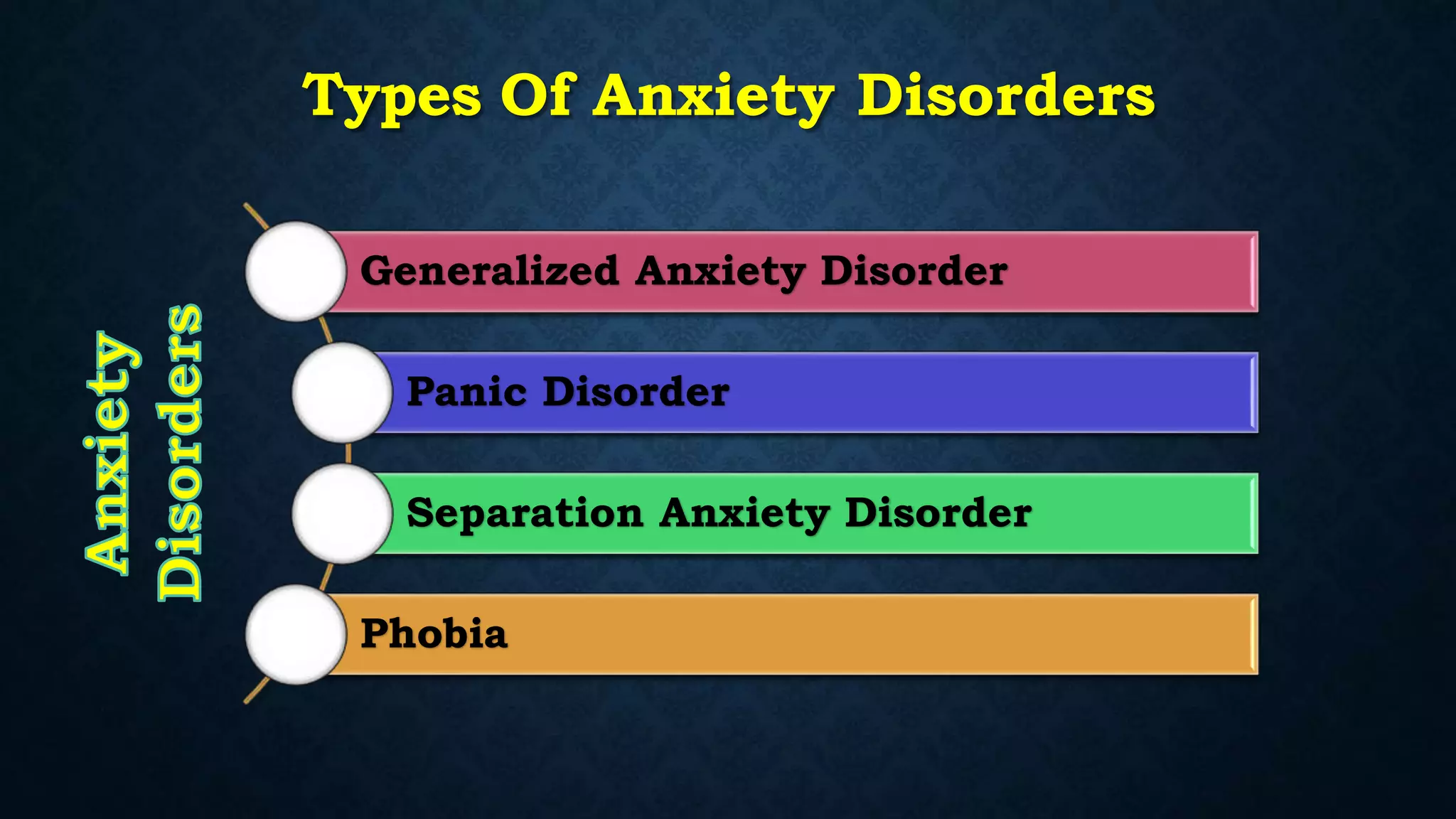
Types Of Anxiety Disorders
Generalized Anxiety Disorder
Panic Disorder
Separation Anxiety Disorder
Phobia
Generalised Anxiety Disorders
 It consists of a prolonged, vague,
unexplained and intense fears that are not
attached to any object
 Symptoms
 Worry and apprehensive feelings about the
future
 Hypervigilance which involves constantly
scanning the environment for danger
 It is marked by motor tension as a result of which
the person is unable to relax
 Restless, tense and visibly shaky
Panic Disorder
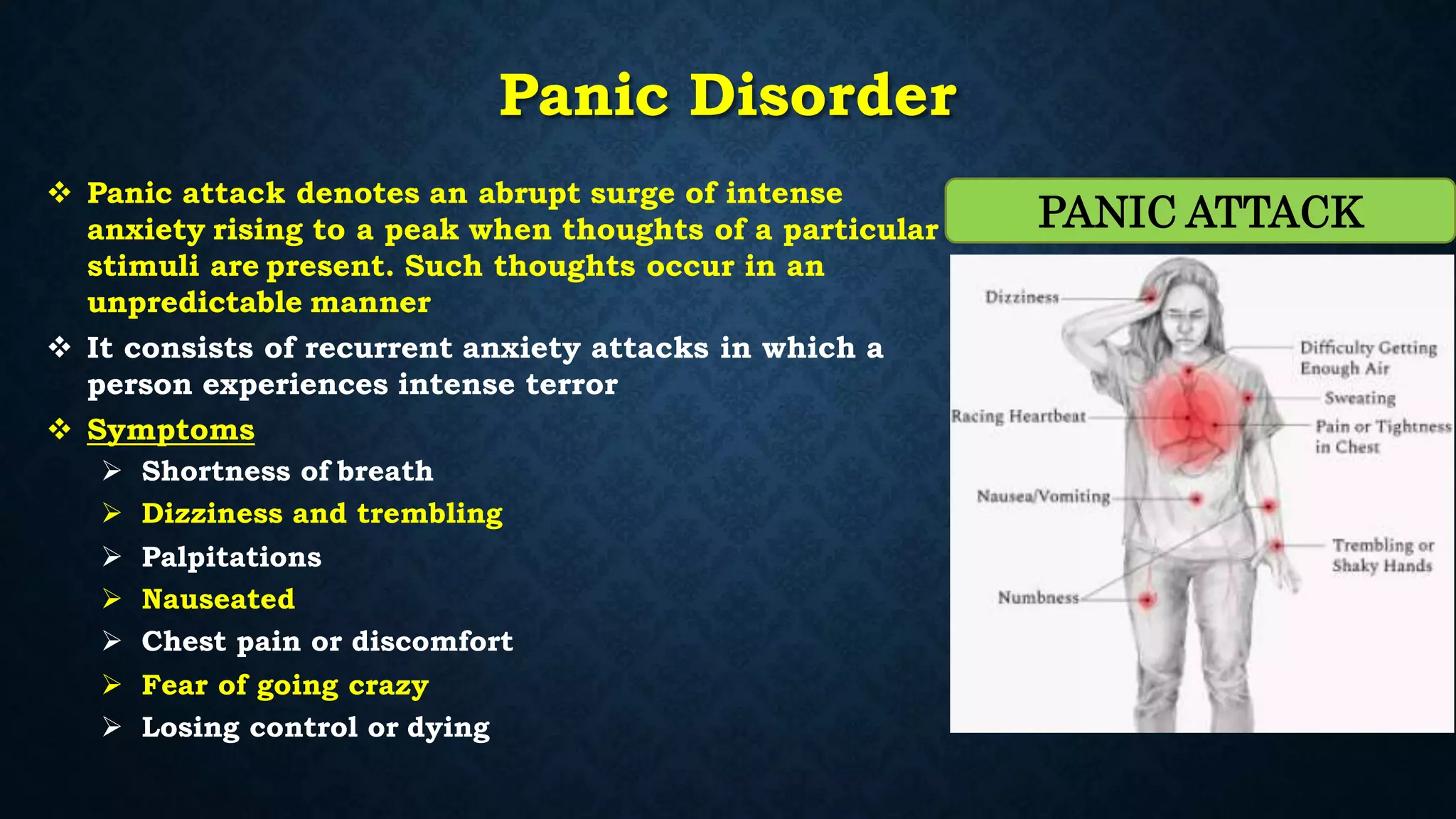
 Panic attack denotes an abrupt surge of intense
anxiety rising to a peak when thoughts of a particular
stimuli are present. Such thoughts occur in an
unpredictable manner
 It consists of recurrent anxiety attacks in which a
person experiences intense terror
 Symptoms
 Shortness of breath
 Dizziness and trembling
 Palpitations
 Nauseated
 Chest pain or discomfort
 Fear of going crazy
 Losing control or dying
PANIC ATTACK
Phobias
 Irrational fears related to specific objects, people or situations
 Phobias often develop gradually or begin with a generalised anxiety
disorder
Types of Phobia
Specific Phobia
• Most commonly occurring phobia.
• This group includes irrational fears such as intense fear of a certain
type of animal or being in an enclosed space
Social Phobia/ Social anxiety disorder
• Intense and incapacitating fear and embarrassment when dealing with
others characterises social anxiety disorder
Agoraphobia
• When people develop a fear of entering unfamiliar situations.
• Many people with agoraphobia are afraid of leaving their home.
• So their ability to carry out normal life activities is severely limited
Separation Anxiety Disorder
 Individuals with this disorder are fearful and
anxious about separation from attachment
figures to an extent that is developmentally
not appropriate
 Symptoms in children
 Difficulty being in a room by themselves
 Going to school alone
 Fearful of entering new situations
 Cling to and shadow their parents every move
 To avoid separation children with SAD may fuss, scream,
throw severe tantrums or make suicidal gestures
2. Obsessive Compulsive & Related Disorders
 People affected by OCD are unable to control their preoccupation
with specific ideas or are unable to prevent themselves from
repeatedly carrying out a particular act or series of acts that affect
their ability to carry out normal activities
 Obsessive behaviour
 The inability to stop thinking about a particular idea ortopic
 The person involved, often finds these thoughts to be
unpleasant and shameful
 Compulsive behaviour
 The need to perform certain behaviours over and over again
 Many compulsions deal with counting, ordering, checking,
touching and washing
 Other disorders int his category include Hoarding
disorder, Trichotillomania- Hair pulling disorder
 Excoriation – Skin picking disorder
3. Trauma & Stressor Related Disorders
 Post Traumatic Disorder
 People who have been caught in a natural disaster
( such as tsunami, earthquakes) or have been
victims of bomb blasts by terrorists or war related
situations or met with a serious accident
experience post-traumatic stress disorder.
 Symptoms
 Recurrent dreams
 Flashbacks
 Impaired concentration and emotional numbing
 Adjustment disorders and acute stress disorders
are included in this category
4. Somatic Symptom & Related Disorders
 These are conditions in which there are physical symptoms in the absence of a
physical disease
 Individuals have psychological difficulties and complaints of physical symptoms
with no biological cause
 Types of Somatic Symptoms Disorder
Somatic
Symptom
Disorder
Illness Anxiety
Disorder
Conversion
Disorder
 The person experiences body related
symptoms which may or may not be related to
any serious medical condition
 People with this disorder are
 Overly preoccupied with their symptoms
 Continually worry about the health and make
frequent doctor visits
 As a result they experience significant distress
and disturbances in their daily life
 Expression is in terms of physical illness
Somatic Symptom Disorder
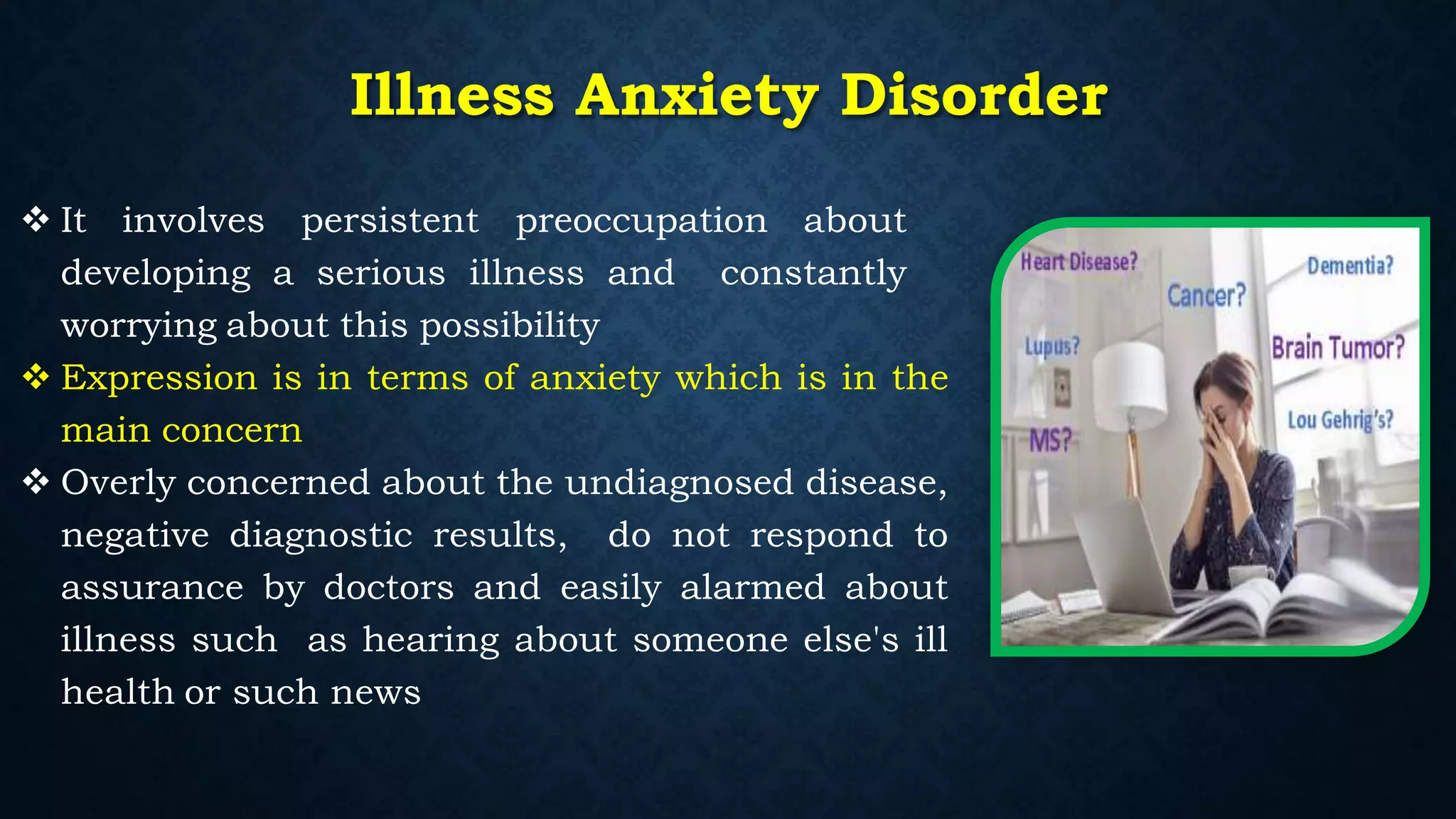
 It involves persistent preoccupation about
developing a serious illness and constantly
worrying about this possibility
 Expression is in terms of anxiety which is in the
main concern
 Overly concerned about the undiagnosed disease,
negative diagnostic results, do not respond to
assurance by doctors and easily alarmed about
illness such as hearing about someone else's ill
health or such news
Illness Anxiety Disorder
Conversion Disorders
 The person suffers from a loss or impairment of
motor or sensory function (paralysis, blindness
etc) that has no physical cause but may be a
response to stress and psychological problems
 Paralysis
 Blindness
 Deafness &
 Difficulty in walking are generally reported
among the symptoms
Dissociative Disorders
 Dissociation : It can be viewed as severance of the connections between ideas
and emotions
 Symptoms : feelings of unreality, estrangement, depersonalisation and
sometimes a loss of shift of identity
 Dissociative disorders: Sudden temporary alternations in consciousness that
blot out painful experiences are a defining characteristic of dissociative disorders
Dissociative Amnesia
Depersonalisation
Disorder
Dissociative
Identity Disorder
 It is characterised by extensive but selective memory loss that
has no organic cause ( headinjury)
 Some people cannot remember anything about their past.
Others can no longer recall specific events, people, places or
objects while their memory for other events remain intact. A
part of dissociative amnesia is dissociative fugue
 Essential feature of this could be an unexpected travel away from
home and workplace. The assumption of a new identity and the
inability to recall the previous identity
 The fugue usually ends when the person suddenly wakes up with
no memory of the events that occurred during the fugue.
Types of Dissociative Disorders
Dissociative Amnesia
Dissociative Fugue
Unexpected travel
away home and
assuming a new
identity
 It is referred to as multiple personality and the most dramatic
of the dissociative disorders
 In this disorder, the person assumes alternate personalities
that may or may not be aware of each other. It is often
associated with traumatic experience of the childhood
 It involves a dreamlike state in which the person has a sense of
being separated both from self and from the reality
 In depersonalisation ,there is a change of self perception and
the persons sense of reality is temporarily lost or changed
Dissociative Identity Disorder
Depersonalisation/ Derealisation Disorder
Person assumes
alternate
personalities
Types of Dissociative Disorders
6. Depressive Disorders
Major Depression Disorder
 Major depressive disorder is defined as a period of depression mood or loss of interest
or pleasure in most activities together with other symptoms like
 Change in body weight
 Constant sleep problems
 Tiredness
 Inability to think clearly
 Agitation
 Greatly slower behaviour
 Thoughts of death and suicide
 Excessive guilt or feelings of worthlessness
Factors Predisposing Towards Depression
 Genetic make up or heredity is an important risk factor for major depression
 Age: women are particularly at risk during young adulthood while men are at
highest risk in early middle age
 Gender: women in comparison to men are more likely to report a depressive
disorder
 Negative life events and lack of social support
GENDER HEREDIT
Y
NEGATIVE LIFE
EVENTS
7. Bipolar and Related Disorders
 Bipolar 1 disorder involves both mania and
depression, which alternatively present and
sometimes interrupted by periods of normal mood.
 Bipolar disorders were earlier referred as
manic- depressive disorders.
Depression
Mania
Depression Mania
Depressed Mood Euphoric Mood
Loss of Energy & Fatigue Hyper Activity
Poverty of Speech Excessively Talkative
Negative Self Concept Inflated Self Esteem
Highly Pessimistic Highly Optimistic
Suicide
 Suicide refers to act of intentionally killing oneself.
 Suicide occurs as a result of complex interface of biological,
genetic, psychological, sociological, cultural and
environmental factors
 Suicide warning signs
 Exhibits drastic changes in behavior
 Withdraws from friends or social activities
 Loses interest in school, work or hobbies
 Trouble with eating or sleeping
 Preoccupied with death and dying
 Gives away prized possessions
 Increased intake of alcohol or drugs
 Previous suicidal attempt is an important risk factor
Suicide Prevention
 Suicides are preventable. improving identification, referral and management of
behaviours are crucial.
 We need to identify vulnerability, comprehend the circumstances leading to such
behaviour and accordingly plan interventions
 Measures suggested by WHO :
1.Limiting access to the means of suicide
2. Reporting of suicide in media in a responsible way
3.Bringing in alcohol related policies
4. Early identification, treatment and carer of risk
5.Training health workers in assessing and managing for suicide
6.Care for people who attempted suicide and providing community support
8. Schizophrenia Spectrum and other Psychotic
Disorders
 Schizophrenia is the descriptive term for a group of psychotic
disorders in which personal, social and occupational functioning
deteriorate as a result of disturbed thought process, strange
perceptions, unusual emotional states and motor abnormalities.
 The symptoms of schizophrenia can be grouped into 3 categories
A. Positive symptoms -excesses of thought emotion and behavior.
Delusion, disorganized thinking and speech, heightened
perception, hallucinations and inappropriate affect
B. Negative symptoms- deficits of thought, emotion and behavior.
Poverty of speech, blunted and flat affect , loss of volition and
social withdrawal.
C. Psychomotor symptoms
Positive
symptoms
Negative
symptoms
Psychomotor
symptoms
A. Positive Symptoms of Schizophrenia
 Delusion:
 A delusion is a false belief that is firmly held on inadequate
grounds . It is not affected by rational argument and has no basis
in the reality
 Types Of Delusion
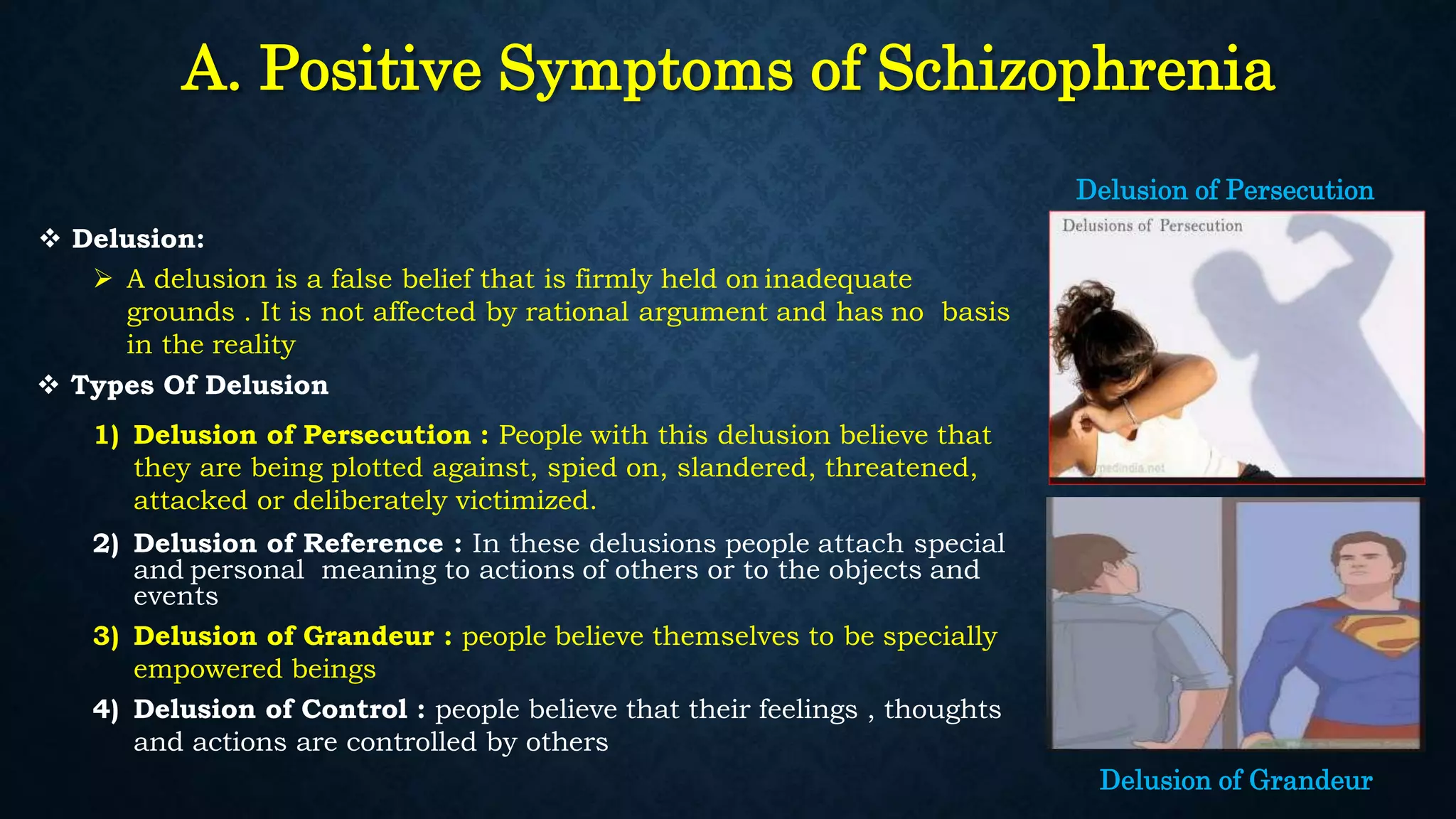
1) Delusion of Persecution : People with this delusion believe that
they are being plotted against, spied on, slandered, threatened,
attacked or deliberately victimized.
2) Delusion of Reference : In these delusions people attach special
and personal meaning to actions of others or to the objects and
events
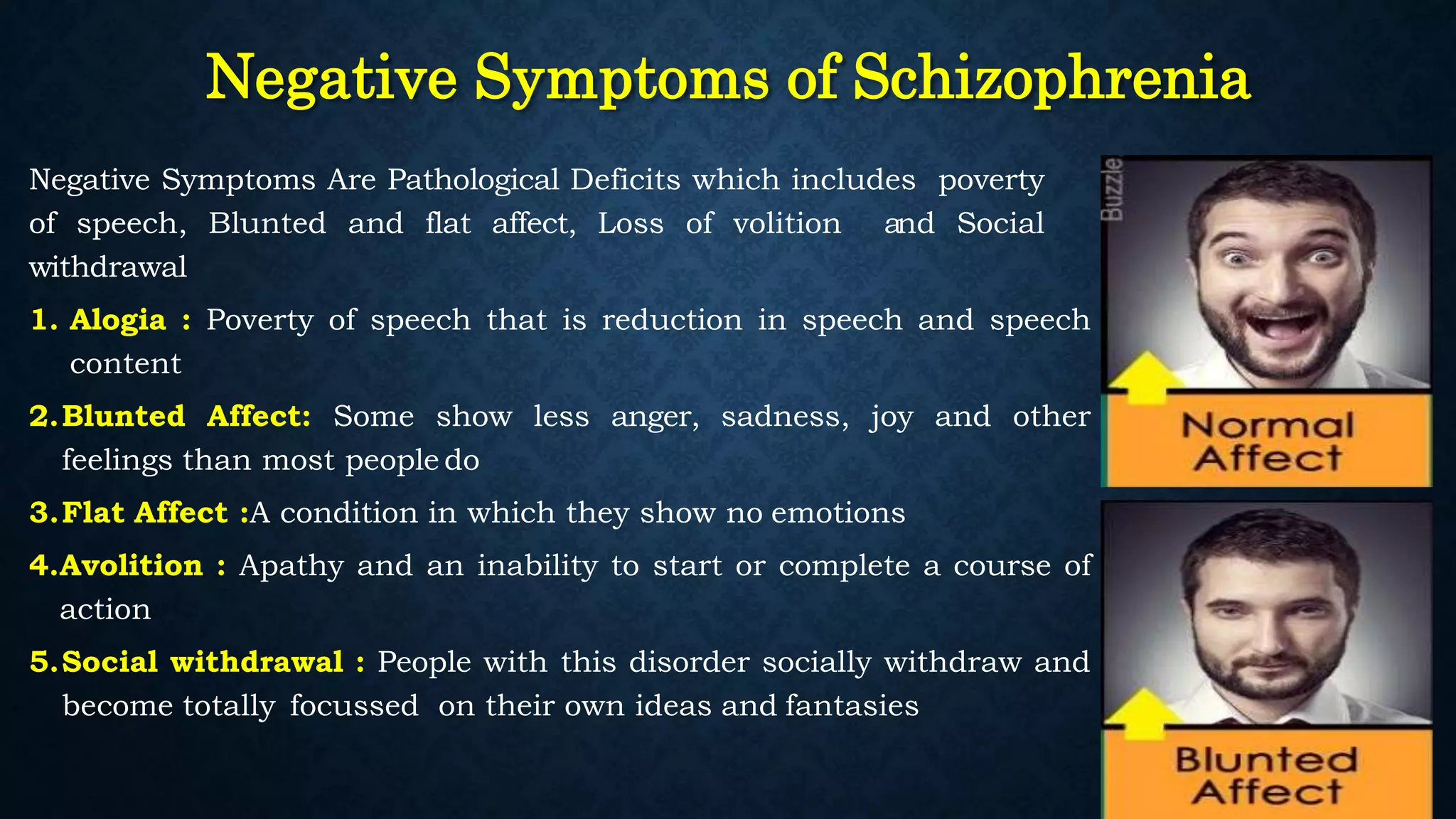
3) Delusion of Grandeur : people believe themselves to be specially
empowered beings
4) Delusion of Control : people believe that their feelings , thoughts
and actions are controlled by others
Delusion of Grandeur
Delusion of Persecution
Schizophrenia
 Formal thought disorders include
 Rapidly shifting from one topic to another so that the normal structure of thinking is
muddled and become illogical ( loosening of association andderailment)
 Neologism-inventing new words or phrases
 Perseveration- persistent and inappropriate repetition of the same thoughts
Inappropriate repetition of
same thoughts
Types of Hallucination
 HALLUCINATION : Perception that occur in the absence of external stimuli
 TYPES OF HALLUCINATION:
1) Auditory Hallucination:
 Most common in schizophrenia. Patients hear sounds or voices that speak words,
phrases and sentences directly to the patient ( second –person hallucination)
 Talk to one another referring to the patient ( third – person hallucination)
2) Tactile Hallucinations: Forms of tingling , burning
3) Somatic Hallucination: Something happening inside the body such as snake crawling
inside ones stomach
4) Visual Hallucination: Vague perceptions of colour or distinctvisions of people or objects
5) Gustatory Hallucination: Food or drink tastes strange
6) Olfactory Hallucination: Smell of poison or smoke
Types of Hallucination
VISUAL HALLUCINATION
AUDITORY
HALLUCINATION
TACTILE HALLUCINATION
OLFACTORY HALLUCINATION
Negative Symptoms of Schizophrenia
Negative Symptoms Are Pathological Deficits which includes poverty
of speech, Blunted and flat affect, Loss of volition and Social
withdrawal
1. Alogia : Poverty of speech that is reduction in speech and speech
content
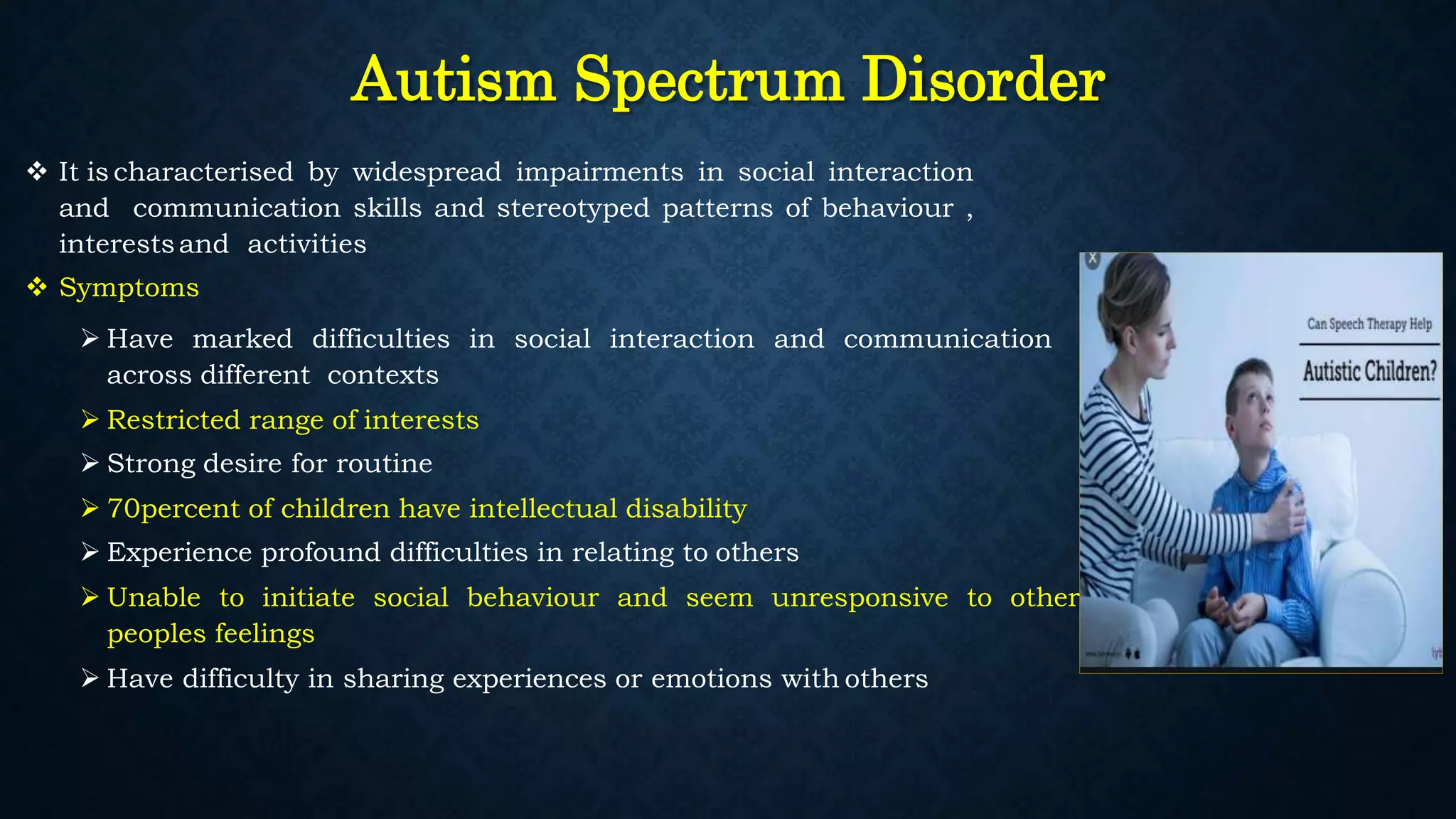
2.Blunted Affect: Some show less anger, sadness, joy and other
feelings than most people do
3.Flat Affect :A condition in which they show no emotions
4.Avolition : Apathy and an inability to start or complete a course of
action
5.Social withdrawal : People with this disorder socially withdraw and
become totally focussed on their own ideas and fantasies
Psychomotor Symptoms of Schizophrenia
Catatonic Rigidity
CATATONIA : They move less spontaneously or
make odd grimaces and gestures. These symptoms
may take extreme forms called catatonia.
CATATONIC STUPOR : people remain motionless
and silent for long stretches of time
CATATONIC RIGIDITY : maintaining a rigid,
upright postures for hours
CATATONIC POSTURING : assuming awkward,
bizarre position for hours
Catatonic posturing
9.Neurodevelopmental Disorders
• A common feature of the neurodevelopmental disorders is that they manifest in the
early stage of development
• Often the symptoms appear before the child enters school or during the early stage of
schooling
• These disorders result in hampering personal, social , academic and occupational
functioning
• Types :
Attention deficit
hyperactive
disorder
Autism spectrum
disorder
Intellectual
disability
Specific Learning
Disorder
Attention Deficit Hyperactive Disorder
The main features of ADHD are inattention, hyperactivity and
impulsive
Inattention:
 Children who are inattentive find it difficult to sustain mental
effort during a work or play.. They have a hard time keeping their
minds on any one thing or following instructions
 Symptoms
 Child does not listen and cannot concentrate
 Disorganised
 Easily distracted and forgetful
 Does not finish assignments
 Quick to lose interest in boring activities
Attention Deficit Hyperactive Disorder (ADHD)
 HYPERACTIVITY
 Children with ADHD are in constant motion. Parents and teachers
describe them as " driven by a motor “
 Talks incessantly
 The child may fidget, squirm, climb and run around the room aimlessly
 Sitting still through a lesson is impossible forthem
 IMPULSIVE
 Children who are impulsive seem unable to control their immediate
reactions or think before they act. Common complaints are
 They find difficult to wait or take turns
 Difficulty resisting immediate temptations or delaying gratification
 Minor mishaps, knocking things over and sometimes serious accidents or
injuries can occur
Autism Spectrum Disorder
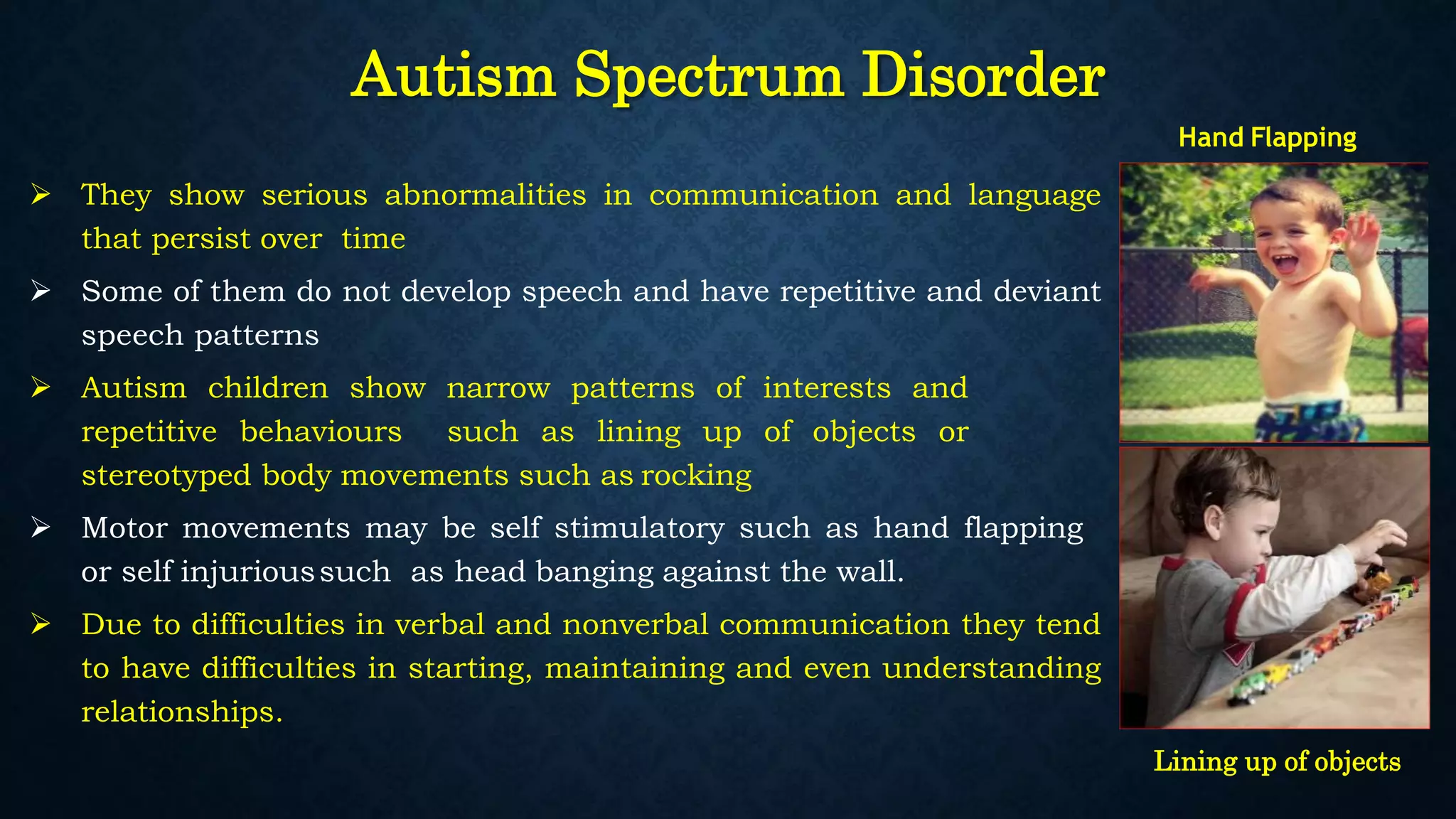
 It is characterised by widespread impairments in social interaction
and communication skills and stereotyped patterns of behaviour ,
interestsand activities
 Symptoms
 Have marked difficulties in social interaction and communication
across different contexts
 Restricted range of interests
 Strong desire for routine
 70percent of children have intellectual disability
 Experience profound difficulties in relating to others
 Unable to initiate social behaviour and seem unresponsive to other
peoples feelings
 Have difficulty in sharing experiences or emotions with others
Autism Spectrum Disorder
 They show serious abnormalities in communication and language
that persist over time
 Some of them do not develop speech and have repetitive and deviant
speech patterns
 Autism children show narrow patterns of interests and
repetitive behaviours such as lining up of objects or
stereotyped body movements such as rocking
 Motor movements may be self stimulatory such as hand flapping
or self injurioussuch as head banging against the wall.
 Due to difficulties in verbal and nonverbal communication they tend
to have difficulties in starting, maintaining and even understanding
relationships.
Hand Flapping
Lining up of objects
Intellectual Disability
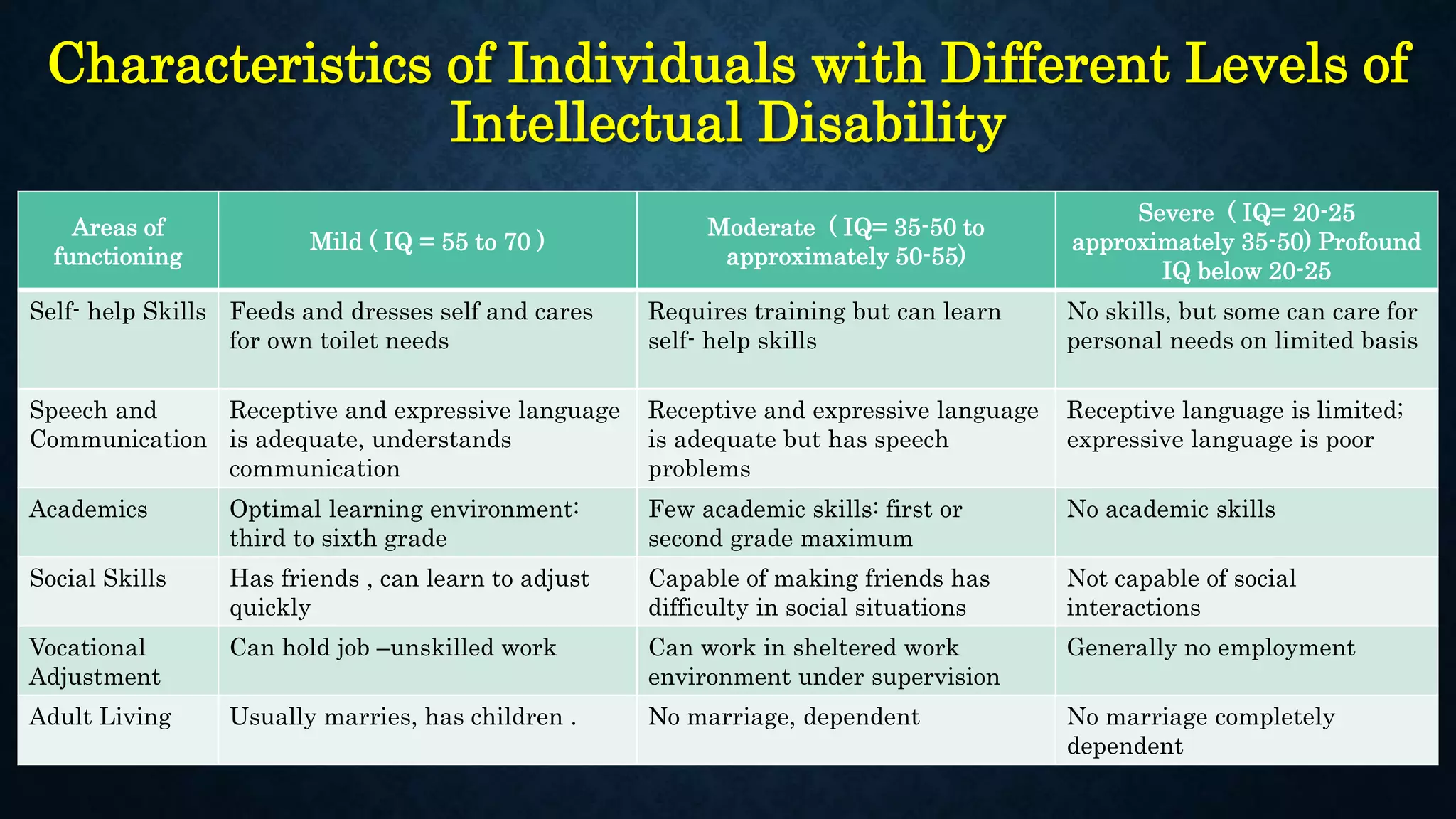
Refers to below average intellectual
functioning ( IQ of 70 or below) and deficits
or impairments in adaptive behaviour in the
areas of communication, self café, home
living, social/ interpersonal skills,
functional academic skills, work etc. which
are manifested before the age of 18 years
Characteristics of Individuals with Different Levels of
Intellectual Disability
Areas of
functioning
Mild ( IQ = 55 to 70 )
Moderate ( IQ= 35-50 to
approximately 50-55)
Severe ( IQ= 20-25
approximately 35-50) Profound
IQ below 20-25
Self- help Skills Feeds and dresses self and cares
for own toilet needs
Requires training but can learn
self- help skills
No skills, but some can care for
personal needs on limited basis
Speech and
Communication
Receptive and expressive language
is adequate, understands
communication
Receptive and expressive language
is adequate but has speech
problems
Receptive language is limited;
expressive language is poor
Academics Optimal learning environment:
third to sixth grade
Few academic skills: first or
second grade maximum
No academic skills
Social Skills Has friends , can learn to adjust
quickly
Capable of making friends has
difficulty in social situations
Not capable of social
interactions
Vocational
Adjustment
Can hold job –unskilled work Can work in sheltered work
environment under supervision
Generally no employment
Adult Living Usually marries, has children . No marriage, dependent No marriage completely
dependent
Specific Learning Disorder
 Individuals experience difficulty in perceiving or
processing information efficiently and accurately
 It gets manifested during early school years and the
individual encounters problems in basic skills in
reading, writing or mathematics
 The affected child tends to perform below average for his/
her age
 However with additional inputs and efforts the individuals
will be able to reach acceptable performance levels
 Specific learning disorder is likely to impair functioning
and performance in activities / occupations dependant
on related skills
10. Disruptive, Impulse-Control and
Conduct Disorder
 The disorders included under the category are
1) Oppositional defiant disorder
2) Conduct disorder
1) Oppositional Defiant Disorder:
 Children with ODD display age inappropriate
amounts of stubbornness, irritable , defiant,
disobedient and behave in a hostile manner
 Individuals with ODD will not see themselves as angry,
oppositional or defiant and often justify their behaviour
as reactions to circumstances or demands
 The symptoms of the disorder become entangled
with the problematic interactions with others
Oppositional Defiant Disorder
2) Conduct disorders and antisocial behaviour refer to age inappropriate actions and
attitudes that violate family expectation societal norms and the personal or property rights
of others
 Symptoms of Conduct Disorder:
 Aggressive actions that cause or threaten harm to people or animals
 Non aggressive conduct that causes property damage
 Major deceitfulness or theft and serious rule violations
 Different types of aggressive behaviour shown by Children:
 Verbal aggression- name calling, swearing
 Physical aggression- hitting, fighting
 Hostile aggression- directed at inflicting injury to others
 Proactive aggression- dominating and bullying others without
provocation
10. Disruptive, Impulse-Control and
Conduct Disorder
11. Feeding And Eating Disorders
Disorders included in this category are
 Anorexia nervosa
 Bulimia nervosa
 Binge eating
 Anorexia Nervosa:
 The individual has a distorted body image that leads him/her
to see herself as overweight
 Symptoms:
 Refusing to eat
 Exercising compulsively
 Developing unusual habits such as refusing to eat in front
of others
 Starve to death
 Person with anorexia may loose large amounts of weight
ANOREXIA NERVOSA
 Bulimia Nervosa:
 The individual may eat excessive amounts of food,
then purge the food by using medicines such as
laxatives or diuretics or by vomiting
 The person often feels disgusted and ashamed
when he/she binges and is relieved of tension and
negative emotions afterpurging
 Binge Eating :
 In this condition there are frequent episodes of out
of control eating
 The individual tends to eat at a higher speed
than normal and continuous eating till she
feels uncomfortably full
 Large amounts of food may be eaten even when the
individual is not hungry
11. Feeding And Eating Disorders
12. Substance-Related and Addictive
Disorders
 Disorders related to maladaptive behaviours resulting from regular and consistent use
of the substance involved are included under substance related and addictive disorders
 These disorders include problems associated with the use and abuse of alcohol, cocaine,
tobacco and opioids among others , which alter the way people think, feel and behave
 Commonly abused substances ( DSM- 5 )
 Alcohol
 Stimulants : Cocaine, Dextroamphetimines
 Caffeine : Coffee, Tea, Analgesics, Chocolate, Cocoa
 Cannabis : Marijuana
 Hallucinogens : LSD
 Opioid : Morphine, Heroin
 Tobacco : Cigarettes, Bidi
Alcohol
 People who abuse alcohol drink large amounts regularly and rely on it to help them face
difficult situations.
 Eventually, drinking interferes with their social behaviour and ability to think & work
 Tolerance : Their bodies build up a tolerance for alcohol and they need to drink even
greater amounts to feel its effects
 Withdrawal : they also experience withdrawal symptoms
when they stop drinking alcoholism affects families, social
relationships and careers and intoxicated drivers are
responsible for road accidents
 Children of persons with this disorder suffer from
psychological disorders such as anxiety, depression,
phobias, and substance abuse disorders
 Excessive drinking results in serious damage to physical
health
Effects of Alcohol
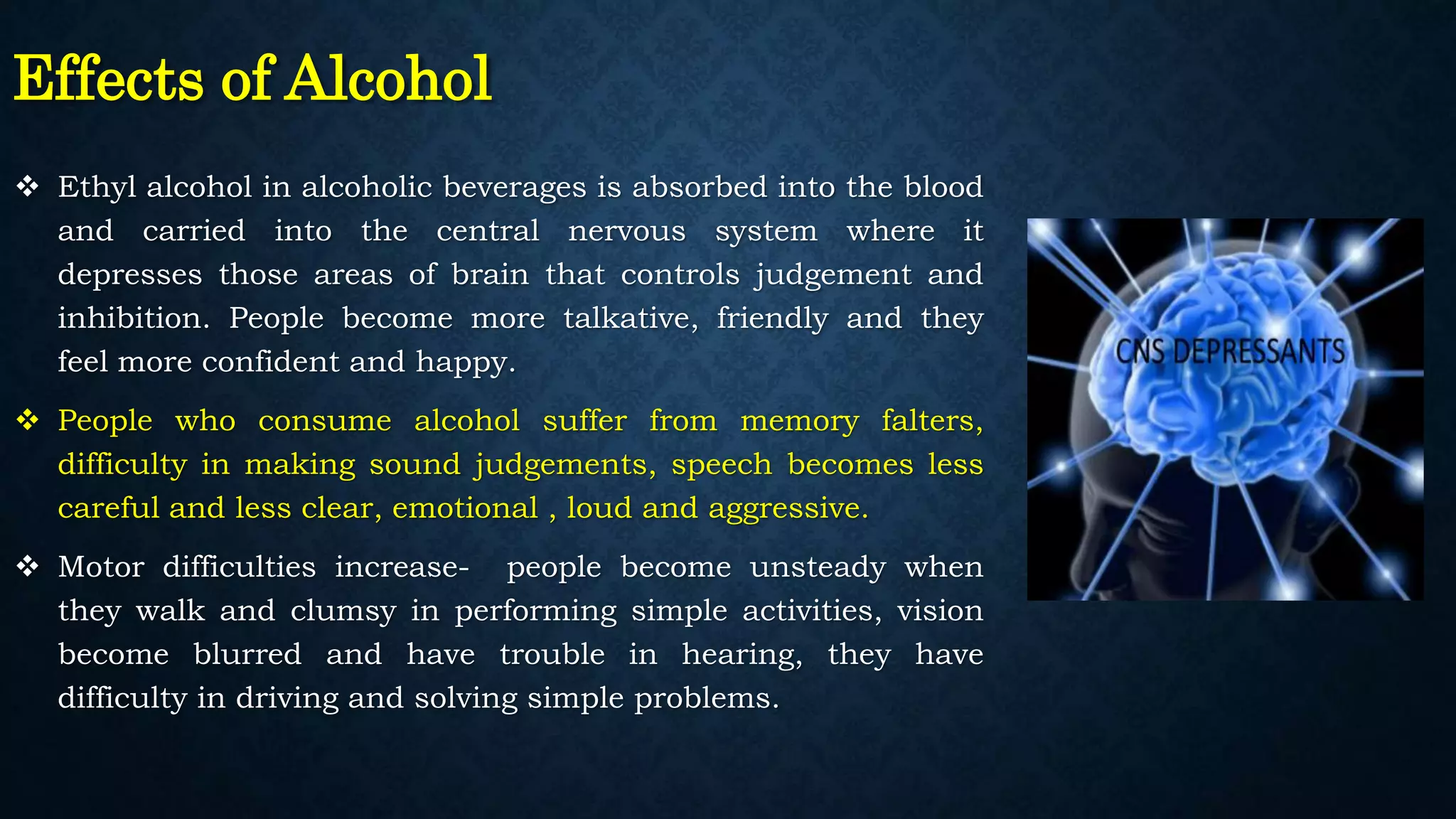
 Ethyl alcohol in alcoholic beverages is absorbed into the blood
and carried into the central nervous system where it
depresses those areas of brain that controls judgement and
inhibition. People become more talkative, friendly and they
feel more confident and happy.
 People who consume alcohol suffer from memory falters,
difficulty in making sound judgements, speech becomes less
careful and less clear, emotional , loud and aggressive.
 Motor difficulties increase- people become unsteady when
they walk and clumsy in performing simple activities, vision
become blurred and have trouble in hearing, they have
difficulty in driving and solving simple problems.
Heroin
 Heroin intake significantly interferes with
social and occupational functioning
 Most abusers further develop a dependence on
heroin, revolving their lives around the
substance, building up a tolerance for it and
experiencing a withdrawal reaction when they
stop taking it.
 The most direct dangerof heroin abuse is an
overdose, which slows down the respiratory
centers in the brain almost paralysing
breathing and in many cases death
Cocaine
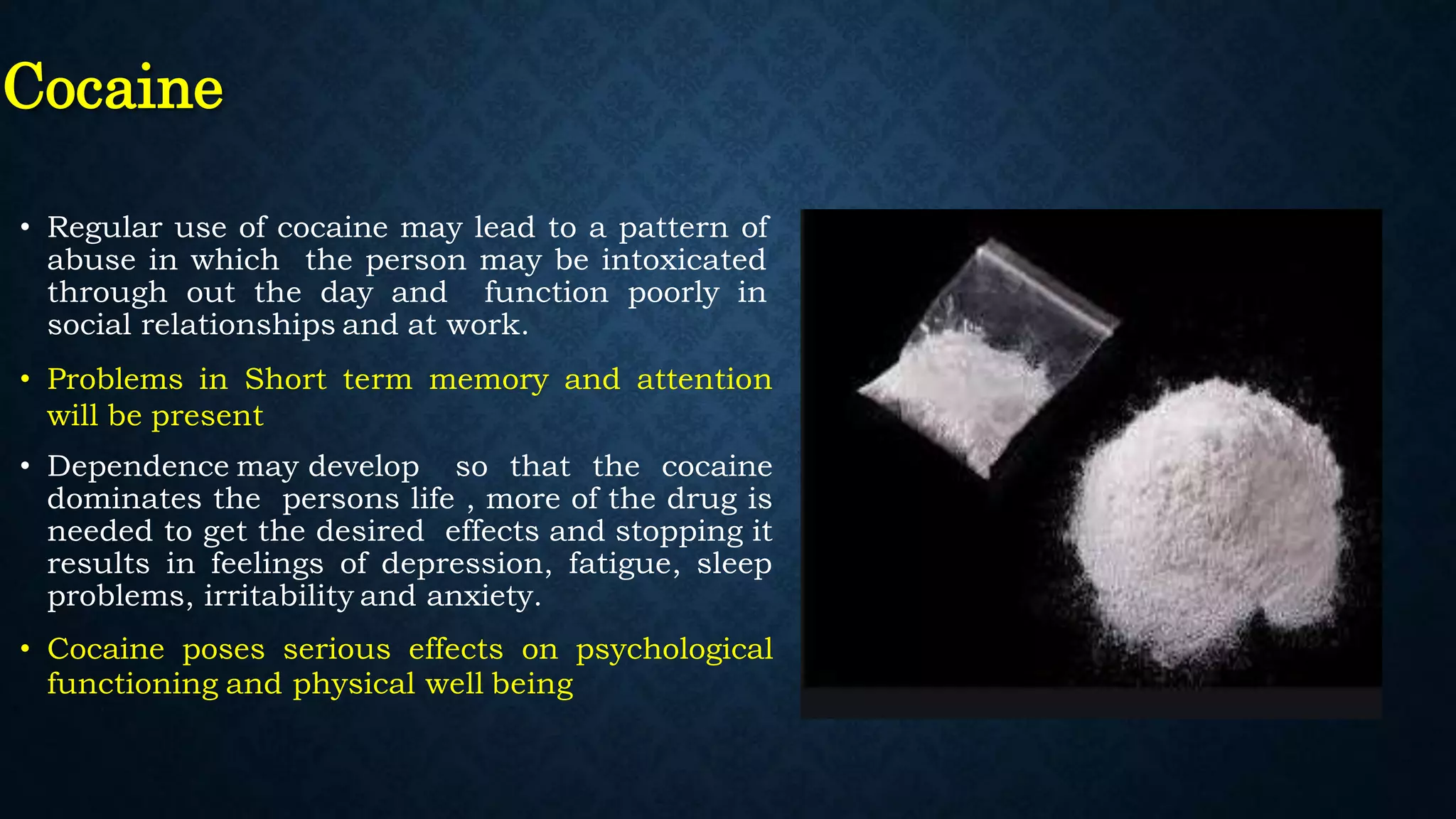
• Regular use of cocaine may lead to a pattern of
abuse in which the person may be intoxicated
through out the day and function poorly in
social relationships and at work.
• Problems in Short term memory and attention
will be present
• Dependence may develop so that the cocaine
dominates the persons life , more of the drug is
needed to get the desired effects and stopping it
results in feelings of depression, fatigue, sleep
problems, irritability and anxiety.
• Cocaine poses serious effects on psychological
functioning and physical well being
“MentalIllnessisnotaCHOICEButRECOVERYis”

Chapter 4 psychological disorders-final-30.05.2021

  • 1.
    Chapter 4 : PsychologicalDisorders Mrs. Navarathina Devakumar, M.Phil (Psy) CBSE Class XII
  • 3.
    Classification of PsychologicalDisorders 1. Anxiety Disorders 2. Obsessive- Compulsive And Related Disorders 3. Trauma And Stressor- Related Disorders 4. Somatic Symptom And Related Disorders 5. Dissociative Disorders 6. Depressive Disorders 7. Bipolar And Related Disorders 8. Schizophrenia Spectrum And Other Psychotic Disorders 9. Neurodevelopmental Disorders 10. Disruptive, Impulse -Control And Conduct Disorders 11. Feeding and eating Disorders 12. Substance- Related And Addictive Disorders
  • 4.
    1. Anxiety Disorders Anxiety is defined as a diffuse, vague, very unpleasant feeling of fear and apprehension.  Symptoms:  Rapid heart rate  Shortness of breath  Diarrhoea and loss of appetite  Fainting and dizziness  Sleeplessness  Sweating and tremors  Frequent urination  Anxiety disorders are the most commonest psychological disorders
  • 5.
    Types Of AnxietyDisorders Generalized Anxiety Disorder Panic Disorder Separation Anxiety Disorder Phobia
  • 6.
    Generalised Anxiety Disorders It consists of a prolonged, vague, unexplained and intense fears that are not attached to any object  Symptoms  Worry and apprehensive feelings about the future  Hypervigilance which involves constantly scanning the environment for danger  It is marked by motor tension as a result of which the person is unable to relax  Restless, tense and visibly shaky
  • 7.
    Panic Disorder  Panicattack denotes an abrupt surge of intense anxiety rising to a peak when thoughts of a particular stimuli are present. Such thoughts occur in an unpredictable manner  It consists of recurrent anxiety attacks in which a person experiences intense terror  Symptoms  Shortness of breath  Dizziness and trembling  Palpitations  Nauseated  Chest pain or discomfort  Fear of going crazy  Losing control or dying PANIC ATTACK
  • 8.
    Phobias  Irrational fearsrelated to specific objects, people or situations  Phobias often develop gradually or begin with a generalised anxiety disorder
  • 9.
    Types of Phobia SpecificPhobia • Most commonly occurring phobia. • This group includes irrational fears such as intense fear of a certain type of animal or being in an enclosed space Social Phobia/ Social anxiety disorder • Intense and incapacitating fear and embarrassment when dealing with others characterises social anxiety disorder Agoraphobia • When people develop a fear of entering unfamiliar situations. • Many people with agoraphobia are afraid of leaving their home. • So their ability to carry out normal life activities is severely limited
  • 10.
    Separation Anxiety Disorder Individuals with this disorder are fearful and anxious about separation from attachment figures to an extent that is developmentally not appropriate  Symptoms in children  Difficulty being in a room by themselves  Going to school alone  Fearful of entering new situations  Cling to and shadow their parents every move  To avoid separation children with SAD may fuss, scream, throw severe tantrums or make suicidal gestures
  • 11.
    2. Obsessive Compulsive& Related Disorders  People affected by OCD are unable to control their preoccupation with specific ideas or are unable to prevent themselves from repeatedly carrying out a particular act or series of acts that affect their ability to carry out normal activities  Obsessive behaviour  The inability to stop thinking about a particular idea ortopic  The person involved, often finds these thoughts to be unpleasant and shameful  Compulsive behaviour  The need to perform certain behaviours over and over again  Many compulsions deal with counting, ordering, checking, touching and washing  Other disorders int his category include Hoarding disorder, Trichotillomania- Hair pulling disorder  Excoriation – Skin picking disorder
  • 12.
    3. Trauma &Stressor Related Disorders  Post Traumatic Disorder  People who have been caught in a natural disaster ( such as tsunami, earthquakes) or have been victims of bomb blasts by terrorists or war related situations or met with a serious accident experience post-traumatic stress disorder.  Symptoms  Recurrent dreams  Flashbacks  Impaired concentration and emotional numbing  Adjustment disorders and acute stress disorders are included in this category
  • 13.
    4. Somatic Symptom& Related Disorders  These are conditions in which there are physical symptoms in the absence of a physical disease  Individuals have psychological difficulties and complaints of physical symptoms with no biological cause  Types of Somatic Symptoms Disorder Somatic Symptom Disorder Illness Anxiety Disorder Conversion Disorder
  • 14.
     The personexperiences body related symptoms which may or may not be related to any serious medical condition  People with this disorder are  Overly preoccupied with their symptoms  Continually worry about the health and make frequent doctor visits  As a result they experience significant distress and disturbances in their daily life  Expression is in terms of physical illness Somatic Symptom Disorder
  • 15.
     It involvespersistent preoccupation about developing a serious illness and constantly worrying about this possibility  Expression is in terms of anxiety which is in the main concern  Overly concerned about the undiagnosed disease, negative diagnostic results, do not respond to assurance by doctors and easily alarmed about illness such as hearing about someone else's ill health or such news Illness Anxiety Disorder
  • 16.
    Conversion Disorders  Theperson suffers from a loss or impairment of motor or sensory function (paralysis, blindness etc) that has no physical cause but may be a response to stress and psychological problems  Paralysis  Blindness  Deafness &  Difficulty in walking are generally reported among the symptoms
  • 17.
    Dissociative Disorders  Dissociation: It can be viewed as severance of the connections between ideas and emotions  Symptoms : feelings of unreality, estrangement, depersonalisation and sometimes a loss of shift of identity  Dissociative disorders: Sudden temporary alternations in consciousness that blot out painful experiences are a defining characteristic of dissociative disorders Dissociative Amnesia Depersonalisation Disorder Dissociative Identity Disorder
  • 18.
     It ischaracterised by extensive but selective memory loss that has no organic cause ( headinjury)  Some people cannot remember anything about their past. Others can no longer recall specific events, people, places or objects while their memory for other events remain intact. A part of dissociative amnesia is dissociative fugue  Essential feature of this could be an unexpected travel away from home and workplace. The assumption of a new identity and the inability to recall the previous identity  The fugue usually ends when the person suddenly wakes up with no memory of the events that occurred during the fugue. Types of Dissociative Disorders Dissociative Amnesia Dissociative Fugue Unexpected travel away home and assuming a new identity
  • 19.
     It isreferred to as multiple personality and the most dramatic of the dissociative disorders  In this disorder, the person assumes alternate personalities that may or may not be aware of each other. It is often associated with traumatic experience of the childhood  It involves a dreamlike state in which the person has a sense of being separated both from self and from the reality  In depersonalisation ,there is a change of self perception and the persons sense of reality is temporarily lost or changed Dissociative Identity Disorder Depersonalisation/ Derealisation Disorder Person assumes alternate personalities Types of Dissociative Disorders
  • 20.
    6. Depressive Disorders MajorDepression Disorder  Major depressive disorder is defined as a period of depression mood or loss of interest or pleasure in most activities together with other symptoms like  Change in body weight  Constant sleep problems  Tiredness  Inability to think clearly  Agitation  Greatly slower behaviour  Thoughts of death and suicide  Excessive guilt or feelings of worthlessness
  • 21.
    Factors Predisposing TowardsDepression  Genetic make up or heredity is an important risk factor for major depression  Age: women are particularly at risk during young adulthood while men are at highest risk in early middle age  Gender: women in comparison to men are more likely to report a depressive disorder  Negative life events and lack of social support GENDER HEREDIT Y NEGATIVE LIFE EVENTS
  • 22.
    7. Bipolar andRelated Disorders  Bipolar 1 disorder involves both mania and depression, which alternatively present and sometimes interrupted by periods of normal mood.  Bipolar disorders were earlier referred as manic- depressive disorders. Depression Mania Depression Mania Depressed Mood Euphoric Mood Loss of Energy & Fatigue Hyper Activity Poverty of Speech Excessively Talkative Negative Self Concept Inflated Self Esteem Highly Pessimistic Highly Optimistic
  • 23.
    Suicide  Suicide refersto act of intentionally killing oneself.  Suicide occurs as a result of complex interface of biological, genetic, psychological, sociological, cultural and environmental factors  Suicide warning signs  Exhibits drastic changes in behavior  Withdraws from friends or social activities  Loses interest in school, work or hobbies  Trouble with eating or sleeping  Preoccupied with death and dying  Gives away prized possessions  Increased intake of alcohol or drugs  Previous suicidal attempt is an important risk factor
  • 24.
    Suicide Prevention  Suicidesare preventable. improving identification, referral and management of behaviours are crucial.  We need to identify vulnerability, comprehend the circumstances leading to such behaviour and accordingly plan interventions  Measures suggested by WHO : 1.Limiting access to the means of suicide 2. Reporting of suicide in media in a responsible way 3.Bringing in alcohol related policies 4. Early identification, treatment and carer of risk 5.Training health workers in assessing and managing for suicide 6.Care for people who attempted suicide and providing community support
  • 25.
    8. Schizophrenia Spectrumand other Psychotic Disorders  Schizophrenia is the descriptive term for a group of psychotic disorders in which personal, social and occupational functioning deteriorate as a result of disturbed thought process, strange perceptions, unusual emotional states and motor abnormalities.  The symptoms of schizophrenia can be grouped into 3 categories A. Positive symptoms -excesses of thought emotion and behavior. Delusion, disorganized thinking and speech, heightened perception, hallucinations and inappropriate affect B. Negative symptoms- deficits of thought, emotion and behavior. Poverty of speech, blunted and flat affect , loss of volition and social withdrawal. C. Psychomotor symptoms Positive symptoms Negative symptoms Psychomotor symptoms
  • 26.
    A. Positive Symptomsof Schizophrenia  Delusion:  A delusion is a false belief that is firmly held on inadequate grounds . It is not affected by rational argument and has no basis in the reality  Types Of Delusion 1) Delusion of Persecution : People with this delusion believe that they are being plotted against, spied on, slandered, threatened, attacked or deliberately victimized. 2) Delusion of Reference : In these delusions people attach special and personal meaning to actions of others or to the objects and events 3) Delusion of Grandeur : people believe themselves to be specially empowered beings 4) Delusion of Control : people believe that their feelings , thoughts and actions are controlled by others Delusion of Grandeur Delusion of Persecution
  • 27.
    Schizophrenia  Formal thoughtdisorders include  Rapidly shifting from one topic to another so that the normal structure of thinking is muddled and become illogical ( loosening of association andderailment)  Neologism-inventing new words or phrases  Perseveration- persistent and inappropriate repetition of the same thoughts Inappropriate repetition of same thoughts
  • 28.
    Types of Hallucination HALLUCINATION : Perception that occur in the absence of external stimuli  TYPES OF HALLUCINATION: 1) Auditory Hallucination:  Most common in schizophrenia. Patients hear sounds or voices that speak words, phrases and sentences directly to the patient ( second –person hallucination)  Talk to one another referring to the patient ( third – person hallucination) 2) Tactile Hallucinations: Forms of tingling , burning 3) Somatic Hallucination: Something happening inside the body such as snake crawling inside ones stomach 4) Visual Hallucination: Vague perceptions of colour or distinctvisions of people or objects 5) Gustatory Hallucination: Food or drink tastes strange 6) Olfactory Hallucination: Smell of poison or smoke
  • 29.
    Types of Hallucination VISUALHALLUCINATION AUDITORY HALLUCINATION TACTILE HALLUCINATION OLFACTORY HALLUCINATION
  • 30.
    Negative Symptoms ofSchizophrenia Negative Symptoms Are Pathological Deficits which includes poverty of speech, Blunted and flat affect, Loss of volition and Social withdrawal 1. Alogia : Poverty of speech that is reduction in speech and speech content 2.Blunted Affect: Some show less anger, sadness, joy and other feelings than most people do 3.Flat Affect :A condition in which they show no emotions 4.Avolition : Apathy and an inability to start or complete a course of action 5.Social withdrawal : People with this disorder socially withdraw and become totally focussed on their own ideas and fantasies
  • 31.
    Psychomotor Symptoms ofSchizophrenia Catatonic Rigidity CATATONIA : They move less spontaneously or make odd grimaces and gestures. These symptoms may take extreme forms called catatonia. CATATONIC STUPOR : people remain motionless and silent for long stretches of time CATATONIC RIGIDITY : maintaining a rigid, upright postures for hours CATATONIC POSTURING : assuming awkward, bizarre position for hours Catatonic posturing
  • 32.
    9.Neurodevelopmental Disorders • Acommon feature of the neurodevelopmental disorders is that they manifest in the early stage of development • Often the symptoms appear before the child enters school or during the early stage of schooling • These disorders result in hampering personal, social , academic and occupational functioning • Types : Attention deficit hyperactive disorder Autism spectrum disorder Intellectual disability Specific Learning Disorder
  • 33.
    Attention Deficit HyperactiveDisorder The main features of ADHD are inattention, hyperactivity and impulsive Inattention:  Children who are inattentive find it difficult to sustain mental effort during a work or play.. They have a hard time keeping their minds on any one thing or following instructions  Symptoms  Child does not listen and cannot concentrate  Disorganised  Easily distracted and forgetful  Does not finish assignments  Quick to lose interest in boring activities
  • 34.
    Attention Deficit HyperactiveDisorder (ADHD)  HYPERACTIVITY  Children with ADHD are in constant motion. Parents and teachers describe them as " driven by a motor “  Talks incessantly  The child may fidget, squirm, climb and run around the room aimlessly  Sitting still through a lesson is impossible forthem  IMPULSIVE  Children who are impulsive seem unable to control their immediate reactions or think before they act. Common complaints are  They find difficult to wait or take turns  Difficulty resisting immediate temptations or delaying gratification  Minor mishaps, knocking things over and sometimes serious accidents or injuries can occur
  • 35.
    Autism Spectrum Disorder It is characterised by widespread impairments in social interaction and communication skills and stereotyped patterns of behaviour , interestsand activities  Symptoms  Have marked difficulties in social interaction and communication across different contexts  Restricted range of interests  Strong desire for routine  70percent of children have intellectual disability  Experience profound difficulties in relating to others  Unable to initiate social behaviour and seem unresponsive to other peoples feelings  Have difficulty in sharing experiences or emotions with others
  • 36.
    Autism Spectrum Disorder They show serious abnormalities in communication and language that persist over time  Some of them do not develop speech and have repetitive and deviant speech patterns  Autism children show narrow patterns of interests and repetitive behaviours such as lining up of objects or stereotyped body movements such as rocking  Motor movements may be self stimulatory such as hand flapping or self injurioussuch as head banging against the wall.  Due to difficulties in verbal and nonverbal communication they tend to have difficulties in starting, maintaining and even understanding relationships. Hand Flapping Lining up of objects
  • 37.
    Intellectual Disability Refers tobelow average intellectual functioning ( IQ of 70 or below) and deficits or impairments in adaptive behaviour in the areas of communication, self café, home living, social/ interpersonal skills, functional academic skills, work etc. which are manifested before the age of 18 years
  • 38.
    Characteristics of Individualswith Different Levels of Intellectual Disability Areas of functioning Mild ( IQ = 55 to 70 ) Moderate ( IQ= 35-50 to approximately 50-55) Severe ( IQ= 20-25 approximately 35-50) Profound IQ below 20-25 Self- help Skills Feeds and dresses self and cares for own toilet needs Requires training but can learn self- help skills No skills, but some can care for personal needs on limited basis Speech and Communication Receptive and expressive language is adequate, understands communication Receptive and expressive language is adequate but has speech problems Receptive language is limited; expressive language is poor Academics Optimal learning environment: third to sixth grade Few academic skills: first or second grade maximum No academic skills Social Skills Has friends , can learn to adjust quickly Capable of making friends has difficulty in social situations Not capable of social interactions Vocational Adjustment Can hold job –unskilled work Can work in sheltered work environment under supervision Generally no employment Adult Living Usually marries, has children . No marriage, dependent No marriage completely dependent
  • 39.
    Specific Learning Disorder Individuals experience difficulty in perceiving or processing information efficiently and accurately  It gets manifested during early school years and the individual encounters problems in basic skills in reading, writing or mathematics  The affected child tends to perform below average for his/ her age  However with additional inputs and efforts the individuals will be able to reach acceptable performance levels  Specific learning disorder is likely to impair functioning and performance in activities / occupations dependant on related skills
  • 40.
    10. Disruptive, Impulse-Controland Conduct Disorder  The disorders included under the category are 1) Oppositional defiant disorder 2) Conduct disorder 1) Oppositional Defiant Disorder:  Children with ODD display age inappropriate amounts of stubbornness, irritable , defiant, disobedient and behave in a hostile manner  Individuals with ODD will not see themselves as angry, oppositional or defiant and often justify their behaviour as reactions to circumstances or demands  The symptoms of the disorder become entangled with the problematic interactions with others Oppositional Defiant Disorder
  • 41.
    2) Conduct disordersand antisocial behaviour refer to age inappropriate actions and attitudes that violate family expectation societal norms and the personal or property rights of others  Symptoms of Conduct Disorder:  Aggressive actions that cause or threaten harm to people or animals  Non aggressive conduct that causes property damage  Major deceitfulness or theft and serious rule violations  Different types of aggressive behaviour shown by Children:  Verbal aggression- name calling, swearing  Physical aggression- hitting, fighting  Hostile aggression- directed at inflicting injury to others  Proactive aggression- dominating and bullying others without provocation 10. Disruptive, Impulse-Control and Conduct Disorder
  • 42.
    11. Feeding AndEating Disorders Disorders included in this category are  Anorexia nervosa  Bulimia nervosa  Binge eating  Anorexia Nervosa:  The individual has a distorted body image that leads him/her to see herself as overweight  Symptoms:  Refusing to eat  Exercising compulsively  Developing unusual habits such as refusing to eat in front of others  Starve to death  Person with anorexia may loose large amounts of weight ANOREXIA NERVOSA
  • 43.
     Bulimia Nervosa: The individual may eat excessive amounts of food, then purge the food by using medicines such as laxatives or diuretics or by vomiting  The person often feels disgusted and ashamed when he/she binges and is relieved of tension and negative emotions afterpurging  Binge Eating :  In this condition there are frequent episodes of out of control eating  The individual tends to eat at a higher speed than normal and continuous eating till she feels uncomfortably full  Large amounts of food may be eaten even when the individual is not hungry 11. Feeding And Eating Disorders
  • 44.
    12. Substance-Related andAddictive Disorders  Disorders related to maladaptive behaviours resulting from regular and consistent use of the substance involved are included under substance related and addictive disorders  These disorders include problems associated with the use and abuse of alcohol, cocaine, tobacco and opioids among others , which alter the way people think, feel and behave  Commonly abused substances ( DSM- 5 )  Alcohol  Stimulants : Cocaine, Dextroamphetimines  Caffeine : Coffee, Tea, Analgesics, Chocolate, Cocoa  Cannabis : Marijuana  Hallucinogens : LSD  Opioid : Morphine, Heroin  Tobacco : Cigarettes, Bidi
  • 45.
    Alcohol  People whoabuse alcohol drink large amounts regularly and rely on it to help them face difficult situations.  Eventually, drinking interferes with their social behaviour and ability to think & work  Tolerance : Their bodies build up a tolerance for alcohol and they need to drink even greater amounts to feel its effects  Withdrawal : they also experience withdrawal symptoms when they stop drinking alcoholism affects families, social relationships and careers and intoxicated drivers are responsible for road accidents  Children of persons with this disorder suffer from psychological disorders such as anxiety, depression, phobias, and substance abuse disorders  Excessive drinking results in serious damage to physical health
  • 46.
    Effects of Alcohol Ethyl alcohol in alcoholic beverages is absorbed into the blood and carried into the central nervous system where it depresses those areas of brain that controls judgement and inhibition. People become more talkative, friendly and they feel more confident and happy.  People who consume alcohol suffer from memory falters, difficulty in making sound judgements, speech becomes less careful and less clear, emotional , loud and aggressive.  Motor difficulties increase- people become unsteady when they walk and clumsy in performing simple activities, vision become blurred and have trouble in hearing, they have difficulty in driving and solving simple problems.
  • 47.
    Heroin  Heroin intakesignificantly interferes with social and occupational functioning  Most abusers further develop a dependence on heroin, revolving their lives around the substance, building up a tolerance for it and experiencing a withdrawal reaction when they stop taking it.  The most direct dangerof heroin abuse is an overdose, which slows down the respiratory centers in the brain almost paralysing breathing and in many cases death
  • 48.
    Cocaine • Regular useof cocaine may lead to a pattern of abuse in which the person may be intoxicated through out the day and function poorly in social relationships and at work. • Problems in Short term memory and attention will be present • Dependence may develop so that the cocaine dominates the persons life , more of the drug is needed to get the desired effects and stopping it results in feelings of depression, fatigue, sleep problems, irritability and anxiety. • Cocaine poses serious effects on psychological functioning and physical well being
  • 49.