A behavior that is deviant,
maladaptive, or personally distressful
over a relatively long period of time.
Deviant- statistically unusual
Maladaptive- interferes a person’s
ability to function effectively in the
world.
Personally distressful- something
troubling a person in a long period of
time.
Biological Approach- attributes psychological
disorders to organic, internal causes.
Focuses on the brain, genetic factors as
sources of abnormality.
Psychological Approach- emphasizes the
contributions of experiences, thoughts, and
emotions, & personality characteristics in
explaining disorders.
Sociocultural Approach- emphasizes
the social context such as individual’s
gender, ethnicity, socioeconomic status
, family relationship, culture
Biopsychosocial Model – abnormal
behavior can be influenced by
biological (genes), psychological
(childhood experiences), sociocultural
(gender).
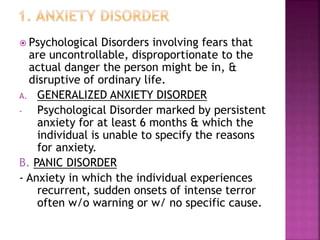
 Psychological Disorders involving fears that
are uncontrollable, disproportionate to the
actual danger the person might be in, &
disruptive of ordinary life.
A. GENERALIZED ANXIETY DISORDER
- Psychological Disorder marked by persistent
anxiety for at least 6 months & which the
individual is unable to specify the reasons
for anxiety.
B. PANIC DISORDER
- Anxiety in which the individual experiences
recurrent, sudden onsets of intense terror
often w/o warning or w/ no specific cause.
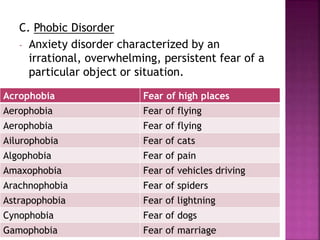
C. Phobic Disorder
- Anxiety disorder characterized by an
irrational, overwhelming, persistent fear of a
particular object or situation.
Acrophobia Fear of high places
Aerophobia Fear of flying
Ailurophobia Fear of cats
Algophobia Fear of pain
Amaxophobia Fear of vehicles driving
Arachnophobia Fear of spiders
Astrapophobia Fear of lightning
Cynophobia Fear of dogs
Gamophobia Fear of marriage
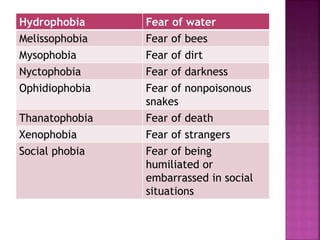
Hydrophobia Fear of water
Melissophobia Fear of bees
Mysophobia Fear of dirt
Nyctophobia Fear of darkness
Ophidiophobia Fear of nonpoisonous
snakes
Thanatophobia Fear of death
Xenophobia Fear of strangers
Social phobia Fear of being
humiliated or
embarrassed in social
situations
D. Obsessive-compulsive disorder (OCD)
-anxiety disorder w/c the individual has
anxiety-provoking thoughts that will not go
away and/ or urges to perform repetitive,
ritualistic behaviors to prevent or produce
some future situation.
Obsession- recurrent thoughts
Compulsions-recurrent behaviors
E. Post- traumatic Stress Disorder (PTSD)
- Develops through exposure to a traumatic
event that has overwhelmed the person’s
abilities to cope.
Psychological Disorders in which there is a primary
disturbance of mood- which colors the entire
emotional state of a person.
a. Depressive Disorder
a mood disorder in which the individual suffers
from depression- ruthless lack of pleasure in
life.
Major types:
Major Depressive Disorder (MDD)
Dysthymic Disorder (DD)
b. Bipolar Disorder
- Mood disorder characterized by extreme
mood swings that include one or more
episodes of mania, an overexcited,
unrealistically optimistic state.
 Involve a sudden loss of memory or change in
identity due to the dissociation (separation)
of the individual’s conscious awareness from
previous memories and thoughts.
a. Dissociative Amnesia
- Characterized by extreme memory loss that
is caused by extensive psychological stress.
b. Dissociative Fugue
- The individual not only develops amnesia but
also unexpectedly travels away from home
and sometimes assumes new identity.
c. Dissociative Identity Disorder (DID)
- Formerly called multiple personality disorder,
a disorder in which individual has two or
more distinct personalities or identities,
each with its own memories, behaviors, and
relationships.
- Each identity has its own memories,
behaviors, and relationships.
Schizophrenia is a chronic and severe brain
disorder.
It is a disease that makes it difficult for a
person to tell the difference between real
and unreal experiences, to think logically,
to have appropriate emotional responses
to others, aspects of memory and to act
appropriately in social situations.
Positive symptoms are characterized by abnormal
thoughts, perceptions, language and behavior.
 Delusions: False beliefs/thoughts win no basis in reality
 Hallucinations: Disturbances of sensory perception
(hearing, seeing or feeling things not there)
 Disorganized Thinking/Speech: Jumping from topic to
topic, responding to questions with unrelated answers or
speaking incoherently
 Disorganized Behavior:Problems in performing directed
daily activities.
 Catatonic Behavior: Lowered environmental awareness,
unresponsiveness, rigid posture, resistance to movement or
instructions and inappropriate postures.
Negative symptoms are characterized by
restrictions in range and intensity of
emotional expression, communication, body
language and interest in normal activities.
Blunted (or flat) Affect: Decreased emotional
expressiveness, unresponsive immobile facial appearance,
reduced eye contact and body language.
Alogia: Reduced speech. Responses are detached and
speech is not fluid.
Avolition: Lacking motivation, spontaneity, initiative.
Sitting for lengthy periods or ceasing to participate in work
or daily activities.
Anhedonia: Lacking Pleasure or interest in activities
that were once enjoyable.
Attention Deficit: Difficulty in concentrating
 Chronic, maladaptive cognitive-behavioral
pattern that are thoroughly integrated into an
individual’s personality.
a. Antisocial Personality Disorder (ASPD)
- Psychological disorder characterized by
guiltlessness, law-breaking, exploitation of
others, irresponsibility, and deceit.
b. Borderline Personality Disorder (BDP)
- Psychological disorder characterized by a
pervasive pattern of instability in interpersonal
relationships, self-image, and emotions, and of
marked impulsivity beginning by early adulthood
& present in a variety of context.
Also called biomedical medical
therapies, treatments that reduce or
eliminate the symptoms of
psychological disorders by altering
aspects of the body functioning.
This is commonly used in treating
anxiety disorder, depressive
disorders, and psychotic disorders.
Electroconvulsive Therapy (ECT)-
also known as shock therapy,
which uses drugs in treating
disorders.
Psychosurgery – involves removal
or destruction of the brain tissue
to improve the individual’s
adjustment.
 A nonmedical process that helps individuals
with psychological disorders recognize and
overcome their problems.
a) Psychoanalysis
b) Client-centered Therapy
c) Behavior Therapy
d) Cognitive Therapy
e) Group Therapy

Psychological disorders

  • 2.
    A behavior thatis deviant, maladaptive, or personally distressful over a relatively long period of time. Deviant- statistically unusual Maladaptive- interferes a person’s ability to function effectively in the world. Personally distressful- something troubling a person in a long period of time.
  • 3.
    Biological Approach- attributespsychological disorders to organic, internal causes. Focuses on the brain, genetic factors as sources of abnormality. Psychological Approach- emphasizes the contributions of experiences, thoughts, and emotions, & personality characteristics in explaining disorders.
  • 4.
    Sociocultural Approach- emphasizes thesocial context such as individual’s gender, ethnicity, socioeconomic status , family relationship, culture Biopsychosocial Model – abnormal behavior can be influenced by biological (genes), psychological (childhood experiences), sociocultural (gender).
  • 6.
     Psychological Disordersinvolving fears that are uncontrollable, disproportionate to the actual danger the person might be in, & disruptive of ordinary life. A. GENERALIZED ANXIETY DISORDER - Psychological Disorder marked by persistent anxiety for at least 6 months & which the individual is unable to specify the reasons for anxiety. B. PANIC DISORDER - Anxiety in which the individual experiences recurrent, sudden onsets of intense terror often w/o warning or w/ no specific cause.
  • 7.
    C. Phobic Disorder -Anxiety disorder characterized by an irrational, overwhelming, persistent fear of a particular object or situation. Acrophobia Fear of high places Aerophobia Fear of flying Aerophobia Fear of flying Ailurophobia Fear of cats Algophobia Fear of pain Amaxophobia Fear of vehicles driving Arachnophobia Fear of spiders Astrapophobia Fear of lightning Cynophobia Fear of dogs Gamophobia Fear of marriage
  • 8.
    Hydrophobia Fear ofwater Melissophobia Fear of bees Mysophobia Fear of dirt Nyctophobia Fear of darkness Ophidiophobia Fear of nonpoisonous snakes Thanatophobia Fear of death Xenophobia Fear of strangers Social phobia Fear of being humiliated or embarrassed in social situations
  • 9.
    D. Obsessive-compulsive disorder(OCD) -anxiety disorder w/c the individual has anxiety-provoking thoughts that will not go away and/ or urges to perform repetitive, ritualistic behaviors to prevent or produce some future situation. Obsession- recurrent thoughts Compulsions-recurrent behaviors E. Post- traumatic Stress Disorder (PTSD) - Develops through exposure to a traumatic event that has overwhelmed the person’s abilities to cope.
  • 10.
    Psychological Disorders inwhich there is a primary disturbance of mood- which colors the entire emotional state of a person. a. Depressive Disorder a mood disorder in which the individual suffers from depression- ruthless lack of pleasure in life. Major types: Major Depressive Disorder (MDD) Dysthymic Disorder (DD)
  • 11.
    b. Bipolar Disorder -Mood disorder characterized by extreme mood swings that include one or more episodes of mania, an overexcited, unrealistically optimistic state.
  • 12.
     Involve asudden loss of memory or change in identity due to the dissociation (separation) of the individual’s conscious awareness from previous memories and thoughts. a. Dissociative Amnesia - Characterized by extreme memory loss that is caused by extensive psychological stress. b. Dissociative Fugue - The individual not only develops amnesia but also unexpectedly travels away from home and sometimes assumes new identity.
  • 13.
    c. Dissociative IdentityDisorder (DID) - Formerly called multiple personality disorder, a disorder in which individual has two or more distinct personalities or identities, each with its own memories, behaviors, and relationships. - Each identity has its own memories, behaviors, and relationships.
  • 14.
    Schizophrenia is achronic and severe brain disorder. It is a disease that makes it difficult for a person to tell the difference between real and unreal experiences, to think logically, to have appropriate emotional responses to others, aspects of memory and to act appropriately in social situations.
  • 15.
    Positive symptoms arecharacterized by abnormal thoughts, perceptions, language and behavior.  Delusions: False beliefs/thoughts win no basis in reality  Hallucinations: Disturbances of sensory perception (hearing, seeing or feeling things not there)  Disorganized Thinking/Speech: Jumping from topic to topic, responding to questions with unrelated answers or speaking incoherently  Disorganized Behavior:Problems in performing directed daily activities.  Catatonic Behavior: Lowered environmental awareness, unresponsiveness, rigid posture, resistance to movement or instructions and inappropriate postures.
  • 16.
    Negative symptoms arecharacterized by restrictions in range and intensity of emotional expression, communication, body language and interest in normal activities. Blunted (or flat) Affect: Decreased emotional expressiveness, unresponsive immobile facial appearance, reduced eye contact and body language. Alogia: Reduced speech. Responses are detached and speech is not fluid. Avolition: Lacking motivation, spontaneity, initiative. Sitting for lengthy periods or ceasing to participate in work or daily activities. Anhedonia: Lacking Pleasure or interest in activities that were once enjoyable. Attention Deficit: Difficulty in concentrating
  • 17.
     Chronic, maladaptivecognitive-behavioral pattern that are thoroughly integrated into an individual’s personality. a. Antisocial Personality Disorder (ASPD) - Psychological disorder characterized by guiltlessness, law-breaking, exploitation of others, irresponsibility, and deceit. b. Borderline Personality Disorder (BDP) - Psychological disorder characterized by a pervasive pattern of instability in interpersonal relationships, self-image, and emotions, and of marked impulsivity beginning by early adulthood & present in a variety of context.
  • 19.
    Also called biomedicalmedical therapies, treatments that reduce or eliminate the symptoms of psychological disorders by altering aspects of the body functioning. This is commonly used in treating anxiety disorder, depressive disorders, and psychotic disorders.
  • 20.
    Electroconvulsive Therapy (ECT)- alsoknown as shock therapy, which uses drugs in treating disorders. Psychosurgery – involves removal or destruction of the brain tissue to improve the individual’s adjustment.
  • 21.
     A nonmedicalprocess that helps individuals with psychological disorders recognize and overcome their problems. a) Psychoanalysis b) Client-centered Therapy c) Behavior Therapy d) Cognitive Therapy e) Group Therapy