Perspectives on Psychological
            Disorders
• Society: Behavior is abnormal when it does not
  conform to the existing social order.
• Individual: One’s own sense of personal well-
  being determines normality.
• Mental-health professional: Personality and
  degree of personal discomfort and life functioning
  determine normality.
Approaches to Psychological
           Disorders
• biological model: Disorders have a
  biochemical or physiological basis.
• psychoanalytic model: Disorders result from
  unconscious internal conflicts.
• cognitive-behavioral model: Disorders result
  from learning maladaptive ways of thinking
  and behaving.
Approaches to Psychological
           Disorders
• diathesis-stress model: People biologically
  predisposed to a mental disorder (diathesis)
  will tend to exhibit that disorder when
  particularly affected by stress.
• systems approach: Biological,
  psychological, and social risk factors
  combine to produce disorders.
Diagnostic & Statistic Manual of
 Mental Disorders (4th edition)
• A publication of the American Psychiatric
  Association that classifies over 230
  psychological disorders into 16 categories.
• The most widely used classification of
  psychological disorders.
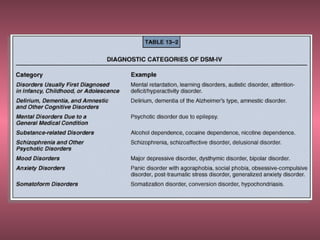
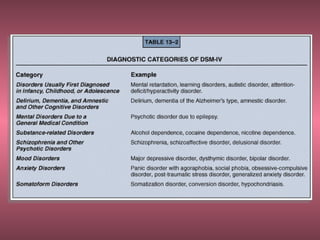
Diagnostic Categories of DSM-IV
Mood Disorders
Disturbances in mood or prolonged emotional
  state.
• depression
• mania
• bipolar disorder
Depression
• A mood disorder characterized by
  overwhelming feelings of sadness,
• lack of interest in activities,
• and perhaps excessive guilt or feelings of
  worthlessness.
Mania
• A mood disorder characterized by euphoric
  states,
• extreme physical activity,
• excessive talkativeness,
• distractedness,
• and sometimes grandiosity.
Bipolar Disorder
• A mood disorder in which periods of mania
  and depression alternate, sometimes with
  periods of normal mood intervening.
Causes of Mood Disorders
• Most psychologists now believe that mood
  disorders result from a combination of
• biological factors,
• psychological factors,
• and social factors.
Biological Factors
• Genetics appears to play a role in the
  development of mood disorders.
• The strongest evidence for the role of
  genetics comes from twin studies.
• Certain chemical imbalances in the brain
  have been linked to mood disorders.
Psychological Factors
• Cognitive distortions may lead to the
  development of mood disorders.
• cognitive distortions: An illogical and
  maladaptive response to early negative life
  events that leads to feelings of incompetence
  and unworthiness that are reactivated whenever
  a new situation arises that resembles the
  original events.
Types of Illogical Thinking
arbitrary inference
selective abstraction
overgeneralization
magnification and minimization
Social Factors
• Difficulties in interpersonal relationships
  may lead to mood disorders.
• The link between depression and troubled
  relationships may explain why women are
  more likely to suffer from depression--
  women tend to be more relationship-
  oriented than men.
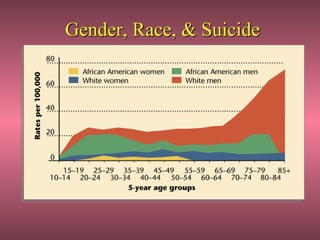
Gender, Race, & Suicide
Anxiety Disorders
Disorders in which anxiety is a characteristic feature
  or the avoidance of anxiety seems to motivate
  abnormal behavior.
• phobias
• panic disorder
• generalized anxiety disorder
• obsessive-compulsive disorder
Types of Phobias
• specific: intense, paralyzing fear of some object
  or thing
• social: excessive, inappropriate fears connected
  with social situations or performances in front of
  other people
• agoraphobia: involves multiple, intense fear of
  crowds, public places, and other situations that
  require separation from a source of security
Panic Disorder
• An anxiety disorder characterized by
  recurrent panic attacks.
• panic attack: A sudden, unpredictable, and
  overwhelming experience of intense fear or
  terror without any reasonable cause.
Generalized Anxiety Disorder
• An anxiety disorder characterized by
  prolonged vague but intense fears that are
  not attached to any particular object or
  circumstance.
Obsessive-Compulsive Disorder
• An anxiety disorder in which a person feels
  driven to think disturbing thoughts
  (obsessions) and/or to perform senseless
  rituals (compulsions).
Causes of Anxiety Disorders
• prepared responses: responses that
  evolution has made us biologically
  predisposed to acquire through learning
• not feeling in control of one’s life
• may be caused by an inherited
  predisposition
• internal psychological conflict
Psychosomatic vs. Somatoform
• psychosomatic: Disorders in which there is
  REAL physical illness that is largely caused
  by psychological factors such as stress and
  anxiety.
• somatoform: Disorders in which there is an
  APPARENT physical illness for which
  there is no organic basis.
Somatoform Disorders
•   somatization disorder
•   conversion disorder
•   hypochondriasis
•   body dysmorphic disorder
Somatization Disorder
• A somatoform disorder characterized
  by recurrent vague somatic complaints
  without a physical cause.
Conversion Disorder
• Somatoform disorders in which a dramatic
  specific disability has no physical cause but
  instead seems related to psychological
  problems.
Hypochondriasis
• A somatoform disorder in which a person
  interprets insignificant symptoms as signs
  of serious illness in the absence of any
  organic evidence of such illness.

Disorders

  • 1.
    Perspectives on Psychological Disorders • Society: Behavior is abnormal when it does not conform to the existing social order. • Individual: One’s own sense of personal well- being determines normality. • Mental-health professional: Personality and degree of personal discomfort and life functioning determine normality.
  • 2.
    Approaches to Psychological Disorders • biological model: Disorders have a biochemical or physiological basis. • psychoanalytic model: Disorders result from unconscious internal conflicts. • cognitive-behavioral model: Disorders result from learning maladaptive ways of thinking and behaving.
  • 3.
    Approaches to Psychological Disorders • diathesis-stress model: People biologically predisposed to a mental disorder (diathesis) will tend to exhibit that disorder when particularly affected by stress. • systems approach: Biological, psychological, and social risk factors combine to produce disorders.
  • 4.
    Diagnostic & StatisticManual of Mental Disorders (4th edition) • A publication of the American Psychiatric Association that classifies over 230 psychological disorders into 16 categories. • The most widely used classification of psychological disorders.
  • 5.
  • 6.
  • 7.
    Mood Disorders Disturbances inmood or prolonged emotional state. • depression • mania • bipolar disorder
  • 8.
    Depression • A mooddisorder characterized by overwhelming feelings of sadness, • lack of interest in activities, • and perhaps excessive guilt or feelings of worthlessness.
  • 9.
    Mania • A mooddisorder characterized by euphoric states, • extreme physical activity, • excessive talkativeness, • distractedness, • and sometimes grandiosity.
  • 10.
    Bipolar Disorder • Amood disorder in which periods of mania and depression alternate, sometimes with periods of normal mood intervening.
  • 11.
    Causes of MoodDisorders • Most psychologists now believe that mood disorders result from a combination of • biological factors, • psychological factors, • and social factors.
  • 12.
    Biological Factors • Geneticsappears to play a role in the development of mood disorders. • The strongest evidence for the role of genetics comes from twin studies. • Certain chemical imbalances in the brain have been linked to mood disorders.
  • 13.
    Psychological Factors • Cognitivedistortions may lead to the development of mood disorders. • cognitive distortions: An illogical and maladaptive response to early negative life events that leads to feelings of incompetence and unworthiness that are reactivated whenever a new situation arises that resembles the original events.
  • 14.
    Types of IllogicalThinking arbitrary inference selective abstraction overgeneralization magnification and minimization
  • 15.
    Social Factors • Difficultiesin interpersonal relationships may lead to mood disorders. • The link between depression and troubled relationships may explain why women are more likely to suffer from depression-- women tend to be more relationship- oriented than men.
  • 16.
  • 17.
    Anxiety Disorders Disorders inwhich anxiety is a characteristic feature or the avoidance of anxiety seems to motivate abnormal behavior. • phobias • panic disorder • generalized anxiety disorder • obsessive-compulsive disorder
  • 18.
    Types of Phobias •specific: intense, paralyzing fear of some object or thing • social: excessive, inappropriate fears connected with social situations or performances in front of other people • agoraphobia: involves multiple, intense fear of crowds, public places, and other situations that require separation from a source of security
  • 19.
    Panic Disorder • Ananxiety disorder characterized by recurrent panic attacks. • panic attack: A sudden, unpredictable, and overwhelming experience of intense fear or terror without any reasonable cause.
  • 20.
    Generalized Anxiety Disorder •An anxiety disorder characterized by prolonged vague but intense fears that are not attached to any particular object or circumstance.
  • 21.
    Obsessive-Compulsive Disorder • Ananxiety disorder in which a person feels driven to think disturbing thoughts (obsessions) and/or to perform senseless rituals (compulsions).
  • 22.
    Causes of AnxietyDisorders • prepared responses: responses that evolution has made us biologically predisposed to acquire through learning • not feeling in control of one’s life • may be caused by an inherited predisposition • internal psychological conflict
  • 23.
    Psychosomatic vs. Somatoform •psychosomatic: Disorders in which there is REAL physical illness that is largely caused by psychological factors such as stress and anxiety. • somatoform: Disorders in which there is an APPARENT physical illness for which there is no organic basis.
  • 24.
    Somatoform Disorders • somatization disorder • conversion disorder • hypochondriasis • body dysmorphic disorder
  • 25.
    Somatization Disorder • Asomatoform disorder characterized by recurrent vague somatic complaints without a physical cause.
  • 26.
    Conversion Disorder • Somatoformdisorders in which a dramatic specific disability has no physical cause but instead seems related to psychological problems.
  • 27.
    Hypochondriasis • A somatoformdisorder in which a person interprets insignificant symptoms as signs of serious illness in the absence of any organic evidence of such illness.