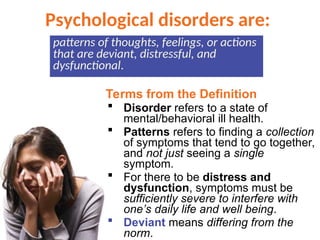
Psychological disorders are:
patternsof thoughts, feelings, or actions
that are deviant, distressful, and
dysfunctional.
Disorder refers to a state of
mental/behavioral ill health.
Patterns refers to finding a collection
of symptoms that tend to go together,
and not just seeing a single
symptom.
For there to be distress and
dysfunction, symptoms must be
sufficiently severe to interfere with
one’s daily life and well being.
Deviant means differing from the
norm.
Terms from the Definition
3.
Understanding the Natureof
Psychological Disorders
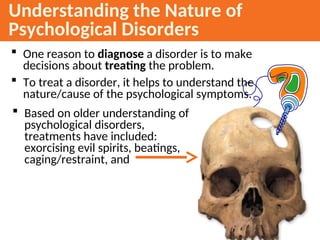
One reason to diagnose a disorder is to make
decisions about treating the problem.
To treat a disorder, it helps to understand the
nature/cause of the psychological symptoms.
Based on older understanding of
psychological disorders,
treatments have included:
exorcising evil spirits, beatings,
caging/restraint, and
4.
The Medical
Model
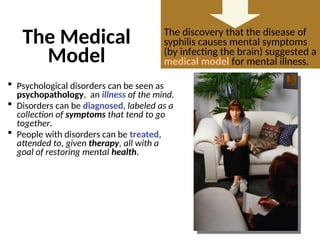
Psychologicaldisorders can be seen as
psychopathology, an illness of the mind.
Disorders can be diagnosed, labeled as a
collection of symptoms that tend to go
together.
People with disorders can be treated,
attended to, given therapy, all with a
goal of restoring mental health.
The discovery that the disease of
syphilis causes mental symptoms
(by infecting the brain) suggested a
medical model for mental illness.
5.
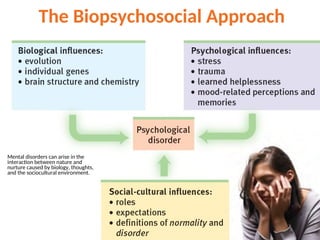
Mental disorders canarise in the
interaction between nature and
nurture caused by biology, thoughts,
and the sociocultural environment.
The Biopsychosocial Approach
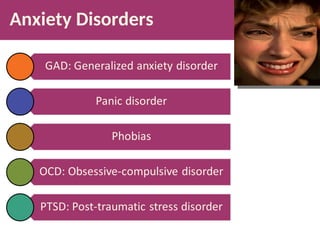
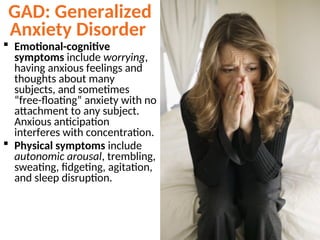
GAD: Generalized
Anxiety Disorder
Emotional-cognitive
symptoms include worrying,
having anxious feelings and
thoughts about many
subjects, and sometimes
“free-floating” anxiety with no
attachment to any subject.
Anxious anticipation
interferes with concentration.
Physical symptoms include
autonomic arousal, trembling,
sweating, fidgeting, agitation,
and sleep disruption.
9.
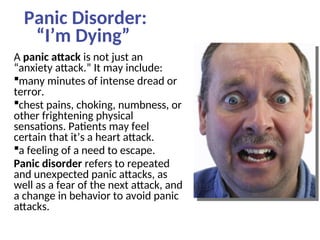
Panic Disorder:
“I’m Dying”
Apanic attack is not just an
“anxiety attack.” It may include:
many minutes of intense dread or
terror.
chest pains, choking, numbness, or
other frightening physical
sensations. Patients may feel
certain that it’s a heart attack.
a feeling of a need to escape.
Panic disorder refers to repeated
and unexpected panic attacks, as
well as a fear of the next attack, and
a change in behavior to avoid panic
attacks.
10.
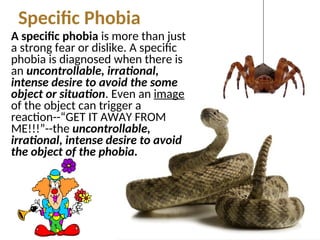
Specific Phobia
A specificphobia is more than just
a strong fear or dislike. A specific
phobia is diagnosed when there is
an uncontrollable, irrational,
intense desire to avoid the some
object or situation. Even an image
of the object can trigger a
reaction--“GET IT AWAY FROM
ME!!!”--the uncontrollable,
irrational, intense desire to avoid
the object of the phobia.
11.
Agoraphobia is the
avoidanceof situations in
which one will fear having a
panic attack, especially a
situation in which it is
difficult to get help, and from
which it difficult to escape.
Social phobia refers to an intense
fear of being watched and judged by
others. It is visible as a fear of public
appearances in which
embarrassment or humiliation is
possible, such as public speaking,
eating, or performing.
Some Other Phobias
12.
Obsessive-Compulsive Disorder [OCD]
Obsessions are intense, unwanted
worries, ideas, and images that
repeatedly pop up in the mind.
A compulsion is a repeatedly strong
feeling of “needing” to carry out an
action, even though it doesn’t feel
like it makes sense.
When is it a “disorder”?
Distress: when you are deeply
frustrated with not being able to
control the behaviors
or
Dysfunction: when the time and
mental energy spent on these
thoughts and behaviors interfere
with everyday life
13.
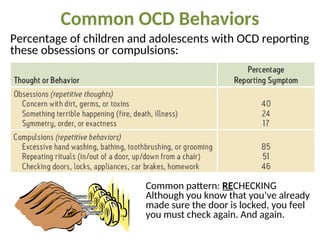
Common OCD Behaviors
Commonpattern: RECHECKING
Although you know that you’ve already
made sure the door is locked, you feel
you must check again. And again.
Percentage of children and adolescents with OCD reporting
these obsessions or compulsions:
14.
Post-Traumatic
Stress Disorder
[PTSD]
About 10to 35 percent of people who experience
trauma not only have burned-in memories, but
also four weeks to a lifetime of:
repeated intrusive recall of
those memories.
nightmares and other re-
experiencing.
social withdrawal or phobic
avoidance.
jumpy anxiety or
hypervigilance.
insomnia or sleep problems.
15.
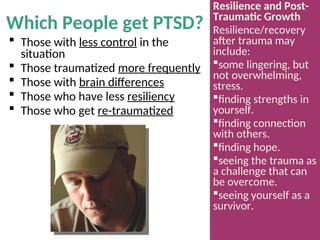
Which People getPTSD?
Those with less control in the
situation
Those traumatized more frequently
Those with brain differences
Those who have less resiliency
Those who get re-traumatized
Resilience and Post-
Traumatic Growth
Resilience/recovery
after trauma may
include:
some lingering, but
not overwhelming,
stress.
finding strengths in
yourself.
finding connection
with others.
finding hope.
seeing the trauma as
a challenge that can
be overcome.
seeing yourself as a
survivor.
16.
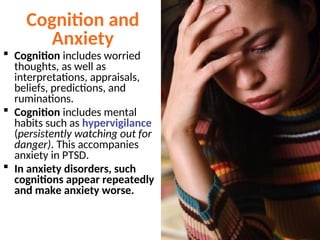
Cognition and
Anxiety
Cognitionincludes worried
thoughts, as well as
interpretations, appraisals,
beliefs, predictions, and
ruminations.
Cognition includes mental
habits such as hypervigilance
(persistently watching out for
danger). This accompanies
anxiety in PTSD.
In anxiety disorders, such
cognitions appear repeatedly
and make anxiety worse.
17.
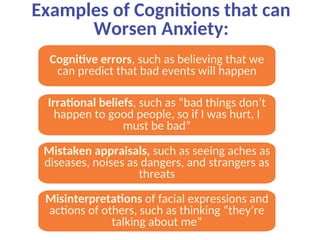
Examples of Cognitionsthat can
Worsen Anxiety:
Cognitive errors, such as believing that we
can predict that bad events will happen
Irrational beliefs, such as “bad things don’t
happen to good people, so if I was hurt, I
must be bad”
Mistaken appraisals, such as seeing aches as
diseases, noises as dangers, and strangers as
threats
Misinterpretations of facial expressions and
actions of others, such as thinking “they’re
talking about me”
18.
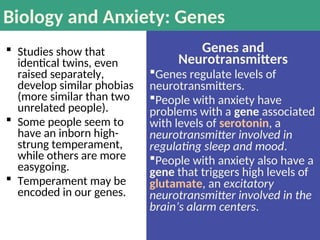
Biology and Anxiety:Genes
Studies show that
identical twins, even
raised separately,
develop similar phobias
(more similar than two
unrelated people).
Some people seem to
have an inborn high-
strung temperament,
while others are more
easygoing.
Temperament may be
encoded in our genes.
Genes and
Neurotransmitters
Genes regulate levels of
neurotransmitters.
People with anxiety have
problems with a gene associated
with levels of serotonin, a
neurotransmitter involved in
regulating sleep and mood.
People with anxiety also have a
gene that triggers high levels of
glutamate, an excitatory
neurotransmitter involved in the
brain’s alarm centers.
19.
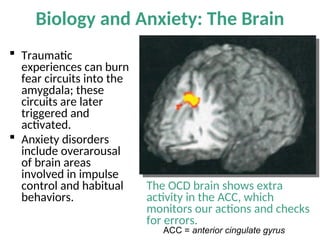
Biology and Anxiety:The Brain
Traumatic
experiences can burn
fear circuits into the
amygdala; these
circuits are later
triggered and
activated.
Anxiety disorders
include overarousal
of brain areas
involved in impulse
control and habitual
behaviors.
The OCD brain shows extra
activity in the ACC, which
monitors our actions and checks
for errors.
ACC = anterior cingulate gyrus
20.
Mood Disorders
Major depressivedisorder [MDD] is:
more than just feeling “down.”
more than just feeling sad
about something.
Bipolar disorder is:
more than “mood swings.”
depression plus the problematic
overly “up” mood called “mania.”
21.
Criteria of MajorDepressive Disorders
Depressed mood most of the day, and/or
Markedly diminished interest or pleasure in activities
Significant increase or decrease in appetite or weight
Insomnia, sleeping too much, or disrupted sleep
Lethargy, or physical agitation
Fatigue or loss of energy nearly every day
Worthlessness, or excessive/inappropriate guilt
Daily problems in thinking, concentrating, and/or
making decisions
Recurring thoughts of death and suicide
Major depressive disorder is not just one of these
symptoms.
It is one or both of the first two, PLUS three or more
of the rest.
22.
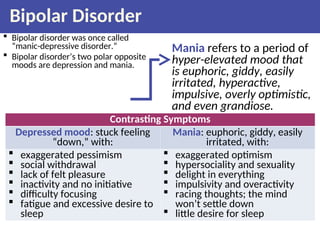
Bipolar Disorder
Bipolardisorder was once called
“manic-depressive disorder.”
Bipolar disorder’s two polar opposite
moods are depression and mania.
Mania refers to a period of
hyper-elevated mood that
is euphoric, giddy, easily
irritated, hyperactive,
impulsive, overly optimistic,
and even grandiose.
Contrasting Symptoms
Depressed mood: stuck feeling
“down,” with:
Mania: euphoric, giddy, easily
irritated, with:
exaggerated pessimism
social withdrawal
lack of felt pleasure
inactivity and no initiative
difficulty focusing
fatigue and excessive desire to
sleep
exaggerated optimism
hypersociality and sexuality
delight in everything
impulsivity and overactivity
racing thoughts; the mind
won’t settle down
little desire for sleep
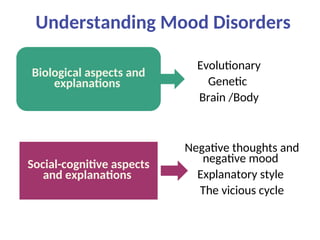
Understanding Mood Disorders
Biologicalaspects and
explanations
Social-cognitive aspects
and explanations
Evolutionary
Genetic
Brain /Body
Negative thoughts and
negative mood
Explanatory style
The vicious cycle
25.
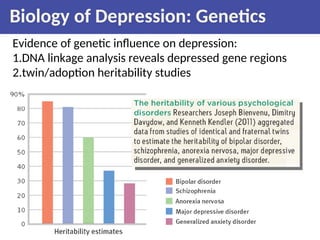
Biology of Depression:Genetics
Evidence of genetic influence on depression:
1.DNA linkage analysis reveals depressed gene regions
2.twin/adoption heritability studies
26.
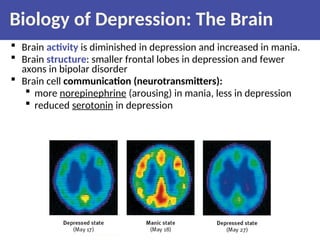
Biology of Depression:The Brain
Brain activity is diminished in depression and increased in mania.
Brain structure: smaller frontal lobes in depression and fewer
axons in bipolar disorder
Brain cell communication (neurotransmitters):
more norepinephrine (arousing) in mania, less in depression
reduced serotonin in depression
27.
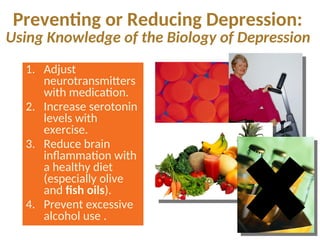
Preventing or ReducingDepression:
Using Knowledge of the Biology of Depression
1. Adjust
neurotransmitters
with medication.
2. Increase serotonin
levels with
exercise.
3. Reduce brain
inflammation with
a healthy diet
(especially olive
and fish oils).
4. Prevent excessive
alcohol use .
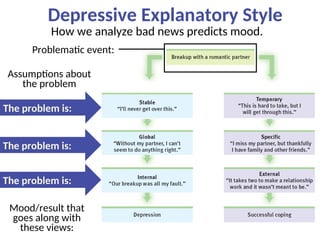
Depressive Explanatory Style
Mood/resultthat
goes along with
these views:
How we analyze bad news predicts mood.
Assumptions about
the problem
The problem is:
The problem is:
The problem is:
Problematic event:
30.
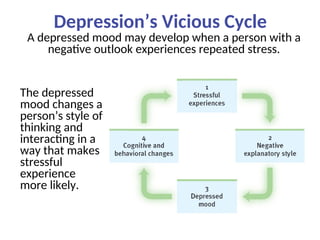
Depression’s Vicious Cycle
Adepressed mood may develop when a person with a
negative outlook experiences repeated stress.
The depressed
mood changes a
person’s style of
thinking and
interacting in a
way that makes
stressful
experience
more likely.
31.
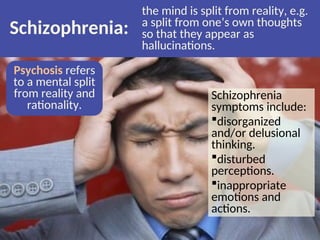
Schizophrenia:
the mind issplit from reality, e.g.
a split from one’s own thoughts
so that they appear as
hallucinations.
Psychosis refers
to a mental split
from reality and
rationality.
Schizophrenia
symptoms include:
disorganized
and/or delusional
thinking.
disturbed
perceptions.
inappropriate
emotions and
actions.
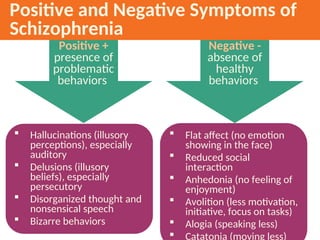
32.
Positive +
presence of
problematic
behaviors
Negative-
absence of
healthy
behaviors
Hallucinations (illusory
perceptions), especially
auditory
Delusions (illusory
beliefs), especially
persecutory
Disorganized thought and
nonsensical speech
Bizarre behaviors
Flat affect (no emotion
showing in the face)
Reduced social
interaction
Anhedonia (no feeling of
enjoyment)
Avolition (less motivation,
initiative, focus on tasks)
Alogia (speaking less)
Catatonia (moving less)
Positive and Negative Symptoms of
Schizophrenia
33.
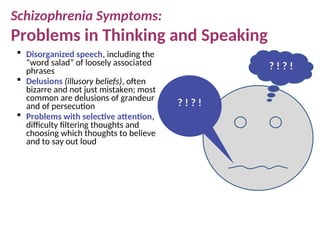
Schizophrenia Symptoms:
Problems inThinking and Speaking
Disorganized speech, including the
“word salad” of loosely associated
phrases
Delusions (illusory beliefs), often
bizarre and not just mistaken; most
common are delusions of grandeur
and of persecution
Problems with selective attention,
difficulty filtering thoughts and
choosing which thoughts to believe
and to say out loud
? ! ? !
? ! ? !
34.
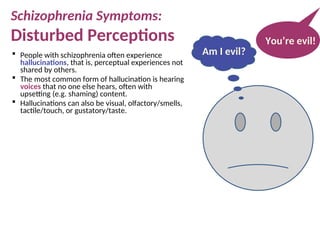
People withschizophrenia often experience
hallucinations, that is, perceptual experiences not
shared by others.
The most common form of hallucination is hearing
voices that no one else hears, often with
upsetting (e.g. shaming) content.
Hallucinations can also be visual, olfactory/smells,
tactile/touch, or gustatory/taste.
You’re evil!
Am I evil?
Schizophrenia Symptoms:
Disturbed Perceptions
35.
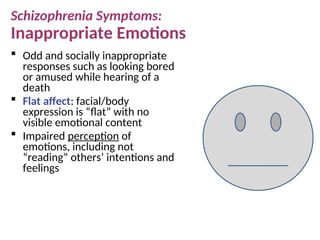
Odd andsocially inappropriate
responses such as looking bored
or amused while hearing of a
death
Flat affect: facial/body
expression is “flat” with no
visible emotional content
Impaired perception of
emotions, including not
“reading” others’ intentions and
feelings
Schizophrenia Symptoms:
Inappropriate Emotions
36.
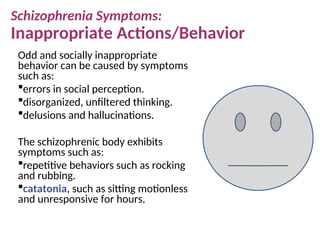
Odd and sociallyinappropriate
behavior can be caused by symptoms
such as:
errors in social perception.
disorganized, unfiltered thinking.
delusions and hallucinations.
The schizophrenic body exhibits
symptoms such as:
repetitive behaviors such as rocking
and rubbing.
catatonia, such as sitting motionless
and unresponsive for hours.
Schizophrenia Symptoms:
Inappropriate Actions/Behavior
37.
Onset and
Development of
Schizophrenia
Onset: Typically, schizophrenic symptoms
appear at the end of adolescence and in
early adulthood, later for women than for
men.
Prevalence: Nearly 1 in 100 people develop
schizophrenia, slightly more men than
women.
Development: The course of schizophrenia
can be acute/reactive or chronic.
Course of
Schizophrenia
Acute/Reactive Schizophrenia
In reaction to stress, some
people develop positive
symptoms such as
hallucinations.
– Recovery is likely.
Chronic/Process Schizophrenia
develops slowly, with more
negative symptoms such as flat
affect and social withdrawal.
– With treatment and
support, there may be
periods of a normal life,
but not a cure.
– Without treatment, this
type of schizophrenia
often leads to poverty and
social problems.
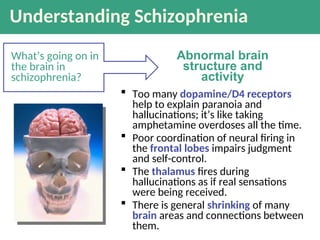
What’s going onin
the brain in
schizophrenia?
Too many dopamine/D4 receptors
help to explain paranoia and
hallucinations; it’s like taking
amphetamine overdoses all the time.
Poor coordination of neural firing in
the frontal lobes impairs judgment
and self-control.
The thalamus fires during
hallucinations as if real sensations
were being received.
There is general shrinking of many
brain areas and connections between
them.
Abnormal brain
structure and
activity
Understanding Schizophrenia
40.
Understanding Schizophrenia
Are therebiological risk factors
affecting early development?
low birth weight
maternal diabetes
older paternal age
famine
oxygen deprivation during delivery
maternal virus during mid-pregnancy
impairing brain development
Biological Risk Factors
Schizophrenia is more
likely to develop in
babies born:
during and after flu
epidemics.
in densely populated
areas.
a few months after flu
season.
after mothers had the
flu during the second
trimester, or had
antibodies showing
viral infection.
The lesson is to:
Schizophrenia is somewhat more
likely to develop when one or more of
these factors is present:
get flu shots
with early fall
pregnancies.
41.
Understanding Schizophrenia
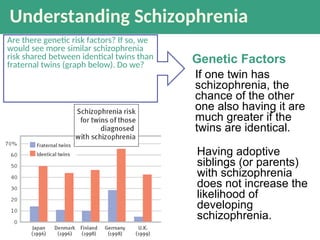
Are theregenetic risk factors? If so, we
would see more similar schizophrenia
risk shared between identical twins than
fraternal twins (graph below). Do we?
Having adoptive
siblings (or parents)
with schizophrenia
does not increase the
likelihood of
developing
schizophrenia.
Genetic Factors
If one twin has
schizophrenia, the
chance of the other
one also having it are
much greater if the
twins are identical.
42.
Are there
psychological
causes?
Researchdoes not support the idea
that social or psychological factors
(such as parenting) alone can cause
schizophrenia.
However, there may be factors such
as stress that affect the onset of
schizophrenia.
Until we find a mechanism of
causation, all we may have is a list of
factors which correlate with
increased risk.
Social-
Psychological
Factors
Understanding Schizophrenia
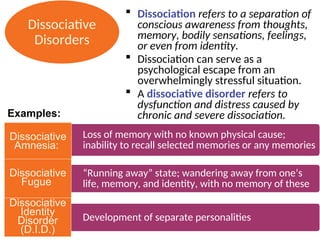
Dissociation refersto a separation of
conscious awareness from thoughts,
memory, bodily sensations, feelings,
or even from identity.
Dissociation can serve as a
psychological escape from an
overwhelmingly stressful situation.
A dissociative disorder refers to
dysfunction and distress caused by
chronic and severe dissociation.
Dissociative
Disorders
Loss of memory with no known physical cause;
inability to recall selected memories or any memories
“Running away” state; wandering away from one’s
life, memory, and identity, with no memory of these
Development of separate personalities
Dissociative
Amnesia:
Dissociative
Fugue
Dissociative
Identity
Disorder
(D.I.D.)
Examples:
45.
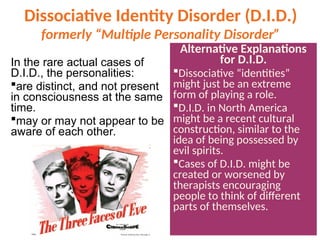
Dissociative Identity Disorder(D.I.D.)
formerly “Multiple Personality Disorder”
In the rare actual cases of
D.I.D., the personalities:
are distinct, and not present
in consciousness at the same
time.
may or may not appear to be
aware of each other.
Alternative Explanations
for D.I.D.
Dissociative “identities”
might just be an extreme
form of playing a role.
D.I.D. in North America
might be a recent cultural
construction, similar to the
idea of being possessed by
evil spirits.
Cases of D.I.D. might be
created or worsened by
therapists encouraging
people to think of different
parts of themselves.
46.
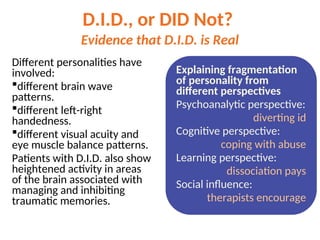
D.I.D., or DIDNot?
Evidence that D.I.D. is Real
Different personalities have
involved:
different brain wave
patterns.
different left-right
handedness.
different visual acuity and
eye muscle balance patterns.
Patients with D.I.D. also show
heightened activity in areas
of the brain associated with
managing and inhibiting
traumatic memories.
Explaining fragmentation
of personality from
different perspectives
Psychoanalytic perspective:
diverting id
Cognitive perspective:
coping with abuse
Learning perspective:
dissociation pays
Social influence:
therapists encourage
47.
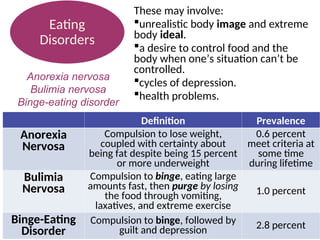
Definition Prevalence
Anorexia
Nervosa
Compulsion tolose weight,
coupled with certainty about
being fat despite being 15 percent
or more underweight
0.6 percent
meet criteria at
some time
during lifetime
Bulimia
Nervosa
Compulsion to binge, eating large
amounts fast, then purge by losing
the food through vomiting,
laxatives, and extreme exercise
1.0 percent
Binge-Eating
Disorder
Compulsion to binge, followed by
guilt and depression 2.8 percent
These may involve:
unrealistic body image and extreme
body ideal.
a desire to control food and the
body when one’s situation can’t be
controlled.
cycles of depression.
health problems.
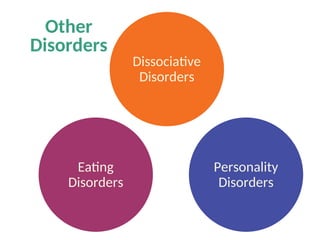
Eating
Disorders
Anorexia nervosa
Bulimia nervosa
Binge-eating disorder
48.
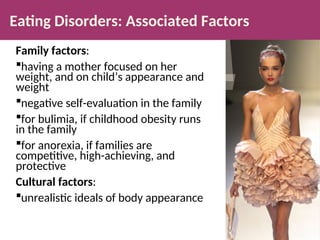
Eating Disorders: AssociatedFactors
Family factors:
having a mother focused on her
weight, and on child’s appearance and
weight
negative self-evaluation in the family
for bulimia, if childhood obesity runs
in the family
for anorexia, if families are
competitive, high-achieving, and
protective
Cultural factors:
unrealistic ideals of body appearance
49.
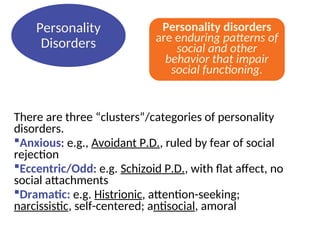
Personality disorders
are enduringpatterns of
social and other
behavior that impair
social functioning.
There are three “clusters”/categories of personality
disorders.
Anxious: e.g., Avoidant P.D., ruled by fear of social
rejection
Eccentric/Odd: e.g. Schizoid P.D., with flat affect, no
social attachments
Dramatic: e.g. Histrionic, attention-seeking;
narcissistic, self-centered; antisocial, amoral
Personality
Disorders
50.
Antisocial Personality Disorder[APD]
Antisocial personality
disorder refers to acting
impulsively or fearlessly
without regard for
others’ needs and
feelings.
The diagnostic criteria
include a pattern of
violating the rights of
others since age 15,
including three of these:
Deceitfulness
Disregard for safety of self or
others
Aggressiveness
Failure to conform to social
norms
Lack of remorse
Impulsivity and failure to plan
ahead
Irritability
Irresponsibility regarding jobs,
family, and money
#2 Click to reveal bullets.
The term “disorder” is used instead of “disease” because the latter term typically implies a known cause of the symptoms. In naming a disorder, you’re not naming a cause such as a virus. Instead, you are naming the collection of symptoms that tend to go together.
More on the issue of pattern vs. single symptom: one of the symptoms of brain cancer is a headache. If you have a headache, though, it would be a mistake to assume that you have brain cancer. Similarly, one of the symptoms of major depression may be that you feel sad. If you feel sad, though, this is not enough to qualify for diagnosis of major depressive disorder. Keep this in mind when we discuss ADHD.
More about deviance coming up. Another common term is “ abnormal,” which more literally means varying from the norm. Both of these terms have acquired an unnecessarily negative connotation outside the field of psychology.
Image from the text.
#3 Click to reveal bullets.
The term for drilling holes in the skull to release evil spirits is “trephination.”
When you click the drill will bounce and to demonstrate the old medical technique, although the equipment may be anachronistic.
#4 Click to reveal bullets.
The medical model also implies ideas about etiology, the cause of mental disorders. It is not always possible to determine the cause of a specific mental disorder, but in general, the assumption here is that the cause is physical and mental, and not spiritual.
#6 No animation.
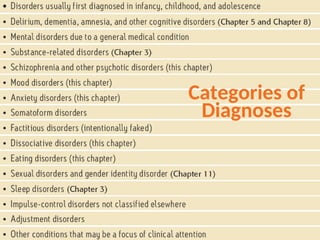
The text describes this table as a list of syndromes. However, this is a table of contents of the DSM, a list of the categories under which other diagnoses fall.
#8 Click to reveal bullets.
GAD tends to occur along with mild but persistent depression.
GAD becomes more rare after age 50. Why might that be? Perhaps experience shows that things usually don’t turn out as badly as those with Generalized Anxiety Disorder think they will.
#9 Click to reveal bullets.
Panic disorder includes the fight or flight system, and easy triggering of the autonomic nervous system.
In a panic attack, the mind fills in an explanation: “If I’m feeling terror and a physical response to a threat, there must be some danger here.” People sometimes attribute the panic to whatever situation was present when the attack occurred.
Extreme avoidance of possible panic triggers agoraphobia, an anxiety disorder characterized by anxiety in situations where the sufferer perceives the environment to be difficult or embarrassing to escape, such as wide-open spaces.
#10 Automatic animation.
“Irrational” means the fear and the avoidance compulsion are out of proportion to the actual threat (e.g. triggered by even a photograph) and the phobia occurs even when the person knows that the fear doesn’t make sense.
Some phobias may make evolutionary sense. More on this later, but in case you decide to delete the biological perspective slide, there are some fears more likely to form phobias. These seem to be part of our biological heritage to avoid (for example, clowns may trigger a fear of baboons and mandrills bred into our ancestors). People reasonably fear handguns, but are not likely to panic and run away from a mere photograph of a gun unless they had a personal traumatic experience with one. However, people fear heights, snakes and spiders with no previous bad experience with these, because those that didn’t fear these 100,000 years ago might have not lived to reproduce.
I suggest asking students, before viewing the next slide with its list of phobias and fears, about their own fears. You might ask, “is anyone getting an irrational fear reaction triggered by this slide?” and “do any of you have a fear that meets the criteria to be called a phobia?”
This diagnosis is known in the DSM as “specific phobia,” although agoraphobia is in a separate category because it is so closely and frequently associated with panic disorder. Social phobia is also a separate diagnosis.
#11 Click to reveal two additional phobias.
The number of people with the specific FEAR varies more widely than the number of people with that specific PHOBIA. This implies that what we are really seeing in the lighter color is the number of people prone to a phobic-level fear. Not clear why clowns were not part of the survey, since this is a phobia mentioned often in the popular culture and by Intro Psych students.
#12 Click to reveal bullets.
Why is OCD considered an anxiety disorder? Because obsessions can be a distraction from underlying anxiety, and compulsions worsen through a cycle of negative reinforcement related to anxiety. The OCD sufferer resists carrying out a compulsion, feels anxious, and ultimately relieves the anxiety by giving in to the compulsion.
#13 Click to show bottom text box and start animation.
Emphasize the concept of “again.” Doing one of these behaviors does not mean that you have OCD. You are more likely to get a higher level of distress or dysfunction when you keep having these thoughts or behaviors, even when it makes no sense to you and you want to stop, but feel too much anxiety when you try to stop the compulsions and feel that the obsessions are outside of your control.
#14 Click to reveal bullets.
Instructor: point out that PTSD is not just an outcome of war experience. Overwhelming trauma happens to people in all walks of life.
Why is PTSD classified as an anxiety disorder? The overall experience may look like spacey withdrawal and occasional jumpiness from the outside. However, inside there is tension, turmoil, worry, fear, dread, angst, stress, and re-living the feelings of the trauma itself, which is likely to be anxiety and related reactions to threat.
#15 Click to reveal bullets and sidebar.
Most people experiencing trauma do NOT develop PTSD.
Those with less control: sensing less of a chance to escape or change the situation.
Those traumatized more frequently refers to people with less chance to recover from stress and harm.
Those with brain differences such as a sensitive amygdala, or difficulty controlling attention.
Those who have fewer traits and behaviors of resiliency, such as finding mentors.
Those re-traumatized by intrusive debriefing.
“That which does not kill us makes us stronger.”-- Friedrich Nietzsche (1844-1900), not known popularly as a bright-eyed optimist.
#17 Click to reveal four examples.
Not mentioned in the book:
“what-if” questions/worries such as, “what if a truck crashed into this room?” These questions are not really seeking answers, but statements of worry.
Anxiety might serve a potential cognitive function to get our minds to do some planning to avoid threats. In the same way, cognitive therapy could involve getting anxiety to work that way, doing some planning for whatever threats are most pressing, and correcting the cognitive errors and unhelpful beliefs and anxiety-provoking interpretations and appraisals.
#18 Click to reveal bullets and sidebar.
Even if natural selection explains some things about humans as a whole, why are some people more prone to anxiety than others? Part of the answer is in a person’s experience, but part is in the genes.
This association with a serotonin-related gene may be why some people with worrying-style anxiety respond to the SSRIs which increase serotonin at the synapse.
A third major type of neurotransmitter involvement related to anxiety is GABA (gamma-aminobutyric acid), the inhibitory and “calming” neurotransmitter. GABA is not mentioned in this section of the text, probably because there is not a related gene that has been identified as being different in people with anxiety.
#21 Click to reveal bullets.
Diagnosing major depressive disorder, as with making other diagnoses, requires seeing the whole pattern rather than just one or two symptoms. Depression crosses the line into a disorder when it impairs daily functioning and/or causes significant distress.
With this list, the pattern is one or both of the first two symptoms and three to four of the rest of the symptoms, lasting more than two weeks.
The criteria related to weight loss does not include weight loss caused by deliberate dieting.
#22 Click to reveal bullets and table of contrasting symptoms.
A typical pattern is three to seven weeks of depression, followed by three to seven DAYS of mania. People enjoying their mania often forget or deny that the manic phase leads back into depression.
Like depression, this euphoria is self-sustaining; in mania, it’s not that you’re happy about something.
#25 No animation.
DNA linkage analysis shows that regions of chromosomes are similar across generations of people in depressed families Another genetic factor to mention here, though it doesn’t come up in the text until the discussion of neurotransmitters (p. 629): people with depression had a variation of a serotonin-controlling gene, although the text notes that this result may not be reliable.
Regarding the chart, see if students can recall the definition of heritability from the chapter on intelligence. Remind them that 80 percent heritability does NOT mean that genes are 80 percent of the cause of schizophrenia, as we shall soon see; it means that 80 percent of the variation among people is caused by genes.
#26 Click to reveal bullets.
Fewer axons, less white matter, and larger ventricles (fluid filled areas in the center of the brain) point to a problem in having different parts of the brain work together smoothly.
#27 Click to reveal bullets.
Some medications, such as Wellbutrin try to reduce depression by increasing norepinephrine; other medications, such as Prozac, Zoloft, and Celexa increase the availability of serotonin.
Exercise has other benefits related to depression.
This is the “Mediterranean” diet, although some people try to get the benefits of this diet by taking Omega 3 supplements.
Alcohol abuse its related not only to biological changes but also to problems in behavior and coping skills.
#28 Click to reveal bubbles.
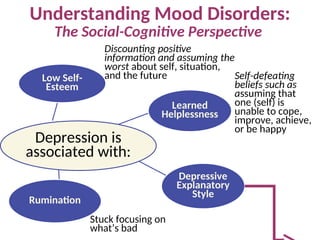
Discounting the positive: “You’re only spending time with me because you feel sorry for me.”
Depression is also associated with cognitive errors, such as assuming one can know the future or the thoughts of others.
#29 Click through to animate the chart.
This chart implies that the negative explanatory style leads to depression. However, as the next chart will show, depression makes it more likely to make cognitive problems such as this negative attributional style.
As Martin Seligman has suggested (quote in the text), depression can be caused by “preexisting pessimism encountering failure.”
#31 Click to reveal two more text boxes.
Literally, schizophrenia means “split mind,” but NOT split personality. The person who invented the term, Eugen Bleuler (1857-1939), spoke of a splintering of the functions governing thinking, perception, personality, and memory, although I would add emotion to that list. Most noticeable are the perceptual problems such as a split from REALITY.
#32 The column headings appear on click.
You can ask first, “which of these are negative symptoms?” Students have experienced this sense of the words “positive” and “negative” when talking about reinforcement, but it’s a difficult shift in word usage so it’s worth testing them on it here. Some of the symptoms, such as disorganized thought and catatonia, could arguably be placed in either column.
#34 Click to reveal bullets.
There is recent evidence that hallucinations in schizophrenia are caused in part because there is dysfunction in the parts of the brain that identify what is self vs. what is external. Thus, the fleeting ideas in the thought balloon might trigger, not just follow, the “heard” words about being evil.
#36 Click to reveal bullets.
See if students can picture an example of “crazy”/odd behavior; then picture the point of view of this person and try to imagine how the symptoms above could be part of the odd behavior. For example, someone with tactile hallucinations might keep rubbing and swatting a part of the body.
Instructor: you might remind students that the evolutionary perspective has difficulty with schizophrenia; it is unlikely that they helped our ancestors survive in any way."
#37 Click to reveal bullets.
“Course” means the development of symptoms over time.
Treatment can include not only medication but psychosocial rehabilitation, exercise, psychotherapy, supervised group homes, case management, daily living skills support, and vocational programs.
Without real treatment, institutionalization was once the norm, then homelessness and incarceration, now outpatient treatment and “partial hospitalization” (day treatment).
#38 No animation.
The previous slide showed two types of course: acute/reactive and chronic/process. This slide differentiates types of schizophrenia by the pattern of symptoms.
Paranoid schizophrenia is the most common and the most likely to be known to students. The symptoms go together as the individual experiences brain-generated perceptions that seem as real as sensory experiences. Often the delusions are an attempt to explain these hallucinations; “thoughts are being broadcast into my head so I must have a special power or role in the world.”
#39 Click to reveal bullets.
Students may need reminding that the thalamus was referred to earlier in the course as the sensory switchboard.
There is also abnormal amygdala functioning in schizophrenia, which could be a result of schizophrenia or could explain the hyper-sensitivity to threat that could feed into paranoid ideas and aggressive reactive behavior.
In addition to the shrinkage of the brain tissue, enlargement of the ventricles (fluid-filled areas within and between areas of tissue) can be seen.
#40 Click to reveal bullets.
Lesson: even if we do not know how the virus in the mother derails the fetus’s brain development, the statistical results here are enough of a warning. Get a flu inoculation (in the shot form, if you want to avoid nasal mist exposure to live-deactivated virus) if pregnancy will include flu season.
#41 Click to reveal bullets.
Questions to raise here: what does this tell us about the role of genes in schizophrenia? They must play some role, because having more genes in common means more similar likelihood of developing schizophrenia.
Preview of the next slide, or in place of it: why is the risk not identical for identical twins? It could be environmental factors. Or, it could be a difference beginning even sooner (not sharing a placenta).
#44 Click to reveal bullets.
Dissociation is related to “spacing out” but well beyond it. During a physical assault, people might try to separate themselves from bodily experience, which is functional at the time but can lead to problems in relating to one’s bodily memory and experience later.
Click to reveal examples.
Question for class: using this definition of dissociation, describe the process of dissociation going on in each of these disorders.
Answer: the person is dissociating 1) from memory, 2) from situation and identity, or 3) having dissociations within identity (or among parts of identity).
Another question you might ask before the next slide: “what is another, former name for Dissociative Identity Disorder?”
#45 Click to reveal bullets and sidebar.
“Identity” is another movie to explore on this topic; it portrays schizophrenia from the inside rather than from the outside.
A different way of looking at the cultural issue: could it be that cases of D.I.D. and demonic possession might be two different names for the same phenomenon?
#46 Click to reveal bullets and sidebar.
In apparently genuine cases of Dissociative Identity Disorder, the different personalities show differences that are hard to fake.
In the sidebar, you can prompt students with the hints to do the work guessing at what different perspectives might say.
#47 Click to reveal bullets, then table.
Health problems include malnutrition, shutdown of bodily functions and structures, and death.
“Nervosa” is a leftover term related to neurosis or what we would now call anxiety.
“Underweight,” like “overweight,” is determined by medical standards, and obviously not by the felt standards of those with anorexia.
#49 Click to reveal bullets.
A full list of the disorders in each category of the DSM, although the list is changing with the DSM-V:
Anxious Cluster: Avoidant, Dependent, and Obsessive-Compulsive Personality Disorder
Eccentric/Odd/Detached cluster: Schizoid, Schizotypal, and Paranoid Personality Disorders
Dramatic/Erratic/Impulsive cluster: Histrionic, Narcissistic, Antisocial, and Borderline Personality Disorders
![Obsessive-Compulsive Disorder [OCD]
Obsessions are intense, unwanted
worries, ideas, and images that
repeatedly pop up in the mind.
A compulsion is a repeatedly strong
feeling of “needing” to carry out an
action, even though it doesn’t feel
like it makes sense.
When is it a “disorder”?
Distress: when you are deeply
frustrated with not being able to
control the behaviors
or
Dysfunction: when the time and
mental energy spent on these
thoughts and behaviors interfere
with everyday life](https://image.slidesharecdn.com/psychologicaldisorders1-250429131450-1b660bd6/85/Psychological-Disorders-1-powerpoint-presentation-12-320.jpg)
![Post-Traumatic
Stress Disorder
[PTSD]
About 10 to 35 percent of people who experience
trauma not only have burned-in memories, but
also four weeks to a lifetime of:
repeated intrusive recall of
those memories.
nightmares and other re-
experiencing.
social withdrawal or phobic
avoidance.
jumpy anxiety or
hypervigilance.
insomnia or sleep problems.](https://image.slidesharecdn.com/psychologicaldisorders1-250429131450-1b660bd6/85/Psychological-Disorders-1-powerpoint-presentation-14-320.jpg)
![Mood Disorders
Major depressive disorder [MDD] is:
more than just feeling “down.”
more than just feeling sad
about something.
Bipolar disorder is:
more than “mood swings.”
depression plus the problematic
overly “up” mood called “mania.”](https://image.slidesharecdn.com/psychologicaldisorders1-250429131450-1b660bd6/85/Psychological-Disorders-1-powerpoint-presentation-20-320.jpg)
![Antisocial Personality Disorder [APD]
Antisocial personality
disorder refers to acting
impulsively or fearlessly
without regard for
others’ needs and
feelings.
The diagnostic criteria
include a pattern of
violating the rights of
others since age 15,
including three of these:
Deceitfulness
Disregard for safety of self or
others
Aggressiveness
Failure to conform to social
norms
Lack of remorse
Impulsivity and failure to plan
ahead
Irritability
Irresponsibility regarding jobs,
family, and money](https://image.slidesharecdn.com/psychologicaldisorders1-250429131450-1b660bd6/85/Psychological-Disorders-1-powerpoint-presentation-50-320.jpg)



![Patent ductus arteriosus [PDA], shane stanley.pptx](https://cdn.slidesharecdn.com/ss_thumbnails/patentductusarteriosuspdashanestanley-251016112835-ae3342d7-thumbnail.jpg?width=640&height=640&fit=bounds)


![ONFH[AVN HIP] -TRIPLE REGIME -A NOVAL SURGICAL CONCEPT .pptx](https://cdn.slidesharecdn.com/ss_thumbnails/onfhavnhip2026koaconcalicutdrgokuldevdrmashraf-260210064517-213ec005-thumbnail.jpg?width=640&height=640&fit=bounds)


