CH 12: Psychopathology
1
➔Schizophrenia
➔Mood Disorders
➔Anxiety & Related Disorders
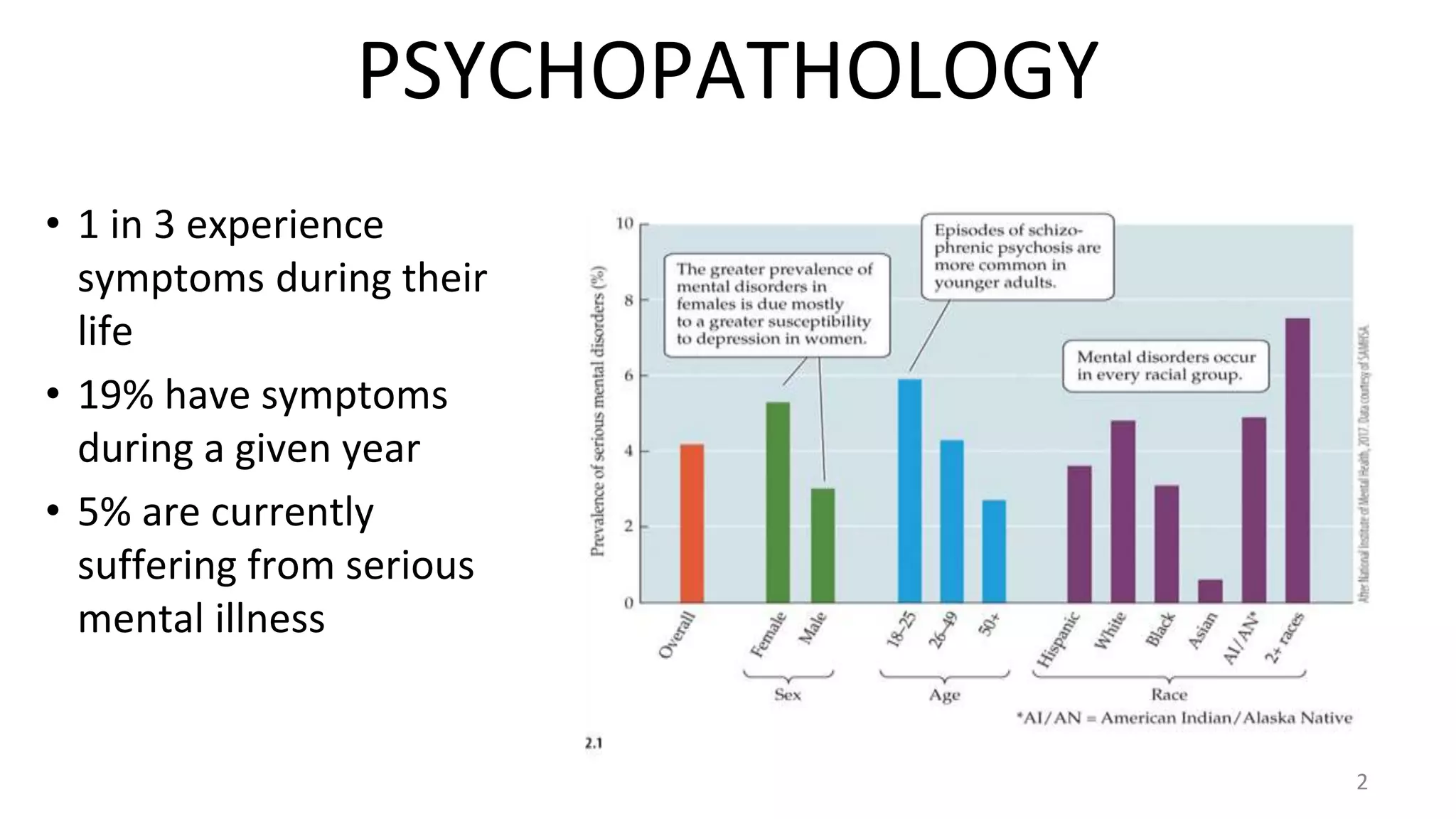
PSYCHOPATHOLOGY
• 1 in 3 experience
symptoms during their
life
• 19% have symptoms
during a given year
• 5% are currently
suffering from serious
mental illness
2
• Historically
believed to be a
result of weak
will, demonic
possession, or
misbehavior
3
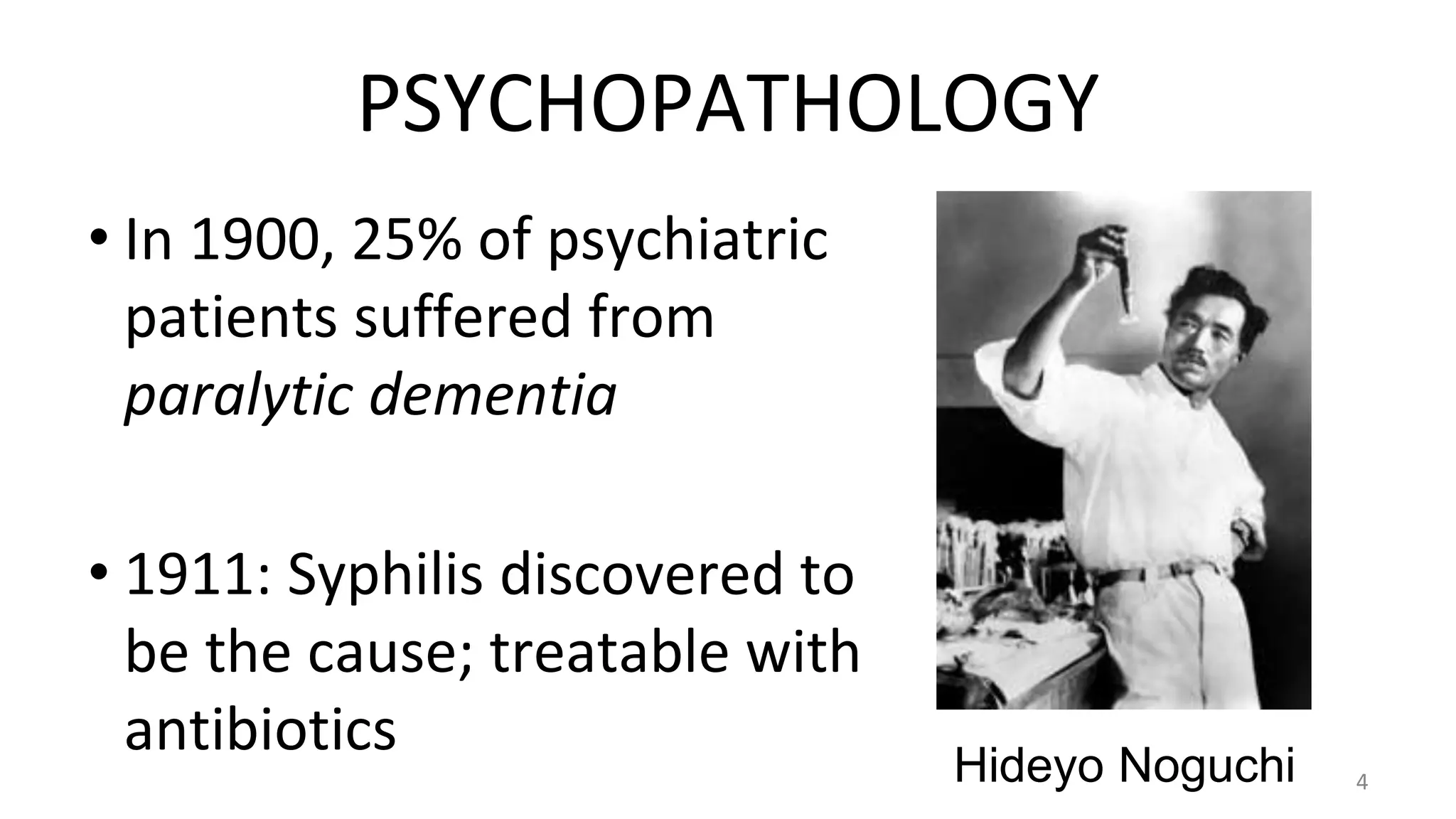
PSYCHOPATHOLOGY
• In 1900, 25% of psychiatric
patients suffered from
paralytic dementia
• 1911: Syphilis discovered to
be the cause; treatable with
antibiotics
4
Hideyo Noguchi
SCHIZOPHRENIA
SCHIZOPHRENIA: a disordered state with unusual symptoms
5
SCHIZOPHRENIA
SCHIZOPHRENIA: a disordered state with unusual symptoms
6
SCHIZOPHRENIA
SCHIZOPHRENIA: a disordered state with unusual symptoms
7
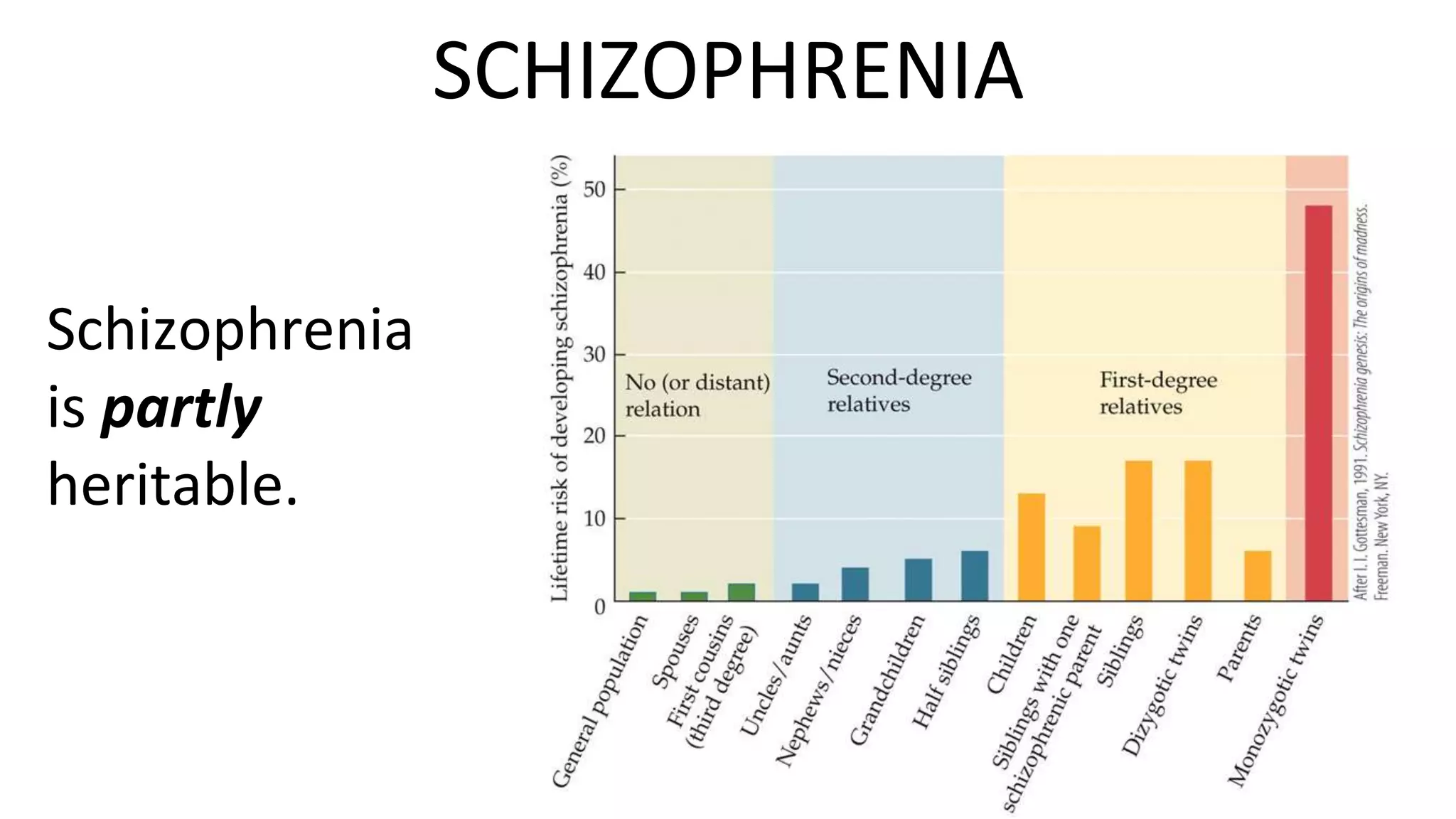
SCHIZOPHRENIA
Schizophrenia
is partly
heritable.
8
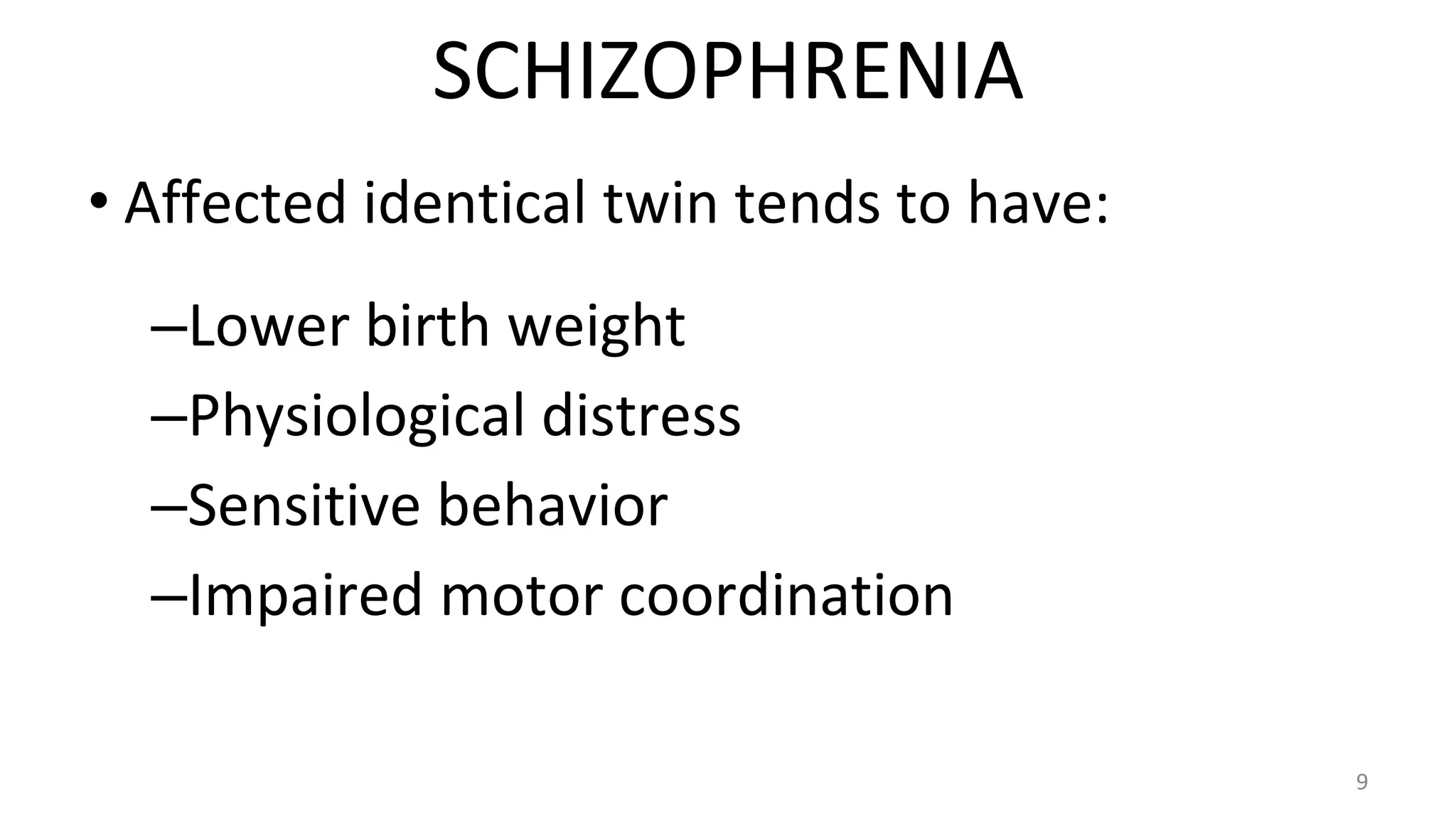
SCHIZOPHRENIA
• Affected identical twin tends to have:
–Lower birth weight
–Physiological distress
–Sensitive behavior
–Impaired motor coordination
9
SCHIZOPHRENIA
10
SCHIZOPHRENIA
• Genes that influence schizophrenia:
–Some participate in synaptic plasticity
–DISC1—a mutant, disabled version of a gene
disrupted in schizophrenia
• Epigenetic factors: father’s age
11
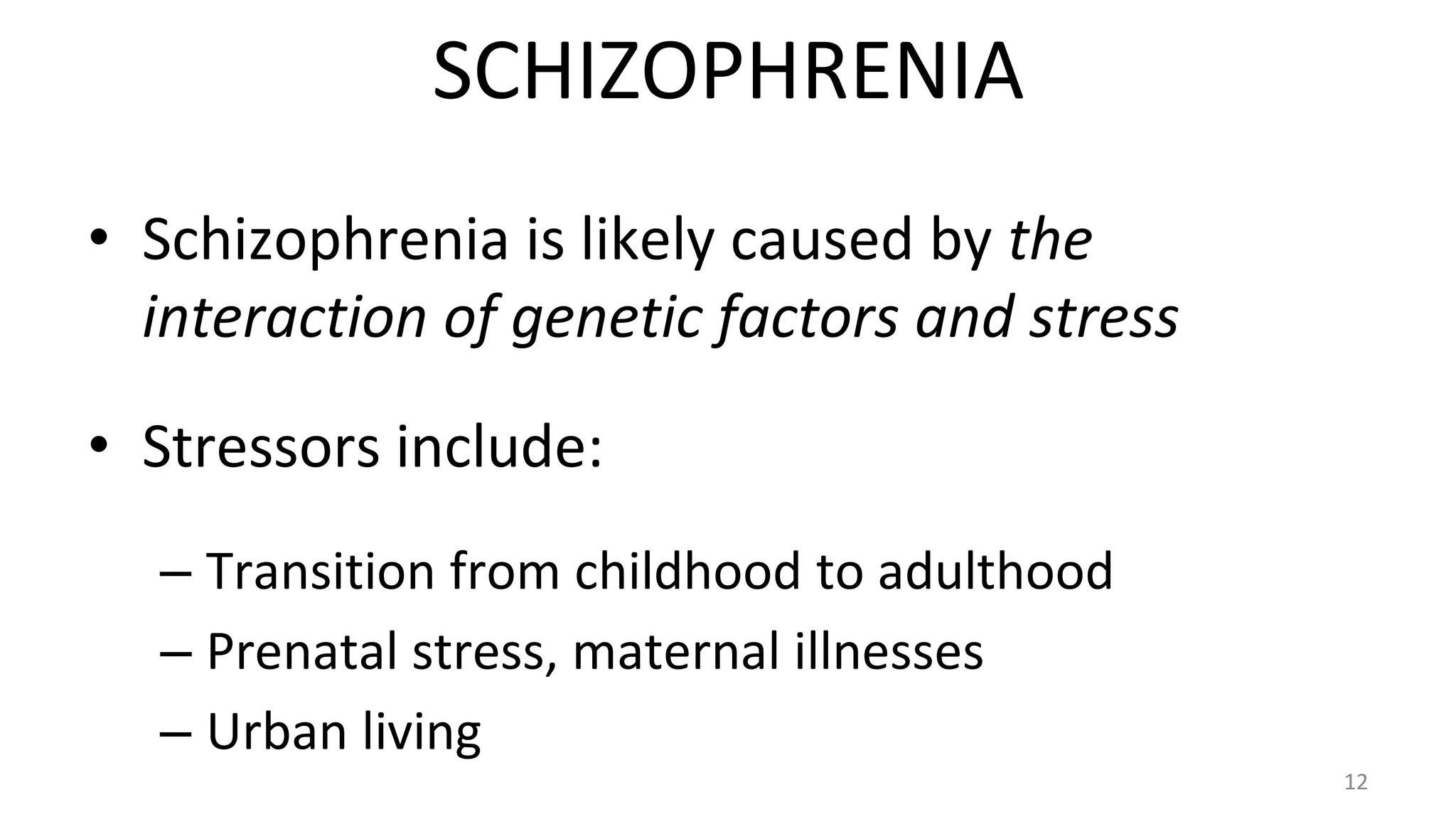
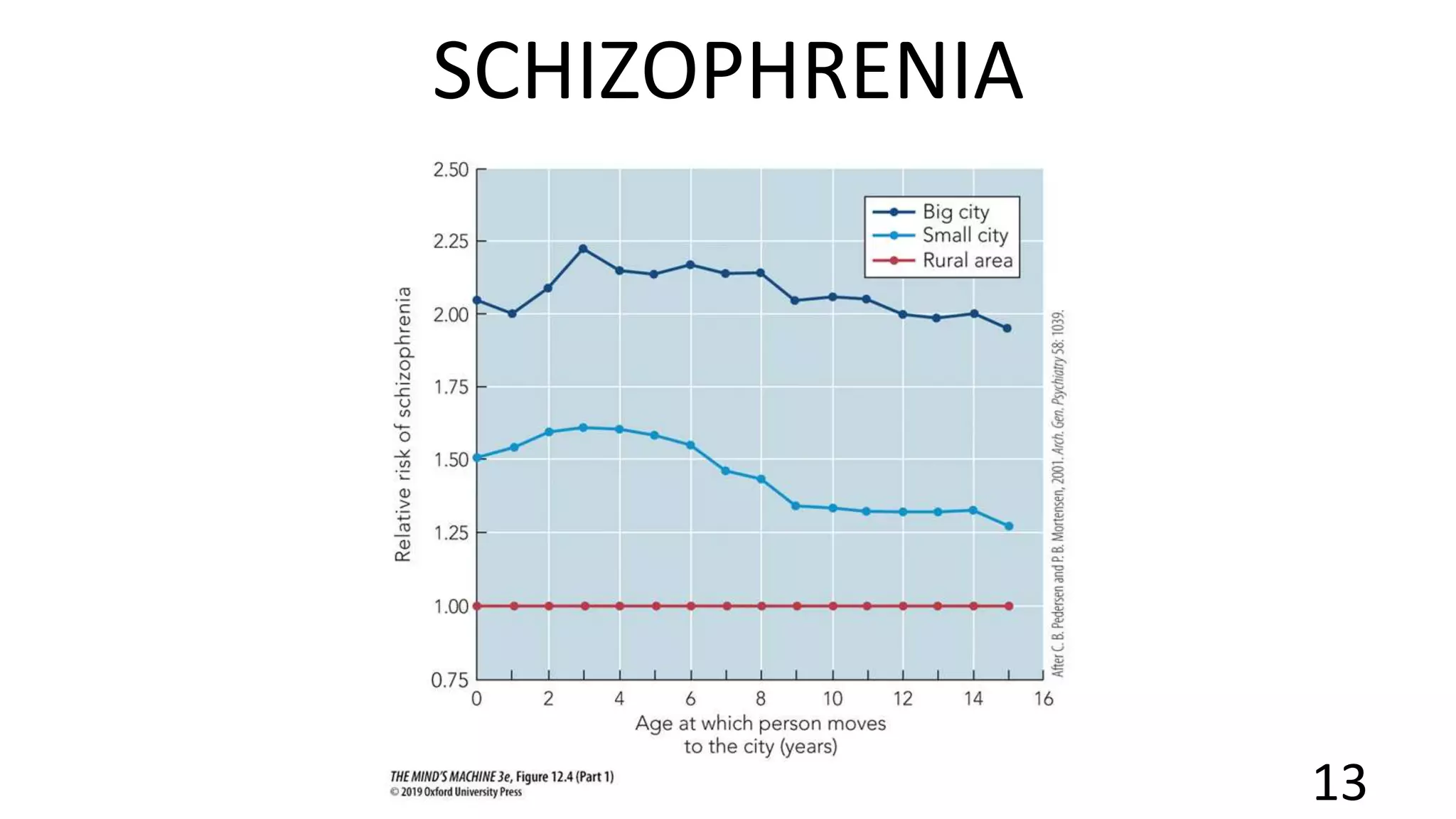
• Schizophrenia is likely caused by the
interaction of genetic factors and stress
• Stressors include:
– Transition from childhood to adulthood
– Prenatal stress, maternal illnesses
– Urban living
12
SCHIZOPHRENIA
13
SCHIZOPHRENIA
14
SCHIZOPHRENIA
• Brain changes in patients with schizophrenia:
– Enlarged cerebral ventricles: twins studies
15
SCHIZOPHRENIA
16
SCHIZOPHRENIA
• Brain changes:
– Enlarged cerebral ventricles: Mice with mutated
DISC1
• Brain changes:
– Cortical abnormalities
• Thicker corpus callosum
• Abnormal prenatal
neuron migration in
frontal cortex
• Loss of gray matter
17
SCHIZOPHRENIA
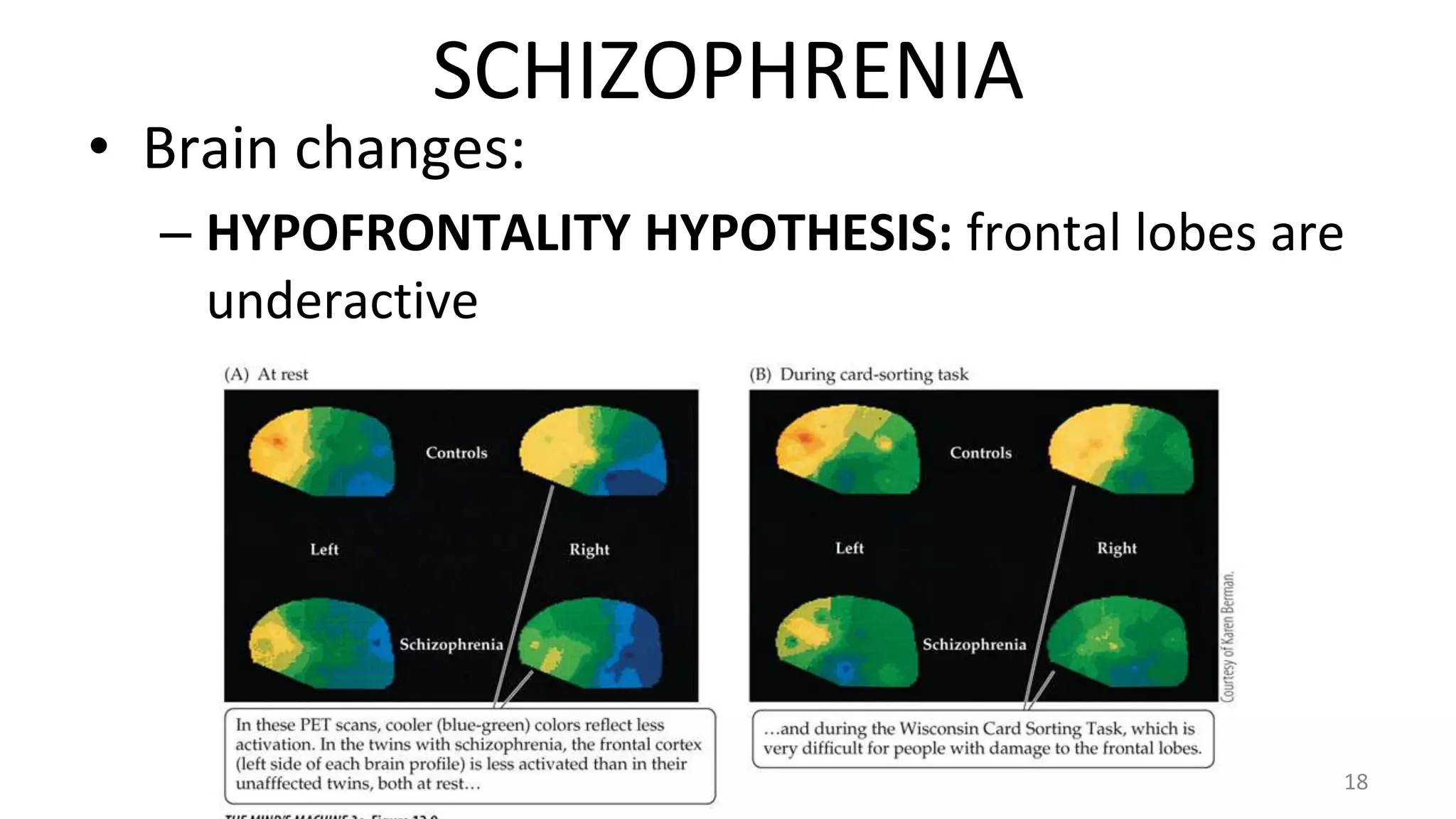
• Brain changes:
– HYPOFRONTALITY HYPOTHESIS: frontal lobes are
underactive
18
SCHIZOPHRENIA
SCHIZOPHRENIA
• LOBOTOMY: is the surgical separation of the
frontal lobes from the rest of the brain
19
António Egas Moniz Walter Freeman
SCHIZOPHRENIA
• My Lobotomy, by Howard Dully
20
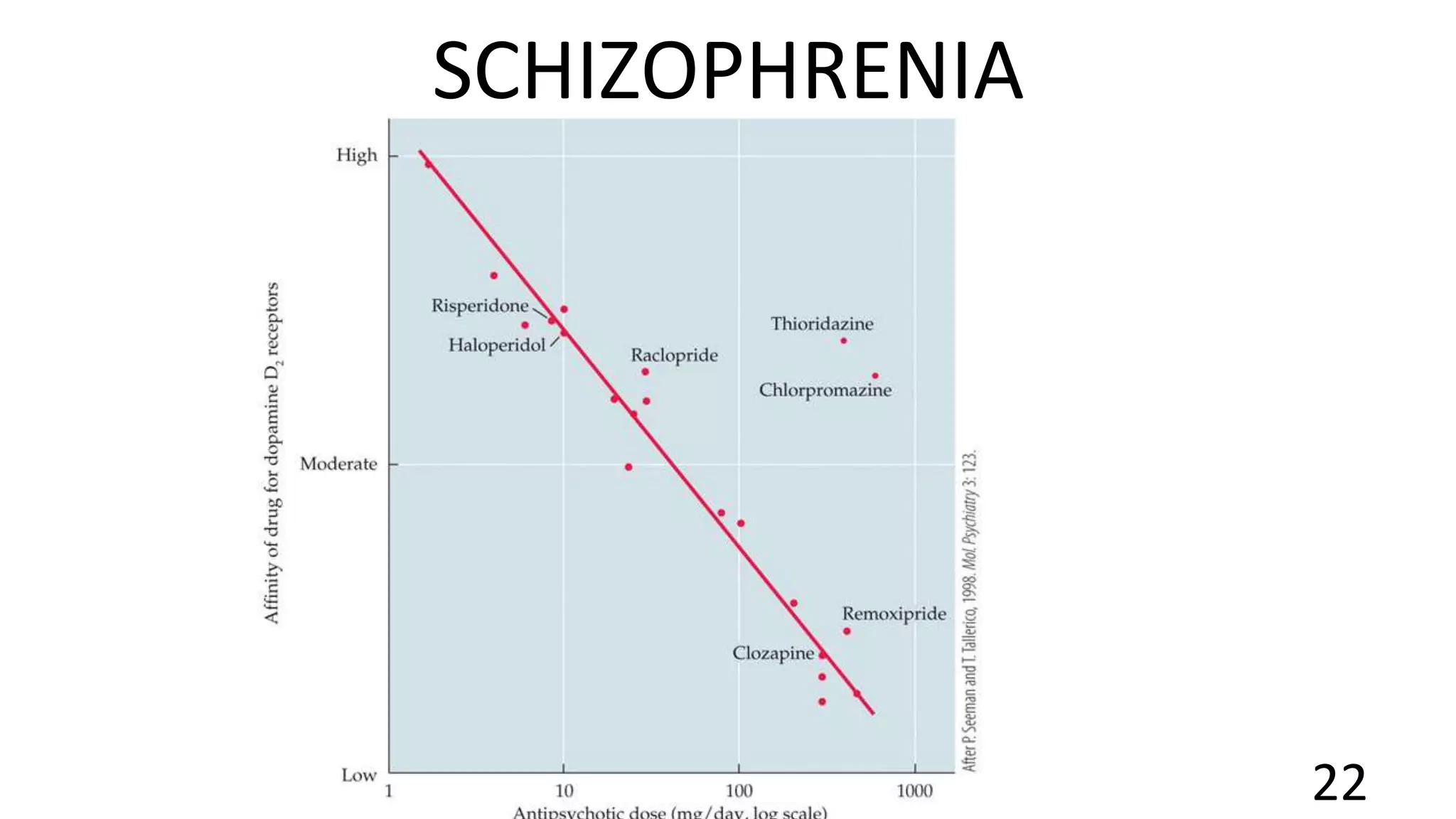
• CHLORPROMAZINE: can reduce
positive symptoms
• FIRST-GENERATION
ANTIPSYCHOTICS: antagonists
at dopamine D2 receptors
21
SCHIZOPHRENIA
22
SCHIZOPHRENIA
SCHIZOPHRENIA
• Antipsychotic drugs can have side effects:
– TARDIVE DYSKINESIA
SCHIZOPHRENIA
24
• Antipsychotic drugs can have side effects:
– TARDIVE DYSKINESIA
• DOPAMINE HYPOTHESIS: schizophrenia is
caused by excessive dopamine release
• Evidence:
–First-generation antipsychotics
block D2 receptors
–Amphetamine use = schizophrenia symptoms
25
SCHIZOPHRENIA
• DOPAMINE HYPOTHESIS: schizophrenia is caused
by excessive dopamine release
• Problems with the dopamine hypothesis:
– Drugs block D2 receptors faster than symptoms
are reduced
– Some patients don’t respond
– Newer drugs don’t have high affinity for D2 26
SCHIZOPHRENIA
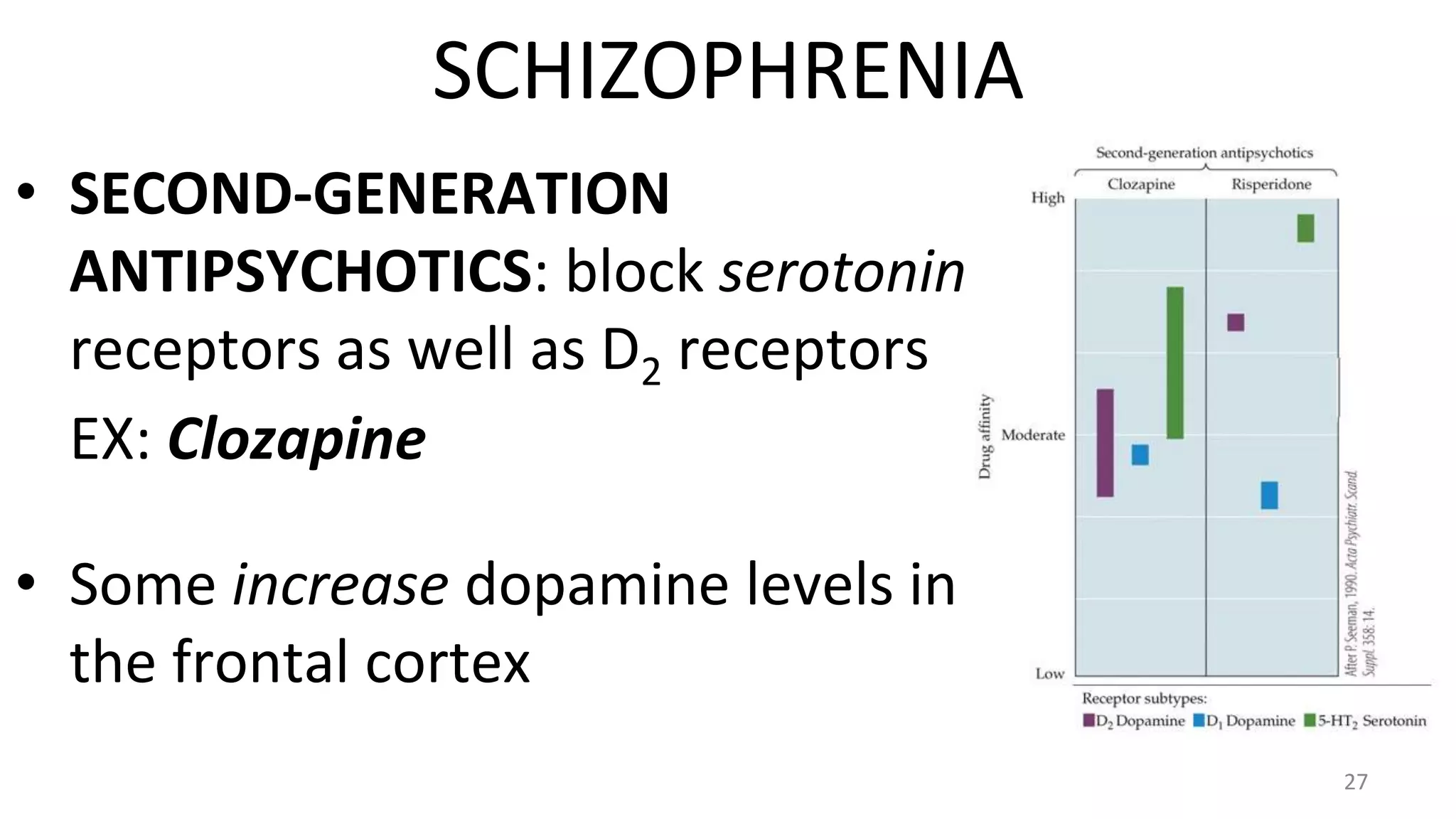
• SECOND-GENERATION
ANTIPSYCHOTICS: block serotonin
receptors as well as D2 receptors
EX: Clozapine
• Some increase dopamine levels in
the frontal cortex
27
SCHIZOPHRENIA
CH 12: Psychopathology
28
➔Schizophrenia
➔Mood Disorders
➔Anxiety & Related Disorders
• UNIPOLAR DEPRESSION: mood disorder
characterized by
– Dysphoria
– Anhedonia
– Changes in appetite and sleep
– Difficulty in concentration
– Pessimism & suicidality
29
MOOD DISORDERS
• Brain changes with
depression:
– Increased blood flow to the
frontal cortex and amygdala
– Decreased blood flow to
attention areas
– Cortex of the right
hemisphere is thinner
30
MOOD DISORDERS
Treatments for depression:
– ELECTROCONVULSIVE THERAPY
(ECT): causes a seizure—an
electrical current is passed
through the brain
– TRANSCRANIAL MAGNETIC
STIMULATION (TMS): also alters
cortical electrical activity
31
MOOD DISORDERS
32
MOOD DISORDERS
33
MOOD DISORDERS
34
MOOD DISORDERS
35
MOOD DISORDERS
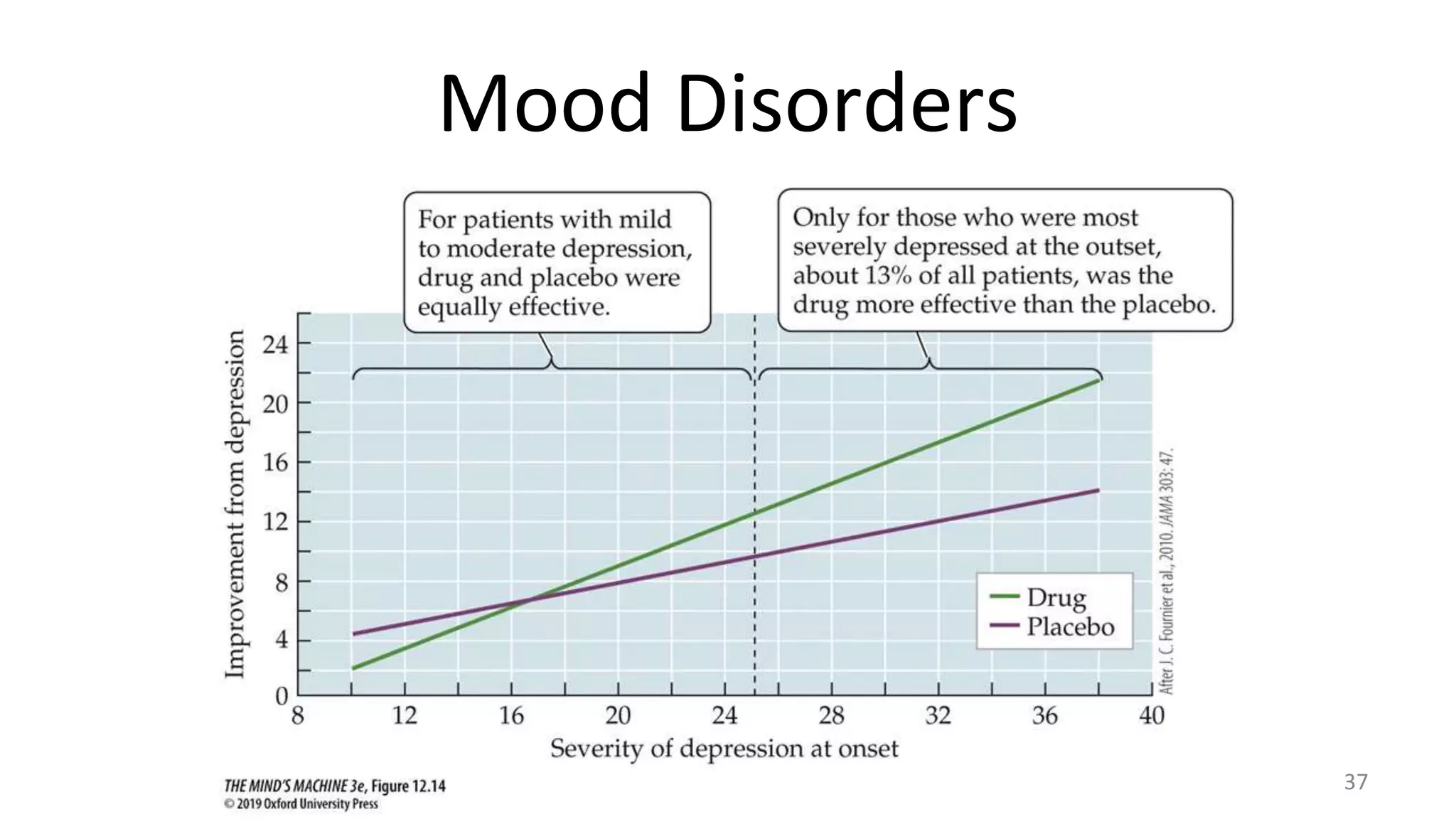
• Problems with idea of serotonin reduction as a
cause of depression:
– Delay between medication and results
– Not everyone is helped and placebo effect
– Risk of suicide in children and adolescents
36
MOOD DISORDERS
Mood Disorders
37
• Other treatments being researched:
– Ketamine and leptin
– Vagal nerve stimulation
– DEEP BRAIN STIMULATION (DBS)
– COGNITIVE BEHAVIORAL THERAPY (CBT)
38
MOOD DISORDERS
MOOD DISORDERS
39
• More women than men suffer from depression
– Help-seeking patterns
– Gender differences in hormone levels
– POSTPARTUM DEPRESSION immediately precedes
or follows childbirth
40
MOOD DISORDERS
• Sleep is altered by depression:
– Stage 3 of slow-wave sleep is reduced
41
MOOD DISORDERS
42
MOOD DISORDERS
• Sleep is altered by depression:
• Some signs of depression are observable behaviors:
– LEARNED HELPLESSNESS:
• An animal is exposed to a repetitive stressful stimulus
• Linked to a decrease in serotonin function
43
MOOD DISORDERS
• BIPOLAR DISORDER: depressive periods
alternating with periods of expansive mood, or
mania
44
MOOD DISORDERS
• BIPOLAR DISORDER: depressive periods
alternating with periods of expansive mood, or
mania
–Enlarged ventricles and reduced gray matter
–LITHIUM is an effective treatment, but its use must
be monitored for side effects
45
MOOD DISORDERS
CH 12: Psychopathology
46
➔Schizophrenia
➔Mood Disorders
➔Anxiety & Related Disorders
ANXIETY DISORDERS
• ANXIETY DISORDERS:
– PHOBIC DISORDERS: intense irrational fears
centered on an object, activity, or situation that a
person avoids
– PANIC DISORDER: recurrent attacks of intense
fearfulness
– GENERALIZED ANXIETY DISORDER: persistent,
excessive anxiety and worry 47
Treatments for Anxiety Disorders
–BENZODIAZEPINES: bind to GABA receptors and
enhance the inhibitory activity GABA
–Serotonin agonists and SSRIs can also treat anxiety
48
ANXIETY DISORDERS
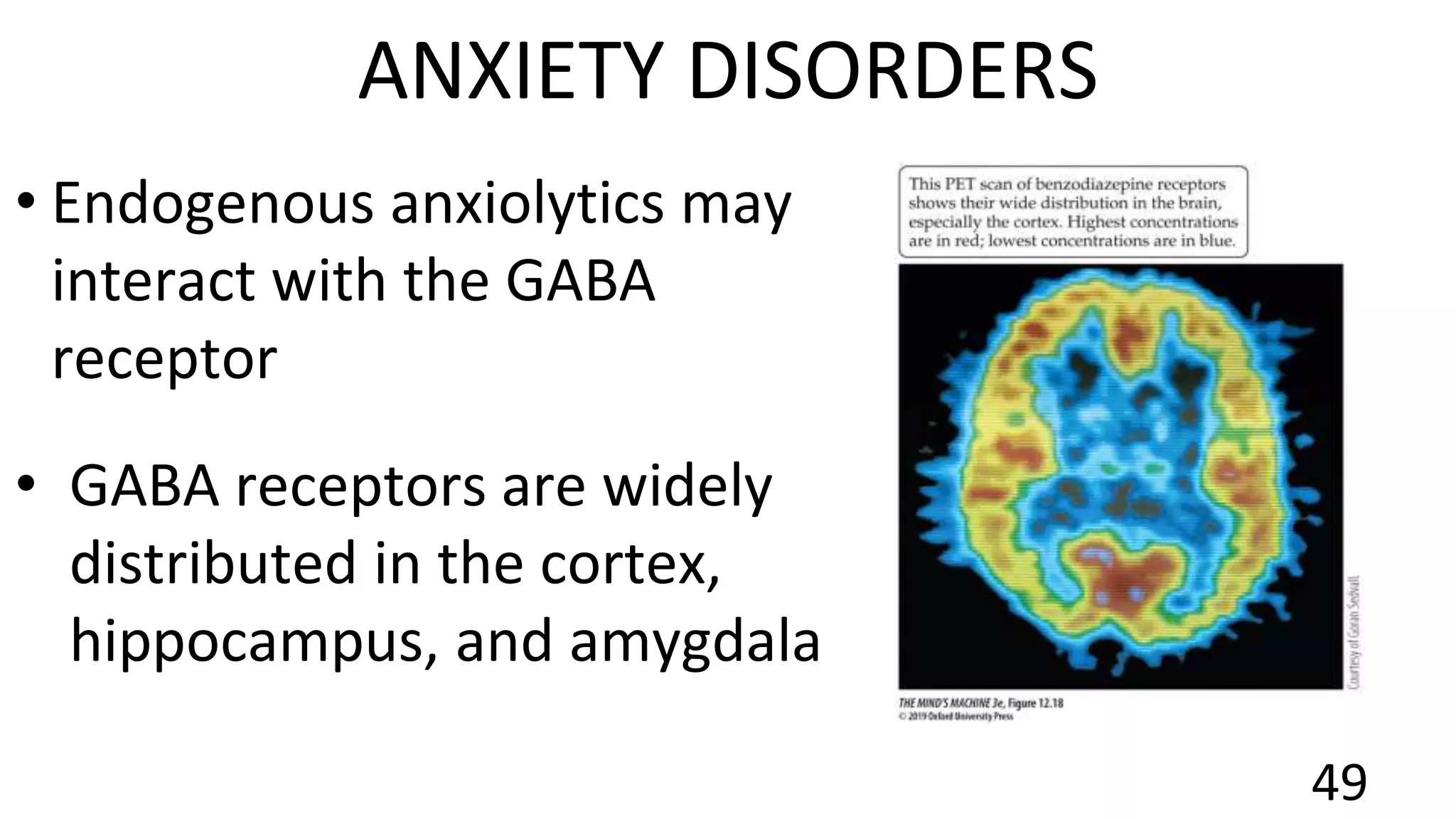
• Endogenous anxiolytics may
interact with the GABA
receptor
• GABA receptors are widely
distributed in the cortex,
hippocampus, and amygdala
49
ANXIETY DISORDERS
• POSTTRAUMATIC STRESS DISORDER (PTSD):
occurs when a person has difficulty recovering
from a traumatic event
– Memory changes
– Flashbacks
– Hypervigilance
– Avoidance
– Deficits in short-term memory 50
ANXIETY DISORDERS
ANXIETY DISORDERS
51
ANXIETY DISORDERS
52
• OBSESSIVE-COMPULSIVE DISORDER (OCD):
marked by recurring, repetitive acts
– In OCD patients:
• Routine acts become compulsions
• Recurrent thoughts become obsessions
–OCD responds to SSRIs
–Depression and OCD often occur together and may
be related 53
ANXIETY DISORDERS
• OCD is often CO-MORBID with Tourette’s syndrome—
both involve disorders of the basal ganglia
• OCD may be triggered by infections
• Treatments in addition to drugs include:
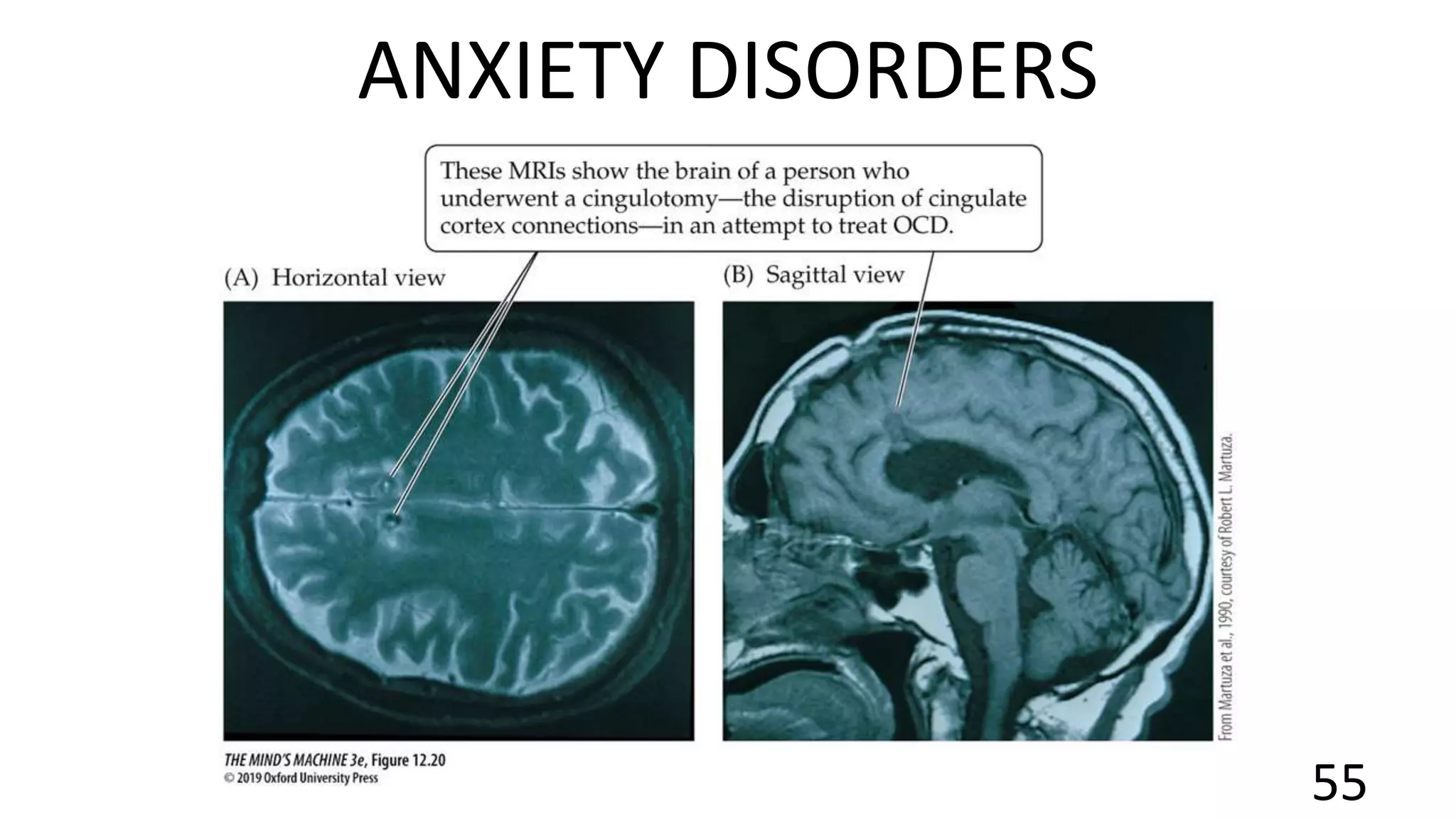
– PSYCHOSURGERY: brain lesions used to modify severe
psychiatric disorders
– CINGULOTOMY: lesions of the cingulate cortex 54
ANXIETY DISORDERS
55
ANXIETY DISORDERS
• TOURETTE’S SYNDROME:
–Heightened sensitivity
–May fling their arms, kick,
or make violent shoulder
movements
–Diagnosed early, at 6–7 yrs
–Many also exhibit ADHD or
OCD
56
ANXIETY DISORDERS
• TOURETTE’S SYNDROME:
– In twin studies, an affected twin has
more dopamine D2 receptors in the
caudate nucleus of the basal ganglia
– Treatments include haloperidol, a
D2 receptor antagonist, atypical
antipsychotics, behavior
modification, and deep brain
stimulation
57
ANXIETY DISORDERS

PSY-2 Ch12: Psychopathology

  • 1.
    CH 12: Psychopathology 1 ➔Schizophrenia ➔MoodDisorders ➔Anxiety & Related Disorders
  • 2.
    PSYCHOPATHOLOGY • 1 in3 experience symptoms during their life • 19% have symptoms during a given year • 5% are currently suffering from serious mental illness 2
  • 3.
    • Historically believed tobe a result of weak will, demonic possession, or misbehavior 3
  • 4.
    PSYCHOPATHOLOGY • In 1900,25% of psychiatric patients suffered from paralytic dementia • 1911: Syphilis discovered to be the cause; treatable with antibiotics 4 Hideyo Noguchi
  • 5.
    SCHIZOPHRENIA SCHIZOPHRENIA: a disorderedstate with unusual symptoms 5
  • 6.
    SCHIZOPHRENIA SCHIZOPHRENIA: a disorderedstate with unusual symptoms 6
  • 7.
    SCHIZOPHRENIA SCHIZOPHRENIA: a disorderedstate with unusual symptoms 7
  • 8.
  • 9.
    SCHIZOPHRENIA • Affected identicaltwin tends to have: –Lower birth weight –Physiological distress –Sensitive behavior –Impaired motor coordination 9
  • 10.
  • 11.
    SCHIZOPHRENIA • Genes thatinfluence schizophrenia: –Some participate in synaptic plasticity –DISC1—a mutant, disabled version of a gene disrupted in schizophrenia • Epigenetic factors: father’s age 11
  • 12.
    • Schizophrenia islikely caused by the interaction of genetic factors and stress • Stressors include: – Transition from childhood to adulthood – Prenatal stress, maternal illnesses – Urban living 12 SCHIZOPHRENIA
  • 13.
  • 14.
  • 15.
    • Brain changesin patients with schizophrenia: – Enlarged cerebral ventricles: twins studies 15 SCHIZOPHRENIA
  • 16.
    16 SCHIZOPHRENIA • Brain changes: –Enlarged cerebral ventricles: Mice with mutated DISC1
  • 17.
    • Brain changes: –Cortical abnormalities • Thicker corpus callosum • Abnormal prenatal neuron migration in frontal cortex • Loss of gray matter 17 SCHIZOPHRENIA
  • 18.
    • Brain changes: –HYPOFRONTALITY HYPOTHESIS: frontal lobes are underactive 18 SCHIZOPHRENIA
  • 19.
    SCHIZOPHRENIA • LOBOTOMY: isthe surgical separation of the frontal lobes from the rest of the brain 19 António Egas Moniz Walter Freeman
  • 20.
  • 21.
    • CHLORPROMAZINE: canreduce positive symptoms • FIRST-GENERATION ANTIPSYCHOTICS: antagonists at dopamine D2 receptors 21 SCHIZOPHRENIA
  • 22.
  • 23.
    SCHIZOPHRENIA • Antipsychotic drugscan have side effects: – TARDIVE DYSKINESIA
  • 24.
    SCHIZOPHRENIA 24 • Antipsychotic drugscan have side effects: – TARDIVE DYSKINESIA
  • 25.
    • DOPAMINE HYPOTHESIS:schizophrenia is caused by excessive dopamine release • Evidence: –First-generation antipsychotics block D2 receptors –Amphetamine use = schizophrenia symptoms 25 SCHIZOPHRENIA
  • 26.
    • DOPAMINE HYPOTHESIS:schizophrenia is caused by excessive dopamine release • Problems with the dopamine hypothesis: – Drugs block D2 receptors faster than symptoms are reduced – Some patients don’t respond – Newer drugs don’t have high affinity for D2 26 SCHIZOPHRENIA
  • 27.
    • SECOND-GENERATION ANTIPSYCHOTICS: blockserotonin receptors as well as D2 receptors EX: Clozapine • Some increase dopamine levels in the frontal cortex 27 SCHIZOPHRENIA
  • 28.
    CH 12: Psychopathology 28 ➔Schizophrenia ➔MoodDisorders ➔Anxiety & Related Disorders
  • 29.
    • UNIPOLAR DEPRESSION:mood disorder characterized by – Dysphoria – Anhedonia – Changes in appetite and sleep – Difficulty in concentration – Pessimism & suicidality 29 MOOD DISORDERS
  • 30.
    • Brain changeswith depression: – Increased blood flow to the frontal cortex and amygdala – Decreased blood flow to attention areas – Cortex of the right hemisphere is thinner 30 MOOD DISORDERS
  • 31.
    Treatments for depression: –ELECTROCONVULSIVE THERAPY (ECT): causes a seizure—an electrical current is passed through the brain – TRANSCRANIAL MAGNETIC STIMULATION (TMS): also alters cortical electrical activity 31 MOOD DISORDERS
  • 32.
  • 33.
  • 34.
  • 35.
  • 36.
    • Problems withidea of serotonin reduction as a cause of depression: – Delay between medication and results – Not everyone is helped and placebo effect – Risk of suicide in children and adolescents 36 MOOD DISORDERS
  • 37.
  • 38.
    • Other treatmentsbeing researched: – Ketamine and leptin – Vagal nerve stimulation – DEEP BRAIN STIMULATION (DBS) – COGNITIVE BEHAVIORAL THERAPY (CBT) 38 MOOD DISORDERS
  • 39.
  • 40.
    • More womenthan men suffer from depression – Help-seeking patterns – Gender differences in hormone levels – POSTPARTUM DEPRESSION immediately precedes or follows childbirth 40 MOOD DISORDERS
  • 41.
    • Sleep isaltered by depression: – Stage 3 of slow-wave sleep is reduced 41 MOOD DISORDERS
  • 42.
    42 MOOD DISORDERS • Sleepis altered by depression:
  • 43.
    • Some signsof depression are observable behaviors: – LEARNED HELPLESSNESS: • An animal is exposed to a repetitive stressful stimulus • Linked to a decrease in serotonin function 43 MOOD DISORDERS
  • 44.
    • BIPOLAR DISORDER:depressive periods alternating with periods of expansive mood, or mania 44 MOOD DISORDERS
  • 45.
    • BIPOLAR DISORDER:depressive periods alternating with periods of expansive mood, or mania –Enlarged ventricles and reduced gray matter –LITHIUM is an effective treatment, but its use must be monitored for side effects 45 MOOD DISORDERS
  • 46.
    CH 12: Psychopathology 46 ➔Schizophrenia ➔MoodDisorders ➔Anxiety & Related Disorders
  • 47.
    ANXIETY DISORDERS • ANXIETYDISORDERS: – PHOBIC DISORDERS: intense irrational fears centered on an object, activity, or situation that a person avoids – PANIC DISORDER: recurrent attacks of intense fearfulness – GENERALIZED ANXIETY DISORDER: persistent, excessive anxiety and worry 47
  • 48.
    Treatments for AnxietyDisorders –BENZODIAZEPINES: bind to GABA receptors and enhance the inhibitory activity GABA –Serotonin agonists and SSRIs can also treat anxiety 48 ANXIETY DISORDERS
  • 49.
    • Endogenous anxiolyticsmay interact with the GABA receptor • GABA receptors are widely distributed in the cortex, hippocampus, and amygdala 49 ANXIETY DISORDERS
  • 50.
    • POSTTRAUMATIC STRESSDISORDER (PTSD): occurs when a person has difficulty recovering from a traumatic event – Memory changes – Flashbacks – Hypervigilance – Avoidance – Deficits in short-term memory 50 ANXIETY DISORDERS
  • 51.
  • 52.
  • 53.
    • OBSESSIVE-COMPULSIVE DISORDER(OCD): marked by recurring, repetitive acts – In OCD patients: • Routine acts become compulsions • Recurrent thoughts become obsessions –OCD responds to SSRIs –Depression and OCD often occur together and may be related 53 ANXIETY DISORDERS
  • 54.
    • OCD isoften CO-MORBID with Tourette’s syndrome— both involve disorders of the basal ganglia • OCD may be triggered by infections • Treatments in addition to drugs include: – PSYCHOSURGERY: brain lesions used to modify severe psychiatric disorders – CINGULOTOMY: lesions of the cingulate cortex 54 ANXIETY DISORDERS
  • 55.
  • 56.
    • TOURETTE’S SYNDROME: –Heightenedsensitivity –May fling their arms, kick, or make violent shoulder movements –Diagnosed early, at 6–7 yrs –Many also exhibit ADHD or OCD 56 ANXIETY DISORDERS
  • 57.
    • TOURETTE’S SYNDROME: –In twin studies, an affected twin has more dopamine D2 receptors in the caudate nucleus of the basal ganglia – Treatments include haloperidol, a D2 receptor antagonist, atypical antipsychotics, behavior modification, and deep brain stimulation 57 ANXIETY DISORDERS