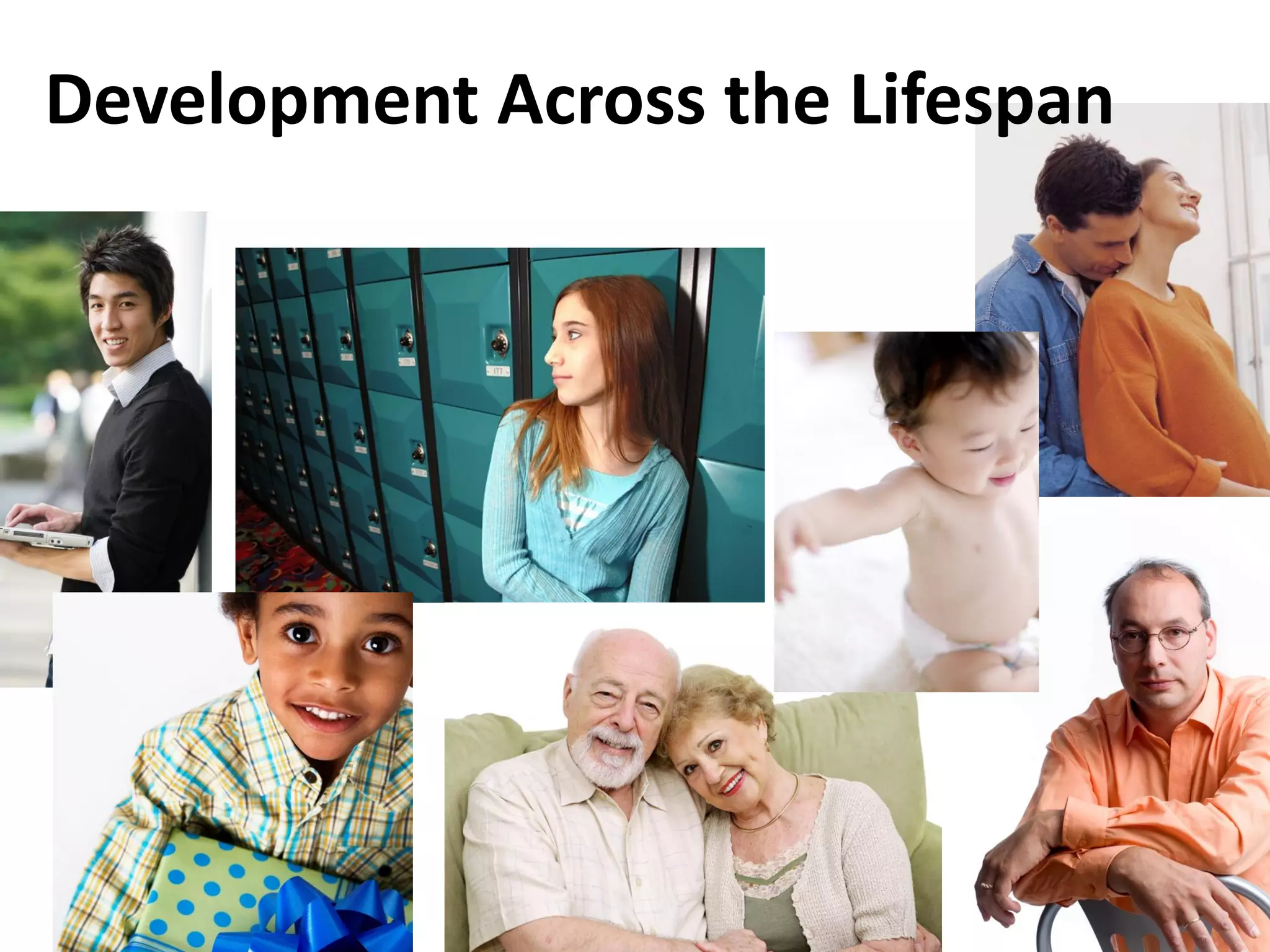
Development Across the Lifespan
1
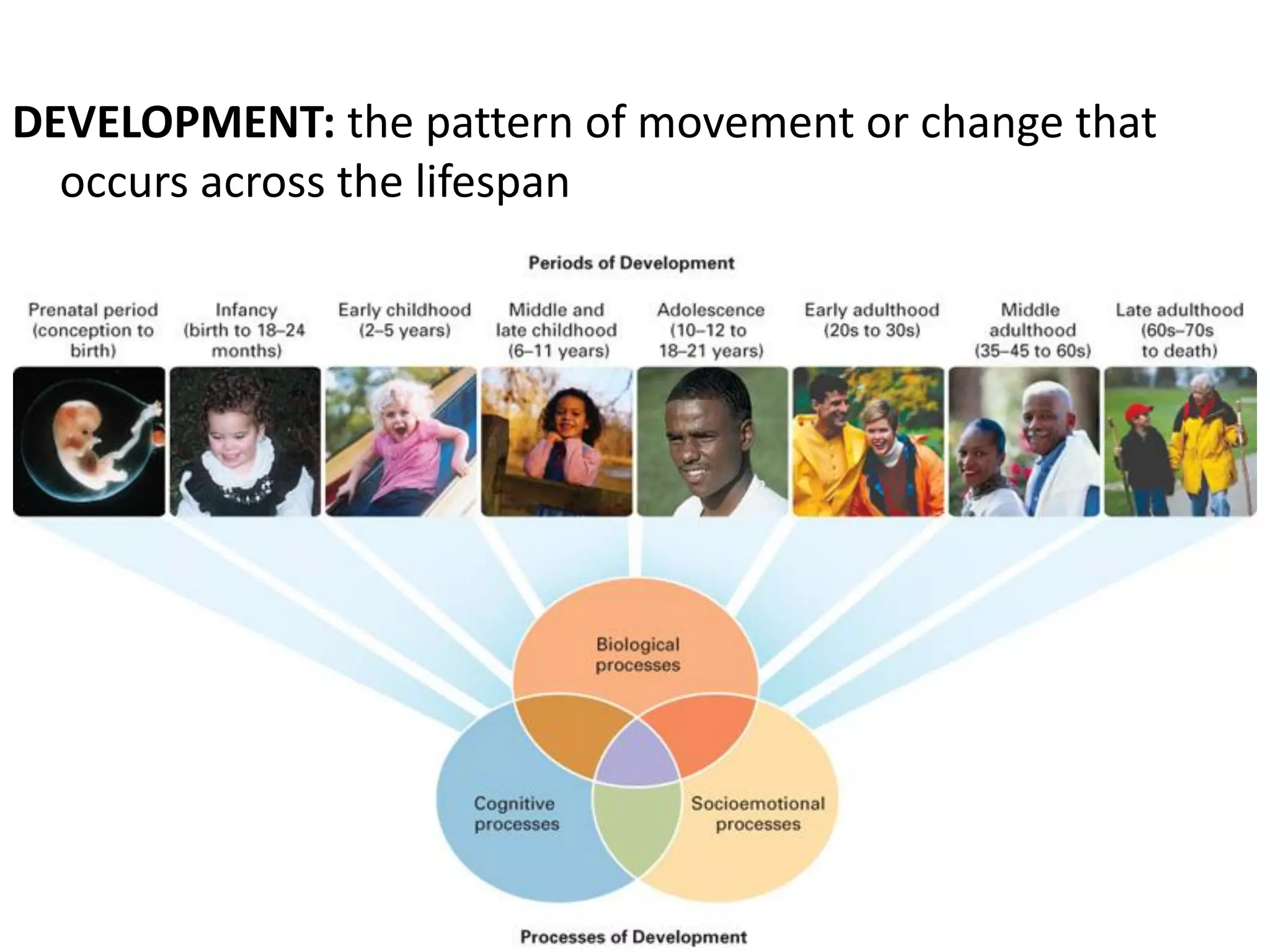
DEVELOPMENT: the pattern of movement or change that
occurs across the lifespan
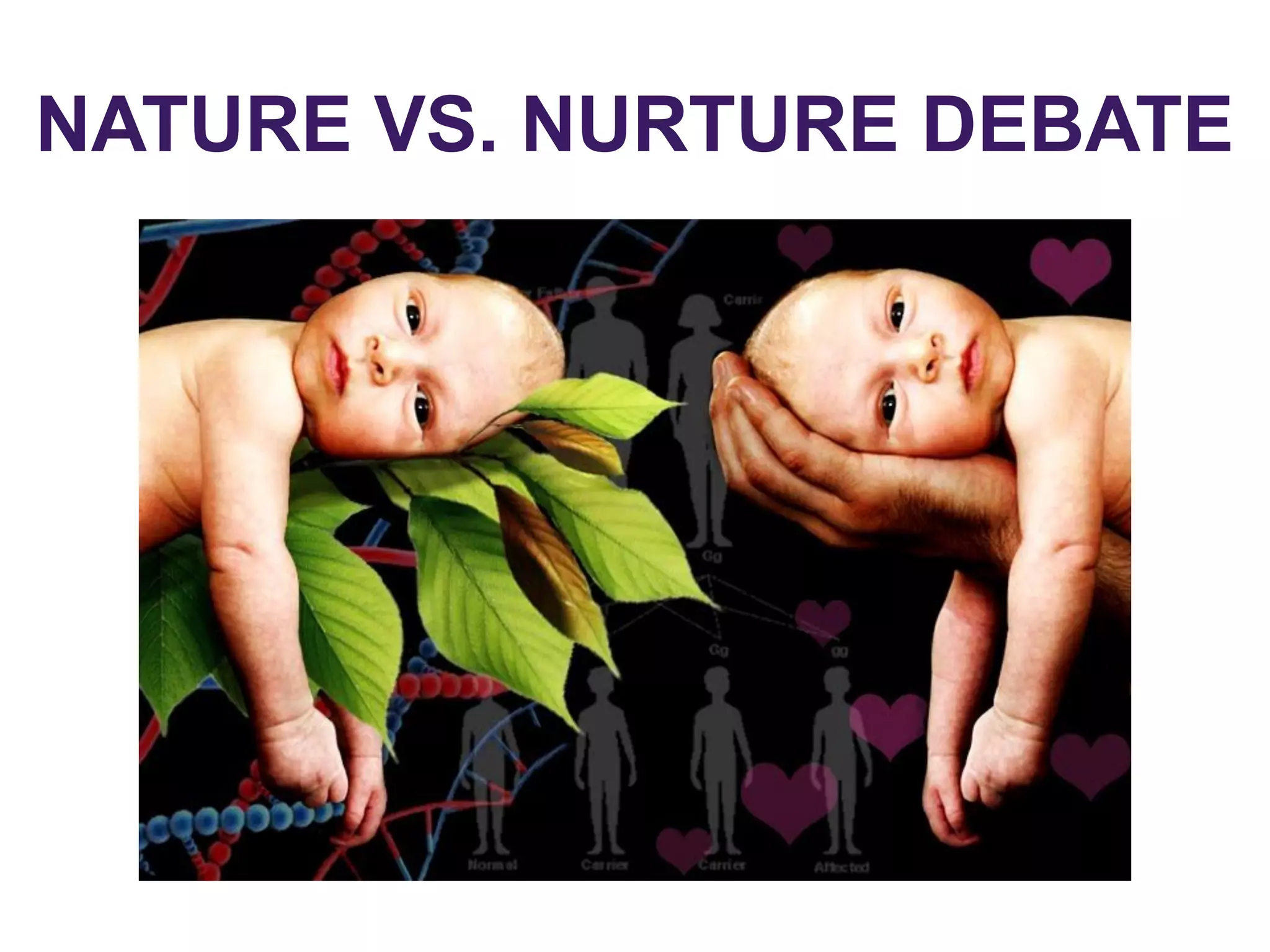
NATURE VS. NURTURE DEBATE
Lecture Outline
•Biological Development
•Cognitive Development
•Social Development
4
Biological Development
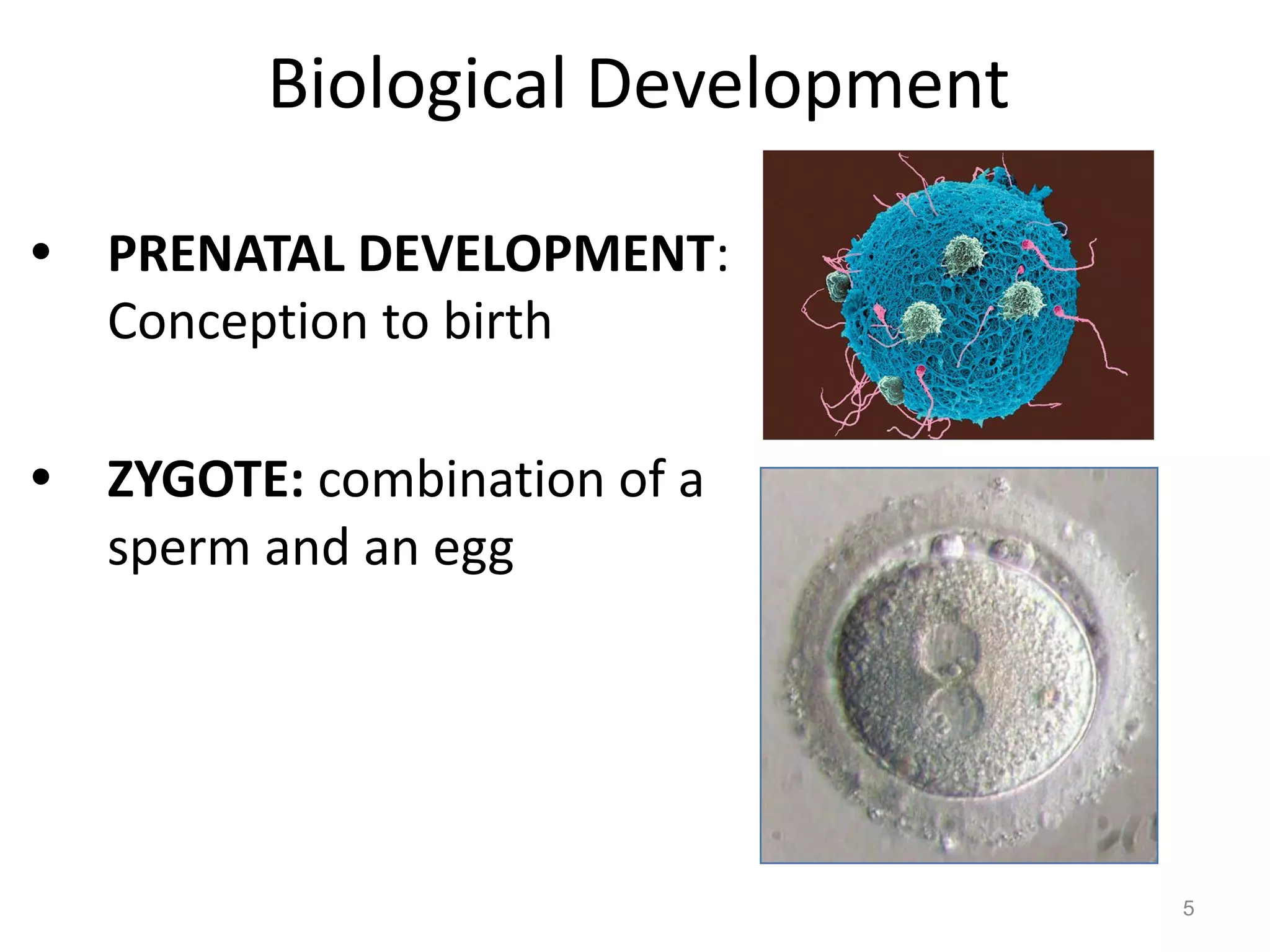
• PRENATAL DEVELOPMENT:
Conception to birth
• ZYGOTE: combination of a
sperm and an egg
5
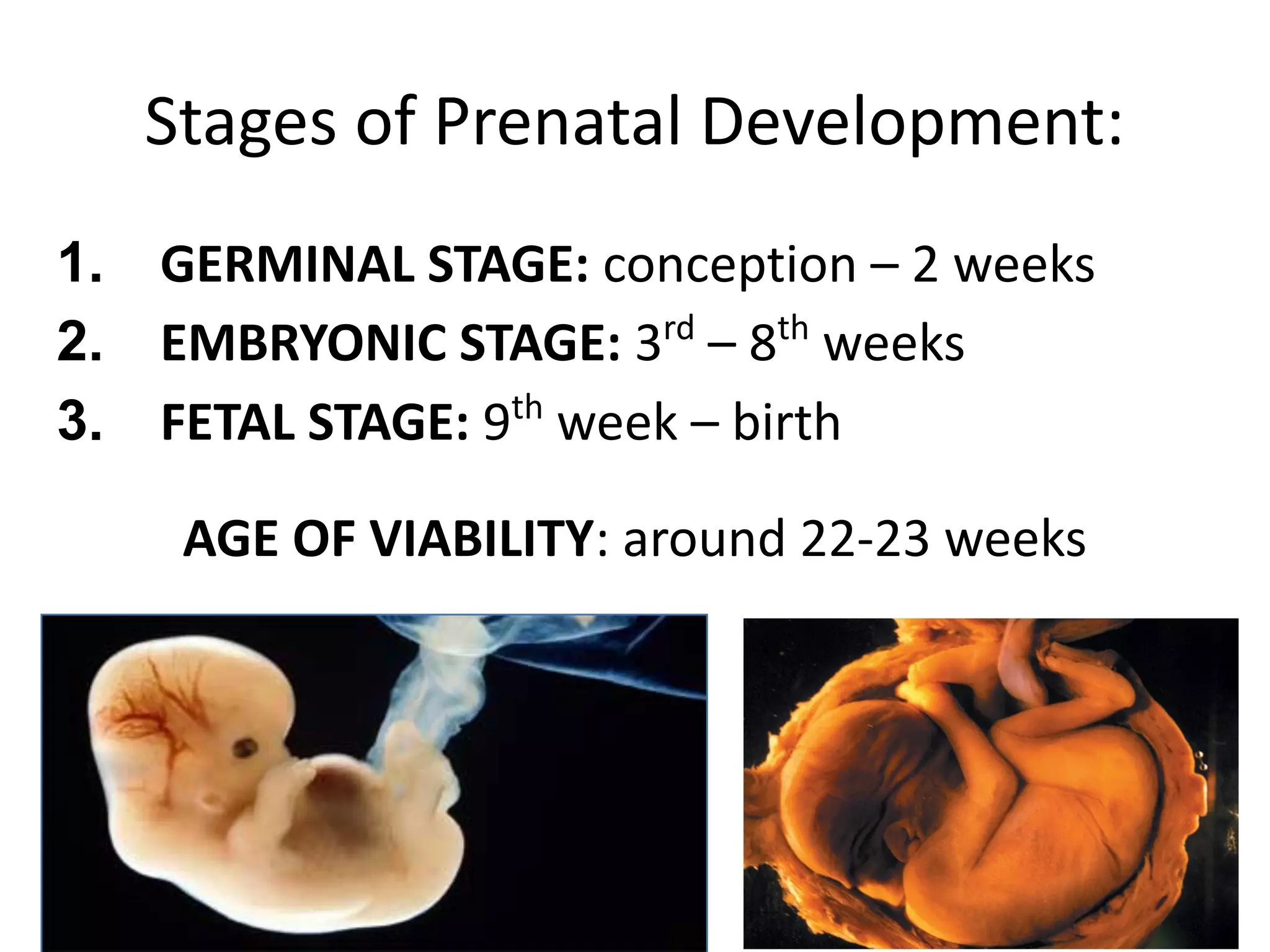
Stages of Prenatal Development:
1. GERMINAL STAGE: conception – 2 weeks
2. EMBRYONIC STAGE: 3rd
– 8th
weeks
3. FETAL STAGE: 9th
week – birth
AGE OF VIABILITY: around 22-23 weeks
6
Prenatal Supports & Risks
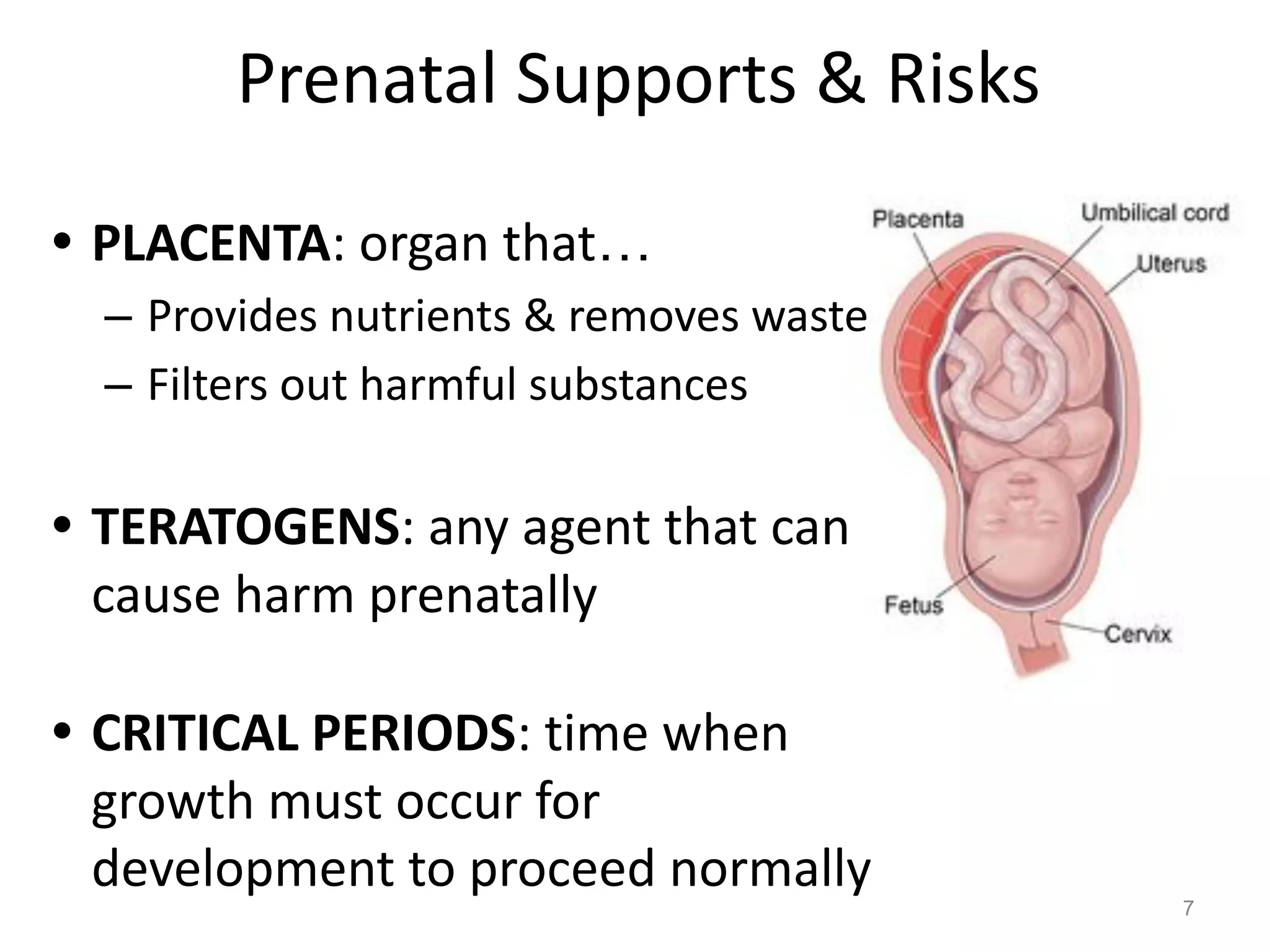
• PLACENTA: organ that…
– Provides nutrients & removes waste
– Filters out harmful substances
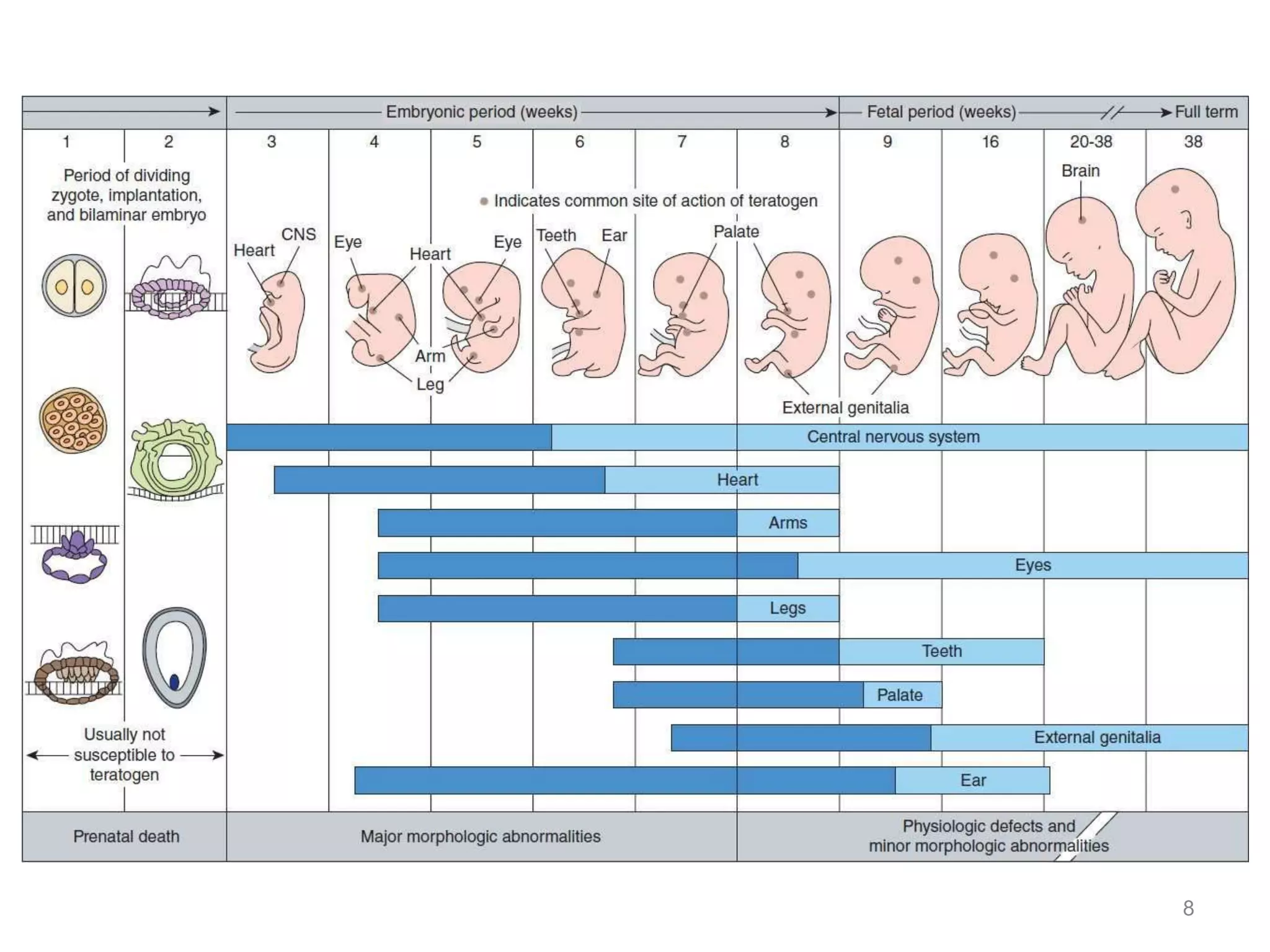
• TERATOGENS: any agent that can
cause harm prenatally
• CRITICAL PERIODS: time when
growth must occur for
development to proceed normally
7
8
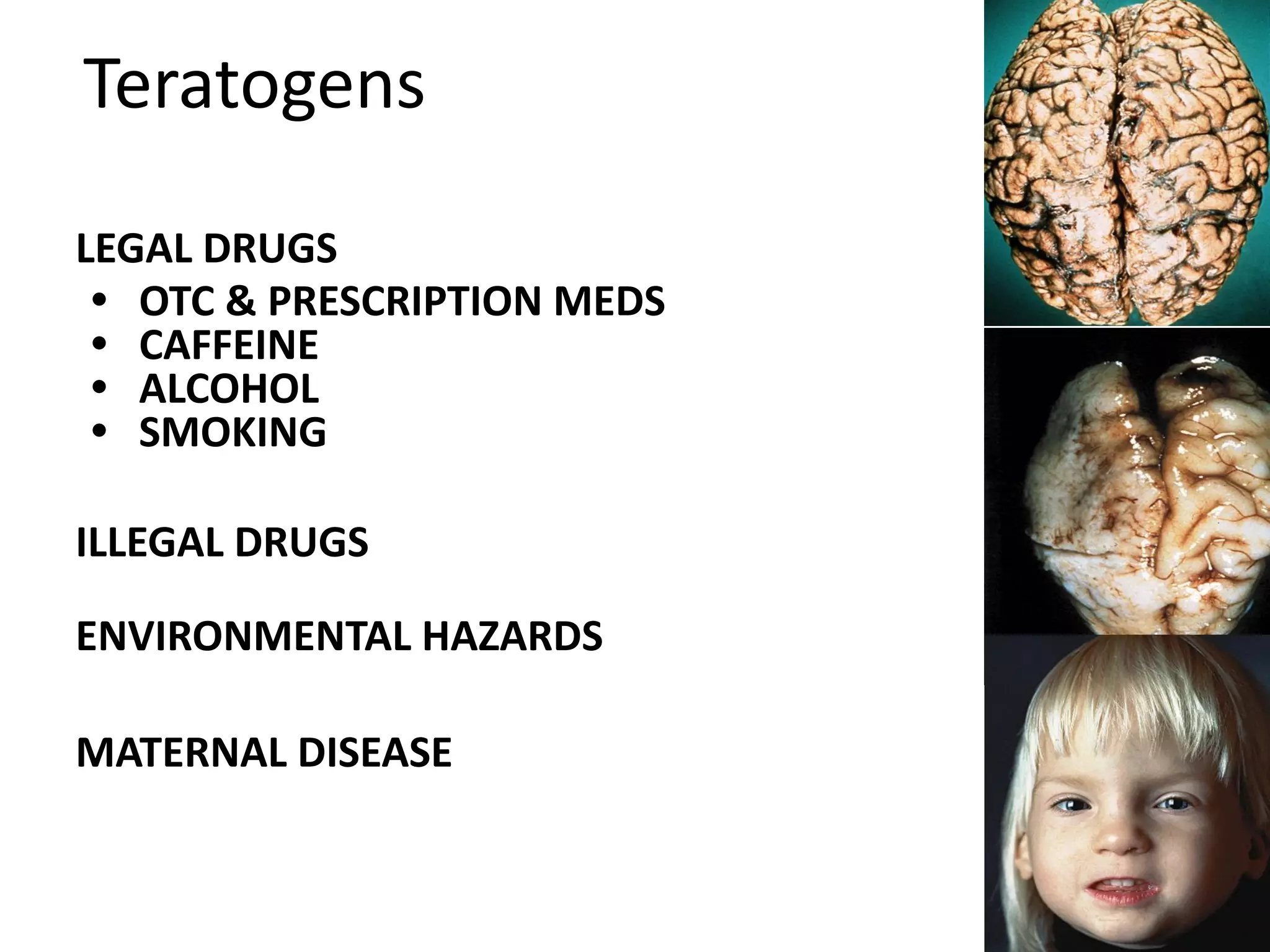
Teratogens
9
LEGAL DRUGS
• OTC & PRESCRIPTION MEDS
• CAFFEINE
• ALCOHOL
• SMOKING
ILLEGAL DRUGS
ENVIRONMENTAL HAZARDS
MATERNAL DISEASE
Lecture Outline
•Biological Development
•Cognitive Development
•Social Development
14
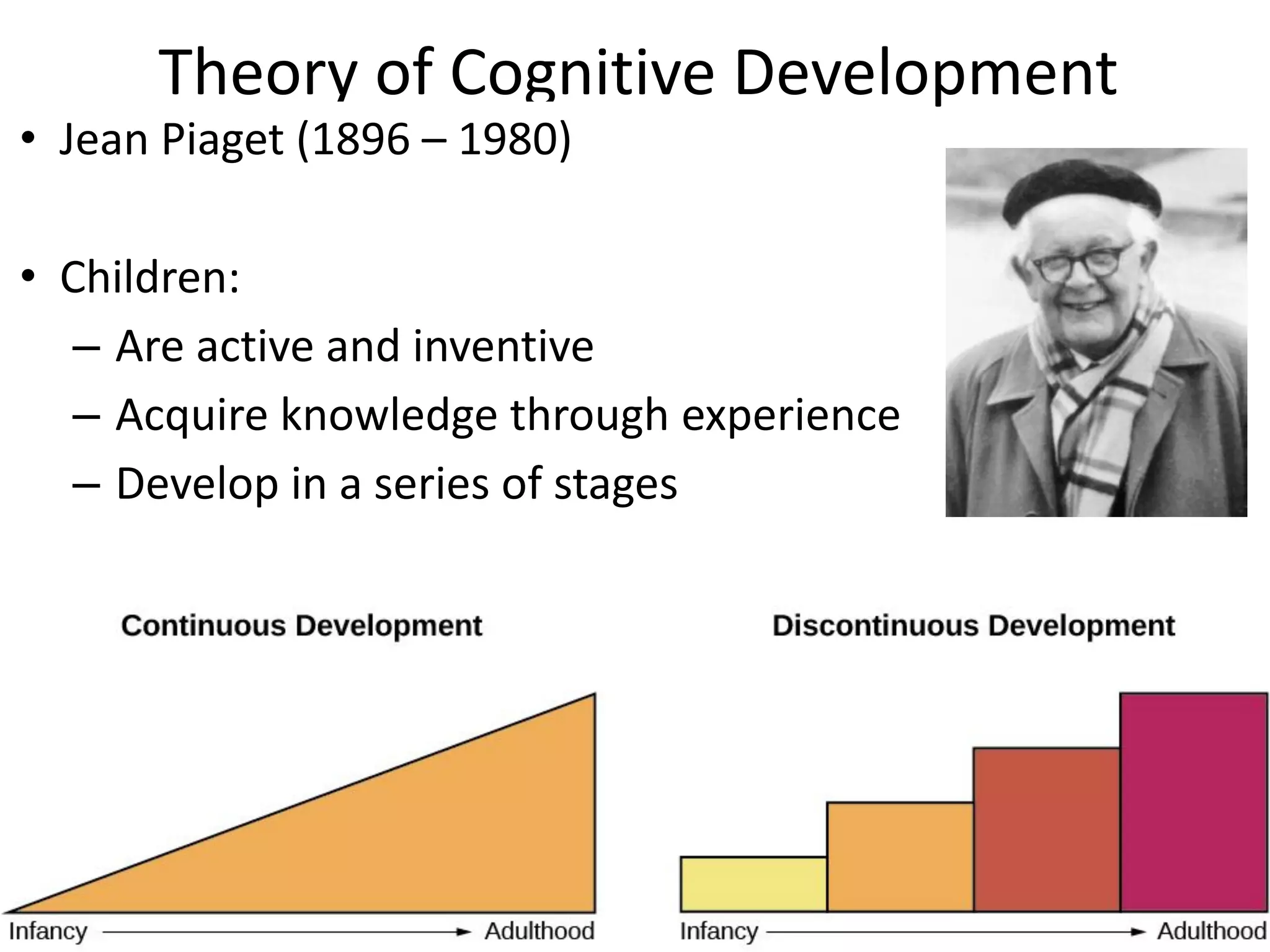
Theory of Cognitive Development
• Jean Piaget (1896 – 1980)
• Children:
– Are active and inventive
– Acquire knowledge through experience
– Develop in a series of stages
16
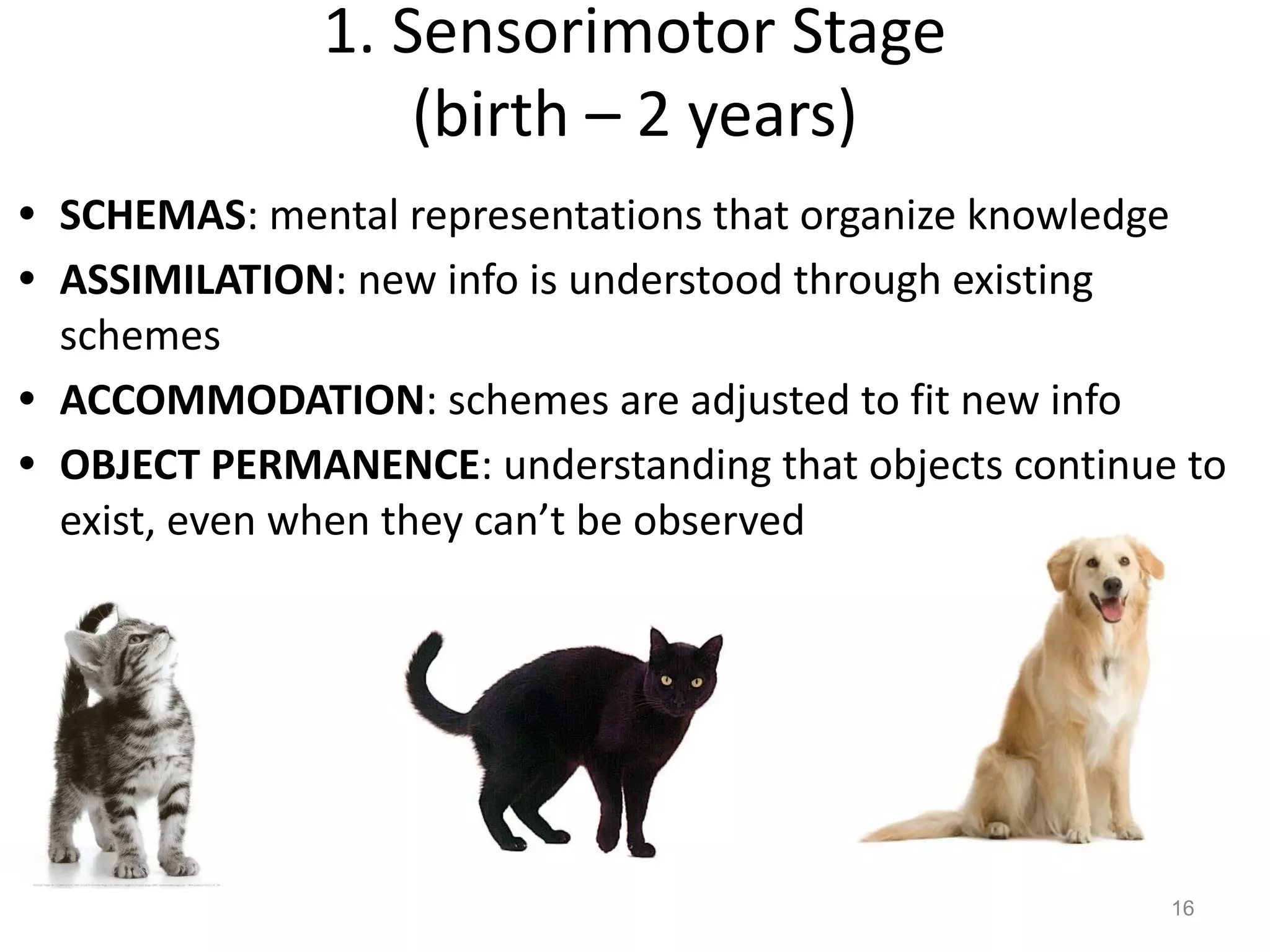
• SCHEMAS: mental representations that organize knowledge
• ASSIMILATION: new info is understood through existing
schemes
• ACCOMMODATION: schemes are adjusted to fit new info
• OBJECT PERMANENCE: understanding that objects continue to
exist, even when they can’t be observed
1. Sensorimotor Stage
(birth – 2 years)
2. Preoperational Stage
(2-7 years)
17
• SYMBOLIC THINKING: representing the world with words and
images
• EGOCENTRISM: difficulty taking another person’s point of view
• ANIMISM: the belief that inanimate objects have lifelike
qualities
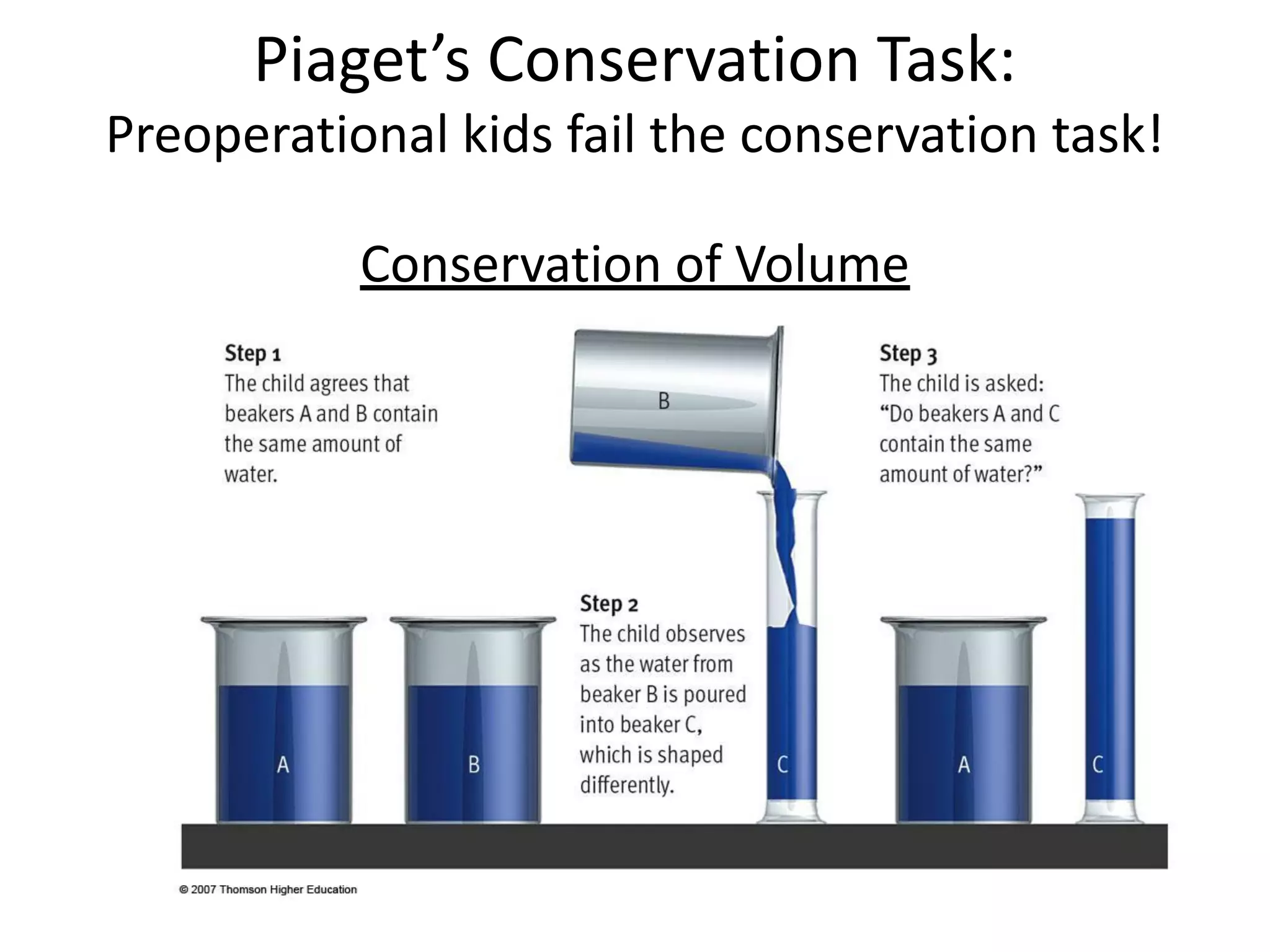
• CONSERVATION: understanding that properties such as mass,
volume, and number stay the same despite changes in shapes
Kids in the Preoperational Stage fail to understand conservation.
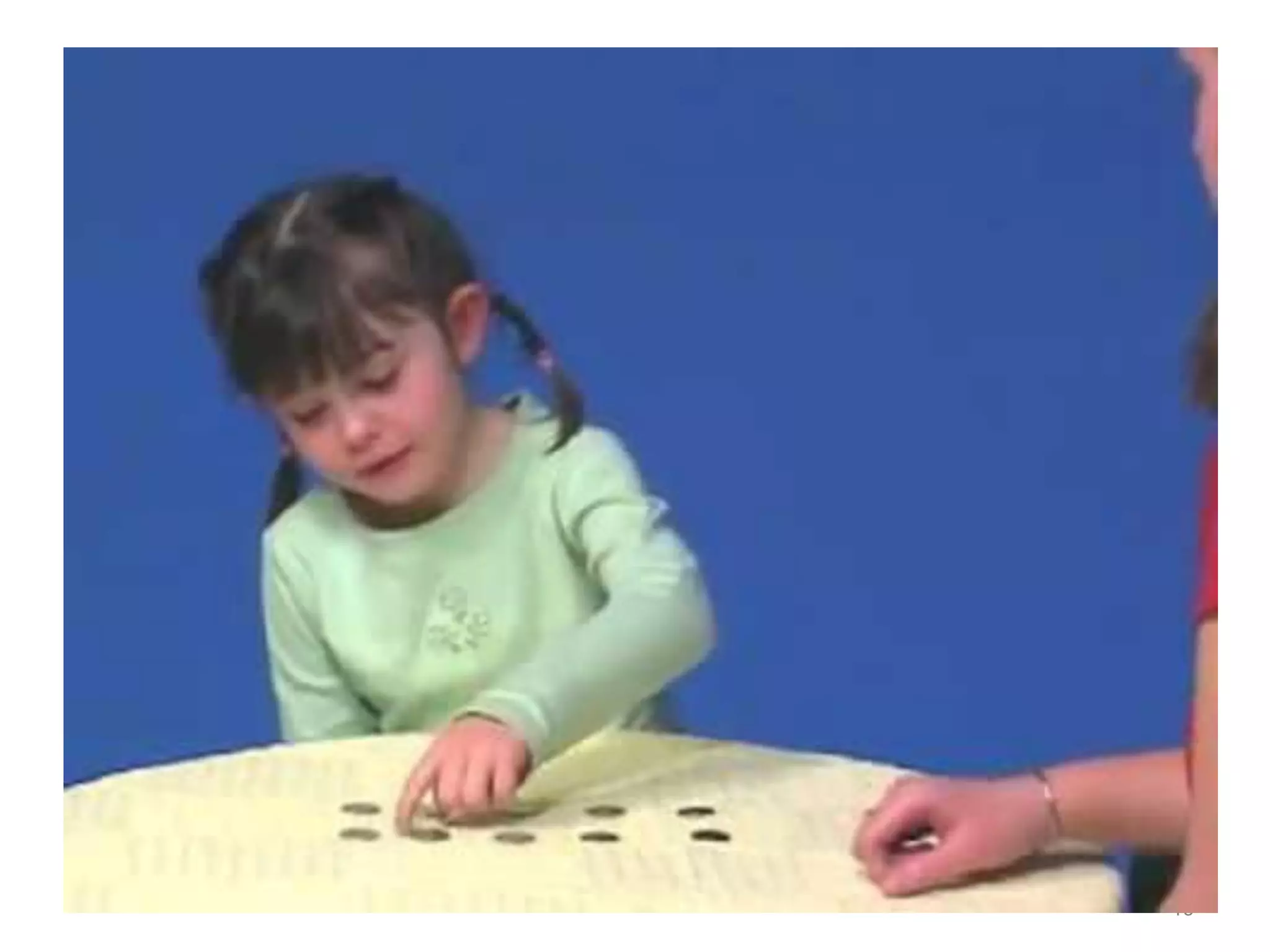
Piaget’s Conservation Task:
Preoperational kids fail the conservation task!
Conservation of Volume
19
3. Concrete Operations
(7-11 years)
20
•Kids can now pass the conservation task! Why?
1. REVERSIBILITY: the ability to think through a series of steps and
mentally “un-do” them
2. DECENTRATION: focusing on several aspects of a problem and
relating them, rather than focusing on just one
•Can reason logically about concrete events
•Can categorize objects and events into multiple sets
4. Formal Operations
(11 years – adulthood)
21
• Thought becomes:
– Abstract
– Systematic
– Logical
– Reflective
Research suggests that 50% of
adults never get to this stage!
Lecture Outline
•Biological Development
•Cognitive Development
•Social Development
22
Social Development
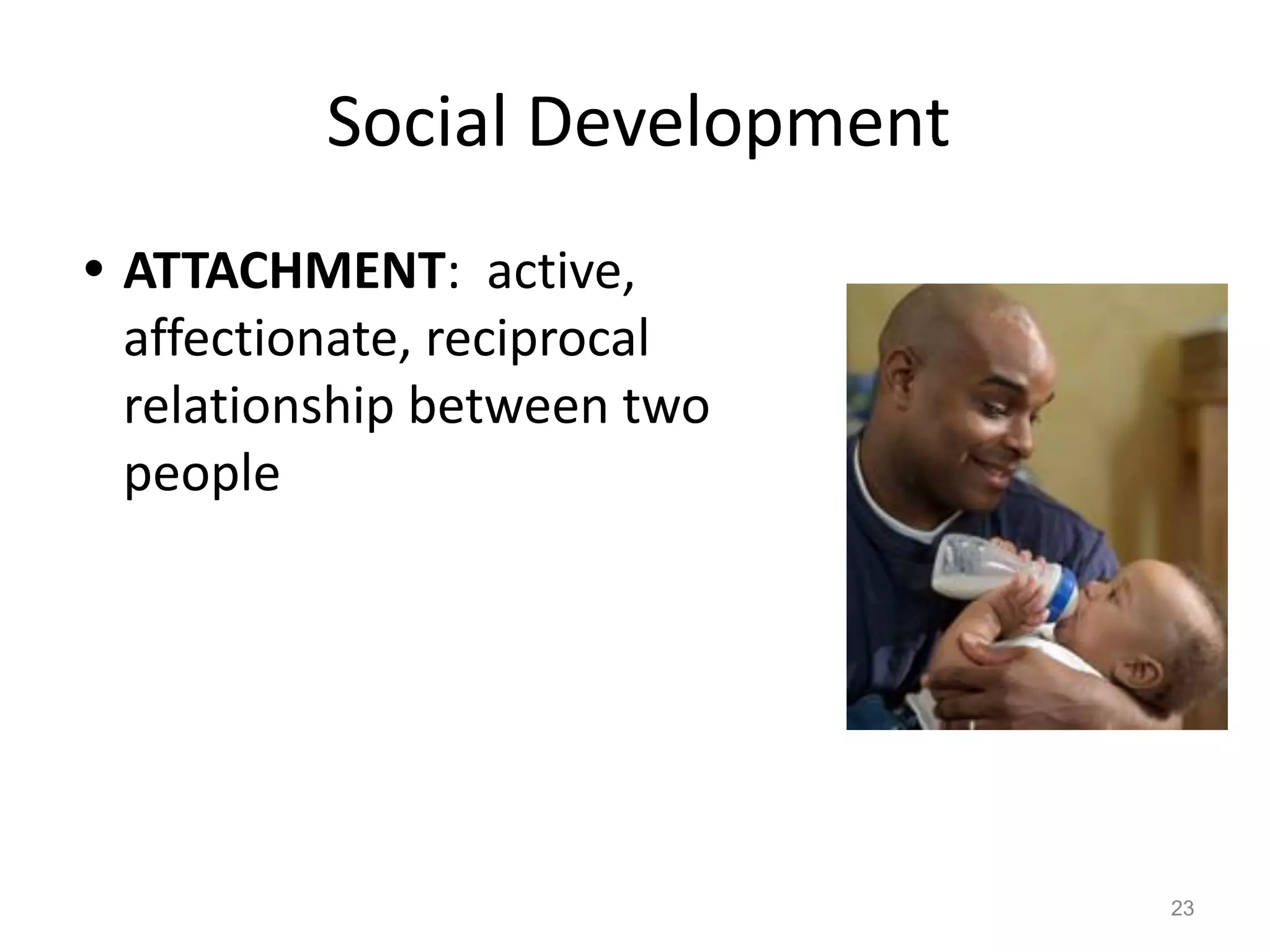
• ATTACHMENT: active,
affectionate, reciprocal
relationship between two
people
23
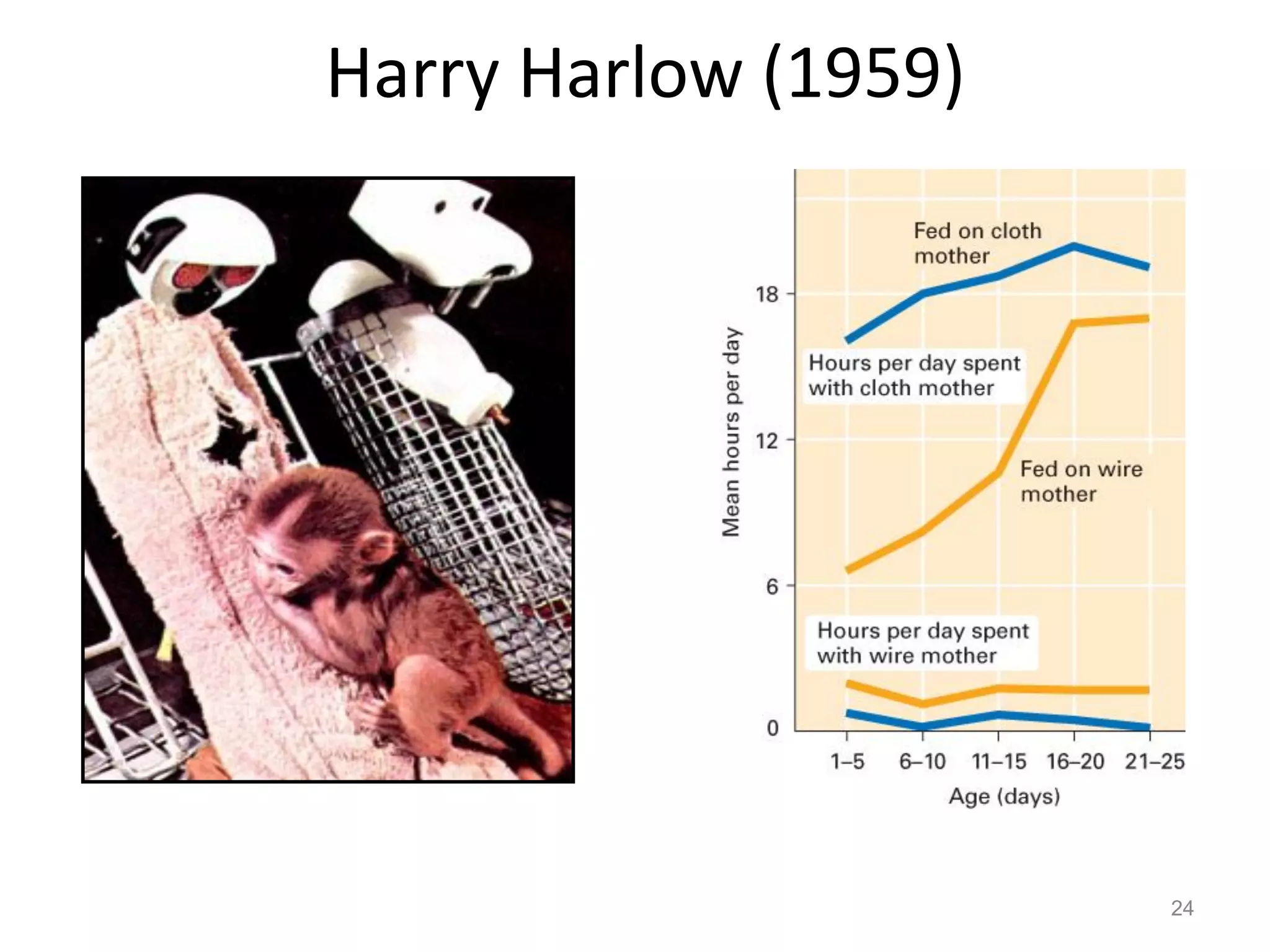
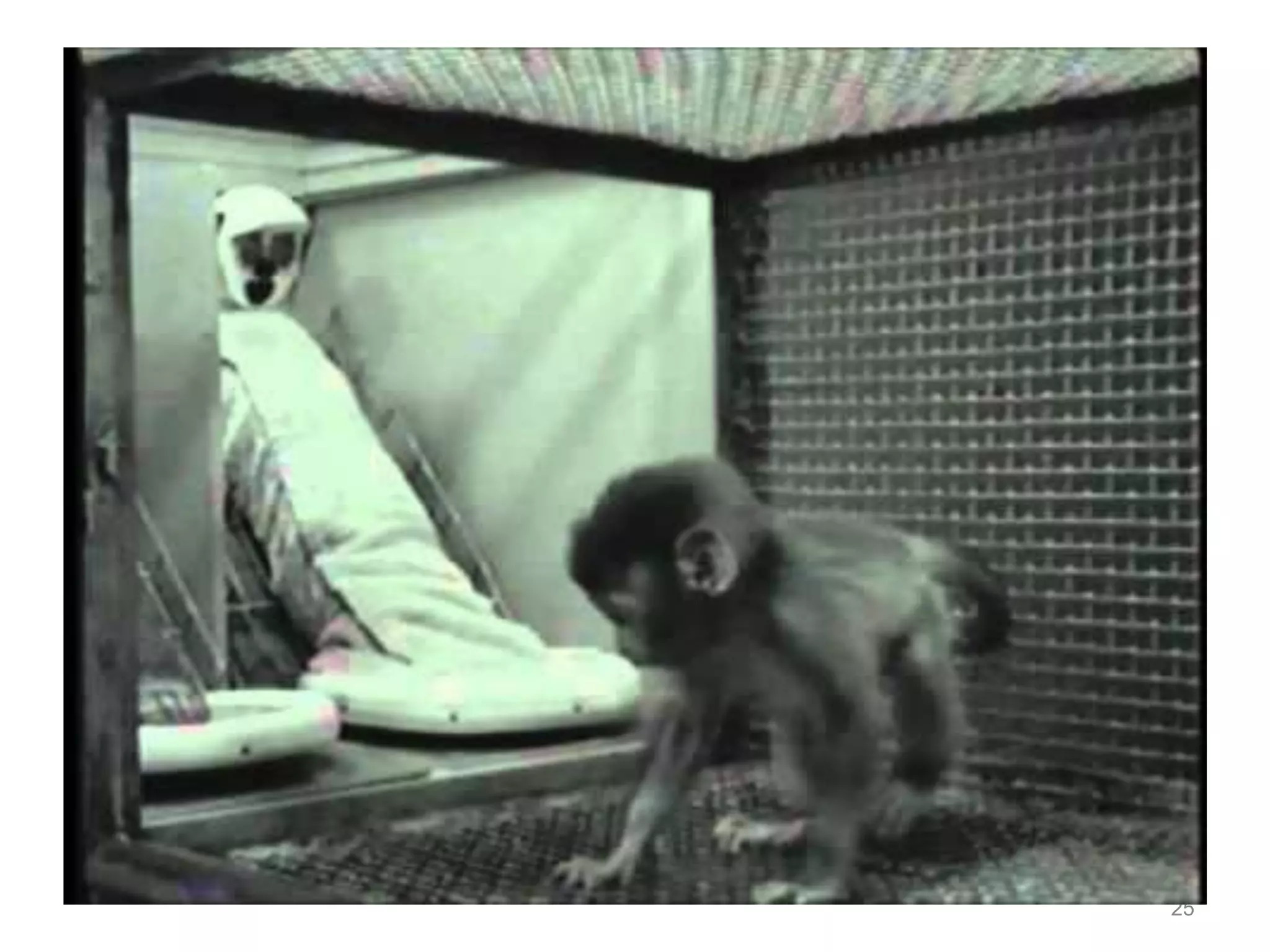
Harry Harlow (1959)
24
25
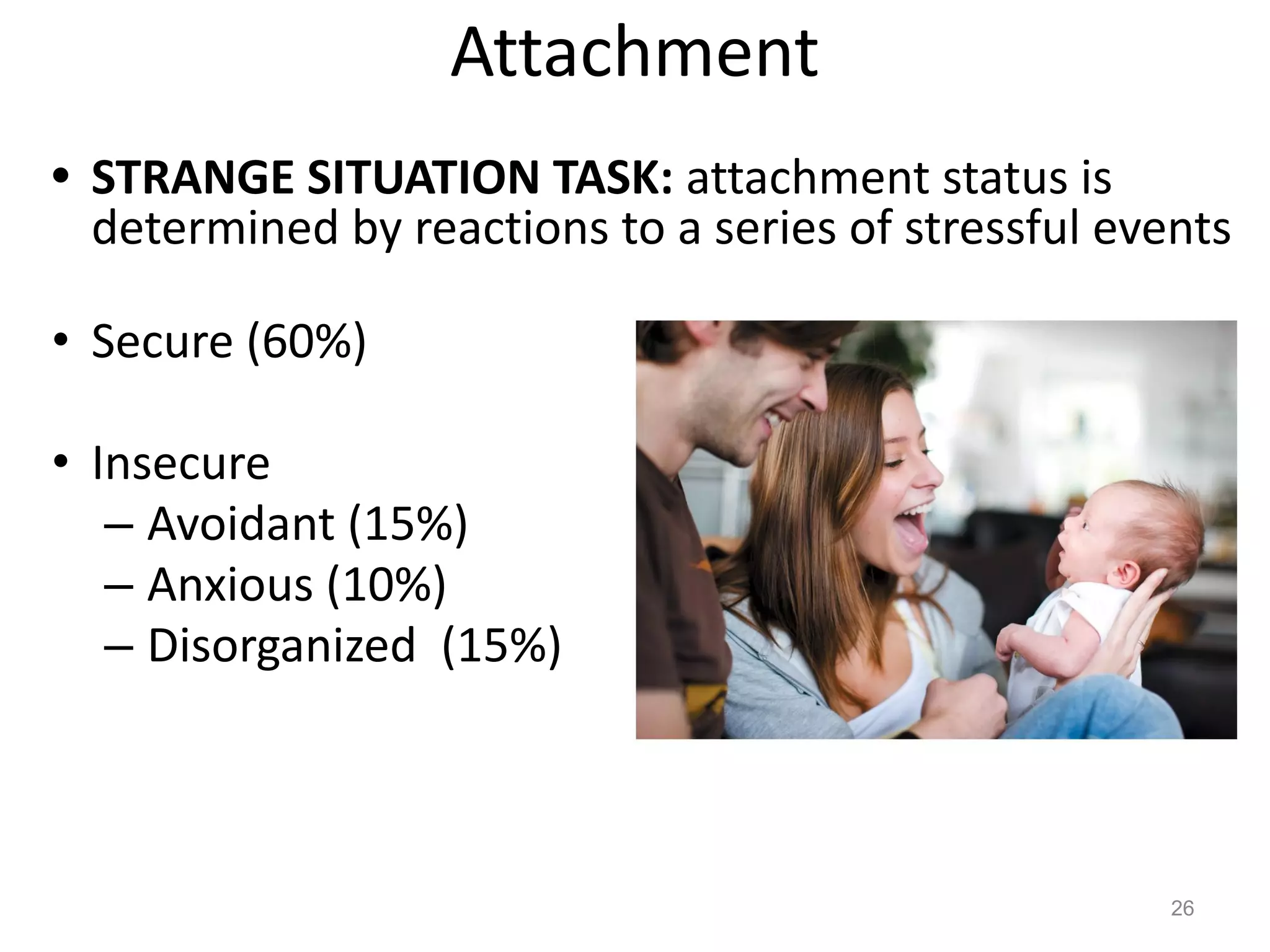
Attachment
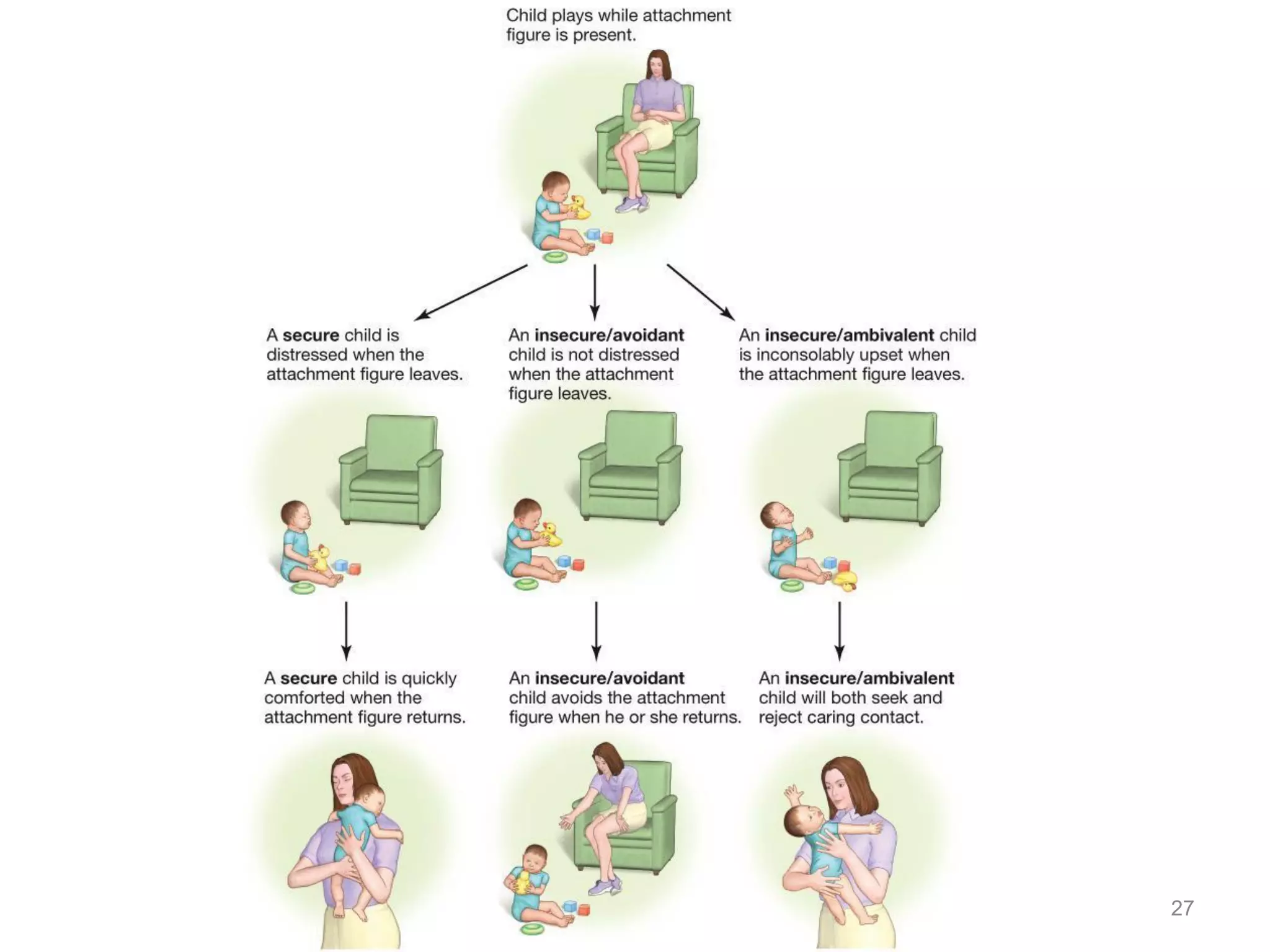
• STRANGE SITUATION TASK: attachment status is
determined by reactions to a series of stressful events
• Secure (60%)
• Insecure
– Avoidant (15%)
– Anxious (10%)
– Disorganized (15%)
26
27
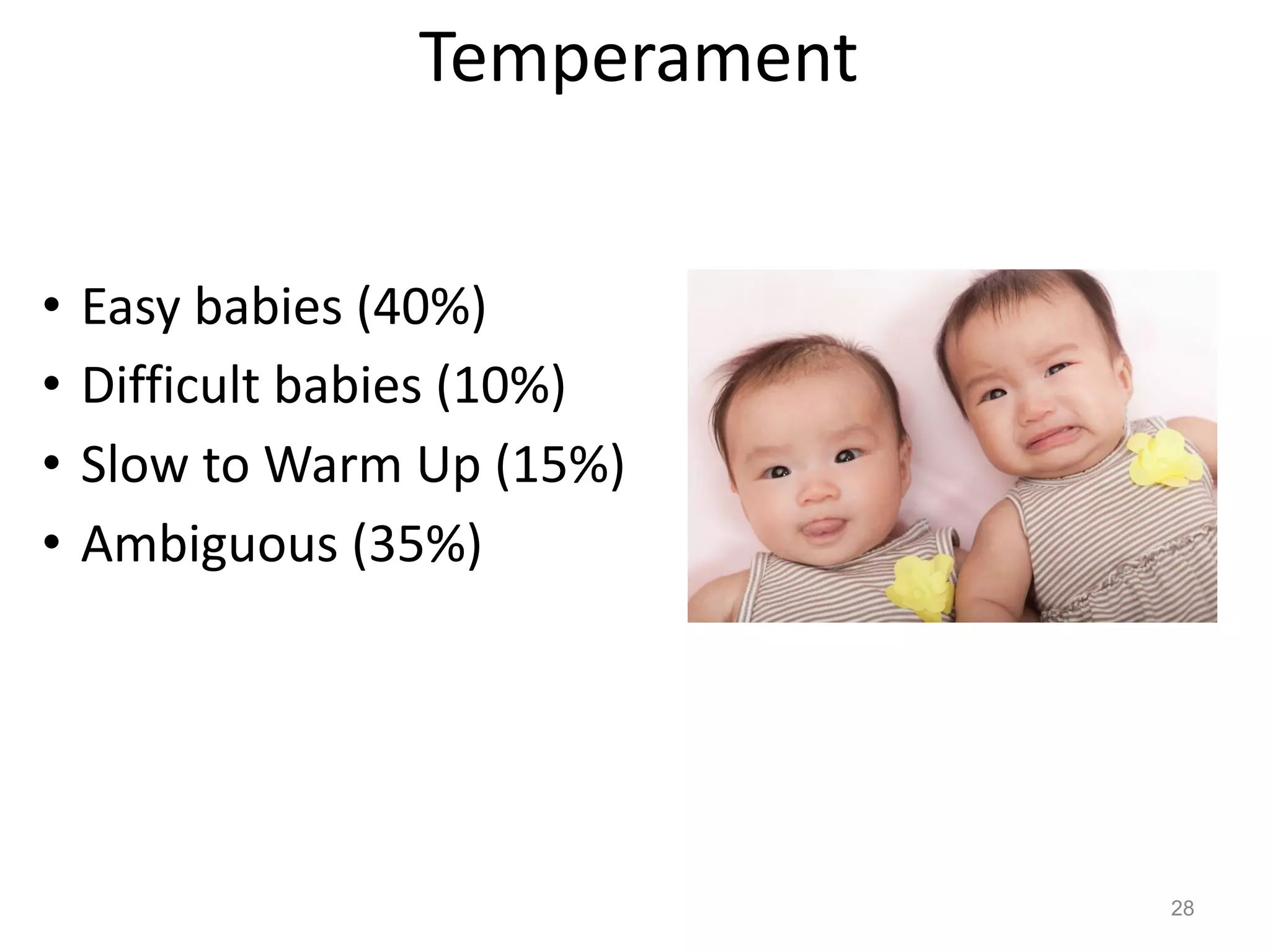
Temperament
• Easy babies (40%)
• Difficult babies (10%)
• Slow to Warm Up (15%)
• Ambiguous (35%)
28
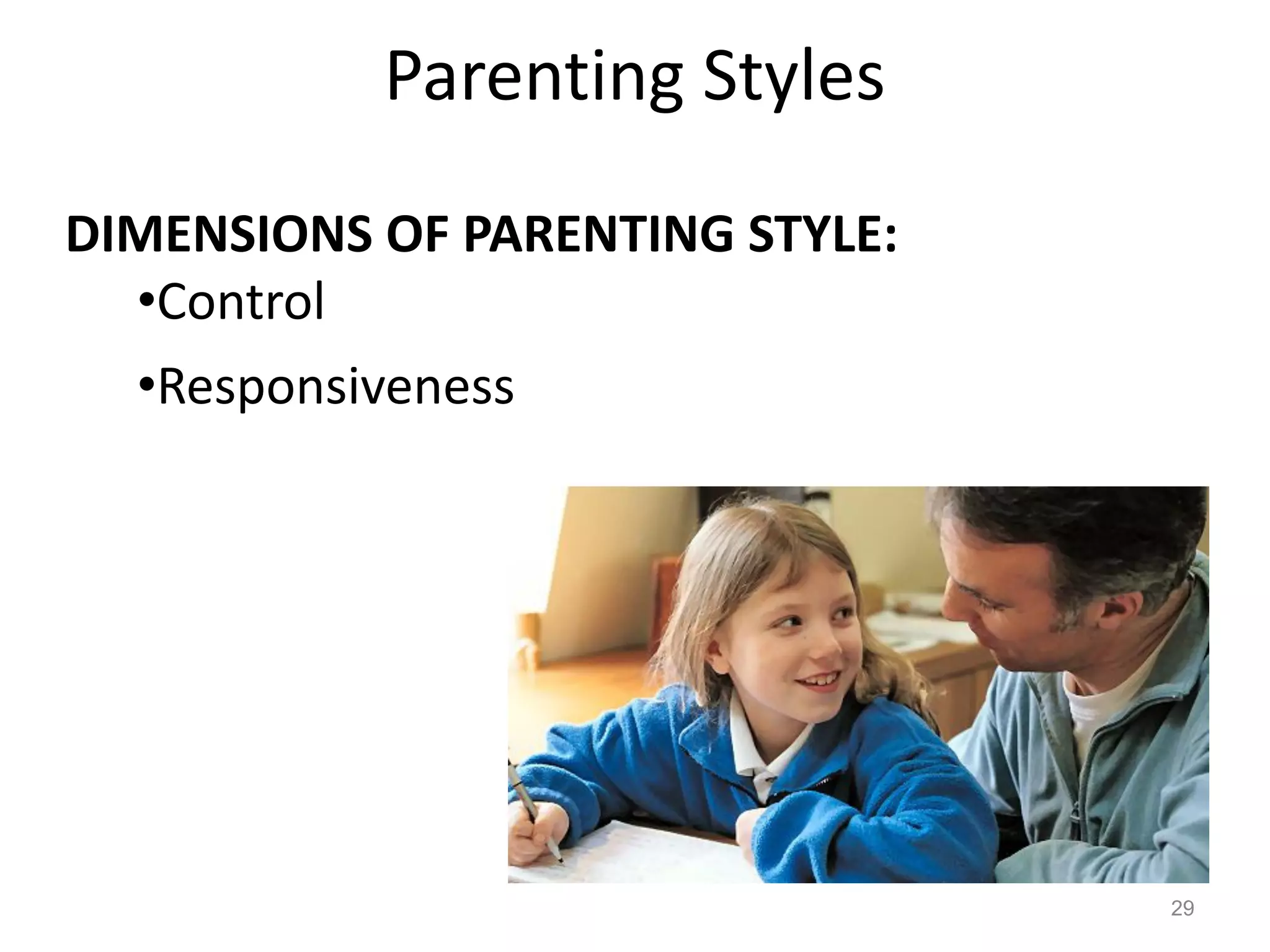
Parenting Styles
29
DIMENSIONS OF PARENTING STYLE:
•Control
•Responsiveness
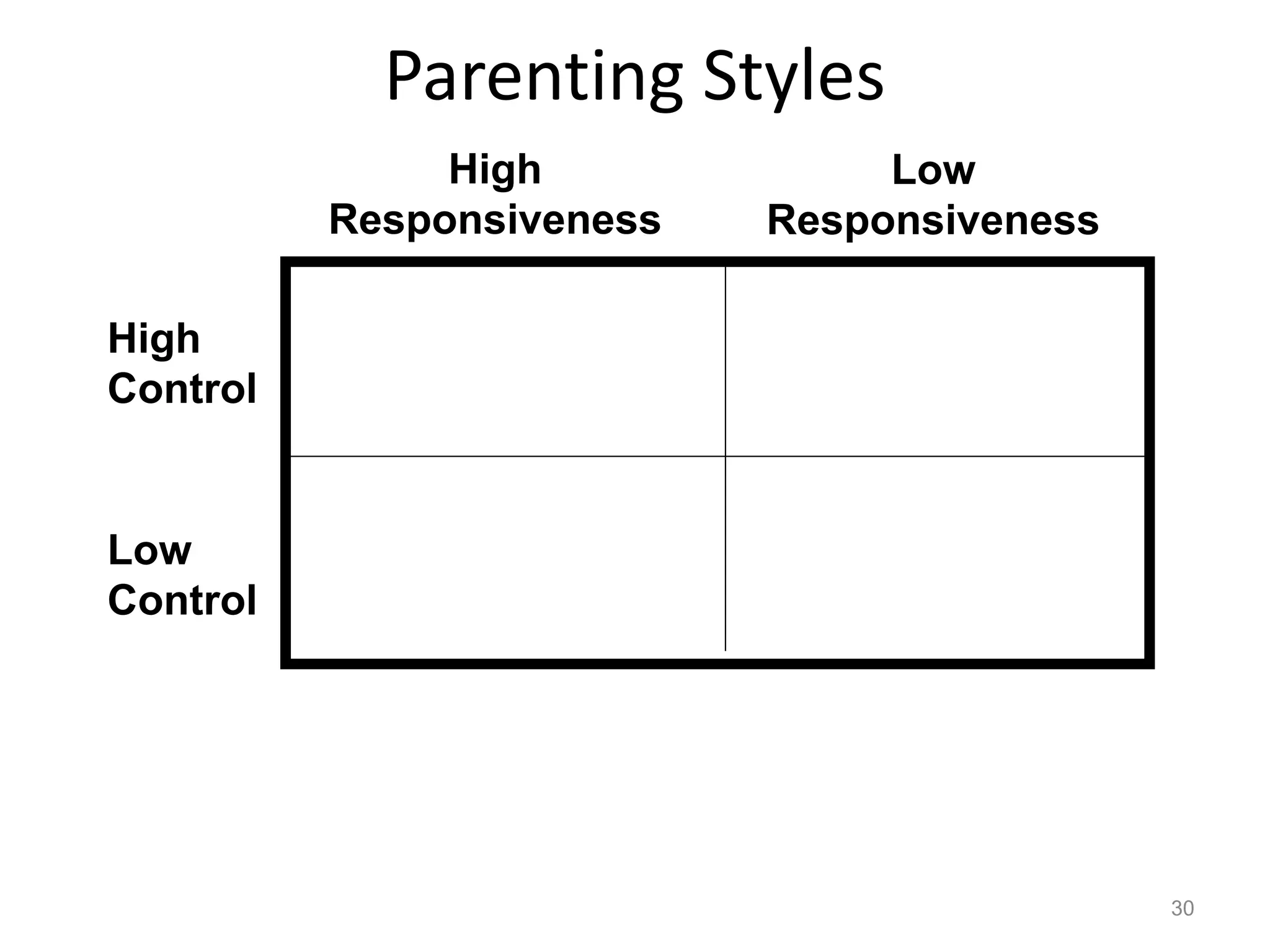
Parenting Styles
30
Authoritative Authoritarian
Permissive Uninvolved
High
Control
Low
Control
High
Responsiveness
Low
Responsiveness
Social Development
Across the Lifespan
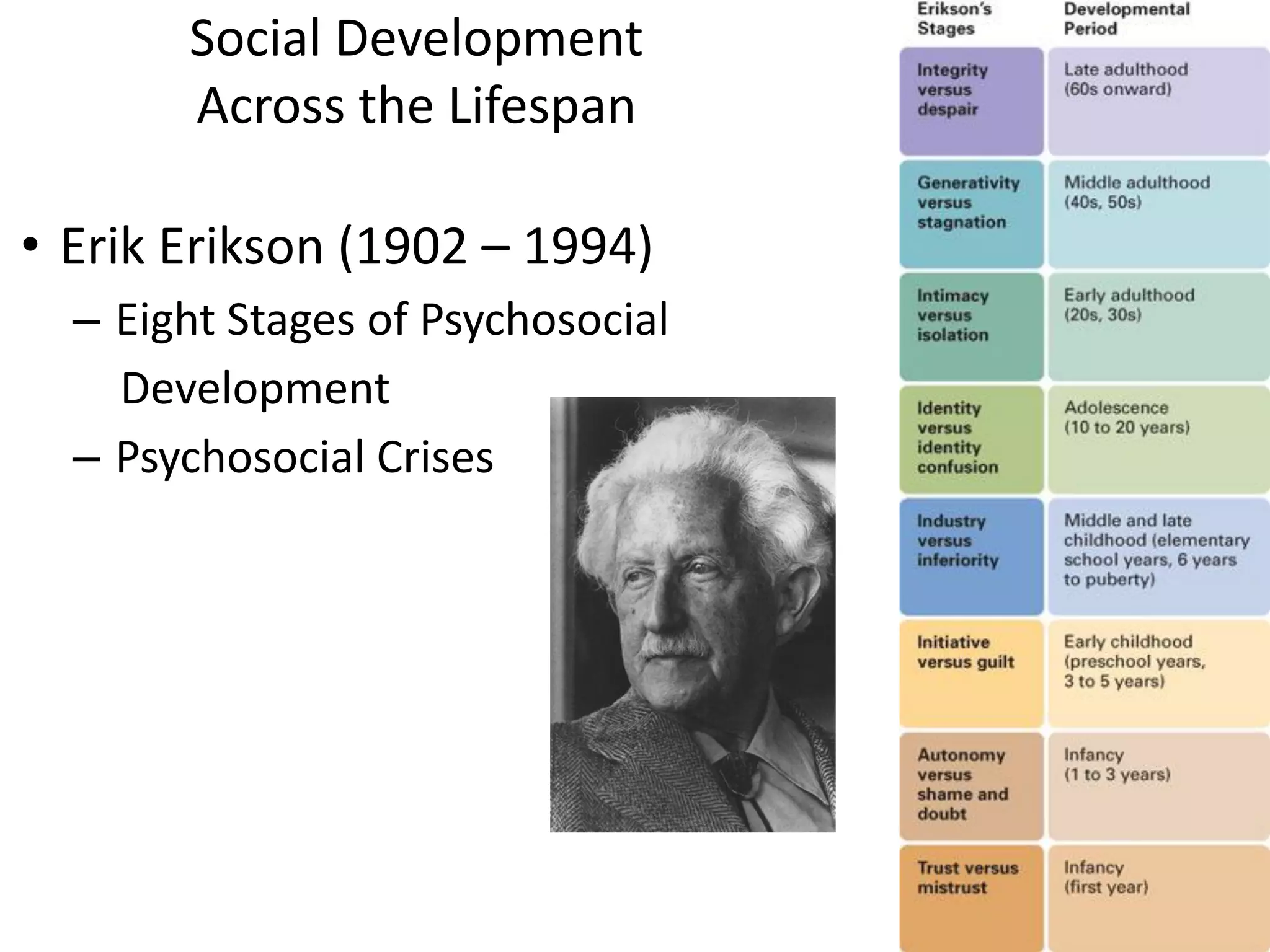
• Erik Erikson (1902 – 1994)
– Eight Stages of Psychosocial
Development
– Psychosocial Crises
31
Psychosocial Stages
5. IDENTITY VS. ROLE CONFUSION:
– Teens work develop a sense of self by testing roles &
blending them to form a single identity. OR
– They become confused about who they are.
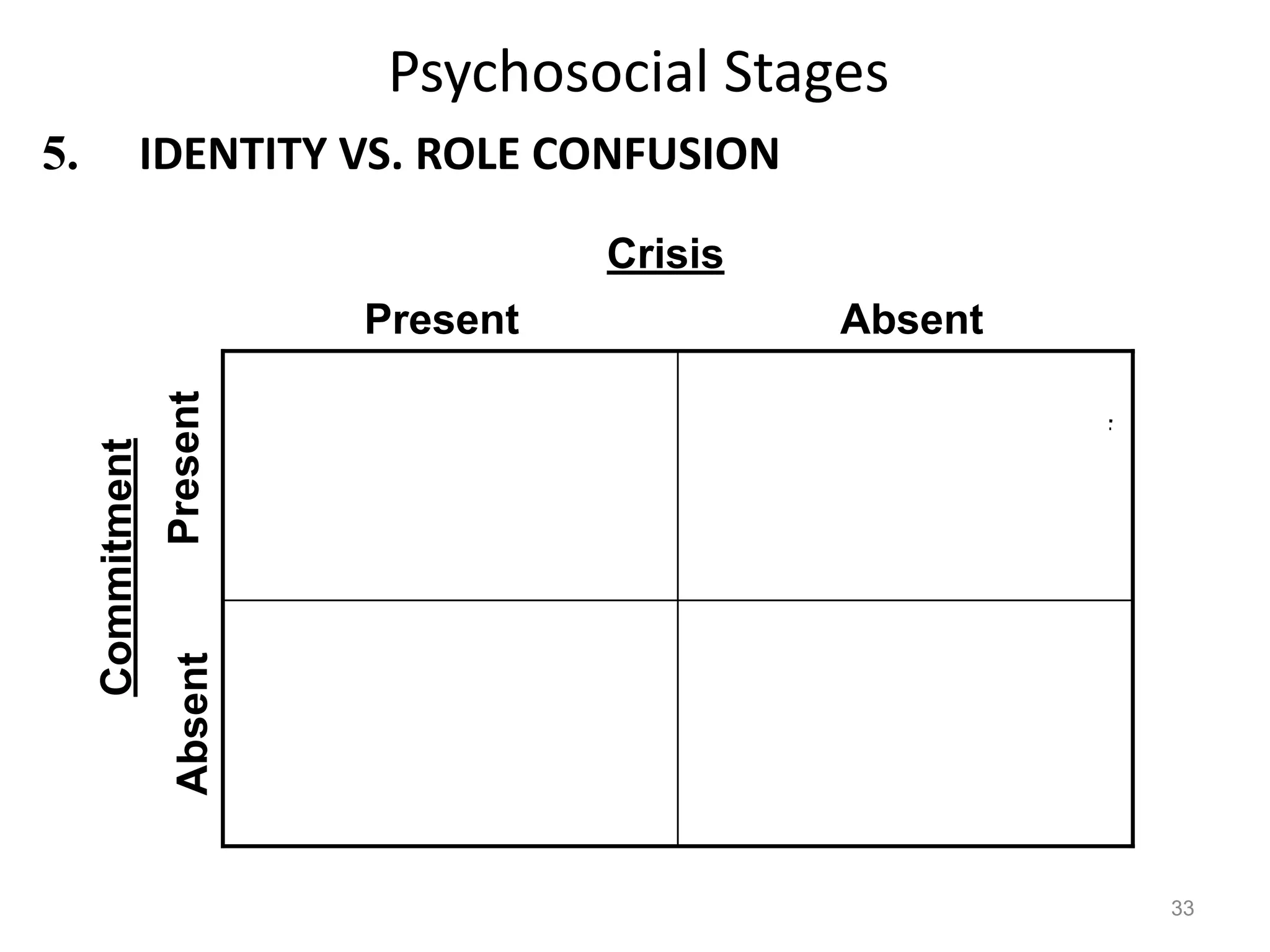
• TWO DIMENSIONS OF IDENTITY:
– CRISIS: period of considering alternatives
– COMMITMENT: adherence to a path of action
32
Psychosocial Stages
5. IDENTITY VS. ROLE CONFUSION
33
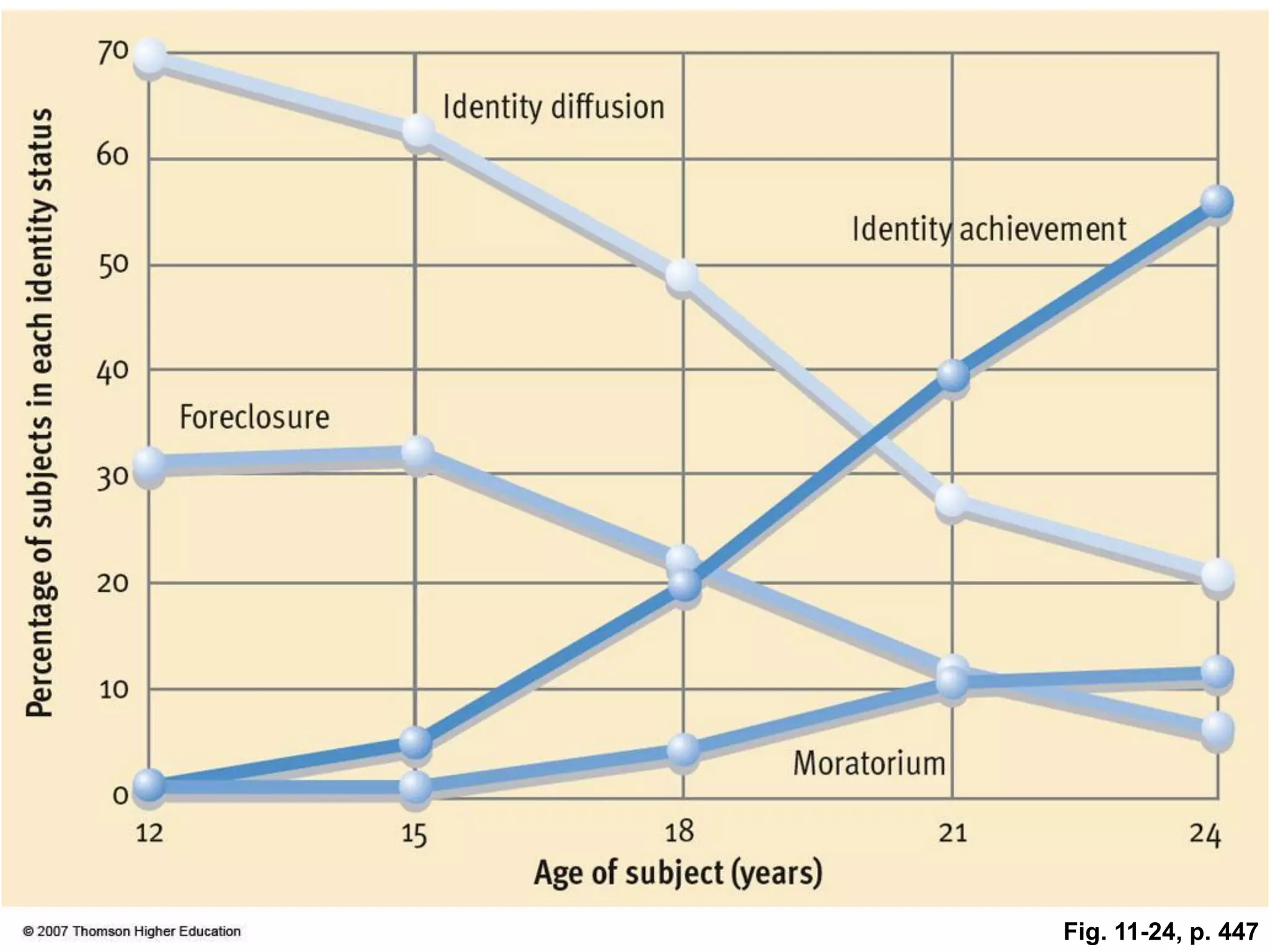
DIFFUSION:
Failure to develop an
identity because of a
lack of goals
MORATORIUM:
Trying on several
identities to without
intending to settle
FORECLOSURE:
Uncritical acceptance of
parental values &
desires
ACHIEVEMENT:
Adoption of well-chosen
values & goals
Present
Present
Absent
Absent
Crisis
Commitment
34
Fig. 11-24, p. 447
Psychosocial Stages
6. INTIMACY VS. ISOLATION –
– Young adults struggle to form close relationships and
to gain the capacity for intimate love. OR
– They feel socially isolated.
7. GENERATIVITY VS. STAGNATION
– Middle-aged adults discover a sense of contributing to the world
through family & work. OR
– They feel a lack of purpose.
8. EGO-INTEGRITY VS. DESPAIR
– Older adults reflect on life and feel a sense of satisfaction. OR
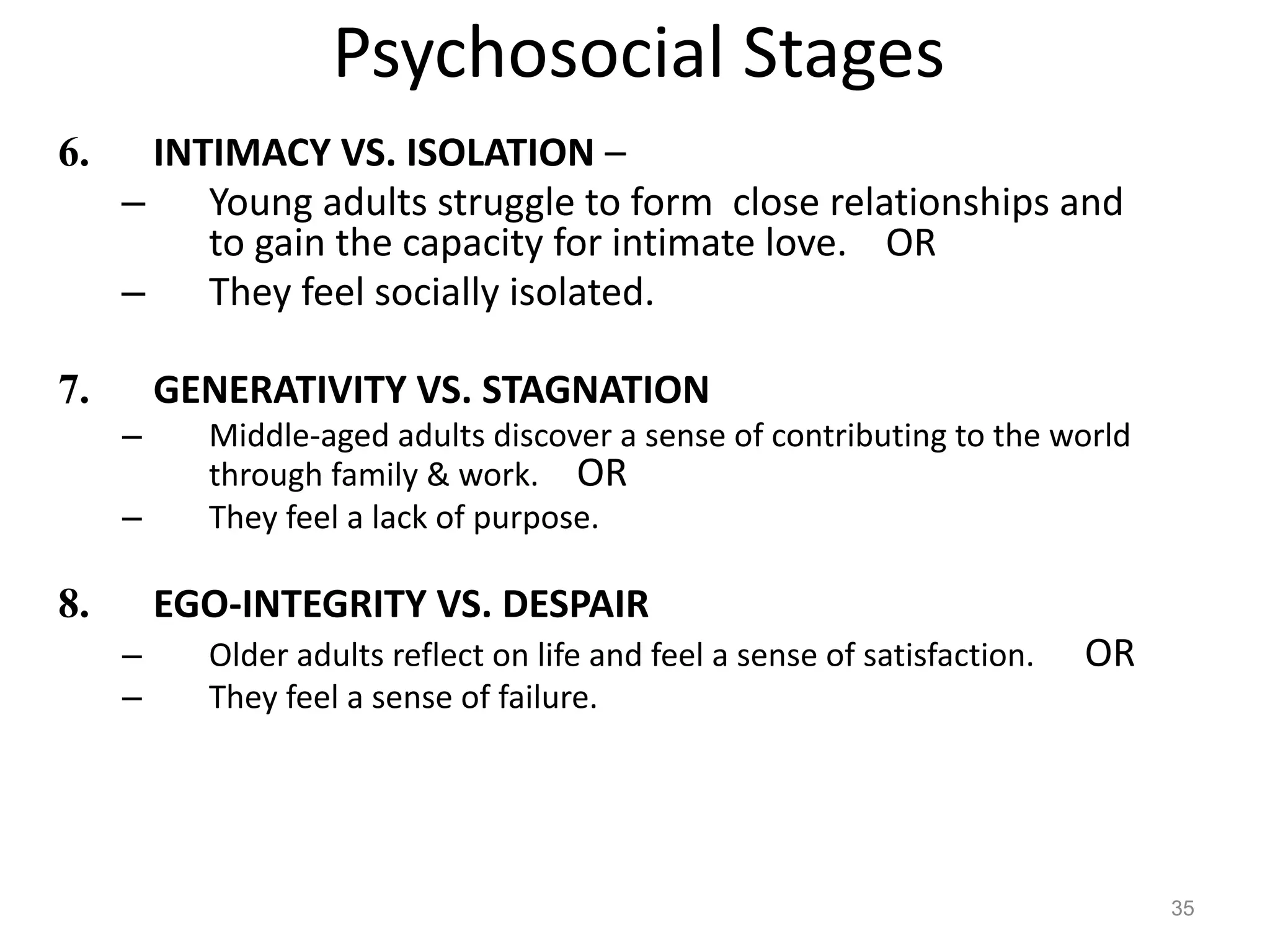
– They feel a sense of failure.
35

Ch09 Lifespan Development

  • 1.
  • 2.
    DEVELOPMENT: the patternof movement or change that occurs across the lifespan
  • 3.
  • 4.
    Lecture Outline •Biological Development •CognitiveDevelopment •Social Development 4
  • 5.
    Biological Development • PRENATALDEVELOPMENT: Conception to birth • ZYGOTE: combination of a sperm and an egg 5
  • 6.
    Stages of PrenatalDevelopment: 1. GERMINAL STAGE: conception – 2 weeks 2. EMBRYONIC STAGE: 3rd – 8th weeks 3. FETAL STAGE: 9th week – birth AGE OF VIABILITY: around 22-23 weeks 6
  • 7.
    Prenatal Supports &Risks • PLACENTA: organ that… – Provides nutrients & removes waste – Filters out harmful substances • TERATOGENS: any agent that can cause harm prenatally • CRITICAL PERIODS: time when growth must occur for development to proceed normally 7
  • 8.
  • 9.
    Teratogens 9 LEGAL DRUGS • OTC& PRESCRIPTION MEDS • CAFFEINE • ALCOHOL • SMOKING ILLEGAL DRUGS ENVIRONMENTAL HAZARDS MATERNAL DISEASE
  • 14.
    Lecture Outline •Biological Development •CognitiveDevelopment •Social Development 14
  • 15.
    Theory of CognitiveDevelopment • Jean Piaget (1896 – 1980) • Children: – Are active and inventive – Acquire knowledge through experience – Develop in a series of stages
  • 16.
    16 • SCHEMAS: mentalrepresentations that organize knowledge • ASSIMILATION: new info is understood through existing schemes • ACCOMMODATION: schemes are adjusted to fit new info • OBJECT PERMANENCE: understanding that objects continue to exist, even when they can’t be observed 1. Sensorimotor Stage (birth – 2 years)
  • 17.
    2. Preoperational Stage (2-7years) 17 • SYMBOLIC THINKING: representing the world with words and images • EGOCENTRISM: difficulty taking another person’s point of view • ANIMISM: the belief that inanimate objects have lifelike qualities • CONSERVATION: understanding that properties such as mass, volume, and number stay the same despite changes in shapes Kids in the Preoperational Stage fail to understand conservation.
  • 18.
    Piaget’s Conservation Task: Preoperationalkids fail the conservation task! Conservation of Volume
  • 19.
  • 20.
    3. Concrete Operations (7-11years) 20 •Kids can now pass the conservation task! Why? 1. REVERSIBILITY: the ability to think through a series of steps and mentally “un-do” them 2. DECENTRATION: focusing on several aspects of a problem and relating them, rather than focusing on just one •Can reason logically about concrete events •Can categorize objects and events into multiple sets
  • 21.
    4. Formal Operations (11years – adulthood) 21 • Thought becomes: – Abstract – Systematic – Logical – Reflective Research suggests that 50% of adults never get to this stage!
  • 22.
    Lecture Outline •Biological Development •CognitiveDevelopment •Social Development 22
  • 23.
    Social Development • ATTACHMENT:active, affectionate, reciprocal relationship between two people 23
  • 24.
  • 25.
  • 26.
    Attachment • STRANGE SITUATIONTASK: attachment status is determined by reactions to a series of stressful events • Secure (60%) • Insecure – Avoidant (15%) – Anxious (10%) – Disorganized (15%) 26
  • 27.
  • 28.
    Temperament • Easy babies(40%) • Difficult babies (10%) • Slow to Warm Up (15%) • Ambiguous (35%) 28
  • 29.
    Parenting Styles 29 DIMENSIONS OFPARENTING STYLE: •Control •Responsiveness
  • 30.
    Parenting Styles 30 Authoritative Authoritarian PermissiveUninvolved High Control Low Control High Responsiveness Low Responsiveness
  • 31.
    Social Development Across theLifespan • Erik Erikson (1902 – 1994) – Eight Stages of Psychosocial Development – Psychosocial Crises 31
  • 32.
    Psychosocial Stages 5. IDENTITYVS. ROLE CONFUSION: – Teens work develop a sense of self by testing roles & blending them to form a single identity. OR – They become confused about who they are. • TWO DIMENSIONS OF IDENTITY: – CRISIS: period of considering alternatives – COMMITMENT: adherence to a path of action 32
  • 33.
    Psychosocial Stages 5. IDENTITYVS. ROLE CONFUSION 33 DIFFUSION: Failure to develop an identity because of a lack of goals MORATORIUM: Trying on several identities to without intending to settle FORECLOSURE: Uncritical acceptance of parental values & desires ACHIEVEMENT: Adoption of well-chosen values & goals Present Present Absent Absent Crisis Commitment
  • 34.
  • 35.
    Psychosocial Stages 6. INTIMACYVS. ISOLATION – – Young adults struggle to form close relationships and to gain the capacity for intimate love. OR – They feel socially isolated. 7. GENERATIVITY VS. STAGNATION – Middle-aged adults discover a sense of contributing to the world through family & work. OR – They feel a lack of purpose. 8. EGO-INTEGRITY VS. DESPAIR – Older adults reflect on life and feel a sense of satisfaction. OR – They feel a sense of failure. 35