Ch08: Hormones & Sex
➔The Endocrine System
➔The Pituitary Gland
➔Reproductive Behavior
➔Sexual Differentiation
➔Sexual Dimorphism
➔Sexual Orientation
THE ENDOCRINE SYSTEM
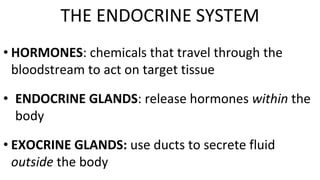
• HORMONES: chemicals that travel through the
bloodstream to act on target tissue
• ENDOCRINE GLANDS: release hormones within the
body
• EXOCRINE GLANDS: use ducts to secrete fluid
outside the body
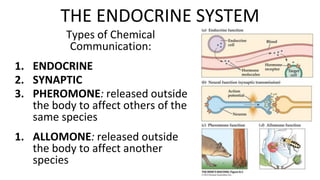
Types of Chemical
Communication:
1. ENDOCRINE
2. SYNAPTIC
3. PHEROMONE: released outside
the body to affect others of the
same species
1. ALLOMONE: released outside
the body to affect another
species
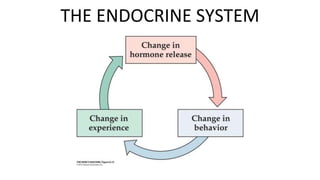
THE ENDOCRINE SYSTEM
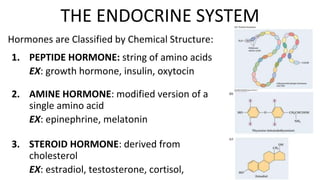
Hormones are Classified by Chemical Structure:
1. PEPTIDE HORMONE: string of amino acids
EX: growth hormone, insulin, oxytocin
2. AMINE HORMONE: modified version of a
single amino acid
EX: epinephrine, melatonin
3. STEROID HORMONE: derived from
cholesterol
EX: estradiol, testosterone, cortisol,
THE ENDOCRINE SYSTEM
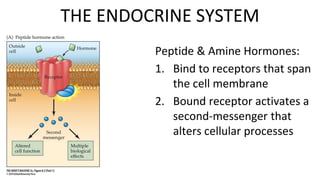
Peptide & Amine Hormones:
1. Bind to receptors that span
the cell membrane
2. Bound receptor activates a
second-messenger that
alters cellular processes
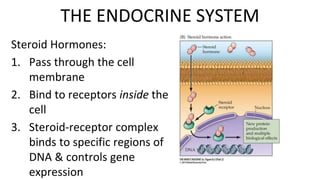
Steroid Hormones:
1. Pass through the cell
membrane
2. Bind to receptors inside the
cell
3. Steroid-receptor complex
binds to specific regions of
DNA & controls gene
expression
THE ENDOCRINE SYSTEM
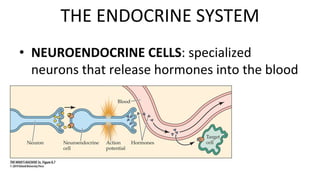
• NEUROENDOCRINE CELLS: specialized
neurons that release hormones into the blood
THE ENDOCRINE SYSTEM
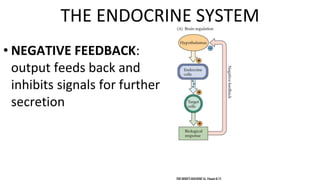
• NEGATIVE FEEDBACK:
output feeds back and
inhibits signals for further
secretion
THE ENDOCRINE SYSTEM
Ch08: Hormones & Sex
➔The Endocrine System
➔The Pituitary Gland
➔Reproductive Behavior
➔Sexual Differentiation
➔Sexual Dimorphism
➔Sexual Orientation
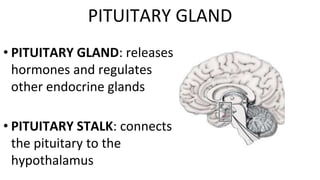
• PITUITARY GLAND: releases
hormones and regulates
other endocrine glands
• PITUITARY STALK: connects
the pituitary to the
hypothalamus
PITUITARY GLAND
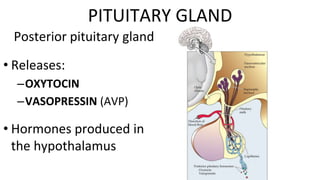
Posterior pituitary gland
• Releases:
–OXYTOCIN
–VASOPRESSIN (AVP)
• Hormones produced in
the hypothalamus
PITUITARY GLAND
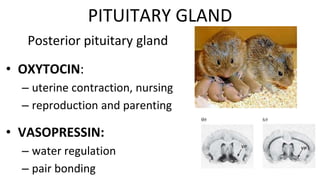
Posterior pituitary gland
• OXYTOCIN:
– uterine contraction, nursing
– reproduction and parenting
• VASOPRESSIN:
– water regulation
– pair bonding
PITUITARY GLAND
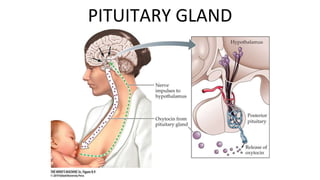
Figure 8.9 The Milk Letdown Reflex
PITUITARY GLAND
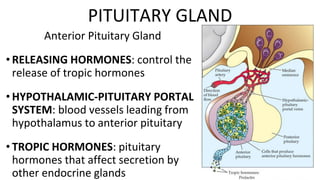
Anterior Pituitary Gland
• RELEASING HORMONES: control the
release of tropic hormones
• HYPOTHALAMIC-PITUITARY PORTAL
SYSTEM: blood vessels leading from
hypothalamus to anterior pituitary
• TROPIC HORMONES: pituitary
hormones that affect secretion by
other endocrine glands
PITUITARY GLAND
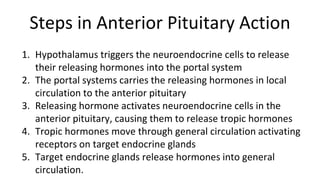
Steps in Anterior Pituitary Action
1. Hypothalamus triggers the neuroendocrine cells to release
their releasing hormones into the portal system
2. The portal systems carries the releasing hormones in local
circulation to the anterior pituitary
3. Releasing hormone activates neuroendocrine cells in the
anterior pituitary, causing them to release tropic hormones
4. Tropic hormones move through general circulation activating
receptors on target endocrine glands
5. Target endocrine glands release hormones into general
circulation.
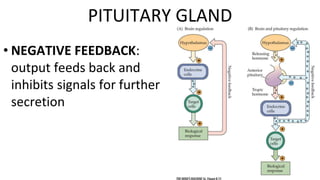
• NEGATIVE FEEDBACK:
output feeds back and
inhibits signals for further
secretion
PITUITARY GLAND
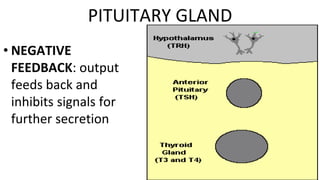
• NEGATIVE
FEEDBACK: output
feeds back and
inhibits signals for
further secretion
PITUITARY GLAND
Hypothalamic neurons that synthesize releasing
hormones are sensitive to two influences:
1. Circulating messages such as other hormones,
which contribute to negative feedback
1. Synaptic input from other brain regions, which
can be inhibitory or excitatory
PITUITARY GLAND
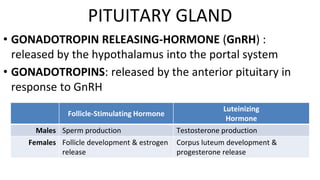
• GONADOTROPIN RELEASING-HORMONE (GnRH) :
released by the hypothalamus into the portal system
• GONADOTROPINS: released by the anterior pituitary in
response to GnRH
PITUITARY GLAND
Follicle-Stimulating Hormone
Luteinizing
Hormone
Males Sperm production Testosterone production
Females Follicle development & estrogen
release
Corpus luteum development &
progesterone release
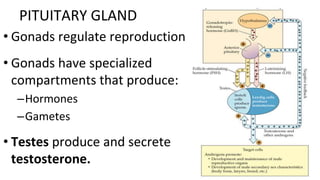
• Gonads regulate reproduction
• Gonads have specialized
compartments that produce:
–Hormones
–Gametes
• Testes produce and secrete
testosterone.
PITUITARY GLAND
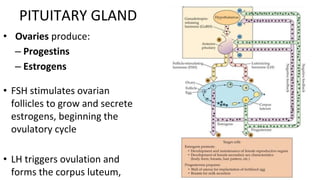
• Ovaries produce:
– Progestins
– Estrogens
• FSH stimulates ovarian
follicles to grow and secrete
estrogens, beginning the
ovulatory cycle
• LH triggers ovulation and
forms the corpus luteum,
PITUITARY GLAND
Ch08: Hormones & Sex
➔The Endocrine System
➔The Pituitary Gland
➔Reproductive Behavior
➔Sexual Differentiation
➔Sexual Dimorphism
➔Sexual Orientation
Ch08: Hormones & Sex
➔The Endocrine System
➔The Pituitary Gland
➔Reproductive Behavior
➔Sexual Differentiation
➔Sexual Dimorphism
➔Sexual Orientation
The Case of Caster Semenya
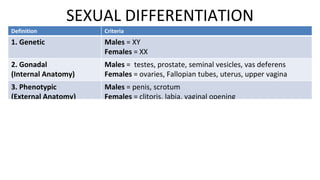
SEXUAL DIFFERENTIATION
• SEXUAL DIFFERENTIATION: the process of
developing male/female bodies and behaviors
• SEX DETERMINATION: early developmental
events that determines sex
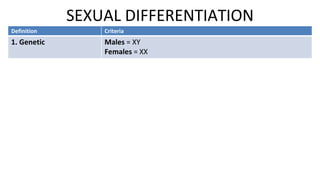
Definition Criteria
1. Genetic Males = XY
Females = XX
2. Gonadal
(Internal Anatomy)
Males = testes, prostate, seminal vesicles, vas deferens
Females = ovaries, Fallopian tubes, uterus, upper vagina
3. Phenotypic
(External Anatomy)
Males = penis, scrotum
Females = clitoris, labia, vaginal opening
4. Secondary Sex
Characteristics
Males = facial hair, enlarged larynx, broader shoulders +
narrow hips, increased muscle mass, larger bodies, heavier
bones
Females = breasts, narrow shoulders + wider hips, higher
proportion of body fat
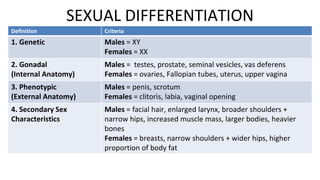
SEXUAL DIFFERENTIATION
Definition Criteria
1. Genetic Males = XY
Females = XX
2. Gonadal
(Internal Anatomy)
Males = testes, prostate, seminal vesicles, vas deferens
Females = ovaries, Fallopian tubes, uterus, upper vagina
3. Phenotypic
(External Anatomy)
Males = penis, scrotum
Females = clitoris, labia, vaginal opening
4. Secondary Sex
Characteristics
Males = facial hair, enlarged larynx, broader shoulders +
narrow hips, increased muscle mass, larger bodies, heavier
bones
Females = breasts, narrow shoulders + wider hips, higher
proportion of body fat
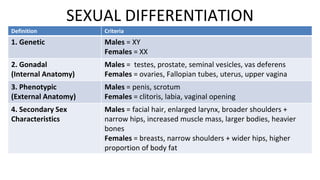
SEXUAL DIFFERENTIATION
Definition Criteria
1. Genetic Males = XY
Females = XX
2. Gonadal
(Internal Anatomy)
Males = testes, prostate, seminal vesicles, vas deferens
Females = ovaries, Fallopian tubes, uterus, upper vagina
3. Phenotypic
(External Anatomy)
Males = penis, scrotum
Females = clitoris, labia, vaginal opening
4. Secondary Sex
Characteristics
Males = facial hair, enlarged larynx, broader shoulders +
narrow hips, increased muscle mass, larger bodies, heavier
bones
Females = breasts, narrow shoulders + wider hips, higher
proportion of body fat
SEXUAL DIFFERENTIATION
Definition Criteria
1. Genetic Males = XY
Females = XX
2. Gonadal
(Internal Anatomy)
Males = testes, prostate, seminal vesicles, vas deferens
Females = ovaries, Fallopian tubes, uterus, upper vagina
3. Phenotypic
(External Anatomy)
Males = penis, scrotum
Females = clitoris, labia, vaginal opening
4. Secondary Sex
Characteristics
Males = facial hair, enlarged larynx, broader shoulders +
narrow hips, increased muscle mass, larger bodies, heavier
bones
Females = breasts, narrow shoulders + wider hips, higher
proportion of body fat
SEXUAL DIFFERENTIATION
Definition Criteria
1. Genetic Males = XY
Females = XX
2. Gonadal
(Internal Anatomy)
Males = testes, prostate, seminal vesicles, vas deferens
Females = ovaries, Fallopian tubes, uterus, upper vagina
3. Phenotypic
(External Anatomy)
Males = penis, scrotum
Females = clitoris, labia, vaginal opening
4. Secondary Sex
Characteristics
Males = facial hair, enlarged larynx, broader shoulders +
narrow hips, increased muscle mass, larger bodies, heavier
bones
Females = breasts, narrow shoulders + wider hips, higher
proportion of body fat
SEXUAL DIFFERENTIATION
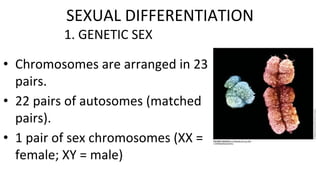
1. GENETIC SEX
• Chromosomes are arranged in 23
pairs.
• 22 pairs of autosomes (matched
pairs).
• 1 pair of sex chromosomes (XX =
female; XY = male)
SEXUAL DIFFERENTIATION
1. GENETIC SEX
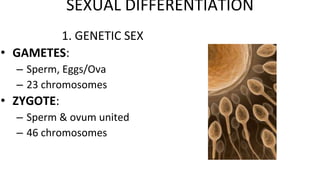
• GAMETES:
– Sperm, Eggs/Ova
– 23 chromosomes
• ZYGOTE:
– Sperm & ovum united
– 46 chromosomes
SEXUAL DIFFERENTIATION
1. GENETIC SEX
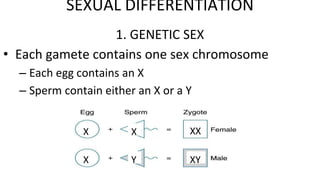
• Each gamete contains one sex chromosome
– Each egg contains an X
– Sperm contain either an X or a Y
X
X Y
X
XY
XX
SEXUAL DIFFERENTIATION
2. GONADAL SEX
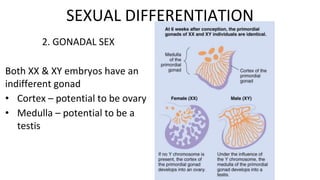
Both XX & XY embryos have an
indifferent gonad
• Cortex – potential to be ovary
• Medulla – potential to be a
testis
SEXUAL DIFFERENTIATION
3. PHENOTYPIC SEX
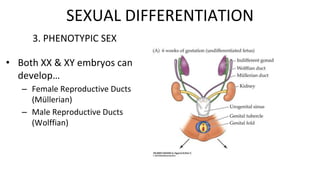
• Both XX & XY embryos can
develop…
– Female Reproductive Ducts
(Müllerian)
– Male Reproductive Ducts
(Wolffian)
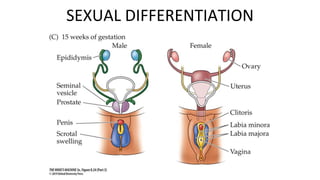
SEXUAL DIFFERENTIATION
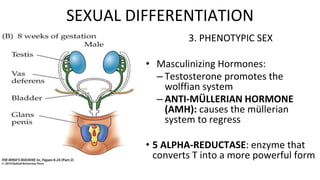
Figure 8.24 Sexual Differentiation
in Humans (Part 2)
SEXUAL DIFFERENTIATION
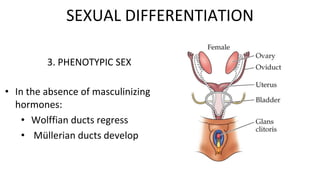
3. PHENOTYPIC SEX
• Masculinizing Hormones:
– Testosterone promotes the
wolffian system
– ANTI-MÜLLERIAN HORMONE
(AMH): causes the müllerian
system to regress
• 5 ALPHA-REDUCTASE: enzyme that
converts T into a more powerful form
SEXUAL DIFFERENTIATION
3. PHENOTYPIC SEX
• In the absence of masculinizing
hormones:
• Wolffian ducts regress
• Müllerian ducts develop
Figure 8.24 Sexual Differentiation
in Humans (Part 3)
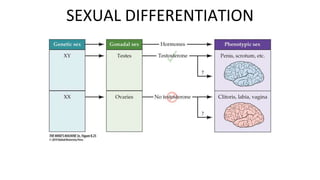
SEXUAL DIFFERENTIATION
Figure 8.25 The Sequence of
Sexual Differentiation
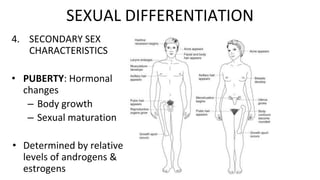
SEXUAL DIFFERENTIATION
4. SECONDARY SEX
CHARACTERISTICS
• PUBERTY: Hormonal
changes
– Body growth
– Sexual maturation
• Determined by relative
levels of androgens &
estrogens
SEXUAL DIFFERENTIATION
• INTERSEX: a person with atypical genital
development and sexual differentiation
– 17/1000 infants are intersex
– NIH Intersex Categories…
SEXUAL DIFFERENTIATION
61
Intersex Categories
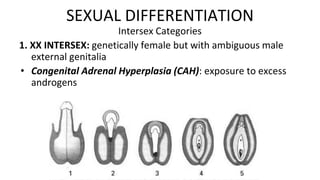
1. XX INTERSEX: genetically female but with ambiguous male
external genitalia
• Congenital Adrenal Hyperplasia (CAH): exposure to excess
androgens
SEXUAL DIFFERENTIATION
62
Intersex Categories
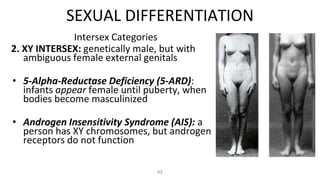
2. XY INTERSEX: genetically male, but with
ambiguous female external genitals
• 5-Alpha-Reductase Deficiency (5-ARD):
infants appear female until puberty, when
bodies become masculinized
• Androgen Insensitivity Syndrome (AIS): a
person has XY chromosomes, but androgen
receptors do not function
SEXUAL DIFFERENTIATION
64
Intersex Categories
3. TRUE GONADAL INTERSEX: has both ovarian and testicular
tissue
• Cause: unknown
SEXUAL DIFFERENTIATION
65
Intersex Categories
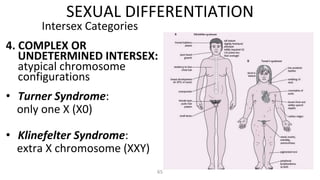
4. COMPLEX OR
UNDETERMINED INTERSEX:
atypical chromosome
configurations
• Turner Syndrome:
only one X (X0)
• Klinefelter Syndrome:
extra X chromosome (XXY)
SEXUAL DIFFERENTIATION
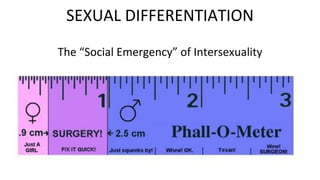
The “Social Emergency” of Intersexuality
SEXUAL DIFFERENTIATION
The Case of Caster Semenya
Ch08: Hormones & Sex
➔The Endocrine System
➔The Pituitary Gland
➔Reproductive Behavior
➔Sexual Differentiation
➔Sexual Dimorphism
➔Sexual Orientation
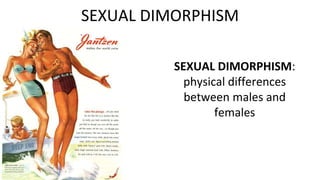
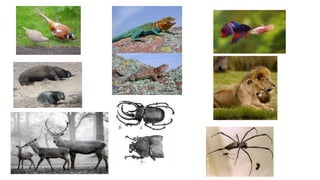
SEXUAL DIMORPHISM:
physical differences
between males and
females
SEXUAL DIMORPHISM
• The same steroids that masculinize the developing
genitalia also masculinize the brain
• This ORGANIZATIONAL EFFECT permanently alters
behavior, in contrast to a temporary activational effect
• Steroids have an organizational effect only when
present during a SENSITIVE PERIOD in early
development
• Depending on the species and the behavior, this period
may be before birth or just afterward, in the
NEONATAL period
SEXUAL DIMORPHISM
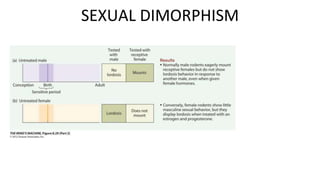
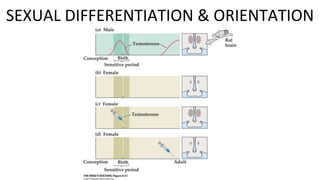
Figure 8.29 Organizational Effects
of Testosterone on Rodent
Behavior (Part 1)
SEXUAL DIMORPHISM
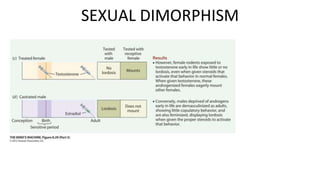
Figure 8.29 Organizational Effects
of Testosterone on Rodent
Behavior (Part 2)
SEXUAL DIMORPHISM
Figure 8.29 Organizational Effects
of Testosterone on Rodent
Behavior (Part 3)
SEXUAL DIMORPHISM
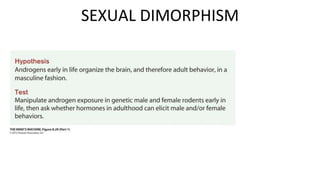
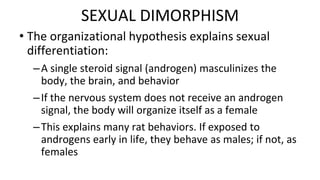
• The organizational hypothesis explains sexual
differentiation:
–A single steroid signal (androgen) masculinizes the
body, the brain, and behavior
–If the nervous system does not receive an androgen
signal, the body will organize itself as a female
–This explains many rat behaviors. If exposed to
androgens early in life, they behave as males; if not, as
females
SEXUAL DIMORPHISM
SEXUAL DIMORPHISM
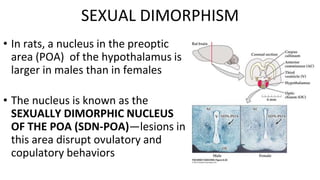
• In rats, a nucleus in the preoptic
area (POA) of the hypothalamus is
larger in males than in females
• The nucleus is known as the
SEXUALLY DIMORPHIC NUCLEUS
OF THE POA (SDN-POA)—lesions in
this area disrupt ovulatory and
copulatory behaviors
Figure 8.31 Organization of the
SDN-POA
SEXUAL DIFFERENTIATION & ORIENTATION
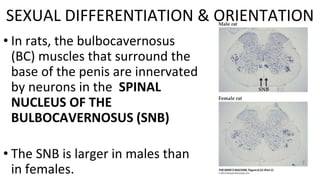
• In rats, the bulbocavernosus
(BC) muscles that surround the
base of the penis are innervated
by neurons in the SPINAL
NUCLEUS OF THE
BULBOCAVERNOSUS (SNB)
• The SNB is larger in males than
in females.
SEXUAL DIFFERENTIATION & ORIENTATION
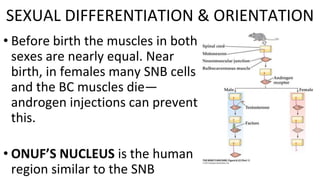
• Before birth the muscles in both
sexes are nearly equal. Near
birth, in females many SNB cells
and the BC muscles die—
androgen injections can prevent
this.
• ONUF’S NUCLEUS is the human
region similar to the SNB
SEXUAL DIFFERENTIATION & ORIENTATION
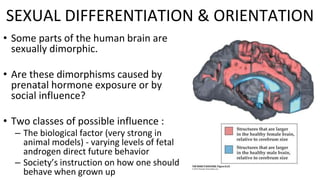
Figure 8.33 Sexual Dimorphism in
the Human Brain
• Some parts of the human brain are
sexually dimorphic.
• Are these dimorphisms caused by
prenatal hormone exposure or by
social influence?
• Two classes of possible influence :
– The biological factor (very strong in
animal models) - varying levels of fetal
androgen direct future behavior
– Society’s instruction on how one should
behave when grown up
SEXUAL DIFFERENTIATION & ORIENTATION
Ch08: Hormones & Sex
➔The Endocrine System
➔The Pituitary Gland
➔Reproductive Behavior
➔Sexual Differentiation
➔Sexual Dimorphism
➔Sexual Orientation
What Determines Sexual Orientation?
1. Genetics
2. Hormones
3. Birth Order
4. Physiology
SEXUAL ORIENTATION
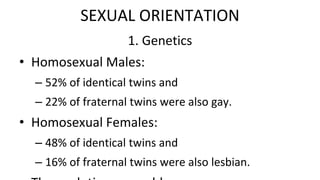
1. Genetics
• Homosexual Males:
– 52% of identical twins and
– 22% of fraternal twins were also gay.
• Homosexual Females:
– 48% of identical twins and
– 16% of fraternal twins were also lesbian.
SEXUAL ORIENTATION
2. Hormones
• Prenatal Factors:
– Hormone injections in pregnancy can result in
homosexual behavior
– Women exposed to DES (synthetic estrogen) are
less likely to be heterosexual
• Adult Hormone Levels: no significant
difference in blood androgen levels
SEXUAL ORIENTATION
3. Birth Order
• FRATERNAL BIRTH ORDER EFFECT:
– Each older brother increases a man’s chance of being
gay by 33%
• MATERNAL IMMUNE HYPOTHESIS:
– Mothers may develop an immune response to
masculinizing hormones
– “Anti-male” antibodies may affect the sexual
differentiation of successive sons
SEXUAL ORIENTATION
4. Physiology
• Areas of the hypothalamus
– Straight men & lesbian women may be more alike
– Straight women and gay men may be more alike
• Gay men are more likely to use both sides of
their brain (similar to heterosexual women)
SEXUAL ORIENTATION
4. Physiology
• Gay men & lesbians are more likely to be left-
handed than heterosexual people
– Lesbians are 91% more likely to be left handed
than heterosexual women
– Gay men are 34% more likely
SEXUAL ORIENTATION
4. Physiology
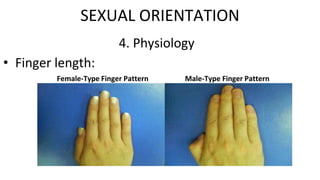
• Finger length:
SEXUAL ORIENTATION
Female-Type Finger Pattern Male-Type Finger Pattern
SEXUAL ORIENTATION
• May result in more acceptance
• Potential for scary genetic engineering
• Should it really matter whether homosexuality is
biologically based for people to receive equal rights?

PSY-2 Ch08 Hormones & Sex

  • 1.
    Ch08: Hormones &Sex ➔The Endocrine System ➔The Pituitary Gland ➔Reproductive Behavior ➔Sexual Differentiation ➔Sexual Dimorphism ➔Sexual Orientation
  • 2.
    THE ENDOCRINE SYSTEM •HORMONES: chemicals that travel through the bloodstream to act on target tissue • ENDOCRINE GLANDS: release hormones within the body • EXOCRINE GLANDS: use ducts to secrete fluid outside the body
  • 3.
    Types of Chemical Communication: 1.ENDOCRINE 2. SYNAPTIC 3. PHEROMONE: released outside the body to affect others of the same species 1. ALLOMONE: released outside the body to affect another species THE ENDOCRINE SYSTEM
  • 4.
    Hormones are Classifiedby Chemical Structure: 1. PEPTIDE HORMONE: string of amino acids EX: growth hormone, insulin, oxytocin 2. AMINE HORMONE: modified version of a single amino acid EX: epinephrine, melatonin 3. STEROID HORMONE: derived from cholesterol EX: estradiol, testosterone, cortisol, THE ENDOCRINE SYSTEM
  • 5.
    THE ENDOCRINE SYSTEM Peptide& Amine Hormones: 1. Bind to receptors that span the cell membrane 2. Bound receptor activates a second-messenger that alters cellular processes
  • 6.
    Steroid Hormones: 1. Passthrough the cell membrane 2. Bind to receptors inside the cell 3. Steroid-receptor complex binds to specific regions of DNA & controls gene expression THE ENDOCRINE SYSTEM
  • 7.
  • 8.
    • NEUROENDOCRINE CELLS:specialized neurons that release hormones into the blood THE ENDOCRINE SYSTEM
  • 9.
    • NEGATIVE FEEDBACK: outputfeeds back and inhibits signals for further secretion THE ENDOCRINE SYSTEM
  • 10.
  • 11.
    Ch08: Hormones &Sex ➔The Endocrine System ➔The Pituitary Gland ➔Reproductive Behavior ➔Sexual Differentiation ➔Sexual Dimorphism ➔Sexual Orientation
  • 12.
    • PITUITARY GLAND:releases hormones and regulates other endocrine glands • PITUITARY STALK: connects the pituitary to the hypothalamus PITUITARY GLAND
  • 13.
    Posterior pituitary gland •Releases: –OXYTOCIN –VASOPRESSIN (AVP) • Hormones produced in the hypothalamus PITUITARY GLAND
  • 14.
    Posterior pituitary gland •OXYTOCIN: – uterine contraction, nursing – reproduction and parenting • VASOPRESSIN: – water regulation – pair bonding PITUITARY GLAND
  • 15.
    Figure 8.9 TheMilk Letdown Reflex PITUITARY GLAND
  • 16.
    Anterior Pituitary Gland •RELEASING HORMONES: control the release of tropic hormones • HYPOTHALAMIC-PITUITARY PORTAL SYSTEM: blood vessels leading from hypothalamus to anterior pituitary • TROPIC HORMONES: pituitary hormones that affect secretion by other endocrine glands PITUITARY GLAND
  • 17.
    Steps in AnteriorPituitary Action 1. Hypothalamus triggers the neuroendocrine cells to release their releasing hormones into the portal system 2. The portal systems carries the releasing hormones in local circulation to the anterior pituitary 3. Releasing hormone activates neuroendocrine cells in the anterior pituitary, causing them to release tropic hormones 4. Tropic hormones move through general circulation activating receptors on target endocrine glands 5. Target endocrine glands release hormones into general circulation.
  • 18.
    • NEGATIVE FEEDBACK: outputfeeds back and inhibits signals for further secretion PITUITARY GLAND
  • 19.
    • NEGATIVE FEEDBACK: output feedsback and inhibits signals for further secretion PITUITARY GLAND
  • 20.
    Hypothalamic neurons thatsynthesize releasing hormones are sensitive to two influences: 1. Circulating messages such as other hormones, which contribute to negative feedback 1. Synaptic input from other brain regions, which can be inhibitory or excitatory PITUITARY GLAND
  • 21.
    • GONADOTROPIN RELEASING-HORMONE(GnRH) : released by the hypothalamus into the portal system • GONADOTROPINS: released by the anterior pituitary in response to GnRH PITUITARY GLAND Follicle-Stimulating Hormone Luteinizing Hormone Males Sperm production Testosterone production Females Follicle development & estrogen release Corpus luteum development & progesterone release
  • 22.
    • Gonads regulatereproduction • Gonads have specialized compartments that produce: –Hormones –Gametes • Testes produce and secrete testosterone. PITUITARY GLAND
  • 23.
    • Ovaries produce: –Progestins – Estrogens • FSH stimulates ovarian follicles to grow and secrete estrogens, beginning the ovulatory cycle • LH triggers ovulation and forms the corpus luteum, PITUITARY GLAND
  • 24.
    Ch08: Hormones &Sex ➔The Endocrine System ➔The Pituitary Gland ➔Reproductive Behavior ➔Sexual Differentiation ➔Sexual Dimorphism ➔Sexual Orientation
  • 25.
    Ch08: Hormones &Sex ➔The Endocrine System ➔The Pituitary Gland ➔Reproductive Behavior ➔Sexual Differentiation ➔Sexual Dimorphism ➔Sexual Orientation
  • 26.
    The Case ofCaster Semenya
  • 27.
    SEXUAL DIFFERENTIATION • SEXUALDIFFERENTIATION: the process of developing male/female bodies and behaviors • SEX DETERMINATION: early developmental events that determines sex
  • 28.
    Definition Criteria 1. GeneticMales = XY Females = XX 2. Gonadal (Internal Anatomy) Males = testes, prostate, seminal vesicles, vas deferens Females = ovaries, Fallopian tubes, uterus, upper vagina 3. Phenotypic (External Anatomy) Males = penis, scrotum Females = clitoris, labia, vaginal opening 4. Secondary Sex Characteristics Males = facial hair, enlarged larynx, broader shoulders + narrow hips, increased muscle mass, larger bodies, heavier bones Females = breasts, narrow shoulders + wider hips, higher proportion of body fat SEXUAL DIFFERENTIATION
  • 29.
    Definition Criteria 1. GeneticMales = XY Females = XX 2. Gonadal (Internal Anatomy) Males = testes, prostate, seminal vesicles, vas deferens Females = ovaries, Fallopian tubes, uterus, upper vagina 3. Phenotypic (External Anatomy) Males = penis, scrotum Females = clitoris, labia, vaginal opening 4. Secondary Sex Characteristics Males = facial hair, enlarged larynx, broader shoulders + narrow hips, increased muscle mass, larger bodies, heavier bones Females = breasts, narrow shoulders + wider hips, higher proportion of body fat SEXUAL DIFFERENTIATION
  • 30.
    Definition Criteria 1. GeneticMales = XY Females = XX 2. Gonadal (Internal Anatomy) Males = testes, prostate, seminal vesicles, vas deferens Females = ovaries, Fallopian tubes, uterus, upper vagina 3. Phenotypic (External Anatomy) Males = penis, scrotum Females = clitoris, labia, vaginal opening 4. Secondary Sex Characteristics Males = facial hair, enlarged larynx, broader shoulders + narrow hips, increased muscle mass, larger bodies, heavier bones Females = breasts, narrow shoulders + wider hips, higher proportion of body fat SEXUAL DIFFERENTIATION
  • 31.
    Definition Criteria 1. GeneticMales = XY Females = XX 2. Gonadal (Internal Anatomy) Males = testes, prostate, seminal vesicles, vas deferens Females = ovaries, Fallopian tubes, uterus, upper vagina 3. Phenotypic (External Anatomy) Males = penis, scrotum Females = clitoris, labia, vaginal opening 4. Secondary Sex Characteristics Males = facial hair, enlarged larynx, broader shoulders + narrow hips, increased muscle mass, larger bodies, heavier bones Females = breasts, narrow shoulders + wider hips, higher proportion of body fat SEXUAL DIFFERENTIATION
  • 32.
    Definition Criteria 1. GeneticMales = XY Females = XX 2. Gonadal (Internal Anatomy) Males = testes, prostate, seminal vesicles, vas deferens Females = ovaries, Fallopian tubes, uterus, upper vagina 3. Phenotypic (External Anatomy) Males = penis, scrotum Females = clitoris, labia, vaginal opening 4. Secondary Sex Characteristics Males = facial hair, enlarged larynx, broader shoulders + narrow hips, increased muscle mass, larger bodies, heavier bones Females = breasts, narrow shoulders + wider hips, higher proportion of body fat SEXUAL DIFFERENTIATION
  • 33.
    1. GENETIC SEX •Chromosomes are arranged in 23 pairs. • 22 pairs of autosomes (matched pairs). • 1 pair of sex chromosomes (XX = female; XY = male) SEXUAL DIFFERENTIATION
  • 34.
    1. GENETIC SEX •GAMETES: – Sperm, Eggs/Ova – 23 chromosomes • ZYGOTE: – Sperm & ovum united – 46 chromosomes SEXUAL DIFFERENTIATION
  • 35.
    1. GENETIC SEX •Each gamete contains one sex chromosome – Each egg contains an X – Sperm contain either an X or a Y X X Y X XY XX SEXUAL DIFFERENTIATION
  • 36.
    2. GONADAL SEX BothXX & XY embryos have an indifferent gonad • Cortex – potential to be ovary • Medulla – potential to be a testis SEXUAL DIFFERENTIATION
  • 37.
    3. PHENOTYPIC SEX •Both XX & XY embryos can develop… – Female Reproductive Ducts (Müllerian) – Male Reproductive Ducts (Wolffian) SEXUAL DIFFERENTIATION
  • 38.
    Figure 8.24 SexualDifferentiation in Humans (Part 2) SEXUAL DIFFERENTIATION 3. PHENOTYPIC SEX • Masculinizing Hormones: – Testosterone promotes the wolffian system – ANTI-MÜLLERIAN HORMONE (AMH): causes the müllerian system to regress • 5 ALPHA-REDUCTASE: enzyme that converts T into a more powerful form
  • 39.
    SEXUAL DIFFERENTIATION 3. PHENOTYPICSEX • In the absence of masculinizing hormones: • Wolffian ducts regress • Müllerian ducts develop
  • 40.
    Figure 8.24 SexualDifferentiation in Humans (Part 3) SEXUAL DIFFERENTIATION
  • 41.
    Figure 8.25 TheSequence of Sexual Differentiation SEXUAL DIFFERENTIATION
  • 42.
    4. SECONDARY SEX CHARACTERISTICS •PUBERTY: Hormonal changes – Body growth – Sexual maturation • Determined by relative levels of androgens & estrogens SEXUAL DIFFERENTIATION
  • 43.
    • INTERSEX: aperson with atypical genital development and sexual differentiation – 17/1000 infants are intersex – NIH Intersex Categories… SEXUAL DIFFERENTIATION
  • 44.
    61 Intersex Categories 1. XXINTERSEX: genetically female but with ambiguous male external genitalia • Congenital Adrenal Hyperplasia (CAH): exposure to excess androgens SEXUAL DIFFERENTIATION
  • 45.
    62 Intersex Categories 2. XYINTERSEX: genetically male, but with ambiguous female external genitals • 5-Alpha-Reductase Deficiency (5-ARD): infants appear female until puberty, when bodies become masculinized • Androgen Insensitivity Syndrome (AIS): a person has XY chromosomes, but androgen receptors do not function SEXUAL DIFFERENTIATION
  • 47.
    64 Intersex Categories 3. TRUEGONADAL INTERSEX: has both ovarian and testicular tissue • Cause: unknown SEXUAL DIFFERENTIATION
  • 48.
    65 Intersex Categories 4. COMPLEXOR UNDETERMINED INTERSEX: atypical chromosome configurations • Turner Syndrome: only one X (X0) • Klinefelter Syndrome: extra X chromosome (XXY) SEXUAL DIFFERENTIATION
  • 49.
    The “Social Emergency”of Intersexuality SEXUAL DIFFERENTIATION
  • 50.
    The Case ofCaster Semenya
  • 51.
    Ch08: Hormones &Sex ➔The Endocrine System ➔The Pituitary Gland ➔Reproductive Behavior ➔Sexual Differentiation ➔Sexual Dimorphism ➔Sexual Orientation
  • 52.
    SEXUAL DIMORPHISM: physical differences betweenmales and females SEXUAL DIMORPHISM
  • 54.
    • The samesteroids that masculinize the developing genitalia also masculinize the brain • This ORGANIZATIONAL EFFECT permanently alters behavior, in contrast to a temporary activational effect • Steroids have an organizational effect only when present during a SENSITIVE PERIOD in early development • Depending on the species and the behavior, this period may be before birth or just afterward, in the NEONATAL period SEXUAL DIMORPHISM
  • 55.
    Figure 8.29 OrganizationalEffects of Testosterone on Rodent Behavior (Part 1) SEXUAL DIMORPHISM
  • 56.
    Figure 8.29 OrganizationalEffects of Testosterone on Rodent Behavior (Part 2) SEXUAL DIMORPHISM
  • 57.
    Figure 8.29 OrganizationalEffects of Testosterone on Rodent Behavior (Part 3) SEXUAL DIMORPHISM
  • 58.
    • The organizationalhypothesis explains sexual differentiation: –A single steroid signal (androgen) masculinizes the body, the brain, and behavior –If the nervous system does not receive an androgen signal, the body will organize itself as a female –This explains many rat behaviors. If exposed to androgens early in life, they behave as males; if not, as females SEXUAL DIMORPHISM
  • 59.
    SEXUAL DIMORPHISM • Inrats, a nucleus in the preoptic area (POA) of the hypothalamus is larger in males than in females • The nucleus is known as the SEXUALLY DIMORPHIC NUCLEUS OF THE POA (SDN-POA)—lesions in this area disrupt ovulatory and copulatory behaviors
  • 60.
    Figure 8.31 Organizationof the SDN-POA SEXUAL DIFFERENTIATION & ORIENTATION
  • 61.
    • In rats,the bulbocavernosus (BC) muscles that surround the base of the penis are innervated by neurons in the SPINAL NUCLEUS OF THE BULBOCAVERNOSUS (SNB) • The SNB is larger in males than in females. SEXUAL DIFFERENTIATION & ORIENTATION
  • 62.
    • Before birththe muscles in both sexes are nearly equal. Near birth, in females many SNB cells and the BC muscles die— androgen injections can prevent this. • ONUF’S NUCLEUS is the human region similar to the SNB SEXUAL DIFFERENTIATION & ORIENTATION
  • 63.
    Figure 8.33 SexualDimorphism in the Human Brain • Some parts of the human brain are sexually dimorphic. • Are these dimorphisms caused by prenatal hormone exposure or by social influence? • Two classes of possible influence : – The biological factor (very strong in animal models) - varying levels of fetal androgen direct future behavior – Society’s instruction on how one should behave when grown up SEXUAL DIFFERENTIATION & ORIENTATION
  • 64.
    Ch08: Hormones &Sex ➔The Endocrine System ➔The Pituitary Gland ➔Reproductive Behavior ➔Sexual Differentiation ➔Sexual Dimorphism ➔Sexual Orientation
  • 65.
    What Determines SexualOrientation? 1. Genetics 2. Hormones 3. Birth Order 4. Physiology SEXUAL ORIENTATION
  • 66.
    1. Genetics • HomosexualMales: – 52% of identical twins and – 22% of fraternal twins were also gay. • Homosexual Females: – 48% of identical twins and – 16% of fraternal twins were also lesbian. SEXUAL ORIENTATION
  • 67.
    2. Hormones • PrenatalFactors: – Hormone injections in pregnancy can result in homosexual behavior – Women exposed to DES (synthetic estrogen) are less likely to be heterosexual • Adult Hormone Levels: no significant difference in blood androgen levels SEXUAL ORIENTATION
  • 68.
    3. Birth Order •FRATERNAL BIRTH ORDER EFFECT: – Each older brother increases a man’s chance of being gay by 33% • MATERNAL IMMUNE HYPOTHESIS: – Mothers may develop an immune response to masculinizing hormones – “Anti-male” antibodies may affect the sexual differentiation of successive sons SEXUAL ORIENTATION
  • 69.
    4. Physiology • Areasof the hypothalamus – Straight men & lesbian women may be more alike – Straight women and gay men may be more alike • Gay men are more likely to use both sides of their brain (similar to heterosexual women) SEXUAL ORIENTATION
  • 70.
    4. Physiology • Gaymen & lesbians are more likely to be left- handed than heterosexual people – Lesbians are 91% more likely to be left handed than heterosexual women – Gay men are 34% more likely SEXUAL ORIENTATION
  • 71.
    4. Physiology • Fingerlength: SEXUAL ORIENTATION Female-Type Finger Pattern Male-Type Finger Pattern
  • 72.
    SEXUAL ORIENTATION • Mayresult in more acceptance • Potential for scary genetic engineering • Should it really matter whether homosexuality is biologically based for people to receive equal rights?