PSYCHIATRIC DISORDERS
BY
TANUSHREE KARMAKAR
M PHARM (PHARMACOLOGY)
1ST Year ODD SEMESTER
BATCH 2018-2020
TOPICS OF DISCUSSION
PHARMACOTHERAPY OF
• Anxiety
• Obsessive compulsive disorders
• Depression
• Bipolar disorder
• Mania
What are Psychiatric Disorders:
• A Psychiatric disorder or mental disorder,or illness, is a behavioral or mental pattern
change that causes significant distress or impairment of personal functioning.
• A Psychological syndrome associated with distress , disability (impairment in one or
more important areas of functioning), increased risk of death, or causes a significant
loss of autonomy.
• Most common types:
• Anxiety disorders, including panic disorder, obsessive-compulsive disorder, post-
traumatic stress disorder, and phobias
• Depression, bipolar disorder, and other mood disorders
• Personality disorders
• Psychotic disorders, including schizophrenia
Biological Hypothesis in Mental illness:
• Different biological mechanisms may underlie some mental health
disorders,related to neurotransmitters and the monoamine chemical
imbalance hypothesis.
• In addition,other agents may also have shown to mimic some of the
symptoms of severe mental illness such as LSD which induces
hallucinations,altered emotional states and antihypertensives such as
Reserpine induce depression.
• A leading hypothesis that arose from such consideration was that
antidepressants enhance the biological activity of monoamine
neurotransmitters in CNS and anti adrenergic compounds induce
depression
• May also be related to Genetics and environmental factors
Anxiety
• An unpleasant emotion characterized by a general sense of danger,dread
and physiological arousal.
• A feeling of uneasiness and worry, usually generalized and unfocused as
an overreaction to a situation that is only subjectively seen as menacing.
• Accompanied by muscular tension,restlessness, fatigue and problems in
concentration.
• Components of anxiety:
Emotional: Fright ,Nervousness ,Irritability.
Cognitive: Hypervigilance ,Poor Concentration ,Rumination.
Behavioural: Freezing up , Avoidant behaviour
Physical : Muscle tension ,Pounding Heart .Dry mouth
Types and classification:
• Generalized anxiety disorders: an ongoing state of
excessive anxiety lacking any clear reason or focus
• Social anxiety disorder: fear of being with and interacting
with other people
• Phobias: strong fear of specific objects or situations
• Panic disorders: sudden attacks of overwhelming fear that
occur in association with marked somatic symptoms such as
sweating,tachycardia,chest pain,trembling and choking.
• Post traumatic stress disorders: anxiety triggered by
recall of past stressful experiences.
• Obessive compulsive disorders: compulsive ritualistic
behaviour driven by irrational anxiety
Drugs used to treat anxiety
• Classification:
Benzodiazepines: Diazepam,Oxazepam
Barbiturates: Amobarbitol,Pentobarbitol
Azapirones: Buspirone, Gepirone
Beta- blocker: Propanolol
Anti Depressants:
Selective serotonin reuptake inhibitors(SSRI):
Fluoxetine,Citalopram
Selective Serotonin – norepinephrine reuptake inhibitors (SNRI):
Duloxetine, venlafaxine
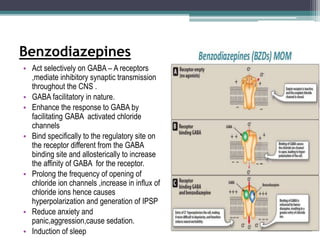
Benzodiazepines
• Act selectively on GABA – A receptors
,mediate inhibitory synaptic transmission
throughout the CNS .
• GABA facilitatory in nature.
• Enhance the response to GABA by
facilitating GABA activated chloride
channels
• Bind specifically to the regulatory site on
the receptor different from the GABA
binding site and allosterically to increase
the affinity of GABA for the receptor.
• Prolong the frequency of opening of
chloride ion channels ,increase in influx of
chloride ions hence causes
hyperpolarization and generation of IPSP
• Reduce anxiety and
panic,aggression,cause sedation.
• Induction of sleep
Barbiturates: Buspirone :
• Bind to different interface subunit
other than benzodiazepines.
• Binding site is close to GABA binding
site.
• Action seems to prolong the duration
of opening of GABA – activated
chloride channels, increases influx of
chloride ions hence causes
hyperpolarization.
• Potentiate GABA action( GABA
mimetics).
• Degree of hyperpolarization is much
more compared to that of BZDs hence
lead to respiratory and CVS failure on
prolonged use.
• Partial agonist at 5-HT 1A
receptors .
• Highly specific for 5-HT 1A
receptors
• These receptors function as
inhibitory autoreceptors that
reduce release of 5-HT and other
mediators.
• Used in generalized anxiety
disorders.
• Show delayed anxiolytic effects
• Drug mostly used: Propanolol
• Particularly used to treat some forms of anxiety where physical symptoms such as sweating ,
tremor,tachycardia are troublesome.
• Do not affect psychological symptoms but some people find they can relax more if their physical
symptoms are reduced.
• Anti depressants:
• SELECTIVE SEROTONIN REUPTAKE INHIBITORS(SSRI):
Fluoxetine,Citalopram,Paroxetine
Block Neuronal transport of serotonin. Increased synaptic availability of serotonin stimulates a
large number of post synaptic 5-HT receptor types.
Acute increase of serotonergic synaptic activity.
Used in anxiety disorders,major depression,panic disorder,ocd.
• SEROTONIN-NOREPINEPHRINE REUPTAKE INHIBITORS(SNRI):
Duloxetine,venlafaxine
Non selective nor epinephrine and serotonin reuptake inhibitors
Increase of serotonergic synaptic activity
Beta-blockers:
Obsessive compulsive disorder:
• OCD is an anxiety disorder characterized by intrusive thoughts that
produce uneasiness,apprehension,fear or worry ; by repetitive
behaviours aimed at reducing the associated anxiety.
• Have involuntary seemingly uncontrollable thoughts , images or impulses
that occur over and over.
• Cognitive deficits regarding: spatial memory loss,verbal
memory.fluency,auditory attention.
• The most common types of obsessions are related to contamination,
pathological doubts,somatic dysfunction, need for symmetry,aggression.
• The classical forms of compulsion include
checking,washing,counting,precision.
TREATMENT
• Cognitive behavioral therapy (CBT). OCD has a cycle:
obsessions, anxiety, compulsions, and relief. CBT, a type of
psychotherapy, gives you tools to think, act, and react to your
unhealthy thoughts and habits. The goal is to replace negative
thoughts with productive ones.
• Medications
• Certain psychiatric medications can help control the obsessions
and compulsions of OCD. Most commonly, antidepressants are
tried first.
• Antidepressants:
• Clomipramine
• Fluoxetine
• Fluvoxamine
• Paroxetine
• Sertraline
Contd:
• SSRIs: serotonin reuptake inhibitors (SRIs) are consistently effective in
patients of Obsessive compulsive disorder
• Atypical antipsychotics have also proven to be helpful . Among
these antipsychotics are:
• Risperidone,Quetiapine,Olanzapine,Ziprasidone
• In some cases, benzodiazepines can offer anxiety relief, but they are
typically only used in conjunction with more reliable treatments.
• Cognitive therapy is the preferred form of treatment, but many patients
benefit from combining medication with therapy.
• Psychosurgery
Psychosurgery is used to alleviate symptoms of obsessive-compulsive
disorder in patients who do not respond to medications or behavioral
therapy.
DEFINITION:
• It is a mental illness characterized by pathological changes in mood,loss of
interest,feelings of guilt or low self worth,disturbed sleep or appetite,low energy or poor
concentration.
• Most common mood disorder often accompanied with hallucinations and delusions
• Hetergeneous disorder with patients presenting with one or more core symptoms. Also
associated with psychiatric conditions including anxiety,drug addiction etc
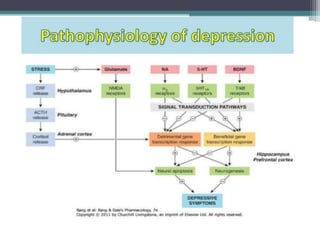
• Mechanism is associated with changes in the level of neurotransmitters in the brain that
help nerve cells to communicate.e.g serotonin,dopamine,norepinephrine.
• The level can be influenced by physical illness,genetics,substance abuse,diet,hormonal
changes,brain injuries or social circumstances.
• Emotional symptoms of depression include:
• Low mood,excessive rumination of negetive thought,misery,apathy and pessimism.
• Low self esteem,feelings of guilt, inadequacy
• Indecisiveness, loss of motivation
• Biological symptoms include:
• Retardation of thought and action.
• Sleep disturbance and loss of appetitte
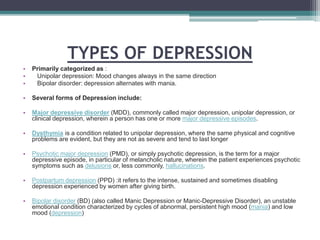
TYPES OF DEPRESSION
• Primarily categorized as :
• Unipolar depression: Mood changes always in the same direction
• Bipolar disorder: depression alternates with mania.
• Several forms of Depression include:
• Major depressive disorder (MDD), commonly called major depression, unipolar depression, or
clinical depression, wherein a person has one or more major depressive episodes.
• Dysthymia is a condition related to unipolar depression, where the same physical and cognitive
problems are evident, but they are not as severe and tend to last longer
• Psychotic major depression (PMD), or simply psychotic depression, is the term for a major
depressive episode, in particular of melancholic nature, wherein the patient experiences psychotic
symptoms such as delusions or, less commonly, hallucinations.
• Postpartum depression (PPD) :it refers to the intense, sustained and sometimes disabling
depression experienced by women after giving birth.
• Bipolar disorder (BD) (also called Manic Depression or Manic-Depressive Disorder), an unstable
emotional condition characterized by cycles of abnormal, persistent high mood (mania) and low
mood (depression)
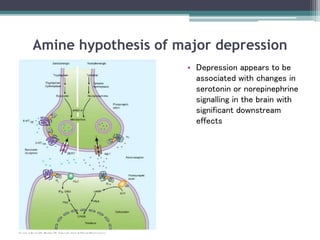
Amine hypothesis of major depression
• Depression appears to be
associated with changes in
serotonin or norepinephrine
signalling in the brain with
significant downstream
effects
Anti depressant drugs
• Categories: Mainly Involves the process to increase the levels of
neurotransmitters in the synapse, potentiate action of
serotonin,dopamine ,noradrenaline.
• Mono amine Reuptake Inhibitors:
• Selective serotonin reuptake inhibitors:: Citalopram,fluoxetine
• Serotonin- Norepinephrine reuptake inhibitors:
Venlafaxine,Duloxetine
• Classical TCA group: Imipramine,Amitryptaline
• Nor epinephrine uptake inhibitors: Bupropion, Reboxetine
• Monoamine receptor antagonist: Mirtazepine,Trazadone
• Monoamine Oxidase Inhibitors:
• Irreversible Non Competitive Inhibitors:
Phenelzine,tranylcypromine
• Reversible MAO-A Selective Inhibitors: Moclobemide
BIPOLAR DISORDER
• Definition:
• Bipolar disorder (BD) (also called Manic Depression or Manic-
Depressive Disorder), an unstable emotional condition
characterized by cycles of abnormal, persistent high mood
(mania) and low mood (depression)
• A brain disorder that causes unusual shifts in mood, energy,
activity levels, and the ability to carry out day-to-day tasks.
• Recurrent fluctuations in mood.
• Extremes of human experiences.
• Mania alternates / occurs simultaneously with depression.
• Elevated mood,inflated self esteem.
• Decreased Sleep.
Contd:
• Subtypes include:
• Bipolar I is distinguished by the presence or history of one or more manic
episodes or mixed episodes with or without major depressive episodes.
• Bipolar II consisting of recurrent intermittent hypomanic and depressive episodes or mixed
episodes.
• Cyclothymia is a form of bipolar disorder, consisting of recurrent hypomanic
and dysthymic episodes, but no full manic episodes or full major depressive episodes.
• The key symptoms of bipolar disorder in manic phase includes expansion of irritable
mood,hyperactivity,impulsivity,disinhibition,diminished need for sleep,cognitive impairment
etc.
• Wheras in depressed phase,the key features include depressed mood,diurnal
variation,sleep disturbance,anxiety.
Drug Therapy:
• Treatment of bipolar disorder involves 3 therapeutic domains: acute
mania, acute depression and maintenance
• Major drugs are:
Lithium
Several anti convulsant drugs: Carbamazepine, valproate
Anti Psychotics: Olanzepine, Risperidone
• Lithium as mood stabilizers:
• Monovalent cation,mimic role of Na + in excitable tissues,able to permeate voltage
gated sodium channels,generation of impulse and hence depolarisation of cell.
• Biochemical effects of lithium are complex.
• Directly supresses inositol signalling through depletion of intracellular inositol and
inhibits glycogen synthase kinase 3(GSK-3,multifunctional protein kinase)
• Prevent mood swings between mania and depression.
• Toxic effects of Lithium include: tremor,polyuria,thyroid enlargement,weight
gain,hair loss
Mania
• Mania, also known as manic syndrome, is a state of abnormally elevated
arousal, affect, or "a state of heightened overall activation with
enhanced affective expression
• Mania is often conceived as a "mirror image" to depression, the
heightened mood can be either euphoric or irritable; indeed, as the
mania intensifies, irritability can be more pronounced and result
in violence, or anxiety.
• Symptoms:
• The symptoms of mania include heightened mood (either euphoric
or irritable); flight of ideas and pressure of speech; and increased
energy, decreased need for sleep, and hyperactivity
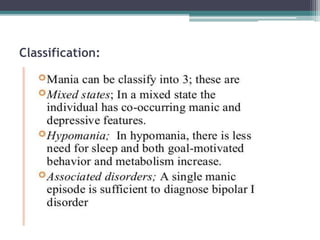
Classification:
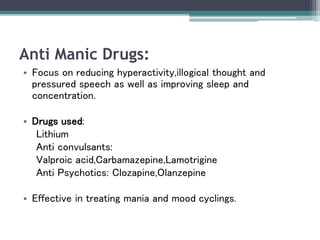
Anti Manic Drugs:
• Focus on reducing hyperactivity,illogical thought and
pressured speech as well as improving sleep and
concentration.
• Drugs used:
Lithium
Anti convulsants:
Valproic acid,Carbamazepine,Lamotrigine
Anti Psychotics: Clozapine,Olanzepine
• Effective in treating mania and mood cyclings.
Psychiatric disorders

Psychiatric disorders

  • 1.
    PSYCHIATRIC DISORDERS BY TANUSHREE KARMAKAR MPHARM (PHARMACOLOGY) 1ST Year ODD SEMESTER BATCH 2018-2020
  • 2.
    TOPICS OF DISCUSSION PHARMACOTHERAPYOF • Anxiety • Obsessive compulsive disorders • Depression • Bipolar disorder • Mania
  • 3.
    What are PsychiatricDisorders: • A Psychiatric disorder or mental disorder,or illness, is a behavioral or mental pattern change that causes significant distress or impairment of personal functioning. • A Psychological syndrome associated with distress , disability (impairment in one or more important areas of functioning), increased risk of death, or causes a significant loss of autonomy. • Most common types: • Anxiety disorders, including panic disorder, obsessive-compulsive disorder, post- traumatic stress disorder, and phobias • Depression, bipolar disorder, and other mood disorders • Personality disorders • Psychotic disorders, including schizophrenia
  • 4.
    Biological Hypothesis inMental illness: • Different biological mechanisms may underlie some mental health disorders,related to neurotransmitters and the monoamine chemical imbalance hypothesis. • In addition,other agents may also have shown to mimic some of the symptoms of severe mental illness such as LSD which induces hallucinations,altered emotional states and antihypertensives such as Reserpine induce depression. • A leading hypothesis that arose from such consideration was that antidepressants enhance the biological activity of monoamine neurotransmitters in CNS and anti adrenergic compounds induce depression • May also be related to Genetics and environmental factors
  • 5.
    Anxiety • An unpleasantemotion characterized by a general sense of danger,dread and physiological arousal. • A feeling of uneasiness and worry, usually generalized and unfocused as an overreaction to a situation that is only subjectively seen as menacing. • Accompanied by muscular tension,restlessness, fatigue and problems in concentration. • Components of anxiety: Emotional: Fright ,Nervousness ,Irritability. Cognitive: Hypervigilance ,Poor Concentration ,Rumination. Behavioural: Freezing up , Avoidant behaviour Physical : Muscle tension ,Pounding Heart .Dry mouth
  • 6.
    Types and classification: •Generalized anxiety disorders: an ongoing state of excessive anxiety lacking any clear reason or focus • Social anxiety disorder: fear of being with and interacting with other people • Phobias: strong fear of specific objects or situations • Panic disorders: sudden attacks of overwhelming fear that occur in association with marked somatic symptoms such as sweating,tachycardia,chest pain,trembling and choking. • Post traumatic stress disorders: anxiety triggered by recall of past stressful experiences. • Obessive compulsive disorders: compulsive ritualistic behaviour driven by irrational anxiety
  • 7.
    Drugs used totreat anxiety • Classification: Benzodiazepines: Diazepam,Oxazepam Barbiturates: Amobarbitol,Pentobarbitol Azapirones: Buspirone, Gepirone Beta- blocker: Propanolol Anti Depressants: Selective serotonin reuptake inhibitors(SSRI): Fluoxetine,Citalopram Selective Serotonin – norepinephrine reuptake inhibitors (SNRI): Duloxetine, venlafaxine
  • 8.
    Benzodiazepines • Act selectivelyon GABA – A receptors ,mediate inhibitory synaptic transmission throughout the CNS . • GABA facilitatory in nature. • Enhance the response to GABA by facilitating GABA activated chloride channels • Bind specifically to the regulatory site on the receptor different from the GABA binding site and allosterically to increase the affinity of GABA for the receptor. • Prolong the frequency of opening of chloride ion channels ,increase in influx of chloride ions hence causes hyperpolarization and generation of IPSP • Reduce anxiety and panic,aggression,cause sedation. • Induction of sleep
  • 9.
    Barbiturates: Buspirone : •Bind to different interface subunit other than benzodiazepines. • Binding site is close to GABA binding site. • Action seems to prolong the duration of opening of GABA – activated chloride channels, increases influx of chloride ions hence causes hyperpolarization. • Potentiate GABA action( GABA mimetics). • Degree of hyperpolarization is much more compared to that of BZDs hence lead to respiratory and CVS failure on prolonged use. • Partial agonist at 5-HT 1A receptors . • Highly specific for 5-HT 1A receptors • These receptors function as inhibitory autoreceptors that reduce release of 5-HT and other mediators. • Used in generalized anxiety disorders. • Show delayed anxiolytic effects
  • 10.
    • Drug mostlyused: Propanolol • Particularly used to treat some forms of anxiety where physical symptoms such as sweating , tremor,tachycardia are troublesome. • Do not affect psychological symptoms but some people find they can relax more if their physical symptoms are reduced. • Anti depressants: • SELECTIVE SEROTONIN REUPTAKE INHIBITORS(SSRI): Fluoxetine,Citalopram,Paroxetine Block Neuronal transport of serotonin. Increased synaptic availability of serotonin stimulates a large number of post synaptic 5-HT receptor types. Acute increase of serotonergic synaptic activity. Used in anxiety disorders,major depression,panic disorder,ocd. • SEROTONIN-NOREPINEPHRINE REUPTAKE INHIBITORS(SNRI): Duloxetine,venlafaxine Non selective nor epinephrine and serotonin reuptake inhibitors Increase of serotonergic synaptic activity Beta-blockers:
  • 11.
    Obsessive compulsive disorder: •OCD is an anxiety disorder characterized by intrusive thoughts that produce uneasiness,apprehension,fear or worry ; by repetitive behaviours aimed at reducing the associated anxiety. • Have involuntary seemingly uncontrollable thoughts , images or impulses that occur over and over. • Cognitive deficits regarding: spatial memory loss,verbal memory.fluency,auditory attention. • The most common types of obsessions are related to contamination, pathological doubts,somatic dysfunction, need for symmetry,aggression. • The classical forms of compulsion include checking,washing,counting,precision.
  • 13.
    TREATMENT • Cognitive behavioraltherapy (CBT). OCD has a cycle: obsessions, anxiety, compulsions, and relief. CBT, a type of psychotherapy, gives you tools to think, act, and react to your unhealthy thoughts and habits. The goal is to replace negative thoughts with productive ones. • Medications • Certain psychiatric medications can help control the obsessions and compulsions of OCD. Most commonly, antidepressants are tried first. • Antidepressants: • Clomipramine • Fluoxetine • Fluvoxamine • Paroxetine • Sertraline
  • 14.
    Contd: • SSRIs: serotoninreuptake inhibitors (SRIs) are consistently effective in patients of Obsessive compulsive disorder • Atypical antipsychotics have also proven to be helpful . Among these antipsychotics are: • Risperidone,Quetiapine,Olanzapine,Ziprasidone • In some cases, benzodiazepines can offer anxiety relief, but they are typically only used in conjunction with more reliable treatments. • Cognitive therapy is the preferred form of treatment, but many patients benefit from combining medication with therapy. • Psychosurgery Psychosurgery is used to alleviate symptoms of obsessive-compulsive disorder in patients who do not respond to medications or behavioral therapy.
  • 16.
    DEFINITION: • It isa mental illness characterized by pathological changes in mood,loss of interest,feelings of guilt or low self worth,disturbed sleep or appetite,low energy or poor concentration. • Most common mood disorder often accompanied with hallucinations and delusions • Hetergeneous disorder with patients presenting with one or more core symptoms. Also associated with psychiatric conditions including anxiety,drug addiction etc • Mechanism is associated with changes in the level of neurotransmitters in the brain that help nerve cells to communicate.e.g serotonin,dopamine,norepinephrine. • The level can be influenced by physical illness,genetics,substance abuse,diet,hormonal changes,brain injuries or social circumstances. • Emotional symptoms of depression include: • Low mood,excessive rumination of negetive thought,misery,apathy and pessimism. • Low self esteem,feelings of guilt, inadequacy • Indecisiveness, loss of motivation • Biological symptoms include: • Retardation of thought and action. • Sleep disturbance and loss of appetitte
  • 17.
    TYPES OF DEPRESSION •Primarily categorized as : • Unipolar depression: Mood changes always in the same direction • Bipolar disorder: depression alternates with mania. • Several forms of Depression include: • Major depressive disorder (MDD), commonly called major depression, unipolar depression, or clinical depression, wherein a person has one or more major depressive episodes. • Dysthymia is a condition related to unipolar depression, where the same physical and cognitive problems are evident, but they are not as severe and tend to last longer • Psychotic major depression (PMD), or simply psychotic depression, is the term for a major depressive episode, in particular of melancholic nature, wherein the patient experiences psychotic symptoms such as delusions or, less commonly, hallucinations. • Postpartum depression (PPD) :it refers to the intense, sustained and sometimes disabling depression experienced by women after giving birth. • Bipolar disorder (BD) (also called Manic Depression or Manic-Depressive Disorder), an unstable emotional condition characterized by cycles of abnormal, persistent high mood (mania) and low mood (depression)
  • 19.
    Amine hypothesis ofmajor depression • Depression appears to be associated with changes in serotonin or norepinephrine signalling in the brain with significant downstream effects
  • 20.
    Anti depressant drugs •Categories: Mainly Involves the process to increase the levels of neurotransmitters in the synapse, potentiate action of serotonin,dopamine ,noradrenaline. • Mono amine Reuptake Inhibitors: • Selective serotonin reuptake inhibitors:: Citalopram,fluoxetine • Serotonin- Norepinephrine reuptake inhibitors: Venlafaxine,Duloxetine • Classical TCA group: Imipramine,Amitryptaline • Nor epinephrine uptake inhibitors: Bupropion, Reboxetine • Monoamine receptor antagonist: Mirtazepine,Trazadone • Monoamine Oxidase Inhibitors: • Irreversible Non Competitive Inhibitors: Phenelzine,tranylcypromine • Reversible MAO-A Selective Inhibitors: Moclobemide
  • 21.
    BIPOLAR DISORDER • Definition: •Bipolar disorder (BD) (also called Manic Depression or Manic- Depressive Disorder), an unstable emotional condition characterized by cycles of abnormal, persistent high mood (mania) and low mood (depression) • A brain disorder that causes unusual shifts in mood, energy, activity levels, and the ability to carry out day-to-day tasks. • Recurrent fluctuations in mood. • Extremes of human experiences. • Mania alternates / occurs simultaneously with depression. • Elevated mood,inflated self esteem. • Decreased Sleep.
  • 22.
    Contd: • Subtypes include: •Bipolar I is distinguished by the presence or history of one or more manic episodes or mixed episodes with or without major depressive episodes. • Bipolar II consisting of recurrent intermittent hypomanic and depressive episodes or mixed episodes. • Cyclothymia is a form of bipolar disorder, consisting of recurrent hypomanic and dysthymic episodes, but no full manic episodes or full major depressive episodes. • The key symptoms of bipolar disorder in manic phase includes expansion of irritable mood,hyperactivity,impulsivity,disinhibition,diminished need for sleep,cognitive impairment etc. • Wheras in depressed phase,the key features include depressed mood,diurnal variation,sleep disturbance,anxiety.
  • 23.
    Drug Therapy: • Treatmentof bipolar disorder involves 3 therapeutic domains: acute mania, acute depression and maintenance • Major drugs are: Lithium Several anti convulsant drugs: Carbamazepine, valproate Anti Psychotics: Olanzepine, Risperidone • Lithium as mood stabilizers: • Monovalent cation,mimic role of Na + in excitable tissues,able to permeate voltage gated sodium channels,generation of impulse and hence depolarisation of cell. • Biochemical effects of lithium are complex. • Directly supresses inositol signalling through depletion of intracellular inositol and inhibits glycogen synthase kinase 3(GSK-3,multifunctional protein kinase) • Prevent mood swings between mania and depression. • Toxic effects of Lithium include: tremor,polyuria,thyroid enlargement,weight gain,hair loss
  • 24.
    Mania • Mania, alsoknown as manic syndrome, is a state of abnormally elevated arousal, affect, or "a state of heightened overall activation with enhanced affective expression • Mania is often conceived as a "mirror image" to depression, the heightened mood can be either euphoric or irritable; indeed, as the mania intensifies, irritability can be more pronounced and result in violence, or anxiety. • Symptoms: • The symptoms of mania include heightened mood (either euphoric or irritable); flight of ideas and pressure of speech; and increased energy, decreased need for sleep, and hyperactivity
  • 25.
  • 26.
    Anti Manic Drugs: •Focus on reducing hyperactivity,illogical thought and pressured speech as well as improving sleep and concentration. • Drugs used: Lithium Anti convulsants: Valproic acid,Carbamazepine,Lamotrigine Anti Psychotics: Clozapine,Olanzepine • Effective in treating mania and mood cyclings.