PSYCHOLOGICAL RESEARCH
➔Descriptive Research
➔Correlational Research
➔Experimental Research
➔Biases
• To make measurements
• To make predictions
• To fix a problem – improve life
What are the goals of research?
THE SCIENTIFIC METHOD
DESCRIPTIVE RESEARCH
1. DESCRIPTIVE:
a. No hypothesis
b. Describe behaviors that are observed or measured
DESCRIPTIVE RESEARCH
NATURALISTIC OBSERVATION: observing behavior in a
natural setting
Jane Goodall
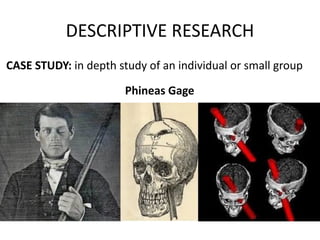
CASE STUDY: in depth study of an individual or small group
Phineas Gage
DESCRIPTIVE RESEARCH
SELF-REPORT: lists of questions that ask people about
themselves
Descriptive Research
A friend of yours is working part-time in a local pet
store. Your friend has become increasingly interested in
how dogs normally communicate and interact with
each other, and is thinking of visiting a local veterinary
clinic to see how dogs interact in the waiting room.
Is this a good research design? Why or why not?Can
you suggest a better method to study this research
question?
PSYCHOLOGICAL RESEARCH
➔Descriptive Research
➔Correlational Research
➔Experimental Research
➔Biases
CORRELATIONAL RESEARCH
1. DESCRIPTIVE:
a. No hypothesis
b. Describe behaviors that are observed or measured
2. CORRELATIONAL:
a. Hypothesizes & tests for specific relationships
b. Two or more measured variables
CORRELATIONAL RESEARCH
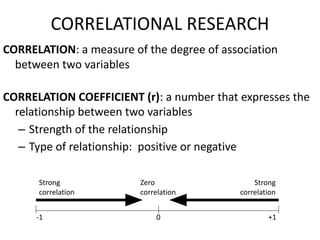
CORRELATION: a measure of the degree of association
between two variables
CORRELATION COEFFICIENT (r): a number that expresses the
relationship between two variables
– Strength of the relationship
– Type of relationship: positive or negative
-1 +1
0
Strong
correlation
Strong
correlation
Zero
correlation
CORRELATIONAL RESEARCH
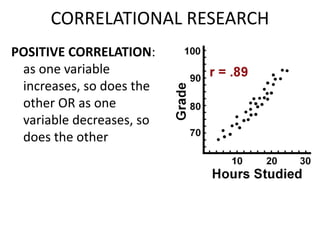
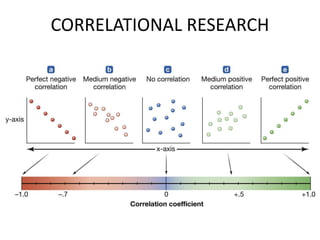
POSITIVE CORRELATION:
as one variable
increases, so does the
other OR as one
variable decreases, so
does the other
CORRELATIONAL RESEARCH
NEGATIVE CORRELATION:
as one variable increases,
the other decreases
CORRELATIONAL RESEARCH
ZERO CORRELATION:
there is no relationship
between the variables
CORRELATIONAL RESEARCH
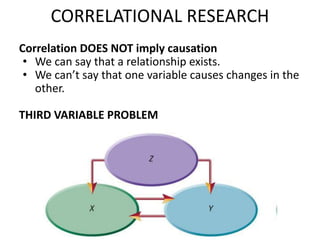
Correlation DOES NOT imply causation
• We can say that a relationship exists.
• We can’t say that one variable causes changes in the
other.
THIRD VARIABLE PROBLEM
Positive or Negative Correlation?
1. Amount of clothing worn & temperature outside
2. Cigarettes smoked & risk of lung cancer
3. MPH & amount of time it takes to arrive at your
destination
4. Income & education
5. Hours spent studying & grade in course
6. Amount of time spent playing World of Warcraft
& number of dates
7. Number of books in the home & child IQ
Consider the following:
Scott has a theory that the amount of caffeine he drinks
makes him a more productive writer. For one month,
he keeps track of how much caffeine he drinks and
how many words he writes each day. At the end of the
month, he calculates the correlation coefficient and
the result is +.89. What pieces of information can he
learn from this number?
Pleased with himself, Scott goes around and brags to all
of his friends that drinking caffeine causes him to write
more. Is his conclusion correct? Why or why not?
PSYCHOLOGICAL RESEARCH
➔Descriptive Research
➔Correlational Research
➔Experimental Research
➔Biases
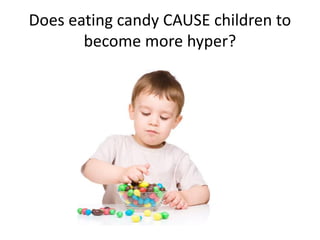
Does eating candy CAUSE children to
become more hyper?
EXPERIMENTAL RESEARCH
1. DESCRIPTIVE:
a. No hypothesis
b. Describe behaviors that are observed or measured
2. CORRELATIONAL:
a. Hypothesizes & tests for specific relationships
b. Two or more measured variables
3. EXPERIMENTAL:
a. Hypothesizes & tests a causal hypothesis
b. Manipulated & measured variables
c. Random assignment to groups
EXPERIMENTAL RESEARCH
EXPERIMENTAL RESEARCH: manipulate one
variable to look for an effect on another
• INDEPENDENT VARIABLE (IV): variable that is
manipulated→ THE CAUSE
– EXPERIMENTAL GROUP: subjects who
receive some special treatment
– CONTROL GROUP: subjects who do not
receive the special treatment
EXPERIMENTAL RESEARCH
• DEPENDENT VARIABLE (DV): what is
measured → THE EFFECT
• OPERATIONAL DEFINITION: defining a variable
by how it will be manipulated or measured
• CONFOUNDING VARIABLE: anything that
could affect the DV besides the IV
EXPERIMENTAL RESEARCH
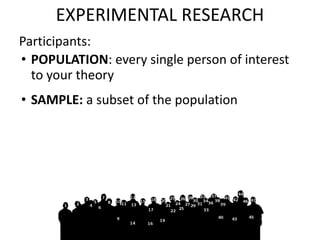
Participants:
• POPULATION: every single person of interest
to your theory
• SAMPLE: a subset of the population
EXPERIMENTAL RESEARCH
Participants:
• REPRESENTATIVE SAMPLE: a sample that
corresponds to the population.
• RANDOM ASSIGNMENT: each person has an
equal opportunity to be put into either group.
EXPERIMENTAL RESEARCH
An experimenter wanted to know whether exposure to bright
light during the winter months would lead to improved
mood among people with Seasonal Affective Disorder. Half
of the participants were assigned to a condition in which
they were asked to sit in front of a special lamp 1 hour a
day. The other half of the participants were exposed to
normal levels of light. The experimenter measured mood
by administering a questionnaire.
Identify the following: IV, DV, Experimental Group, Control
Group
PSYCHOLOGICAL RESEARCH
➔Descriptive Research
➔Correlational Research
➔Experimental Research
➔Biases
BIASES
• EXTRANEOUS/CONFOUNDING VARIABLES: a
factor other than the IV that may have
affected the DV
• DEMAND CHARACTERISTICS: subjects try to
confirm the hypothesis
BIASES
• SOCIAL DESIRABILITY: subjects present
themselves in a way that is more positive than
reality
• Attitudes may not match behaviors
BIASES
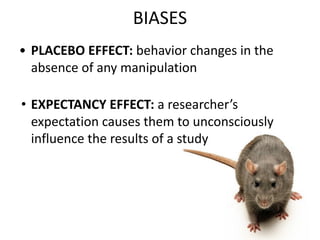
• PLACEBO EFFECT: behavior changes in the
absence of any manipulation
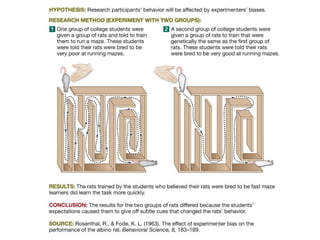
• EXPECTANCY EFFECT: a researcher’s
expectation causes them to unconsciously
influence the results of a study
BIASES
• SINGLE BLIND STUDIES: participant does not know
hypotheses
• DOUBLE BLIND STUDIES: neither participant nor
experimenter know hypotheses
• RANDOM ASSIGNMENT
• REPLICATION
There is no substitute for
good experimental design.
SUMMARY: GOALS OF RESEARCH
• DESCRIPTIVE: Describe the quality or quantity
of a behavior.
• CORRELATIONAL: Predict behavior. Determine
the relationship between two variables.
• EXPERIMENTAL: Explain behavior. Establish
cause and effect between two variables.
SUMMARY: IDENTIFYING
METHODS
Is the study looking at the relationship between 2 or more
variables?
NO
Descriptive
YES
Have people been randomly assigned?
NO YES
Correlational Experimental

Ch02 Psychological Research

  • 1.
    PSYCHOLOGICAL RESEARCH ➔Descriptive Research ➔CorrelationalResearch ➔Experimental Research ➔Biases
  • 2.
    • To makemeasurements • To make predictions • To fix a problem – improve life What are the goals of research?
  • 3.
  • 4.
    DESCRIPTIVE RESEARCH 1. DESCRIPTIVE: a.No hypothesis b. Describe behaviors that are observed or measured
  • 5.
    DESCRIPTIVE RESEARCH NATURALISTIC OBSERVATION:observing behavior in a natural setting Jane Goodall
  • 6.
    CASE STUDY: indepth study of an individual or small group Phineas Gage DESCRIPTIVE RESEARCH
  • 7.
    DESCRIPTIVE RESEARCH SELF-REPORT: listsof questions that ask people about themselves
  • 8.
    Descriptive Research A friendof yours is working part-time in a local pet store. Your friend has become increasingly interested in how dogs normally communicate and interact with each other, and is thinking of visiting a local veterinary clinic to see how dogs interact in the waiting room. Is this a good research design? Why or why not?Can you suggest a better method to study this research question?
  • 9.
    PSYCHOLOGICAL RESEARCH ➔Descriptive Research ➔CorrelationalResearch ➔Experimental Research ➔Biases
  • 10.
    CORRELATIONAL RESEARCH 1. DESCRIPTIVE: a.No hypothesis b. Describe behaviors that are observed or measured 2. CORRELATIONAL: a. Hypothesizes & tests for specific relationships b. Two or more measured variables
  • 11.
    CORRELATIONAL RESEARCH CORRELATION: ameasure of the degree of association between two variables CORRELATION COEFFICIENT (r): a number that expresses the relationship between two variables – Strength of the relationship – Type of relationship: positive or negative -1 +1 0 Strong correlation Strong correlation Zero correlation
  • 13.
    CORRELATIONAL RESEARCH POSITIVE CORRELATION: asone variable increases, so does the other OR as one variable decreases, so does the other
  • 14.
    CORRELATIONAL RESEARCH NEGATIVE CORRELATION: asone variable increases, the other decreases
  • 15.
    CORRELATIONAL RESEARCH ZERO CORRELATION: thereis no relationship between the variables
  • 16.
  • 17.
    CORRELATIONAL RESEARCH Correlation DOESNOT imply causation • We can say that a relationship exists. • We can’t say that one variable causes changes in the other. THIRD VARIABLE PROBLEM
  • 18.
    Positive or NegativeCorrelation? 1. Amount of clothing worn & temperature outside 2. Cigarettes smoked & risk of lung cancer 3. MPH & amount of time it takes to arrive at your destination 4. Income & education 5. Hours spent studying & grade in course 6. Amount of time spent playing World of Warcraft & number of dates 7. Number of books in the home & child IQ
  • 19.
    Consider the following: Scotthas a theory that the amount of caffeine he drinks makes him a more productive writer. For one month, he keeps track of how much caffeine he drinks and how many words he writes each day. At the end of the month, he calculates the correlation coefficient and the result is +.89. What pieces of information can he learn from this number? Pleased with himself, Scott goes around and brags to all of his friends that drinking caffeine causes him to write more. Is his conclusion correct? Why or why not?
  • 20.
    PSYCHOLOGICAL RESEARCH ➔Descriptive Research ➔CorrelationalResearch ➔Experimental Research ➔Biases
  • 21.
    Does eating candyCAUSE children to become more hyper?
  • 22.
    EXPERIMENTAL RESEARCH 1. DESCRIPTIVE: a.No hypothesis b. Describe behaviors that are observed or measured 2. CORRELATIONAL: a. Hypothesizes & tests for specific relationships b. Two or more measured variables 3. EXPERIMENTAL: a. Hypothesizes & tests a causal hypothesis b. Manipulated & measured variables c. Random assignment to groups
  • 23.
    EXPERIMENTAL RESEARCH EXPERIMENTAL RESEARCH:manipulate one variable to look for an effect on another • INDEPENDENT VARIABLE (IV): variable that is manipulated→ THE CAUSE – EXPERIMENTAL GROUP: subjects who receive some special treatment – CONTROL GROUP: subjects who do not receive the special treatment
  • 24.
    EXPERIMENTAL RESEARCH • DEPENDENTVARIABLE (DV): what is measured → THE EFFECT • OPERATIONAL DEFINITION: defining a variable by how it will be manipulated or measured • CONFOUNDING VARIABLE: anything that could affect the DV besides the IV
  • 25.
  • 26.
    EXPERIMENTAL RESEARCH Participants: • POPULATION:every single person of interest to your theory • SAMPLE: a subset of the population
  • 27.
    EXPERIMENTAL RESEARCH Participants: • REPRESENTATIVESAMPLE: a sample that corresponds to the population. • RANDOM ASSIGNMENT: each person has an equal opportunity to be put into either group.
  • 28.
  • 29.
    EXPERIMENTAL RESEARCH An experimenterwanted to know whether exposure to bright light during the winter months would lead to improved mood among people with Seasonal Affective Disorder. Half of the participants were assigned to a condition in which they were asked to sit in front of a special lamp 1 hour a day. The other half of the participants were exposed to normal levels of light. The experimenter measured mood by administering a questionnaire. Identify the following: IV, DV, Experimental Group, Control Group
  • 30.
    PSYCHOLOGICAL RESEARCH ➔Descriptive Research ➔CorrelationalResearch ➔Experimental Research ➔Biases
  • 31.
    BIASES • EXTRANEOUS/CONFOUNDING VARIABLES:a factor other than the IV that may have affected the DV • DEMAND CHARACTERISTICS: subjects try to confirm the hypothesis
  • 32.
    BIASES • SOCIAL DESIRABILITY:subjects present themselves in a way that is more positive than reality • Attitudes may not match behaviors
  • 33.
    BIASES • PLACEBO EFFECT:behavior changes in the absence of any manipulation • EXPECTANCY EFFECT: a researcher’s expectation causes them to unconsciously influence the results of a study
  • 35.
    BIASES • SINGLE BLINDSTUDIES: participant does not know hypotheses • DOUBLE BLIND STUDIES: neither participant nor experimenter know hypotheses • RANDOM ASSIGNMENT • REPLICATION There is no substitute for good experimental design.
  • 36.
    SUMMARY: GOALS OFRESEARCH • DESCRIPTIVE: Describe the quality or quantity of a behavior. • CORRELATIONAL: Predict behavior. Determine the relationship between two variables. • EXPERIMENTAL: Explain behavior. Establish cause and effect between two variables.
  • 37.
    SUMMARY: IDENTIFYING METHODS Is thestudy looking at the relationship between 2 or more variables? NO Descriptive YES Have people been randomly assigned? NO YES Correlational Experimental