Introduction to
Psychiatry
Dr.D.Raj Kiran
Dept. of Psychiatry
KIMS
6th semester UG Class
Introduction by Tollywood…
Introduction by Hollywood…
Introduction by a Psychiatrist…
 Definitions
 History
 Famous Personalities
 Phenomenology
 Nosology
 Sub-Specialties
Definitions
 Psychiatry- It is a branch of medicine dealing with
mental disorder and its treatment
 ‘Psych’- soul or mind
 ‘Iatros’- healer
 Psychology- It is a science that investigates
behaviour, experience, and normal functioning of
the mind
 Psychotherapy- the treatment of psychological
issues by non-physical means
 Psychoanalysis- a particular sort of psychotherapy,
or means of exploring the unconscious mind
History
 5th century- Mental disorders were considered
supernatural in origin.
 Religious leaders often turned to versions of
exorcism to treat mental disorders.
 Specialist hospitals were built in Baghdad, Fes,
Cairo & Bethlem Royal Hospital in London in
medieval Europe to treat mental disorders.
 These institutions were used only as custodial
care and did not provide any type of
treatment.
History
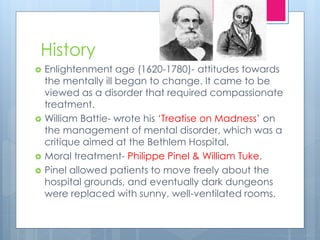
 Enlightenment age (1620-1780)- attitudes towards
the mentally ill began to change. It came to be
viewed as a disorder that required compassionate
treatment.
 William Battie- wrote his ‘Treatise on Madness’ on
the management of mental disorder, which was a
critique aimed at the Bethlem Hospital.
 Moral treatment- Philippe Pinel & William Tuke.
 Pinel allowed patients to move freely about the
hospital grounds, and eventually dark dungeons
were replaced with sunny, well-ventilated rooms.
History
 In UK, the Lunacy Act 1845 was an important
landmark in the treatment of the mentally ill, it
explicitly changed the status of mentally ill people.
 All asylums were required to have written
regulations and to have a resident qualified
physician.
 Early 1800s- advances were made in the diagnosis
of mental illness by broadening the category of
mental disease.
 20th century- introduced a new psychiatry into the
world, with different perspectives of looking at
mental disorders.
History
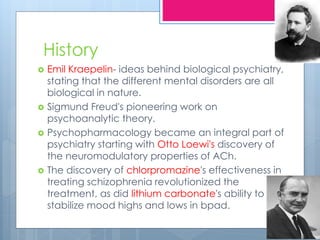
 Emil Kraepelin- ideas behind biological psychiatry,
stating that the different mental disorders are all
biological in nature.
 Sigmund Freud's pioneering work on
psychoanalytic theory.
 Psychopharmacology became an integral part of
psychiatry starting with Otto Loewi's discovery of
the neuromodulatory properties of ACh.
 The discovery of chlorpromazine's effectiveness in
treating schizophrenia revolutionized the
treatment, as did lithium carbonate's ability to
stabilize mood highs and lows in bpad.
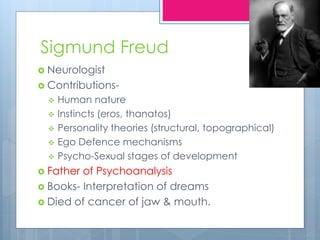
Sigmund Freud
 Neurologist
 Contributions-
 Human nature
 Instincts (eros, thanatos)
 Personality theories (structural, topographical)
 Ego Defence mechanisms
 Psycho-Sexual stages of development
 Father of Psychoanalysis
 Books- Interpretation of dreams
 Died of cancer of jaw & mouth.
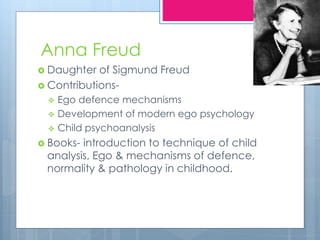
Anna Freud
 Daughter of Sigmund Freud
 Contributions-
 Ego defence mechanisms
 Development of modern ego psychology
 Child psychoanalysis
 Books- introduction to technique of child
analysis, Ego & mechanisms of defence,
normality & pathology in childhood.
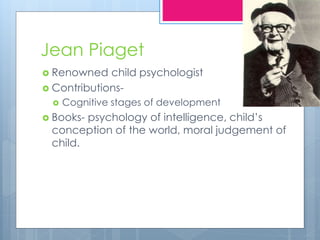
Jean Piaget
 Renowned child psychologist
 Contributions-
 Cognitive stages of development
 Books- psychology of intelligence, child’s
conception of the world, moral judgement of
child.
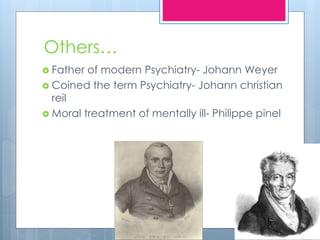
Others…
 Father of modern Psychiatry- Johann Weyer
 Coined the term Psychiatry- Johann christian
reil
 Moral treatment of mentally ill- Philippe pinel
Psychiatry also has its language…
Phenomenology
 Description of nature of inner life of the patient.
 Delusion- A false unshakable belief which arises
from internal morbid processes. It is easily
recognized when it is not keeping with the
person’s educational & cultural context.
 Hallucination- A perception without an object.
 Illusion- Misinterpretation of stimuli arising from
an external object.
Delusions- Types
 Persecution- person believes that people are
trying to conspire against him.
 Infidelity- person becomes convinced of
spouse’s infidelity.
 Love (Erotomania)- person is convinced that
some person is in love with him/her.
 Grandiose- person is convinced that he is the
president of India or acquired property of bill
gates etc..,
 Nihilistic- person denies the existence of his/her
body or mind or world around.
Hallucinations- Types
 Auditory- elementary, second/third person.
 Visual
 Olfactory- smell
 Gustatory- taste
 Tactile- touch
 Visceral- deep sensation
 Hypnogogic & Hypnopompic- occur when
person is falling/waking from sleep.
Phenomenology
 Emotion- A stirred up physiological state as a
response to an event.
 Mood- Pervasive & sustained emotion that
colours the person’s perception of the world.
 Euthymia- normal range of mood, implying
absence of depressed or elevated mood.
 Elevated mood- A mood more cheerful than
normal but not necessarily pathological.
 Ecstasy- Intense sense of rapture or
blissfulness.
Phenomenology
 Thought Insertion/ Withdrawal/ Broadcasting-
Abnormalities of thought, where person feels
thoughts being inserted into mind/ removed/
everyone is thinking along with him.
 Made Feeling/ Impulses/ Acts- Person
experience that feelings/ impulses/ actions
are not his own, they have been imposed
upon.
 Obsession- Involuntary, ego-dystonic,
recurrent, irrational, thoughts that cannot be
eliminated from consciousness.
 Compulsion- obsessional motor acts.
Phenomenology
 Fear- unpleasant affective state in response to
a realistic threat.
 Anxiety- unpleasant affective state with the
expectation but not the certainty of
something untoward happening.
 Panic- acute, intense, overwhelming attack of
anxiety accompanied by feelings of
impending doom & autonomic arousal
symptoms.
 Phobia- persistent, pathological, unrealistic,
intense fear of an object/ situation.
Phenomenology
 Deja vu- over familiarity of places or events.
 Jamais vu- less familiarity with places or
events already known or occurred.
 Confabulation- falsification of memory
occurring in clear consciousness.
 Insight- one’s ability to understand oneself or
external situation.
Nosology
 Science of classification of diseases.
 Classification- process of putting things into
groups based on ways that they are alike.
 “Diagnosis and classification are means of
viewing the world” (Sartorius,N.1988).
Classification in Psychiatry…
 Classification ideally must be based on
aetiology  but do we know the
aetiology???
 Until we know the cause of the various
mental illnesses  what to do???
 So a Pragmatic/ Practical approach to
classification is being followed.
Earlier Classifications
 Initial classification  due to disease of the
brain or those with no such basis, i.e. organic
& functional.
 As knowledge of neurobiological processes is
increasing, their original meaning is being
lost.
 These categories of classification (i.e. organic
versus functional) are becoming absurd
now!!!...
Organic syndromes
 Classified into acute, sub-acute & chronic.
 Most common feature is alteration in
consciousness. It includes delirium.
 It also includes substance use disorders due
to use of alcohol, cannabis, opium etc..,
 Chronic organic states include various
dementias, generalized and focal, as well as
amnestic disorders.
 In modern classification they find their place
in F00 to F19.
Functional syndromes
 Refers to those syndromes where there is no
apparent coarse brain disease.
 Although increasingly it is recognized that
some finer variety of brain disease may exist,
often at a cellular level.
 It was customary to divide these functional
disorders into neurosis and psychosis.
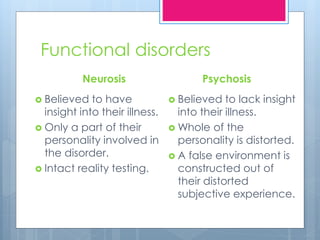
Functional disorders
Neurosis
 Believed to have
insight into their illness.
 Only a part of their
personality involved in
the disorder.
 Intact reality testing.
Psychosis
 Believed to lack insight
into their illness.
 Whole of the
personality is distorted.
 A false environment is
constructed out of
their distorted
subjective experience.
Neurosis
 Neurosis- difficult to define, broad, more info
conveyed if specific diagnosis used.
 Used as aetiological meaning in
psychodynamic writings.
 Not in used DSM 4.
 Retained in ICD-10 under “neurotic stress related
somatoform disorders”.
 Used as non precise term.
Psychosis
 Was used in ICD-9.
 Psychosis- little use in classifying disorders.
 Difficult to define, broad category.
 Used in ICD-10 under “acute & transient
psychotic disorders”.
 Used in DSM-4 “Psychotic disorders NOS”.
Neurotic v/s Psychotic
 Oversimplification !!!...
 Many individuals with neurotic conditions have
 No insight,
 Far from accepting their illness &
 May minimise or deny it totally.
 While people with schizophrenia may seek help
willingly during or before episodes of relapse.
 Moreover, personality
 Can be changed significantly by non-psychotic
disorders such as depressive illness,
 It may be intact in some people with psychotic
disorders such as persistent delusional disorder.
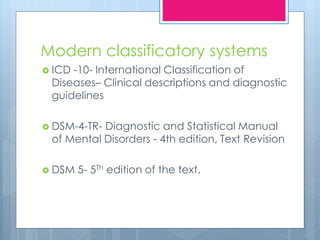
Modern classificatory systems
 ICD -10- International Classification of
Diseases– Clinical descriptions and diagnostic
guidelines
 DSM-4-TR- Diagnostic and Statistical Manual
of Mental Disorders - 4th edition, Text Revision
 DSM 5- 5Th edition of the text.
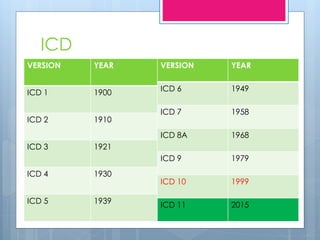
ICD
VERSION YEAR
ICD 1 1900
ICD 2 1910
ICD 3 1921
ICD 4 1930
ICD 5 1939
VERSION YEAR
ICD 6 1949
ICD 7 1958
ICD 8A 1968
ICD 9 1979
ICD 10 1999
ICD 11 2015
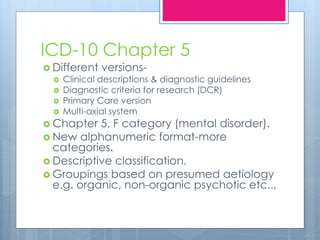
ICD-10 Chapter 5
 Different versions-
 Clinical descriptions & diagnostic guidelines
 Diagnostic criteria for research (DCR)
 Primary Care version
 Multi-axial system
 Chapter 5, F category (mental disorder).
 New alphanumeric format-more
categories.
 Descriptive classification.
 Groupings based on presumed aetiology
e.g. organic, non-organic psychotic etc..,
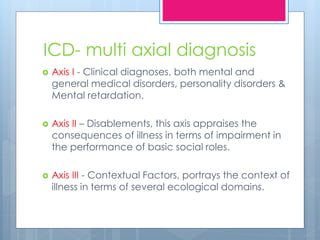
ICD- multi axial diagnosis
 Axis I - Clinical diagnoses, both mental and
general medical disorders, personality disorders &
Mental retardation.
 Axis II – Disablements, this axis appraises the
consequences of illness in terms of impairment in
the performance of basic social roles.
 Axis III - Contextual Factors, portrays the context of
illness in terms of several ecological domains.
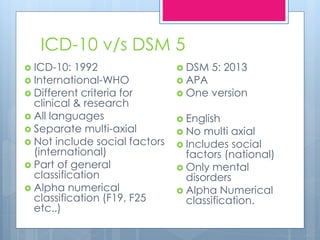
ICD-10 v/s DSM 5
 ICD-10: 1992
 International-WHO
 Different criteria for
clinical & research
 All languages
 Separate multi-axial
 Not include social factors
(international)
 Part of general
classification
 Alpha numerical
classification (F19, F25
etc..)
 DSM 5: 2013
 APA
 One version
 English
 No multi axial
 Includes social
factors (national)
 Only mental
disorders
 Alpha Numerical
classification.
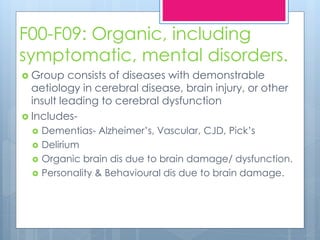
F00-F09: Organic, including
symptomatic, mental disorders.
 Group consists of diseases with demonstrable
aetiology in cerebral disease, brain injury, or other
insult leading to cerebral dysfunction
 Includes-
 Dementias- Alzheimer’s, Vascular, CJD, Pick’s
 Delirium
 Organic brain dis due to brain damage/ dysfunction.
 Personality & Behavioural dis due to brain damage.
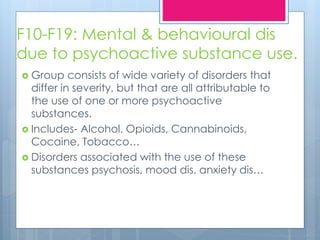
F10-F19: Mental & behavioural dis
due to psychoactive substance use.
 Group consists of wide variety of disorders that
differ in severity, but that are all attributable to
the use of one or more psychoactive
substances.
 Includes- Alcohol, Opioids, Cannabinoids,
Cocaine, Tobacco…
 Disorders associated with the use of these
substances psychosis, mood dis, anxiety dis…
F20-F29: Schizophrenia, schizotypal
and delusional disorders.
 They are a heterogeneous & poorly understood
collection of disorders.
 Schizophrenia is the commonest and most
important disorder of this group.
 Others-
 Schizotypal disorder
 Delusional disorders
 Acute and transient psychotic disorders
 Schizoaffective disorders
F30-F39: Mood [affective] disorders.
 Fundamental disturbance is a change in mood
or affect, usually to depression or to elation. It is
normally accompanied by a change in the
overall level of activity.
 They tend to be recurrent & onset is usually
related to a stressful event.
 Includes-
 Manic/ Hypomanic/ Depressive episode
 Bipolar Affective disorder
 Recurrent depressive disorder
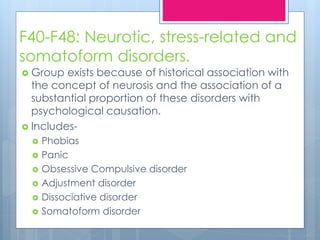
F40-F48: Neurotic, stress-related and
somatoform disorders.
 Group exists because of historical association with
the concept of neurosis and the association of a
substantial proportion of these disorders with
psychological causation.
 Includes-
 Phobias
 Panic
 Obsessive Compulsive disorder
 Adjustment disorder
 Dissociative disorder
 Somatoform disorder
F50-F59: Behavioural syndromes
associated with physiological
disturbances & physical factors.
 Group consists of heterogeneous disorders which
cannot be placed under separate headings.
 Includes-
 Eating disorders- Anorexia, Bulimia
 Sleep disorders
 Sexual dysfunctions
 Disorders during Puerperium
F60-F69: Disorders of adult
personality and behaviour.
 Group includes variety of clinically significant
conditions & behaviour patterns which tend to be
persistent and are the expression of an individual's
characteristic lifestyle.
 Includes-
 Personality disorders
 Habit & Impulse disorders
 Gender identity disorders
 Disorders of sexual preference
F70-F79: Mental retardation.
 It is a condition of arrested or incomplete
development of the mind, which is characterized
by impairment of skills.
 Includes- based on the IQ
 Mild (50-70)
 Moderate (35-49)
 Severe (20-34)
 Profound (<20)
F80-F89: Disorders of psychological
development.
 Common features are-
 Onset in infancy or childhood,
 Impairment or delay in the development of
functions that are related to biological maturation
of the CNS,
 Steady course
 Includes-
 Specific learning disability
 Autism spectrum disorder
F90-F98: Behavioural & emotional dis
with onset in childhood &
adolescence.
 Includes-
 Hyperkinetic disorders
 Conduct disorders
 Emotional disorders
 Tic disorders
 Enuresis, Encopresis
Sub-Specialties
 Addiction psychiatry- Evaluation and treatment of
individuals with alcohol, drug, or other substance-
related disorders.
 Biological psychiatry- Approach to psychiatry that aims
to understand mental disorders in terms of the biological
function of the nervous system.
 Child and adolescent psychiatry- Branch of psychiatry
that specializes in work with children, teenagers, and
their families.
 Community psychiatry- An approach that reflects an
inclusive public health perspective.
Sub-Specialties
 Forensic psychiatry- Interface between law and
psychiatry.
 Geriatric psychiatry- Branch of psychiatry dealing
with the study, prevention, and treatment of
mental disorders in old age.
 Liaison psychiatry- Branch of psychiatry that
specializes in the interface between other medical
specialties and psychiatry.
 Military psychiatry- Covers special aspects of
psychiatry and mental disorders within the military
context.
Thank you

Introduction to psychiatry

  • 1.
    Introduction to Psychiatry Dr.D.Raj Kiran Dept.of Psychiatry KIMS 6th semester UG Class
  • 2.
  • 3.
  • 4.
    Introduction by aPsychiatrist…  Definitions  History  Famous Personalities  Phenomenology  Nosology  Sub-Specialties
  • 5.
    Definitions  Psychiatry- Itis a branch of medicine dealing with mental disorder and its treatment  ‘Psych’- soul or mind  ‘Iatros’- healer  Psychology- It is a science that investigates behaviour, experience, and normal functioning of the mind  Psychotherapy- the treatment of psychological issues by non-physical means  Psychoanalysis- a particular sort of psychotherapy, or means of exploring the unconscious mind
  • 6.
    History  5th century-Mental disorders were considered supernatural in origin.  Religious leaders often turned to versions of exorcism to treat mental disorders.  Specialist hospitals were built in Baghdad, Fes, Cairo & Bethlem Royal Hospital in London in medieval Europe to treat mental disorders.  These institutions were used only as custodial care and did not provide any type of treatment.
  • 7.
    History  Enlightenment age(1620-1780)- attitudes towards the mentally ill began to change. It came to be viewed as a disorder that required compassionate treatment.  William Battie- wrote his ‘Treatise on Madness’ on the management of mental disorder, which was a critique aimed at the Bethlem Hospital.  Moral treatment- Philippe Pinel & William Tuke.  Pinel allowed patients to move freely about the hospital grounds, and eventually dark dungeons were replaced with sunny, well-ventilated rooms.
  • 8.
    History  In UK,the Lunacy Act 1845 was an important landmark in the treatment of the mentally ill, it explicitly changed the status of mentally ill people.  All asylums were required to have written regulations and to have a resident qualified physician.  Early 1800s- advances were made in the diagnosis of mental illness by broadening the category of mental disease.  20th century- introduced a new psychiatry into the world, with different perspectives of looking at mental disorders.
  • 9.
    History  Emil Kraepelin-ideas behind biological psychiatry, stating that the different mental disorders are all biological in nature.  Sigmund Freud's pioneering work on psychoanalytic theory.  Psychopharmacology became an integral part of psychiatry starting with Otto Loewi's discovery of the neuromodulatory properties of ACh.  The discovery of chlorpromazine's effectiveness in treating schizophrenia revolutionized the treatment, as did lithium carbonate's ability to stabilize mood highs and lows in bpad.
  • 10.
    Sigmund Freud  Neurologist Contributions-  Human nature  Instincts (eros, thanatos)  Personality theories (structural, topographical)  Ego Defence mechanisms  Psycho-Sexual stages of development  Father of Psychoanalysis  Books- Interpretation of dreams  Died of cancer of jaw & mouth.
  • 11.
    Anna Freud  Daughterof Sigmund Freud  Contributions-  Ego defence mechanisms  Development of modern ego psychology  Child psychoanalysis  Books- introduction to technique of child analysis, Ego & mechanisms of defence, normality & pathology in childhood.
  • 12.
    Jean Piaget  Renownedchild psychologist  Contributions-  Cognitive stages of development  Books- psychology of intelligence, child’s conception of the world, moral judgement of child.
  • 13.
    Others…  Father ofmodern Psychiatry- Johann Weyer  Coined the term Psychiatry- Johann christian reil  Moral treatment of mentally ill- Philippe pinel
  • 14.
    Psychiatry also hasits language…
  • 15.
    Phenomenology  Description ofnature of inner life of the patient.  Delusion- A false unshakable belief which arises from internal morbid processes. It is easily recognized when it is not keeping with the person’s educational & cultural context.  Hallucination- A perception without an object.  Illusion- Misinterpretation of stimuli arising from an external object.
  • 16.
    Delusions- Types  Persecution-person believes that people are trying to conspire against him.  Infidelity- person becomes convinced of spouse’s infidelity.  Love (Erotomania)- person is convinced that some person is in love with him/her.  Grandiose- person is convinced that he is the president of India or acquired property of bill gates etc..,  Nihilistic- person denies the existence of his/her body or mind or world around.
  • 17.
    Hallucinations- Types  Auditory-elementary, second/third person.  Visual  Olfactory- smell  Gustatory- taste  Tactile- touch  Visceral- deep sensation  Hypnogogic & Hypnopompic- occur when person is falling/waking from sleep.
  • 18.
    Phenomenology  Emotion- Astirred up physiological state as a response to an event.  Mood- Pervasive & sustained emotion that colours the person’s perception of the world.  Euthymia- normal range of mood, implying absence of depressed or elevated mood.  Elevated mood- A mood more cheerful than normal but not necessarily pathological.  Ecstasy- Intense sense of rapture or blissfulness.
  • 19.
    Phenomenology  Thought Insertion/Withdrawal/ Broadcasting- Abnormalities of thought, where person feels thoughts being inserted into mind/ removed/ everyone is thinking along with him.  Made Feeling/ Impulses/ Acts- Person experience that feelings/ impulses/ actions are not his own, they have been imposed upon.  Obsession- Involuntary, ego-dystonic, recurrent, irrational, thoughts that cannot be eliminated from consciousness.  Compulsion- obsessional motor acts.
  • 20.
    Phenomenology  Fear- unpleasantaffective state in response to a realistic threat.  Anxiety- unpleasant affective state with the expectation but not the certainty of something untoward happening.  Panic- acute, intense, overwhelming attack of anxiety accompanied by feelings of impending doom & autonomic arousal symptoms.  Phobia- persistent, pathological, unrealistic, intense fear of an object/ situation.
  • 21.
    Phenomenology  Deja vu-over familiarity of places or events.  Jamais vu- less familiarity with places or events already known or occurred.  Confabulation- falsification of memory occurring in clear consciousness.  Insight- one’s ability to understand oneself or external situation.
  • 22.
    Nosology  Science ofclassification of diseases.  Classification- process of putting things into groups based on ways that they are alike.  “Diagnosis and classification are means of viewing the world” (Sartorius,N.1988).
  • 23.
    Classification in Psychiatry… Classification ideally must be based on aetiology  but do we know the aetiology???  Until we know the cause of the various mental illnesses  what to do???  So a Pragmatic/ Practical approach to classification is being followed.
  • 24.
    Earlier Classifications  Initialclassification  due to disease of the brain or those with no such basis, i.e. organic & functional.  As knowledge of neurobiological processes is increasing, their original meaning is being lost.  These categories of classification (i.e. organic versus functional) are becoming absurd now!!!...
  • 25.
    Organic syndromes  Classifiedinto acute, sub-acute & chronic.  Most common feature is alteration in consciousness. It includes delirium.  It also includes substance use disorders due to use of alcohol, cannabis, opium etc..,  Chronic organic states include various dementias, generalized and focal, as well as amnestic disorders.  In modern classification they find their place in F00 to F19.
  • 26.
    Functional syndromes  Refersto those syndromes where there is no apparent coarse brain disease.  Although increasingly it is recognized that some finer variety of brain disease may exist, often at a cellular level.  It was customary to divide these functional disorders into neurosis and psychosis.
  • 27.
    Functional disorders Neurosis  Believedto have insight into their illness.  Only a part of their personality involved in the disorder.  Intact reality testing. Psychosis  Believed to lack insight into their illness.  Whole of the personality is distorted.  A false environment is constructed out of their distorted subjective experience.
  • 28.
    Neurosis  Neurosis- difficultto define, broad, more info conveyed if specific diagnosis used.  Used as aetiological meaning in psychodynamic writings.  Not in used DSM 4.  Retained in ICD-10 under “neurotic stress related somatoform disorders”.  Used as non precise term.
  • 29.
    Psychosis  Was usedin ICD-9.  Psychosis- little use in classifying disorders.  Difficult to define, broad category.  Used in ICD-10 under “acute & transient psychotic disorders”.  Used in DSM-4 “Psychotic disorders NOS”.
  • 30.
    Neurotic v/s Psychotic Oversimplification !!!...  Many individuals with neurotic conditions have  No insight,  Far from accepting their illness &  May minimise or deny it totally.  While people with schizophrenia may seek help willingly during or before episodes of relapse.  Moreover, personality  Can be changed significantly by non-psychotic disorders such as depressive illness,  It may be intact in some people with psychotic disorders such as persistent delusional disorder.
  • 31.
    Modern classificatory systems ICD -10- International Classification of Diseases– Clinical descriptions and diagnostic guidelines  DSM-4-TR- Diagnostic and Statistical Manual of Mental Disorders - 4th edition, Text Revision  DSM 5- 5Th edition of the text.
  • 32.
    ICD VERSION YEAR ICD 11900 ICD 2 1910 ICD 3 1921 ICD 4 1930 ICD 5 1939 VERSION YEAR ICD 6 1949 ICD 7 1958 ICD 8A 1968 ICD 9 1979 ICD 10 1999 ICD 11 2015
  • 33.
    ICD-10 Chapter 5 Different versions-  Clinical descriptions & diagnostic guidelines  Diagnostic criteria for research (DCR)  Primary Care version  Multi-axial system  Chapter 5, F category (mental disorder).  New alphanumeric format-more categories.  Descriptive classification.  Groupings based on presumed aetiology e.g. organic, non-organic psychotic etc..,
  • 34.
    ICD- multi axialdiagnosis  Axis I - Clinical diagnoses, both mental and general medical disorders, personality disorders & Mental retardation.  Axis II – Disablements, this axis appraises the consequences of illness in terms of impairment in the performance of basic social roles.  Axis III - Contextual Factors, portrays the context of illness in terms of several ecological domains.
  • 35.
    ICD-10 v/s DSM5  ICD-10: 1992  International-WHO  Different criteria for clinical & research  All languages  Separate multi-axial  Not include social factors (international)  Part of general classification  Alpha numerical classification (F19, F25 etc..)  DSM 5: 2013  APA  One version  English  No multi axial  Includes social factors (national)  Only mental disorders  Alpha Numerical classification.
  • 36.
    F00-F09: Organic, including symptomatic,mental disorders.  Group consists of diseases with demonstrable aetiology in cerebral disease, brain injury, or other insult leading to cerebral dysfunction  Includes-  Dementias- Alzheimer’s, Vascular, CJD, Pick’s  Delirium  Organic brain dis due to brain damage/ dysfunction.  Personality & Behavioural dis due to brain damage.
  • 37.
    F10-F19: Mental &behavioural dis due to psychoactive substance use.  Group consists of wide variety of disorders that differ in severity, but that are all attributable to the use of one or more psychoactive substances.  Includes- Alcohol, Opioids, Cannabinoids, Cocaine, Tobacco…  Disorders associated with the use of these substances psychosis, mood dis, anxiety dis…
  • 38.
    F20-F29: Schizophrenia, schizotypal anddelusional disorders.  They are a heterogeneous & poorly understood collection of disorders.  Schizophrenia is the commonest and most important disorder of this group.  Others-  Schizotypal disorder  Delusional disorders  Acute and transient psychotic disorders  Schizoaffective disorders
  • 39.
    F30-F39: Mood [affective]disorders.  Fundamental disturbance is a change in mood or affect, usually to depression or to elation. It is normally accompanied by a change in the overall level of activity.  They tend to be recurrent & onset is usually related to a stressful event.  Includes-  Manic/ Hypomanic/ Depressive episode  Bipolar Affective disorder  Recurrent depressive disorder
  • 40.
    F40-F48: Neurotic, stress-relatedand somatoform disorders.  Group exists because of historical association with the concept of neurosis and the association of a substantial proportion of these disorders with psychological causation.  Includes-  Phobias  Panic  Obsessive Compulsive disorder  Adjustment disorder  Dissociative disorder  Somatoform disorder
  • 41.
    F50-F59: Behavioural syndromes associatedwith physiological disturbances & physical factors.  Group consists of heterogeneous disorders which cannot be placed under separate headings.  Includes-  Eating disorders- Anorexia, Bulimia  Sleep disorders  Sexual dysfunctions  Disorders during Puerperium
  • 42.
    F60-F69: Disorders ofadult personality and behaviour.  Group includes variety of clinically significant conditions & behaviour patterns which tend to be persistent and are the expression of an individual's characteristic lifestyle.  Includes-  Personality disorders  Habit & Impulse disorders  Gender identity disorders  Disorders of sexual preference
  • 43.
    F70-F79: Mental retardation. It is a condition of arrested or incomplete development of the mind, which is characterized by impairment of skills.  Includes- based on the IQ  Mild (50-70)  Moderate (35-49)  Severe (20-34)  Profound (<20)
  • 44.
    F80-F89: Disorders ofpsychological development.  Common features are-  Onset in infancy or childhood,  Impairment or delay in the development of functions that are related to biological maturation of the CNS,  Steady course  Includes-  Specific learning disability  Autism spectrum disorder
  • 45.
    F90-F98: Behavioural &emotional dis with onset in childhood & adolescence.  Includes-  Hyperkinetic disorders  Conduct disorders  Emotional disorders  Tic disorders  Enuresis, Encopresis
  • 46.
    Sub-Specialties  Addiction psychiatry-Evaluation and treatment of individuals with alcohol, drug, or other substance- related disorders.  Biological psychiatry- Approach to psychiatry that aims to understand mental disorders in terms of the biological function of the nervous system.  Child and adolescent psychiatry- Branch of psychiatry that specializes in work with children, teenagers, and their families.  Community psychiatry- An approach that reflects an inclusive public health perspective.
  • 47.
    Sub-Specialties  Forensic psychiatry-Interface between law and psychiatry.  Geriatric psychiatry- Branch of psychiatry dealing with the study, prevention, and treatment of mental disorders in old age.  Liaison psychiatry- Branch of psychiatry that specializes in the interface between other medical specialties and psychiatry.  Military psychiatry- Covers special aspects of psychiatry and mental disorders within the military context.
  • 48.