Pseudomonas aeruginosa
by/ Mai Mamdouh Elfouly
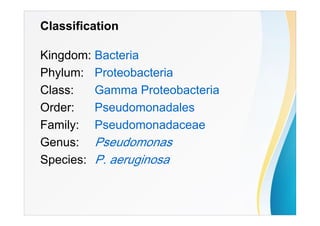
Classification
Kingdom: Bacteria
Phylum: Proteobacteria
Class: Gamma Proteobacteria
Order: Pseudomonadales
Family: Pseudomonadaceae
Genus: Pseudomonas
Species: P. aeruginosa
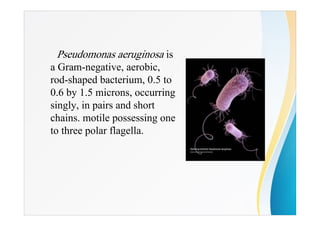
  Pseudomonas aeruginosa is
a Gram-negative, aerobic,
rod-shaped bacterium, 0.5 to
0.6 by 1.5 microns, occurring
singly, in pairs and short
chains. motile possessing one
to three polar flagella.
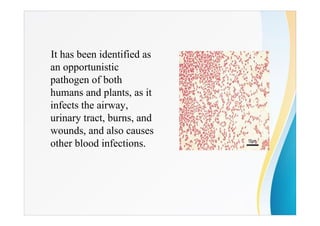
It has been identified as
an opportunistic
pathogen of both
humans and plants, as it
infects the airway,
urinary tract, burns, and
wounds, and also causes
other blood infections.
Furthermore, it has been known for its
characteristic water-soluble pigment as
pyocyanin (blue-green), pyoverdine (yellow-
green fluorescent), and pyorubin (red-brown,
produced by a small proportion of strains), also
for high ability to resist antibiotics.
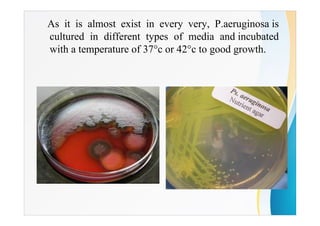
As it is almost exist in every very, P.aeruginosa is
cultured in different types of media and incubated
with a temperature of 37°c or 42°c to good growth.
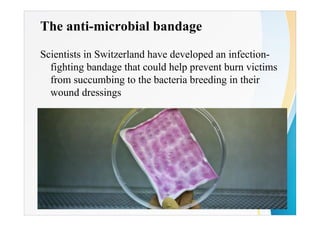
The anti-microbial bandage
Scientists in Switzerland have developed an infection-
fighting bandage that could help prevent burn victims
from succumbing to the bacteria breeding in their
wound dressings
During convalescence, burn patients might be missing
skin on parts of their bodies and wear bandages to treat
their injuries. While these dressings may help heal burn
wounds, like other cloth-based materials, they’re also
ideal breeding grounds for bacteria.
It’s a significant problem, since, according to the
researchers, death from post-burn infections is more
common than fatalities from the burns alone. This is
especially so with Pseudomonas aeruginosa, the main
cause of bacterial infection among patients with serious
burns.
This is where the new biological bandage comes in.
Designed to accelerate the scarring process, the
dressing aims to ultimately keep bacteria from
multiplying, which could help head off infections
before they take hold.
What the researchers have done now is combine the
bandage with molecules called dendrimers. When the
gauze is applied to a bacteria-infected site on a patient’s
skin, some of the dendrimers migrate to the skin and
destroy the microbes in the vicinity, while others stay
behind as a kind of rear guard.
Thank you

Pseudomonas aeruginosa

  • 1.
  • 2.
    Classification Kingdom: Bacteria Phylum: Proteobacteria Class:Gamma Proteobacteria Order: Pseudomonadales Family: Pseudomonadaceae Genus: Pseudomonas Species: P. aeruginosa
  • 3.
      Pseudomonas aeruginosais a Gram-negative, aerobic, rod-shaped bacterium, 0.5 to 0.6 by 1.5 microns, occurring singly, in pairs and short chains. motile possessing one to three polar flagella.
  • 4.
    It has beenidentified as an opportunistic pathogen of both humans and plants, as it infects the airway, urinary tract, burns, and wounds, and also causes other blood infections.
  • 5.
    Furthermore, it hasbeen known for its characteristic water-soluble pigment as pyocyanin (blue-green), pyoverdine (yellow- green fluorescent), and pyorubin (red-brown, produced by a small proportion of strains), also for high ability to resist antibiotics.
  • 6.
    As it isalmost exist in every very, P.aeruginosa is cultured in different types of media and incubated with a temperature of 37°c or 42°c to good growth.
  • 7.
    The anti-microbial bandage Scientistsin Switzerland have developed an infection- fighting bandage that could help prevent burn victims from succumbing to the bacteria breeding in their wound dressings
  • 8.
    During convalescence, burnpatients might be missing skin on parts of their bodies and wear bandages to treat their injuries. While these dressings may help heal burn wounds, like other cloth-based materials, they’re also ideal breeding grounds for bacteria. It’s a significant problem, since, according to the researchers, death from post-burn infections is more common than fatalities from the burns alone. This is especially so with Pseudomonas aeruginosa, the main cause of bacterial infection among patients with serious burns.
  • 9.
    This is wherethe new biological bandage comes in. Designed to accelerate the scarring process, the dressing aims to ultimately keep bacteria from multiplying, which could help head off infections before they take hold. What the researchers have done now is combine the bandage with molecules called dendrimers. When the gauze is applied to a bacteria-infected site on a patient’s skin, some of the dendrimers migrate to the skin and destroy the microbes in the vicinity, while others stay behind as a kind of rear guard.
  • 10.