

www.jaailab.com
Fluid Fractions of semen
1. Urethral glands (2-5% volume)- mucous like.
2. Prostate: (20% to 30% volume)
 acidic fluid
 Contains acid phosphatase and proteolytic enzymes.
 Act on the seminal fluid and causes liquefaction.
3. Seminal vesicles (46-80% volume)
 Viscous, alkaline (acidic environment in the vagina).
 Rich in fructose, vitamin C, prostaglandin.
 Nourish and activate the sperm while passing through
female tract.
4. Testis & Epididymis (5% volume)
 Epididymis provides a temporary storage
www.jaailab.com
Semen Analysis
 It provides information on
1. Sperm production.
2. Patency of the male ducts.
3. The function of the accessory glands.
4. Ejaculative function.
 Indications:
1. Male infertility (30% ).
2. Effectiveness of a vasectomy (6 weeks after the vasectomy).
3. Evaluation of rape victim.
4. Suitability for artificial insemination (ART).
www.jaailab.com
Methods of collection
1. Masturbation.
2. By condom (contain spermicidal agents).
3. By coitus interrupts
4. Assisted ejaculation: used in paraplegics
5. Percutaneous Epididymal Semen Aspiration (PESA).
 Only indicated for therapeutic reasons in obstructive azoospermic.
6. Testicular sperm extraction (TESE/ TESA): Open Testicular
Biopsy:
 Highly invasive, open surgical procedure.
www.jaailab.com
Instructions for collection
• Abstinence 2-6 days.
• Sample container should be provided from laboratory.
• Container must be properly labelled.
• Collection should be in the vicinity of laboratory.
• Collected after passing urine.
• Preferably by masturbation
• Entire sample must be collected into container (No spillage).
• Time of collection must be noted.
• Keep the sample at body temperature, no sunlight
• Deliver the sample within one hour of ejaculation
www.jaailab.com
Since semen samples may vary from day to day.
2 or 3 samples must be evaluated within a 3-6
month period for accurate testing.
www.jaailab.com
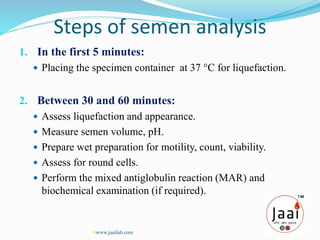
Steps of semen analysis
1. In the first 5 minutes:
 Placing the specimen container at 37 °C for liquefaction.
2. Between 30 and 60 minutes:
 Assess liquefaction and appearance.
 Measure semen volume, pH.
 Prepare wet preparation for motility, count, viability.
 Assess for round cells.
 Perform the mixed antiglobulin reaction (MAR) and
biochemical examination (if required).
www.jaailab.com
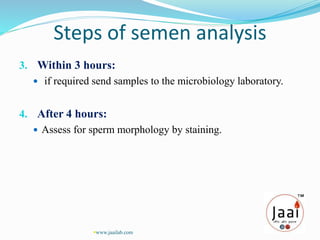
Steps of semen analysis
3. Within 3 hours:
 if required send samples to the microbiology laboratory.
4. After 4 hours:
 Assess for sperm morphology by staining.
www.jaailab.com
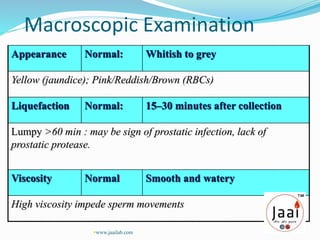
Macroscopic Examination
Appearance Normal: Whitish to grey
Yellow (jaundice); Pink/Reddish/Brown (RBCs)
Liquefaction Normal: 15–30 minutes after collection
Lumpy >60 min : may be sign of prostatic infection, lack of
prostatic protease.
Viscosity Normal Smooth and watery
High viscosity impede sperm movements
www.jaailab.com
Macroscopic Examination
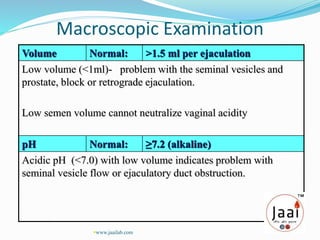
Volume Normal: >1.5 ml per ejaculation
Low volume (<1ml)- problem with the seminal vesicles and
prostate, block or retrograde ejaculation.
Low semen volume cannot neutralize vaginal acidity
pH Normal: ≥7.2 (alkaline)
Acidic pH (<7.0) with low volume indicates problem with
seminal vesicle flow or ejaculatory duct obstruction.
www.jaailab.com
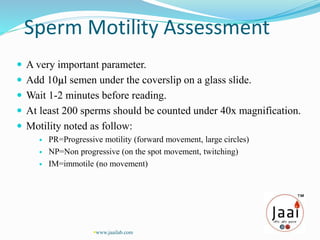
Sperm Motility Assessment
 A very important parameter.
 Add 10µl semen under the coverslip on a glass slide.
 Wait 1-2 minutes before reading.
 At least 200 sperms should be counted under 40x magnification.
 Motility noted as follow:
 PR=Progressive motility (forward movement, large circles)
 NP=Non progressive (on the spot movement, twitching)
 IM=immotile (no movement)
www.jaailab.com
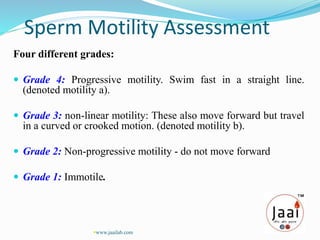
Four different grades:
 Grade 4: Progressive motility. Swim fast in a straight line.
(denoted motility a).
 Grade 3: non-linear motility: These also move forward but travel
in a curved or crooked motion. (denoted motility b).
 Grade 2: Non-progressive motility - do not move forward
 Grade 1: Immotile.
Sperm Motility Assessment
www.jaailab.com
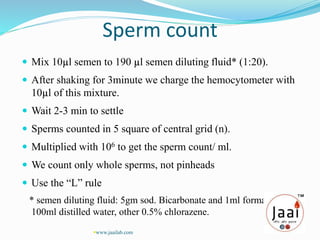
Sperm count
 Mix 10µl semen to 190 µl semen diluting fluid* (1:20).
 After shaking for 3minute we charge the hemocytometer with
10µl of this mixture.
 Wait 2-3 min to settle
 Sperms counted in 5 square of central grid (n).
 Multiplied with 106 to get the sperm count/ ml.
 We count only whole sperms, not pinheads
 Use the “L” rule
* semen diluting fluid: 5gm sod. Bicarbonate and 1ml formalin in
100ml distilled water, other 0.5% chlorazene.
www.jaailab.com
Sperm count calculation
 With chamber depth of 100µm, each large grid (1x1mm) holds 0.1
µl (100nl) volume.
 The central grid contains 25 squares = 4nl per square.
 Count = Number of sperms / volume x dilution factor
Example :
N (per 5 squares) x 20 (DF) = N x 106 sperms per ml
volume of 5 square (20 nl)
1 ml = 1x10⁶ nanolitre
www.jaailab.com
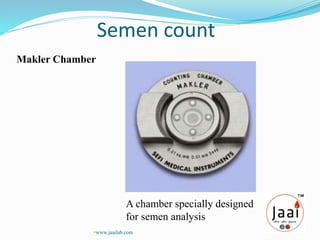
Semen count
Makler Chamber
A chamber specially designed
for semen analysis
www.jaailab.com
Vitality Assessment
 1 part semen mixed with 5 part sod bicarbonate and
centrifuge for 2to 3 minutes at 2000 to 3000 rpm.
 Discarding supernatent and add normal saline and again
centrifuge.
 Sediment is used to prepare a smear by using wire loop.
 This smear stained by any of the following methods:
 Dead sperms take up the stain while live doesn’t.
www.jaailab.com
Vitality Assessment
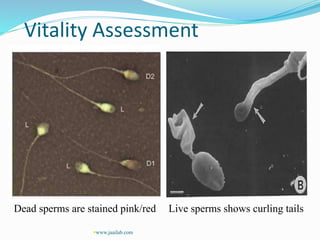
1. Eosin-nigrosin (dead sperm stain pink/red)
2. Eosin (1%) (dead sperm stain pink/red)
3. Trypan blue (0.4%) (dead sperm stain blue)
4. Hypo-osmotic swelling test (HOS) (live sperm shows tail
curling
 Usually 1:1 ratio of semen sediment and dye used for staining.
 At least 200 sperms must be counted.
 Test 4 is use to choose live (immotile) sperm for ICSI
www.jaailab.com
Vitality Assessment
Dead sperms are stained pink/red Live sperms shows curling tails
www.jaailab.com
Assessment of morphology
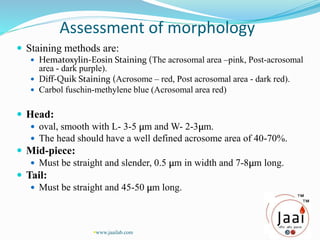
 Staining methods are:
 Hematoxylin-Eosin Staining (The acrosomal area –pink, Post-acrosomal
area - dark purple).
 Diff-Quik Staining (Acrosome – red, Post acrosomal area - dark red).
 Carbol fuschin-methylene blue (Acrosomal area red)
 Head:
 oval, smooth with L- 3-5 µm and W- 2-3µm.
 The head should have a well defined acrosome area of 40-70%.
 Mid-piece:
 Must be straight and slender, 0.5 µm in width and 7-8µm long.
 Tail:
 Must be straight and 45-50 µm long.
www.jaailab.com
Assessment of morphology
 To be classified as normal, the sperm must be normal
in all portions (head, mid-piece, tail).
 At least 400 sperms must be scored on randomly
chosen fields.
Normal Forms (%) = normal sperms / the total
number of sperms evaluated x 100.
www.jaailab.com
Morphology Assessment
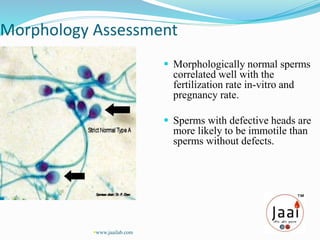
 Morphologically normal sperms
correlated well with the
fertilization rate in-vitro and
pregnancy rate.
 Sperms with defective heads are
more likely to be immotile than
sperms without defects.
www.jaailab.com
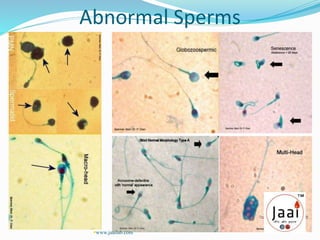
Abnormal Sperms
www.jaailab.com
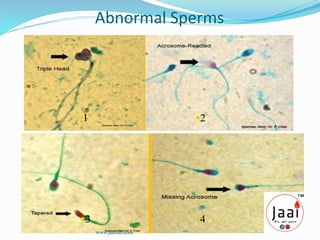
Abnormal Sperms
1 2
43
www.jaailab.com
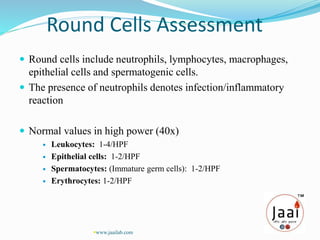
Round Cells Assessment
 Round cells include neutrophils, lymphocytes, macrophages,
epithelial cells and spermatogenic cells.
 The presence of neutrophils denotes infection/inflammatory
reaction
 Normal values in high power (40x)
 Leukocytes: 1-4/HPF
 Epithelial cells: 1-2/HPF
 Spermatocytes: (Immature germ cells): 1-2/HPF
 Erythrocytes: 1-2/HPF
www.jaailab.com
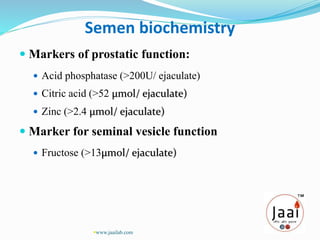
Semen biochemistry
 Markers of prostatic function:
 Acid phosphatase (>200U/ ejaculate)
 Citric acid (>52 µmol/ ejaculate)
 Zinc (>2.4 µmol/ ejaculate)
 Marker for seminal vesicle function
 Fructose (>13µmol/ ejaculate)
www.jaailab.com
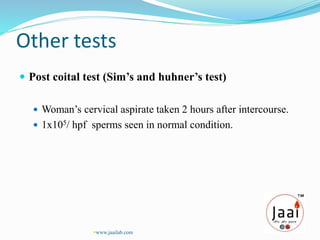
Other tests
 Post coital test (Sim’s and huhner’s test)
 Woman’s cervical aspirate taken 2 hours after intercourse.
 1x10⁵/ hpf sperms seen in normal condition.
www.jaailab.com
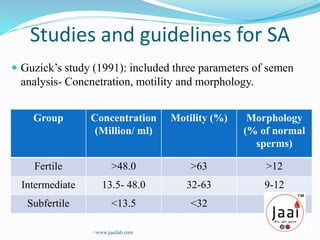
Studies and guidelines for SA
 Guzick’s study (1991): included three parameters of semen
analysis- Concnetration, motility and morphology.
Group Concentration
(Million/ ml)
Motility (%) Morphology
(% of normal
sperms)
Fertile >48.0 >63 >12
Intermediate 13.5- 48.0 32-63 9-12
Subfertile <13.5 <32 <9
www.jaailab.com
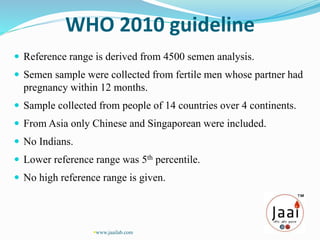
WHO 2010 guideline
 Reference range is derived from 4500 semen analysis.
 Semen sample were collected from fertile men whose partner had
pregnancy within 12 months.
 Sample collected from people of 14 countries over 4 continents.
 From Asia only Chinese and Singaporean were included.
 No Indians.
 Lower reference range was 5th percentile.
 No high reference range is given.
www.jaailab.com
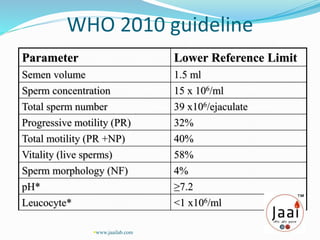
WHO 2010 guideline
Parameter Lower Reference Limit
Semen volume 1.5 ml
Sperm concentration 15 x 106/ml
Total sperm number 39 x106/ejaculate
Progressive motility (PR) 32%
Total motility (PR +NP) 40%
Vitality (live sperms) 58%
Sperm morphology (NF) 4%
pH* ≥7.2
Leucocyte* <1 x10⁶/ml
www.jaailab.com
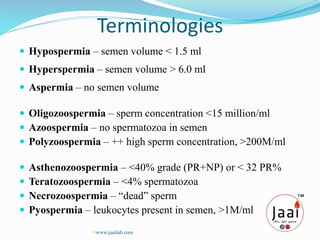
Terminologies
 Hypospermia – semen volume < 1.5 ml
 Hyperspermia – semen volume > 6.0 ml
 Aspermia – no semen volume
 Oligozoospermia – sperm concentration <15 million/ml
 Azoospermia – no spermatozoa in semen
 Polyzoospermia – ++ high sperm concentration, >200M/ml
 Asthenozoospermia – <40% grade (PR+NP) or < 32 PR%
 Teratozoospermia – <4% spermatozoa
 Necrozoospermia – “dead” sperm
 Pyospermia – leukocytes present in semen, >1M/ml
www.jaailab.com
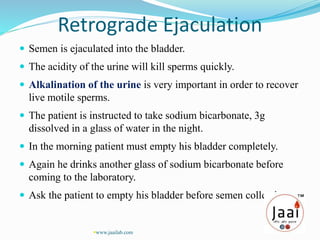
Retrograde Ejaculation
 Semen is ejaculated into the bladder.
 The acidity of the urine will kill sperms quickly.
 Alkalination of the urine is very important in order to recover
live motile sperms.
 The patient is instructed to take sodium bicarbonate, 3g
dissolved in a glass of water in the night.
 In the morning patient must empty his bladder completely.
 Again he drinks another glass of sodium bicarbonate before
coming to the laboratory.
 Ask the patient to empty his bladder before semen collection.
www.jaailab.com
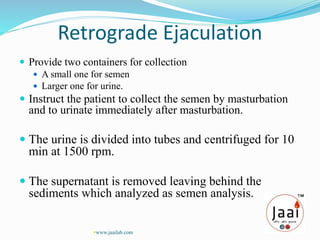
Retrograde Ejaculation
 Provide two containers for collection
 A small one for semen
 Larger one for urine.
 Instruct the patient to collect the semen by masturbation
and to urinate immediately after masturbation.
 The urine is divided into tubes and centrifuged for 10
min at 1500 rpm.
 The supernatant is removed leaving behind the
sediments which analyzed as semen analysis.
www.jaailab.com
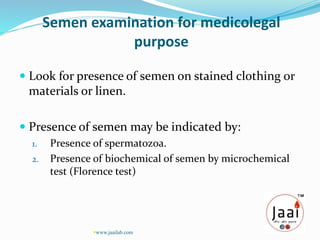
Semen examination for medicolegal
purpose
 Look for presence of semen on stained clothing or
materials or linen.
 Presence of semen may be indicated by:
1. Presence of spermatozoa.
2. Presence of biochemical of semen by microchemical
test (Florence test)
www.jaailab.com
Advantages of semen analysis
 Noninvasive
 Simple
 Inexpensive
 Fast result
www.jaailab.com
Limitations of semen analysis
 Patient may be too embarrassed to provide sample.
 Sample from outside laboratory may not be reliable.
 Wrong sampling.
 Improper transportation
 Subjective test so inter-observer differences high.
 Semen quality vary from day to day hence single test is
not reliable.
 Reproducibility is low as it is subjective test.
 Hesitation in reporting due medicolegal issues.
www.jaailab.com
Computer Assisted SA (CASA)
 Uses video and computer software technology to capture the
types and speed of sperm.
 Additional parameters can be measured such as
 Curvilinear velocity (VCL)
 Straightline velocity (VSL)
 Linearity
 Flagellar beat frequency
 Amplitude of lateral head (ALH)
www.jaailab.com
Computer Assisted SA (CASA)
 Advantages
 More objective and reproducible measurement
 Superior in measurement of sperm motility
 Disadvantages
 Not reliable if sperm density is <2x10⁶/ml or >50x106/ml.
 lots of debris/immotile sperm.
 Parameters not standardized between laboratories –difficult
to interpret results
 Can not distinguishing fertilizing capacity of semen.
www.jaailab.com
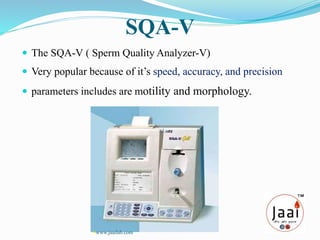
SQA-V
 The SQA-V ( Sperm Quality Analyzer-V)
 Very popular because of it’s speed, accuracy, and precision
 parameters includes are motility and morphology.
www.jaailab.com
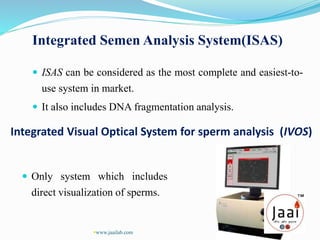
Integrated Semen Analysis System(ISAS)
 ISAS can be considered as the most complete and easiest-to-
use system in market.
 It also includes DNA fragmentation analysis.
Integrated Visual Optical System for sperm analysis (IVOS)
 Only system which includes
direct visualization of sperms.
www.jaailab.com
CASA for Research
 This study was conducted in Calcutta, India
 Groups were studied for risk factor exposure by using CASA.
 The parameters considered among CASA results were: VCL,
VSL, VAP, STR.
1. Tobacco-exposed group- VCL and STR were declined.
2. Heavy metal-exposed group- VCL and ALH were
declined.
www.jaailab.com
Factors affecting SA result
Poor SA can result from factors such as:-
• Incorrect semen collection technique
• Spillage
• Delay in delivering sample
• History of recent illness – flu or high fever may depress
sperm counts
• Long period of abstinence – increased abnormal sperm
morphology and decrease motility
• Short abstinence period – lower sperm count
As it take 10 weeks (64-70 days) for a new batch of sperm to
be generated by the testes, it is best to repeat SA after a
period
www.jaailab.com
Factors affecting SA results
 Medicines (cimetidine, male and female hormones,
sulfasalazine, nitrofurantoin)
 Caffeine, alcohol, cocaine, marijuana, and smoking tobacco.
 Temperature - sperm motility decreased if sample cold.
 Exposure to radiation, some chemicals (certain pesticides)
 Prolonged heat exposure.
www.jaailab.com
Conditions with Abnormal SA
Low or absent sperm count:
 Orchitis
 Varicocele
 Klinefelter syndrome
 Radiation
 Mumps
 Chronic illness (diabetes) may cause retrograde ejaculation
 Hormonal imbalance
www.jaailab.com
Improving SA
 Quality Assurance Program
 SOP
 Documentation
 Proper labeling and reporting
 External QC
 Internal QC
www.jaailab.com
1. In vitro fertilization (IVF)
2. Zygote intrafallopian transfer (ZIFT):
3. Gamete intrafallopian transfer (GIFT)
4. Intracytoplasmic sperm injection (ICSI)
Assisted reproductive technology (ART)
www.jaailab.com
Sperm preparation
 The semen is a mixture of motile and dead spermatozoa with cells,
cellular debris and sometimes micro-organisms present.
 A variety of methods have been developed to separate the motile
sperms from the ejaculate.
 The most common methods are based on washing and
centrifugation
1. Simple sperm wash
2. Swim up
3. Gradient
www.jaailab.com

Semen analysis dr kamlesh

  • 1.
  • 2.
    Fluid Fractions ofsemen 1. Urethral glands (2-5% volume)- mucous like. 2. Prostate: (20% to 30% volume)  acidic fluid  Contains acid phosphatase and proteolytic enzymes.  Act on the seminal fluid and causes liquefaction. 3. Seminal vesicles (46-80% volume)  Viscous, alkaline (acidic environment in the vagina).  Rich in fructose, vitamin C, prostaglandin.  Nourish and activate the sperm while passing through female tract. 4. Testis & Epididymis (5% volume)  Epididymis provides a temporary storage www.jaailab.com
  • 3.
    Semen Analysis  Itprovides information on 1. Sperm production. 2. Patency of the male ducts. 3. The function of the accessory glands. 4. Ejaculative function.  Indications: 1. Male infertility (30% ). 2. Effectiveness of a vasectomy (6 weeks after the vasectomy). 3. Evaluation of rape victim. 4. Suitability for artificial insemination (ART). www.jaailab.com
  • 4.
    Methods of collection 1.Masturbation. 2. By condom (contain spermicidal agents). 3. By coitus interrupts 4. Assisted ejaculation: used in paraplegics 5. Percutaneous Epididymal Semen Aspiration (PESA).  Only indicated for therapeutic reasons in obstructive azoospermic. 6. Testicular sperm extraction (TESE/ TESA): Open Testicular Biopsy:  Highly invasive, open surgical procedure. www.jaailab.com
  • 5.
    Instructions for collection •Abstinence 2-6 days. • Sample container should be provided from laboratory. • Container must be properly labelled. • Collection should be in the vicinity of laboratory. • Collected after passing urine. • Preferably by masturbation • Entire sample must be collected into container (No spillage). • Time of collection must be noted. • Keep the sample at body temperature, no sunlight • Deliver the sample within one hour of ejaculation www.jaailab.com
  • 6.
    Since semen samplesmay vary from day to day. 2 or 3 samples must be evaluated within a 3-6 month period for accurate testing. www.jaailab.com
  • 7.
    Steps of semenanalysis 1. In the first 5 minutes:  Placing the specimen container at 37 °C for liquefaction. 2. Between 30 and 60 minutes:  Assess liquefaction and appearance.  Measure semen volume, pH.  Prepare wet preparation for motility, count, viability.  Assess for round cells.  Perform the mixed antiglobulin reaction (MAR) and biochemical examination (if required). www.jaailab.com
  • 8.
    Steps of semenanalysis 3. Within 3 hours:  if required send samples to the microbiology laboratory. 4. After 4 hours:  Assess for sperm morphology by staining. www.jaailab.com
  • 9.
    Macroscopic Examination Appearance Normal:Whitish to grey Yellow (jaundice); Pink/Reddish/Brown (RBCs) Liquefaction Normal: 15–30 minutes after collection Lumpy >60 min : may be sign of prostatic infection, lack of prostatic protease. Viscosity Normal Smooth and watery High viscosity impede sperm movements www.jaailab.com
  • 10.
    Macroscopic Examination Volume Normal:>1.5 ml per ejaculation Low volume (<1ml)- problem with the seminal vesicles and prostate, block or retrograde ejaculation. Low semen volume cannot neutralize vaginal acidity pH Normal: ≥7.2 (alkaline) Acidic pH (<7.0) with low volume indicates problem with seminal vesicle flow or ejaculatory duct obstruction. www.jaailab.com
  • 11.
    Sperm Motility Assessment A very important parameter.  Add 10µl semen under the coverslip on a glass slide.  Wait 1-2 minutes before reading.  At least 200 sperms should be counted under 40x magnification.  Motility noted as follow:  PR=Progressive motility (forward movement, large circles)  NP=Non progressive (on the spot movement, twitching)  IM=immotile (no movement) www.jaailab.com
  • 12.
    Four different grades: Grade 4: Progressive motility. Swim fast in a straight line. (denoted motility a).  Grade 3: non-linear motility: These also move forward but travel in a curved or crooked motion. (denoted motility b).  Grade 2: Non-progressive motility - do not move forward  Grade 1: Immotile. Sperm Motility Assessment www.jaailab.com
  • 13.
    Sperm count  Mix10µl semen to 190 µl semen diluting fluid* (1:20).  After shaking for 3minute we charge the hemocytometer with 10µl of this mixture.  Wait 2-3 min to settle  Sperms counted in 5 square of central grid (n).  Multiplied with 106 to get the sperm count/ ml.  We count only whole sperms, not pinheads  Use the “L” rule * semen diluting fluid: 5gm sod. Bicarbonate and 1ml formalin in 100ml distilled water, other 0.5% chlorazene. www.jaailab.com
  • 14.
    Sperm count calculation With chamber depth of 100µm, each large grid (1x1mm) holds 0.1 µl (100nl) volume.  The central grid contains 25 squares = 4nl per square.  Count = Number of sperms / volume x dilution factor Example : N (per 5 squares) x 20 (DF) = N x 106 sperms per ml volume of 5 square (20 nl) 1 ml = 1x10⁶ nanolitre www.jaailab.com
  • 15.
    Semen count Makler Chamber Achamber specially designed for semen analysis www.jaailab.com
  • 16.
    Vitality Assessment  1part semen mixed with 5 part sod bicarbonate and centrifuge for 2to 3 minutes at 2000 to 3000 rpm.  Discarding supernatent and add normal saline and again centrifuge.  Sediment is used to prepare a smear by using wire loop.  This smear stained by any of the following methods:  Dead sperms take up the stain while live doesn’t. www.jaailab.com
  • 17.
    Vitality Assessment 1. Eosin-nigrosin(dead sperm stain pink/red) 2. Eosin (1%) (dead sperm stain pink/red) 3. Trypan blue (0.4%) (dead sperm stain blue) 4. Hypo-osmotic swelling test (HOS) (live sperm shows tail curling  Usually 1:1 ratio of semen sediment and dye used for staining.  At least 200 sperms must be counted.  Test 4 is use to choose live (immotile) sperm for ICSI www.jaailab.com
  • 18.
    Vitality Assessment Dead spermsare stained pink/red Live sperms shows curling tails www.jaailab.com
  • 19.
    Assessment of morphology Staining methods are:  Hematoxylin-Eosin Staining (The acrosomal area –pink, Post-acrosomal area - dark purple).  Diff-Quik Staining (Acrosome – red, Post acrosomal area - dark red).  Carbol fuschin-methylene blue (Acrosomal area red)  Head:  oval, smooth with L- 3-5 µm and W- 2-3µm.  The head should have a well defined acrosome area of 40-70%.  Mid-piece:  Must be straight and slender, 0.5 µm in width and 7-8µm long.  Tail:  Must be straight and 45-50 µm long. www.jaailab.com
  • 20.
    Assessment of morphology To be classified as normal, the sperm must be normal in all portions (head, mid-piece, tail).  At least 400 sperms must be scored on randomly chosen fields. Normal Forms (%) = normal sperms / the total number of sperms evaluated x 100. www.jaailab.com
  • 21.
    Morphology Assessment  Morphologicallynormal sperms correlated well with the fertilization rate in-vitro and pregnancy rate.  Sperms with defective heads are more likely to be immotile than sperms without defects. www.jaailab.com
  • 22.
  • 23.
  • 24.
    Round Cells Assessment Round cells include neutrophils, lymphocytes, macrophages, epithelial cells and spermatogenic cells.  The presence of neutrophils denotes infection/inflammatory reaction  Normal values in high power (40x)  Leukocytes: 1-4/HPF  Epithelial cells: 1-2/HPF  Spermatocytes: (Immature germ cells): 1-2/HPF  Erythrocytes: 1-2/HPF www.jaailab.com
  • 25.
    Semen biochemistry  Markersof prostatic function:  Acid phosphatase (>200U/ ejaculate)  Citric acid (>52 µmol/ ejaculate)  Zinc (>2.4 µmol/ ejaculate)  Marker for seminal vesicle function  Fructose (>13µmol/ ejaculate) www.jaailab.com
  • 26.
    Other tests  Postcoital test (Sim’s and huhner’s test)  Woman’s cervical aspirate taken 2 hours after intercourse.  1x10⁵/ hpf sperms seen in normal condition. www.jaailab.com
  • 27.
    Studies and guidelinesfor SA  Guzick’s study (1991): included three parameters of semen analysis- Concnetration, motility and morphology. Group Concentration (Million/ ml) Motility (%) Morphology (% of normal sperms) Fertile >48.0 >63 >12 Intermediate 13.5- 48.0 32-63 9-12 Subfertile <13.5 <32 <9 www.jaailab.com
  • 28.
    WHO 2010 guideline Reference range is derived from 4500 semen analysis.  Semen sample were collected from fertile men whose partner had pregnancy within 12 months.  Sample collected from people of 14 countries over 4 continents.  From Asia only Chinese and Singaporean were included.  No Indians.  Lower reference range was 5th percentile.  No high reference range is given. www.jaailab.com
  • 29.
    WHO 2010 guideline ParameterLower Reference Limit Semen volume 1.5 ml Sperm concentration 15 x 106/ml Total sperm number 39 x106/ejaculate Progressive motility (PR) 32% Total motility (PR +NP) 40% Vitality (live sperms) 58% Sperm morphology (NF) 4% pH* ≥7.2 Leucocyte* <1 x10⁶/ml www.jaailab.com
  • 30.
    Terminologies  Hypospermia –semen volume < 1.5 ml  Hyperspermia – semen volume > 6.0 ml  Aspermia – no semen volume  Oligozoospermia – sperm concentration <15 million/ml  Azoospermia – no spermatozoa in semen  Polyzoospermia – ++ high sperm concentration, >200M/ml  Asthenozoospermia – <40% grade (PR+NP) or < 32 PR%  Teratozoospermia – <4% spermatozoa  Necrozoospermia – “dead” sperm  Pyospermia – leukocytes present in semen, >1M/ml www.jaailab.com
  • 31.
    Retrograde Ejaculation  Semenis ejaculated into the bladder.  The acidity of the urine will kill sperms quickly.  Alkalination of the urine is very important in order to recover live motile sperms.  The patient is instructed to take sodium bicarbonate, 3g dissolved in a glass of water in the night.  In the morning patient must empty his bladder completely.  Again he drinks another glass of sodium bicarbonate before coming to the laboratory.  Ask the patient to empty his bladder before semen collection. www.jaailab.com
  • 32.
    Retrograde Ejaculation  Providetwo containers for collection  A small one for semen  Larger one for urine.  Instruct the patient to collect the semen by masturbation and to urinate immediately after masturbation.  The urine is divided into tubes and centrifuged for 10 min at 1500 rpm.  The supernatant is removed leaving behind the sediments which analyzed as semen analysis. www.jaailab.com
  • 33.
    Semen examination formedicolegal purpose  Look for presence of semen on stained clothing or materials or linen.  Presence of semen may be indicated by: 1. Presence of spermatozoa. 2. Presence of biochemical of semen by microchemical test (Florence test) www.jaailab.com
  • 34.
    Advantages of semenanalysis  Noninvasive  Simple  Inexpensive  Fast result www.jaailab.com
  • 35.
    Limitations of semenanalysis  Patient may be too embarrassed to provide sample.  Sample from outside laboratory may not be reliable.  Wrong sampling.  Improper transportation  Subjective test so inter-observer differences high.  Semen quality vary from day to day hence single test is not reliable.  Reproducibility is low as it is subjective test.  Hesitation in reporting due medicolegal issues. www.jaailab.com
  • 36.
    Computer Assisted SA(CASA)  Uses video and computer software technology to capture the types and speed of sperm.  Additional parameters can be measured such as  Curvilinear velocity (VCL)  Straightline velocity (VSL)  Linearity  Flagellar beat frequency  Amplitude of lateral head (ALH) www.jaailab.com
  • 37.
    Computer Assisted SA(CASA)  Advantages  More objective and reproducible measurement  Superior in measurement of sperm motility  Disadvantages  Not reliable if sperm density is <2x10⁶/ml or >50x106/ml.  lots of debris/immotile sperm.  Parameters not standardized between laboratories –difficult to interpret results  Can not distinguishing fertilizing capacity of semen. www.jaailab.com
  • 38.
    SQA-V  The SQA-V( Sperm Quality Analyzer-V)  Very popular because of it’s speed, accuracy, and precision  parameters includes are motility and morphology. www.jaailab.com
  • 39.
    Integrated Semen AnalysisSystem(ISAS)  ISAS can be considered as the most complete and easiest-to- use system in market.  It also includes DNA fragmentation analysis. Integrated Visual Optical System for sperm analysis (IVOS)  Only system which includes direct visualization of sperms. www.jaailab.com
  • 40.
    CASA for Research This study was conducted in Calcutta, India  Groups were studied for risk factor exposure by using CASA.  The parameters considered among CASA results were: VCL, VSL, VAP, STR. 1. Tobacco-exposed group- VCL and STR were declined. 2. Heavy metal-exposed group- VCL and ALH were declined. www.jaailab.com
  • 41.
    Factors affecting SAresult Poor SA can result from factors such as:- • Incorrect semen collection technique • Spillage • Delay in delivering sample • History of recent illness – flu or high fever may depress sperm counts • Long period of abstinence – increased abnormal sperm morphology and decrease motility • Short abstinence period – lower sperm count As it take 10 weeks (64-70 days) for a new batch of sperm to be generated by the testes, it is best to repeat SA after a period www.jaailab.com
  • 42.
    Factors affecting SAresults  Medicines (cimetidine, male and female hormones, sulfasalazine, nitrofurantoin)  Caffeine, alcohol, cocaine, marijuana, and smoking tobacco.  Temperature - sperm motility decreased if sample cold.  Exposure to radiation, some chemicals (certain pesticides)  Prolonged heat exposure. www.jaailab.com
  • 43.
    Conditions with AbnormalSA Low or absent sperm count:  Orchitis  Varicocele  Klinefelter syndrome  Radiation  Mumps  Chronic illness (diabetes) may cause retrograde ejaculation  Hormonal imbalance www.jaailab.com
  • 44.
    Improving SA  QualityAssurance Program  SOP  Documentation  Proper labeling and reporting  External QC  Internal QC www.jaailab.com
  • 45.
    1. In vitrofertilization (IVF) 2. Zygote intrafallopian transfer (ZIFT): 3. Gamete intrafallopian transfer (GIFT) 4. Intracytoplasmic sperm injection (ICSI) Assisted reproductive technology (ART) www.jaailab.com
  • 46.
    Sperm preparation  Thesemen is a mixture of motile and dead spermatozoa with cells, cellular debris and sometimes micro-organisms present.  A variety of methods have been developed to separate the motile sperms from the ejaculate.  The most common methods are based on washing and centrifugation 1. Simple sperm wash 2. Swim up 3. Gradient www.jaailab.com