COMPUTER-AIDED PREDICTION OF XENOBIOTICS TOXICITY  Reporters:  Zinchenko T.O., Nebesna T.Yu. Scientific  advisers: prof.  I. S. Chekman,  prof. O.P. Javorovsky National O.O. Bogomolets Medical University Department of pharmacology and clinical pharmacology   Chief of department: prof.  I.S. Chekman Department of  hygiene of work   Chief of department: prof. O.P. Javorovsky
Toxicology   is the study of the adverse effects of chemicals on living organisms. It is the study of symptoms, mechanisms, treatments and detection of poisoning, especially the poisoning of people. Toxicity   is the degree to which a substance is able to damage an exposed organism. A xenobiotic   is a chemical which is found in an organism but which is not normally produced or expected to be present in it.
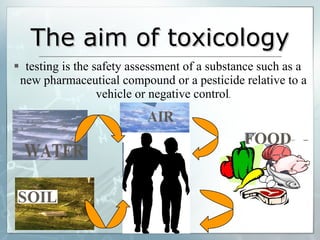
The aim of toxicology testing is the safety assessment of a substance such as a new pharmaceutical compound or a pesticide relative to a vehicle or negative control .
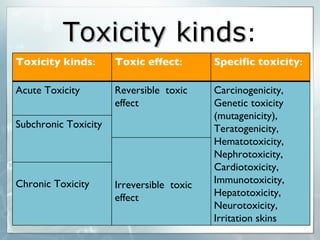
Toxicity kinds : Toxicity kinds : Toxic effect : Specific toxicity : Acute Toxicity Reversible  toxic effect Carcinogenicity, Genetic toxicity (mutagenicity), Teratogenicity, Hematotoxicity, Nephrotoxicity, Cardiotoxicity, Immunotoxicity, Hepatotoxicity, Neurotoxicity, Irritation skins  Subchronic Toxicity Irreversible  toxic effect Chronic Toxicity
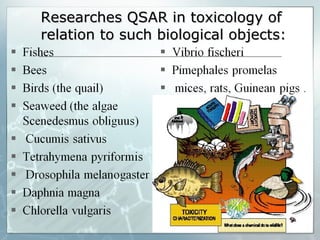
Researches QSAR in toxicology of relation to such biological objects:
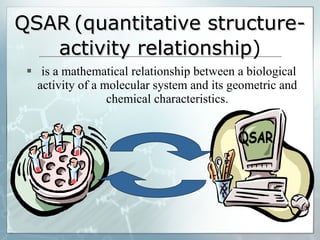
QSAR   (quantitative structure-activity relationship ) is a mathematical relationship between a biological activity of a molecular system and its geometric and chemical characteristics.
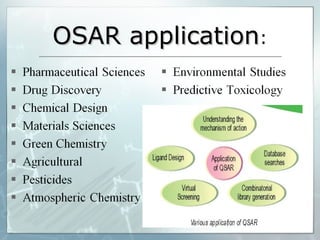
OSAR application :
 
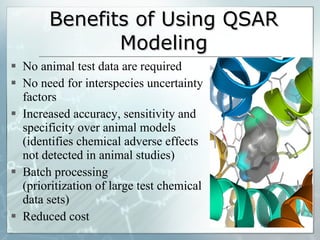
Benefits of Using QSAR Modeling No animal test data are required No need for interspecies uncertainty factors Increased accuracy, sensitivity and specificity over animal models (identifies chemical adverse effects not detected in animal studies) Batch processing (prioritization of large test chemical data sets) Reduced cost
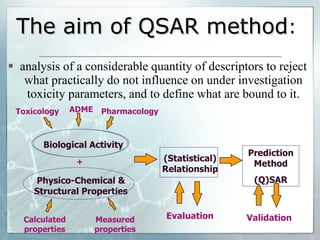
The aim of QSAR method :  analysis of a considerable quantity of descriptors to reject what practically do not influence on under investigation toxicity parameters, and to define what are bound to it. Biological Activity Physico-Chemical & Structural Properties + (Statistical) Relationship Prediction Method (Q)SAR Evaluation Toxicology Pharmacology Calculated properties Measured properties ADME Validation
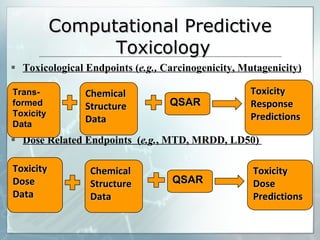
Computational Predictive  Toxicology Toxicological Endpoints ( e.g.,  Carcinogenicity, Mutagenicity) Dose Related Endpoints  ( e.g. , MTD, MRDD, LD50)  Trans-formed Toxicity Data  Chemical Structure Data QSAR Toxicity Response Predictions  Toxicity Dose Data  Chemical Structure Data QSAR Toxicity Dose Predictions
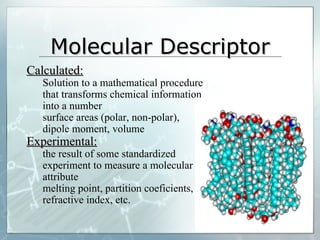
Molecular Descriptor Calculated: Solution to a mathematical procedure that transforms chemical information into a number surface areas (polar, non-polar), dipole moment, volume Experimental: the result of some standardized experiment to measure a molecular attribute  melting point, partition coeficients, refractive index, etc.
Types of Descriptors
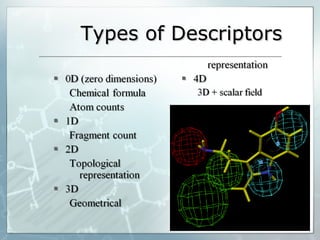
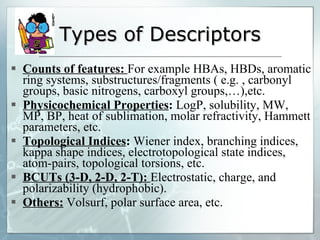
Types of Descriptors Counts of features:  For example HBAs, HBDs, aromatic ring systems, substructures/fragments ( e.g. , carbonyl groups, basic nitrogens, carboxyl groups,…),etc. Physicochemical Properties :  LogP, solubility, MW, MP, BP, heat of sublimation, molar refractivity, Hammett parameters, etc. Topological Indices :  Wiener index, branching indices, kappa shape indices, electrotopological state indices, atom-pairs, topological torsions, etc. BCUTs (3-D, 2-D, 2-T):  Electrostatic, charge, and polarizability (hydrophobic). Others:   Volsurf, polar surface area, etc.
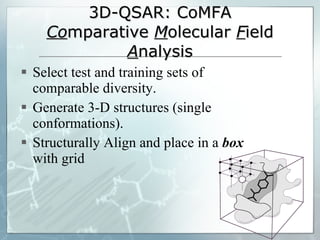
3D-QSAR: CoMFA Co mparative  M olecular  F ield  A nalysis Select test and training sets of comparable diversity. Generate 3-D structures (single conformations). Structurally Align and place in a  box  with grid
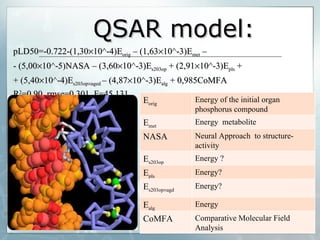
QSAR model : pLD50=-0.722-(1,30  10^-4)E orig  – (1,63  10^-3)E met  –  - (5,00  10^-5)NASA – (3,60  10^-3)E s203op  + (2,91  10^-3)E pls  +  + (5,40  10^-4)E s203op  aged  – (4,87  10^-3)E alg  + 0,985CoMFA R 2 =0.90, rmse=0.301, F=45.131. E orig   Energy of the initial organ phosphorus compound E met   Energy  metabolite  NASA Neural Approach  to  structure-activity E s203op Energy ? E pls Energy? E s203op  agd Energy? E alg Energy CoMFA  Comparative Molecular Field Analysis
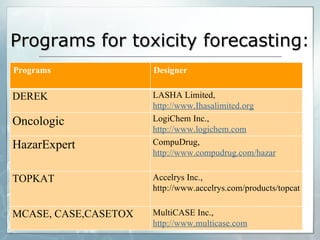
Programs for toxicity forecasting : Programs Designer DEREK LASHA Limited, http://www.Ihasalimited.org Oncologic LogiChem Inc., http://www.logichem.com HazarExpert CompuDrug, http://www.compudrug.com/hazar TOPKAT Accelrys Inc., http://www.accelrys.com/products/topcat MCASE, CASE,CASETOX MultiCASE Inc., http://www.multicase.com
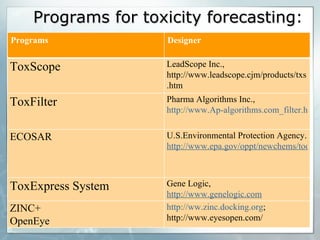
Programs for toxicity forecasting : Programs Designer ToxScope LeadScope Inc., http://www.leadscope.cjm/products/txs.htm ToxFilter Pharma Algorithms Inc., http://www.Ap-algorithms.com_filter.htm ECOSAR U.S.Environmental Protection Agency. http://www.epa.gov/oppt/newchems/tools/21ecosar.htm ToxExpress System Gene Logic, http://www.genelogic.com ZINC+ OpenEye http://ww.zinc.docking.org ;  http://www.eyesopen.com/
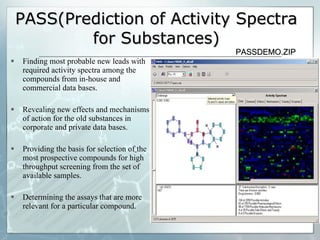
PASS(Prediction of Activity Spectra for Substances) Finding most probable new leads with required activity spectra among the compounds from in-house and commercial data bases. Revealing new effects and mechanisms of action for the old substances in corporate and private data bases. Providing the basis for selection of   the most prospective compounds for high throughput screening from the set of available samples. Determining the assays that are more relevant for a particular compound. PASSDEMO.ZIP
Thanks for your attention!

Computer-aided prediction of xenobiotics toxicity

  • 1.
    COMPUTER-AIDEDPREDICTION OF XENOBIOTICS TOXICITY Reporters: Zinchenko T.O., Nebesna T.Yu. Scientific advisers: prof. I. S. Chekman, prof. O.P. Javorovsky National O.O. Bogomolets Medical University Department of pharmacology and clinical pharmacology Chief of department: prof. I.S. Chekman Department of hygiene of work Chief of department: prof. O.P. Javorovsky
  • 2.
    Toxicology is the study of the adverse effects of chemicals on living organisms. It is the study of symptoms, mechanisms, treatments and detection of poisoning, especially the poisoning of people. Toxicity is the degree to which a substance is able to damage an exposed organism. A xenobiotic is a chemical which is found in an organism but which is not normally produced or expected to be present in it.
  • 3.
    The aim oftoxicology testing is the safety assessment of a substance such as a new pharmaceutical compound or a pesticide relative to a vehicle or negative control .
  • 4.
    Toxicity kinds :Toxicity kinds : Toxic effect : Specific toxicity : Acute Toxicity Reversible toxic effect Carcinogenicity, Genetic toxicity (mutagenicity), Teratogenicity, Hematotoxicity, Nephrotoxicity, Cardiotoxicity, Immunotoxicity, Hepatotoxicity, Neurotoxicity, Irritation skins Subchronic Toxicity Irreversible toxic effect Chronic Toxicity
  • 5.
    Researches QSAR intoxicology of relation to such biological objects:
  • 6.
    QSAR (quantitative structure-activity relationship ) is a mathematical relationship between a biological activity of a molecular system and its geometric and chemical characteristics.
  • 7.
  • 8.
  • 9.
    Benefits of UsingQSAR Modeling No animal test data are required No need for interspecies uncertainty factors Increased accuracy, sensitivity and specificity over animal models (identifies chemical adverse effects not detected in animal studies) Batch processing (prioritization of large test chemical data sets) Reduced cost
  • 10.
    The aim ofQSAR method : analysis of a considerable quantity of descriptors to reject what practically do not influence on under investigation toxicity parameters, and to define what are bound to it. Biological Activity Physico-Chemical & Structural Properties + (Statistical) Relationship Prediction Method (Q)SAR Evaluation Toxicology Pharmacology Calculated properties Measured properties ADME Validation
  • 11.
    Computational Predictive Toxicology Toxicological Endpoints ( e.g., Carcinogenicity, Mutagenicity) Dose Related Endpoints ( e.g. , MTD, MRDD, LD50) Trans-formed Toxicity Data Chemical Structure Data QSAR Toxicity Response Predictions Toxicity Dose Data Chemical Structure Data QSAR Toxicity Dose Predictions
  • 12.
    Molecular Descriptor Calculated:Solution to a mathematical procedure that transforms chemical information into a number surface areas (polar, non-polar), dipole moment, volume Experimental: the result of some standardized experiment to measure a molecular attribute melting point, partition coeficients, refractive index, etc.
  • 13.
  • 14.
    Types of DescriptorsCounts of features: For example HBAs, HBDs, aromatic ring systems, substructures/fragments ( e.g. , carbonyl groups, basic nitrogens, carboxyl groups,…),etc. Physicochemical Properties : LogP, solubility, MW, MP, BP, heat of sublimation, molar refractivity, Hammett parameters, etc. Topological Indices : Wiener index, branching indices, kappa shape indices, electrotopological state indices, atom-pairs, topological torsions, etc. BCUTs (3-D, 2-D, 2-T): Electrostatic, charge, and polarizability (hydrophobic). Others: Volsurf, polar surface area, etc.
  • 15.
    3D-QSAR: CoMFA Comparative M olecular F ield A nalysis Select test and training sets of comparable diversity. Generate 3-D structures (single conformations). Structurally Align and place in a box with grid
  • 16.
    QSAR model :pLD50=-0.722-(1,30  10^-4)E orig – (1,63  10^-3)E met – - (5,00  10^-5)NASA – (3,60  10^-3)E s203op + (2,91  10^-3)E pls + + (5,40  10^-4)E s203op  aged – (4,87  10^-3)E alg + 0,985CoMFA R 2 =0.90, rmse=0.301, F=45.131. E orig Energy of the initial organ phosphorus compound E met Energy metabolite NASA Neural Approach to structure-activity E s203op Energy ? E pls Energy? E s203op  agd Energy? E alg Energy CoMFA Comparative Molecular Field Analysis
  • 17.
    Programs for toxicityforecasting : Programs Designer DEREK LASHA Limited, http://www.Ihasalimited.org Oncologic LogiChem Inc., http://www.logichem.com HazarExpert CompuDrug, http://www.compudrug.com/hazar TOPKAT Accelrys Inc., http://www.accelrys.com/products/topcat MCASE, CASE,CASETOX MultiCASE Inc., http://www.multicase.com
  • 18.
    Programs for toxicityforecasting : Programs Designer ToxScope LeadScope Inc., http://www.leadscope.cjm/products/txs.htm ToxFilter Pharma Algorithms Inc., http://www.Ap-algorithms.com_filter.htm ECOSAR U.S.Environmental Protection Agency. http://www.epa.gov/oppt/newchems/tools/21ecosar.htm ToxExpress System Gene Logic, http://www.genelogic.com ZINC+ OpenEye http://ww.zinc.docking.org ; http://www.eyesopen.com/
  • 19.
    PASS(Prediction of ActivitySpectra for Substances) Finding most probable new leads with required activity spectra among the compounds from in-house and commercial data bases. Revealing new effects and mechanisms of action for the old substances in corporate and private data bases. Providing the basis for selection of the most prospective compounds for high throughput screening from the set of available samples. Determining the assays that are more relevant for a particular compound. PASSDEMO.ZIP
  • 20.
    Thanks for yourattention!