Dr. C.V. Suresh Babu
• Prototyping‐ rapid prototyping
• testing and evaluation of design
• Design modifications
• Freezing the design
• Cost analysis
• Engineering the design
• From prototype to product
• Planning;
• Scheduling;
• Supply chains;
• Inventory handling;
• development;
• feed‐back on design
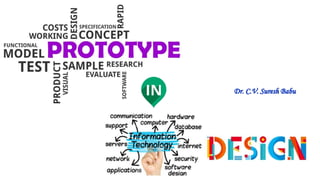
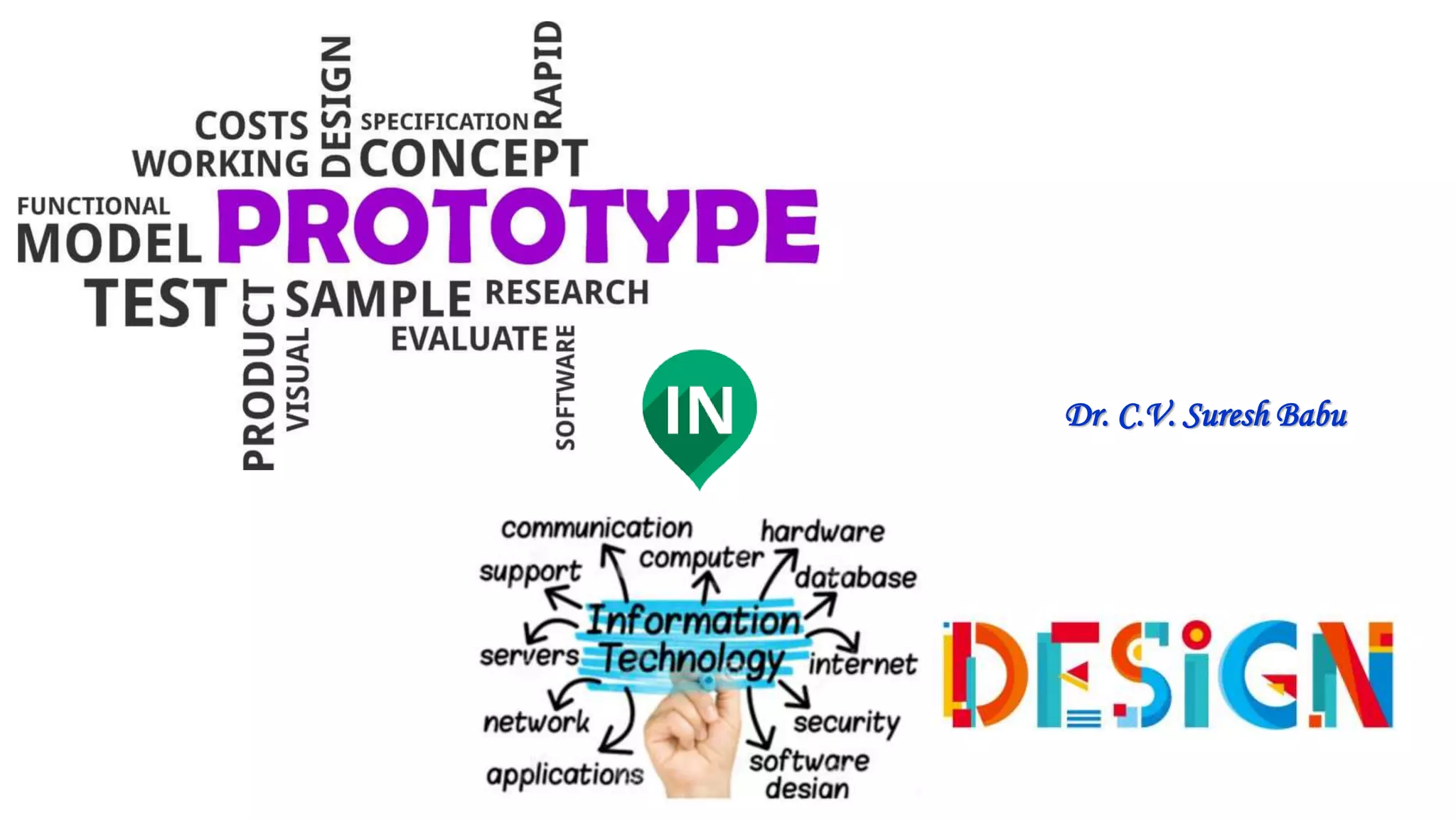
Prototype
A prototype is an original model, form or an instance that serves as a
basis for other processes. In software technology, the term prototype is
a working example through which a new model or a new version of an
existing product can be derived.
In an engineering product design context, a prototype is a preliminary
version of the end-product and used to evaluate the design, test the
technology or analyse the working principle which in turn provides
product specification for a real working system.
Rapid prototyping
• Rapid prototype or rapid prototyping is a relatively new term and in
its simplest form, the process of creating prototypes quickly to
visually and functionally evaluate an engineering product design.
Testing a prototype / developed design is a very important part of the
design and manufacturing process. Testing and evaluation, simply
confirms that the product will work as it is supposed to, or if it needs
refinement.
In general, testing a prototype allows the designer and client to assess
the viability of a design. Will it be successful as a commercial product?
Testing also helps identify potential faults, which in turn allows the
designer to make improvements.
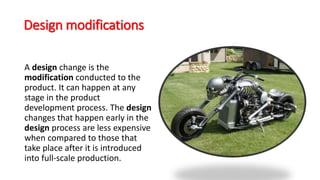
Design modifications
A design change is the
modification conducted to the
product. It can happen at any
stage in the product
development process. The design
changes that happen early in the
design process are less expensive
when compared to those that
take place after it is introduced
into full-scale production.
The building design process
resolves client requirements
into a set of instructions for
the construction of a building
that satisfies those
requirements. It is generally an
iterative process in which the
design becomes more detailed
and more 'fixed' as the project
progresses.
A functional cost analysis is a method
that can be applied to examine the
component costs of a product in
relation to the value as perceived by
the customer. The outcome of the
analysis is to improve the value of
the product while maintaining costs
and/or reduce the costs of the
product without reducing value.
Engineering the design
Engineering design is the method that engineers use to identify and
solve problems. It has been described and mapped out in many ways,
but all descriptions include some common attributes: Engineering
design is a process. This powerful approach to problem solving is
flexible enough to work in almost any situation.
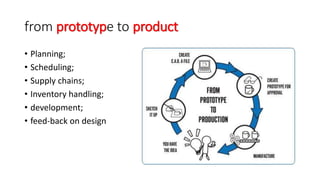
from prototype to product
• Planning;
• Scheduling;
• Supply chains;
• Inventory handling;
• development;
• feed‐back on design

PROTOTYPE IN IT DESIGN

  • 1.
  • 2.
    • Prototyping‐ rapidprototyping • testing and evaluation of design • Design modifications • Freezing the design • Cost analysis • Engineering the design • From prototype to product • Planning; • Scheduling; • Supply chains; • Inventory handling; • development; • feed‐back on design
  • 3.
    Prototype A prototype isan original model, form or an instance that serves as a basis for other processes. In software technology, the term prototype is a working example through which a new model or a new version of an existing product can be derived. In an engineering product design context, a prototype is a preliminary version of the end-product and used to evaluate the design, test the technology or analyse the working principle which in turn provides product specification for a real working system.
  • 4.
    Rapid prototyping • Rapidprototype or rapid prototyping is a relatively new term and in its simplest form, the process of creating prototypes quickly to visually and functionally evaluate an engineering product design.
  • 5.
    Testing a prototype/ developed design is a very important part of the design and manufacturing process. Testing and evaluation, simply confirms that the product will work as it is supposed to, or if it needs refinement. In general, testing a prototype allows the designer and client to assess the viability of a design. Will it be successful as a commercial product? Testing also helps identify potential faults, which in turn allows the designer to make improvements.
  • 6.
    Design modifications A designchange is the modification conducted to the product. It can happen at any stage in the product development process. The design changes that happen early in the design process are less expensive when compared to those that take place after it is introduced into full-scale production.
  • 7.
    The building designprocess resolves client requirements into a set of instructions for the construction of a building that satisfies those requirements. It is generally an iterative process in which the design becomes more detailed and more 'fixed' as the project progresses.
  • 8.
    A functional costanalysis is a method that can be applied to examine the component costs of a product in relation to the value as perceived by the customer. The outcome of the analysis is to improve the value of the product while maintaining costs and/or reduce the costs of the product without reducing value.
  • 9.
    Engineering the design Engineeringdesign is the method that engineers use to identify and solve problems. It has been described and mapped out in many ways, but all descriptions include some common attributes: Engineering design is a process. This powerful approach to problem solving is flexible enough to work in almost any situation.
  • 10.
    from prototype toproduct • Planning; • Scheduling; • Supply chains; • Inventory handling; • development; • feed‐back on design