MODELS
IN SOFTWARE
TESTING
By Mithilesh Singh
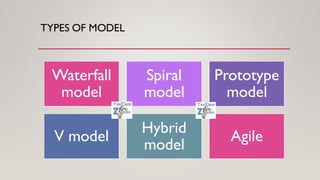
TYPES OF MODEL
Waterfall
model
Spiral
model
Prototype
model
V model
Hybrid
model
Agile
WHYWE USE
THESE MODELS?
• SDLC model gives the proper flow or better
said roadmap for developing and testing the
software.It's a kind of framework that says
when to do what to do and how to do.This is
designed based on requirement types,kinds of
requirements,and challenges that we were facing
to achieve a quality product.Client needs to
come up with their requirements and budget
and we can use specific model to fulfill that.
WATERFALL MODEL
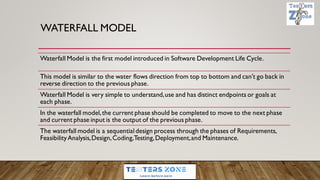
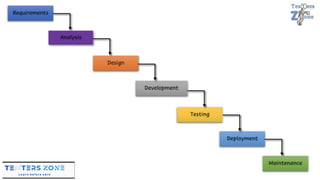
Waterfall Model is the first model introduced in Software Development Life Cycle.
This model is similar to the water flows direction from top to bottom and can't go back in
reverse direction to the previous phase.
Waterfall Model is very simple to understand,use and has distinct endpoints or goals at
each phase.
In the waterfall model,the current phase should be completed to move to the next phase
and current phase input is the output of the previous phase.
The waterfall model is a sequential design process through the phases of Requirements,
FeasibilityAnalysis,Design,Coding,Testing,Deployment,and Maintenance.
WHYTHIS MODEL?
• This was very simple and first model introduced and there was no any other model at
that time and also it fits to the any size(small, medium or large) project that why it got
popularity in short span of time.
WHENTO USEWATERFALL MODEL?
• Requirement is clear and receive in the starting of the project.Thers is no any in
between requirement changes.
• Client is interested with end product and don't want to pitch into in
between development.
• Having clear idea on what is the end product.
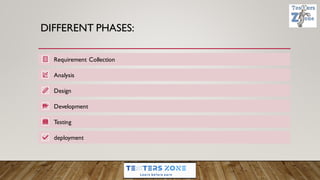
DIFFERENT PHASES:
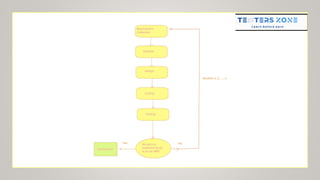
Requirement Collection
Analysis
Design
Development
Testing
deployment
REQUIREMENT COLLECTION
• Requirement Gathering is the most important and first phase of water fall model.In
this phase,business analyst and project manager participate in the meetings with client to
gather the requirements.
• Client:someone who will provide the requirement and tell what to build,who will use it
or purpose of it to all the participants.
• BusinessAnalyst:Person who gathers the requirement from the client.
• Project Manager : who handles the project
• Who involves - Client,BusinessAnalyst,Project Manager and all Stake holders.
ANALYSIS PHASE
• Once the requirements gathering phase completed,BusinessAnalyst (BA) converts the
business requirements into technical requirements with the help senior team members
like SMEs (Subject-matter experts) and team leads.The technical requirements
documented in a document called SRS (Software Requirement Specification) document.
SRS consists of all the technical requirements for all system involved (that includes
cross-applications if exists)
• SRS document name varies from project to project.
SRS (Software Requirement Specification) or Requirement Specification Document
(RSD) or Project Specification Document (PSD).
DESIGN
• In this phase designer converts SRS into DDS(Design Document Specification). overall system architecture is designed by
defining their functionality of each module that includes their interaction with cross-systems.
• The Design DocumentSpecifications that are two types based on their level of design.Those are -
High-level Design (HLD) - HLD contains the high-level architecture changesor design changes.
Low-level Design (LLD) - LLD contains very detailed level architecture or design changes.
• Both HLD and LLD creates by Senior developers or architects creates HLD.
• Note:The architects usually provide more than one approach in a Design Document Specification.This DDS sent for review
to all the stakeholders and the best approach would be selected based on the featuressuch as robustness,budgetand timing
constraints.
CODING/DEVELOPMENT/IMPLEMENTATION
• Once Design is approved implementation gets started with code following organization
coding standards,Once coding for small component is done developer use to compile and
debug the developed code using different tools.
• Coding or Development or Implementation all are having same meaning and purpose.
Implementation means developers are implementing the source code as per DDS, since
the implementation helps to develop the piece of product/software this is also called
as Development. Development needs some programming language understanding to develop
the product, since development means nothing but piece of code using some programming
language and that is coding in technical term so that why we call this phase as Coding also.
TESTING PHASE
• Note:This phase helps to understand whether implemented code is as per client expectation
or not, Once the coding completed The developer performs the initial testing that are unit
testing (UT) and/or Application Integration Testing (AIT) before handover the code to the
testing team.
• Testers do lot of testing like Functional testing, system testing, acceptance testing etc and
verify the BRS(Business requirement specification). If development is not as per BRS, testers
raise or log the defect tagging to developer and dev needs to fix it and share the updated
code with tester in form of build and then tester will do retesting.After retesting defect
might reopen or close.This entire testing and bug logging activity follows certain process that
is called as Software testing life cycle or Software testing process.
DEPLOYMENT PHASE
• Once the product is tested well and that is less buggy then client will review the test
results and artifacts and then approve it for deployment
• Once the software got deployed to production,then the new functionality available to
the end-users who are currently using the system.
MAINTENANCE PHASE
• Once the end-user starts using the newly deployed software,there might be a
possibility that the real-time issues starts coming up.The team has to fix these issues to
avoid the loss in business. if the issue is having less priority and less impact or high
priority and has huge impact,client can take a decision to roll out or backout new
changes and refine the functionalities as required.This process of taking care for the
finished product is called as maintenance.
ADVANTAGES OF WATERFALL
Simple and easy to understand
Requirementsare clear at the beginning of the project.
Easy to manage
Each phase is done one at a time so No overlapping of the phases as it is a step by step process and it takes long delivery time
Client intervention is hardlyrequired.
Best suitable for small projects as the requirementsare clearly stated.
DISADVANTAGES
• Not good for complex and long on-going projects.
• Less client involvement hence No feedback path until the end of the project.
• Testing phase will come late during the development process.
• No intermediate deliveries until the deployment of full product.End-users has to wait
until the deployment even it is urgent requirement.
PROTOTYPE MODEL
• A biggest drawback in theWater fall model was client interaction was very less and if there is any gap in
product development andnot as per client requirement then it increases development cost.To overcome
this one new model came in SDLC and that is Prototype model.
• The basic idea of prototype model is that the prototype gets reviewed andapprovedby the client
• Using this prototype,client can get the "real behavior" of the developing product.Client provides his
valuable feedback once he reviews the prototype.This feedback helps the developers and designers work
on the prototype to incorporate feedback comments.Once the design modified,again sends for client
review.This process will continue until no review comments from client or gets a client signoff to
proceed with design and development.
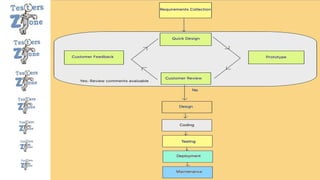
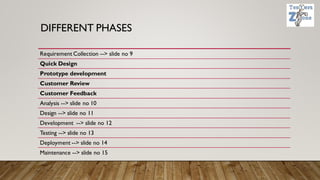
DIFFERENT PHASES
Requirement Collection --> slide no 9
Quick Design
Prototype development
Customer Review
Customer Feedback
Analysis --> slide no 10
Design --> slide no 11
Development --> slide no 12
Testing --> slide no 13
Deployment --> slide no 14
Maintenance --> slide no 15
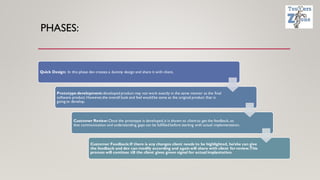
PHASES:
Quick Design: In this phase dev creates a dummy design and share it with client,
Prototype development:developed product may not work exactly in the same manner as the final
software product. However,the overall look and feel would be same as the original product that is
going to develop.
Customer Review:Once the prototype is developed,it is shown to client to get the feedback, so
that communication and understanding gaps can be fulfilled before starting with actual implementation.
Customer Feedback:If there is any changes client needs to be highlighted, he/she can give
the feedback and dev can modify according and again will share with client for review.This
process will continue till the client gives green signal for actual implantation.
ADVANTAGES
• Easy to detect errors in the initial stage.
• Prototypes can be modified or removed.
• Lowers the risk.
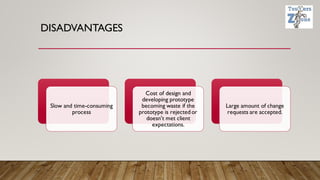
DISADVANTAGES
Slow and time-consuming
process
Cost of design and
developing prototype
becoming waste if the
prototype is rejected or
doesn't met client
expectations.
Large amount of change
requests are accepted.
SPIRAL MODEL
• Spiral model is preferred for large and high-risk projects.
• Main agenda of this model is develop primary and important feature first since it is already defined and remaining features are added in
spirals (iterations) of the project.
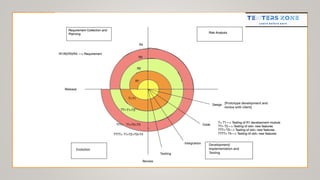
• The spiral model looks as a coil that has a starting point which call it as a "center" and the line that spirals shows the progress of the
project development.The line that spirals outwards indicates the increase of time expenditure and effort by the developers and the
project progress.
• Since it is a iterative model, in between changes are allowed
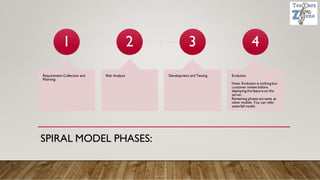
• It is divided into 4 phases Requirement collection, Risk Analysis,Development and Testing and Evolution.
WHEN SHOULD WE GO WITHTHIS MODEL?
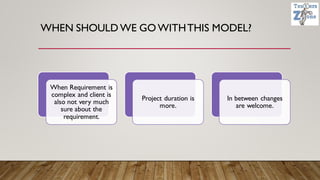
When Requirement is
complex and client is
also not very much
sure about the
requirement.
Project duration is
more.
In between changes
are welcome.
SPIRAL MODEL PHASES:
1
Requirement Collection and
Planning
2
Risk Analysis
3
Development and Testing
4
Evolution
Note: Evolution is nothing but
customer review before
deploying the feature on the
server.
Remaining phases are same as
other models. You can refer
waterfall model.
ADVANTAGES
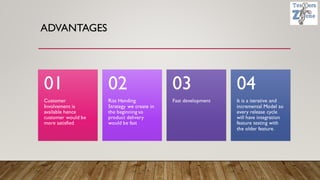
Customer
Involvement is
available hence
customer would be
more satisfied
01
Rist Handing
Strategy we create in
the beginning so
product delivery
would be fast
02
Fast development
03
It is a iterative and
incremental Model so
every release cycle
will have integration
feature testing with
the older feature.
04
DISADVANTAGES
• High cost
• Chances to get clarity on product at the end will be maximum.
• It is suitable for long Project,
• Hard to manage
• Need more resources
V MODEL
• There was a biggest drawback in the waterfall model i.e. we can't identify bug in early
stage of the cycle.And suppose we find major or critical defect in the closing phase
then it's becoming challenging and costly to fix those defects.Because the project
almost came to an end.To resolve this problem,there is a requirement to define new
SDLC model.V-model defined as a solution to the above problem
ABOUT
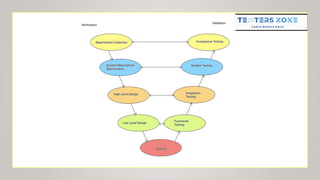
• Each phase of the development has its corresponding testing phase.Both development
and testing activities performs together (parallelly).
• This model is also known as "Verification andValidation model".
• In this model testing use to perform at every stage but in between changes also
not acceptable in this model too.Requirements are well defined,clear and documented
in the Starting phase only.
PHASES
Verification - Involves in
static analysis with code
execution The evolution
procedure carried out during
the development to verify all
the requirements covers in
coding or not.
Validation - Involves dynamic
analysis (both functional and
non-functional) and testing is
performed by code execution.
The validation can be done
once the development
completed.
V MODEL FLOW:
• One big disadvantages in the other models were, stage wise validation was missing and that is the biggest advantage of V model.
• Both verification and validation happens parallelly for each phase so chances of downstream of bug is very less.
• As soon as requirement collection will be completed, team will work on feasibility analysis. Feasibility analysis is kind of requirement
acceptance testing from team to check all the bottle necks at the beginning stage.
• Once BA converts CRS to SRS(Software requirement Specification) end to end feature explanation and flow will be explained in the SRS
so Testers can go through and develop the System testing Cases based on that.
• Once SRS is completed, Designer will take and create Hight level Design,design will also say module wise integration and data flow that
will helpTesters to develop integration testing cases.
• Later point designer will create Low level design which will be component level explanation using virtual design.LLD will help testers to
develop component /functional testing cases.
• Once LLD is completed dev will pick design to develop real module using any programming language.That falls into coding stage.
• Once coding is done, testing cycle will be getting started.Testers will follow Functional, Integration and System test cases for different
types of testing and finally user acceptance testing will be performed from client end.
ADVANTAGES:
Easy and Simple
to understand.
Avoid more
defects
Downward flow
of defects can be
reduced
Development and
progress is very
organized and
systematic.
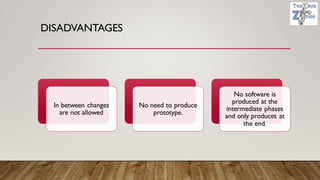
DISADVANTAGES
In between changes
are not allowed
No need to produce
prototype.
No software is
produced at the
intermediate phases
and only produces at
the end.
AGILE METHODOLOGY
Agile model/Methodology helps to handle in between requirement changes of client
and deliver product to client on time.There are many advantages of this model that will
be explaining in further slides.
Agile Model is a people-focused, results-focused continuous iterative process. It
involves the development and testing activities together throughout the Software
Development Life Cycle (SDLC). It is a combination of both Iterative and spiral model.
In Agile, every project is divided into releases and each release is further divided into
small time frames called iterations/sprints. Each iteration lasts for 2-4 weeks.
WHY AGILE ?
• Gathering requirement at once and analyzing takes more time,instead in agile we break
the requirements in the chunks and that can be shared with BA in some time interval.
This helps team to Analyse the part of requirements at a time and start will other
process quickly.
• Customer interaction increases in this SDLC model hence we can deliver more quality
product to client at the end.
• The traditional process is too slow.There is no parallel work progress in the traditional
approach.Due to this, client has to wait more time to complete all phases to deploy in
production.This might costs a profit sometimes.
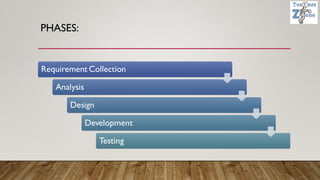
PHASES:
Requirement Collection
Analysis
Design
Development
Testing
REQUIREMENT
COLLECTION
Requirement Gathering is the most important and first phase
of this model. In this phase, business analyst and project manager
participate in the meetings with client to gather the requirements.
Client: someone who will provide the requirement and tell what to
build,who will use it or purpose of it to all the participants.
Business Analyst: Person who gathers the requirement from the
client.
Project Manager : who handles the project
Who involves - Client, BusinessAnalyst, Project Manager and all
Stake holders.
ANALYSIS
• Once the requirements gathering phase completed, BusinessAnalyst (BA) converts the business
requirements into technical requirements with the help senior team members like SMEs (Subject-matter
experts) and team leads.The technical requirements documented in a document called SRS (Software
Requirement Specification) document. SRS consists of all the technical requirements for all system involved
(that includes cross-applications if exists)
• SRS document name varies from project to project.
SRS (Software Requirement Specification) or Requirement Specification Document (RSD) or Project
Specification Document (PSD).
DESIGN
• In this phase designer converts SRS into DDS(Design Document Specification). overall system architecture
is designed by defining their functionality of each module that includes their interaction with cross-systems.
• The Design Document Specifications that are two types based on their level of design.Those are -
High-level Design (HLD) - HLD contains the high-level architecture changes or design changes.
Low-level Design (LLD) - LLD contains very detailed level architecture or design changes.
• Both HLD and LLD creates by Senior developers or architects creates HLD.
• Note:The architects usually provide more than one approach in a Design Document Specification.This
DDS sent for review to all the stakeholders and the best approach would be selected based on the features
such as robustness, budget and timing constraints.
CODING
• Once Design is approved implementation gets started with code,
followed by organization coding standards,Once coding for small
component is done developer use to compile and debug the
developed code using different tools.
• Coding or Developmentor Implementation all are having same
meaning and purpose.
Implementation means developers are implementing the
source code as per DDS, since the implementation helps to
develop the piece of product/software this is also
called as Development.Development needs some programming
language understanding to develop the product,since
development means nothing but piece of code using some
programming language and that is coding in technical term so
that why we call this phase as Coding also.
TESTING
Note:This phase helps to understand whether implemented code
is as per client expectation or not, Once the coding completed The
developer performs the initial testing that are unit testing (UT)
and/or Application Integration Testing (AIT) before handover the
code to the testing team.
Testers do lot of testing like Functional testing, system testing,
acceptance testing etc and verify the BRS(Business requirement
specification). If development is not as per BRS, testers raise or log
the defect tagging to developer and dev needs to fix it and share
the updated code with tester in form of build and then tester will
do retesting.After retesting defect might reopen or close.This
entire testing and bug logging activity follows certain process that is
called as Software testing life cycle or Software testing process.
DEPLOYMENT
Once the product is
tested well and that is less
buggy then client will
review the test results and
artifacts and then approve
it for deployment
Once the software got
deployed to production,
then the new functionality
availabls to the end-users.
ADVANTAGES
More customer satisfaction
Welcome in between changes
Continuous delivery of working product at the end of every iteration.
Easily manageable.
Less chances to downflow of bug hence Faster detection of issues and defects.
Not required to get ready the whole requirements before starting project.
DISADVANTAGES
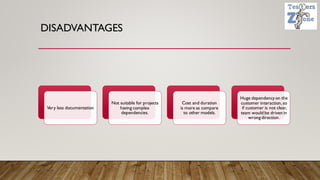
Very less documentation
Not suitable for projects
having complex
dependencies.
Cost and duration
is more as compare
to other models.
Huge dependencyon the
customer interaction,so
if customer is not clear,
team would be driven in
wrong direction.
HYBRID MODEL
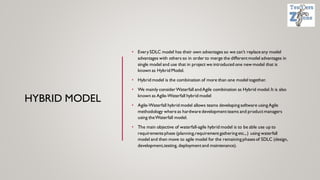
• EverySDLC model has their own advantages so we can’t replace any model
advantages with others so in order to merge the differentmodel advantages in
single model and use that in project we introduced one new model that is
known as Hybrid Model.
• Hybrid model is the combination of more than one model together.
• We mainly considerWaterfall andAgile combination as Hybrid model.It is also
known as Agile-Waterfall hybrid model
• Agile-Waterfall hybrid model allows teams developing software using Agile
methodology where as hardware developmentteams and productmanagers
using theWaterfall model.
• The main objective of waterfall-agile hybrid model is to be able use up to
requirementsphase (planning,requirementgathering etc.,.) using waterfall
model and then move to agile model for the remaining phasesof SDLC (design,
development,testing, deploymentand maintenance).
PHASES:
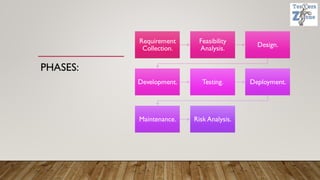
Requirement
Collection.
Feasibility
Analysis.
Design.
Development. Testing. Deployment.
Maintenance. Risk Analysis.
REQUIREMENT COLLECTION
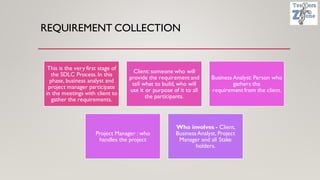
This is the very first stage of
the SDLC Process. In this
phase, business analyst and
project manager participate
in the meetings with client to
gather the requirements.
Client: someone who will
provide the requirement and
tell what to build, who will
use it or purpose of it to all
the participants.
Business Analyst: Person who
gathers the
requirement from the client.
Project Manager : who
handles the project
Who involves - Client,
Business Analyst, Project
Manager and all Stake
holders.
ANALYSIS
Once the requirements gathering phase completed,Business
Analyst (BA) converts the business requirements into technical
requirements with the help senior team members like SMEs
(Subject-matter experts) and team leads.The technical
requirements documented in a document called SRS (Software
Requirement Specification) document.SRS consists of all the
technical requirements for all system involved (that includes
cross-applications if exists)
SRS document name varies from project to project.
SRS (Software Requirement Specification) or Requirement
Specification Document (RSD) or Project Specification
Document (PSD).
DESIGN
• In this phase designer converts SRS into DDS(Design Document Specification). overall system architecture
is designed by defining their functionality of each module that includes their interaction with cross-systems.
• The Design Document Specifications that are two types based on their level of design.Those are -
High-level Design (HLD) - HLD contains the high-level architecture changes or design changes.
Low-level Design (LLD) - LLD contains very detailed level architecture or design changes.
• Both HLD and LLD creates by Senior developers or architects creates HLD.
• Note:The architects usually provide more than one approach in a Design Document Specification.This
DDS sent for review to all the stakeholders and the best approach would be selected based on the features
such as robustness, budget and timing constraints.
CODING
• Once Design is approved implementation gets started with code followed by organization coding standards,Once coding for
small componentis done developer use to compile and debug the developed code using differenttools.
• Coding or Development or Implementation all are having same meaning and purpose.
Implementation means developers are implementing the source code as per DDS,since the implementation helps to develop
the piece of product/software this is also called as Development.Developmentneeds some programming
language understanding to develop the product,since developmentmeans nothing but piece of code using some
programming language and that is coding in technical term so that why we call this phase as Coding also.
TESTING
• Note:This phase helps to understand whether implemented code is as per client expectation or not, Once
the coding completed The developer performs the initial testing that are unit testing (UT) and/or Application
Integration Testing (AIT) before handover the code to the testing team.
• Testers do lot of testing like Functional testing, system testing, acceptance testing etc. and verify
the BRS(Business requirement specification). If development is not as per BRS, testers raise or log the
defect tagging to developer and dev needs to fix it and share the updated code with tester in form of build
and then tester will do retesting.After retesting defect might reopen or close.This entire testing and bug
logging activity follows certain process that is called as Software testing life cycle or Software testing process.
DEPLOYMENT
Once the product is
tested well and that is less
buggy then client will
review the test results and
artifacts and then approve
it for deployment
Once the software got
deployed to production,
then the new functionality
available to the end-users.
MAINTENANCE PHASE:
• Once the end-user starts using the newly deployed software,there might be a possibility
that the real-time issues starts coming up.The team has to fix these issues to avoid the
loss in business if the issue has less priority or less impact.If the issue has high priority
and has huge impact,client can take a decision to roll out or backout new changes and
refine the functionalities as required.This process of taking care for the finished product
is called as maintenance.
RISK ANALYSIS
• This phase parallelly run with all development phases starting with planning and finishes
with maintenance.
• This phase is used to lists all expected risks and provides all the necessary activities to
avoid such risks.
ADVANTAGES:
Simple and easy
to use.
Easy to
implement in
small and medium
projects.
Chances of
rejection would
be very less.
Easy to
understand and
implement.
DISADVANTAGES:
Whenever there is a
change in
Requirements, there
would be a lot of
rework to be done.
Can't be implemented
for large projects.
Following and
implementing this
model would be more
costlier.
SDLC Models.pdf

SDLC Models.pdf

  • 1.
  • 3.
  • 4.
    WHYWE USE THESE MODELS? •SDLC model gives the proper flow or better said roadmap for developing and testing the software.It's a kind of framework that says when to do what to do and how to do.This is designed based on requirement types,kinds of requirements,and challenges that we were facing to achieve a quality product.Client needs to come up with their requirements and budget and we can use specific model to fulfill that.
  • 5.
    WATERFALL MODEL Waterfall Modelis the first model introduced in Software Development Life Cycle. This model is similar to the water flows direction from top to bottom and can't go back in reverse direction to the previous phase. Waterfall Model is very simple to understand,use and has distinct endpoints or goals at each phase. In the waterfall model,the current phase should be completed to move to the next phase and current phase input is the output of the previous phase. The waterfall model is a sequential design process through the phases of Requirements, FeasibilityAnalysis,Design,Coding,Testing,Deployment,and Maintenance.
  • 6.
    WHYTHIS MODEL? • Thiswas very simple and first model introduced and there was no any other model at that time and also it fits to the any size(small, medium or large) project that why it got popularity in short span of time.
  • 7.
    WHENTO USEWATERFALL MODEL? •Requirement is clear and receive in the starting of the project.Thers is no any in between requirement changes. • Client is interested with end product and don't want to pitch into in between development. • Having clear idea on what is the end product.
  • 8.
  • 10.
    REQUIREMENT COLLECTION • RequirementGathering is the most important and first phase of water fall model.In this phase,business analyst and project manager participate in the meetings with client to gather the requirements. • Client:someone who will provide the requirement and tell what to build,who will use it or purpose of it to all the participants. • BusinessAnalyst:Person who gathers the requirement from the client. • Project Manager : who handles the project • Who involves - Client,BusinessAnalyst,Project Manager and all Stake holders.
  • 11.
    ANALYSIS PHASE • Oncethe requirements gathering phase completed,BusinessAnalyst (BA) converts the business requirements into technical requirements with the help senior team members like SMEs (Subject-matter experts) and team leads.The technical requirements documented in a document called SRS (Software Requirement Specification) document. SRS consists of all the technical requirements for all system involved (that includes cross-applications if exists) • SRS document name varies from project to project. SRS (Software Requirement Specification) or Requirement Specification Document (RSD) or Project Specification Document (PSD).
  • 12.
    DESIGN • In thisphase designer converts SRS into DDS(Design Document Specification). overall system architecture is designed by defining their functionality of each module that includes their interaction with cross-systems. • The Design DocumentSpecifications that are two types based on their level of design.Those are - High-level Design (HLD) - HLD contains the high-level architecture changesor design changes. Low-level Design (LLD) - LLD contains very detailed level architecture or design changes. • Both HLD and LLD creates by Senior developers or architects creates HLD. • Note:The architects usually provide more than one approach in a Design Document Specification.This DDS sent for review to all the stakeholders and the best approach would be selected based on the featuressuch as robustness,budgetand timing constraints.
  • 13.
    CODING/DEVELOPMENT/IMPLEMENTATION • Once Designis approved implementation gets started with code following organization coding standards,Once coding for small component is done developer use to compile and debug the developed code using different tools. • Coding or Development or Implementation all are having same meaning and purpose. Implementation means developers are implementing the source code as per DDS, since the implementation helps to develop the piece of product/software this is also called as Development. Development needs some programming language understanding to develop the product, since development means nothing but piece of code using some programming language and that is coding in technical term so that why we call this phase as Coding also.
  • 14.
    TESTING PHASE • Note:Thisphase helps to understand whether implemented code is as per client expectation or not, Once the coding completed The developer performs the initial testing that are unit testing (UT) and/or Application Integration Testing (AIT) before handover the code to the testing team. • Testers do lot of testing like Functional testing, system testing, acceptance testing etc and verify the BRS(Business requirement specification). If development is not as per BRS, testers raise or log the defect tagging to developer and dev needs to fix it and share the updated code with tester in form of build and then tester will do retesting.After retesting defect might reopen or close.This entire testing and bug logging activity follows certain process that is called as Software testing life cycle or Software testing process.
  • 15.
    DEPLOYMENT PHASE • Oncethe product is tested well and that is less buggy then client will review the test results and artifacts and then approve it for deployment • Once the software got deployed to production,then the new functionality available to the end-users who are currently using the system.
  • 16.
    MAINTENANCE PHASE • Oncethe end-user starts using the newly deployed software,there might be a possibility that the real-time issues starts coming up.The team has to fix these issues to avoid the loss in business. if the issue is having less priority and less impact or high priority and has huge impact,client can take a decision to roll out or backout new changes and refine the functionalities as required.This process of taking care for the finished product is called as maintenance.
  • 17.
    ADVANTAGES OF WATERFALL Simpleand easy to understand Requirementsare clear at the beginning of the project. Easy to manage Each phase is done one at a time so No overlapping of the phases as it is a step by step process and it takes long delivery time Client intervention is hardlyrequired. Best suitable for small projects as the requirementsare clearly stated.
  • 18.
    DISADVANTAGES • Not goodfor complex and long on-going projects. • Less client involvement hence No feedback path until the end of the project. • Testing phase will come late during the development process. • No intermediate deliveries until the deployment of full product.End-users has to wait until the deployment even it is urgent requirement.
  • 19.
    PROTOTYPE MODEL • Abiggest drawback in theWater fall model was client interaction was very less and if there is any gap in product development andnot as per client requirement then it increases development cost.To overcome this one new model came in SDLC and that is Prototype model. • The basic idea of prototype model is that the prototype gets reviewed andapprovedby the client • Using this prototype,client can get the "real behavior" of the developing product.Client provides his valuable feedback once he reviews the prototype.This feedback helps the developers and designers work on the prototype to incorporate feedback comments.Once the design modified,again sends for client review.This process will continue until no review comments from client or gets a client signoff to proceed with design and development.
  • 21.
    DIFFERENT PHASES Requirement Collection--> slide no 9 Quick Design Prototype development Customer Review Customer Feedback Analysis --> slide no 10 Design --> slide no 11 Development --> slide no 12 Testing --> slide no 13 Deployment --> slide no 14 Maintenance --> slide no 15
  • 22.
    PHASES: Quick Design: Inthis phase dev creates a dummy design and share it with client, Prototype development:developed product may not work exactly in the same manner as the final software product. However,the overall look and feel would be same as the original product that is going to develop. Customer Review:Once the prototype is developed,it is shown to client to get the feedback, so that communication and understanding gaps can be fulfilled before starting with actual implementation. Customer Feedback:If there is any changes client needs to be highlighted, he/she can give the feedback and dev can modify according and again will share with client for review.This process will continue till the client gives green signal for actual implantation.
  • 23.
    ADVANTAGES • Easy todetect errors in the initial stage. • Prototypes can be modified or removed. • Lowers the risk.
  • 24.
    DISADVANTAGES Slow and time-consuming process Costof design and developing prototype becoming waste if the prototype is rejected or doesn't met client expectations. Large amount of change requests are accepted.
  • 25.
    SPIRAL MODEL • Spiralmodel is preferred for large and high-risk projects. • Main agenda of this model is develop primary and important feature first since it is already defined and remaining features are added in spirals (iterations) of the project. • The spiral model looks as a coil that has a starting point which call it as a "center" and the line that spirals shows the progress of the project development.The line that spirals outwards indicates the increase of time expenditure and effort by the developers and the project progress. • Since it is a iterative model, in between changes are allowed • It is divided into 4 phases Requirement collection, Risk Analysis,Development and Testing and Evolution.
  • 27.
    WHEN SHOULD WEGO WITHTHIS MODEL? When Requirement is complex and client is also not very much sure about the requirement. Project duration is more. In between changes are welcome.
  • 28.
    SPIRAL MODEL PHASES: 1 RequirementCollection and Planning 2 Risk Analysis 3 Development and Testing 4 Evolution Note: Evolution is nothing but customer review before deploying the feature on the server. Remaining phases are same as other models. You can refer waterfall model.
  • 29.
    ADVANTAGES Customer Involvement is available hence customerwould be more satisfied 01 Rist Handing Strategy we create in the beginning so product delivery would be fast 02 Fast development 03 It is a iterative and incremental Model so every release cycle will have integration feature testing with the older feature. 04
  • 30.
    DISADVANTAGES • High cost •Chances to get clarity on product at the end will be maximum. • It is suitable for long Project, • Hard to manage • Need more resources
  • 31.
    V MODEL • Therewas a biggest drawback in the waterfall model i.e. we can't identify bug in early stage of the cycle.And suppose we find major or critical defect in the closing phase then it's becoming challenging and costly to fix those defects.Because the project almost came to an end.To resolve this problem,there is a requirement to define new SDLC model.V-model defined as a solution to the above problem
  • 32.
    ABOUT • Each phaseof the development has its corresponding testing phase.Both development and testing activities performs together (parallelly). • This model is also known as "Verification andValidation model". • In this model testing use to perform at every stage but in between changes also not acceptable in this model too.Requirements are well defined,clear and documented in the Starting phase only.
  • 33.
    PHASES Verification - Involvesin static analysis with code execution The evolution procedure carried out during the development to verify all the requirements covers in coding or not. Validation - Involves dynamic analysis (both functional and non-functional) and testing is performed by code execution. The validation can be done once the development completed.
  • 35.
    V MODEL FLOW: •One big disadvantages in the other models were, stage wise validation was missing and that is the biggest advantage of V model. • Both verification and validation happens parallelly for each phase so chances of downstream of bug is very less. • As soon as requirement collection will be completed, team will work on feasibility analysis. Feasibility analysis is kind of requirement acceptance testing from team to check all the bottle necks at the beginning stage. • Once BA converts CRS to SRS(Software requirement Specification) end to end feature explanation and flow will be explained in the SRS so Testers can go through and develop the System testing Cases based on that. • Once SRS is completed, Designer will take and create Hight level Design,design will also say module wise integration and data flow that will helpTesters to develop integration testing cases. • Later point designer will create Low level design which will be component level explanation using virtual design.LLD will help testers to develop component /functional testing cases. • Once LLD is completed dev will pick design to develop real module using any programming language.That falls into coding stage. • Once coding is done, testing cycle will be getting started.Testers will follow Functional, Integration and System test cases for different types of testing and finally user acceptance testing will be performed from client end.
  • 36.
    ADVANTAGES: Easy and Simple tounderstand. Avoid more defects Downward flow of defects can be reduced Development and progress is very organized and systematic.
  • 37.
    DISADVANTAGES In between changes arenot allowed No need to produce prototype. No software is produced at the intermediate phases and only produces at the end.
  • 38.
    AGILE METHODOLOGY Agile model/Methodologyhelps to handle in between requirement changes of client and deliver product to client on time.There are many advantages of this model that will be explaining in further slides. Agile Model is a people-focused, results-focused continuous iterative process. It involves the development and testing activities together throughout the Software Development Life Cycle (SDLC). It is a combination of both Iterative and spiral model. In Agile, every project is divided into releases and each release is further divided into small time frames called iterations/sprints. Each iteration lasts for 2-4 weeks.
  • 39.
    WHY AGILE ? •Gathering requirement at once and analyzing takes more time,instead in agile we break the requirements in the chunks and that can be shared with BA in some time interval. This helps team to Analyse the part of requirements at a time and start will other process quickly. • Customer interaction increases in this SDLC model hence we can deliver more quality product to client at the end. • The traditional process is too slow.There is no parallel work progress in the traditional approach.Due to this, client has to wait more time to complete all phases to deploy in production.This might costs a profit sometimes.
  • 40.
  • 42.
    REQUIREMENT COLLECTION Requirement Gathering isthe most important and first phase of this model. In this phase, business analyst and project manager participate in the meetings with client to gather the requirements. Client: someone who will provide the requirement and tell what to build,who will use it or purpose of it to all the participants. Business Analyst: Person who gathers the requirement from the client. Project Manager : who handles the project Who involves - Client, BusinessAnalyst, Project Manager and all Stake holders.
  • 43.
    ANALYSIS • Once therequirements gathering phase completed, BusinessAnalyst (BA) converts the business requirements into technical requirements with the help senior team members like SMEs (Subject-matter experts) and team leads.The technical requirements documented in a document called SRS (Software Requirement Specification) document. SRS consists of all the technical requirements for all system involved (that includes cross-applications if exists) • SRS document name varies from project to project. SRS (Software Requirement Specification) or Requirement Specification Document (RSD) or Project Specification Document (PSD).
  • 44.
    DESIGN • In thisphase designer converts SRS into DDS(Design Document Specification). overall system architecture is designed by defining their functionality of each module that includes their interaction with cross-systems. • The Design Document Specifications that are two types based on their level of design.Those are - High-level Design (HLD) - HLD contains the high-level architecture changes or design changes. Low-level Design (LLD) - LLD contains very detailed level architecture or design changes. • Both HLD and LLD creates by Senior developers or architects creates HLD. • Note:The architects usually provide more than one approach in a Design Document Specification.This DDS sent for review to all the stakeholders and the best approach would be selected based on the features such as robustness, budget and timing constraints.
  • 45.
    CODING • Once Designis approved implementation gets started with code, followed by organization coding standards,Once coding for small component is done developer use to compile and debug the developed code using different tools. • Coding or Developmentor Implementation all are having same meaning and purpose. Implementation means developers are implementing the source code as per DDS, since the implementation helps to develop the piece of product/software this is also called as Development.Development needs some programming language understanding to develop the product,since development means nothing but piece of code using some programming language and that is coding in technical term so that why we call this phase as Coding also.
  • 46.
    TESTING Note:This phase helpsto understand whether implemented code is as per client expectation or not, Once the coding completed The developer performs the initial testing that are unit testing (UT) and/or Application Integration Testing (AIT) before handover the code to the testing team. Testers do lot of testing like Functional testing, system testing, acceptance testing etc and verify the BRS(Business requirement specification). If development is not as per BRS, testers raise or log the defect tagging to developer and dev needs to fix it and share the updated code with tester in form of build and then tester will do retesting.After retesting defect might reopen or close.This entire testing and bug logging activity follows certain process that is called as Software testing life cycle or Software testing process.
  • 47.
    DEPLOYMENT Once the productis tested well and that is less buggy then client will review the test results and artifacts and then approve it for deployment Once the software got deployed to production, then the new functionality availabls to the end-users.
  • 48.
    ADVANTAGES More customer satisfaction Welcomein between changes Continuous delivery of working product at the end of every iteration. Easily manageable. Less chances to downflow of bug hence Faster detection of issues and defects. Not required to get ready the whole requirements before starting project.
  • 49.
    DISADVANTAGES Very less documentation Notsuitable for projects having complex dependencies. Cost and duration is more as compare to other models. Huge dependencyon the customer interaction,so if customer is not clear, team would be driven in wrong direction.
  • 50.
    HYBRID MODEL • EverySDLCmodel has their own advantages so we can’t replace any model advantages with others so in order to merge the differentmodel advantages in single model and use that in project we introduced one new model that is known as Hybrid Model. • Hybrid model is the combination of more than one model together. • We mainly considerWaterfall andAgile combination as Hybrid model.It is also known as Agile-Waterfall hybrid model • Agile-Waterfall hybrid model allows teams developing software using Agile methodology where as hardware developmentteams and productmanagers using theWaterfall model. • The main objective of waterfall-agile hybrid model is to be able use up to requirementsphase (planning,requirementgathering etc.,.) using waterfall model and then move to agile model for the remaining phasesof SDLC (design, development,testing, deploymentand maintenance).
  • 51.
  • 52.
    REQUIREMENT COLLECTION This isthe very first stage of the SDLC Process. In this phase, business analyst and project manager participate in the meetings with client to gather the requirements. Client: someone who will provide the requirement and tell what to build, who will use it or purpose of it to all the participants. Business Analyst: Person who gathers the requirement from the client. Project Manager : who handles the project Who involves - Client, Business Analyst, Project Manager and all Stake holders.
  • 53.
    ANALYSIS Once the requirementsgathering phase completed,Business Analyst (BA) converts the business requirements into technical requirements with the help senior team members like SMEs (Subject-matter experts) and team leads.The technical requirements documented in a document called SRS (Software Requirement Specification) document.SRS consists of all the technical requirements for all system involved (that includes cross-applications if exists) SRS document name varies from project to project. SRS (Software Requirement Specification) or Requirement Specification Document (RSD) or Project Specification Document (PSD).
  • 54.
    DESIGN • In thisphase designer converts SRS into DDS(Design Document Specification). overall system architecture is designed by defining their functionality of each module that includes their interaction with cross-systems. • The Design Document Specifications that are two types based on their level of design.Those are - High-level Design (HLD) - HLD contains the high-level architecture changes or design changes. Low-level Design (LLD) - LLD contains very detailed level architecture or design changes. • Both HLD and LLD creates by Senior developers or architects creates HLD. • Note:The architects usually provide more than one approach in a Design Document Specification.This DDS sent for review to all the stakeholders and the best approach would be selected based on the features such as robustness, budget and timing constraints.
  • 55.
    CODING • Once Designis approved implementation gets started with code followed by organization coding standards,Once coding for small componentis done developer use to compile and debug the developed code using differenttools. • Coding or Development or Implementation all are having same meaning and purpose. Implementation means developers are implementing the source code as per DDS,since the implementation helps to develop the piece of product/software this is also called as Development.Developmentneeds some programming language understanding to develop the product,since developmentmeans nothing but piece of code using some programming language and that is coding in technical term so that why we call this phase as Coding also.
  • 56.
    TESTING • Note:This phasehelps to understand whether implemented code is as per client expectation or not, Once the coding completed The developer performs the initial testing that are unit testing (UT) and/or Application Integration Testing (AIT) before handover the code to the testing team. • Testers do lot of testing like Functional testing, system testing, acceptance testing etc. and verify the BRS(Business requirement specification). If development is not as per BRS, testers raise or log the defect tagging to developer and dev needs to fix it and share the updated code with tester in form of build and then tester will do retesting.After retesting defect might reopen or close.This entire testing and bug logging activity follows certain process that is called as Software testing life cycle or Software testing process.
  • 57.
    DEPLOYMENT Once the productis tested well and that is less buggy then client will review the test results and artifacts and then approve it for deployment Once the software got deployed to production, then the new functionality available to the end-users.
  • 58.
    MAINTENANCE PHASE: • Oncethe end-user starts using the newly deployed software,there might be a possibility that the real-time issues starts coming up.The team has to fix these issues to avoid the loss in business if the issue has less priority or less impact.If the issue has high priority and has huge impact,client can take a decision to roll out or backout new changes and refine the functionalities as required.This process of taking care for the finished product is called as maintenance.
  • 59.
    RISK ANALYSIS • Thisphase parallelly run with all development phases starting with planning and finishes with maintenance. • This phase is used to lists all expected risks and provides all the necessary activities to avoid such risks.
  • 60.
    ADVANTAGES: Simple and easy touse. Easy to implement in small and medium projects. Chances of rejection would be very less. Easy to understand and implement.
  • 61.
    DISADVANTAGES: Whenever there isa change in Requirements, there would be a lot of rework to be done. Can't be implemented for large projects. Following and implementing this model would be more costlier.