




CONTENTS
• INTRODUCTION
• CLASSIFICATION OF SEX
VARIANTS
• TYPE OF PISTILLATE LINES
• INHERITANCE OF SEX
EXPRESSION
• ENVIRONMENTAL INFLUENCE
ON SEX EXPRESSION
• CONCLUSION
3
2
INTRODUCTION
Castor (Ricinus communis L.) is an important non-
edible oilseed crop of arid and semi-arid regions of the
world. It Belongs to the family Euphorbiaceae, having
chromosome number 2n = 20 and cross pollination up to
the extent of 50 per cent. Castor seed contains 48 to 52
percent oil and having wide range of industrial uses. India
is principle producer and sole exporter of castor seed, oil
and some of its derivatives.
Castor is grown in tropical, subtropical and
temperate climates and almost cultivated in 30 different
countries. India, China, Brazil, Africa, Thailand and South
America are major castor growing countries.
The major castor growing states in India are Gujarat,
Andhra Pradesh, Telangana, Rajsthan, Tamilnadu,
Karnataka and Orissa. Gujarat is leading castor growing
state of country.
4
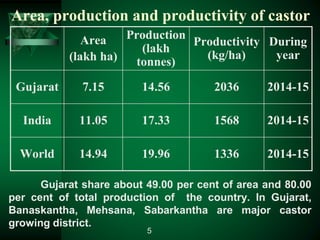
Area, production and productivity of castor
Area
(lakh ha)
Production
(lakh
tonnes)
Productivity
(kg/ha)
During
year
Gujarat 7.15 14.56 2036 2014-15
India 11.05 17.33 1568 2014-15
World 14.94 19.96 1336 2014-15
Gujarat share about 49.00 per cent of area and 80.00
per cent of total production of the country. In Gujarat,
Banaskantha, Mehsana, Sabarkantha are major castor
growing district.
5
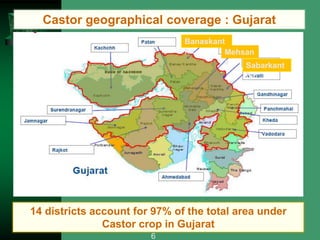
14 districts account for 97% of the total area under
Castor crop in Gujarat
Castor geographical coverage : Gujarat
Banaskant
ha Mehsan
a Sabarkant
ha
6
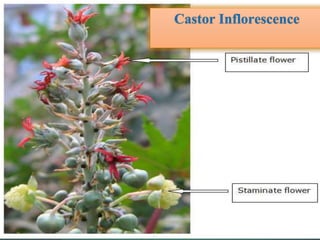
Castor Inflorescence
6
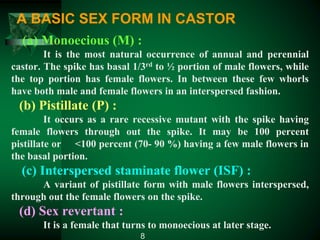
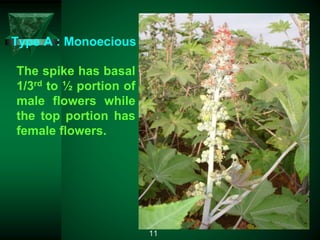
(a) Monoecious (M) :
It is the most natural occurrence of annual and perennial
castor. The spike has basal 1/3rd to ½ portion of male flowers, while
the top portion has female flowers. In between these few whorls
have both male and female flowers in an interspersed fashion.
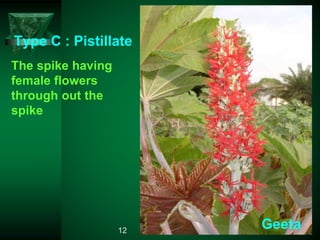
(b) Pistillate (P) :
It occurs as a rare recessive mutant with the spike having
female flowers through out the spike. It may be 100 percent
pistillate or <100 percent (70- 90 %) having a few male flowers in
the basal portion.
(c) Interspersed staminate flower (ISF) :
A variant of pistillate form with male flowers interspersed,
through out the female flowers on the spike.
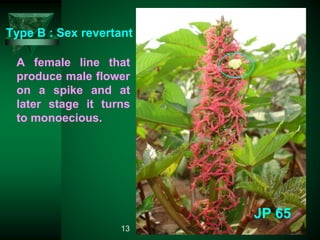
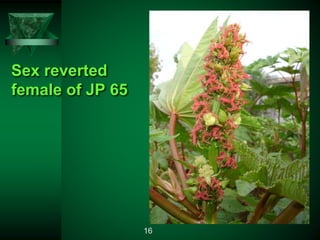
(d) Sex revertant :
It is a female that turns to monoecious at later stage.
A BASIC SEX FORM IN CASTOR
8
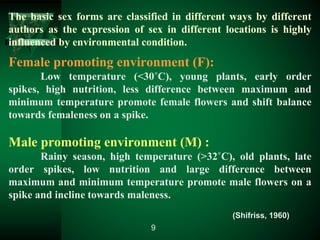
Female promoting environment (F):
Low temperature (<30˚C), young plants, early order
spikes, high nutrition, less difference between maximum and
minimum temperature promote female flowers and shift balance
towards femaleness on a spike.
Male promoting environment (M) :
Rainy season, high temperature (>32˚C), old plants, late
order spikes, low nutrition and large difference between
maximum and minimum temperature promote male flowers on a
spike and incline towards maleness.
(Shifriss, 1960)
The basic sex forms are classified in different ways by different
authors as the expression of sex in different locations is highly
influenced by environmental condition.
9
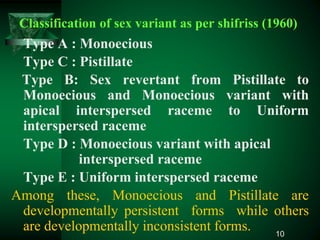
Classification of sex variant as per shifriss (1960)
Type A : Monoecious
Type C : Pistillate
Type B: Sex revertant from Pistillate to
Monoecious and Monoecious variant with
apical interspersed raceme to Uniform
interspersed raceme
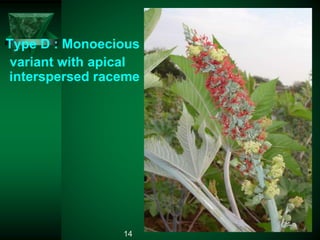
Type D : Monoecious variant with apical
interspersed raceme
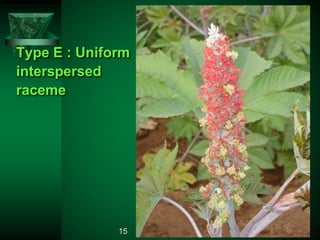
Type E : Uniform interspersed raceme
Among these, Monoecious and Pistillate are
developmentally persistent forms while others
are developmentally inconsistent forms. 10
The spike has basal
1/3rd to ½ portion of
male flowers while
the top portion has
female flowers.
Type A : Monoecious
11
Type C : Pistillate
The spike having
female flowers
through out the
spike
Geeta12
Type B : Sex revertant
JP 65
A female line that
produce male flower
on a spike and at
later stage it turns
to monoecious.
13
Type D : Monoecious
variant with apical
interspersed raceme
14
Type E : Uniform
interspersed
raceme
15
Sex reverted
female of JP 65
16
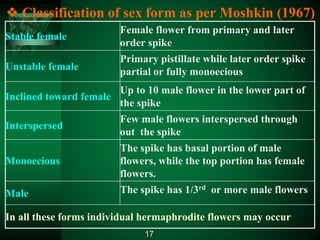
❖ Classification of sex form as per Moshkin (1967)
Stable female
Female flower from primary and later
order spike
Unstable female
Primary pistillate while later order spike
partial or fully monoecious
Inclined toward female
Up to 10 male flower in the lower part of
the spike
Interspersed
Few male flowers interspersed through
out the spike
Monoecious
The spike has basal portion of male
flowers, while the top portion has female
flowers.
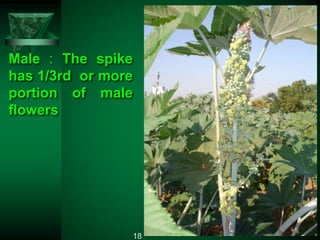
Male The spike has 1/3rd or more male flowers
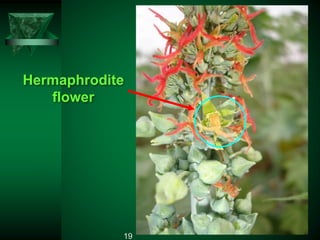
In all these forms individual hermaphrodite flowers may occur
17
Male : The spike
has 1/3rd or more
portion of male
flowers
18
Hermaphrodite
flower
19
❖ Classification of sex variants as conventional and
unconventional system in relation to the environment,
Shifriss (1960).
(A) Conventional system :
Conventional variants are mainly monoecious variants, rare recessive
females. This conventional variants are classified based on
(1) Variation in sex tendency :
The proportion of male : female flower on a spike is the sex tendency.
(2) Variation in sex pattern :
Sex pattern is the distribution of male and female flowers on a spike.
Form 1 : Monoecious, apical non interspersed, middle portion of spike is
interspersed, apical region strictly female flowers and lower
portion with staminate flowers.
Form 2 : Monoecious, apical interspersed like type D, a monoecious
variant
Form 3 : Monoecious, terminal hermaphrodite, eg. A strongly male type
like inbred 97.
Form 4 : Female, identified in a backcross as controlled by a single
recessive gene. This has further developed as ‘N’ type of
pistillate mechanism. 20
(B) Unconventional system :
➢ This system evolves from dominant female mutants which
occurs spontaneously in nature from monoecious inbred of
pattern A and D.
➢ Genetically unstable and influenced by environment.
➢ Though a mutant there is no difference between meiosis of
normal monoecious and dominant female mutant and thus
not associated with breakdown in gametic fertility.
➢ These variants form the basis for ‘S’ type of pistillate
mechanism.
The conventional variants may be controlled by two major group of
genes :
• Qualitative genes which determine the kind of flowers to be
produced whether male or female.
• Polygenes, which accelerate or deplete a substance (may be a
growth regulator), the gradient differentiation of which determines
the sex tendency.
21
Unconventional variants are three types :
Type 1 : Occur as a series of sex reversals (Pistillate to
Monoecious).
Sex reversal begin to bloom as female but later turn to
monoecious. Plant may revert immediately following the
appearance of primary spike.
Type 2 : Non reverted females.
It has evolved from inbred stock of variants Queen 162
and Adam mistaef, which was classified under type of
late reverted female. Both variety having late maturity
and produce their raceme at long intervals.
Type 3 : Mutating recessive females.
It was developed from cross made between female mutant
137-6 and a monoecist N-145-4, which was known to be
heterozygous for the recessive female gene. 22
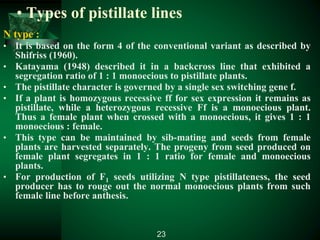
• Types of pistillate lines
N type :
• It is based on the form 4 of the conventional variant as described by
Shifriss (1960).
• Katayama (1948) described it in a backcross line that exhibited a
segregation ratio of 1 : 1 monoecious to pistillate plants.
• The pistillate character is governed by a single sex switching gene f.
• If a plant is homozygous recessive ff for sex expression it remains as
pistillate, while a heterozygous recessive Ff is a monoecious plant.
Thus a female plant when crossed with a monoecious, it gives 1 : 1
monoecious : female.
• This type can be maintained by sib-mating and seeds from female
plants are harvested separately. The progeny from seed produced on
female plant segregates in 1 : 1 ratio for female and monoecious
plants.
• For production of F1 seeds utilizing N type pistillateness, the seed
producer has to rouge out the normal monoecious plants from such
female line before anthesis.
23
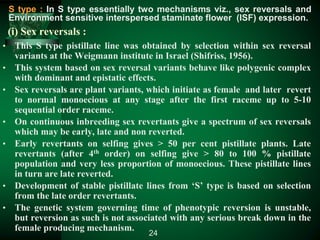
(i) Sex reversals :
• This S type pistillate line was obtained by selection within sex reversal
variants at the Weigmann institute in Israel (Shifriss, 1956).
• This system based on sex reversal variants behave like polygenic complex
with dominant and epistatic effects.
• Sex reversals are plant variants, which initiate as female and later revert
to normal monoecious at any stage after the first raceme up to 5-10
sequential order raceme.
• On continuous inbreeding sex revertants give a spectrum of sex reversals
which may be early, late and non reverted.
• Early revertants on selfing gives > 50 per cent pistillate plants. Late
revertants (after 4th order) on selfing give > 80 to 100 % pistillate
population and very less proportion of monoecious. These pistillate lines
in turn are late reverted.
• Development of stable pistillate lines from ‘S’ type is based on selection
from the late order revertants.
• The genetic system governing time of phenotypic reversion is unstable,
but reversion as such is not associated with any serious break down in the
female producing mechanism.
24
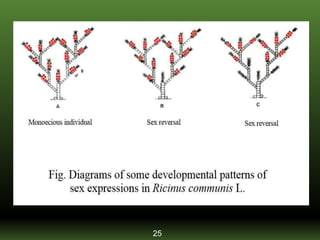
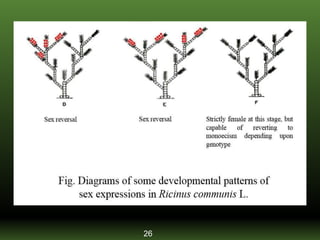
S type : In S type essentially two mechanisms viz., sex reversals and
Environment sensitive interspersed staminate flower (ISF) expression.
25
26
(ii) Non reverted female :
• Such females are developed from inbred stock of Queen 162 and
Adam Mistaef, the population carry gene for interspersed staminate
flower (ISF) expression at a high frequency.
• The penetrance and expressivity of ISF in such type of females are
determined by environment.
• In a female promoting environment only few ISF flowers occur,
which prematurely drop due to the competition from older female
flowers that were fertilized by monoecious pollen in the vicinity.
• This can be overcome by protecting the spikes from cross pollination
by bagging. Though the initial male flowers drops, later developed
male flowers fertilized the female flowers.
• Shifriss (1960) developed a true breeding non reverted female line
that has the gene for environmentally sensitive ISF expression.
• Pistillate line developed in Gujarat possesses both the systems of sex
reversals and non reverted female carry the environmental sensitive
gene for the expression of ISF, which offered an encourage for
hybrid development programme in India in general and Gujarat in
particular. The pistillate lines viz.,VP 1, Geeta, SKP 35, SKP 52,
SKP 93, etc., are the S type of pistillae line.
27
NES type :
• This type is combination of both N and S type as it carries the
homozygous recessive gene for pistillateness and environment
sensitive genes for ISF, which are not confined to any
particular raceme order and are temperature dependent.
• Further it was identified that temperature above 31˚C
promotes ISF while lower temperature results in fully female
racemes. Thus, this type of pistillate lines can be maintained
during summer, where as hybrid seed production can be safely
done during normal kharif / late kharif planting.
• CENES 1 female line developed by Zimmerman and Smith
(1966), and 240 female line by Ankineedu and Rao (1973),
JP 65 from GAU, Junagadh, and a number of pistillate lines
viz., SKP 4, SKP 6, SKP 13, SKP 16, SKP 23, etc. from GAU,
S.K.Nagar are NES type pistillate lines.
28
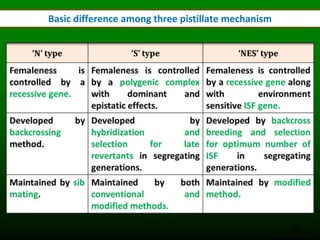
Basic difference among three pistillate mechanism
28
INHERITANCE OF
SEX EXPRESSION
30
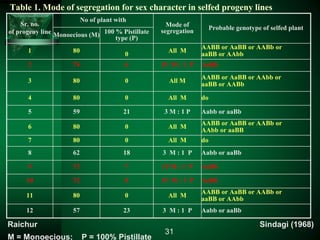
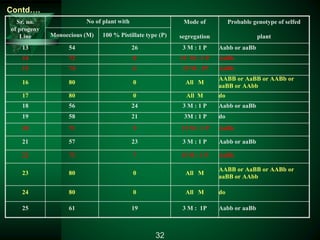
Table 1. Mode of segregation for sex character in selfed progeny lines
Sr. no.
of progeny line
No of plant with
Mode of
segregation Probable genotype of selfed plant
Monoecious (M) 100 % Pistillate
type (P)
1 80
0
All M
AABB or AaBB or AABb or
aaBB or AAbb
2 74 6 15 M : 1 P AaBb
3 80 0 All M
AABB or AaBB or AAbb or
aaBB or AABb
4 80 0 All M do
5 59 21 3 M : 1 P Aabb or aaBb
6 80 0 All M
AABB or AaBB or AABb or
AAbb or aaBB
7 80 0 All M do
8 62 18 3 M : 1 P Aabb or aaBb
9 73 7 15 M : 1 P AaBb
10 72 8 15 M : 1 P AaBb
11 80 0 All M
AABB or AaBB or AABb or
aaBB or AAbb
12 57 23 3 M : 1 P Aabb or aaBb
31
Raichur Sindagi (1968)
M = Monoecious; P = 100% Pistillate
Sr. no.
of progeny
Line
No of plant with Mode of
segregation
Probable genotype of selfed
plantMonoecious (M) 100 % Pistillate type (P)
13 54 26 3 M : 1 P Aabb or aaBb
14 72 8 15 M : 1 P AaBb
15 74 6 15 M : 1P AaBb
16 80 0 All M
AABB or AaBB or AABb or
aaBB or AAbb
17 80 0 All M do
18 56 24 3 M : 1 P Aabb or aaBb
19 58 21 3M : 1 P do
20 71 9 15 M : 1 P AaBb
21 57 23 3 M : 1 P Aabb or aaBb
22 73 7 15 M : 1 P AaBb
23 80 0 All M
AABB or AaBB or AABb or
aaBB or AAbb
24 80 0 All M do
25 61 19 3 M : 1P Aabb or aaBb
32
Contd….
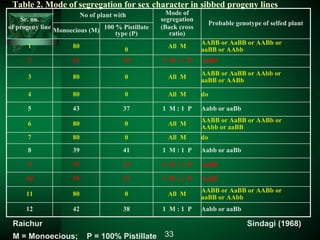
Table 2. Mode of segregation for sex character in sibbed progeny lines
Sr. no.
of progeny line
No of plant with Mode of
segregation
(Back cross
ratio)
Probable genotype of selfed plant
Monoecious (M) 100 % Pistillate
type (P)
1 80
0
All M
AABB or AaBB or AABb or
aaBB or AAbb
2 61 19 3 M : 1 P AaBb
3 80 0 All M
AABB or AaBB or AAbb or
aaBB or AABb
4 80 0 All M do
5 43 37 1 M : 1 P Aabb or aaBb
6 80 0 All M
AABB or AaBB or AABb or
AAbb or aaBB
7 80 0 All M do
8 39 41 1 M : 1 P Aabb or aaBb
9 57 23 3 M : 1 P AaBb
10 59 21 3 M : 1 P AaBb
11 80 0 All M
AABB or AaBB or AABb or
aaBB or AAbb
12 42 38 1 M : 1 P Aabb or aaBb
33
Raichur Sindagi (1968)
M = Monoecious; P = 100% Pistillate
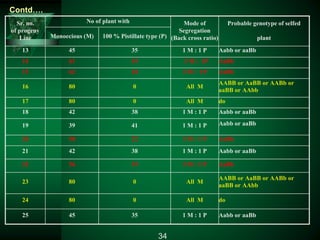
Sr. no.
of progeny
Line
No of plant with Mode of
Segregation
(Back cross ratio)
Probable genotype of selfed
plantMonoecious (M) 100 % Pistillate type (P)
13 45 35 1 M : 1 P Aabb or aaBb
14 61 19 3 M : 1P AaBb
15 62 18 3 M : 1P AaBb
16 80 0 All M
AABB or AaBB or AABb or
aaBB or AAbb
17 80 0 All M do
18 42 38 1 M : 1 P Aabb or aaBb
19 39 41 1 M : 1 P Aabb or aaBb
20 58 22 3 M : 1 P AaBb
21 42 38 1 M : 1 P Aabb or aaBb
22 56 19 3 M : 1 P AaBb
23 80 0 All M
AABB or AaBB or AABb or
aaBB or AAbb
24 80 0 All M do
25 45 35 1 M : 1 P Aabb or aaBb
34
Contd….
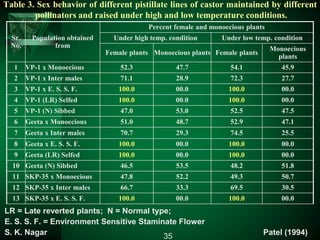
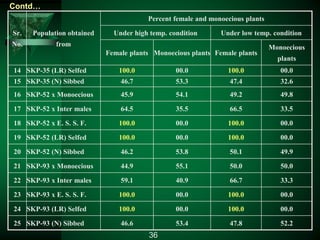
Table 3. Sex behavior of different pistillate lines of castor maintained by different
pollinators and raised under high and low temperature conditions.
Sr.
No.
Population obtained
from
Percent female and monoecious plants
Under high temp. condition Under low temp. condition
Female plants Monoecious plants Female plants
Monoecious
plants
1 VP-1 x Monoecious 52.3 47.7 54.1 45.9
2 VP-1 x Inter males 71.1 28.9 72.3 27.7
3 VP-1 x E. S. S. F. 100.0 00.0 100.0 00.0
4 VP-1 (LR) Selfed 100.0 00.0 100.0 00.0
5 VP-1 (N) Sibbed 47.0 53.0 52.5 47.5
6 Geeta x Monoecious 51.0 48.7 52.9 47.1
7 Geeta x Inter males 70.7 29.3 74.5 25.5
8 Geeta x E. S. S. F. 100.0 00.0 100.0 00.0
9 Geeta (LR) Selfed 100.0 00.0 100.0 00.0
10 Geeta (N) Sibbed 46.5 53.5 48.2 51.8
11 SKP-35 x Monoecious 47.8 52.2 49.3 50.7
12 SKP-35 x Inter males 66.7 33.3 69.5 30.5
13 SKP-35 x E. S. S. F. 100.0 00.0 100.0 00.0
35
LR = Late reverted plants; N = Normal type;
E. S. S. F. = Environment Sensitive Staminate Flower
S. K. Nagar Patel (1994)
Sr.
No.
Population obtained
from
Percent female and monoecious plants
Under high temp. condition Under low temp. condition
Female plants Monoecious plants Female plants
Monoecious
plants
14 SKP-35 (LR) Selfed 100.0 00.0 100.0 00.0
15 SKP-35 (N) Sibbed 46.7 53.3 47.4 32.6
16 SKP-52 x Monoecious 45.9 54.1 49.2 49.8
17 SKP-52 x Inter males 64.5 35.5 66.5 33.5
18 SKP-52 x E. S. S. F. 100.0 00.0 100.0 00.0
19 SKP-52 (LR) Selfed 100.0 00.0 100.0 00.0
20 SKP-52 (N) Sibbed 46.2 53.8 50.1 49.9
21 SKP-93 x Monoecious 44.9 55.1 50.0 50.0
22 SKP-93 x Inter males 59.1 40.9 66.7 33.3
23 SKP-93 x E. S. S. F. 100.0 00.0 100.0 00.0
24 SKP-93 (LR) Selfed 100.0 00.0 100.0 00.0
25 SKP-93 (N) Sibbed 46.6 53.4 47.8 52.2
36
Contd…
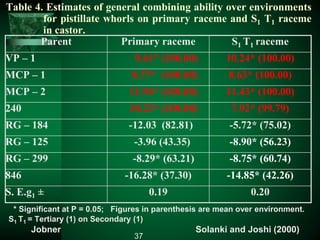
Table 4. Estimates of general combining ability over environments
for pistillate whorls on primary raceme and S1 T1 raceme
in castor.
Parent Primary raceme S1 T1 raceme
VP – 1 9.61* (100.00) 10.24* (100.00)
MCP – 1 8.77* (100.00) 8.63* (100.00)
MCP – 2 11.94* (100.00) 11.43* (100.00)
240 10.23* (100.00) 7.92* (99.79)
RG – 184 -12.03 (82.81) -5.72* (75.02)
RG – 125 -3.96 (43.35) -8.90* (56.23)
RG – 299 -8.29* (63.21) -8.75* (60.74)
846 -16.28* (37.30) -14.85* (42.26)
S. E.g1 ± 0.19 0.20
* Significant at P = 0.05; Figures in parenthesis are mean over environment.
S1 T1 = Tertiary (1) on Secondary (1)
Jobner Solanki and Joshi (2000)
37
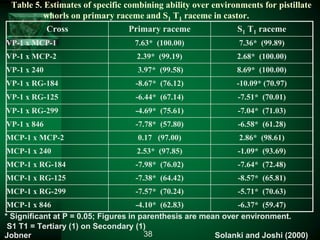
Table 5. Estimates of specific combining ability over environments for pistillate
whorls on primary raceme and S1 T1 raceme in castor.
Cross Primary raceme S1 T1 raceme
VP-1 x MCP-1 7.63* (100.00) 7.36* (99.89)
VP-1 x MCP-2 2.39* (99.19) 2.68* (100.00)
VP-1 x 240 3.97* (99.58) 8.69* (100.00)
VP-1 x RG-184 -8.67* (76.12) -10.09* (70.97)
VP-1 x RG-125 -6.44* (67.14) -7.51* (70.01)
VP-1 x RG-299 -4.69* (75.61) -7.04* (71.03)
VP-1 x 846 -7.78* (57.80) -6.58* (61.28)
MCP-1 x MCP-2 0.17 (97.00) 2.86* (98.61)
MCP-1 x 240 2.53* (97.85) -1.09* (93.69)
MCP-1 x RG-184 -7.98* (76.02) -7.64* (72.48)
MCP-1 x RG-125 -7.38* (64.42) -8.57* (65.81)
MCP-1 x RG-299 -7.57* (70.24) -5.71* (70.63)
MCP-1 x 846 -4.10* (62.83) -6.37* (59.47)
38
* Significant at P = 0.05; Figures in parenthesis are mean over environment.
S1 T1 = Tertiary (1) on Secondary (1)
Jobner Solanki and Joshi (2000)
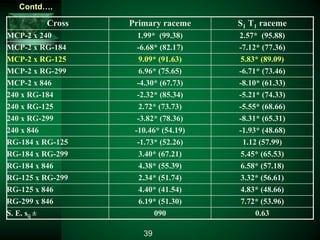
Cross Primary raceme S1 T1 raceme
MCP-2 x 240 1.99* (99.38) 2.57* (95.88)
MCP-2 x RG-184 -6.68* (82.17) -7.12* (77.36)
MCP-2 x RG-125 9.09* (91.63) 5.83* (89.09)
MCP-2 x RG-299 6.96* (75.65) -6.71* (73.46)
MCP-2 x 846 -4.30* (67.73) -8.10* (61.33)
240 x RG-184 -2.32* (85.34) -5.21* (74.33)
240 x RG-125 2.72* (73.73) -5.55* (68.66)
240 x RG-299 -3.82* (78.36) -8.31* (65.31)
240 x 846 -10.46* (54.19) -1.93* (48.68)
RG-184 x RG-125 -1.73* (52.26) 1.12 (57.99)
RG-184 x RG-299 3.40* (67.21) 5.45* (65.53)
RG-184 x 846 4.38* (55.39) 6.58* (57.18)
RG-125 x RG-299 2.34* (51.74) 3.32* (56.61)
RG-125 x 846 4.40* (41.54) 4.83* (48.66)
RG-299 x 846 6.19* (51.30) 7.72* (53.96)
S. E. sij ± 090 0.63
39
Contd….
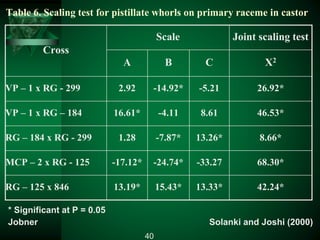
Table 6. Scaling test for pistillate whorls on primary raceme in castor
Cross
Scale Joint scaling test
A B C X2
VP – 1 x RG - 299 2.92 -14.92* -5.21 26.92*
VP – 1 x RG – 184 16.61* -4.11 8.61 46.53*
RG – 184 x RG - 299 1.28 -7.87* 13.26* 8.66*
MCP – 2 x RG - 125 -17.12* -24.74* -33.27 68.30*
RG – 125 x 846 13.19* 15.43* 13.33* 42.24*
* Significant at P = 0.05
Jobner Solanki and Joshi (2000)
40
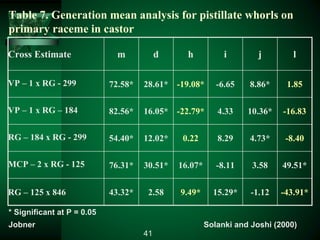
Table 7. Generation mean analysis for pistillate whorls on
primary raceme in castor
Cross Estimate m d h i j l
VP – 1 x RG - 299 72.58* 28.61* -19.08* -6.65 8.86* 1.85
VP – 1 x RG – 184 82.56* 16.05* -22.79* 4.33 10.36* -16.83
RG – 184 x RG - 299 54.40* 12.02* 0.22 8.29 4.73* -8.40
MCP – 2 x RG - 125 76.31* 30.51* 16.07* -8.11 3.58 49.51*
RG – 125 x 846 43.32* 2.58 9.49* 15.29* -1.12 -43.91*
* Significant at P = 0.05
Jobner Solanki and Joshi (2000)
41
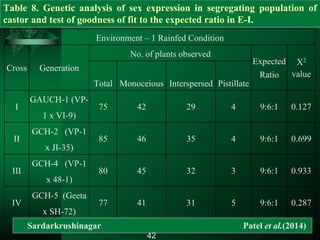
Environment – 1 Rainfed Condition
Cross Generation
No. of plants observed
Expected
Ratio
Χ2
value
Total Monoceious Interspersed Pistillate
I
GAUCH-1 (VP-
1 x VI-9)
75 42 29 4 9:6:1 0.127
II
GCH-2 (VP-1
x JI-35)
85 46 35 4 9:6:1 0.699
III
GCH-4 (VP-1
x 48-1)
80 45 32 3 9:6:1 0.933
IV
GCH-5 (Geeta
x SH-72)
77 41 31 5 9:6:1 0.287
Table 8. Genetic analysis of sex expression in segregating population of
castor and test of goodness of fit to the expected ratio in E-I.
41Sardarkrushinagar Patel et al.(2014)
42
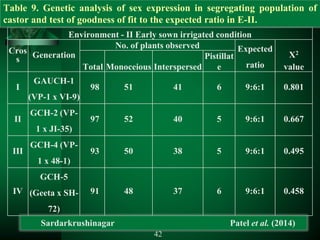
Environment - II Early sown irrigated condition
Cros
s Generation
No. of plants observed Expected
ratio
Χ2
valueTotal Monoceious Interspersed
Pistillat
e
I
GAUCH-1
(VP-1 x VI-9)
98 51 41 6 9:6:1 0.801
II
GCH-2 (VP-
1 x JI-35)
97 52 40 5 9:6:1 0.667
III
GCH-4 (VP-
1 x 48-1)
93 50 38 5 9:6:1 0.495
IV
GCH-5
(Geeta x SH-
72)
91 48 37 6 9:6:1 0.458
Table 9. Genetic analysis of sex expression in segregating population of
castor and test of goodness of fit to the expected ratio in E-II.
Sardarkrushinagar Patel et al. (2014)
42
Genotypes Per cent pistillate
whorls on primary
raceme
Per cent pistillate
whorls on secondary
raceme
Per cent pistillate
whorls on tertiary
raceme
GAUCH 1 US US US
GCH 2 US US US
GCH 4 US US US
GCH 5 S US US
GCH 6 US US US
GCH 7 US US US
VP 1 S S S
GEETA US US US
JP 65 S S S
SKP 84 S S S
VI 9 US US US
JI 35 US US US
48-1 S S S
SH 72 US US US
JI 96 US US US
SKI 215 US S US
Table 10. Performance of promising parents and hybrids for
stability of sex expression in castor.
S = Stable; US = Unstable Patel et al. (2015)S. K. nagar
44
ENVIRONMENTAL INFLUENCE
ON SEX EXPRESSION
45
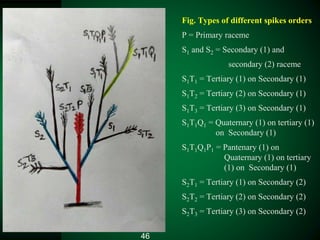
Fig. Types of different spikes orders
P = Primary raceme
S1 and S2 = Secondary (1) and
secondary (2) raceme
S1T1 = Tertiary (1) on Secondary (1)
S1T2 = Tertiary (2) on Secondary (1)
S1T3 = Tertiary (3) on Secondary (1)
S1T1Q1 = Quaternary (1) on tertiary (1)
on Secondary (1)
S1T1Q1P1 = Pantenary (1) on
Quaternary (1) on tertiary
(1) on Secondary (1)
S2T1 = Tertiary (1) on Secondary (2)
S2T2 = Tertiary (2) on Secondary (2)
S2T3 = Tertiary (3) on Secondary (2)
46
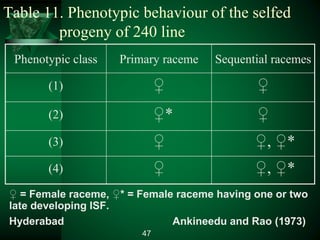
Table 11. Phenotypic behaviour of the selfed
progeny of 240 line
Phenotypic class Primary raceme Sequential racemes
(1) ♀ ♀
(2) ♀* ♀
(3) ♀ ♀, ♀*
(4) ♀ ♀, ♀*
♀ = Female raceme, ♀* = Female raceme having one or two
late developing ISF.
Hyderabad Ankineedu and Rao (1973)
47
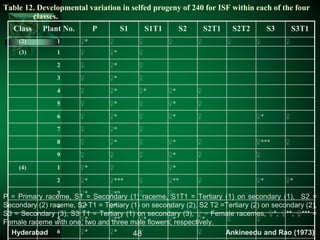
Table 12. Developmental variation in selfed progeny of 240 for ISF within each of the four
classes.
Class Plant No. P S1 S1T1 S2 S2T1 S2T2 S3 S3T1
(2) 1 ♀* ♀ ♀ ♀ ♀ ♀ ♀ ♀
(3) 1 ♀ ♀* ♀
2 ♀ ♀* ♀
3 ♀ ♀* ♀
4 ♀ ♀* ♀* ♀* ♀
5 ♀ ♀* ♀ ♀* ♀
6 ♀ ♀* ♀ ♀* ♀ ♀* ♀
7 ♀ ♀* ♀
8 ♀ ♀* ♀ ♀* ♀ ♀*** ♀
9 ♀ ♀ ♀ ♀* ♀ ♀
(4) 1 ♀* ♀ ♀*
2 ♀* ♀*** ♀ ♀** ♀ ♀* ♀*
3 ♀* ♀** ♀ ♀
4 ♀* ♀* ♀
5 ♀* ♀** ♀* ♀* ♀* ♀ ♀
6 ♀* ♀* ♀ ♀
P = Primary raceme, S1 = Secondary (1) raceme, S1T1 = Tertiary (1) on secondary (1), S2 =
Secondary (2) raceme, S2 T1 = Tertiary (1) on secondary (2), S2 T2 =Tertiary (2) on secondary (2),
S3 = Secondary (3), S3 T1 = Tertiary (1) on secondary (3), ♀ = Female racemes, ♀*, ♀**, ♀*** =
Female raceme with one, two and three male flowers, respectively.
Hyderabad Ankineedu and Rao (1973)48
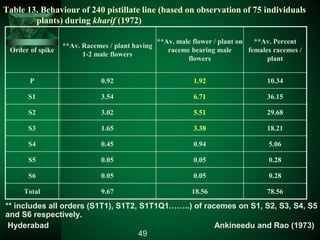
Table 13. Behaviour of 240 pistillate line (based on observation of 75 individuals
plants) during kharif (1972)
Order of spike
**Av. Racemes / plant having
1-2 male flowers
**Av. male flower / plant on
raceme bearing male
flowers
**Av. Percent
females racemes /
plant
P 0.92 1.92 10.34
S1 3.54 6.71 36.15
S2 3.02 5.51 29.68
S3 1.65 3.38 18.21
S4 0.45 0.94 5.06
S5 0.05 0.05 0.28
S6 0.05 0.05 0.28
Total 9.67 18.56 78.56
** includes all orders (S1T1), S1T2, S1T1Q1……..) of racemes on S1, S2, S3, S4, S5
and S6 respectively.
Hyderabad Ankineedu and Rao (1973)
49
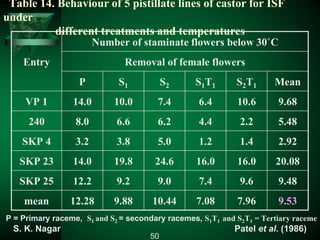
Table 14. Behaviour of 5 pistillate lines of castor for ISF
under
different treatments and temperatures
Entry
Number of staminate flowers below 30˚C
Removal of female flowers
P S1 S2 S1T1 S2T1 Mean
VP 1 14.0 10.0 7.4 6.4 10.6 9.68
240 8.0 6.6 6.2 4.4 2.2 5.48
SKP 4 3.2 3.8 5.0 1.2 1.4 2.92
SKP 23 14.0 19.8 24.6 16.0 16.0 20.08
SKP 25 12.2 9.2 9.0 7.4 9.6 9.48
mean 12.28 9.88 10.44 7.08 7.96 9.53
50
P = Primary raceme, S1 and S2 = secondary racemes, S1T1 and S2T1 = Tertiary raceme
S. K. Nagar Patel et al. (1986)
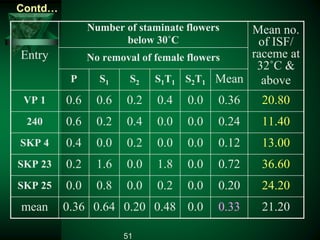
Entry
Number of staminate flowers
below 30˚C
Mean no.
of ISF/
raceme at
32˚C &
above
No removal of female flowers
P S1 S2 S1T1 S2T1 Mean
VP 1 0.6 0.6 0.2 0.4 0.0 0.36 20.80
240 0.6 0.2 0.4 0.0 0.0 0.24 11.40
SKP 4 0.4 0.0 0.2 0.0 0.0 0.12 13.00
SKP 23 0.2 1.6 0.0 1.8 0.0 0.72 36.60
SKP 25 0.0 0.8 0.0 0.2 0.0 0.20 24.20
mean 0.36 0.64 0.20 0.48 0.0 0.33 21.20
51
Contd…
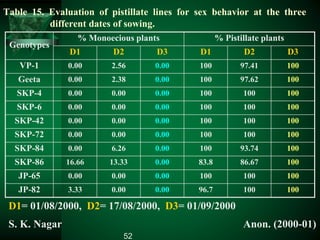
Table 15. Evaluation of pistillate lines for sex behavior at the three
different dates of sowing.
Genotypes
% Monoecious plants % Pistillate plants
D1 D2 D3 D1 D2 D3
VP-1 0.00 2.56 0.00 100 97.41 100
Geeta 0.00 2.38 0.00 100 97.62 100
SKP-4 0.00 0.00 0.00 100 100 100
SKP-6 0.00 0.00 0.00 100 100 100
SKP-42 0.00 0.00 0.00 100 100 100
SKP-72 0.00 0.00 0.00 100 100 100
SKP-84 0.00 6.26 0.00 100 93.74 100
SKP-86 16.66 13.33 0.00 83.8 86.67 100
JP-65 0.00 0.00 0.00 100 100 100
JP-82 3.33 0.00 0.00 96.7 100 100
D1= 01/08/2000, D2= 17/08/2000, D3= 01/09/2000
S. K. Nagar Anon. (2000-01)
52
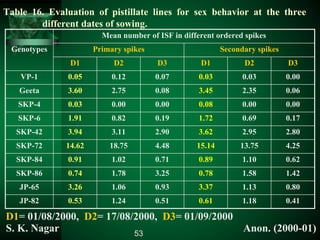
Table 16. Evaluation of pistillate lines for sex behavior at the three
different dates of sowing.
Genotypes
Mean number of ISF in different ordered spikes
Primary spikes Secondary spikes
D1 D2 D3 D1 D2 D3
VP-1 0.05 0.12 0.07 0.03 0.03 0.00
Geeta 3.60 2.75 0.08 3.45 2.35 0.06
SKP-4 0.03 0.00 0.00 0.08 0.00 0.00
SKP-6 1.91 0.82 0.19 1.72 0.69 0.17
SKP-42 3.94 3.11 2.90 3.62 2.95 2.80
SKP-72 14.62 18.75 4.48 15.14 13.75 4.25
SKP-84 0.91 1.02 0.71 0.89 1.10 0.62
SKP-86 0.74 1.78 3.25 0.78 1.58 1.42
JP-65 3.26 1.06 0.93 3.37 1.13 0.80
JP-82 0.53 1.24 0.51 0.61 1.18 0.41
D1= 01/08/2000, D2= 17/08/2000, D3= 01/09/2000
S. K. Nagar Anon. (2000-01)53
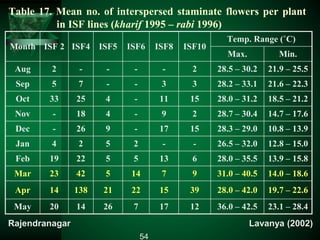
Table 17. Mean no. of interspersed staminate flowers per plant
in ISF lines (kharif 1995 – rabi 1996)
Month ISF 2 ISF4 ISF5 ISF6 ISF8 ISF10
Temp. Range (˚C)
Max. Min.
Aug 2 - - - - 2 28.5 – 30.2 21.9 – 25.5
Sep 5 7 - - 3 3 28.2 – 33.1 21.6 – 22.3
Oct 33 25 4 - 11 15 28.0 – 31.2 18.5 – 21.2
Nov - 18 4 - 9 2 28.7 – 30.4 14.7 – 17.6
Dec - 26 9 - 17 15 28.3 – 29.0 10.8 – 13.9
Jan 4 2 5 2 - - 26.5 – 32.0 12.8 – 15.0
Feb 19 22 5 5 13 6 28.0 – 35.5 13.9 – 15.8
Mar 23 42 5 14 7 9 31.0 – 40.5 14.0 – 18.6
Apr 14 138 21 22 15 39 28.0 – 42.0 19.7 – 22.6
May 20 14 26 7 17 12 36.0 – 42.5 23.1 – 28.4
Rajendranagar Lavanya (2002)
54
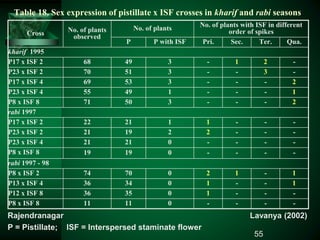
Table 18. Sex expression of pistillate x ISF crosses in kharif and rabi seasons
Cross No. of plants
observed
No. of plants No. of plants with ISF in different
order of spikes
P P with ISF Pri. Sec. Ter. Qua.
kharif 1995
P17 x ISF 2 68 49 3 - 1 2 -
P23 x ISF 2 70 51 3 - - 3 -
P17 x ISF 4 69 53 3 - - - 2
P23 x ISF 4 55 49 1 - - - 1
P8 x ISF 8 71 50 3 - - - 2
rabi 1997
P17 x ISF 2 22 21 1 1 - - -
P23 x ISF 2 21 19 2 2 - - -
P23 x ISF 4 21 21 0 - - - -
P8 x ISF 8 19 19 0 - - - -
rabi 1997 - 98
P8 x ISF 2 74 70 0 2 1 - 1
P13 x ISF 4 36 34 0 1 - - 1
P12 x ISF 8 36 35 0 1 - - -
P8 x ISF 8 11 11 0 - - - -
Rajendranagar Lavanya (2002)
P = Pistillate; ISF = Interspersed staminate flower
55
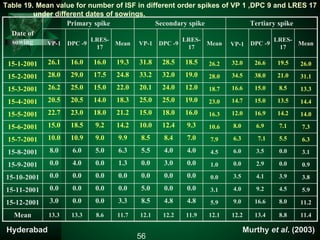
Date of
sowing
Primary spike Secondary spike Tertiary spike
VP-1 DPC -9
LRES-
17
Mean VP-1 DPC -9
LRES-
17
Mean VP-1 DPC -9
LRES-
17
Mean
15-1-2001 26.1 16.0 16.0 19.3 31.8 28.5 18.5 26.2 32.0 26.6 19.5 26.0
15-2-2001 28.0 29.0 17.5 24.8 33.2 32.0 19.0 28.0 34.5 38.0 21.0 31.1
15-3-2001 26.2 25.0 15.0 22.0 20.1 24.0 12.0 18.7 16.6 15.0 8.5 13.3
15-4-2001 20.5 20.5 14.0 18.3 25.0 25.0 19.0 23.0 14.7 15.0 13.5 14.4
15-5-2001 22.7 23.0 18.0 21.2 15.0 18.0 16.0 16.3 12.0 16.9 14.2 14.0
15-6-2001 15.0 18.5 9.2 14.2 10.0 12.4 9.3 10.6 8.0 6.9 7.1 7.3
15-7-2001 10.0 10.9 9.0 9.9 8.5 8.4 7.0 7.9 6.3 7.1 5.5 6.3
15-8-2001 8.0 6.0 5.0 6.3 5.5 4.0 4.0 4.5 6.0 3.5 0.0 3.1
15-9-2001 0.0 4.0 0.0 1.3 0.0 3.0 0.0 1.0 0.0 2.9 0.0 0.9
15-10-2001 0.0 0.0 0.0 0.0 0.0 0.0 0.0 0.0 3.5 4.1 3.9 3.8
15-11-2001 0.0 0.0 0.0 0.0 5.0 0.0 0.0 3.1 4.0 9.2 4.5 5.9
15-12-2001 3.0 0.0 0.0 3.3 8.5 4.8 4.8 5.9 9.0 16.6 8.0 11.2
Mean 13.3 13.3 8.6 11.7 12.1 12.2 11.9 12.1 12.2 13.4 8.8 11.4
Table 19. Mean value for number of ISF in different order spikes of VP 1 ,DPC 9 and LRES 17
under different dates of sowings.
56
Hyderabad Murthy et al. (2003)
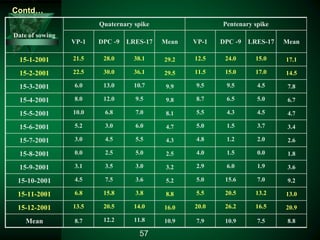
Date of sowing
Quaternary spike Pentenary spike
VP-1 DPC -9 LRES-17 Mean VP-1 DPC -9 LRES-17 Mean
15-1-2001 21.5 28.0 38.1 29.2 12.5 24.0 15.0 17.1
15-2-2001 22.5 30.0 36.1 29.5 11.5 15.0 17.0 14.5
15-3-2001 6.0 13.0 10.7 9.9 9.5 9.5 4.5 7.8
15-4-2001 8.0 12.0 9.5 9.8 8.7 6.5 5.0 6.7
15-5-2001 10.0 6.8 7.0 8.1 5.5 4.3 4.5 4.7
15-6-2001 5.2 3.0 6.0 4.7 5.0 1.5 3.7 3.4
15-7-2001 3.0 4.5 5.5 4.3 4.8 1.2 2.0 2.6
15-8-2001 0.0 2.5 5.0 2.5 4.0 1.5 0.0 1.8
15-9-2001 3.1 3.5 3.0 3.2 2.9 6.0 1.9 3.6
15-10-2001 4.5 7.5 3.6 5.2 5.0 15.6 7.0 9.2
15-11-2001 6.8 15.8 3.8 8.8 5.5 20.5 13.2 13.0
15-12-2001 13.5 20.5 14.0 16.0 20.0 26.2 16.5 20.9
Mean 8.7 12.2 11.8 10.9 7.9 10.9 7.5 8.8
57
Contd…
CONCLUSION
• Castor is known for its sexual polymorphism in which gene
‘F’ for monoecism which controls a genetically stable series of
sex variants ranging from female (f) to strongly male inbreds.
• Sex reversals occur spontaneously in many natural
populations and inbred races. They represent a genetically
unstable series of females differing in time of life at which they
turn to monoecism.
•The phenotypic changes from femaleness to monoecism is
developmentally irreversible.
• Sex reversals is influenced by genetic and non genetic factors
affecting sex tendency.
• The high degree of instability of sex mechanism in castor calls
for adoption of appropriate method of seed multiplication from
basic to foundation stage, as to maximize the recovery of
pistillate plants in hybrid seed production plot.
58
THANK YOU

Sex expression in castor

  • 1.
    CONTENTS • INTRODUCTION • CLASSIFICATIONOF SEX VARIANTS • TYPE OF PISTILLATE LINES • INHERITANCE OF SEX EXPRESSION • ENVIRONMENTAL INFLUENCE ON SEX EXPRESSION • CONCLUSION 3
  • 2.
  • 3.
    INTRODUCTION Castor (Ricinus communisL.) is an important non- edible oilseed crop of arid and semi-arid regions of the world. It Belongs to the family Euphorbiaceae, having chromosome number 2n = 20 and cross pollination up to the extent of 50 per cent. Castor seed contains 48 to 52 percent oil and having wide range of industrial uses. India is principle producer and sole exporter of castor seed, oil and some of its derivatives. Castor is grown in tropical, subtropical and temperate climates and almost cultivated in 30 different countries. India, China, Brazil, Africa, Thailand and South America are major castor growing countries. The major castor growing states in India are Gujarat, Andhra Pradesh, Telangana, Rajsthan, Tamilnadu, Karnataka and Orissa. Gujarat is leading castor growing state of country. 4
  • 4.
    Area, production andproductivity of castor Area (lakh ha) Production (lakh tonnes) Productivity (kg/ha) During year Gujarat 7.15 14.56 2036 2014-15 India 11.05 17.33 1568 2014-15 World 14.94 19.96 1336 2014-15 Gujarat share about 49.00 per cent of area and 80.00 per cent of total production of the country. In Gujarat, Banaskantha, Mehsana, Sabarkantha are major castor growing district. 5
  • 5.
    14 districts accountfor 97% of the total area under Castor crop in Gujarat Castor geographical coverage : Gujarat Banaskant ha Mehsan a Sabarkant ha 6
  • 6.
  • 7.
    (a) Monoecious (M): It is the most natural occurrence of annual and perennial castor. The spike has basal 1/3rd to ½ portion of male flowers, while the top portion has female flowers. In between these few whorls have both male and female flowers in an interspersed fashion. (b) Pistillate (P) : It occurs as a rare recessive mutant with the spike having female flowers through out the spike. It may be 100 percent pistillate or <100 percent (70- 90 %) having a few male flowers in the basal portion. (c) Interspersed staminate flower (ISF) : A variant of pistillate form with male flowers interspersed, through out the female flowers on the spike. (d) Sex revertant : It is a female that turns to monoecious at later stage. A BASIC SEX FORM IN CASTOR 8
  • 8.
    Female promoting environment(F): Low temperature (<30˚C), young plants, early order spikes, high nutrition, less difference between maximum and minimum temperature promote female flowers and shift balance towards femaleness on a spike. Male promoting environment (M) : Rainy season, high temperature (>32˚C), old plants, late order spikes, low nutrition and large difference between maximum and minimum temperature promote male flowers on a spike and incline towards maleness. (Shifriss, 1960) The basic sex forms are classified in different ways by different authors as the expression of sex in different locations is highly influenced by environmental condition. 9
  • 9.
    Classification of sexvariant as per shifriss (1960) Type A : Monoecious Type C : Pistillate Type B: Sex revertant from Pistillate to Monoecious and Monoecious variant with apical interspersed raceme to Uniform interspersed raceme Type D : Monoecious variant with apical interspersed raceme Type E : Uniform interspersed raceme Among these, Monoecious and Pistillate are developmentally persistent forms while others are developmentally inconsistent forms. 10
  • 10.
    The spike hasbasal 1/3rd to ½ portion of male flowers while the top portion has female flowers. Type A : Monoecious 11
  • 11.
    Type C :Pistillate The spike having female flowers through out the spike Geeta12
  • 12.
    Type B :Sex revertant JP 65 A female line that produce male flower on a spike and at later stage it turns to monoecious. 13
  • 13.
    Type D :Monoecious variant with apical interspersed raceme 14
  • 14.
    Type E :Uniform interspersed raceme 15
  • 15.
  • 16.
    ❖ Classification ofsex form as per Moshkin (1967) Stable female Female flower from primary and later order spike Unstable female Primary pistillate while later order spike partial or fully monoecious Inclined toward female Up to 10 male flower in the lower part of the spike Interspersed Few male flowers interspersed through out the spike Monoecious The spike has basal portion of male flowers, while the top portion has female flowers. Male The spike has 1/3rd or more male flowers In all these forms individual hermaphrodite flowers may occur 17
  • 17.
    Male : Thespike has 1/3rd or more portion of male flowers 18
  • 18.
  • 19.
    ❖ Classification ofsex variants as conventional and unconventional system in relation to the environment, Shifriss (1960). (A) Conventional system : Conventional variants are mainly monoecious variants, rare recessive females. This conventional variants are classified based on (1) Variation in sex tendency : The proportion of male : female flower on a spike is the sex tendency. (2) Variation in sex pattern : Sex pattern is the distribution of male and female flowers on a spike. Form 1 : Monoecious, apical non interspersed, middle portion of spike is interspersed, apical region strictly female flowers and lower portion with staminate flowers. Form 2 : Monoecious, apical interspersed like type D, a monoecious variant Form 3 : Monoecious, terminal hermaphrodite, eg. A strongly male type like inbred 97. Form 4 : Female, identified in a backcross as controlled by a single recessive gene. This has further developed as ‘N’ type of pistillate mechanism. 20
  • 20.
    (B) Unconventional system: ➢ This system evolves from dominant female mutants which occurs spontaneously in nature from monoecious inbred of pattern A and D. ➢ Genetically unstable and influenced by environment. ➢ Though a mutant there is no difference between meiosis of normal monoecious and dominant female mutant and thus not associated with breakdown in gametic fertility. ➢ These variants form the basis for ‘S’ type of pistillate mechanism. The conventional variants may be controlled by two major group of genes : • Qualitative genes which determine the kind of flowers to be produced whether male or female. • Polygenes, which accelerate or deplete a substance (may be a growth regulator), the gradient differentiation of which determines the sex tendency. 21
  • 21.
    Unconventional variants arethree types : Type 1 : Occur as a series of sex reversals (Pistillate to Monoecious). Sex reversal begin to bloom as female but later turn to monoecious. Plant may revert immediately following the appearance of primary spike. Type 2 : Non reverted females. It has evolved from inbred stock of variants Queen 162 and Adam mistaef, which was classified under type of late reverted female. Both variety having late maturity and produce their raceme at long intervals. Type 3 : Mutating recessive females. It was developed from cross made between female mutant 137-6 and a monoecist N-145-4, which was known to be heterozygous for the recessive female gene. 22
  • 22.
    • Types ofpistillate lines N type : • It is based on the form 4 of the conventional variant as described by Shifriss (1960). • Katayama (1948) described it in a backcross line that exhibited a segregation ratio of 1 : 1 monoecious to pistillate plants. • The pistillate character is governed by a single sex switching gene f. • If a plant is homozygous recessive ff for sex expression it remains as pistillate, while a heterozygous recessive Ff is a monoecious plant. Thus a female plant when crossed with a monoecious, it gives 1 : 1 monoecious : female. • This type can be maintained by sib-mating and seeds from female plants are harvested separately. The progeny from seed produced on female plant segregates in 1 : 1 ratio for female and monoecious plants. • For production of F1 seeds utilizing N type pistillateness, the seed producer has to rouge out the normal monoecious plants from such female line before anthesis. 23
  • 23.
    (i) Sex reversals: • This S type pistillate line was obtained by selection within sex reversal variants at the Weigmann institute in Israel (Shifriss, 1956). • This system based on sex reversal variants behave like polygenic complex with dominant and epistatic effects. • Sex reversals are plant variants, which initiate as female and later revert to normal monoecious at any stage after the first raceme up to 5-10 sequential order raceme. • On continuous inbreeding sex revertants give a spectrum of sex reversals which may be early, late and non reverted. • Early revertants on selfing gives > 50 per cent pistillate plants. Late revertants (after 4th order) on selfing give > 80 to 100 % pistillate population and very less proportion of monoecious. These pistillate lines in turn are late reverted. • Development of stable pistillate lines from ‘S’ type is based on selection from the late order revertants. • The genetic system governing time of phenotypic reversion is unstable, but reversion as such is not associated with any serious break down in the female producing mechanism. 24 S type : In S type essentially two mechanisms viz., sex reversals and Environment sensitive interspersed staminate flower (ISF) expression.
  • 24.
  • 25.
  • 26.
    (ii) Non revertedfemale : • Such females are developed from inbred stock of Queen 162 and Adam Mistaef, the population carry gene for interspersed staminate flower (ISF) expression at a high frequency. • The penetrance and expressivity of ISF in such type of females are determined by environment. • In a female promoting environment only few ISF flowers occur, which prematurely drop due to the competition from older female flowers that were fertilized by monoecious pollen in the vicinity. • This can be overcome by protecting the spikes from cross pollination by bagging. Though the initial male flowers drops, later developed male flowers fertilized the female flowers. • Shifriss (1960) developed a true breeding non reverted female line that has the gene for environmentally sensitive ISF expression. • Pistillate line developed in Gujarat possesses both the systems of sex reversals and non reverted female carry the environmental sensitive gene for the expression of ISF, which offered an encourage for hybrid development programme in India in general and Gujarat in particular. The pistillate lines viz.,VP 1, Geeta, SKP 35, SKP 52, SKP 93, etc., are the S type of pistillae line. 27
  • 27.
    NES type : •This type is combination of both N and S type as it carries the homozygous recessive gene for pistillateness and environment sensitive genes for ISF, which are not confined to any particular raceme order and are temperature dependent. • Further it was identified that temperature above 31˚C promotes ISF while lower temperature results in fully female racemes. Thus, this type of pistillate lines can be maintained during summer, where as hybrid seed production can be safely done during normal kharif / late kharif planting. • CENES 1 female line developed by Zimmerman and Smith (1966), and 240 female line by Ankineedu and Rao (1973), JP 65 from GAU, Junagadh, and a number of pistillate lines viz., SKP 4, SKP 6, SKP 13, SKP 16, SKP 23, etc. from GAU, S.K.Nagar are NES type pistillate lines. 28
  • 28.
    Basic difference amongthree pistillate mechanism 28
  • 29.
  • 30.
    Table 1. Modeof segregation for sex character in selfed progeny lines Sr. no. of progeny line No of plant with Mode of segregation Probable genotype of selfed plant Monoecious (M) 100 % Pistillate type (P) 1 80 0 All M AABB or AaBB or AABb or aaBB or AAbb 2 74 6 15 M : 1 P AaBb 3 80 0 All M AABB or AaBB or AAbb or aaBB or AABb 4 80 0 All M do 5 59 21 3 M : 1 P Aabb or aaBb 6 80 0 All M AABB or AaBB or AABb or AAbb or aaBB 7 80 0 All M do 8 62 18 3 M : 1 P Aabb or aaBb 9 73 7 15 M : 1 P AaBb 10 72 8 15 M : 1 P AaBb 11 80 0 All M AABB or AaBB or AABb or aaBB or AAbb 12 57 23 3 M : 1 P Aabb or aaBb 31 Raichur Sindagi (1968) M = Monoecious; P = 100% Pistillate
  • 31.
    Sr. no. of progeny Line Noof plant with Mode of segregation Probable genotype of selfed plantMonoecious (M) 100 % Pistillate type (P) 13 54 26 3 M : 1 P Aabb or aaBb 14 72 8 15 M : 1 P AaBb 15 74 6 15 M : 1P AaBb 16 80 0 All M AABB or AaBB or AABb or aaBB or AAbb 17 80 0 All M do 18 56 24 3 M : 1 P Aabb or aaBb 19 58 21 3M : 1 P do 20 71 9 15 M : 1 P AaBb 21 57 23 3 M : 1 P Aabb or aaBb 22 73 7 15 M : 1 P AaBb 23 80 0 All M AABB or AaBB or AABb or aaBB or AAbb 24 80 0 All M do 25 61 19 3 M : 1P Aabb or aaBb 32 Contd….
  • 32.
    Table 2. Modeof segregation for sex character in sibbed progeny lines Sr. no. of progeny line No of plant with Mode of segregation (Back cross ratio) Probable genotype of selfed plant Monoecious (M) 100 % Pistillate type (P) 1 80 0 All M AABB or AaBB or AABb or aaBB or AAbb 2 61 19 3 M : 1 P AaBb 3 80 0 All M AABB or AaBB or AAbb or aaBB or AABb 4 80 0 All M do 5 43 37 1 M : 1 P Aabb or aaBb 6 80 0 All M AABB or AaBB or AABb or AAbb or aaBB 7 80 0 All M do 8 39 41 1 M : 1 P Aabb or aaBb 9 57 23 3 M : 1 P AaBb 10 59 21 3 M : 1 P AaBb 11 80 0 All M AABB or AaBB or AABb or aaBB or AAbb 12 42 38 1 M : 1 P Aabb or aaBb 33 Raichur Sindagi (1968) M = Monoecious; P = 100% Pistillate
  • 33.
    Sr. no. of progeny Line Noof plant with Mode of Segregation (Back cross ratio) Probable genotype of selfed plantMonoecious (M) 100 % Pistillate type (P) 13 45 35 1 M : 1 P Aabb or aaBb 14 61 19 3 M : 1P AaBb 15 62 18 3 M : 1P AaBb 16 80 0 All M AABB or AaBB or AABb or aaBB or AAbb 17 80 0 All M do 18 42 38 1 M : 1 P Aabb or aaBb 19 39 41 1 M : 1 P Aabb or aaBb 20 58 22 3 M : 1 P AaBb 21 42 38 1 M : 1 P Aabb or aaBb 22 56 19 3 M : 1 P AaBb 23 80 0 All M AABB or AaBB or AABb or aaBB or AAbb 24 80 0 All M do 25 45 35 1 M : 1 P Aabb or aaBb 34 Contd….
  • 34.
    Table 3. Sexbehavior of different pistillate lines of castor maintained by different pollinators and raised under high and low temperature conditions. Sr. No. Population obtained from Percent female and monoecious plants Under high temp. condition Under low temp. condition Female plants Monoecious plants Female plants Monoecious plants 1 VP-1 x Monoecious 52.3 47.7 54.1 45.9 2 VP-1 x Inter males 71.1 28.9 72.3 27.7 3 VP-1 x E. S. S. F. 100.0 00.0 100.0 00.0 4 VP-1 (LR) Selfed 100.0 00.0 100.0 00.0 5 VP-1 (N) Sibbed 47.0 53.0 52.5 47.5 6 Geeta x Monoecious 51.0 48.7 52.9 47.1 7 Geeta x Inter males 70.7 29.3 74.5 25.5 8 Geeta x E. S. S. F. 100.0 00.0 100.0 00.0 9 Geeta (LR) Selfed 100.0 00.0 100.0 00.0 10 Geeta (N) Sibbed 46.5 53.5 48.2 51.8 11 SKP-35 x Monoecious 47.8 52.2 49.3 50.7 12 SKP-35 x Inter males 66.7 33.3 69.5 30.5 13 SKP-35 x E. S. S. F. 100.0 00.0 100.0 00.0 35 LR = Late reverted plants; N = Normal type; E. S. S. F. = Environment Sensitive Staminate Flower S. K. Nagar Patel (1994)
  • 35.
    Sr. No. Population obtained from Percent femaleand monoecious plants Under high temp. condition Under low temp. condition Female plants Monoecious plants Female plants Monoecious plants 14 SKP-35 (LR) Selfed 100.0 00.0 100.0 00.0 15 SKP-35 (N) Sibbed 46.7 53.3 47.4 32.6 16 SKP-52 x Monoecious 45.9 54.1 49.2 49.8 17 SKP-52 x Inter males 64.5 35.5 66.5 33.5 18 SKP-52 x E. S. S. F. 100.0 00.0 100.0 00.0 19 SKP-52 (LR) Selfed 100.0 00.0 100.0 00.0 20 SKP-52 (N) Sibbed 46.2 53.8 50.1 49.9 21 SKP-93 x Monoecious 44.9 55.1 50.0 50.0 22 SKP-93 x Inter males 59.1 40.9 66.7 33.3 23 SKP-93 x E. S. S. F. 100.0 00.0 100.0 00.0 24 SKP-93 (LR) Selfed 100.0 00.0 100.0 00.0 25 SKP-93 (N) Sibbed 46.6 53.4 47.8 52.2 36 Contd…
  • 36.
    Table 4. Estimatesof general combining ability over environments for pistillate whorls on primary raceme and S1 T1 raceme in castor. Parent Primary raceme S1 T1 raceme VP – 1 9.61* (100.00) 10.24* (100.00) MCP – 1 8.77* (100.00) 8.63* (100.00) MCP – 2 11.94* (100.00) 11.43* (100.00) 240 10.23* (100.00) 7.92* (99.79) RG – 184 -12.03 (82.81) -5.72* (75.02) RG – 125 -3.96 (43.35) -8.90* (56.23) RG – 299 -8.29* (63.21) -8.75* (60.74) 846 -16.28* (37.30) -14.85* (42.26) S. E.g1 ± 0.19 0.20 * Significant at P = 0.05; Figures in parenthesis are mean over environment. S1 T1 = Tertiary (1) on Secondary (1) Jobner Solanki and Joshi (2000) 37
  • 37.
    Table 5. Estimatesof specific combining ability over environments for pistillate whorls on primary raceme and S1 T1 raceme in castor. Cross Primary raceme S1 T1 raceme VP-1 x MCP-1 7.63* (100.00) 7.36* (99.89) VP-1 x MCP-2 2.39* (99.19) 2.68* (100.00) VP-1 x 240 3.97* (99.58) 8.69* (100.00) VP-1 x RG-184 -8.67* (76.12) -10.09* (70.97) VP-1 x RG-125 -6.44* (67.14) -7.51* (70.01) VP-1 x RG-299 -4.69* (75.61) -7.04* (71.03) VP-1 x 846 -7.78* (57.80) -6.58* (61.28) MCP-1 x MCP-2 0.17 (97.00) 2.86* (98.61) MCP-1 x 240 2.53* (97.85) -1.09* (93.69) MCP-1 x RG-184 -7.98* (76.02) -7.64* (72.48) MCP-1 x RG-125 -7.38* (64.42) -8.57* (65.81) MCP-1 x RG-299 -7.57* (70.24) -5.71* (70.63) MCP-1 x 846 -4.10* (62.83) -6.37* (59.47) 38 * Significant at P = 0.05; Figures in parenthesis are mean over environment. S1 T1 = Tertiary (1) on Secondary (1) Jobner Solanki and Joshi (2000)
  • 38.
    Cross Primary racemeS1 T1 raceme MCP-2 x 240 1.99* (99.38) 2.57* (95.88) MCP-2 x RG-184 -6.68* (82.17) -7.12* (77.36) MCP-2 x RG-125 9.09* (91.63) 5.83* (89.09) MCP-2 x RG-299 6.96* (75.65) -6.71* (73.46) MCP-2 x 846 -4.30* (67.73) -8.10* (61.33) 240 x RG-184 -2.32* (85.34) -5.21* (74.33) 240 x RG-125 2.72* (73.73) -5.55* (68.66) 240 x RG-299 -3.82* (78.36) -8.31* (65.31) 240 x 846 -10.46* (54.19) -1.93* (48.68) RG-184 x RG-125 -1.73* (52.26) 1.12 (57.99) RG-184 x RG-299 3.40* (67.21) 5.45* (65.53) RG-184 x 846 4.38* (55.39) 6.58* (57.18) RG-125 x RG-299 2.34* (51.74) 3.32* (56.61) RG-125 x 846 4.40* (41.54) 4.83* (48.66) RG-299 x 846 6.19* (51.30) 7.72* (53.96) S. E. sij ± 090 0.63 39 Contd….
  • 39.
    Table 6. Scalingtest for pistillate whorls on primary raceme in castor Cross Scale Joint scaling test A B C X2 VP – 1 x RG - 299 2.92 -14.92* -5.21 26.92* VP – 1 x RG – 184 16.61* -4.11 8.61 46.53* RG – 184 x RG - 299 1.28 -7.87* 13.26* 8.66* MCP – 2 x RG - 125 -17.12* -24.74* -33.27 68.30* RG – 125 x 846 13.19* 15.43* 13.33* 42.24* * Significant at P = 0.05 Jobner Solanki and Joshi (2000) 40
  • 40.
    Table 7. Generationmean analysis for pistillate whorls on primary raceme in castor Cross Estimate m d h i j l VP – 1 x RG - 299 72.58* 28.61* -19.08* -6.65 8.86* 1.85 VP – 1 x RG – 184 82.56* 16.05* -22.79* 4.33 10.36* -16.83 RG – 184 x RG - 299 54.40* 12.02* 0.22 8.29 4.73* -8.40 MCP – 2 x RG - 125 76.31* 30.51* 16.07* -8.11 3.58 49.51* RG – 125 x 846 43.32* 2.58 9.49* 15.29* -1.12 -43.91* * Significant at P = 0.05 Jobner Solanki and Joshi (2000) 41
  • 41.
    Environment – 1Rainfed Condition Cross Generation No. of plants observed Expected Ratio Χ2 value Total Monoceious Interspersed Pistillate I GAUCH-1 (VP- 1 x VI-9) 75 42 29 4 9:6:1 0.127 II GCH-2 (VP-1 x JI-35) 85 46 35 4 9:6:1 0.699 III GCH-4 (VP-1 x 48-1) 80 45 32 3 9:6:1 0.933 IV GCH-5 (Geeta x SH-72) 77 41 31 5 9:6:1 0.287 Table 8. Genetic analysis of sex expression in segregating population of castor and test of goodness of fit to the expected ratio in E-I. 41Sardarkrushinagar Patel et al.(2014) 42
  • 42.
    Environment - IIEarly sown irrigated condition Cros s Generation No. of plants observed Expected ratio Χ2 valueTotal Monoceious Interspersed Pistillat e I GAUCH-1 (VP-1 x VI-9) 98 51 41 6 9:6:1 0.801 II GCH-2 (VP- 1 x JI-35) 97 52 40 5 9:6:1 0.667 III GCH-4 (VP- 1 x 48-1) 93 50 38 5 9:6:1 0.495 IV GCH-5 (Geeta x SH- 72) 91 48 37 6 9:6:1 0.458 Table 9. Genetic analysis of sex expression in segregating population of castor and test of goodness of fit to the expected ratio in E-II. Sardarkrushinagar Patel et al. (2014) 42
  • 43.
    Genotypes Per centpistillate whorls on primary raceme Per cent pistillate whorls on secondary raceme Per cent pistillate whorls on tertiary raceme GAUCH 1 US US US GCH 2 US US US GCH 4 US US US GCH 5 S US US GCH 6 US US US GCH 7 US US US VP 1 S S S GEETA US US US JP 65 S S S SKP 84 S S S VI 9 US US US JI 35 US US US 48-1 S S S SH 72 US US US JI 96 US US US SKI 215 US S US Table 10. Performance of promising parents and hybrids for stability of sex expression in castor. S = Stable; US = Unstable Patel et al. (2015)S. K. nagar 44
  • 44.
  • 45.
    Fig. Types ofdifferent spikes orders P = Primary raceme S1 and S2 = Secondary (1) and secondary (2) raceme S1T1 = Tertiary (1) on Secondary (1) S1T2 = Tertiary (2) on Secondary (1) S1T3 = Tertiary (3) on Secondary (1) S1T1Q1 = Quaternary (1) on tertiary (1) on Secondary (1) S1T1Q1P1 = Pantenary (1) on Quaternary (1) on tertiary (1) on Secondary (1) S2T1 = Tertiary (1) on Secondary (2) S2T2 = Tertiary (2) on Secondary (2) S2T3 = Tertiary (3) on Secondary (2) 46
  • 46.
    Table 11. Phenotypicbehaviour of the selfed progeny of 240 line Phenotypic class Primary raceme Sequential racemes (1) ♀ ♀ (2) ♀* ♀ (3) ♀ ♀, ♀* (4) ♀ ♀, ♀* ♀ = Female raceme, ♀* = Female raceme having one or two late developing ISF. Hyderabad Ankineedu and Rao (1973) 47
  • 47.
    Table 12. Developmentalvariation in selfed progeny of 240 for ISF within each of the four classes. Class Plant No. P S1 S1T1 S2 S2T1 S2T2 S3 S3T1 (2) 1 ♀* ♀ ♀ ♀ ♀ ♀ ♀ ♀ (3) 1 ♀ ♀* ♀ 2 ♀ ♀* ♀ 3 ♀ ♀* ♀ 4 ♀ ♀* ♀* ♀* ♀ 5 ♀ ♀* ♀ ♀* ♀ 6 ♀ ♀* ♀ ♀* ♀ ♀* ♀ 7 ♀ ♀* ♀ 8 ♀ ♀* ♀ ♀* ♀ ♀*** ♀ 9 ♀ ♀ ♀ ♀* ♀ ♀ (4) 1 ♀* ♀ ♀* 2 ♀* ♀*** ♀ ♀** ♀ ♀* ♀* 3 ♀* ♀** ♀ ♀ 4 ♀* ♀* ♀ 5 ♀* ♀** ♀* ♀* ♀* ♀ ♀ 6 ♀* ♀* ♀ ♀ P = Primary raceme, S1 = Secondary (1) raceme, S1T1 = Tertiary (1) on secondary (1), S2 = Secondary (2) raceme, S2 T1 = Tertiary (1) on secondary (2), S2 T2 =Tertiary (2) on secondary (2), S3 = Secondary (3), S3 T1 = Tertiary (1) on secondary (3), ♀ = Female racemes, ♀*, ♀**, ♀*** = Female raceme with one, two and three male flowers, respectively. Hyderabad Ankineedu and Rao (1973)48
  • 48.
    Table 13. Behaviourof 240 pistillate line (based on observation of 75 individuals plants) during kharif (1972) Order of spike **Av. Racemes / plant having 1-2 male flowers **Av. male flower / plant on raceme bearing male flowers **Av. Percent females racemes / plant P 0.92 1.92 10.34 S1 3.54 6.71 36.15 S2 3.02 5.51 29.68 S3 1.65 3.38 18.21 S4 0.45 0.94 5.06 S5 0.05 0.05 0.28 S6 0.05 0.05 0.28 Total 9.67 18.56 78.56 ** includes all orders (S1T1), S1T2, S1T1Q1……..) of racemes on S1, S2, S3, S4, S5 and S6 respectively. Hyderabad Ankineedu and Rao (1973) 49
  • 49.
    Table 14. Behaviourof 5 pistillate lines of castor for ISF under different treatments and temperatures Entry Number of staminate flowers below 30˚C Removal of female flowers P S1 S2 S1T1 S2T1 Mean VP 1 14.0 10.0 7.4 6.4 10.6 9.68 240 8.0 6.6 6.2 4.4 2.2 5.48 SKP 4 3.2 3.8 5.0 1.2 1.4 2.92 SKP 23 14.0 19.8 24.6 16.0 16.0 20.08 SKP 25 12.2 9.2 9.0 7.4 9.6 9.48 mean 12.28 9.88 10.44 7.08 7.96 9.53 50 P = Primary raceme, S1 and S2 = secondary racemes, S1T1 and S2T1 = Tertiary raceme S. K. Nagar Patel et al. (1986)
  • 50.
    Entry Number of staminateflowers below 30˚C Mean no. of ISF/ raceme at 32˚C & above No removal of female flowers P S1 S2 S1T1 S2T1 Mean VP 1 0.6 0.6 0.2 0.4 0.0 0.36 20.80 240 0.6 0.2 0.4 0.0 0.0 0.24 11.40 SKP 4 0.4 0.0 0.2 0.0 0.0 0.12 13.00 SKP 23 0.2 1.6 0.0 1.8 0.0 0.72 36.60 SKP 25 0.0 0.8 0.0 0.2 0.0 0.20 24.20 mean 0.36 0.64 0.20 0.48 0.0 0.33 21.20 51 Contd…
  • 51.
    Table 15. Evaluationof pistillate lines for sex behavior at the three different dates of sowing. Genotypes % Monoecious plants % Pistillate plants D1 D2 D3 D1 D2 D3 VP-1 0.00 2.56 0.00 100 97.41 100 Geeta 0.00 2.38 0.00 100 97.62 100 SKP-4 0.00 0.00 0.00 100 100 100 SKP-6 0.00 0.00 0.00 100 100 100 SKP-42 0.00 0.00 0.00 100 100 100 SKP-72 0.00 0.00 0.00 100 100 100 SKP-84 0.00 6.26 0.00 100 93.74 100 SKP-86 16.66 13.33 0.00 83.8 86.67 100 JP-65 0.00 0.00 0.00 100 100 100 JP-82 3.33 0.00 0.00 96.7 100 100 D1= 01/08/2000, D2= 17/08/2000, D3= 01/09/2000 S. K. Nagar Anon. (2000-01) 52
  • 52.
    Table 16. Evaluationof pistillate lines for sex behavior at the three different dates of sowing. Genotypes Mean number of ISF in different ordered spikes Primary spikes Secondary spikes D1 D2 D3 D1 D2 D3 VP-1 0.05 0.12 0.07 0.03 0.03 0.00 Geeta 3.60 2.75 0.08 3.45 2.35 0.06 SKP-4 0.03 0.00 0.00 0.08 0.00 0.00 SKP-6 1.91 0.82 0.19 1.72 0.69 0.17 SKP-42 3.94 3.11 2.90 3.62 2.95 2.80 SKP-72 14.62 18.75 4.48 15.14 13.75 4.25 SKP-84 0.91 1.02 0.71 0.89 1.10 0.62 SKP-86 0.74 1.78 3.25 0.78 1.58 1.42 JP-65 3.26 1.06 0.93 3.37 1.13 0.80 JP-82 0.53 1.24 0.51 0.61 1.18 0.41 D1= 01/08/2000, D2= 17/08/2000, D3= 01/09/2000 S. K. Nagar Anon. (2000-01)53
  • 53.
    Table 17. Meanno. of interspersed staminate flowers per plant in ISF lines (kharif 1995 – rabi 1996) Month ISF 2 ISF4 ISF5 ISF6 ISF8 ISF10 Temp. Range (˚C) Max. Min. Aug 2 - - - - 2 28.5 – 30.2 21.9 – 25.5 Sep 5 7 - - 3 3 28.2 – 33.1 21.6 – 22.3 Oct 33 25 4 - 11 15 28.0 – 31.2 18.5 – 21.2 Nov - 18 4 - 9 2 28.7 – 30.4 14.7 – 17.6 Dec - 26 9 - 17 15 28.3 – 29.0 10.8 – 13.9 Jan 4 2 5 2 - - 26.5 – 32.0 12.8 – 15.0 Feb 19 22 5 5 13 6 28.0 – 35.5 13.9 – 15.8 Mar 23 42 5 14 7 9 31.0 – 40.5 14.0 – 18.6 Apr 14 138 21 22 15 39 28.0 – 42.0 19.7 – 22.6 May 20 14 26 7 17 12 36.0 – 42.5 23.1 – 28.4 Rajendranagar Lavanya (2002) 54
  • 54.
    Table 18. Sexexpression of pistillate x ISF crosses in kharif and rabi seasons Cross No. of plants observed No. of plants No. of plants with ISF in different order of spikes P P with ISF Pri. Sec. Ter. Qua. kharif 1995 P17 x ISF 2 68 49 3 - 1 2 - P23 x ISF 2 70 51 3 - - 3 - P17 x ISF 4 69 53 3 - - - 2 P23 x ISF 4 55 49 1 - - - 1 P8 x ISF 8 71 50 3 - - - 2 rabi 1997 P17 x ISF 2 22 21 1 1 - - - P23 x ISF 2 21 19 2 2 - - - P23 x ISF 4 21 21 0 - - - - P8 x ISF 8 19 19 0 - - - - rabi 1997 - 98 P8 x ISF 2 74 70 0 2 1 - 1 P13 x ISF 4 36 34 0 1 - - 1 P12 x ISF 8 36 35 0 1 - - - P8 x ISF 8 11 11 0 - - - - Rajendranagar Lavanya (2002) P = Pistillate; ISF = Interspersed staminate flower 55
  • 55.
    Date of sowing Primary spikeSecondary spike Tertiary spike VP-1 DPC -9 LRES- 17 Mean VP-1 DPC -9 LRES- 17 Mean VP-1 DPC -9 LRES- 17 Mean 15-1-2001 26.1 16.0 16.0 19.3 31.8 28.5 18.5 26.2 32.0 26.6 19.5 26.0 15-2-2001 28.0 29.0 17.5 24.8 33.2 32.0 19.0 28.0 34.5 38.0 21.0 31.1 15-3-2001 26.2 25.0 15.0 22.0 20.1 24.0 12.0 18.7 16.6 15.0 8.5 13.3 15-4-2001 20.5 20.5 14.0 18.3 25.0 25.0 19.0 23.0 14.7 15.0 13.5 14.4 15-5-2001 22.7 23.0 18.0 21.2 15.0 18.0 16.0 16.3 12.0 16.9 14.2 14.0 15-6-2001 15.0 18.5 9.2 14.2 10.0 12.4 9.3 10.6 8.0 6.9 7.1 7.3 15-7-2001 10.0 10.9 9.0 9.9 8.5 8.4 7.0 7.9 6.3 7.1 5.5 6.3 15-8-2001 8.0 6.0 5.0 6.3 5.5 4.0 4.0 4.5 6.0 3.5 0.0 3.1 15-9-2001 0.0 4.0 0.0 1.3 0.0 3.0 0.0 1.0 0.0 2.9 0.0 0.9 15-10-2001 0.0 0.0 0.0 0.0 0.0 0.0 0.0 0.0 3.5 4.1 3.9 3.8 15-11-2001 0.0 0.0 0.0 0.0 5.0 0.0 0.0 3.1 4.0 9.2 4.5 5.9 15-12-2001 3.0 0.0 0.0 3.3 8.5 4.8 4.8 5.9 9.0 16.6 8.0 11.2 Mean 13.3 13.3 8.6 11.7 12.1 12.2 11.9 12.1 12.2 13.4 8.8 11.4 Table 19. Mean value for number of ISF in different order spikes of VP 1 ,DPC 9 and LRES 17 under different dates of sowings. 56 Hyderabad Murthy et al. (2003)
  • 56.
    Date of sowing Quaternaryspike Pentenary spike VP-1 DPC -9 LRES-17 Mean VP-1 DPC -9 LRES-17 Mean 15-1-2001 21.5 28.0 38.1 29.2 12.5 24.0 15.0 17.1 15-2-2001 22.5 30.0 36.1 29.5 11.5 15.0 17.0 14.5 15-3-2001 6.0 13.0 10.7 9.9 9.5 9.5 4.5 7.8 15-4-2001 8.0 12.0 9.5 9.8 8.7 6.5 5.0 6.7 15-5-2001 10.0 6.8 7.0 8.1 5.5 4.3 4.5 4.7 15-6-2001 5.2 3.0 6.0 4.7 5.0 1.5 3.7 3.4 15-7-2001 3.0 4.5 5.5 4.3 4.8 1.2 2.0 2.6 15-8-2001 0.0 2.5 5.0 2.5 4.0 1.5 0.0 1.8 15-9-2001 3.1 3.5 3.0 3.2 2.9 6.0 1.9 3.6 15-10-2001 4.5 7.5 3.6 5.2 5.0 15.6 7.0 9.2 15-11-2001 6.8 15.8 3.8 8.8 5.5 20.5 13.2 13.0 15-12-2001 13.5 20.5 14.0 16.0 20.0 26.2 16.5 20.9 Mean 8.7 12.2 11.8 10.9 7.9 10.9 7.5 8.8 57 Contd…
  • 57.
    CONCLUSION • Castor isknown for its sexual polymorphism in which gene ‘F’ for monoecism which controls a genetically stable series of sex variants ranging from female (f) to strongly male inbreds. • Sex reversals occur spontaneously in many natural populations and inbred races. They represent a genetically unstable series of females differing in time of life at which they turn to monoecism. •The phenotypic changes from femaleness to monoecism is developmentally irreversible. • Sex reversals is influenced by genetic and non genetic factors affecting sex tendency. • The high degree of instability of sex mechanism in castor calls for adoption of appropriate method of seed multiplication from basic to foundation stage, as to maximize the recovery of pistillate plants in hybrid seed production plot. 58
  • 58.