Antineoplastic agent
MEDICINAL CHEMISTRY
By
Miss. Wagh hrutuja
ASSISTANT PROFESSOR
Lokmanya tilak institute of pharmaceutical sciences
Alkylating agent
NITROGEN MUSTARD
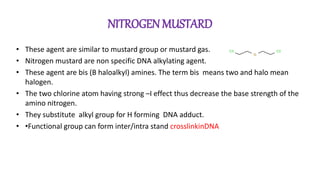
• These agent are similar to mustard group or mustard gas.
• Nitrogen mustard are non specific DNA alkylating agent.
• These agent are bis (B haloalkyl) amines. The term bis means two and halo mean
halogen.
• The two chlorine atom having strong –I effect thus decrease the base strength of the
amino nitrogen.
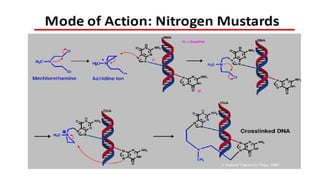
• They substitute alkyl group for H forming DNA adduct.
• •Functional group can form inter/intra stand crosslinkinDNA
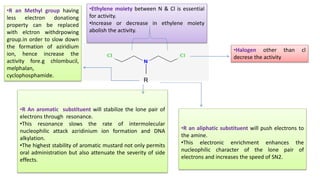
•R an aliphatic substituent will push electrons to
the amine.
•This electronic enrichment enhances the
nucleophilic character of the lone pair of
electrons and increases the speed of SN2.
•R An aromatic substituent will stabilize the lone pair of
electrons through resonance.
•This resonance slows the rate of intermolecular
nucleophilic attack azridinium ion formation and DNA
alkylation.
•The highest stability of aromatic mustard not only permits
oral administration but also attenuate the severity of side
effects.
•Ethylene moiety between N & Cl is essential
for activity.
•Increase or decrease in ethylene moiety
abolish the activity.
R
•Halogen other than cl
decrese the activity
•R an Methyl group having
less electron donationg
property can be replaced
with elctron withdrpowing
group.in order to slow down
the formation of aziridium
ion, hence increase the
activity fore.g chlombucil,
melphalan,
cyclophosphamide.
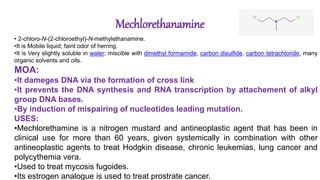
Mechlorethanamine
• 2-chloro-N-(2-chloroethyl)-N-methylethanamine.
•It is Mobile liquid; faint odor of herring.
•It is Very slightly soluble in water; miscible with dimethyl formamide, carbon disulfide, carbon tetrachloride, many
organic solvents and oils.
MOA:
•It dameges DNA via the formation of cross link
•It prevents the DNA synthesis and RNA transcription by attachement of alkyl
group DNA bases.
•By induction of mispairing of nucleotides leading mutation.
USES:
•Mechlorethamine is a nitrogen mustard and antineoplastic agent that has been in
clinical use for more than 60 years, given systemically in combination with other
antineoplastic agents to treat Hodgkin disease, chronic leukemias, lung cancer and
polycythemia vera.
•Used to treat mycosis fugoides.
•Its estrogen analogue is used to treat prostrate cancer.
CYCLOPHOSPHAMIDES
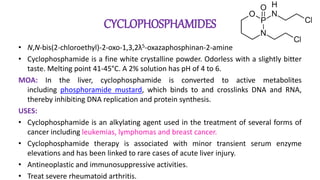
• N,N-bis(2-chloroethyl)-2-oxo-1,3,2λ5-oxazaphosphinan-2-amine
• Cyclophosphamide is a fine white crystalline powder. Odorless with a slightly bitter
taste. Melting point 41-45°C. A 2% solution has pH of 4 to 6.
MOA: In the liver, cyclophosphamide is converted to active metabolites
including phosphoramide mustard, which binds to and crosslinks DNA and RNA,
thereby inhibiting DNA replication and protein synthesis.
USES:
• Cyclophosphamide is an alkylating agent used in the treatment of several forms of
cancer including leukemias, lymphomas and breast cancer.
• Cyclophosphamide therapy is associated with minor transient serum enzyme
elevations and has been linked to rare cases of acute liver injury.
• Antineoplastic and immunosuppressive activities.
• Treat severe rheumatoid arthritis.
melphalan
• Melphalan appears as white to buff-colored powder. Odorless or with a faint odor.
An antineoplastic medicine.
MOA:
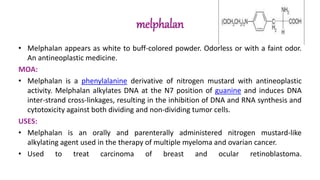
• Melphalan is a phenylalanine derivative of nitrogen mustard with antineoplastic
activity. Melphalan alkylates DNA at the N7 position of guanine and induces DNA
inter-strand cross-linkages, resulting in the inhibition of DNA and RNA synthesis and
cytotoxicity against both dividing and non-dividing tumor cells.
USES:
• Melphalan is an orally and parenterally administered nitrogen mustard-like
alkylating agent used in the therapy of multiple myeloma and ovarian cancer.
• Used to treat carcinoma of breast and ocular retinoblastoma.
chlorombucil
• 4-[4-[bis(2-chloroethyl)amino]phenyl]butanoic acid
• Chlorambucil appears as white to pale beige crystalline or granular powder with a
slight odor. Melting point 65-69°C.
• Insoluble in water .The sodium salt is soluble in water.
MOA:
• Chlorambucil is an orally-active antineoplastic aromatic nitrogen mustard.
Chlorambucil alkylates and cross-links DNA during all phases of the cell cycle,
resulting in disruption of DNA function, cell cycle arrest, and apoptosis.
USES
• the treatment of chronic lymphocytic leukemia. It has a role as an alkylating agent, a
carcinogenic agent, an antineoplastic agent, an immunosuppressive agent and a
drug allergen.Hodgkin and non-Hodgkin lymphomas, and rarely in severe
autoimmune conditions including rheumatoid arthritis, uveitis and nephrotic
syndrome
NITROSOUREAS ( carmustine)
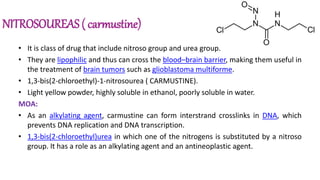
• It is class of drug that include nitroso group and urea group.
• They are lipophilic and thus can cross the blood–brain barrier, making them useful in
the treatment of brain tumors such as glioblastoma multiforme.
• 1,3-bis(2-chloroethyl)-1-nitrosourea ( CARMUSTINE).
• Light yellow powder, highly soluble in ethanol, poorly soluble in water.
MOA:
• As an alkylating agent, carmustine can form interstrand crosslinks in DNA, which
prevents DNA replication and DNA transcription.
• 1,3-bis(2-chloroethyl)urea in which one of the nitrogens is substituted by a nitroso
group. It has a role as an alkylating agent and an antineoplastic agent.
USES Carmustine
• Carmustine is used as an alkylating agent to treat several types of brain
cancer including medulloblastoma and multiple myeloma,
and lymphoma (Hodgkin's and non-Hodgkin).
• It is also used as part of a chemotherapeutic protocol in preparation for
hematological stem cell transplantation, a type of bone marrow transplant, in order
to reduce the white blood cell count in the recipient.

Anti Neoplastic Agent.ppt

  • 1.
    Antineoplastic agent MEDICINAL CHEMISTRY By Miss.Wagh hrutuja ASSISTANT PROFESSOR Lokmanya tilak institute of pharmaceutical sciences
  • 4.
  • 6.
    NITROGEN MUSTARD • Theseagent are similar to mustard group or mustard gas. • Nitrogen mustard are non specific DNA alkylating agent. • These agent are bis (B haloalkyl) amines. The term bis means two and halo mean halogen. • The two chlorine atom having strong –I effect thus decrease the base strength of the amino nitrogen. • They substitute alkyl group for H forming DNA adduct. • •Functional group can form inter/intra stand crosslinkinDNA
  • 7.
    •R an aliphaticsubstituent will push electrons to the amine. •This electronic enrichment enhances the nucleophilic character of the lone pair of electrons and increases the speed of SN2. •R An aromatic substituent will stabilize the lone pair of electrons through resonance. •This resonance slows the rate of intermolecular nucleophilic attack azridinium ion formation and DNA alkylation. •The highest stability of aromatic mustard not only permits oral administration but also attenuate the severity of side effects. •Ethylene moiety between N & Cl is essential for activity. •Increase or decrease in ethylene moiety abolish the activity. R •Halogen other than cl decrese the activity •R an Methyl group having less electron donationg property can be replaced with elctron withdrpowing group.in order to slow down the formation of aziridium ion, hence increase the activity fore.g chlombucil, melphalan, cyclophosphamide.
  • 8.
    Mechlorethanamine • 2-chloro-N-(2-chloroethyl)-N-methylethanamine. •It isMobile liquid; faint odor of herring. •It is Very slightly soluble in water; miscible with dimethyl formamide, carbon disulfide, carbon tetrachloride, many organic solvents and oils. MOA: •It dameges DNA via the formation of cross link •It prevents the DNA synthesis and RNA transcription by attachement of alkyl group DNA bases. •By induction of mispairing of nucleotides leading mutation. USES: •Mechlorethamine is a nitrogen mustard and antineoplastic agent that has been in clinical use for more than 60 years, given systemically in combination with other antineoplastic agents to treat Hodgkin disease, chronic leukemias, lung cancer and polycythemia vera. •Used to treat mycosis fugoides. •Its estrogen analogue is used to treat prostrate cancer.
  • 10.
    CYCLOPHOSPHAMIDES • N,N-bis(2-chloroethyl)-2-oxo-1,3,2λ5-oxazaphosphinan-2-amine • Cyclophosphamideis a fine white crystalline powder. Odorless with a slightly bitter taste. Melting point 41-45°C. A 2% solution has pH of 4 to 6. MOA: In the liver, cyclophosphamide is converted to active metabolites including phosphoramide mustard, which binds to and crosslinks DNA and RNA, thereby inhibiting DNA replication and protein synthesis. USES: • Cyclophosphamide is an alkylating agent used in the treatment of several forms of cancer including leukemias, lymphomas and breast cancer. • Cyclophosphamide therapy is associated with minor transient serum enzyme elevations and has been linked to rare cases of acute liver injury. • Antineoplastic and immunosuppressive activities. • Treat severe rheumatoid arthritis.
  • 11.
    melphalan • Melphalan appearsas white to buff-colored powder. Odorless or with a faint odor. An antineoplastic medicine. MOA: • Melphalan is a phenylalanine derivative of nitrogen mustard with antineoplastic activity. Melphalan alkylates DNA at the N7 position of guanine and induces DNA inter-strand cross-linkages, resulting in the inhibition of DNA and RNA synthesis and cytotoxicity against both dividing and non-dividing tumor cells. USES: • Melphalan is an orally and parenterally administered nitrogen mustard-like alkylating agent used in the therapy of multiple myeloma and ovarian cancer. • Used to treat carcinoma of breast and ocular retinoblastoma.
  • 12.
    chlorombucil • 4-[4-[bis(2-chloroethyl)amino]phenyl]butanoic acid •Chlorambucil appears as white to pale beige crystalline or granular powder with a slight odor. Melting point 65-69°C. • Insoluble in water .The sodium salt is soluble in water. MOA: • Chlorambucil is an orally-active antineoplastic aromatic nitrogen mustard. Chlorambucil alkylates and cross-links DNA during all phases of the cell cycle, resulting in disruption of DNA function, cell cycle arrest, and apoptosis. USES • the treatment of chronic lymphocytic leukemia. It has a role as an alkylating agent, a carcinogenic agent, an antineoplastic agent, an immunosuppressive agent and a drug allergen.Hodgkin and non-Hodgkin lymphomas, and rarely in severe autoimmune conditions including rheumatoid arthritis, uveitis and nephrotic syndrome
  • 13.
    NITROSOUREAS ( carmustine) •It is class of drug that include nitroso group and urea group. • They are lipophilic and thus can cross the blood–brain barrier, making them useful in the treatment of brain tumors such as glioblastoma multiforme. • 1,3-bis(2-chloroethyl)-1-nitrosourea ( CARMUSTINE). • Light yellow powder, highly soluble in ethanol, poorly soluble in water. MOA: • As an alkylating agent, carmustine can form interstrand crosslinks in DNA, which prevents DNA replication and DNA transcription. • 1,3-bis(2-chloroethyl)urea in which one of the nitrogens is substituted by a nitroso group. It has a role as an alkylating agent and an antineoplastic agent.
  • 14.
    USES Carmustine • Carmustineis used as an alkylating agent to treat several types of brain cancer including medulloblastoma and multiple myeloma, and lymphoma (Hodgkin's and non-Hodgkin). • It is also used as part of a chemotherapeutic protocol in preparation for hematological stem cell transplantation, a type of bone marrow transplant, in order to reduce the white blood cell count in the recipient.