PROTOCOL OF USE
FORVANCOMYCIN
Dr.AHLAM SUNDUS
Vancomycin
Vancomycin is an antibacterial used in the treatment of serious Staphylococcal or other
Gram-positive infections when other drugs such as the Penicillins cannot be used because
of resistance or patient intolerance
Vancomycin can also be administered as a continuous infusion in patients with severe or
deep-seated infections (e.g. Pneumonia, Endocarditis, Bone and Joint Infections)
Vancomycin works most effectively when the levels of the drug remain above the
minimum inhibitory concentration (MIC) for the target organism at all times. Trough
levels of vancomycin therefore require to be monitored throughout treatment and these
should be 10-15mg/L in standard infections
Caution
■ Use with caution in patients withTeicoplanin sensitivity due to possibility of cross sensitivity
■ Concurrent administration of neurotoxic and / or nephrotoxic agents increases the risk of
vancomycin toxicity
■ Review therapy and consider amending or withholding nephrotoxic drugs during treatment
with vancomycin
■ Where possible, avoid co-administration with:
 Gentamicin (aminoglycosides)  NSAIDs
 Amphotericin  ACE inhibitors.
 Potent Diuretics
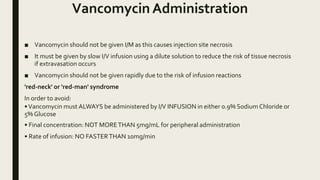
Vancomycin Administration
■ Vancomycin should not be given I/M as this causes injection site necrosis
■ It must be given by slow I/V infusion using a dilute solution to reduce the risk of tissue necrosis
if extravasation occurs
■ Vancomycin should not be given rapidly due to the risk of infusion reactions
'red-neck' or 'red-man' syndrome
In order to avoid:
•Vancomycin must ALWAYS be administered by I/V INFUSION in either 0.9% Sodium Chloride or
5% Glucose
• Final concentration: NOT MORETHAN 5mg/mL for peripheral administration
• Rate of infusion: NO FASTERTHAN 10mg/min
Dose Calculations
■ Calculate loading dose and maintenance dose based on creatinine clearance (CrCl)
using online calculator
■ If CrCl is not known use actual body weight for calculating initial loading dose.
Calculate maintenance dose after calculatingCrCl
‘Cockcroft Gault’ equation can be used to estimate creatinine clearance (CrCl)
CrCl = [140-age (years)] x weight(kg) x 1.23 (male) or 1.04(female)
(mL/min) serum creatinine(μmol / L)
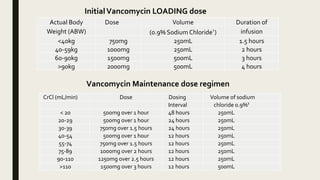
Actual Body Dose Volume Duration of
Weight (ABW) (0.9% Sodium Chloride†) infusion
<40kg 750mg 250mL 1.5 hours
40-59kg 1000mg 250mL 2 hours
60-90kg 1500mg 500mL 3 hours
>90kg 2000mg 500mL 4 hours
InitialVancomycin LOADING dose
CrCl (mL/min) Dose Dosing Volume of sodium
Interval chloride 0.9%‡
< 20 500mg over 1 hour 48 hours 250mL
20-29 500mg over 1 hour 24 hours 250mL
30-39 750mg over 1.5 hours 24 hours 250mL
40-54 500mg over 1 hour 12 hours 250mL
55-74 750mg over 1.5 hours 12 hours 250mL
75-89 1000mg over 2 hours 12 hours 250mL
90-110 1250mg over 2.5 hours 12 hours 250mL
>110 1500mg over 3 hours 12 hours 500mL
Vancomycin Maintenance dose regimen
Monitoring
■ Monitor creatinine daily.
■ Seek advice if renal function is unstable (e.g. a change in creatinine of > 15-20%)
■ Signs of renal toxicity include increase in creatinine or decrease in urine output /
oliguria.
■ Consider an alternative agent if creatinine is rising or the patient becomes oliguric.
■ Vancomycin may increase the risk of aminoglycoside induced ototoxicity – use
caution if co-prescribing.
THANK YOU

Protocol of use for vancomycin

  • 1.
  • 2.
    Vancomycin Vancomycin is anantibacterial used in the treatment of serious Staphylococcal or other Gram-positive infections when other drugs such as the Penicillins cannot be used because of resistance or patient intolerance Vancomycin can also be administered as a continuous infusion in patients with severe or deep-seated infections (e.g. Pneumonia, Endocarditis, Bone and Joint Infections) Vancomycin works most effectively when the levels of the drug remain above the minimum inhibitory concentration (MIC) for the target organism at all times. Trough levels of vancomycin therefore require to be monitored throughout treatment and these should be 10-15mg/L in standard infections
  • 3.
    Caution ■ Use withcaution in patients withTeicoplanin sensitivity due to possibility of cross sensitivity ■ Concurrent administration of neurotoxic and / or nephrotoxic agents increases the risk of vancomycin toxicity ■ Review therapy and consider amending or withholding nephrotoxic drugs during treatment with vancomycin ■ Where possible, avoid co-administration with:  Gentamicin (aminoglycosides)  NSAIDs  Amphotericin  ACE inhibitors.  Potent Diuretics
  • 4.
    Vancomycin Administration ■ Vancomycinshould not be given I/M as this causes injection site necrosis ■ It must be given by slow I/V infusion using a dilute solution to reduce the risk of tissue necrosis if extravasation occurs ■ Vancomycin should not be given rapidly due to the risk of infusion reactions 'red-neck' or 'red-man' syndrome In order to avoid: •Vancomycin must ALWAYS be administered by I/V INFUSION in either 0.9% Sodium Chloride or 5% Glucose • Final concentration: NOT MORETHAN 5mg/mL for peripheral administration • Rate of infusion: NO FASTERTHAN 10mg/min
  • 5.
    Dose Calculations ■ Calculateloading dose and maintenance dose based on creatinine clearance (CrCl) using online calculator ■ If CrCl is not known use actual body weight for calculating initial loading dose. Calculate maintenance dose after calculatingCrCl ‘Cockcroft Gault’ equation can be used to estimate creatinine clearance (CrCl) CrCl = [140-age (years)] x weight(kg) x 1.23 (male) or 1.04(female) (mL/min) serum creatinine(μmol / L)
  • 6.
    Actual Body DoseVolume Duration of Weight (ABW) (0.9% Sodium Chloride†) infusion <40kg 750mg 250mL 1.5 hours 40-59kg 1000mg 250mL 2 hours 60-90kg 1500mg 500mL 3 hours >90kg 2000mg 500mL 4 hours InitialVancomycin LOADING dose CrCl (mL/min) Dose Dosing Volume of sodium Interval chloride 0.9%‡ < 20 500mg over 1 hour 48 hours 250mL 20-29 500mg over 1 hour 24 hours 250mL 30-39 750mg over 1.5 hours 24 hours 250mL 40-54 500mg over 1 hour 12 hours 250mL 55-74 750mg over 1.5 hours 12 hours 250mL 75-89 1000mg over 2 hours 12 hours 250mL 90-110 1250mg over 2.5 hours 12 hours 250mL >110 1500mg over 3 hours 12 hours 500mL Vancomycin Maintenance dose regimen
  • 7.
    Monitoring ■ Monitor creatininedaily. ■ Seek advice if renal function is unstable (e.g. a change in creatinine of > 15-20%) ■ Signs of renal toxicity include increase in creatinine or decrease in urine output / oliguria. ■ Consider an alternative agent if creatinine is rising or the patient becomes oliguric. ■ Vancomycin may increase the risk of aminoglycoside induced ototoxicity – use caution if co-prescribing.
  • 8.