DERMATOLOGICAL DISEASES
DR. AHLAM SUNDUS
Sarcoptes scabiei hominis
Burrows into the upper layer of the skin - the stratum corneum
Eggs and mite proteins produce an allergic reaction  itch and
rash
Skin-to-skin contact
Incubation period (without previous exposure); 2-6 weeks
Previously infested; 1-5 days
SCABIES
Symptoms
Itch, which usually develops within 2 to 6 weeks after infestation.
The itch is generalized, very intense and intractable.
The itch is worst at night.
History of itch among family members within the same period
CLINICAL MANIFESTATION
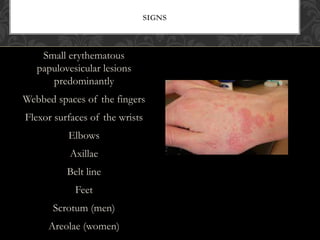
Small erythematous
papulovesicular lesions
predominantly
Webbed spaces of the fingers
Flexor surfaces of the wrists
Elbows
Axillae
Belt line
Feet
Scrotum (men)
Areolae (women)
SIGNS
Permethrin (scabiderm®)
25% Benzyl benzoate (SP-Lotion®)
10% Crotamiton (Scabion®, Crotan®)
Malathion (Ovide®)
10% Sulfur Ointment (Seproderm®, Scabion®)
TREATMENT OPTIONS
Pruritus can persist even after treatment
Crotamiton and antihistamines
Secondary application of Permethrin (at least 7 days after primary
application)
All close person should be treated
Take shower daily
Change bed sheets daily
Use disinfectants while washing bed sheets
Complex
Chronic
Multifactorial
Inflammatory disease
involves an increase in the epidermal cell turnover rate
PSORIASIS
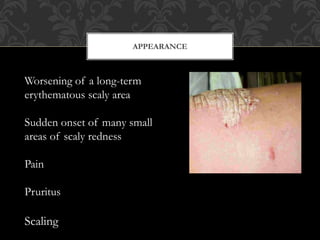
APPEARANCE
Worsening of a long-term
erythematous scaly area
Sudden onset of many small
areas of scaly redness
Pain
Pruritus
Scaling
Plaque psoriasis is characterized by raised, inflamed lesions
covered with a silvery white scale. The scale may be scraped away
to reveal inflamed skin beneath. This is most common on the
extensor surfaces of the knees, elbows, scalp, and trunk.
TYPES
Guttate psoriasis (Latin word meaning Drop) presents
as small salmon-pink papules, 1-10 mm in diameter,
predominately on the trunk; the lesions may be scaly. It
frequently appears suddenly, 2-3 weeks after an upper
respiratory infection
Pustular psoriasis appears as clearly defined, raised
bumps that are filled with a white, thick fluid
composed of white blood cells. Commonly found on
the palms and soles or diffusely over the body.
Pustular psoriasis may cycle through erythema,
pustules, then scaling.
Topical and systemic medication, phototherapy, stress reduction
Various adjuncts such as sunshine, moisturizers, salicylic acid, and
other keratolytics such as urea
Methotrexate (Pharmatrexate®)
Cyclosporine (Sandimmun®)
TREATMENT
Daily sun exposure, sea bathing, topical moisturizers, and
relaxation.
Moisturizers, such as petroleum jelly, are helpful
Nonprescription tar preparation
Salicylic acid, phenolic compounds, and Calcipotriene (a vitamin
D analog)
Combination therapy with a vitamin D analog (calcipotriol and
calcipotriene) or a retinoid such as tazarotene and a topical
corticosteroid is more effective than therapy with either agent
alone
TREATMENT OF SKIN LESIONS
Psoralen is a photosensitizer that is ingested prior to light
exposure.
Patients with psoriasis should avoid injury to skin, including
sunburn and other physical trauma, as these areas may develop
psoriasis
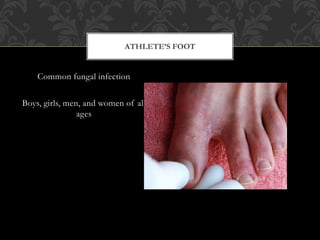
Common fungal infection
Boys, girls, men, and women of all
ages
ATHLETE’S FOOT
scaly red rash
Itching is often the worst right after you take off your shoes and
socks
Some types of athlete's foot feature blisters or ulcers
variety of athlete's foot causes chronic dryness and scaling on the
soles
SIGNS AND SYMPTOMS
Tinea pedis
Damp socks and shoes and warm, humid conditions favor the organisms'
growth
Athlete's foot is contagious and can be spread by contact with an infected
person or from contact with contaminated surfaces, such as towels, floors and
shoes.
CAUSE
Spread to other parts of your body, including:
Your hand. People who scratch or pick at the infected parts of
their feet may develop a similar infection in one of their hands.
Your nails. The fungi associated with athlete's foot can also
infect your toenails, a location that tends to be more resistant to
treatment.
Your groin. Jock itch is often caused by the same fungus that
results in athlete's foot. It's common for the infection to spread
from the feet to the groin as the fungus can travel on your hands
or on a towel.
COMPLICATIONS
Keep your feet dry, especially between your toes. Go barefoot to let your
feet air out as much as possible when you're home. Dry between your toes
after a bath or shower.
Change socks regularly. If your feet get very sweaty, change your socks
twice a day.
Wear light, well-ventilated shoes. Avoid shoes made of synthetic material,
such as vinyl or rubber.
Alternate pairs of shoes. Don't wear the same pair every day so that you
give your shoes time to dry after each use.
Protect your feet in public places. Wear waterproof sandals or shoes
around public pools, showers and lockers rooms.
Treat your feet. Use powder, preferably antifungal, on your feet daily.
Don't share shoes. Sharing risks spreading a fungal infection.
PREVENTION
over-the-counter antifungal ointment, lotion, powder or spray
Benzoic acid + salicylic acid (whitfield’s ointment®)
Imidazole (greater efficacy) Canesten®, Daktarin®
Terbinafine®
Imidazole + hydrocortisone (not for more than 7 days) Daktacort®
TREATMENT
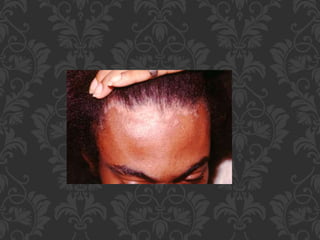
Rough, scaly skin on the scalp and face
Cradle cap
Dandruff
Symptoms similar to psoriasis but scales are thin
Patches of SD may look greasy
SEBORRHEIC DERMATITIS
OTC
Tar containg products (Dithrocil®)
Selenium sulphide (Selsun® shampoo)
Zinc pyrithione
Ketoconazole (better tolerated than selenium) (Nizoral® scalp gel)
Example:
FONGITAR (STIEFEL LAB.)
Coal tar 1%, Zn pyrithione 1%, Juniper Tar 0.3%, Arachis Oil 0.3%
TREATMENT

Dermatological Diseases

  • 1.
  • 2.
    Sarcoptes scabiei hominis Burrowsinto the upper layer of the skin - the stratum corneum Eggs and mite proteins produce an allergic reaction  itch and rash Skin-to-skin contact Incubation period (without previous exposure); 2-6 weeks Previously infested; 1-5 days SCABIES
  • 3.
    Symptoms Itch, which usuallydevelops within 2 to 6 weeks after infestation. The itch is generalized, very intense and intractable. The itch is worst at night. History of itch among family members within the same period CLINICAL MANIFESTATION
  • 4.
    Small erythematous papulovesicular lesions predominantly Webbedspaces of the fingers Flexor surfaces of the wrists Elbows Axillae Belt line Feet Scrotum (men) Areolae (women) SIGNS
  • 5.
    Permethrin (scabiderm®) 25% Benzylbenzoate (SP-Lotion®) 10% Crotamiton (Scabion®, Crotan®) Malathion (Ovide®) 10% Sulfur Ointment (Seproderm®, Scabion®) TREATMENT OPTIONS
  • 6.
    Pruritus can persisteven after treatment Crotamiton and antihistamines Secondary application of Permethrin (at least 7 days after primary application) All close person should be treated Take shower daily Change bed sheets daily Use disinfectants while washing bed sheets
  • 7.
    Complex Chronic Multifactorial Inflammatory disease involves anincrease in the epidermal cell turnover rate PSORIASIS
  • 8.
    APPEARANCE Worsening of along-term erythematous scaly area Sudden onset of many small areas of scaly redness Pain Pruritus Scaling
  • 9.
    Plaque psoriasis ischaracterized by raised, inflamed lesions covered with a silvery white scale. The scale may be scraped away to reveal inflamed skin beneath. This is most common on the extensor surfaces of the knees, elbows, scalp, and trunk. TYPES
  • 10.
    Guttate psoriasis (Latinword meaning Drop) presents as small salmon-pink papules, 1-10 mm in diameter, predominately on the trunk; the lesions may be scaly. It frequently appears suddenly, 2-3 weeks after an upper respiratory infection
  • 11.
    Pustular psoriasis appearsas clearly defined, raised bumps that are filled with a white, thick fluid composed of white blood cells. Commonly found on the palms and soles or diffusely over the body. Pustular psoriasis may cycle through erythema, pustules, then scaling.
  • 12.
    Topical and systemicmedication, phototherapy, stress reduction Various adjuncts such as sunshine, moisturizers, salicylic acid, and other keratolytics such as urea Methotrexate (Pharmatrexate®) Cyclosporine (Sandimmun®) TREATMENT
  • 13.
    Daily sun exposure,sea bathing, topical moisturizers, and relaxation. Moisturizers, such as petroleum jelly, are helpful Nonprescription tar preparation Salicylic acid, phenolic compounds, and Calcipotriene (a vitamin D analog) Combination therapy with a vitamin D analog (calcipotriol and calcipotriene) or a retinoid such as tazarotene and a topical corticosteroid is more effective than therapy with either agent alone TREATMENT OF SKIN LESIONS
  • 14.
    Psoralen is aphotosensitizer that is ingested prior to light exposure. Patients with psoriasis should avoid injury to skin, including sunburn and other physical trauma, as these areas may develop psoriasis
  • 15.
    Common fungal infection Boys,girls, men, and women of all ages ATHLETE’S FOOT
  • 16.
    scaly red rash Itchingis often the worst right after you take off your shoes and socks Some types of athlete's foot feature blisters or ulcers variety of athlete's foot causes chronic dryness and scaling on the soles SIGNS AND SYMPTOMS
  • 17.
    Tinea pedis Damp socksand shoes and warm, humid conditions favor the organisms' growth Athlete's foot is contagious and can be spread by contact with an infected person or from contact with contaminated surfaces, such as towels, floors and shoes. CAUSE
  • 18.
    Spread to otherparts of your body, including: Your hand. People who scratch or pick at the infected parts of their feet may develop a similar infection in one of their hands. Your nails. The fungi associated with athlete's foot can also infect your toenails, a location that tends to be more resistant to treatment. Your groin. Jock itch is often caused by the same fungus that results in athlete's foot. It's common for the infection to spread from the feet to the groin as the fungus can travel on your hands or on a towel. COMPLICATIONS
  • 19.
    Keep your feetdry, especially between your toes. Go barefoot to let your feet air out as much as possible when you're home. Dry between your toes after a bath or shower. Change socks regularly. If your feet get very sweaty, change your socks twice a day. Wear light, well-ventilated shoes. Avoid shoes made of synthetic material, such as vinyl or rubber. Alternate pairs of shoes. Don't wear the same pair every day so that you give your shoes time to dry after each use. Protect your feet in public places. Wear waterproof sandals or shoes around public pools, showers and lockers rooms. Treat your feet. Use powder, preferably antifungal, on your feet daily. Don't share shoes. Sharing risks spreading a fungal infection. PREVENTION
  • 20.
    over-the-counter antifungal ointment,lotion, powder or spray Benzoic acid + salicylic acid (whitfield’s ointment®) Imidazole (greater efficacy) Canesten®, Daktarin® Terbinafine® Imidazole + hydrocortisone (not for more than 7 days) Daktacort® TREATMENT
  • 21.
    Rough, scaly skinon the scalp and face Cradle cap Dandruff Symptoms similar to psoriasis but scales are thin Patches of SD may look greasy SEBORRHEIC DERMATITIS
  • 23.
    OTC Tar containg products(Dithrocil®) Selenium sulphide (Selsun® shampoo) Zinc pyrithione Ketoconazole (better tolerated than selenium) (Nizoral® scalp gel) Example: FONGITAR (STIEFEL LAB.) Coal tar 1%, Zn pyrithione 1%, Juniper Tar 0.3%, Arachis Oil 0.3% TREATMENT