Protocol of Use for
Cimetidine
DR. AHLAM SUNDUS
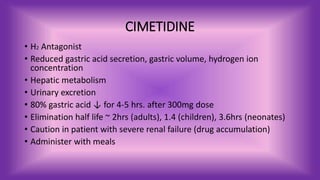
CIMETIDINE
• H2 Antagonist
• Reduced gastric acid secretion, gastric volume, hydrogen ion
concentration
• Hepatic metabolism
• Urinary excretion
• 80% gastric acid ↓ for 4-5 hrs. after 300mg dose
• Elimination half life ~ 2hrs (adults), 1.4 (children), 3.6hrs (neonates)
• Caution in patient with severe renal failure (drug accumulation)
• Administer with meals
Indications
• Short term treatment for active benign gastric and duodenal ulcers
• Gastroesophageal reflux disease
• Hypersecretory conditions (Zollinger-Ellison syndrome, systemic
mastocytosis, multiple endocrine adenomas)
• Heartburn (OTC only)
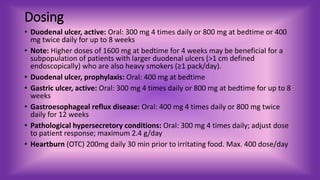
Dosing
• Duodenal ulcer, active: Oral: 300 mg 4 times daily or 800 mg at bedtime or 400
mg twice daily for up to 8 weeks
• Note: Higher doses of 1600 mg at bedtime for 4 weeks may be beneficial for a
subpopulation of patients with larger duodenal ulcers (>1 cm defined
endoscopically) who are also heavy smokers (≥1 pack/day).
• Duodenal ulcer, prophylaxis: Oral: 400 mg at bedtime
• Gastric ulcer, active: Oral: 300 mg 4 times daily or 800 mg at bedtime for up to 8
weeks
• Gastroesophageal reflux disease: Oral: 400 mg 4 times daily or 800 mg twice
daily for 12 weeks
• Pathological hypersecretory conditions: Oral: 300 mg 4 times daily; adjust dose
to patient response; maximum 2.4 g/day
• Heartburn (OTC) 200mg daily 30 min prior to irritating food. Max. 400 dose/day
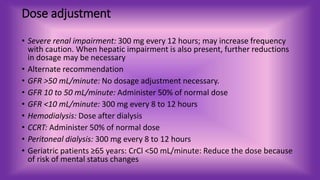
Dose adjustment
• Severe renal impairment: 300 mg every 12 hours; may increase frequency
with caution. When hepatic impairment is also present, further reductions
in dosage may be necessary
• Alternate recommendation
• GFR >50 mL/minute: No dosage adjustment necessary.
• GFR 10 to 50 mL/minute: Administer 50% of normal dose
• GFR <10 mL/minute: 300 mg every 8 to 12 hours
• Hemodialysis: Dose after dialysis
• CCRT: Administer 50% of normal dose
• Peritoneal dialysis: 300 mg every 8 to 12 hours
• Geriatric patients ≥65 years: CrCl <50 mL/minute: Reduce the dose because
of risk of mental status changes
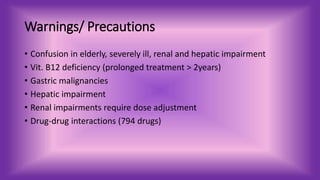
Warnings/ Precautions
• Confusion in elderly, severely ill, renal and hepatic impairment
• Vit. B12 deficiency (prolonged treatment > 2years)
• Gastric malignancies
• Hepatic impairment
• Renal impairments require dose adjustment
• Drug-drug interactions (794 drugs)
Monitoring parameters
• CBC
• Gastric pH
• Monitor renal function to correct dose
• Occult blood with GI bleeding
• Signs of confusion.
Patient education
Educate patient to report immediately to prescriber
• Signs of liver problems (dark urine, fatigue, lack of appetite, nausea, abdominal pain, light-
colored stools, vomiting, or jaundice)
• Signs of Pancreatitis (severe abdominal pain, severe back pain, severe nausea, or vomiting)
• Urinary Retention, Change in Amount of Urine Passed
• Tachycardia, Bradycardia, Abnormal Heartbeat
• Chest pain, Wheezing
• Confusion, Mood Changes, Hallucinations
• Enlarged Breasts (Males), or Sexual Dysfunction
THANK YOU

Protocol of use for cimetidine

  • 1.
    Protocol of Usefor Cimetidine DR. AHLAM SUNDUS
  • 2.
    CIMETIDINE • H2 Antagonist •Reduced gastric acid secretion, gastric volume, hydrogen ion concentration • Hepatic metabolism • Urinary excretion • 80% gastric acid ↓ for 4-5 hrs. after 300mg dose • Elimination half life ~ 2hrs (adults), 1.4 (children), 3.6hrs (neonates) • Caution in patient with severe renal failure (drug accumulation) • Administer with meals
  • 3.
    Indications • Short termtreatment for active benign gastric and duodenal ulcers • Gastroesophageal reflux disease • Hypersecretory conditions (Zollinger-Ellison syndrome, systemic mastocytosis, multiple endocrine adenomas) • Heartburn (OTC only)
  • 4.
    Dosing • Duodenal ulcer,active: Oral: 300 mg 4 times daily or 800 mg at bedtime or 400 mg twice daily for up to 8 weeks • Note: Higher doses of 1600 mg at bedtime for 4 weeks may be beneficial for a subpopulation of patients with larger duodenal ulcers (>1 cm defined endoscopically) who are also heavy smokers (≥1 pack/day). • Duodenal ulcer, prophylaxis: Oral: 400 mg at bedtime • Gastric ulcer, active: Oral: 300 mg 4 times daily or 800 mg at bedtime for up to 8 weeks • Gastroesophageal reflux disease: Oral: 400 mg 4 times daily or 800 mg twice daily for 12 weeks • Pathological hypersecretory conditions: Oral: 300 mg 4 times daily; adjust dose to patient response; maximum 2.4 g/day • Heartburn (OTC) 200mg daily 30 min prior to irritating food. Max. 400 dose/day
  • 5.
    Dose adjustment • Severerenal impairment: 300 mg every 12 hours; may increase frequency with caution. When hepatic impairment is also present, further reductions in dosage may be necessary • Alternate recommendation • GFR >50 mL/minute: No dosage adjustment necessary. • GFR 10 to 50 mL/minute: Administer 50% of normal dose • GFR <10 mL/minute: 300 mg every 8 to 12 hours • Hemodialysis: Dose after dialysis • CCRT: Administer 50% of normal dose • Peritoneal dialysis: 300 mg every 8 to 12 hours • Geriatric patients ≥65 years: CrCl <50 mL/minute: Reduce the dose because of risk of mental status changes
  • 6.
    Warnings/ Precautions • Confusionin elderly, severely ill, renal and hepatic impairment • Vit. B12 deficiency (prolonged treatment > 2years) • Gastric malignancies • Hepatic impairment • Renal impairments require dose adjustment • Drug-drug interactions (794 drugs)
  • 7.
    Monitoring parameters • CBC •Gastric pH • Monitor renal function to correct dose • Occult blood with GI bleeding • Signs of confusion.
  • 8.
    Patient education Educate patientto report immediately to prescriber • Signs of liver problems (dark urine, fatigue, lack of appetite, nausea, abdominal pain, light- colored stools, vomiting, or jaundice) • Signs of Pancreatitis (severe abdominal pain, severe back pain, severe nausea, or vomiting) • Urinary Retention, Change in Amount of Urine Passed • Tachycardia, Bradycardia, Abnormal Heartbeat • Chest pain, Wheezing • Confusion, Mood Changes, Hallucinations • Enlarged Breasts (Males), or Sexual Dysfunction
  • 9.