Application Paper
Ada Amaya
Lamar University
MSNC 5356 Clinical Approach to Advanced Pharmacology
Dr. Elizabeth Long
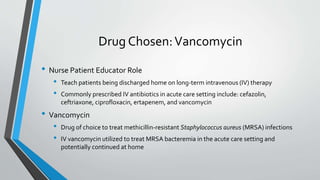
Drug Chosen:Vancomycin
• Nurse Patient Educator Role
• Teach patients being discharged home on long-term intravenous (IV) therapy
• Commonly prescribed IV antibiotics in acute care setting include: cefazolin,
ceftriaxone, ciprofloxacin, ertapenem, and vancomycin
• Vancomycin
• Drug of choice to treat methicillin-resistant Staphylococcus aureus (MRSA) infections
• IV vancomycin utilized to treat MRSA bacteremia in the acute care setting and
potentially continued at home
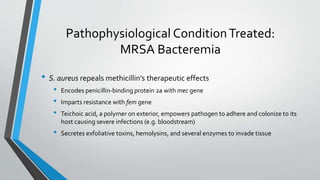
Pathophysiological ConditionTreated:
MRSA Bacteremia
• S. aureus repeals methicillin’s therapeutic effects
• Encodes penicillin-binding protein 2a with mec gene
• Imparts resistance with fem gene
• Teichoic acid, a polymer on exterior, empowers pathogen to adhere and colonize to its
host causing severe infections (e.g. bloodstream)
• Secretes exfoliative toxins, hemolysins, and several enzymes to invade tissue
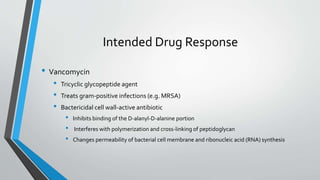
Intended Drug Response
• Vancomycin
• Tricyclic glycopeptide agent
• Treats gram-positive infections (e.g. MRSA)
• Bactericidal cell wall-active antibiotic
• Inhibits binding of the D-alanyl-D-alanine portion
• Interferes with polymerization and cross-linking of peptidoglycan
• Changes permeability of bacterial cell membrane and ribonucleic acid (RNA) synthesis
Potential Interactions
• Aminoglycosides
• Gentamicin, tobramycin, and amikacin
• Augment nephrotoxic effects
• Non-steroidal anti-inflammatory drugs
• Increase the serum concentration of vancomycin
• Neuromuscular blocking agents—extreme caution
• Rapacuronium and succinylcholine
• Cause neurotoxicity
Adverse Drug Reactions
• Cardiovascular system: severe hypotension and cardiac arrest
• Skin: drug-induced erythroderma or red man syndrome (characterized by
flushing of the face, neck, and upper torso); phlebitis
• Hematological (rare): neutropenia, thrombocytopenia, and eosinophilia
• Other: ototoxicity, nephrotoxicity, and interstitial nephritis
Side Effects
• Flu-like signs and symptoms
• Chills, fever, and sore throat
• Wheezing and chest tightness
• Rash, hives, and itching
• Painful urination and changes in hearing
Pharmacokinetics:Vancomycin
• Slow bactericidal and time-dependent antimicrobial killing agent
• Absorption: 60% intra-parenteral
• Peaks immediately after infusion completion
• Trough best drawn 30 minutes before the 4th dose
• Target trough 15 to 20 mg/L in complicated infections (e.g. MRSA bacteremia)
• Distribution: fairly well in the urine, skin, and soft tissues; poor penetration to deeper
tissues (e.g. lung and cerebrospinal fluid)
• 55% protein bound
• Volume of distribution: not available.
• Metabolism: no apparent action
• Excretion: occurs via kidney by glomerular filtration
• Within the first 24 hours, about 75% of the administered dose is excreted in urine
• Half-life: 4-6 hours; 7.5 days with end-stage renal disease
• Steady state: approximately occurs prior to fourth or fifth dose
Drug Binding Issues
• Literature is scarce
• Protein binding for vancomycin ~55%
• Mainly binds to albumin
• Albumin infusion
• Increases vancomycin binding
• Elevate serum concentration of drug
• Pharmacodynamic response is overstressed leading to toxic levels
Improving Communication
• Collaboration with pharmacist
• Presentation for new intern/resident doctors during orientation
• Pharmacist consult
• Vancomycin in-service
• Inform nursing staff during monthly meeting
• Plan with unit manager
• Bridge patient to the outpatient
• Referral to outpatient nurse case manager
• Lab and ID follow-up appointments
Application to the Practice Setting
• Therapeutic drug monitoring for agent vancomycin
• Nursing aware patients’ physiological alterations require higher doses of antibiotic
• Diligently monitor trough, creatinine levels, and intake/output
• Emergence of MRSA strains cause safety hazard as vancomycin’s dosing is adjusted to
effectively attack organisms at source of infection
• Inform patient of potential ADRs and side effects that may occur with vancomycin
• During administration, careful monitoring for previously mentioned ADRs and side effects is warranted
• Accurately drug monitor serum concentrations throughout therapy and stop the medication when levels are
toxic before permanent injury occurs
• ID consultation complete
• Review electronic medical record (e.g. ID recommendations, trough)
• Central line access for IV vancomycin administration
• Collaborate with clinical nurse case manager to ensure patient will have home health set-up to
reinforce teaching
• Emphasize importance of obtaining vancomycin trough at precise time
• Appointment at nearest Harris Health clinic for patient’s convenience
References
• Bloch, K. C. (2014). Infectious diseases. In G. D. Hammer & S. J. McPhee (Eds.), Pathophysiology of disease: An introduction to clinical medicine
(61-87). NewYork City, NY: McGraw-Hill Education
• Choo, E. J., & Chambers, H. F. (2016). Treatment of methicillin-resistant Staphylococcus aureus bacteremia. Infection & Chemotherapy.
Advance online publication. doi:10.3947/ic.2016.48.4.467
• Droege, M. E.,Van Fleet, S. L., & Mueller, E.W. (2016). Application of antibiotic pharmacodynamics and dosing principles in patients with
sepsis. Critical Care Nurse, 36(2), 22-32. doi:10.4037/ccn2016881
• Gelone, S. P., Pacetti, S.,O’Donnell, J. A. (2017). Principles of antimicrobial therapy. InV. Arcangelo, A. M. Peterson,V. Wilbur, & J. A. Reinhold
(Eds.), Pharmacotherapeutics for advanced practice: A practical approach (pp. 111-134). Philadelphia, PA:Wolters Kluwer
• Kang,T., & Peterson,A. M. (2017). Impact of drug interactions and adverse events on therapeutics. InV.Arcangelo, A. M. Peterson,V.Wilbur,
& J. A. Reinhold (Eds.), Pharmacotherapeutics for advanced practice: A practical approach (pp. 33-52). Philadelphia, PA:Wolters Kluwer
• Lim, H., Chong,Y. P., Noh,Y., Jung, J., & Kim,Y. S. (2014). Exploration of optimal dosing regimens of vancomycin in patients infected with
methicillin-resistant Staphylococcus aureus by modeling and simulation. Journal of Clinical Pharmacy &Therapeutics, 39(2), 196-203.
doi:10.1111/jcpt.12123
• Mercier, I., Peterson,A. M., & Issa, A. M. (2017). Pharmacogenomics. InV.Arcangelo, A. M. Peterson,V.Wilbur, & J. A. Reinhold (Eds.),
Pharmacotherapeutics for advanced practice: A practical approach (pp. 145-152). Philadelphia, PA:Wolters Kluwer
• Naber, C. K. (2009). Staphylococcus aureus bacteremia: Epidemiology, pathophysiology, and management strategies. Clinical Infectious
Diseases, 48(Suppl 4), S231-S237. doi:10.1086/598189
• Peterson, A. M. (2017). Pharmacokinetics basis of therapeutics and pharmacodynamic principles. InV.Arcangelo, A. M. Peterson,V.Wilbur, &
J. A. Reinhold (Eds.), Pharmacotherapeutics for advanced practice: A practical approach (pp. 17-31). Philadelphia, PA:Wolters Kluwer
• Rybak, M., Lomaestro, B., Rotschafer, J. C., Moellering, R., Craig,W., Billeter, M., . . . Levine, D. P. (2009).Therapeutic monitoring of
vancomycin in adult patients: A consensus review of the American society of health-system pharmacists, the infectious diseases society of
America, and the society of infectious diseases pharmacists. AmJ Health-Syst Pharm, 66, 82-98. doi: 10.2146/ajhp080434
• Schafer, J. J. & Foy, F. C. (2017). Bacterial infections of the skin. InV. Arcangelo, A. M. Peterson,V.Wilbur, & J. A. Reinhold (Eds.),
Pharmacotherapeutics for advanced practice: A practical approach (pp. 181-195). Philadelphia, PA:Wolters Kluwer
• Uribe, L. M. (2016).Vancomycin (vancocin). CINAHL Nursing Guide. Retrieved from
http://web.b.ebscohost.com/nup/pdfviewer/pdfviewer?vid=7&sid=1c651e2e-884a-402b-8287-3098d19ddfd6%40pdc-v-sessmgr01

Application Paper PP Presentation

  • 1.
    Application Paper Ada Amaya LamarUniversity MSNC 5356 Clinical Approach to Advanced Pharmacology Dr. Elizabeth Long
  • 2.
    Drug Chosen:Vancomycin • NursePatient Educator Role • Teach patients being discharged home on long-term intravenous (IV) therapy • Commonly prescribed IV antibiotics in acute care setting include: cefazolin, ceftriaxone, ciprofloxacin, ertapenem, and vancomycin • Vancomycin • Drug of choice to treat methicillin-resistant Staphylococcus aureus (MRSA) infections • IV vancomycin utilized to treat MRSA bacteremia in the acute care setting and potentially continued at home
  • 3.
    Pathophysiological ConditionTreated: MRSA Bacteremia •S. aureus repeals methicillin’s therapeutic effects • Encodes penicillin-binding protein 2a with mec gene • Imparts resistance with fem gene • Teichoic acid, a polymer on exterior, empowers pathogen to adhere and colonize to its host causing severe infections (e.g. bloodstream) • Secretes exfoliative toxins, hemolysins, and several enzymes to invade tissue
  • 4.
    Intended Drug Response •Vancomycin • Tricyclic glycopeptide agent • Treats gram-positive infections (e.g. MRSA) • Bactericidal cell wall-active antibiotic • Inhibits binding of the D-alanyl-D-alanine portion • Interferes with polymerization and cross-linking of peptidoglycan • Changes permeability of bacterial cell membrane and ribonucleic acid (RNA) synthesis
  • 5.
    Potential Interactions • Aminoglycosides •Gentamicin, tobramycin, and amikacin • Augment nephrotoxic effects • Non-steroidal anti-inflammatory drugs • Increase the serum concentration of vancomycin • Neuromuscular blocking agents—extreme caution • Rapacuronium and succinylcholine • Cause neurotoxicity
  • 6.
    Adverse Drug Reactions •Cardiovascular system: severe hypotension and cardiac arrest • Skin: drug-induced erythroderma or red man syndrome (characterized by flushing of the face, neck, and upper torso); phlebitis • Hematological (rare): neutropenia, thrombocytopenia, and eosinophilia • Other: ototoxicity, nephrotoxicity, and interstitial nephritis
  • 7.
    Side Effects • Flu-likesigns and symptoms • Chills, fever, and sore throat • Wheezing and chest tightness • Rash, hives, and itching • Painful urination and changes in hearing
  • 8.
    Pharmacokinetics:Vancomycin • Slow bactericidaland time-dependent antimicrobial killing agent • Absorption: 60% intra-parenteral • Peaks immediately after infusion completion • Trough best drawn 30 minutes before the 4th dose • Target trough 15 to 20 mg/L in complicated infections (e.g. MRSA bacteremia) • Distribution: fairly well in the urine, skin, and soft tissues; poor penetration to deeper tissues (e.g. lung and cerebrospinal fluid) • 55% protein bound • Volume of distribution: not available. • Metabolism: no apparent action • Excretion: occurs via kidney by glomerular filtration • Within the first 24 hours, about 75% of the administered dose is excreted in urine • Half-life: 4-6 hours; 7.5 days with end-stage renal disease • Steady state: approximately occurs prior to fourth or fifth dose
  • 9.
    Drug Binding Issues •Literature is scarce • Protein binding for vancomycin ~55% • Mainly binds to albumin • Albumin infusion • Increases vancomycin binding • Elevate serum concentration of drug • Pharmacodynamic response is overstressed leading to toxic levels
  • 10.
    Improving Communication • Collaborationwith pharmacist • Presentation for new intern/resident doctors during orientation • Pharmacist consult • Vancomycin in-service • Inform nursing staff during monthly meeting • Plan with unit manager • Bridge patient to the outpatient • Referral to outpatient nurse case manager • Lab and ID follow-up appointments
  • 11.
    Application to thePractice Setting • Therapeutic drug monitoring for agent vancomycin • Nursing aware patients’ physiological alterations require higher doses of antibiotic • Diligently monitor trough, creatinine levels, and intake/output • Emergence of MRSA strains cause safety hazard as vancomycin’s dosing is adjusted to effectively attack organisms at source of infection • Inform patient of potential ADRs and side effects that may occur with vancomycin • During administration, careful monitoring for previously mentioned ADRs and side effects is warranted • Accurately drug monitor serum concentrations throughout therapy and stop the medication when levels are toxic before permanent injury occurs • ID consultation complete • Review electronic medical record (e.g. ID recommendations, trough) • Central line access for IV vancomycin administration • Collaborate with clinical nurse case manager to ensure patient will have home health set-up to reinforce teaching • Emphasize importance of obtaining vancomycin trough at precise time • Appointment at nearest Harris Health clinic for patient’s convenience
  • 12.
    References • Bloch, K.C. (2014). Infectious diseases. In G. D. Hammer & S. J. McPhee (Eds.), Pathophysiology of disease: An introduction to clinical medicine (61-87). NewYork City, NY: McGraw-Hill Education • Choo, E. J., & Chambers, H. F. (2016). Treatment of methicillin-resistant Staphylococcus aureus bacteremia. Infection & Chemotherapy. Advance online publication. doi:10.3947/ic.2016.48.4.467 • Droege, M. E.,Van Fleet, S. L., & Mueller, E.W. (2016). Application of antibiotic pharmacodynamics and dosing principles in patients with sepsis. Critical Care Nurse, 36(2), 22-32. doi:10.4037/ccn2016881 • Gelone, S. P., Pacetti, S.,O’Donnell, J. A. (2017). Principles of antimicrobial therapy. InV. Arcangelo, A. M. Peterson,V. Wilbur, & J. A. Reinhold (Eds.), Pharmacotherapeutics for advanced practice: A practical approach (pp. 111-134). Philadelphia, PA:Wolters Kluwer • Kang,T., & Peterson,A. M. (2017). Impact of drug interactions and adverse events on therapeutics. InV.Arcangelo, A. M. Peterson,V.Wilbur, & J. A. Reinhold (Eds.), Pharmacotherapeutics for advanced practice: A practical approach (pp. 33-52). Philadelphia, PA:Wolters Kluwer • Lim, H., Chong,Y. P., Noh,Y., Jung, J., & Kim,Y. S. (2014). Exploration of optimal dosing regimens of vancomycin in patients infected with methicillin-resistant Staphylococcus aureus by modeling and simulation. Journal of Clinical Pharmacy &Therapeutics, 39(2), 196-203. doi:10.1111/jcpt.12123 • Mercier, I., Peterson,A. M., & Issa, A. M. (2017). Pharmacogenomics. InV.Arcangelo, A. M. Peterson,V.Wilbur, & J. A. Reinhold (Eds.), Pharmacotherapeutics for advanced practice: A practical approach (pp. 145-152). Philadelphia, PA:Wolters Kluwer • Naber, C. K. (2009). Staphylococcus aureus bacteremia: Epidemiology, pathophysiology, and management strategies. Clinical Infectious Diseases, 48(Suppl 4), S231-S237. doi:10.1086/598189 • Peterson, A. M. (2017). Pharmacokinetics basis of therapeutics and pharmacodynamic principles. InV.Arcangelo, A. M. Peterson,V.Wilbur, & J. A. Reinhold (Eds.), Pharmacotherapeutics for advanced practice: A practical approach (pp. 17-31). Philadelphia, PA:Wolters Kluwer • Rybak, M., Lomaestro, B., Rotschafer, J. C., Moellering, R., Craig,W., Billeter, M., . . . Levine, D. P. (2009).Therapeutic monitoring of vancomycin in adult patients: A consensus review of the American society of health-system pharmacists, the infectious diseases society of America, and the society of infectious diseases pharmacists. AmJ Health-Syst Pharm, 66, 82-98. doi: 10.2146/ajhp080434 • Schafer, J. J. & Foy, F. C. (2017). Bacterial infections of the skin. InV. Arcangelo, A. M. Peterson,V.Wilbur, & J. A. Reinhold (Eds.), Pharmacotherapeutics for advanced practice: A practical approach (pp. 181-195). Philadelphia, PA:Wolters Kluwer • Uribe, L. M. (2016).Vancomycin (vancocin). CINAHL Nursing Guide. Retrieved from http://web.b.ebscohost.com/nup/pdfviewer/pdfviewer?vid=7&sid=1c651e2e-884a-402b-8287-3098d19ddfd6%40pdc-v-sessmgr01