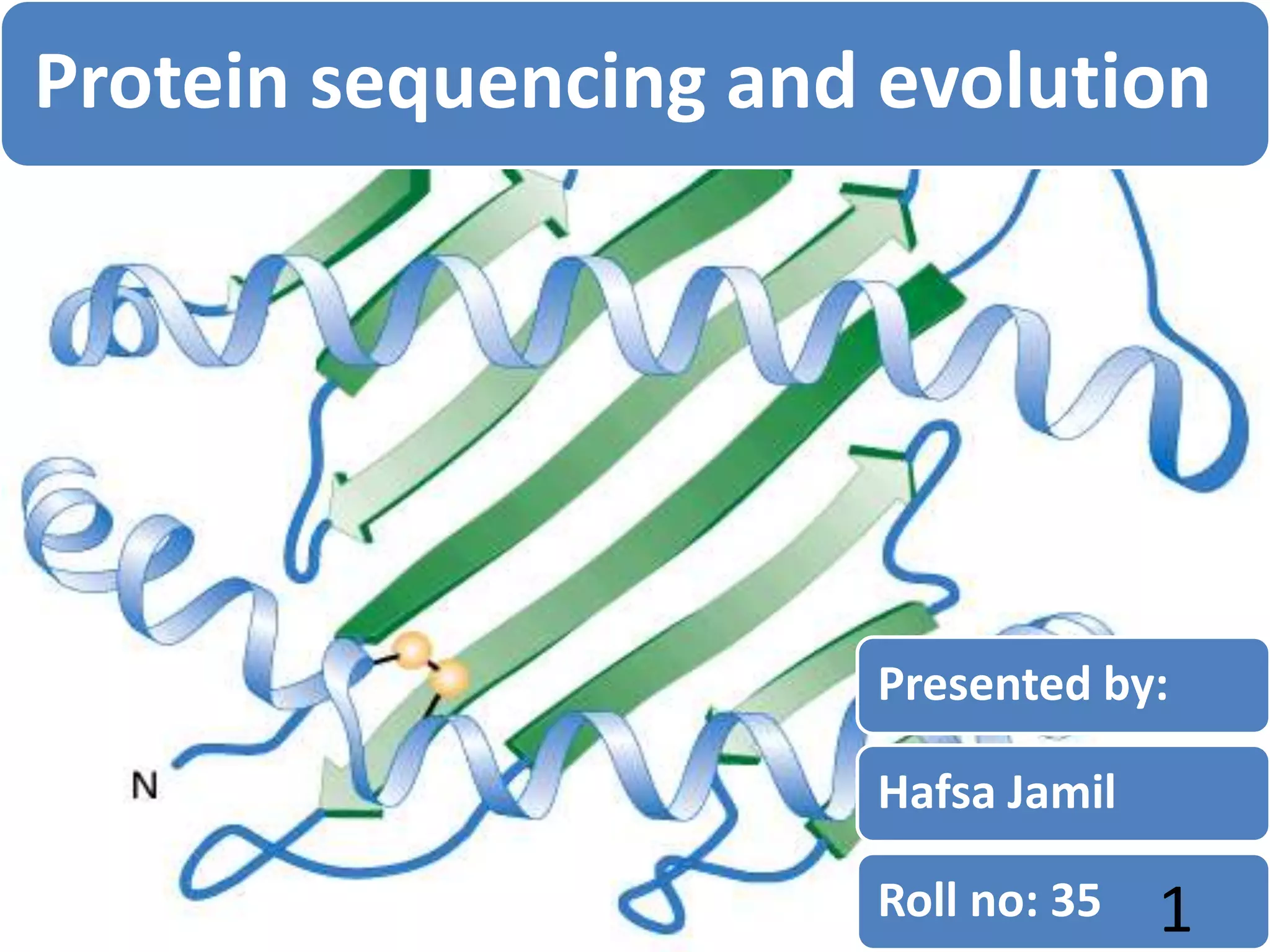
Protein sequencing and evolution
Presented by:
Hafsa Jamil
Roll no: 35 1
Table of content:
Introduction:
• Proteins
• Protein sequencing
First protein sequence
Methods of protein sequencing
N terminal sequencing:
• Sanger method
• Edman degradation method
C terminal sequencing
Prediction from DNA sequence
Protein sequencing and evolution
Conclusion
References
2
What are proteins?
Class of nitrogenous organic compounds which have large
molecules composed of one or more long chains of amino
acids and are an essential part of all living organisms
3
Protein
sequencing:
Protein sequencing is the
practical process of determining
the amino acid sequence of all
or part of a protein or peptide.
4
First sequence:
First protein
sequence was
achieved by Fredric
Sanger in 1953.
He determined the
amino acid sequence
of insulin.
5
Sequencing
methods:
N- Terminal
sequencing
C- terminal
sequencing
Prediction
from DNA
sequence
6
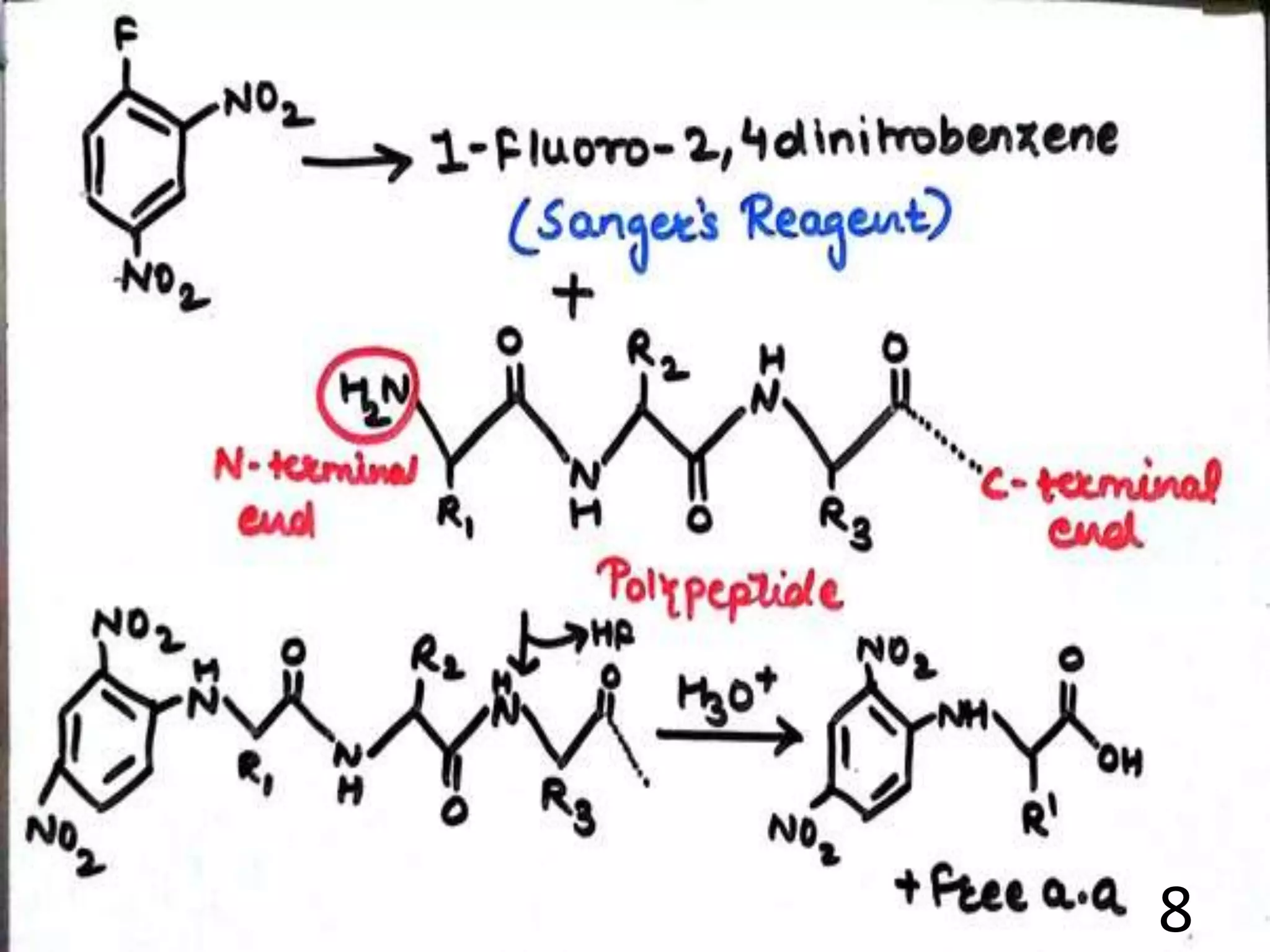
Sanger developed the reagent 1-fluoro-2,4-
dinitrobenzene (FDNB) to label and identify the amino-
terminal amino acid residue.
Other reagents used to label the amino-terminal
residue, dansyl chloride and dabsyl chloride
After the amino-terminal residue is labeled with one of
these reagents, the polypeptide is hydrolyzed to its
constituent amino acids and the labeled amino acid is
identified.
Sanger sequencing:
7
8
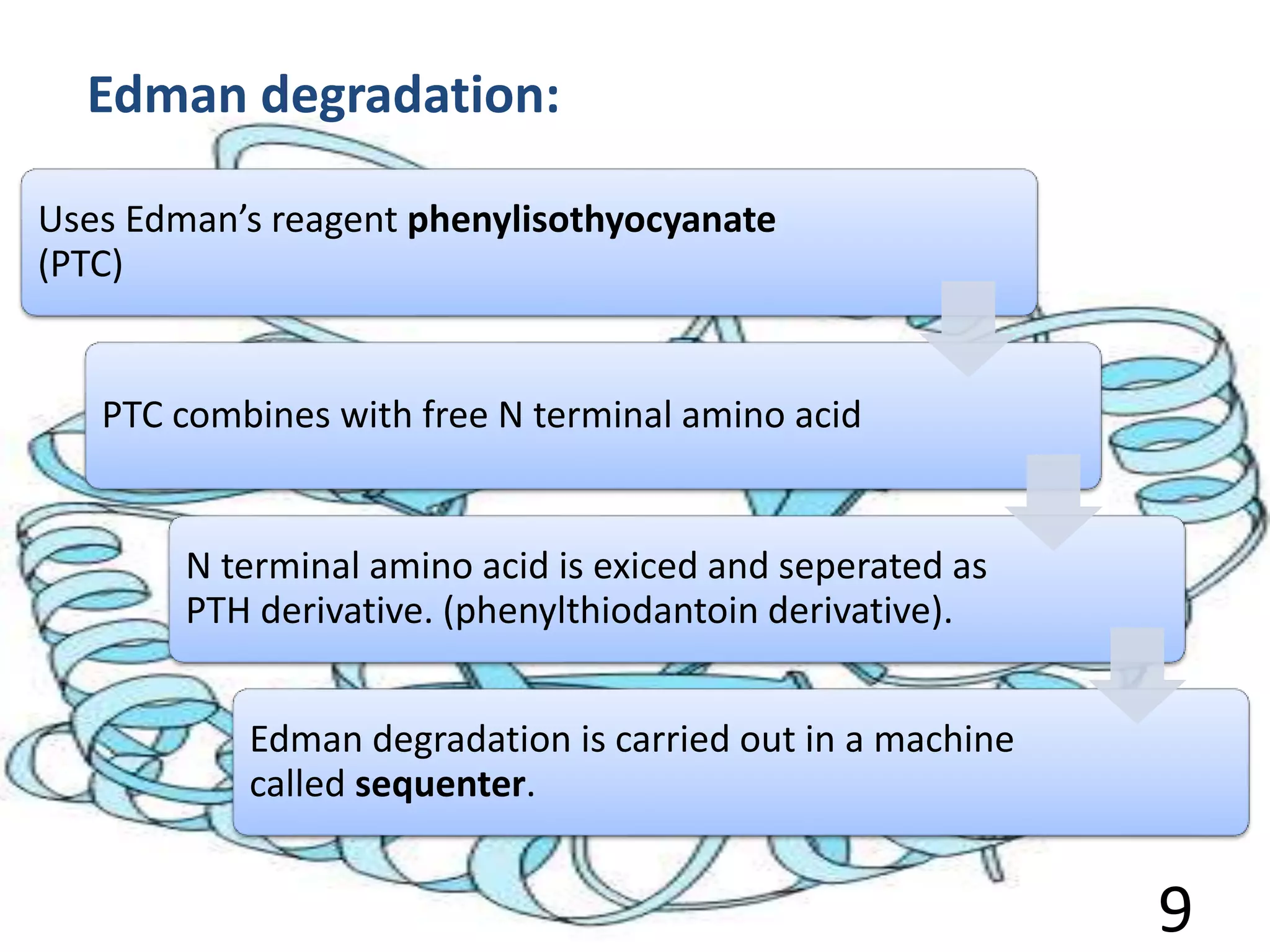
Uses Edman’s reagent phenylisothyocyanate
(PTC)
PTC combines with free N terminal amino acid
N terminal amino acid is exiced and seperated as
PTH derivative. (phenylthiodantoin derivative).
Edman degradation is carried out in a machine
called sequenter.
Edman degradation:
9
10
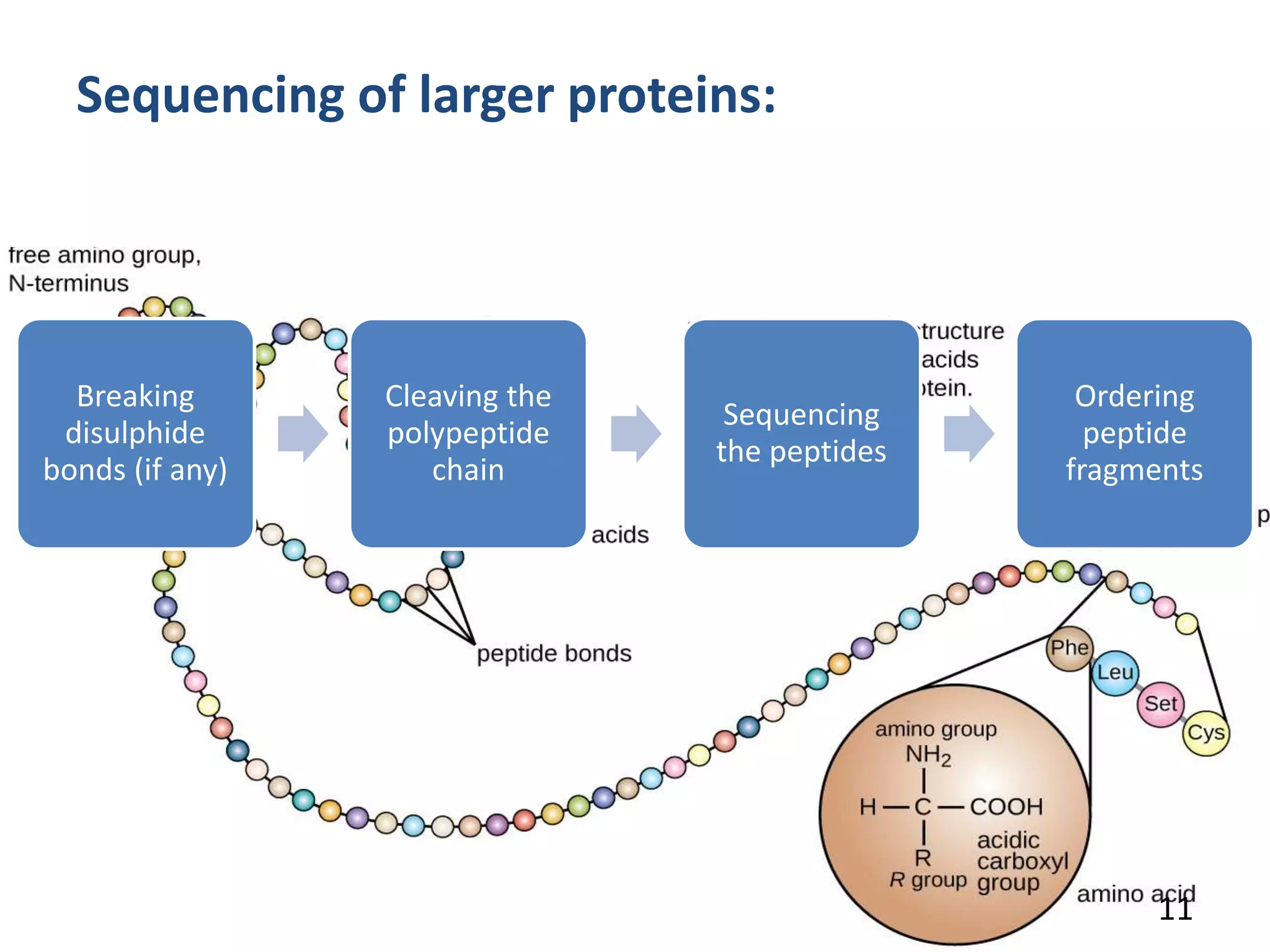
Breaking
disulphide
bonds (if any)
Cleaving the
polypeptide
chain
Sequencing
the peptides
Ordering
peptide
fragments
Sequencing of larger proteins:
11
Less no. of
methods
available than N
terminal
sequencing
Mot common
method is the
addition of
caboxypeptidases
to a solution of
protein
Take samples at
regular interval
Determine
terminal amino
acid by analyzing
a plot of amino
acid
concentration
against time.
C-terminal sequencing
12
Prediction from DNA sequence:
With the development of rapid DNA sequencing methods
researchers can deduce the sequence of a polypeptide by determining
the sequence of nucleotides in the gene that codes for it
When the gene is available, sequencing the DNA can be faster and more
accurate than sequencing the protein. Most proteins are now
sequenced in this in direct way.
13
Protein Sequences and Evolution
Protein sequences can elucidate history of life on earth
If two organisms are closely related, the sequences of their genes and proteins
should be similar. The sequences increasingly diverge as the evolutionary
distance between two organisms increases.
Change in amino acids may be due to mutations
As more sequence information is made available in databases, evolutionary trees are
constructed based on a variety of different proteins
Analyses using the sequences of many different proteins can provide a detailed
and accurate picture of evolutionary relationships.
14
Work done in Pakistan:
 Structural analysis and epitope prediction of HCV E1 protein isolated in Pakistan
Sobia Idrees and Usman A Ashfaq (Idrees and Ashfaq Virology Journal2013)
Department of Bioinformatics and Biotechnology, Government College University
(GCU), Faisalabad, Pakistan
 A novel insertion mutation in the cartilage-derived morphogenetic protein-1
(CDMP1) gene underlies Grebe-type chondrodysplasia in a consanguineous
Pakistani family
Basit et al, 2008
Department of Biochemistry, Faculty of Biological Sciences, Quaid-i-Azam
University Islamabad, Pakistan
 Mutations in WDR62 gene in Pakistani families with autosomal recessive
primary microcephaly
Kousar et al, 2011
Department of Biochemistry, Faculty of Biological Sciences, Quaid-i-Azam University,
Islamabad, Pakistan
 Molecular characterization, cloning and sequencing of coat protein gene of a
Pakistani potato leaf roll virus isolate and its phylogenetic analysis
Belal Hossain, Idrees Ahmad Nasir, Bushra Tabassum and Tayyab Husnain, 2013
Centre of Excellence in Molecular Biology (CEMB), University of the Punjab, Lahore
15
Protein sequences are a rich source
of information about protein
structure and function, as well as the
evolution of life on this planet.
Sophisticated methods are being
developed to trace evolution by
analyzing the resultant slow changes
in the amino acid sequences of
homologous proteins. Protein
sequences can also be used to find
out the location of gene coding for
that protein
Conclusion:
16
References
• Lehninger Principles of Biochemistry (fourth edition)
David L. Nelson , Michael M. Cox
• Harper’s Illustrated Biochemistry
Robert K. Murray, Daryl K. Granner, Peter A. Mayes, Victor W. Rodwell
• Methods in molecular biology volume 211
• Protein sequencing protocols
Baryan John Smith
• Fundamentals of molecular evolution
Dan Graur, Wen-Hsiung Li
• Molecules as Documents of Evolutionary History
Emile Zuckerkandl and Linus Pauling
• J Bailey - US Patent 5,807,748, 1998 - Google
• S Liang - Chinese Bulletin of Life Sciences, 1999 - europepmc.org
• https://bmcbiotechnol.biomedcentral.com/articles/10.1186/1472-6750-10-64
• https://patents.google.com/patent/US5807748A/en
17
18

Protein sequencing

  • 1.
    Protein sequencing andevolution Presented by: Hafsa Jamil Roll no: 35 1
  • 2.
    Table of content: Introduction: •Proteins • Protein sequencing First protein sequence Methods of protein sequencing N terminal sequencing: • Sanger method • Edman degradation method C terminal sequencing Prediction from DNA sequence Protein sequencing and evolution Conclusion References 2
  • 3.
    What are proteins? Classof nitrogenous organic compounds which have large molecules composed of one or more long chains of amino acids and are an essential part of all living organisms 3
  • 4.
    Protein sequencing: Protein sequencing isthe practical process of determining the amino acid sequence of all or part of a protein or peptide. 4
  • 5.
    First sequence: First protein sequencewas achieved by Fredric Sanger in 1953. He determined the amino acid sequence of insulin. 5
  • 6.
  • 7.
    Sanger developed thereagent 1-fluoro-2,4- dinitrobenzene (FDNB) to label and identify the amino- terminal amino acid residue. Other reagents used to label the amino-terminal residue, dansyl chloride and dabsyl chloride After the amino-terminal residue is labeled with one of these reagents, the polypeptide is hydrolyzed to its constituent amino acids and the labeled amino acid is identified. Sanger sequencing: 7
  • 8.
  • 9.
    Uses Edman’s reagentphenylisothyocyanate (PTC) PTC combines with free N terminal amino acid N terminal amino acid is exiced and seperated as PTH derivative. (phenylthiodantoin derivative). Edman degradation is carried out in a machine called sequenter. Edman degradation: 9
  • 10.
  • 11.
    Breaking disulphide bonds (if any) Cleavingthe polypeptide chain Sequencing the peptides Ordering peptide fragments Sequencing of larger proteins: 11
  • 12.
    Less no. of methods availablethan N terminal sequencing Mot common method is the addition of caboxypeptidases to a solution of protein Take samples at regular interval Determine terminal amino acid by analyzing a plot of amino acid concentration against time. C-terminal sequencing 12
  • 13.
    Prediction from DNAsequence: With the development of rapid DNA sequencing methods researchers can deduce the sequence of a polypeptide by determining the sequence of nucleotides in the gene that codes for it When the gene is available, sequencing the DNA can be faster and more accurate than sequencing the protein. Most proteins are now sequenced in this in direct way. 13
  • 14.
    Protein Sequences andEvolution Protein sequences can elucidate history of life on earth If two organisms are closely related, the sequences of their genes and proteins should be similar. The sequences increasingly diverge as the evolutionary distance between two organisms increases. Change in amino acids may be due to mutations As more sequence information is made available in databases, evolutionary trees are constructed based on a variety of different proteins Analyses using the sequences of many different proteins can provide a detailed and accurate picture of evolutionary relationships. 14
  • 15.
    Work done inPakistan:  Structural analysis and epitope prediction of HCV E1 protein isolated in Pakistan Sobia Idrees and Usman A Ashfaq (Idrees and Ashfaq Virology Journal2013) Department of Bioinformatics and Biotechnology, Government College University (GCU), Faisalabad, Pakistan  A novel insertion mutation in the cartilage-derived morphogenetic protein-1 (CDMP1) gene underlies Grebe-type chondrodysplasia in a consanguineous Pakistani family Basit et al, 2008 Department of Biochemistry, Faculty of Biological Sciences, Quaid-i-Azam University Islamabad, Pakistan  Mutations in WDR62 gene in Pakistani families with autosomal recessive primary microcephaly Kousar et al, 2011 Department of Biochemistry, Faculty of Biological Sciences, Quaid-i-Azam University, Islamabad, Pakistan  Molecular characterization, cloning and sequencing of coat protein gene of a Pakistani potato leaf roll virus isolate and its phylogenetic analysis Belal Hossain, Idrees Ahmad Nasir, Bushra Tabassum and Tayyab Husnain, 2013 Centre of Excellence in Molecular Biology (CEMB), University of the Punjab, Lahore 15
  • 16.
    Protein sequences area rich source of information about protein structure and function, as well as the evolution of life on this planet. Sophisticated methods are being developed to trace evolution by analyzing the resultant slow changes in the amino acid sequences of homologous proteins. Protein sequences can also be used to find out the location of gene coding for that protein Conclusion: 16
  • 17.
    References • Lehninger Principlesof Biochemistry (fourth edition) David L. Nelson , Michael M. Cox • Harper’s Illustrated Biochemistry Robert K. Murray, Daryl K. Granner, Peter A. Mayes, Victor W. Rodwell • Methods in molecular biology volume 211 • Protein sequencing protocols Baryan John Smith • Fundamentals of molecular evolution Dan Graur, Wen-Hsiung Li • Molecules as Documents of Evolutionary History Emile Zuckerkandl and Linus Pauling • J Bailey - US Patent 5,807,748, 1998 - Google • S Liang - Chinese Bulletin of Life Sciences, 1999 - europepmc.org • https://bmcbiotechnol.biomedcentral.com/articles/10.1186/1472-6750-10-64 • https://patents.google.com/patent/US5807748A/en 17
  • 18.