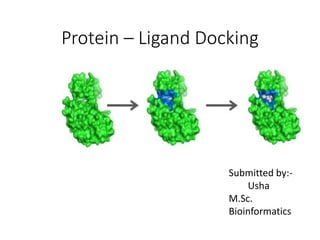
Protein – Ligand Docking
Submitted by:-
Usha
M.Sc.
Bioinformatics
Docking
It predicts the best bounding orientation of
one molecule to other to form a stable
complex.
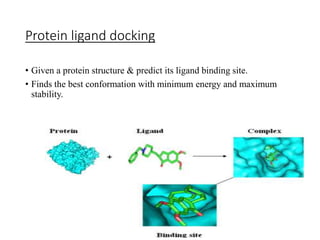
Protein ligand docking
• Given a protein structure & predict its ligand binding site.
• Finds the best conformation with minimum energy and maximum
stability.
Components of docking software
• Search algorithm
Generates a large number of poses of molecule in binding site.
• Scoring function
Calculate a score or binding affinity for particular pose.
Algorithm
• AutoDock
• GOLD
AutoDock
• Search methods
Genetic algorithm
 Stimulated annealing
Global – local search method based by Lamarckian genetic algorithm
• Finds the binding free energy for predicting the conformation
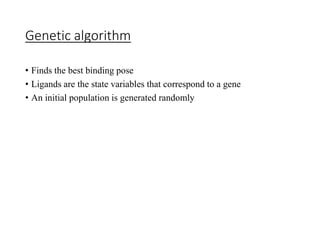
Genetic algorithm
• Finds the best binding pose
• Ligands are the state variables that correspond to a gene
• An initial population is generated randomly
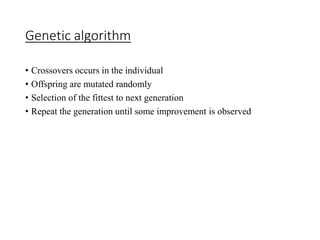
Genetic algorithm
• Crossovers occurs in the individual
• Offspring are mutated randomly
• Selection of the fittest to next generation
• Repeat the generation until some improvement is observed
N = (F – E)/ (F - <F>), when F ≠ <F>
Where :
N - number of offspring to be allocated to individual
<F> - mean fitness of individual
F – fitness of worst individual or highest energy in n
generations
E - fitness of individual (energy of protein & ligand)
• F > E or <F>
• If E = F than E < <F>
• If (F – E) > (F - <F>) ; these individual will allocate at least one
offspring.
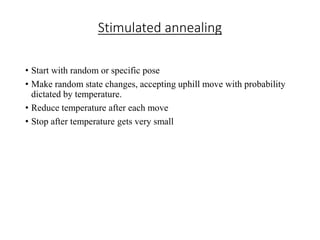
Stimulated annealing
• Start with random or specific pose
• Make random state changes, accepting uphill move with probability
dictated by temperature.
• Reduce temperature after each move
• Stop after temperature gets very small
Lamarckian genetic algorithm
Hybrid of genetic algorithm & adaptive local
search is LGA
Energy evaluation
ΔG= ΔGvdw + ΔGhbond +ΔGelect + ΔGconfor
+ΔGtor +ΔGsol
ΔGelect – electrostatic forces
ΔGconfor – deviation from covalent bond
ΔGsol – solvation & binding effect
ΔGvdw – vanderwal forces (dispersive/repulsive forces)
ΔGhbond – hydrogen bonding
ΔGtor – torsion angles
Observed vs predicted binding free energies
GOLD
• Scoring function
Goldscore
Chemscore
• Local scoring
Standard scoring
Local optimization
• Mechanism for protein ligand binding
• Search algorithm
It occur by genetic algorithm
Scoring function
• Goldscore
Gold fitness = Shbond-ext + Svdw-ext +Shbond-int +Svdw-int
Shbond – hydrogen bond score due intramolecular force & protein ligand
binding score
Svdw – vanderwal forces score due to intramolecular force and protein
ligand binding score
Scoring function
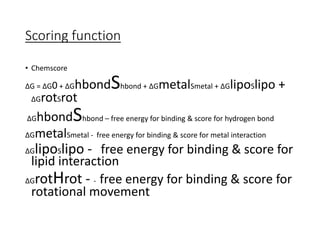
• Chemscore
ΔG = ΔG0 + ΔGhbondShbond + ΔGmetalSmetal + ΔGlipoSlipo +
ΔGrotSrot
ΔGhbondShbond – free energy for binding & score for hydrogen bond
ΔGmetalSmetal - free energy for binding & score for metal interaction
ΔGlipoSlipo - free energy for binding & score for
lipid interaction
ΔGrotHrot - - free energy for binding & score for
rotational movement
Tools for protein ligand docking
• HADDOCK
• Cluspro
• PatchDock
• PyDock
• SwissDock
Protein ligand docking

Protein ligand docking

  • 1.
    Protein – LigandDocking Submitted by:- Usha M.Sc. Bioinformatics
  • 2.
    Docking It predicts thebest bounding orientation of one molecule to other to form a stable complex.
  • 3.
    Protein ligand docking •Given a protein structure & predict its ligand binding site. • Finds the best conformation with minimum energy and maximum stability.
  • 4.
    Components of dockingsoftware • Search algorithm Generates a large number of poses of molecule in binding site. • Scoring function Calculate a score or binding affinity for particular pose.
  • 5.
  • 6.
    AutoDock • Search methods Geneticalgorithm  Stimulated annealing Global – local search method based by Lamarckian genetic algorithm • Finds the binding free energy for predicting the conformation
  • 7.
    Genetic algorithm • Findsthe best binding pose • Ligands are the state variables that correspond to a gene • An initial population is generated randomly
  • 8.
    Genetic algorithm • Crossoversoccurs in the individual • Offspring are mutated randomly • Selection of the fittest to next generation • Repeat the generation until some improvement is observed
  • 9.
    N = (F– E)/ (F - <F>), when F ≠ <F> Where : N - number of offspring to be allocated to individual <F> - mean fitness of individual F – fitness of worst individual or highest energy in n generations E - fitness of individual (energy of protein & ligand) • F > E or <F> • If E = F than E < <F> • If (F – E) > (F - <F>) ; these individual will allocate at least one offspring.
  • 10.
    Stimulated annealing • Startwith random or specific pose • Make random state changes, accepting uphill move with probability dictated by temperature. • Reduce temperature after each move • Stop after temperature gets very small
  • 11.
    Lamarckian genetic algorithm Hybridof genetic algorithm & adaptive local search is LGA
  • 12.
    Energy evaluation ΔG= ΔGvdw+ ΔGhbond +ΔGelect + ΔGconfor +ΔGtor +ΔGsol ΔGelect – electrostatic forces ΔGconfor – deviation from covalent bond ΔGsol – solvation & binding effect ΔGvdw – vanderwal forces (dispersive/repulsive forces) ΔGhbond – hydrogen bonding ΔGtor – torsion angles
  • 13.
    Observed vs predictedbinding free energies
  • 14.
    GOLD • Scoring function Goldscore Chemscore •Local scoring Standard scoring Local optimization • Mechanism for protein ligand binding • Search algorithm It occur by genetic algorithm
  • 15.
    Scoring function • Goldscore Goldfitness = Shbond-ext + Svdw-ext +Shbond-int +Svdw-int Shbond – hydrogen bond score due intramolecular force & protein ligand binding score Svdw – vanderwal forces score due to intramolecular force and protein ligand binding score
  • 16.
    Scoring function • Chemscore ΔG= ΔG0 + ΔGhbondShbond + ΔGmetalSmetal + ΔGlipoSlipo + ΔGrotSrot ΔGhbondShbond – free energy for binding & score for hydrogen bond ΔGmetalSmetal - free energy for binding & score for metal interaction ΔGlipoSlipo - free energy for binding & score for lipid interaction ΔGrotHrot - - free energy for binding & score for rotational movement
  • 17.
    Tools for proteinligand docking • HADDOCK • Cluspro • PatchDock • PyDock • SwissDock