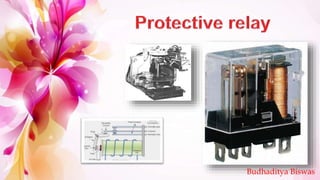
Budhaditya Biswas
Three aspects are generally considered in the design of a
power system
Desire normal operation Prevention of failure
The reduction of
damaging effect caused
by the failure.
The provision of adequate insulation, use of overhead ground wire and low
tower footing resistance, batter mechanical design etc are used to minimize the
failure but it is never possible to prevent the occurrence of fault. The fault implies
any abnormal condition which reduces the insulation strength between conductor of
different phases and between phase conductor and ground. Generally a fault
produces excessive current and reduces the system voltage.
EFFECTS OF FAULT
Faulty element carrying
excessive current, gets damage
due to heating, burning and
mechanical stresses set up in
the element.
Stability of the electrical
system may be affected
causing complete shutdown
of the system.
A large reduction of line
voltage.
The function of protective relaying is to cause the prompt removal from service of
any element of a power system when it starts to operate in any abnormal manner
that might cause damage or otherwise interfere with the effective operation of the
rest of the system. The relaying equipment is aided in this task by circuit breakers
that are capable of disconnecting the faulty element when they are called upon to
do so by the relaying equipment.
•Sensitivity : any relaying equipment must be sufficiently sensitive so that it will
operate when required under the actual condition that produces the least
operating tendency. It has ability to discriminate between a fault and no fault
condition.
•Selectivity : only the faulty element should be isolated and remaining healthy
section are to be left intact. The relaying equipment should be able to select the
proper condition of the system for which it must operate and the condition which
are to be overlooked by the relay. It should operate only when the fault has
occurred within a particular selected area and never for fault outside that area.
•Reliability : relay should positively operate every time during the abnormality
for which it has been connected to the system. To assure reliability the relay
should in general be simple and robust. Inherently reliable design checked by
thorough maintenance reduces the risk of failure and protection of system.
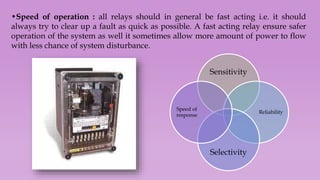
•Speed of operation : all relays should in general be fast acting i.e. it should
always try to clear up a fault as quick as possible. A fast acting relay ensure safer
operation of the system as well it sometimes allow more amount of power to flow
with less chance of system disturbance.
Sensitivity
Reliability
Selectivity
Speed of
response
Relay
Primary
relaying
Backup
relaying
Local backup
Relay backup
Breaker
backup
Remote
backup
Primary relaying : It is those relays
which initiate the tripping of the
faulty section of the system as soon
as fault occur
Backup relaying : It is those relays
which operate only when the
primary relay connected to a circuit
fails to operate.
The whole power system is generally subdivided into several independent zones so far as relaying concern. Firstly this
facilitates quick detection and isolation of the faulty section. Secondly by increasing the number of independent zone
the disconnecting portion of the system may be kept to a minimum. Normal practice to selecting a zone maintain a
overlap to the extent of one circuit breaker between successive zone, this is made to prevent the presence of any section
which is not covered by at least one of the zone. The creation of this protecting zones or relaying zones also helps to provide
backup protection.
If the primary relay fails to operate because of some defects inherent to it or its
associated equipments, signals or power supply, the backup relay will operate.
The backup relays are of two types
• Local backup
I) Relay backup
II) Breaker backup
• Remote backup
Regarding relay backup, here a single breaker is operated in succession by two
separate relays. The scheme does not take care about breaker failure.
Regarding breaker backup, here same relay send signal in successions to two
breakers. The near one should trip fast; the scheme is prone to relay failure.
In case of remote backup both relay and breaker used for back up protection is
separate from primary protection. As the defects may crop up in any circuit
hence backup relay should have no common circuitry with its primary relay.
Backup relay is normally placed at a
different location and is energized from
different sources. Also it generally covers a
lager zone compare to primary relay and
trips a larger number of circuit breakers at
a time. The circuit breakers trip by backup
relay is different from those that would
have been trip if the primary relay
operates satisfactorily.
Assuming a fault occurs in the line between C & D and the primary relay have failed to operate. The backup relay should
be located at A,G,F and J and they should trip the associated circuit breaker at these places. Breakers at B,H,E,I should not
tripped simply because the breakers at A,F,G,J are physically apart from the equipment that has failed. Backup relays
must operate after sufficient time delay to allow the primary relay operate first. The typical backup relay operating time
is given by
Rb=Rp+B+Op+Tm
Where, Rb=backup relay operating time
Rp=primary relay operating time
B=breaker operating time
Op=over travel time of primary relay
Tm=time margin
All protective relays are
comprised by few basic
elements. The nature of duties
perform by each of them
nearly same whatever be the
type of relays but the manner
of execution of the duties may
vary from relay to relay.
•Measuring Elements : The basic duty of this element is to get an assessment of
the power system quantity and to derive the actual relay input quantity.
•Comparing Elements : The duty of this type of element is to compare two or
more input quantity and to originate a signal when the relationship between the
input quantity deviate from a preset quantity.
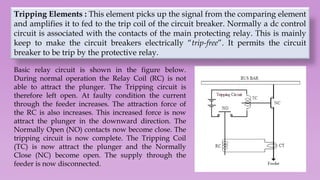
Tripping Elements : This element picks up the signal from the comparing element
and amplifies it to fed to the trip coil of the circuit breaker. Normally a dc control
circuit is associated with the contacts of the main protecting relay. This is mainly
keep to make the circuit breakers electrically “trip-free”. It permits the circuit
breaker to be trip by the protective relay.
Basic relay circuit is shown in the figure below.
During normal operation the Relay Coil (RC) is not
able to attract the plunger. The Tripping circuit is
therefore left open. At faulty condition the current
through the feeder increases. The attraction force of
the RC is also increases. This increased force is now
attract the plunger in the downward direction. The
Normally Open (NO) contacts now become close. The
tripping circuit is now complete. The Tripping Coil
(TC) is now attract the plunger and the Normally
Close (NC) become open. The supply through the
feeder is now disconnected.
A CT used for metering purpose should maintain its
ratio and phase angle error within specified limits upto
120% of full load and prevent damage of measuring
instrument. It should saturate at the current greater
than 120% of full load. To maintain high accuracy a CT
is designed with high permeability low loss core
working at lower value of the flux densities and using
standard turn compensation method.
On the other hand a CT used for protective purpose need not be very accurate
from the point of view of ratio and phase angle error. But its transient
performance under heavy true fault faithfully reproducing the primary current
on the secondary side without itself being saturated is of most importance.
Moreover its construction should be rugged in order to withstand the thermal
and mechanical stress arriving due to the flow of heavy fault current.
SOME DEFINITIONS
Operating force or Torque - It is torque (or force) which tends to close the
contacts of the relay.
Restraining force or Torque- It is the torque (or force) which opposes the
operating torque and tends to prevent the closure of relay contacts.
Pick up level - The value of the actuating quantity which is on the threshold,
above which the relay operates.
Reset level - The value of the current or voltage below which the relay opens it
contacts and comes to its original condition.
Operating time - The time which elapse between the instant when the actuating
quantity exceeds the pick up value to the instant when the relay contacts closed.
Reset time - The time which elapses between the instant when the actuating
quantity becomes less than the reset value to the instant when the relay contacts
returns to its normal position.
Reach - A distance relay operates whenever the impedance seen by the relay is
less than a pre specified value. This impedance or the corresponding distance is
known as the reach of the relay.
Under reach - The tendency of the relay to operate a value of the actuating
quantity which is lower than the set value.
Over reach - The tendency of the relay to operate a value of the actuating quantity
which is greater than the set value.
Relay
Based on
Characteristic
Based on logic of
the protection
Based on actuating
parameter
Based on Characteristic the protection relay can be categorized as:
1. Definite time relays
2. Inverse time relays with definite minimum time(IDMT)
3. Instantaneous relays
4. IDMT with instantaneous.
5. Stepped characteristic
6. Programmed switches
7. Voltage restraint over current relay
•Instantaneous over current relay is one in which no intentional time delay is
provided for the operation. The time of operation of such relay is approximately
0.1 sec. This characteristic can be achieved with the help of hinged armature
relays. The instantaneous relay is more effective where the impedance Zs between
the source and the relay is small compared with the impedance Zl of the section
to be protected.
•Inverse time current relay is one in which the operating time reduces as the
actuating quantity increases in magnitude. The more pronounced the effect is
the more inverse the characteristic is said to be. In fact, all time current curves
are inverse to a greater or lesser degree. They are normally more inverse near the
pick up value of the actuating quantity and become less inverse as it is increased.
This characteristic can be obtained with induction type of relays by using a
suitable core which does not saturate for a large value of fault current. If the
saturation occurs at a very early stage, the time of operation remains same over
the working range. The characteristic is shown by curve (a) in the figure and is
known as definite time characteristic.
•Inverse definite minimum time current relay is one in which the operating time is
approximately inversely proportional to the faulty current near pick up value and
becomes substantially constant slightly above the pick up value of the relay[curve
(b)]. This is achieved by using a core of the electromagnet which gets saturated for
current slightly greater than the pick up current.
•Very inverse relay is one in which the saturation of the core occurs at a later stage,
the characteristic assumes the shape as shown in curve (c) and is known as very
inverse characteristic. The time current characteristic is inverse over a greater range
and after saturation tends to definite time.
•Extremely inverse relay is one in which the saturation occurs at a still later stage
than curve (c) in the figure. The equation describing the curve (d) in the figure is
approximately of the form I2t=K, where I is the operating current and t the
operating time.
The time lag in induction type of relays may be achieved by using a permanent
magnet which is so arranged that the relay rotor cuts the flux between the poles of
this magnet. This type of magnet is called Drag Magnet.
Based on of logic the protection relay can be categorized as
1. Differential
2. Unbalance
3. Neutral displacement
4. Directional
5. Restricted earth fault
6. Over fluxing
7. Distance schemes
8. Bus bar protection
9. Reverse power relays
10.Loss of excitation
11.Negative phase sequence relays
Based on actuating parameter the protection relay can be categorized as
1.Current relays
2. Voltage relays
3. Frequency relays
4. Power relays etc.
Depending upon working principle
i. Attracted Armature type relay
ii. Induction Disc type relay
iii. Induction Cup type relay
iv. Balanced Beam type relay
v. Moving coil type relay
vi. Polarized Moving Iron type relay
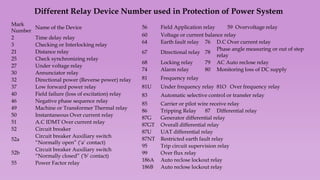
Different Relay Device Number used in Protection of Power System
Mark
Number
Name of the Device
2 Time delay relay
3 Checking or Interlocking relay
21 Distance relay
25 Check synchronizing relay
27 Under voltage relay
30 Annunciator relay
32 Directional power (Reverse power) relay
37 Low forward power relay
40 Field failure (loss of excitation) relay
46 Negative phase sequence relay
49 Machine or Transformer Thermal relay
50 Instantaneous Over current relay
51 A.C IDMT Over current relay
52 Circuit breaker
52a
Circuit breaker Auxiliary switch
“Normally open” (‘a’ contact)
52b
Circuit breaker Auxiliary switch
“Normally closed” (‘b’ contact)
55 Power Factor relay
56 Field Application relay 59 Overvoltage relay
60 Voltage or current balance relay
64 Earth fault relay 76 D.C Over current relay
67 Directional relay 78
Phase angle measuring or out of step
relay
68 Locking relay 79 AC Auto reclose relay
74 Alarm relay 80 Monitoring loss of DC supply
81 Frequency relay
81U Under frequency relay 81O Over frequency relay
83 Automatic selective control or transfer relay
85 Carrier or pilot wire receive relay
86 Tripping Relay 87 Differential relay
87G Generator differential relay
87GT Overall differential relay
87U UAT differential relay
87NT Restricted earth fault relay
95 Trip circuit supervision relay
99 Over flux relay
186A Auto reclose lockout relay
186B Auto reclose lockout relay
During study of electrical protective relays, some special
terms are frequently used. For proper understanding, the
functions of different protective relays, the definition of
such terms must be understood properly.
Such terms are
1) Pick up current.
2) Current setting.
3) Plug setting multiplier (PSM).
4) Time setting multiplier (TSM).
In all electrical relays, the moving contacts are not free to move. All the contacts
remain in their respective normal position by some force applied on them
continuously. This force is called controlling force of the relay. This controlling
force may be gravitational force, may be spring force, may be magnetic force.
The force applied on the relay’s moving parts for changing the normal position
of the contacts, is called deflecting force. This deflecting force is always in
opposition of controlling force and presents always in the relay. Although the
deflecting force always presents in the relay directly connected to live line, but as
the magnitude of this force is less than controlling force in normal condition, the
relay does not operate. If the actuating current in the relay coil increases
gradually, the deflecting force in electro mechanical relay, is also increased.
Once, the deflecting force crosses the controlling force, the moving parts of the
relay initiate to move to change the position of the contacts in the relay. The
current for which the relay initiates it operation is called pick up current of
relay.
The minimum pick up value of the deflecting force of an electrical relay is
constant. Again the deflecting force of the coil is proportional to its number of
turns and electric current flowing through the coil.
Now, if we can change the number of active turns of any coil, the required current
to reach at minimum pick value of the deflecting force, in the coil also changes.
That means if active turns of the relay coil is reduced, then proportionately more
current is required to produce desired relay actuating force. Similarly if active
turns of the relay coil is increased, then proportionately reduced current is
required to produce same desired deflecting force.
Practically same model relays may be used in different systems. As per these
systems requirement the pick up current of relay is adjusted. This is known as
current setting of relay. This is achieved by providing required number of tapping
in the coil. These taps are brought out to a plug bridge. The number of active turns
in the coil can be changed by inserting plug in different points in the bridge.
The current setting of relay is expressed in percentage ratio
of relay pick up current to rated secondary current of CT.
That means,
The current setting is sometimes referred as current plug
setting.
The current setting of over current relay is generally
ranged from 50% to 200%, in steps of 25%. For earth fault
relay it is from 10% to 70% in steps of 10%.
Plug setting multiplier of relay is referred as ratio of fault current in the relay
to its pick up current.
The operating time of an electrical relay mainly depends upon two factors :
1) How long distance to be travelled by the moving parts of the relay for
closing relay contacts and
2) How fast the moving parts of the relay cover this distance.
So far adjusting relay operating time, both of the factors to be adjusted.
The adjustment of travelling distance of an electromechanical relay is
commonly known as time setting multiplier of relay. The time setting dial is
calibrated from 0 to 1 in steps 0.05 sec.
But by adjusting only time setting multiplier, we can not set the actual time of operation of
an electrical relay. As we already said, the time of operation also depends upon the speed
of operation. The speed of moving parts of relay depends upon the force due to current in
the relay coil. Hence it is clear that, speed of operation of an electrical relay depends upon
the level of fault current. In other words, time of operation of relay depends upon plug
setting multiplier. The relation between time of operation and plug setting multiplier is
plotted on a graph paper and this is known as time / PSM graph. From this graph one can
determine, the total time taken by the moving parts of an electromechanical relay, to
complete its total travelling distance for different PSM.
For calculating actual relay operating time, we need to know these following
operation.
1) Current setting.
2) Fault current level.
3) Ratio of current transformer.
4) Time / PSM curve.
5) Time setting.
An IDMT type over-current relay is used to protect a feeder through 500/1 A CT. The relay
has a plug setting (PS) of 125% and TMS = 0.3. Find the time of operation of the said relay
if a fault current of 5000 A flows through the feeder. Make use of the following
characteristic
PSM 2 3 5 8 10 15
Time for unity TMs 10 6 4.5 3.2 3 2.5
(100% current = 1A)
Fault current, If = 5000 A, CT Ratio = 500:1
therefore Relay current,
5000
10
CTRatio 500
f
R
I
I A
  
Pick up value of the relay = Current setting × rated secondary current of CT
125
1 1.25
100
A
  
Plug setting multiplier of the relay, PSM =
fault current in relay coil, 10
8
Pickup value of relay 1.25
R
I
 
Time corresponding to the PSM of 8 from the given data is 3.2 second
So actual operating time = 3.2 × time setting multiplier
= 3.2 × 0.3 = 0.96 second.
Determine the time of operation of a 1A, 3s over-current relay having plug
setting of 125% and a time multiplier of 0.6. The supplying CT is rated 400:1 A
and fault current is 4000 A. The relay characteristic curve is given below:
PSM 1.3 2 4 8 10 20
Time of operation 30 10 5 3.3 3 2.2
(in second)
Relay current,
4000
10
CTRatio 400
f
R
I
I A
  
Pick up value of the relay = Current setting × rated secondary current of CT
125
1 1.25
100
A
 
Plug setting multiplier of the relay, PSM =
fault current in relay coil, 10
8
Pickup value of relay 1.25
R
I
 
Time corresponding to the PSM of 8 from the given data is 3.3 second
So actual operating time = 3.3 × time setting multiplier = 3.3 × 0.6 =1.98 Second
Referring to the figure below, given that Fault current = 2000 A; Relay 1 set on
100%; CT ratio = 200/1;
Relay 2 set on 125%. For discrimination the time gradient margin between the
relays is 0.5 second.
Determine the time of operation of the two relays assuming that both the relays
having the characteristic as shown in the following table and the relay no. 1 has
a time multiplier setting = 0.2.
Also determine the time setting multiplier of relay number 2.
PSM Time for unity
TMs
2 10
3.6 6
5 3.9
8 3.15
10 2.8
15 2.2
20 2.1
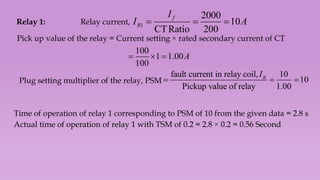
Relay 1: Relay current, 1
2000
10
CTRatio 200
f
R
I
I A
  
Pick up value of the relay = Current setting × rated secondary current of CT
100
1 1.00
100
A
  
Plug setting multiplier of the relay, PSM
fault current in relay coil, 10
10
Pickup value of relay 1.00
R
I
  
Time of operation of relay 1 corresponding to PSM of 10 from the given data = 2.8 s
Actual time of operation of relay 1 with TSM of 0.2 = 2.8 × 0.2 = 0.56 Second
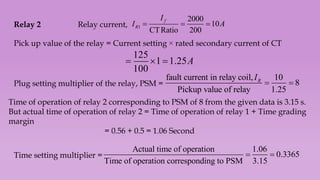
Relay 2 Relay current, 1
2000
10
CTRatio 200
f
R
I
I A
  
Pick up value of the relay = Current setting × rated secondary current of CT
125
1 1.25
100
A
  
Plug setting multiplier of the relay, PSM =
fault current in relay coil, 10
8
Pickup value of relay 1.25
R
I
 
Time of operation of relay 2 corresponding to PSM of 8 from the given data is 3.15 s.
But actual time of operation of relay 2 = Time of operation of relay 1 + Time grading
margin
= 0.56 + 0.5 = 1.06 Second
Time setting multiplier =
Actual time of operation 1.06
0.3365
Time of operation corresponding to PSM 3.15
 
It is given that fault current level at 33
kV side is 2700 A; CT ratio at 33 kV side
is 200:1 and 132 kV side is 100:1
(referring to figure). If both the relays R1
and R2 are set for 100% plug setting,
determine the operating time for both
the relays when time grading margin of
0.6 second is given and TMS for Relay 1
is 0.15. Both the relays having the
characteristic as shown in the following
table
PSM 2 3.6 6.75 8 10 13.5 20
Time for unity TMs 10 6 3.6 3.15 2.8 2.6 2.1
Relay 1: Relay current, 1
2700
13.5
CTRatio 200
f
R
I
I A
  
Pick up value of the relay = Current setting × rated secondary current of CT
100
1 1.00
100
A
  
Plug setting multiplier of the relay, PSM =
fault current in relay coil, 13.5
13.5
Pickup value of relay 1.00
R
I
 
Time of operation of relay 1 corresponding to PSM of 13.5 from the given data =
2.6 second
Actual time of operation of relay 1 with TSM of 0.15 = 2.6 × 0.15 = 0.39 Second
Relay 2
Fault current on 132 kV side =
2700
33 675
132
A
 
Relay current, 1
675
6.75
CTRatio 100
f
R
I
I A
  
Pick up value of the relay = Current setting × rated secondary current of CT
100
1 1.00
100
A
  
Plug setting multiplier of the relay, PSM =
fault current in relay coil, 6.75
6.75
Pickup value of relay 1.00
R
I
 
Time of operation of relay 2 corresponding to PSM of 6.75 from the given data is 3.6 second.
But actual time of operation of relay 2 = Time of operation of relay 1 + Time grading margin
= 0.39 + 0.6 = 0.99 Second
Time setting multiplier =
Actual time of operation 0.99
0.275
Time of operation corresponding to PSM 3.6
 
A 20 MVA transformer which is used to operate at 30% overload feeds an 11 kV
bus-bar through a circuit breaker. The transformer circuit breaker is equipped
with a 1000/5 CT and the feeder circuit breaker with 400/5 CT and both the
current transformers feed IDMT relays having the following characteristics.
PSM 2 3 5 10 15 20
Time for unity TMs 10 6 4.1 3 2.5 2.2
The relay on the feeder circuit breaker has 125% plug setting and a 0.3 time
multiplier setting. If a fault current of 5000 A flows from the transformer to the
feeder, determine
1. Operating time of feeder relay
2. Suggest suitable plug setting and time multiplier setting of the transformer
relay to ensure adequate discrimination of 0.5 s between the transformer relay
and the feeder relay.
OVER CURRENT RELAYS
The over current relays fall under the basic category of single input relay.
Though all protective comparators utilize at least two inputs but in the case of
over current relays one of the inputs is not an electrical one. This is a mechanical
force manifested in the form of a spring tension against the electrically produced
force or torque acts. Over current relays are most widely used among the family
of single input relays. The other relays of this group are Under Current, Over
Voltage and Under Voltage Relays. Among this over current relays are widely used
in power system protection. Whereas Over and Under Voltage Relays are
generally used in motor protection.
Principle of operation:
This relay operates as soon as circuit current exceeds a predetermined
limit. Restraining force is imported by spring tension. The minimum current at
which the relay operates is called its Pickup current. The minimum current at
which it releases its contact is called Drop-out current. Normally pick-up current
of the relay is higher than its drop-out current.
Types of over current relays:
Electromagnetic over current relays are of two types :
•Attraction type
•Induction type.
Attraction Type Over Current Relay:
This type of relays may be used in ac and dc system. Here if I be the
operating current then force of operation is 2
1 2
F=k I k

Where k2=restraining force of the spring
K1=constant of proportionality.
At pick up condition 2
1 2
2
1
k I k
k
I
k


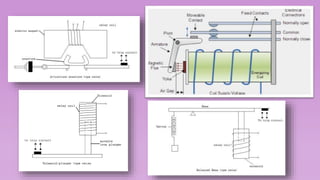
Attraction type over current relays may also be three types:
•Hinged Armature Type
•Balanced beam type
•Plunger Type
The main trouble of attraction type over current relay is its wide differentiating
pickup and dropout values. Normally the pickup value is higher compare to
dropout value. This is because of the fact that this relay remain operate at lower
value of currents as the air gap shorten after operation. This may cause false
tripping due to transients. This is more pronounced in dc operation.
In ac the relays have a tendency to reset after every half cycle when the flux falls
to zero. 2 2 2 2 2
max max max
1
k sin cos2
2
e
F I kI t k I I t
 
 
   
 
This shows that the force consist of two components, one the constant, independent
of time, whereas the other is a function of time and pulsates at double the supply
frequency. The total deflecting force, therefore, pulsates at double the frequency.
Since the restraining force is constant the net force is a pulsating one by which the
relay armature vibrates at double the power supply frequency. This vibration will
lead to sparking between the contacts and the relay will soon be damaged.
To overcome this difficulty in ac electromagnet, the two fluxes producing
the force are displaced in time phase so that the resultant deflecting force is always
positive and constant. This phase displacement can be achieved either by providing
two windings on the electromagnet having a phase shift network or by putting
shading ring on the poles of the magnet. However the shading ring or coil method is
more simple and is widely used.
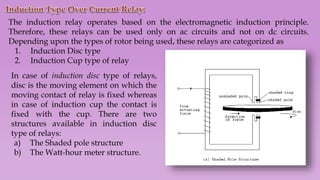
The induction relay operates based on the electromagnetic induction principle.
Therefore, these relays can be used only on ac circuits and not on dc circuits.
Depending upon the types of rotor being used, these relays are categorized as
1. Induction Disc type
2. Induction Cup type of relay
In case of induction disc type of relays,
disc is the moving element on which the
moving contact of relay is fixed whereas
in case of induction cup the contact is
fixed with the cup. There are two
structures available in induction disc
type of relays:
a) The Shaded pole structure
b) The Watt-hour meter structure.
In shaded pole, here the air gap flux is split in two parts by a shading ring in the
pole phase. In watt-hour structure there are two electromagnets each carrying a
current which are in phase apart.
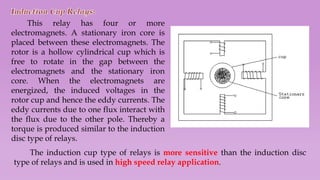
This relay has four or more
electromagnets. A stationary iron core is
placed between these electromagnets. The
rotor is a hollow cylindrical cup which is
free to rotate in the gap between the
electromagnets and the stationary iron
core. When the electromagnets are
energized, the induced voltages in the
rotor cup and hence the eddy currents. The
eddy currents due to one flux interact with
the flux due to the other pole. Thereby a
torque is produced similar to the induction
disc type of relays.
The induction cup type of relays is more sensitive than the induction disc
type of relays and is used in high speed relay application.
It is known that for producing torque two fluxes displaced from each other in
space are required. Let the two fluxes are
1 1
2 2
sin
sin( )
m
m
t
t
  
   

 
Where Φ1 is produced by the shaded pole and Φ2 by the
unshaded pole. The shaded pole flux lags that by the
unshaded pole by an angle θ. The two fluxes Φ1 and Φ2
will induces voltages e1 and e2 respectively in the disc
due to induction. These voltages will circulates eddy
currents in the disc of the relay. Assuming the disc to be
non inductive, these currents will be in phase with their
respective voltages. The phasor diagram shows the phase
relation between various quantities.
1
1 1
2
2 2
cos
cos( )
m
m
d
e t
dt
d
e t
dt

  

   
 
  
And the eddy currents i1∞e1 and i2∞e2
1 1
2 2
cos
cos( )
m
m
i t
i t
  
   

 
The flux 1 will interact with eddy current i2 and 2 will interact with i1 and since 2 is leading
1, the torque due to 2 and i1 will be positive (assume) whereas that due to 1 and i2 as
negative. The resultant torque is
2 1 1 2
2 1 1 2
1 2 1 2
1 2
( )
sin( ) cos sin cos( )
sin( )cos sin cos( )
sin
m m m m
m m m m
m m
T i i
t t t t
t t t t
 
           
         
  
 
   
   

Thus the torque is maximum when the two fluxes displaced by 900.
Equipments protected by over current relay:
• Transmission line : Generally used for phase and ground fault protection in
distribution circuits and backup protection of transmission lines. Normally
inverse characteristics are preferred by achieving selectivity.
• Generators and Transformers : Used as a backup relay for external faults
fed by this equipments.
• Busbars : Used as a backup relay to other fast acting relay like differential
relay. Normally definite time lag over current relays are preferred.
• Motors : Used as a primary relay either instantaneous or definite time lag
over current relay are used.
The relay consists of two units:
(i) directional unit
(ii) non-directional or inverse time current unit.
The directional unit is a four pole induction cup unit. Two opposite poles are fed
with voltage and the other two poles are fed with current. The voltage is taken as
the polarizing quantity. The polarizing quantity is one which produces one of the
two fluxes required for production of torque and this quantity is taken as the
reference compared with the other quantity which is current here. This means that
the phase angle of the polarizing quantity must remain more or less fixed when
the other quantity suffers wide changes in phase angle.
In a circuit at a point the current can flow in one direction at a particular instant.
Let us say this is the normal direction of flow of current. Under this condition the
directional unit will develop negative torque and the relay will be restrained to
operate. Now if due to certain changes in the circuit condition, the current flows
in the opposite direction, the relay will develop positive torque and will operate.
For a directional over current unit
unless the directional unit contacts
are closed, the over current unit is not
energized because the operating coil
of the over current unit completes its
circuit through the directional unit
contacts.
The torque developed by a directional
unit is given by
cos( )
T VI K
 
  
Where
V= rms magnitude of the voltage fed to the
voltage coil circuit
I= the rms magnitude of the current in the
current coil
θ= the angle between V and I
τ= the maximum torque angle
K= restraining torque including spring and
friction.
Dead Zone of the directional relay:
The torque developed by a directional unit is given by
cos( )
T VI K
 
  
Say for a particular installation cos( )
 
 = constant K1; then the torque equation
becomes 1
T K VI K
 
Under threshold condition when the relay is about to start,
1
'
1
0
T K VI K
K
VI K constnt
K
  
  
This characteristic is known as a constant product characteristic and is of the form
of a rectangular hyperbola.
For the operation of the relay the product of V and I should give a minimum
torque which exceeds the friction and spring torque. Let A is the location of the
directional relay. In case the fault is close to the relay the voltage to be fed to the
relay may be less than the minimum voltage required. The maximum distance
upto which the voltage is less than the minimum voltage required is known as the
dead zone of the directional relay i.e., if the fault takes place within this zone the
relay will not operate.
A
The Universal Relay Torque Equation:
The universal relay torque equation is given as follows:
 
2 2
1 2 3
T=K I +K V +K VIcos - +K
 
By assigning plus or minus signs to some of the terms and letting others be zero
and sometimes adding some terms having a combination of voltage and current,
the operating characteristic of all types of relays can be obtained. For example, for
over current relay K2=0, K3=0 and the spring torque will be –K. similarly, for
directional relay, K1=0, K2=0 and the spring torque will be –K.
Distance Relays:
With the help of the universal relay torque equation, a very interesting and
versatile family of relays known as distance relays can be described. Under this,
only a few types of relays will be considered here. They are
• Impedance Relay
• Reactance Relay
• Mho Relay
It is to be noted here that in electrical engineering ‘impedance’ term can be
applied to resistance alone or reactance alone or a combination of the two. In
protective relaying, however, these terms have different meanings and hence
relay under these names will have different characteristics.
From the universal torque equation putting K3=0 and giving negative sign to
voltage term, it becomes
2 2
1 2
T=K I -K V (neglectingspring torque)
This means that the operating torque is produced by the current coil and
restraining torque by the voltage coil, which means that an impedance relay is a
voltage restrained over current relay.
For the operation of the relay the operating torque should be greater than the
restraining torque, i.e.
2 2
1 2
K I >K V
Here V and I are the voltage and current quantities fed by the relay.
2
1
2
2
K
V
I K
 
1
2
K
Z
K
 Z<constant (design impedance)
This means that the impedance relay will operate only if the impedance seen by
the relay is less than a pre specified value (design impedance). At threshold
condition,
1
2
K
Z
K

The operating characteristic of an impedance relay on V-I diagram is shown in
figure below. The initial bend in the characteristic is due to the presence of spring
torque.
Normally, the operating
characteristics of distance
relays are shown on an
impedance diagram or R-
X diagram. This
characteristic for an
impedance diagram is
shown in the figure
below.
This is clear from the characteristic that if the impedance as seen by the relay
lies within the circle the relay will operate; otherwise, it will not. The position of
one value of Z is shown in the figure with angle θ with the +R axis. This means that
the current lags the voltage by an angle θ. In case the two were in phase, the Z
vector would have coincide with +R axis. In case the current was lagging the
voltage by 1800, the Z vector would coincide with –R axis. It is to be noted here that
–R axis does not mean here negative resistance axis but the one as explained. When
I lags behind V, the Z vector lies on the upper semi circle and Z lies in the lower
when I leads the voltage. Since the operation of the relay is independent of the
phase relation between V and I, the operating characteristic is a circle and hence it is
a non directional relay.
The impedance relays normally used are high speed relays. These relays may use a
balance beam structure or an induction cup structure.
The directional property to the
impedance relay can be given by
using the impedance relay along
with a directional units is done
in case of a simple over current
relay to work as a directional
over current relay. This means
the impedance unit will operate
only when the directional has
operated. The characteristic of
such a combination is shown in
the figure.
Reactance relay:
In this relay the operating torque is obtained by current and the
restraining torque due to a current voltage directional element. This means, a
reactance relay is an over current relay with directional restraint. The directional
element is so designed that its maximum torque angle is 900, i.e., τ=900 in the
universal torque equation.
2
1 3
2 0
1 3
2
1 3
cos( )
cos( 90 )
sin
T K I K VI
K I K VI
K I K VI
 


  
  
 
For the operation of the relay,
2
1 3
1
2
3
1
3
1
3
sin
sin
sin
K I K VI
K
VI
I K
K
Z
K
K
X
K







This means for the operation of the relay the reactance seen by the relay should be
smaller than the reactance for which the relay has been designed. The characteristic
will be shown in the figure.
If the impedance vector lies on the
parallel lines (R axis in the operating
characteristic) this will have a constant
X component. The important point
about this characteristic is that the
resistance component of the impedance
has no effect on the operation of the
relay. It responds only to the reactance
component of the impedance. The relay
will operate for all the impedances
which lie between below the operating
characteristic whether below or above R
axis.
Mho relay:
In this relay the operating torque is obtained by the VI element and restraining
torque due to the voltage element. This means the mho relay is a voltage restrain
directional relay. From the universal torque equation
2
3 2
cos( )
T K VI K V
 
  
For the relay to operate,
2
3 2
2
3
2
3
2
cos( )
, cos( )
, cos( )
K VI K V
K
V
or
VI K
K
or Z
K
 
 
 
 
 
 
This characteristic when drawn on an VI diagram is a straight line passing through
the origin and if drawn on an impedance diagram it is a circle passing through the
origin as shown in the figure.
The relay operates when the impedance
seen by the relay fall within the circle. The
relay is inherently directional so that it
needs only one pair of contacts which
makes it fast tripping for fault clearance
and reduces the VA burden on the current
transformers.
Z3
Z2
Z1
Multi-zone protection by distance relays:
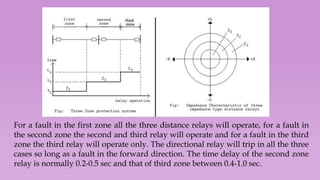
Normally transmission line is divided into different zone depending upon
the availability of circuit breakers along the line. Each such zone is provides with
separate distance relays one of which acts as a primary relay of that zone and others
backup relay for the next zone. Normally the reach of the primary relay is set for
about 80–90% of line segment length such that it does not unnecessary trip the
breaker of next zone due to some over reach of the relay. This is called first zone of
protection.
The next relay covers the rest of the first line segment and upto 20-50% of
the next line segment and is called the second zone of protection.
Another relay covers rest of the second line segment and it is called third
zone of protection. The first zone relay operates almost instantly, while other two
relays operate with increasing time lag.
For a fault in the first zone all the three distance relays will operate, for a fault in
the second zone the second and third relay will operate and for a fault in the third
zone the third relay will operate only. The directional relay will trip in all the three
cases so long as a fault in the forward direction. The time delay of the second zone
relay is normally 0.2-0.5 sec and that of third zone between 0.4-1.0 sec.
DIFFERENTIAL RELAYS:
Differential relays is that type of relay which operated when the phasor
difference of two or more similar electrical quantities exceeds a predetermined
value.
Almost any type of relay, when connected in a certain way can be made to
operate as a differential relay. The two fundamental or balanced protections are:
• Current balanced protection
• Voltage balanced protection
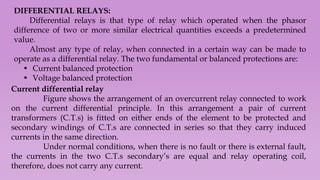
Current differential relay
Figure shows the arrangement of an overcurrent relay connected to work
on the current differential principle. In this arrangement a pair of current
transformers (C.T.s) is fitted on either ends of the element to be protected and
secondary windings of C.T.s are connected in series so that they carry induced
currents in the same direction.
Under normal conditions, when there is no fault or there is external fault,
the currents in the two C.T.s secondary’s are equal and relay operating coil,
therefore, does not carry any current.
Whenever there is an internal fault, current is the two C.T.s secondary are different,
the relay operating coil gets energized by the current equal to their difference and
the trip circuit is complete to operate the circuit breaker.
This system is employed for the protection of feeders, alternators and
transformers.
 Two identical C.T.s are employed when used either at the two ends of an
alternator winding or at the two ends of a feeder with no tapping.
 When this system is to be used for protection of transformers, correction
must be made for different currents determined approximately by the
transformer turn-ratio.
Such a system used for a single phase alternator is shown in figure.
Voltage balance differential relay
Figure below shows a voltage balance differential relay.
This is an alternative arrangement of obtaining a differential protection gear.
In this scheme of protection, two similar C.T.s are connected at either ends of the
equipment (e.g., alternator winding) to be protected by means of pilot curves. The
secondaries of C.T.s are connected in series with a relay in such a way that under
normal conditions, their induced e.m.f.s are in opposition.
Under normal healthy conditions (i.e., when there is no fault in the system)
equal currents (I1=I2) flow in both the primary windings. Therefore, the secondary
voltages of the two transformers are balanced again each other and no current will
flow through the relay operating coil.
Whenever fault occurs in the protected zone, the currents in the two primaries
will differ from one another (i.e. I1≠I2) and their secondary voltages will no longer
be in balance. Consequently, a circulating current will flow through the operating
coil, causing the trip circuit to close.
Thank you for listeni

Protective relay.pptx

  • 1.
  • 2.
    Three aspects aregenerally considered in the design of a power system Desire normal operation Prevention of failure The reduction of damaging effect caused by the failure. The provision of adequate insulation, use of overhead ground wire and low tower footing resistance, batter mechanical design etc are used to minimize the failure but it is never possible to prevent the occurrence of fault. The fault implies any abnormal condition which reduces the insulation strength between conductor of different phases and between phase conductor and ground. Generally a fault produces excessive current and reduces the system voltage.
  • 3.
    EFFECTS OF FAULT Faultyelement carrying excessive current, gets damage due to heating, burning and mechanical stresses set up in the element. Stability of the electrical system may be affected causing complete shutdown of the system. A large reduction of line voltage. The function of protective relaying is to cause the prompt removal from service of any element of a power system when it starts to operate in any abnormal manner that might cause damage or otherwise interfere with the effective operation of the rest of the system. The relaying equipment is aided in this task by circuit breakers that are capable of disconnecting the faulty element when they are called upon to do so by the relaying equipment.
  • 5.
    •Sensitivity : anyrelaying equipment must be sufficiently sensitive so that it will operate when required under the actual condition that produces the least operating tendency. It has ability to discriminate between a fault and no fault condition. •Selectivity : only the faulty element should be isolated and remaining healthy section are to be left intact. The relaying equipment should be able to select the proper condition of the system for which it must operate and the condition which are to be overlooked by the relay. It should operate only when the fault has occurred within a particular selected area and never for fault outside that area. •Reliability : relay should positively operate every time during the abnormality for which it has been connected to the system. To assure reliability the relay should in general be simple and robust. Inherently reliable design checked by thorough maintenance reduces the risk of failure and protection of system.
  • 6.
    •Speed of operation: all relays should in general be fast acting i.e. it should always try to clear up a fault as quick as possible. A fast acting relay ensure safer operation of the system as well it sometimes allow more amount of power to flow with less chance of system disturbance. Sensitivity Reliability Selectivity Speed of response
  • 7.
    Relay Primary relaying Backup relaying Local backup Relay backup Breaker backup Remote backup Primaryrelaying : It is those relays which initiate the tripping of the faulty section of the system as soon as fault occur Backup relaying : It is those relays which operate only when the primary relay connected to a circuit fails to operate.
  • 8.
    The whole powersystem is generally subdivided into several independent zones so far as relaying concern. Firstly this facilitates quick detection and isolation of the faulty section. Secondly by increasing the number of independent zone the disconnecting portion of the system may be kept to a minimum. Normal practice to selecting a zone maintain a overlap to the extent of one circuit breaker between successive zone, this is made to prevent the presence of any section which is not covered by at least one of the zone. The creation of this protecting zones or relaying zones also helps to provide backup protection.
  • 9.
    If the primaryrelay fails to operate because of some defects inherent to it or its associated equipments, signals or power supply, the backup relay will operate. The backup relays are of two types • Local backup I) Relay backup II) Breaker backup • Remote backup Regarding relay backup, here a single breaker is operated in succession by two separate relays. The scheme does not take care about breaker failure. Regarding breaker backup, here same relay send signal in successions to two breakers. The near one should trip fast; the scheme is prone to relay failure. In case of remote backup both relay and breaker used for back up protection is separate from primary protection. As the defects may crop up in any circuit hence backup relay should have no common circuitry with its primary relay.
  • 10.
    Backup relay isnormally placed at a different location and is energized from different sources. Also it generally covers a lager zone compare to primary relay and trips a larger number of circuit breakers at a time. The circuit breakers trip by backup relay is different from those that would have been trip if the primary relay operates satisfactorily.
  • 11.
    Assuming a faultoccurs in the line between C & D and the primary relay have failed to operate. The backup relay should be located at A,G,F and J and they should trip the associated circuit breaker at these places. Breakers at B,H,E,I should not tripped simply because the breakers at A,F,G,J are physically apart from the equipment that has failed. Backup relays must operate after sufficient time delay to allow the primary relay operate first. The typical backup relay operating time is given by Rb=Rp+B+Op+Tm Where, Rb=backup relay operating time Rp=primary relay operating time B=breaker operating time Op=over travel time of primary relay Tm=time margin
  • 12.
    All protective relaysare comprised by few basic elements. The nature of duties perform by each of them nearly same whatever be the type of relays but the manner of execution of the duties may vary from relay to relay. •Measuring Elements : The basic duty of this element is to get an assessment of the power system quantity and to derive the actual relay input quantity. •Comparing Elements : The duty of this type of element is to compare two or more input quantity and to originate a signal when the relationship between the input quantity deviate from a preset quantity.
  • 13.
    Tripping Elements :This element picks up the signal from the comparing element and amplifies it to fed to the trip coil of the circuit breaker. Normally a dc control circuit is associated with the contacts of the main protecting relay. This is mainly keep to make the circuit breakers electrically “trip-free”. It permits the circuit breaker to be trip by the protective relay. Basic relay circuit is shown in the figure below. During normal operation the Relay Coil (RC) is not able to attract the plunger. The Tripping circuit is therefore left open. At faulty condition the current through the feeder increases. The attraction force of the RC is also increases. This increased force is now attract the plunger in the downward direction. The Normally Open (NO) contacts now become close. The tripping circuit is now complete. The Tripping Coil (TC) is now attract the plunger and the Normally Close (NC) become open. The supply through the feeder is now disconnected.
  • 14.
    A CT usedfor metering purpose should maintain its ratio and phase angle error within specified limits upto 120% of full load and prevent damage of measuring instrument. It should saturate at the current greater than 120% of full load. To maintain high accuracy a CT is designed with high permeability low loss core working at lower value of the flux densities and using standard turn compensation method. On the other hand a CT used for protective purpose need not be very accurate from the point of view of ratio and phase angle error. But its transient performance under heavy true fault faithfully reproducing the primary current on the secondary side without itself being saturated is of most importance. Moreover its construction should be rugged in order to withstand the thermal and mechanical stress arriving due to the flow of heavy fault current.
  • 17.
    SOME DEFINITIONS Operating forceor Torque - It is torque (or force) which tends to close the contacts of the relay. Restraining force or Torque- It is the torque (or force) which opposes the operating torque and tends to prevent the closure of relay contacts. Pick up level - The value of the actuating quantity which is on the threshold, above which the relay operates. Reset level - The value of the current or voltage below which the relay opens it contacts and comes to its original condition. Operating time - The time which elapse between the instant when the actuating quantity exceeds the pick up value to the instant when the relay contacts closed.
  • 18.
    Reset time -The time which elapses between the instant when the actuating quantity becomes less than the reset value to the instant when the relay contacts returns to its normal position. Reach - A distance relay operates whenever the impedance seen by the relay is less than a pre specified value. This impedance or the corresponding distance is known as the reach of the relay. Under reach - The tendency of the relay to operate a value of the actuating quantity which is lower than the set value. Over reach - The tendency of the relay to operate a value of the actuating quantity which is greater than the set value.
  • 19.
    Relay Based on Characteristic Based onlogic of the protection Based on actuating parameter
  • 20.
    Based on Characteristicthe protection relay can be categorized as: 1. Definite time relays 2. Inverse time relays with definite minimum time(IDMT) 3. Instantaneous relays 4. IDMT with instantaneous. 5. Stepped characteristic 6. Programmed switches 7. Voltage restraint over current relay
  • 21.
    •Instantaneous over currentrelay is one in which no intentional time delay is provided for the operation. The time of operation of such relay is approximately 0.1 sec. This characteristic can be achieved with the help of hinged armature relays. The instantaneous relay is more effective where the impedance Zs between the source and the relay is small compared with the impedance Zl of the section to be protected. •Inverse time current relay is one in which the operating time reduces as the actuating quantity increases in magnitude. The more pronounced the effect is the more inverse the characteristic is said to be. In fact, all time current curves are inverse to a greater or lesser degree. They are normally more inverse near the pick up value of the actuating quantity and become less inverse as it is increased. This characteristic can be obtained with induction type of relays by using a suitable core which does not saturate for a large value of fault current. If the saturation occurs at a very early stage, the time of operation remains same over the working range. The characteristic is shown by curve (a) in the figure and is known as definite time characteristic.
  • 22.
    •Inverse definite minimumtime current relay is one in which the operating time is approximately inversely proportional to the faulty current near pick up value and becomes substantially constant slightly above the pick up value of the relay[curve (b)]. This is achieved by using a core of the electromagnet which gets saturated for current slightly greater than the pick up current. •Very inverse relay is one in which the saturation of the core occurs at a later stage, the characteristic assumes the shape as shown in curve (c) and is known as very inverse characteristic. The time current characteristic is inverse over a greater range and after saturation tends to definite time. •Extremely inverse relay is one in which the saturation occurs at a still later stage than curve (c) in the figure. The equation describing the curve (d) in the figure is approximately of the form I2t=K, where I is the operating current and t the operating time. The time lag in induction type of relays may be achieved by using a permanent magnet which is so arranged that the relay rotor cuts the flux between the poles of this magnet. This type of magnet is called Drag Magnet.
  • 24.
    Based on oflogic the protection relay can be categorized as 1. Differential 2. Unbalance 3. Neutral displacement 4. Directional 5. Restricted earth fault 6. Over fluxing 7. Distance schemes 8. Bus bar protection 9. Reverse power relays 10.Loss of excitation 11.Negative phase sequence relays
  • 25.
    Based on actuatingparameter the protection relay can be categorized as 1.Current relays 2. Voltage relays 3. Frequency relays 4. Power relays etc.
  • 26.
    Depending upon workingprinciple i. Attracted Armature type relay ii. Induction Disc type relay iii. Induction Cup type relay iv. Balanced Beam type relay v. Moving coil type relay vi. Polarized Moving Iron type relay
  • 27.
    Different Relay DeviceNumber used in Protection of Power System Mark Number Name of the Device 2 Time delay relay 3 Checking or Interlocking relay 21 Distance relay 25 Check synchronizing relay 27 Under voltage relay 30 Annunciator relay 32 Directional power (Reverse power) relay 37 Low forward power relay 40 Field failure (loss of excitation) relay 46 Negative phase sequence relay 49 Machine or Transformer Thermal relay 50 Instantaneous Over current relay 51 A.C IDMT Over current relay 52 Circuit breaker 52a Circuit breaker Auxiliary switch “Normally open” (‘a’ contact) 52b Circuit breaker Auxiliary switch “Normally closed” (‘b’ contact) 55 Power Factor relay 56 Field Application relay 59 Overvoltage relay 60 Voltage or current balance relay 64 Earth fault relay 76 D.C Over current relay 67 Directional relay 78 Phase angle measuring or out of step relay 68 Locking relay 79 AC Auto reclose relay 74 Alarm relay 80 Monitoring loss of DC supply 81 Frequency relay 81U Under frequency relay 81O Over frequency relay 83 Automatic selective control or transfer relay 85 Carrier or pilot wire receive relay 86 Tripping Relay 87 Differential relay 87G Generator differential relay 87GT Overall differential relay 87U UAT differential relay 87NT Restricted earth fault relay 95 Trip circuit supervision relay 99 Over flux relay 186A Auto reclose lockout relay 186B Auto reclose lockout relay
  • 28.
    During study ofelectrical protective relays, some special terms are frequently used. For proper understanding, the functions of different protective relays, the definition of such terms must be understood properly. Such terms are 1) Pick up current. 2) Current setting. 3) Plug setting multiplier (PSM). 4) Time setting multiplier (TSM).
  • 29.
    In all electricalrelays, the moving contacts are not free to move. All the contacts remain in their respective normal position by some force applied on them continuously. This force is called controlling force of the relay. This controlling force may be gravitational force, may be spring force, may be magnetic force. The force applied on the relay’s moving parts for changing the normal position of the contacts, is called deflecting force. This deflecting force is always in opposition of controlling force and presents always in the relay. Although the deflecting force always presents in the relay directly connected to live line, but as the magnitude of this force is less than controlling force in normal condition, the relay does not operate. If the actuating current in the relay coil increases gradually, the deflecting force in electro mechanical relay, is also increased. Once, the deflecting force crosses the controlling force, the moving parts of the relay initiate to move to change the position of the contacts in the relay. The current for which the relay initiates it operation is called pick up current of relay.
  • 30.
    The minimum pickup value of the deflecting force of an electrical relay is constant. Again the deflecting force of the coil is proportional to its number of turns and electric current flowing through the coil. Now, if we can change the number of active turns of any coil, the required current to reach at minimum pick value of the deflecting force, in the coil also changes. That means if active turns of the relay coil is reduced, then proportionately more current is required to produce desired relay actuating force. Similarly if active turns of the relay coil is increased, then proportionately reduced current is required to produce same desired deflecting force. Practically same model relays may be used in different systems. As per these systems requirement the pick up current of relay is adjusted. This is known as current setting of relay. This is achieved by providing required number of tapping in the coil. These taps are brought out to a plug bridge. The number of active turns in the coil can be changed by inserting plug in different points in the bridge.
  • 31.
    The current settingof relay is expressed in percentage ratio of relay pick up current to rated secondary current of CT. That means, The current setting is sometimes referred as current plug setting. The current setting of over current relay is generally ranged from 50% to 200%, in steps of 25%. For earth fault relay it is from 10% to 70% in steps of 10%.
  • 32.
    Plug setting multiplierof relay is referred as ratio of fault current in the relay to its pick up current.
  • 33.
    The operating timeof an electrical relay mainly depends upon two factors : 1) How long distance to be travelled by the moving parts of the relay for closing relay contacts and 2) How fast the moving parts of the relay cover this distance. So far adjusting relay operating time, both of the factors to be adjusted. The adjustment of travelling distance of an electromechanical relay is commonly known as time setting multiplier of relay. The time setting dial is calibrated from 0 to 1 in steps 0.05 sec. But by adjusting only time setting multiplier, we can not set the actual time of operation of an electrical relay. As we already said, the time of operation also depends upon the speed of operation. The speed of moving parts of relay depends upon the force due to current in the relay coil. Hence it is clear that, speed of operation of an electrical relay depends upon the level of fault current. In other words, time of operation of relay depends upon plug setting multiplier. The relation between time of operation and plug setting multiplier is plotted on a graph paper and this is known as time / PSM graph. From this graph one can determine, the total time taken by the moving parts of an electromechanical relay, to complete its total travelling distance for different PSM.
  • 34.
    For calculating actualrelay operating time, we need to know these following operation. 1) Current setting. 2) Fault current level. 3) Ratio of current transformer. 4) Time / PSM curve. 5) Time setting.
  • 35.
    An IDMT typeover-current relay is used to protect a feeder through 500/1 A CT. The relay has a plug setting (PS) of 125% and TMS = 0.3. Find the time of operation of the said relay if a fault current of 5000 A flows through the feeder. Make use of the following characteristic PSM 2 3 5 8 10 15 Time for unity TMs 10 6 4.5 3.2 3 2.5 (100% current = 1A) Fault current, If = 5000 A, CT Ratio = 500:1 therefore Relay current, 5000 10 CTRatio 500 f R I I A    Pick up value of the relay = Current setting × rated secondary current of CT 125 1 1.25 100 A   
  • 36.
    Plug setting multiplierof the relay, PSM = fault current in relay coil, 10 8 Pickup value of relay 1.25 R I   Time corresponding to the PSM of 8 from the given data is 3.2 second So actual operating time = 3.2 × time setting multiplier = 3.2 × 0.3 = 0.96 second.
  • 37.
    Determine the timeof operation of a 1A, 3s over-current relay having plug setting of 125% and a time multiplier of 0.6. The supplying CT is rated 400:1 A and fault current is 4000 A. The relay characteristic curve is given below: PSM 1.3 2 4 8 10 20 Time of operation 30 10 5 3.3 3 2.2 (in second) Relay current, 4000 10 CTRatio 400 f R I I A    Pick up value of the relay = Current setting × rated secondary current of CT 125 1 1.25 100 A  
  • 38.
    Plug setting multiplierof the relay, PSM = fault current in relay coil, 10 8 Pickup value of relay 1.25 R I   Time corresponding to the PSM of 8 from the given data is 3.3 second So actual operating time = 3.3 × time setting multiplier = 3.3 × 0.6 =1.98 Second
  • 39.
    Referring to thefigure below, given that Fault current = 2000 A; Relay 1 set on 100%; CT ratio = 200/1; Relay 2 set on 125%. For discrimination the time gradient margin between the relays is 0.5 second. Determine the time of operation of the two relays assuming that both the relays having the characteristic as shown in the following table and the relay no. 1 has a time multiplier setting = 0.2. Also determine the time setting multiplier of relay number 2. PSM Time for unity TMs 2 10 3.6 6 5 3.9 8 3.15 10 2.8 15 2.2 20 2.1
  • 40.
    Relay 1: Relaycurrent, 1 2000 10 CTRatio 200 f R I I A    Pick up value of the relay = Current setting × rated secondary current of CT 100 1 1.00 100 A    Plug setting multiplier of the relay, PSM fault current in relay coil, 10 10 Pickup value of relay 1.00 R I    Time of operation of relay 1 corresponding to PSM of 10 from the given data = 2.8 s Actual time of operation of relay 1 with TSM of 0.2 = 2.8 × 0.2 = 0.56 Second
  • 41.
    Relay 2 Relaycurrent, 1 2000 10 CTRatio 200 f R I I A    Pick up value of the relay = Current setting × rated secondary current of CT 125 1 1.25 100 A    Plug setting multiplier of the relay, PSM = fault current in relay coil, 10 8 Pickup value of relay 1.25 R I   Time of operation of relay 2 corresponding to PSM of 8 from the given data is 3.15 s. But actual time of operation of relay 2 = Time of operation of relay 1 + Time grading margin = 0.56 + 0.5 = 1.06 Second Time setting multiplier = Actual time of operation 1.06 0.3365 Time of operation corresponding to PSM 3.15  
  • 42.
    It is giventhat fault current level at 33 kV side is 2700 A; CT ratio at 33 kV side is 200:1 and 132 kV side is 100:1 (referring to figure). If both the relays R1 and R2 are set for 100% plug setting, determine the operating time for both the relays when time grading margin of 0.6 second is given and TMS for Relay 1 is 0.15. Both the relays having the characteristic as shown in the following table PSM 2 3.6 6.75 8 10 13.5 20 Time for unity TMs 10 6 3.6 3.15 2.8 2.6 2.1
  • 43.
    Relay 1: Relaycurrent, 1 2700 13.5 CTRatio 200 f R I I A    Pick up value of the relay = Current setting × rated secondary current of CT 100 1 1.00 100 A    Plug setting multiplier of the relay, PSM = fault current in relay coil, 13.5 13.5 Pickup value of relay 1.00 R I   Time of operation of relay 1 corresponding to PSM of 13.5 from the given data = 2.6 second Actual time of operation of relay 1 with TSM of 0.15 = 2.6 × 0.15 = 0.39 Second
  • 44.
    Relay 2 Fault currenton 132 kV side = 2700 33 675 132 A   Relay current, 1 675 6.75 CTRatio 100 f R I I A    Pick up value of the relay = Current setting × rated secondary current of CT 100 1 1.00 100 A    Plug setting multiplier of the relay, PSM = fault current in relay coil, 6.75 6.75 Pickup value of relay 1.00 R I   Time of operation of relay 2 corresponding to PSM of 6.75 from the given data is 3.6 second. But actual time of operation of relay 2 = Time of operation of relay 1 + Time grading margin = 0.39 + 0.6 = 0.99 Second Time setting multiplier = Actual time of operation 0.99 0.275 Time of operation corresponding to PSM 3.6  
  • 45.
    A 20 MVAtransformer which is used to operate at 30% overload feeds an 11 kV bus-bar through a circuit breaker. The transformer circuit breaker is equipped with a 1000/5 CT and the feeder circuit breaker with 400/5 CT and both the current transformers feed IDMT relays having the following characteristics. PSM 2 3 5 10 15 20 Time for unity TMs 10 6 4.1 3 2.5 2.2 The relay on the feeder circuit breaker has 125% plug setting and a 0.3 time multiplier setting. If a fault current of 5000 A flows from the transformer to the feeder, determine 1. Operating time of feeder relay 2. Suggest suitable plug setting and time multiplier setting of the transformer relay to ensure adequate discrimination of 0.5 s between the transformer relay and the feeder relay.
  • 46.
    OVER CURRENT RELAYS Theover current relays fall under the basic category of single input relay. Though all protective comparators utilize at least two inputs but in the case of over current relays one of the inputs is not an electrical one. This is a mechanical force manifested in the form of a spring tension against the electrically produced force or torque acts. Over current relays are most widely used among the family of single input relays. The other relays of this group are Under Current, Over Voltage and Under Voltage Relays. Among this over current relays are widely used in power system protection. Whereas Over and Under Voltage Relays are generally used in motor protection. Principle of operation: This relay operates as soon as circuit current exceeds a predetermined limit. Restraining force is imported by spring tension. The minimum current at which the relay operates is called its Pickup current. The minimum current at which it releases its contact is called Drop-out current. Normally pick-up current of the relay is higher than its drop-out current.
  • 47.
    Types of overcurrent relays: Electromagnetic over current relays are of two types : •Attraction type •Induction type. Attraction Type Over Current Relay: This type of relays may be used in ac and dc system. Here if I be the operating current then force of operation is 2 1 2 F=k I k  Where k2=restraining force of the spring K1=constant of proportionality. At pick up condition 2 1 2 2 1 k I k k I k   Attraction type over current relays may also be three types: •Hinged Armature Type •Balanced beam type •Plunger Type
  • 50.
    The main troubleof attraction type over current relay is its wide differentiating pickup and dropout values. Normally the pickup value is higher compare to dropout value. This is because of the fact that this relay remain operate at lower value of currents as the air gap shorten after operation. This may cause false tripping due to transients. This is more pronounced in dc operation. In ac the relays have a tendency to reset after every half cycle when the flux falls to zero. 2 2 2 2 2 max max max 1 k sin cos2 2 e F I kI t k I I t          
  • 51.
    This shows thatthe force consist of two components, one the constant, independent of time, whereas the other is a function of time and pulsates at double the supply frequency. The total deflecting force, therefore, pulsates at double the frequency. Since the restraining force is constant the net force is a pulsating one by which the relay armature vibrates at double the power supply frequency. This vibration will lead to sparking between the contacts and the relay will soon be damaged. To overcome this difficulty in ac electromagnet, the two fluxes producing the force are displaced in time phase so that the resultant deflecting force is always positive and constant. This phase displacement can be achieved either by providing two windings on the electromagnet having a phase shift network or by putting shading ring on the poles of the magnet. However the shading ring or coil method is more simple and is widely used.
  • 52.
    The induction relayoperates based on the electromagnetic induction principle. Therefore, these relays can be used only on ac circuits and not on dc circuits. Depending upon the types of rotor being used, these relays are categorized as 1. Induction Disc type 2. Induction Cup type of relay In case of induction disc type of relays, disc is the moving element on which the moving contact of relay is fixed whereas in case of induction cup the contact is fixed with the cup. There are two structures available in induction disc type of relays: a) The Shaded pole structure b) The Watt-hour meter structure.
  • 53.
    In shaded pole,here the air gap flux is split in two parts by a shading ring in the pole phase. In watt-hour structure there are two electromagnets each carrying a current which are in phase apart.
  • 55.
    This relay hasfour or more electromagnets. A stationary iron core is placed between these electromagnets. The rotor is a hollow cylindrical cup which is free to rotate in the gap between the electromagnets and the stationary iron core. When the electromagnets are energized, the induced voltages in the rotor cup and hence the eddy currents. The eddy currents due to one flux interact with the flux due to the other pole. Thereby a torque is produced similar to the induction disc type of relays. The induction cup type of relays is more sensitive than the induction disc type of relays and is used in high speed relay application.
  • 57.
    It is knownthat for producing torque two fluxes displaced from each other in space are required. Let the two fluxes are 1 1 2 2 sin sin( ) m m t t           Where Φ1 is produced by the shaded pole and Φ2 by the unshaded pole. The shaded pole flux lags that by the unshaded pole by an angle θ. The two fluxes Φ1 and Φ2 will induces voltages e1 and e2 respectively in the disc due to induction. These voltages will circulates eddy currents in the disc of the relay. Assuming the disc to be non inductive, these currents will be in phase with their respective voltages. The phasor diagram shows the phase relation between various quantities.
  • 58.
    1 1 1 2 2 2 cos cos() m m d e t dt d e t dt               And the eddy currents i1∞e1 and i2∞e2 1 1 2 2 cos cos( ) m m i t i t           The flux 1 will interact with eddy current i2 and 2 will interact with i1 and since 2 is leading 1, the torque due to 2 and i1 will be positive (assume) whereas that due to 1 and i2 as negative. The resultant torque is 2 1 1 2 2 1 1 2 1 2 1 2 1 2 ( ) sin( ) cos sin cos( ) sin( )cos sin cos( ) sin m m m m m m m m m m T i i t t t t t t t t                                       Thus the torque is maximum when the two fluxes displaced by 900.
  • 59.
    Equipments protected byover current relay: • Transmission line : Generally used for phase and ground fault protection in distribution circuits and backup protection of transmission lines. Normally inverse characteristics are preferred by achieving selectivity. • Generators and Transformers : Used as a backup relay for external faults fed by this equipments. • Busbars : Used as a backup relay to other fast acting relay like differential relay. Normally definite time lag over current relays are preferred. • Motors : Used as a primary relay either instantaneous or definite time lag over current relay are used.
  • 60.
    The relay consistsof two units: (i) directional unit (ii) non-directional or inverse time current unit. The directional unit is a four pole induction cup unit. Two opposite poles are fed with voltage and the other two poles are fed with current. The voltage is taken as the polarizing quantity. The polarizing quantity is one which produces one of the two fluxes required for production of torque and this quantity is taken as the reference compared with the other quantity which is current here. This means that the phase angle of the polarizing quantity must remain more or less fixed when the other quantity suffers wide changes in phase angle. In a circuit at a point the current can flow in one direction at a particular instant. Let us say this is the normal direction of flow of current. Under this condition the directional unit will develop negative torque and the relay will be restrained to operate. Now if due to certain changes in the circuit condition, the current flows in the opposite direction, the relay will develop positive torque and will operate.
  • 61.
    For a directionalover current unit unless the directional unit contacts are closed, the over current unit is not energized because the operating coil of the over current unit completes its circuit through the directional unit contacts. The torque developed by a directional unit is given by cos( ) T VI K      Where V= rms magnitude of the voltage fed to the voltage coil circuit I= the rms magnitude of the current in the current coil θ= the angle between V and I τ= the maximum torque angle K= restraining torque including spring and friction.
  • 63.
    Dead Zone ofthe directional relay: The torque developed by a directional unit is given by cos( ) T VI K      Say for a particular installation cos( )    = constant K1; then the torque equation becomes 1 T K VI K   Under threshold condition when the relay is about to start, 1 ' 1 0 T K VI K K VI K constnt K       This characteristic is known as a constant product characteristic and is of the form of a rectangular hyperbola.
  • 64.
    For the operationof the relay the product of V and I should give a minimum torque which exceeds the friction and spring torque. Let A is the location of the directional relay. In case the fault is close to the relay the voltage to be fed to the relay may be less than the minimum voltage required. The maximum distance upto which the voltage is less than the minimum voltage required is known as the dead zone of the directional relay i.e., if the fault takes place within this zone the relay will not operate. A
  • 65.
    The Universal RelayTorque Equation: The universal relay torque equation is given as follows:   2 2 1 2 3 T=K I +K V +K VIcos - +K   By assigning plus or minus signs to some of the terms and letting others be zero and sometimes adding some terms having a combination of voltage and current, the operating characteristic of all types of relays can be obtained. For example, for over current relay K2=0, K3=0 and the spring torque will be –K. similarly, for directional relay, K1=0, K2=0 and the spring torque will be –K.
  • 66.
    Distance Relays: With thehelp of the universal relay torque equation, a very interesting and versatile family of relays known as distance relays can be described. Under this, only a few types of relays will be considered here. They are • Impedance Relay • Reactance Relay • Mho Relay It is to be noted here that in electrical engineering ‘impedance’ term can be applied to resistance alone or reactance alone or a combination of the two. In protective relaying, however, these terms have different meanings and hence relay under these names will have different characteristics. From the universal torque equation putting K3=0 and giving negative sign to voltage term, it becomes 2 2 1 2 T=K I -K V (neglectingspring torque)
  • 67.
    This means thatthe operating torque is produced by the current coil and restraining torque by the voltage coil, which means that an impedance relay is a voltage restrained over current relay. For the operation of the relay the operating torque should be greater than the restraining torque, i.e. 2 2 1 2 K I >K V Here V and I are the voltage and current quantities fed by the relay. 2 1 2 2 K V I K   1 2 K Z K  Z<constant (design impedance) This means that the impedance relay will operate only if the impedance seen by the relay is less than a pre specified value (design impedance). At threshold condition,
  • 68.
    1 2 K Z K  The operating characteristicof an impedance relay on V-I diagram is shown in figure below. The initial bend in the characteristic is due to the presence of spring torque. Normally, the operating characteristics of distance relays are shown on an impedance diagram or R- X diagram. This characteristic for an impedance diagram is shown in the figure below.
  • 69.
    This is clearfrom the characteristic that if the impedance as seen by the relay lies within the circle the relay will operate; otherwise, it will not. The position of one value of Z is shown in the figure with angle θ with the +R axis. This means that the current lags the voltage by an angle θ. In case the two were in phase, the Z vector would have coincide with +R axis. In case the current was lagging the voltage by 1800, the Z vector would coincide with –R axis. It is to be noted here that –R axis does not mean here negative resistance axis but the one as explained. When I lags behind V, the Z vector lies on the upper semi circle and Z lies in the lower when I leads the voltage. Since the operation of the relay is independent of the phase relation between V and I, the operating characteristic is a circle and hence it is a non directional relay. The impedance relays normally used are high speed relays. These relays may use a balance beam structure or an induction cup structure.
  • 70.
    The directional propertyto the impedance relay can be given by using the impedance relay along with a directional units is done in case of a simple over current relay to work as a directional over current relay. This means the impedance unit will operate only when the directional has operated. The characteristic of such a combination is shown in the figure.
  • 71.
    Reactance relay: In thisrelay the operating torque is obtained by current and the restraining torque due to a current voltage directional element. This means, a reactance relay is an over current relay with directional restraint. The directional element is so designed that its maximum torque angle is 900, i.e., τ=900 in the universal torque equation. 2 1 3 2 0 1 3 2 1 3 cos( ) cos( 90 ) sin T K I K VI K I K VI K I K VI             For the operation of the relay, 2 1 3 1 2 3 1 3 1 3 sin sin sin K I K VI K VI I K K Z K K X K       
  • 72.
    This means forthe operation of the relay the reactance seen by the relay should be smaller than the reactance for which the relay has been designed. The characteristic will be shown in the figure. If the impedance vector lies on the parallel lines (R axis in the operating characteristic) this will have a constant X component. The important point about this characteristic is that the resistance component of the impedance has no effect on the operation of the relay. It responds only to the reactance component of the impedance. The relay will operate for all the impedances which lie between below the operating characteristic whether below or above R axis.
  • 73.
    Mho relay: In thisrelay the operating torque is obtained by the VI element and restraining torque due to the voltage element. This means the mho relay is a voltage restrain directional relay. From the universal torque equation 2 3 2 cos( ) T K VI K V      For the relay to operate, 2 3 2 2 3 2 3 2 cos( ) , cos( ) , cos( ) K VI K V K V or VI K K or Z K            
  • 74.
    This characteristic whendrawn on an VI diagram is a straight line passing through the origin and if drawn on an impedance diagram it is a circle passing through the origin as shown in the figure. The relay operates when the impedance seen by the relay fall within the circle. The relay is inherently directional so that it needs only one pair of contacts which makes it fast tripping for fault clearance and reduces the VA burden on the current transformers.
  • 75.
    Z3 Z2 Z1 Multi-zone protection bydistance relays: Normally transmission line is divided into different zone depending upon the availability of circuit breakers along the line. Each such zone is provides with separate distance relays one of which acts as a primary relay of that zone and others backup relay for the next zone. Normally the reach of the primary relay is set for about 80–90% of line segment length such that it does not unnecessary trip the breaker of next zone due to some over reach of the relay. This is called first zone of protection. The next relay covers the rest of the first line segment and upto 20-50% of the next line segment and is called the second zone of protection. Another relay covers rest of the second line segment and it is called third zone of protection. The first zone relay operates almost instantly, while other two relays operate with increasing time lag.
  • 76.
    For a faultin the first zone all the three distance relays will operate, for a fault in the second zone the second and third relay will operate and for a fault in the third zone the third relay will operate only. The directional relay will trip in all the three cases so long as a fault in the forward direction. The time delay of the second zone relay is normally 0.2-0.5 sec and that of third zone between 0.4-1.0 sec.
  • 77.
    DIFFERENTIAL RELAYS: Differential relaysis that type of relay which operated when the phasor difference of two or more similar electrical quantities exceeds a predetermined value. Almost any type of relay, when connected in a certain way can be made to operate as a differential relay. The two fundamental or balanced protections are: • Current balanced protection • Voltage balanced protection Current differential relay Figure shows the arrangement of an overcurrent relay connected to work on the current differential principle. In this arrangement a pair of current transformers (C.T.s) is fitted on either ends of the element to be protected and secondary windings of C.T.s are connected in series so that they carry induced currents in the same direction. Under normal conditions, when there is no fault or there is external fault, the currents in the two C.T.s secondary’s are equal and relay operating coil, therefore, does not carry any current.
  • 78.
    Whenever there isan internal fault, current is the two C.T.s secondary are different, the relay operating coil gets energized by the current equal to their difference and the trip circuit is complete to operate the circuit breaker. This system is employed for the protection of feeders, alternators and transformers.  Two identical C.T.s are employed when used either at the two ends of an alternator winding or at the two ends of a feeder with no tapping.  When this system is to be used for protection of transformers, correction must be made for different currents determined approximately by the transformer turn-ratio. Such a system used for a single phase alternator is shown in figure.
  • 80.
    Voltage balance differentialrelay Figure below shows a voltage balance differential relay.
  • 81.
    This is analternative arrangement of obtaining a differential protection gear. In this scheme of protection, two similar C.T.s are connected at either ends of the equipment (e.g., alternator winding) to be protected by means of pilot curves. The secondaries of C.T.s are connected in series with a relay in such a way that under normal conditions, their induced e.m.f.s are in opposition. Under normal healthy conditions (i.e., when there is no fault in the system) equal currents (I1=I2) flow in both the primary windings. Therefore, the secondary voltages of the two transformers are balanced again each other and no current will flow through the relay operating coil. Whenever fault occurs in the protected zone, the currents in the two primaries will differ from one another (i.e. I1≠I2) and their secondary voltages will no longer be in balance. Consequently, a circulating current will flow through the operating coil, causing the trip circuit to close.
  • 82.