PROSTATE CANCER
Mr.Abdulaziz R. Alanzi
Medical Student, Al-Imam University
Riyadh – Saudi Arabia
Objectives
1. Anatomy & Histology of Prostate Gland
2. Causes of Hematuria
3. Benign Prostatic Hyperplasia (In General Overview)
4. Prostatic Adenocarcinoma:
 Definition
 Etiology & Risk Factors
 Pathophysiology
 Clinical Presentation (Common metastasis)
 S&S of Spinal Cord :
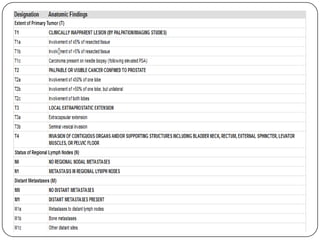
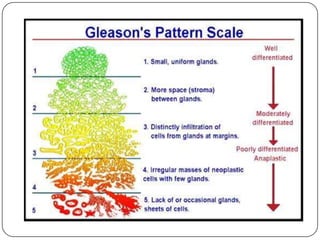
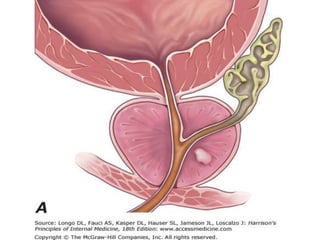
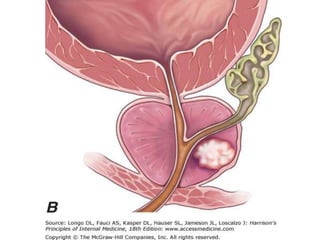
 Grading and Stages
 Investigation
 Management
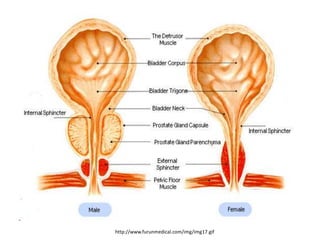
Anatomy &
Histology of
Prostate Gland
http://www.furunmedical.com/img/img17.gif
Figure - Zones of the prostate. The peripheral zone, accounting for of the prostate gland, is the site of origin of ≤ of prostate cancers; the central zone,
approximately of the prostate gland, gives rise to only to of prostate cancers; and the transition zone, ∼ to of the prostate gland, gives rise to of
prostate cancers and is the site of origin of benign prostatic hyperplasia (BPH
(From Green DR, Shabsign R, Scardino PT: Urological ultrasonography. In: Walsh PC, Rettic AB, Stamey CA, Vaughan ED Jr [eds]: Campbells's Textbook of Urology,
th ed. Philadelphia, WB Saunders,
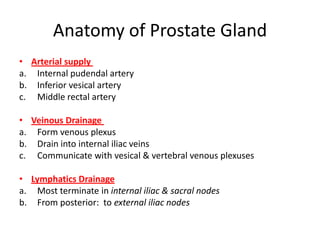
Anatomy of Prostate Gland
• Arterial supply
a. Internal pudendal artery
b. Inferior vesical artery
c. Middle rectal artery
• Veinous Drainage
a. Form venous plexus
b. Drain into internal iliac veins
c. Communicate with vesical & vertebral venous plexuses
• Lymphatics Drainage
a. Most terminate in internal iliac & sacral nodes
b. From posterior: to external iliac nodes
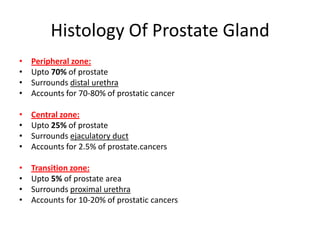
Histology Of Prostate Gland
• Peripheral zone:
• Upto 70% of prostate
• Surrounds distal urethra
• Accounts for 70-80% of prostatic cancer
• Central zone:
• Upto 25% of prostate
• Surrounds ejaculatory duct
• Accounts for 2.5% of prostate.cancers
• Transition zone:
• Upto 5% of prostate area
• Surrounds proximal urethra
• Accounts for 10-20% of prostatic cancers
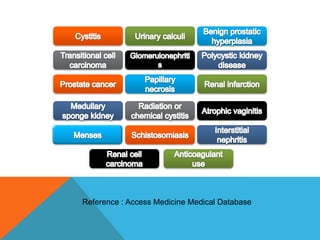
Causes of Hematuria
Reference : Access Medicine Medical Database
Benign Prostatic
Hyperplasia
(In General Overview)
Definition
• Benign prostatic hyperplasia (BPH) is defined
histologically by hyperplasia of both epithelial
and stromal cells, beginning in the
periurethral area. With aging, multiple small
hyperplastic nodules grow, coalesce, and
compress normal tissue outward against the
true prostatic capsule, creating a surgical
capsule that bounds the expanding adenoma.
Figure 91–2 Testosterone (T) diffuses into the prostate epithelial and stromal cell. T can interact directly with the androgen (steroid) receptors bound to the promoter
region of androgen-regulated genes. In the stromal cell a majority of T is converted into dihydrotestosterone (DHT)—a much more potent androgen—which can act in
an autocrine fashion in the stromal cell or in a paracrine fashion by diffusing into epithelial cells in close proximity. DHT produced peripherally, primarily in the skin
and liver, can diffuse into the prostate from the circulation and act in a true endocrine fashion. In some cases the basal cell in the prostate may serve as a DHT
production site, similar to the stromal cell. Autocrine and paracrine growth factors may also be involved in androgen-dependent processes within the prostate.
(From Roehrborn CG. Pathology of benign prostatic hyperplasia. Int J Impot Res 2008;20[Suppl. 3]:S11–8.)
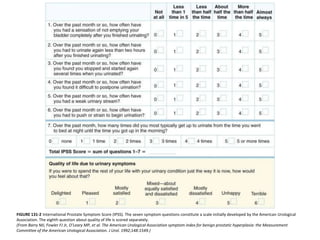
FIGURE 131-2 International Prostate Symptom Score (IPSS). The seven symptom questions constitute a scale initially developed by the American Urological
Association. The eighth question about quality of life is scored separately.
(From Barry MJ, Fowler FJ Jr, O’Leary MP, et al. The American Urological Association symptom index for benign prostatic hyperplasia: the Measurement
Committee of the American Urological Association. J Urol. 1992;148:1549.)
Prostatic
Adenocarcinoma:
Definition
Overview
• Prostate cancer is the most common
noncutaneous malignant neoplasm in men in
the United States, where it results in about
32,000 deaths each year, making it the second
most common cause of cancer death in men.
Prostate cancer is a single histologic disease
with marked clinical heterogeneity ranging
from indolent, clinically irrelevant disease to a
virulent, rapidly lethal phenotype.
Reference: www.uptodate.com
Prostatic
Adenocarcinoma:
Etiology & RF
RF
• Age
• Race (polymorphism of the X-linked AR gene )
• Hormone levels (High Androgens)
• Environmental variables
• Familial prostate cancers (germline mutations of
BRCA2)
• Animal fat — A diet high in animal fat may be an
important factor in the development of prostate cancer
• Vegetables — A diet low in vegetables may be another
risk factor for prostate cancer
Reference: www.uptodate.com
Pathophysiology
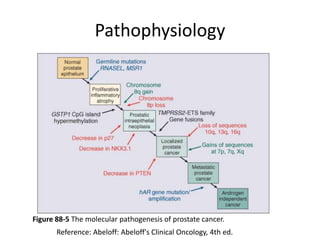
Pathophysiology
Figure 88-5 The molecular pathogenesis of prostate cancer.
Reference: Abeloff: Abeloff's Clinical Oncology, 4th ed.
Prostatic
Adenocarcinoma:
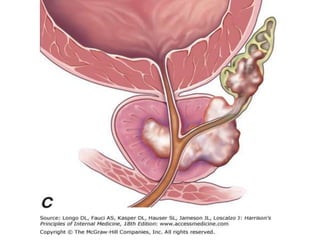
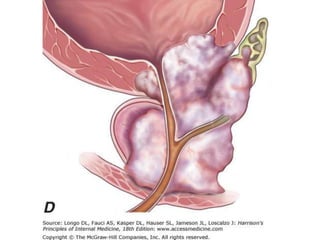
Clinical Presentation
+
Metastasis
Clinical Presentation
• Most men with early stage prostate cancer have no symptoms
attributable to the cancer.
• Urinary frequency, urgency, nocturia, and hesitancy are seen
commonly but are usually related to a concomitant benign prostate
enlargement.
• Hematuria and hematospermia are uncommon presentations of
prostate cancer but their presence in older men should prompt
consideration of prostate cancer in the differential diagnosis. These
symptoms are also present in men with benign prostatic
hyperplasia (BPH) and are more likely to be caused by BPH than
cancer.
• Bone pain may be the presenting symptom in men with metastatic
disease but an initial diagnosis when bone metastases are present
has become unusual
Reference: www.uptodate.com
Metastasis
Metastases first spread via lymphatics:
• initially to the obturator nodes
• eventually to the para-aortic nodes
Hematogenous spread occurs mainly to the
bones.
Reference: Dr Mamlook Lecture
S & S of Spinal cord
compression
Vertebral metastases are a particularly common
site of metastatic disease in men with advanced
prostate cancer.
Pain is usually the first symptom of spinal cord
compression, and this generally precedes the
development of other symptoms by weeks or even
months.
Symptoms occurring later can include motor
weakness, sensory findings, bowel and bladder
dysfunction, and ataxia
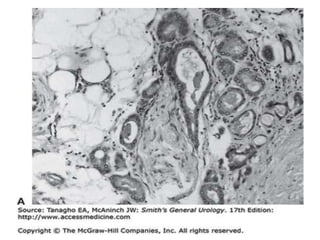
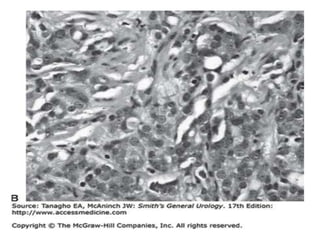
Grading & Staging
Investigations
Investigations of Prostate Cancer
 Serum Tumor Markers
 Miscellaneous laboratory testing (BUN,
Creatinine, AP)
 Prostate biopsy
 IMAGING TESTS
- Transrectal ultrasonography
- MRI
- Radionuclide bone scan (Bony Metastasis)
Reference: CURRENT Medical Dx & Tx > Chapter 39. Cancer
Management
Treatment of Prostate Cancer
 Radical Prostatectomy (seminal vesicles,
prostate, and ampullae of the vas deferens are
removed).
 Radiation Therapy
 Surveillance
 Cryosurgery
 Combination therapy (androgen deprivation
combined with surgery or irradiation)
Reference: CURRENT Medical Dx & Tx > Chapter 39. Cancer
Thank You
d0pa@hotmail.com
@AbdulazizEnazi

Prostate Cancer

  • 1.
    PROSTATE CANCER Mr.Abdulaziz R.Alanzi Medical Student, Al-Imam University Riyadh – Saudi Arabia
  • 2.
    Objectives 1. Anatomy &Histology of Prostate Gland 2. Causes of Hematuria 3. Benign Prostatic Hyperplasia (In General Overview) 4. Prostatic Adenocarcinoma:  Definition  Etiology & Risk Factors  Pathophysiology  Clinical Presentation (Common metastasis)  S&S of Spinal Cord :  Grading and Stages  Investigation  Management
  • 3.
  • 4.
  • 5.
    Figure - Zonesof the prostate. The peripheral zone, accounting for of the prostate gland, is the site of origin of ≤ of prostate cancers; the central zone, approximately of the prostate gland, gives rise to only to of prostate cancers; and the transition zone, ∼ to of the prostate gland, gives rise to of prostate cancers and is the site of origin of benign prostatic hyperplasia (BPH (From Green DR, Shabsign R, Scardino PT: Urological ultrasonography. In: Walsh PC, Rettic AB, Stamey CA, Vaughan ED Jr [eds]: Campbells's Textbook of Urology, th ed. Philadelphia, WB Saunders,
  • 6.
    Anatomy of ProstateGland • Arterial supply a. Internal pudendal artery b. Inferior vesical artery c. Middle rectal artery • Veinous Drainage a. Form venous plexus b. Drain into internal iliac veins c. Communicate with vesical & vertebral venous plexuses • Lymphatics Drainage a. Most terminate in internal iliac & sacral nodes b. From posterior: to external iliac nodes
  • 7.
    Histology Of ProstateGland • Peripheral zone: • Upto 70% of prostate • Surrounds distal urethra • Accounts for 70-80% of prostatic cancer • Central zone: • Upto 25% of prostate • Surrounds ejaculatory duct • Accounts for 2.5% of prostate.cancers • Transition zone: • Upto 5% of prostate area • Surrounds proximal urethra • Accounts for 10-20% of prostatic cancers
  • 8.
  • 9.
    Reference : AccessMedicine Medical Database
  • 10.
  • 11.
    Definition • Benign prostatichyperplasia (BPH) is defined histologically by hyperplasia of both epithelial and stromal cells, beginning in the periurethral area. With aging, multiple small hyperplastic nodules grow, coalesce, and compress normal tissue outward against the true prostatic capsule, creating a surgical capsule that bounds the expanding adenoma.
  • 12.
    Figure 91–2 Testosterone(T) diffuses into the prostate epithelial and stromal cell. T can interact directly with the androgen (steroid) receptors bound to the promoter region of androgen-regulated genes. In the stromal cell a majority of T is converted into dihydrotestosterone (DHT)—a much more potent androgen—which can act in an autocrine fashion in the stromal cell or in a paracrine fashion by diffusing into epithelial cells in close proximity. DHT produced peripherally, primarily in the skin and liver, can diffuse into the prostate from the circulation and act in a true endocrine fashion. In some cases the basal cell in the prostate may serve as a DHT production site, similar to the stromal cell. Autocrine and paracrine growth factors may also be involved in androgen-dependent processes within the prostate. (From Roehrborn CG. Pathology of benign prostatic hyperplasia. Int J Impot Res 2008;20[Suppl. 3]:S11–8.)
  • 13.
    FIGURE 131-2 InternationalProstate Symptom Score (IPSS). The seven symptom questions constitute a scale initially developed by the American Urological Association. The eighth question about quality of life is scored separately. (From Barry MJ, Fowler FJ Jr, O’Leary MP, et al. The American Urological Association symptom index for benign prostatic hyperplasia: the Measurement Committee of the American Urological Association. J Urol. 1992;148:1549.)
  • 14.
  • 15.
    Overview • Prostate canceris the most common noncutaneous malignant neoplasm in men in the United States, where it results in about 32,000 deaths each year, making it the second most common cause of cancer death in men. Prostate cancer is a single histologic disease with marked clinical heterogeneity ranging from indolent, clinically irrelevant disease to a virulent, rapidly lethal phenotype. Reference: www.uptodate.com
  • 16.
  • 17.
    RF • Age • Race(polymorphism of the X-linked AR gene ) • Hormone levels (High Androgens) • Environmental variables • Familial prostate cancers (germline mutations of BRCA2) • Animal fat — A diet high in animal fat may be an important factor in the development of prostate cancer • Vegetables — A diet low in vegetables may be another risk factor for prostate cancer Reference: www.uptodate.com
  • 18.
  • 19.
    Pathophysiology Figure 88-5 Themolecular pathogenesis of prostate cancer. Reference: Abeloff: Abeloff's Clinical Oncology, 4th ed.
  • 20.
  • 21.
    Clinical Presentation • Mostmen with early stage prostate cancer have no symptoms attributable to the cancer. • Urinary frequency, urgency, nocturia, and hesitancy are seen commonly but are usually related to a concomitant benign prostate enlargement. • Hematuria and hematospermia are uncommon presentations of prostate cancer but their presence in older men should prompt consideration of prostate cancer in the differential diagnosis. These symptoms are also present in men with benign prostatic hyperplasia (BPH) and are more likely to be caused by BPH than cancer. • Bone pain may be the presenting symptom in men with metastatic disease but an initial diagnosis when bone metastases are present has become unusual Reference: www.uptodate.com
  • 22.
    Metastasis Metastases first spreadvia lymphatics: • initially to the obturator nodes • eventually to the para-aortic nodes Hematogenous spread occurs mainly to the bones. Reference: Dr Mamlook Lecture
  • 23.
    S & Sof Spinal cord compression
  • 24.
    Vertebral metastases area particularly common site of metastatic disease in men with advanced prostate cancer. Pain is usually the first symptom of spinal cord compression, and this generally precedes the development of other symptoms by weeks or even months. Symptoms occurring later can include motor weakness, sensory findings, bowel and bladder dysfunction, and ataxia
  • 25.
  • 35.
  • 36.
    Investigations of ProstateCancer  Serum Tumor Markers  Miscellaneous laboratory testing (BUN, Creatinine, AP)  Prostate biopsy  IMAGING TESTS - Transrectal ultrasonography - MRI - Radionuclide bone scan (Bony Metastasis) Reference: CURRENT Medical Dx & Tx > Chapter 39. Cancer
  • 37.
  • 38.
    Treatment of ProstateCancer  Radical Prostatectomy (seminal vesicles, prostate, and ampullae of the vas deferens are removed).  Radiation Therapy  Surveillance  Cryosurgery  Combination therapy (androgen deprivation combined with surgery or irradiation) Reference: CURRENT Medical Dx & Tx > Chapter 39. Cancer
  • 39.

Editor's Notes