What is Prostate Cancer The most common type of cancer in men and second most frequent cause of cancer-related death in men Prostate cancer  occurs when cells in the prostate gland grow out of control. Some prostate cancers grow very slowly and may not cause problems for years There are often no early prostate cancer symptoms, but some men have urinary symptoms and discomfort.
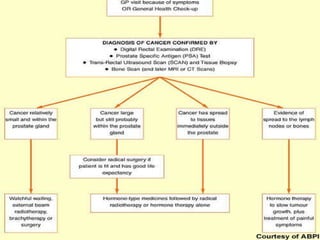
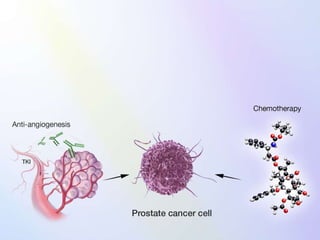
Treatment Options Prostate cancer treatment options are  Surgery,  Chemotherapy,  Cryotherapy,  Hormonal therapy,  “ Watchful waiting."
 
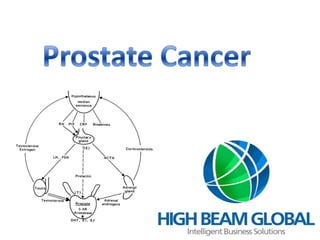
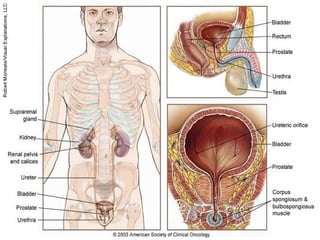
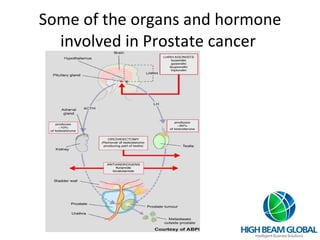
Some of the organs and hormone involved in Prostate cancer
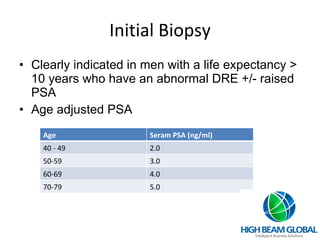
Initial Biopsy Clearly indicated in men with a life expectancy > 10 years who have an abnormal DRE +/- raised PSA Age adjusted PSA Age Seram PSA (ng/ml) 40 - 49 2.0 50-59 3.0 60-69 4.0 70-79 5.0
 
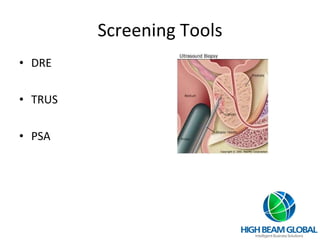
Screening Tools DRE  TRUS  PSA
Symptoms A frequent need to urinate, especially at night. Difficulty starting or stopping the urinary stream. A weak or interrupted urinary stream. A painful or burning sensation during urination or ejaculation. Blood in urine or semen .
Symptoms  of advanced Prostate cancer Symptoms of advanced prostate cancer include: Dull, incessant deep pain or stiffness in the pelvis, lower back, ribs or upper thighs; arthritic pain in the bones of those areas. Loss of weight and appetite, fatigue, nausea, or vomiting. Swelling of the lower extremities
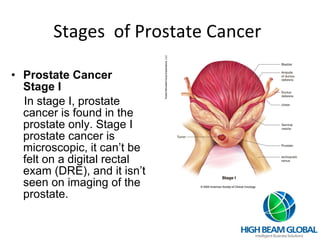
Stages  of Prostate Cancer Prostate Cancer Stage I In stage I, prostate cancer is found in the prostate only. Stage I prostate cancer is microscopic, it can’t be felt on a digital rectal exam (DRE), and it isn’t seen on imaging of the prostate.
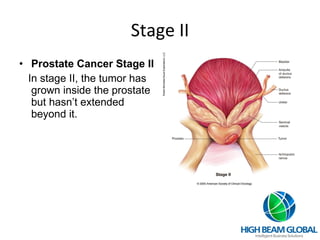
Stage II Prostate Cancer Stage II In stage II, the tumor has grown inside the prostate but hasn’t extended beyond it.
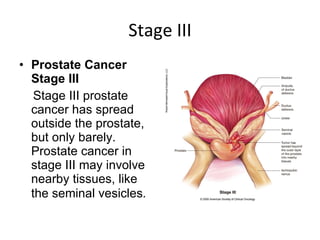
Stage III Prostate Cancer Stage III Stage III prostate cancer has spread outside the prostate, but only barely. Prostate cancer in stage III may involve nearby tissues, like the seminal vesicles .
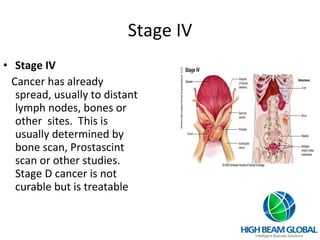
Stage IV Stage IV  Cancer has already spread, usually to distant lymph nodes, bones or other  sites.  This is usually determined by bone scan, Prostascint scan or other studies. Stage D cancer is not curable but is treatable
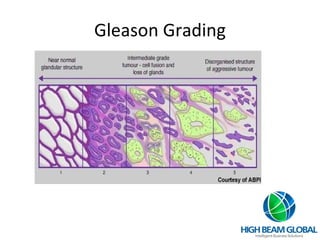
Tumor Grading  When prostate cancer is found in a biopsy, it will be graded to estimate how quickly it is likely to grow and spread.  The most commonly used prostate cancer grading system, called  Gleason grading
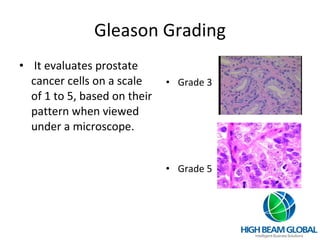
Gleason Grading It evaluates prostate cancer cells on a scale of 1 to 5, based on their pattern when viewed under a microscope. Grade 3 Grade 5
Gleason Grading
Treatment The  choice of what type of therapy is appropriate for a patient with Prostate Cancer is dependant on many factors including:  the  Gleason Grade; the  Stage  of the cancer; the patient's  age ;  the patients  medical condition ;  and the patient's  desires .
Types of treatment On the basis of symptoms treatment is given to the patient like: Radical Prostatectomy  External-beam Radiation Brachytherapy Cryotherapy PVP Hormonal Therapy
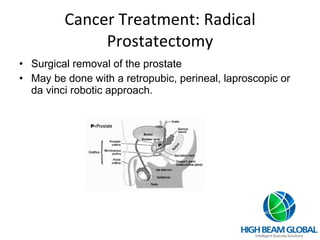
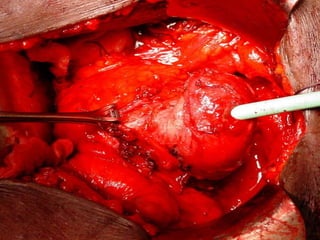
Cancer Treatment: Radical Prostatectomy Surgical removal of the prostate May be done with a retropubic, perineal, laproscopic or da vinci robotic approach.
 
 
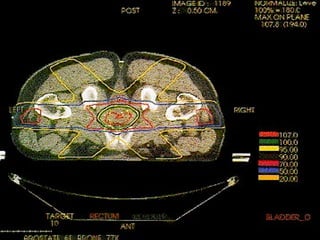
Cancer Treatment: External-beam Radiation Radiation to the prostate from outside the body Evidence that higher doses are associated with better efficacy Newer techniques (such as 3-D conformal, Intensity Modulated Radiation Therapy (IMRT), Stereotactic Radio surgery (SRS) and Stereotactic Radiotherapy (SRT) ) hope to increase radiation delivery and to decrease toxicity.
 
Cancer Treatment: Brachytherapy Radiation implants placed directly into the prostate under ultrasound or ct guidance Very high dose radiation to the prostate with little radiation outside the prostatic bed Procedure completed in one day.
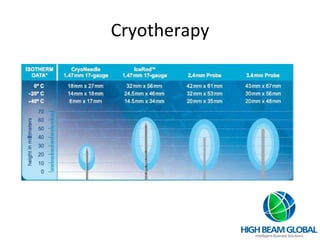
Cancer Treatment: Cryotherapy The goal of cryotherapy is to eradicate prostate cancer by freezing the prostate gland. Cryotherapy uses ultra-thin needles to produce ice balls of extreme sub-zero temperatures. The doctor uses ultrasound to accurately guide insertion of the needles, precisely control the size and shape of the ice balls and monitor the freezing and destroys the entire prostate.
Cryotherapy
Hormonal Therapy Hormonal Therapy  is based on the fact that prostate cancer cells frequently use the male hormone, testosterone, as "fertilizer", and the absence of testosterone leads to the death or weakening, (apoptosis),  of many, but not all, prostate cancer cells.
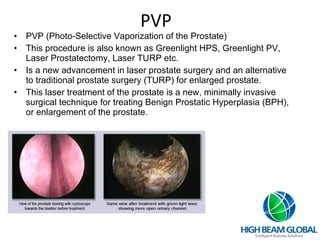
PVP PVP (Photo-Selective Vaporization of the Prostate)  This procedure is also known as Greenlight HPS, Greenlight PV, Laser Prostatectomy, Laser TURP etc.  Is a new advancement in laser prostate surgery and an alternative to traditional prostate surgery (TURP) for enlarged prostate.  This laser treatment of the prostate is a new, minimally invasive surgical technique for treating Benign Prostatic Hyperplasia (BPH), or enlargement of the prostate.
 
High Beam Global  209, Udyog Vihar, Phase – 1, Gurgaon.  Phone: +91-124-4824560 Fax: +91-124-4824550 E-mail:   info@medicalfacilitiesinindia.com  [email_address] Web address:  www.highbeamglobal.com

Prostate Cancer

  • 1.
  • 2.
    What is ProstateCancer The most common type of cancer in men and second most frequent cause of cancer-related death in men Prostate cancer occurs when cells in the prostate gland grow out of control. Some prostate cancers grow very slowly and may not cause problems for years There are often no early prostate cancer symptoms, but some men have urinary symptoms and discomfort.
  • 3.
    Treatment Options Prostatecancer treatment options are Surgery, Chemotherapy, Cryotherapy, Hormonal therapy, “ Watchful waiting."
  • 4.
  • 5.
    Some of theorgans and hormone involved in Prostate cancer
  • 6.
    Initial Biopsy Clearlyindicated in men with a life expectancy > 10 years who have an abnormal DRE +/- raised PSA Age adjusted PSA Age Seram PSA (ng/ml) 40 - 49 2.0 50-59 3.0 60-69 4.0 70-79 5.0
  • 7.
  • 8.
  • 9.
    Symptoms A frequentneed to urinate, especially at night. Difficulty starting or stopping the urinary stream. A weak or interrupted urinary stream. A painful or burning sensation during urination or ejaculation. Blood in urine or semen .
  • 10.
    Symptoms ofadvanced Prostate cancer Symptoms of advanced prostate cancer include: Dull, incessant deep pain or stiffness in the pelvis, lower back, ribs or upper thighs; arthritic pain in the bones of those areas. Loss of weight and appetite, fatigue, nausea, or vomiting. Swelling of the lower extremities
  • 11.
    Stages ofProstate Cancer Prostate Cancer Stage I In stage I, prostate cancer is found in the prostate only. Stage I prostate cancer is microscopic, it can’t be felt on a digital rectal exam (DRE), and it isn’t seen on imaging of the prostate.
  • 12.
    Stage II ProstateCancer Stage II In stage II, the tumor has grown inside the prostate but hasn’t extended beyond it.
  • 13.
    Stage III ProstateCancer Stage III Stage III prostate cancer has spread outside the prostate, but only barely. Prostate cancer in stage III may involve nearby tissues, like the seminal vesicles .
  • 14.
    Stage IV StageIV Cancer has already spread, usually to distant lymph nodes, bones or other  sites.  This is usually determined by bone scan, Prostascint scan or other studies. Stage D cancer is not curable but is treatable
  • 15.
    Tumor Grading When prostate cancer is found in a biopsy, it will be graded to estimate how quickly it is likely to grow and spread. The most commonly used prostate cancer grading system, called Gleason grading
  • 16.
    Gleason Grading Itevaluates prostate cancer cells on a scale of 1 to 5, based on their pattern when viewed under a microscope. Grade 3 Grade 5
  • 17.
  • 18.
    Treatment The  choiceof what type of therapy is appropriate for a patient with Prostate Cancer is dependant on many factors including: the Gleason Grade; the Stage of the cancer; the patient's age ; the patients medical condition ; and the patient's desires .
  • 19.
    Types of treatmentOn the basis of symptoms treatment is given to the patient like: Radical Prostatectomy External-beam Radiation Brachytherapy Cryotherapy PVP Hormonal Therapy
  • 20.
    Cancer Treatment: RadicalProstatectomy Surgical removal of the prostate May be done with a retropubic, perineal, laproscopic or da vinci robotic approach.
  • 21.
  • 22.
  • 23.
    Cancer Treatment: External-beamRadiation Radiation to the prostate from outside the body Evidence that higher doses are associated with better efficacy Newer techniques (such as 3-D conformal, Intensity Modulated Radiation Therapy (IMRT), Stereotactic Radio surgery (SRS) and Stereotactic Radiotherapy (SRT) ) hope to increase radiation delivery and to decrease toxicity.
  • 24.
  • 25.
    Cancer Treatment: BrachytherapyRadiation implants placed directly into the prostate under ultrasound or ct guidance Very high dose radiation to the prostate with little radiation outside the prostatic bed Procedure completed in one day.
  • 26.
    Cancer Treatment: CryotherapyThe goal of cryotherapy is to eradicate prostate cancer by freezing the prostate gland. Cryotherapy uses ultra-thin needles to produce ice balls of extreme sub-zero temperatures. The doctor uses ultrasound to accurately guide insertion of the needles, precisely control the size and shape of the ice balls and monitor the freezing and destroys the entire prostate.
  • 27.
  • 28.
    Hormonal Therapy HormonalTherapy is based on the fact that prostate cancer cells frequently use the male hormone, testosterone, as "fertilizer", and the absence of testosterone leads to the death or weakening, (apoptosis),  of many, but not all, prostate cancer cells.
  • 29.
    PVP PVP (Photo-SelectiveVaporization of the Prostate) This procedure is also known as Greenlight HPS, Greenlight PV, Laser Prostatectomy, Laser TURP etc. Is a new advancement in laser prostate surgery and an alternative to traditional prostate surgery (TURP) for enlarged prostate. This laser treatment of the prostate is a new, minimally invasive surgical technique for treating Benign Prostatic Hyperplasia (BPH), or enlargement of the prostate.
  • 30.
  • 31.
    High Beam Global 209, Udyog Vihar, Phase – 1, Gurgaon. Phone: +91-124-4824560 Fax: +91-124-4824550 E-mail: info@medicalfacilitiesinindia.com [email_address] Web address: www.highbeamglobal.com