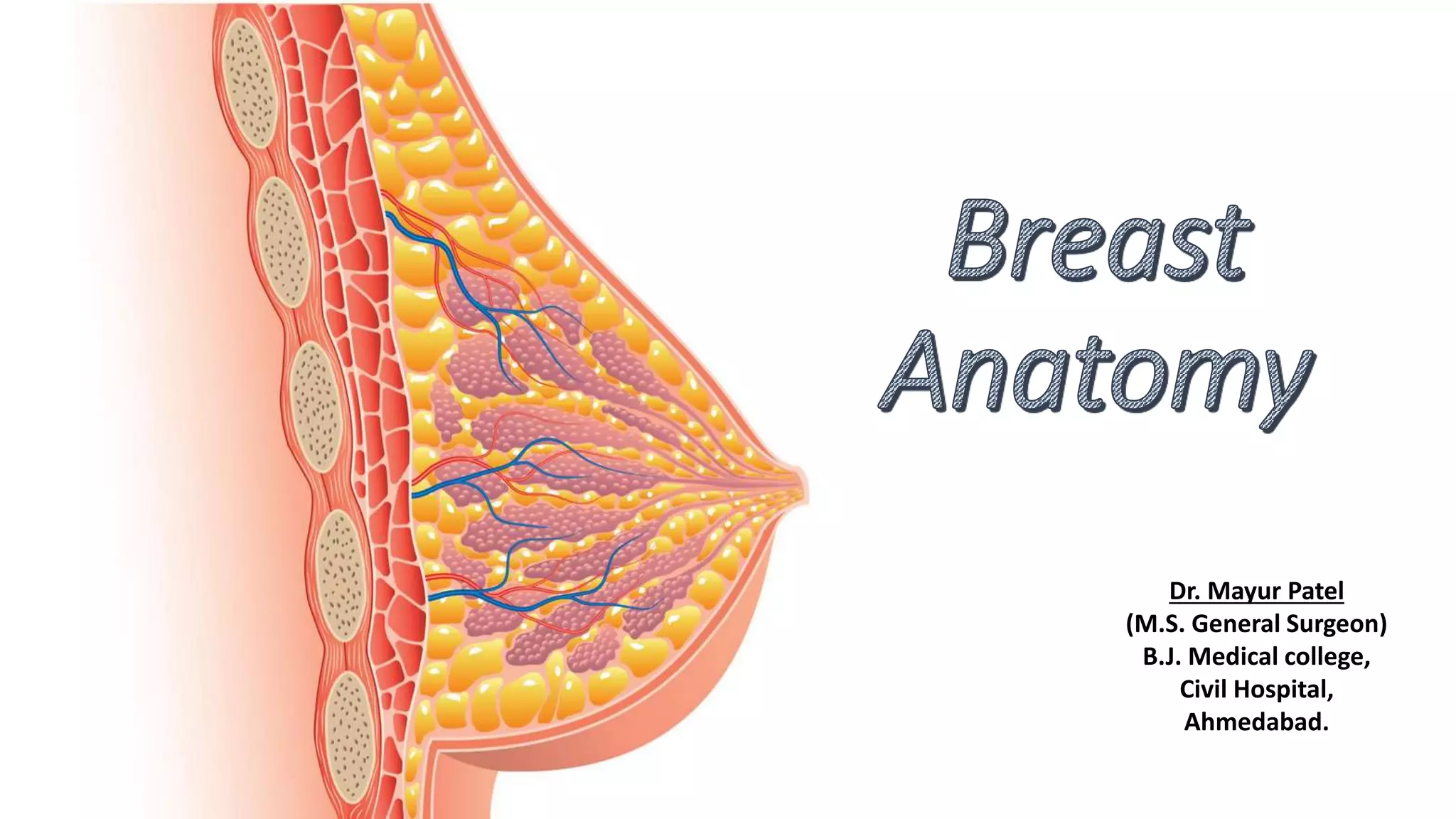
Dr. Mayur Patel
(M.S. General Surgeon)
B.J. Medical college,
Civil Hospital,
Ahmedabad.
Introduction
• Latin word Breast = Mammary gland.
• Modified sweat gland.
• Accessory organ of female reproduction system.
Situation and extend
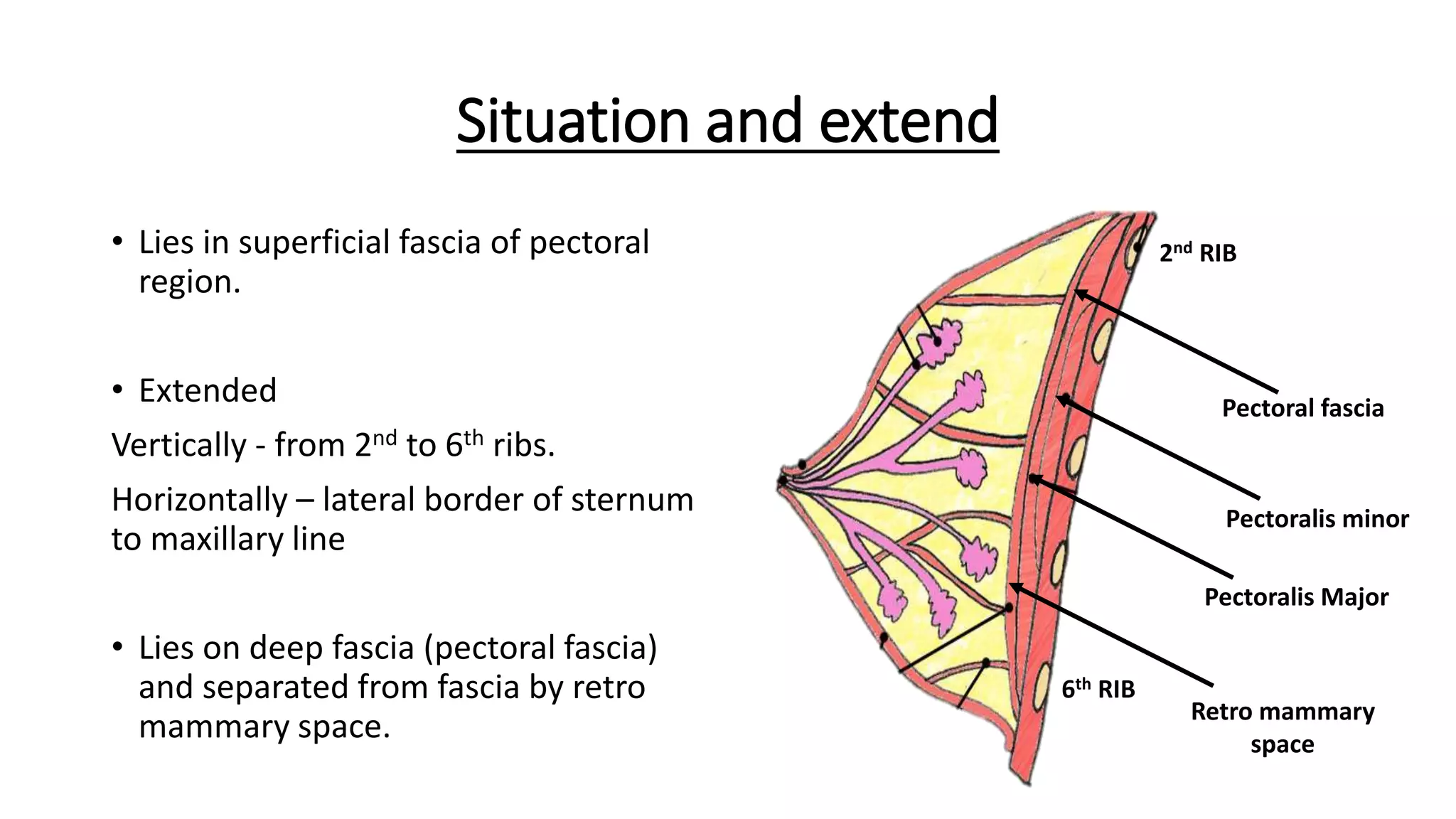
• Lies in superficial fascia of pectoral
region.
• Extended
Vertically - from 2nd to 6th ribs.
Horizontally – lateral border of sternum
to maxillary line
• Lies on deep fascia (pectoral fascia)
and separated from fascia by retro
mammary space.
2nd RIB
6th RIB
Pectoral fascia
Pectoralis minor
Pectoralis Major
Retro mammary
space
Situation and extend
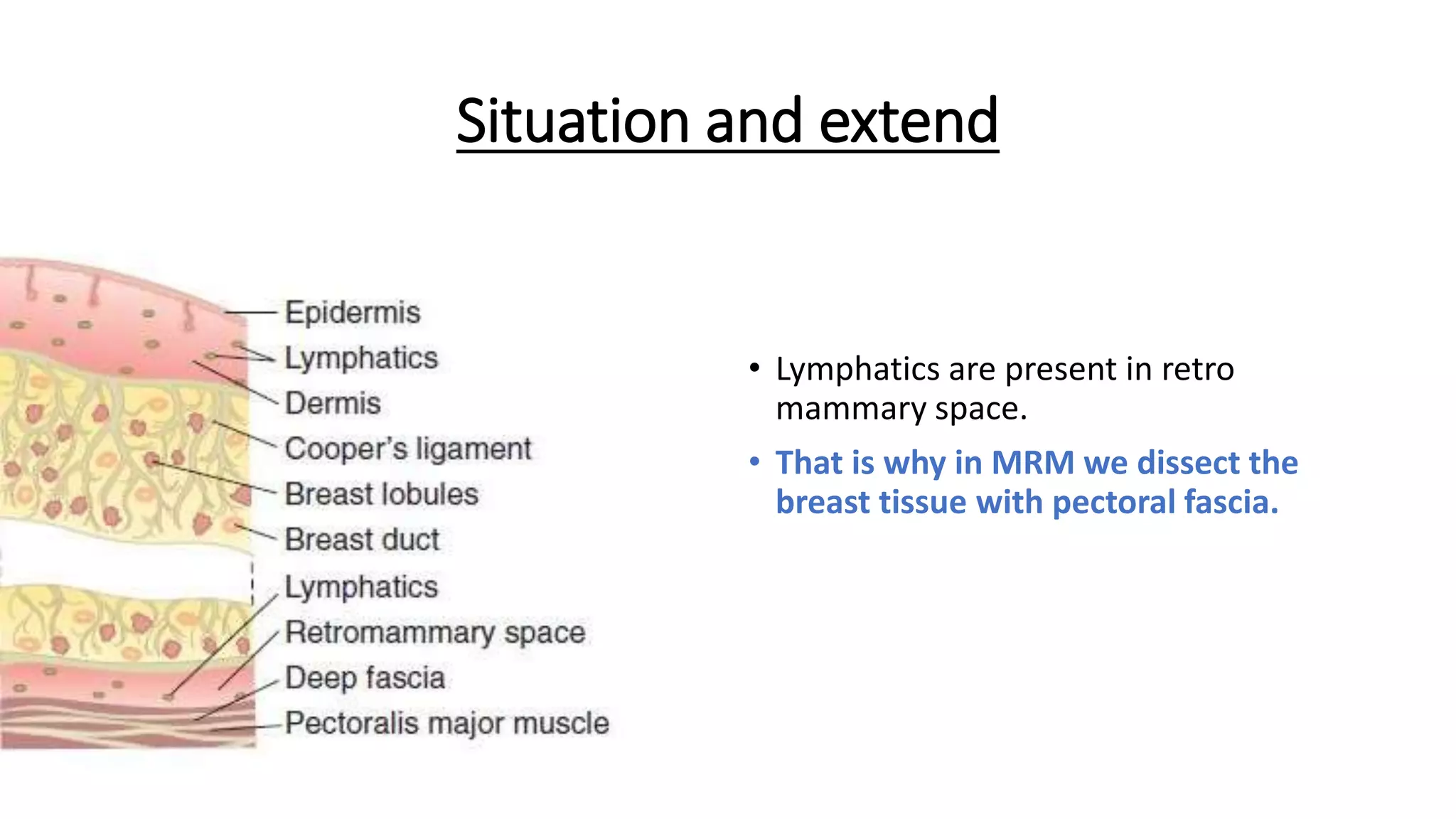
• Lymphatics are present in retro
mammary space.
• That is why in MRM we dissect the
breast tissue with pectoral fascia.
Situation and extend
• Breast is divided in four quadrants
1. Upper inner
2. Upper outer
3. Lower outer
4. Lower inner
• Nipple areola complex should be
mentioned separately while
describing breast examination.
Situation and extend
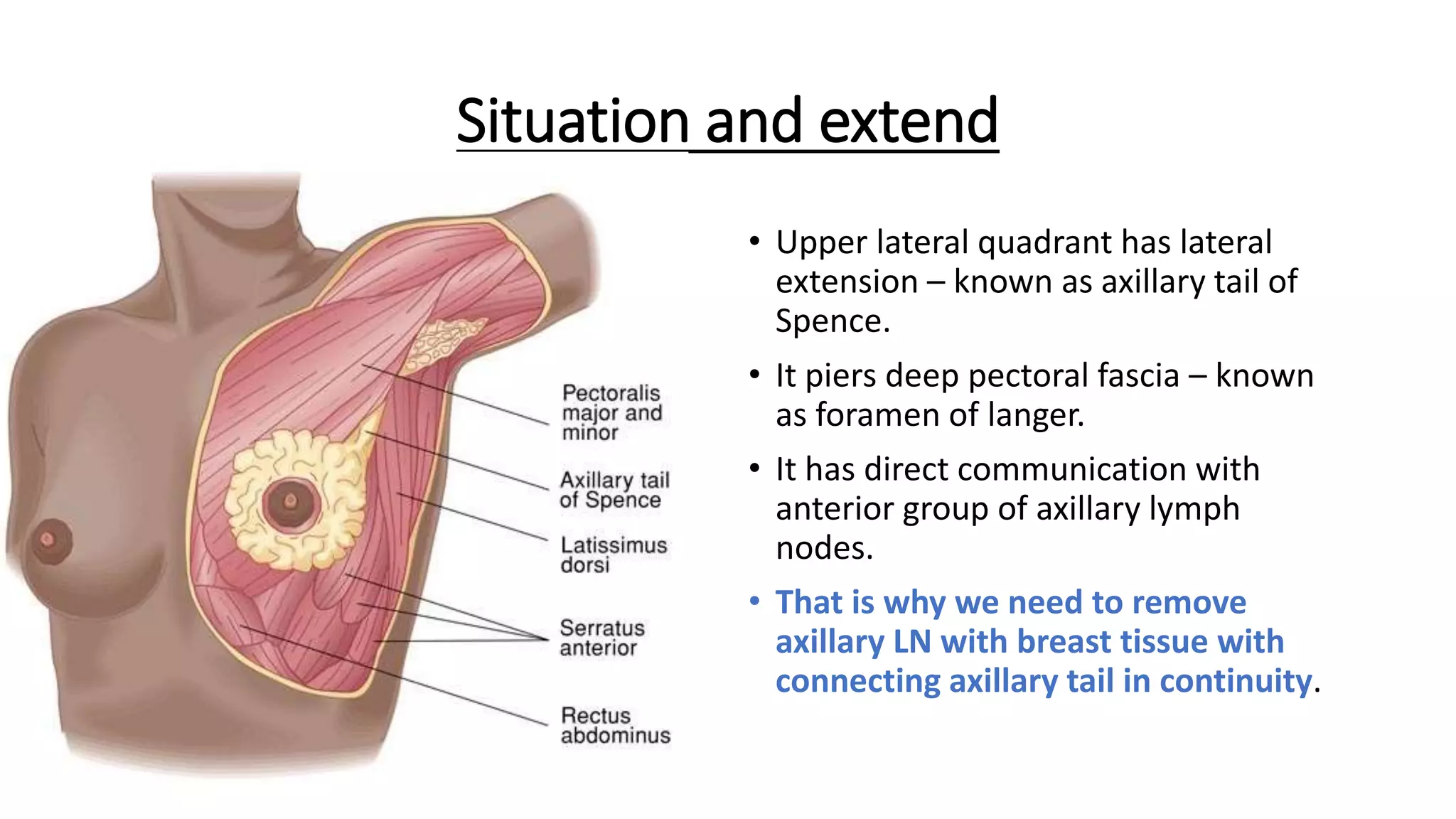
• Upper lateral quadrant has lateral
extension – known as axillary tail of
Spence.
• It piers deep pectoral fascia – known
as foramen of langer.
• It has direct communication with
anterior group of axillary lymph
nodes.
• That is why we need to remove
axillary LN with breast tissue with
connecting axillary tail in continuity.
Structure of breast
• It can be divided in 3 components
1. Skin with nipple areola
2. Parenchyma
3. Stroma
Structure of breast
• Nipple
- A conical projection
- Present just below the centre of the
breast at the level of the fourth
intercostal space 10 cm from the midline.
- The nipple is pierced by 15 to 20
lactiferous ducts.
- It contains circular and longitudinal
smooth muscle fibres which can make the
nipple stiff or flatten it, respectively.
- It has a few modified sweat and
sebaceous glands.
Structure of breast
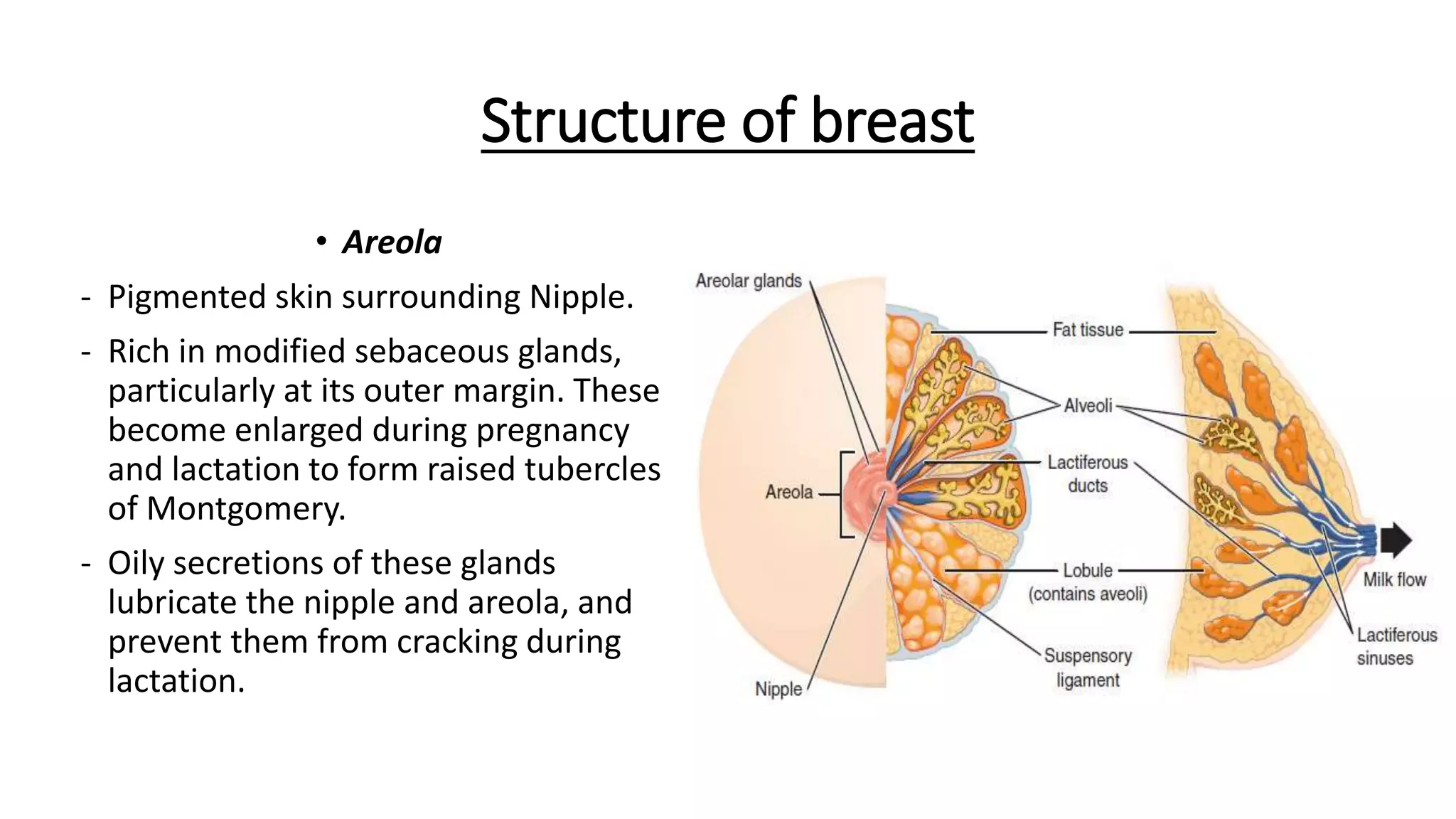
• Areola
- Pigmented skin surrounding Nipple.
- Rich in modified sebaceous glands,
particularly at its outer margin. These
become enlarged during pregnancy
and lactation to form raised tubercles
of Montgomery.
- Oily secretions of these glands
lubricate the nipple and areola, and
prevent them from cracking during
lactation.
Structure of breast
• Areola
- Apart from sebaceous glands, the
areola also contains some sweat
glands, and accessory mammary
glands.
- The skin of the areola and nipple is
devoid of hair, and there is no fat
subjacent to it.
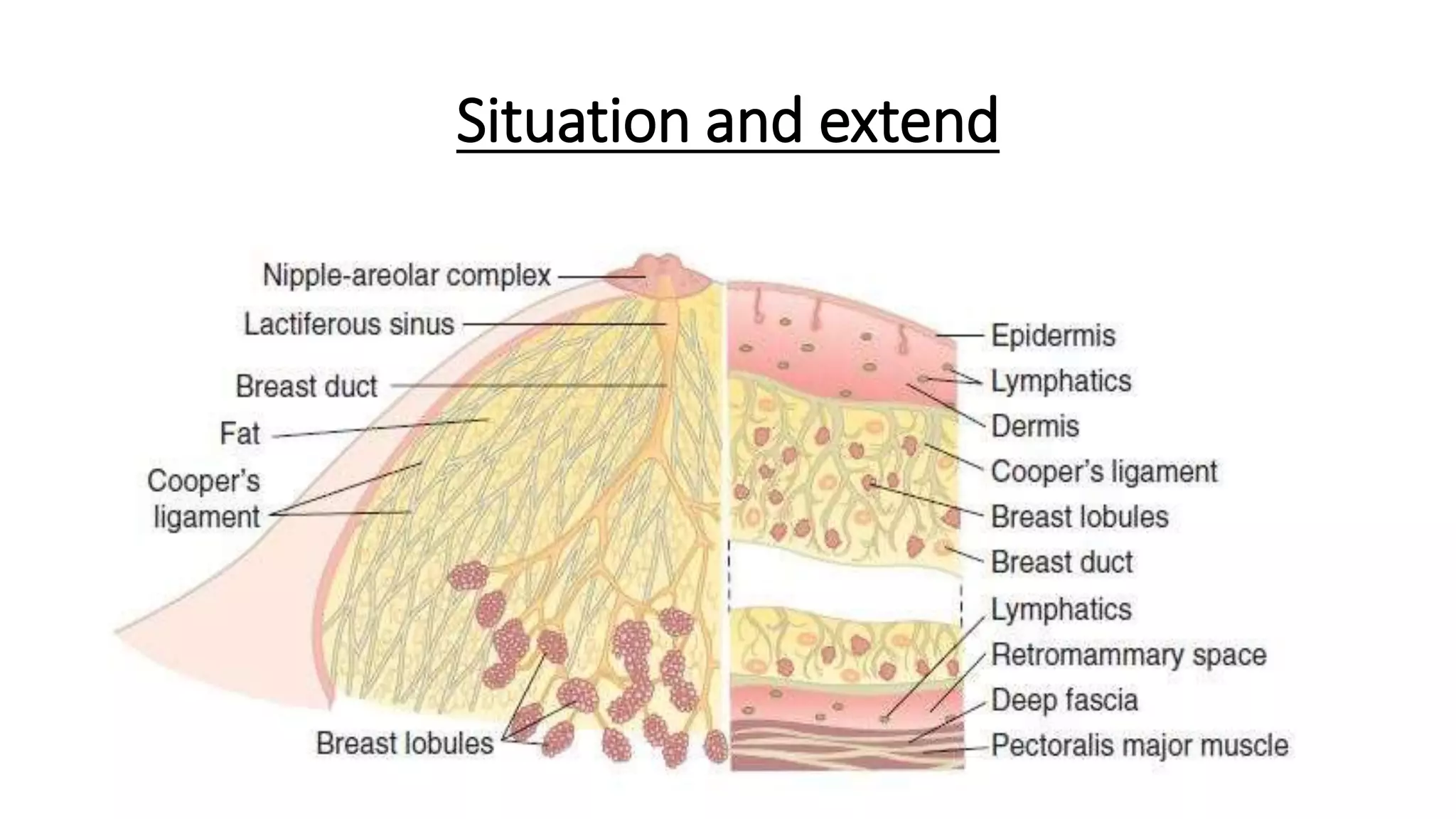
- Below the areola lie lactiferous sinus
where stored milk is seen.
Structure of breast
• Langer’ lines
- Circumareolar incision  Webster’s
incision
- Submammary incision  Galliard
Thomas incision
- In upper quadrants – Incision if away
from NAC then it should be along the
langer’s line
- But in lower quadrants – it should be
radial to prevent NAC displacement
downward.
Structure of breast
• Parenchyma
- It is a compound tubulo-alveolar gland
which secretes milk.
- The gland consists of 15 to 20 lobes.
- Each lobe is a cluster of alveoli, and is
drained by a lactiferous duct.
- The lactiferous ducts converge
towards the nipple and open on it.
- Near its termination each duct has a
dilatation called a lactiferous sinus
Structure of breast
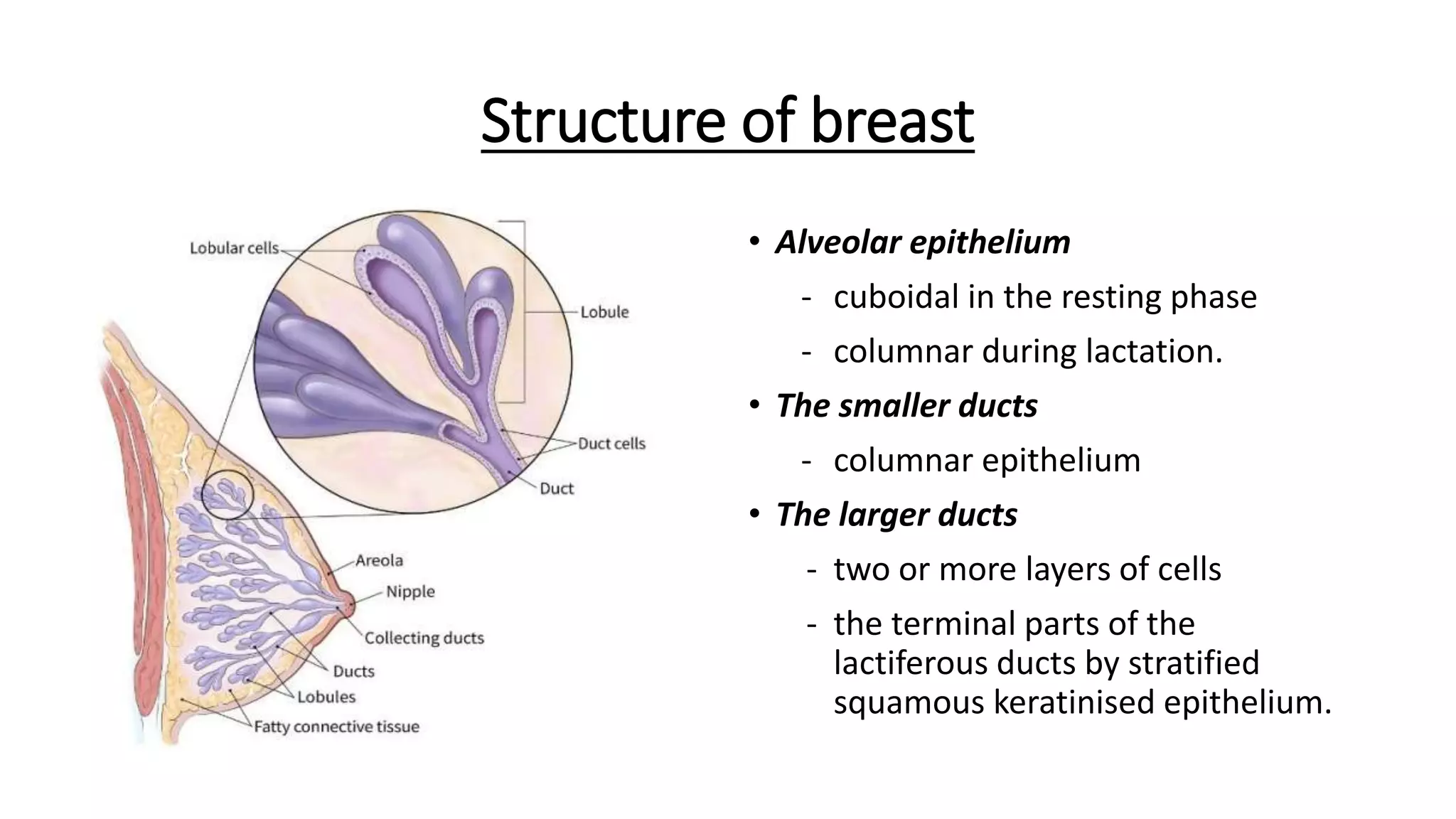
• Alveolar epithelium
- cuboidal in the resting phase
- columnar during lactation.
• The smaller ducts
- columnar epithelium
• The larger ducts
- two or more layers of cells
- the terminal parts of the
lactiferous ducts by stratified
squamous keratinised epithelium.
Structure of breast
• The passage of the milk from the
alveoli into and along the ducts is
facilitated by contraction of
myoepitheliocytes, which are found
around the alveoli and around the
ducts, lying between the epithelium
and the basement membrane.
Structure of breast
• Stroma
- Stroma forms the supporting
framework of the gland.
- It is partly fibrous and partly fatty.
- There are fibrous bands that provide
structural support and insert
perpendicularly into the dermis,
termed the suspensory ligaments of
Cooper.
That is why if involvement of cooper’s
ligament  skin retraction
Blood supply
• The mammary gland is
extremely vascular.
1. Internal thoracic artery, a
branch of the subclavian
artery, through its perforating
branches.
2. The lateral thoracic, superior
thoracic and acromiothoracic
(thoracoacromial) branches of
the axillary artery.
3. Lateral branches of the
posterior intercostal arteries.
Blood supply
• The mammary gland is
extremely vascular.
1. Internal thoracic artery, a
branch of the subclavian
artery, through its perforating
branches.
2. The lateral thoracic, superior
thoracic and acromiothoracic
(thoracoacromial) branches of
the axillary artery.
3. Lateral branches of the
posterior intercostal arteries.
Blood supply
First Part –
• Origin to Medial border of scalene
anterior
1. Vertebral artery
2. Internal thoracic artery  Continue
as superior epigastric artery.
3. Thyrocervical trunk
Second Part –
• Behind scalene anterior
1. Costocervical trunk
Third Part –
• Lateral border of scalene anterior and
medial border of first rib.
1. Dorsal scapular artery.
Subclavian artery
Blood supply
Blood supply
First Part –
• Superior to the pectoralis minor
1. Superior thoracic artery (Supreme
thoracic artery)
Second Part –
• Posterior to the pectoralis minor
1. Thoraco-acromian artery
2. Lateral thoracic artery
Third Part –
• Inferior to the pectoralis minor.
1. Subscapular artery
2. Anterior circumflex humoral artery
3. Posterior circumflex humoral artery
Axillary artery
Blood supply
Lymphatic drainage
• Specialized lymphatic channels
collect under the nipple and areola
and form Sappey’s plexus.
75% axillary nodes
20% internal mammary nodes
5% posterior intercostal nodes
Lymphatic drainage
Breast lymph
Anterior and
Posterior group
Central and
Lateral group
Supraclavicular group
Apical group
Lymphatic drainage
• The lymphatics from the deep
surface of the breast pass through
the pectoralis major muscle and the
clavipectoral fascia to reach the
apical nodes, and also to the internal
mammary nodes.
Lymphatic drainage
• Lymphatics from the lower and inner
quadrants of the breast may
communicate with the sub
diaphragmatic and sub peritoneal
lymph plexuses after crossing the
costal margin and then piercing the
anterior abdominal wall through the
upper part of the linea alba.
Lymphatic drainage
• Three anatomic levels defined by their
relationship to the pectoralis minor
muscle.
1. Level I nodes are located lateral to
the lateral border of the pectoralis
minor muscle.
2. Level II nodes are located posterior
to the pectoralis minor muscle.
3. Level III nodes include the sub
clavicular nodes medial to the
pectoralis minor muscle.
Lymphatic drainage
• The anterior (pectoral) group lie along
the lateral thoracic vessels.
• The posterior (scapular) group lie
along the subscapular vessels.
• The lateral group lie along the upper
part of the numerus, medial to the
axillary vein.
• The central group lie in the fat of the
upper axilla.
• The apical (infraclaaicular) group lie
deep to the clavipectoral fascia, along
the axillary vessels.
Lymphatic drainage
• Lymph nodes in the space between
the pectoralis major and minor
muscles are termed the interpectoral
group, or Rotter’s nodes.

Breast Anatomy

  • 1.
    Dr. Mayur Patel (M.S.General Surgeon) B.J. Medical college, Civil Hospital, Ahmedabad.
  • 2.
    Introduction • Latin wordBreast = Mammary gland. • Modified sweat gland. • Accessory organ of female reproduction system.
  • 3.
    Situation and extend •Lies in superficial fascia of pectoral region. • Extended Vertically - from 2nd to 6th ribs. Horizontally – lateral border of sternum to maxillary line • Lies on deep fascia (pectoral fascia) and separated from fascia by retro mammary space. 2nd RIB 6th RIB Pectoral fascia Pectoralis minor Pectoralis Major Retro mammary space
  • 4.
  • 5.
    Situation and extend •Lymphatics are present in retro mammary space. • That is why in MRM we dissect the breast tissue with pectoral fascia.
  • 6.
    Situation and extend •Breast is divided in four quadrants 1. Upper inner 2. Upper outer 3. Lower outer 4. Lower inner • Nipple areola complex should be mentioned separately while describing breast examination.
  • 7.
    Situation and extend •Upper lateral quadrant has lateral extension – known as axillary tail of Spence. • It piers deep pectoral fascia – known as foramen of langer. • It has direct communication with anterior group of axillary lymph nodes. • That is why we need to remove axillary LN with breast tissue with connecting axillary tail in continuity.
  • 8.
    Structure of breast •It can be divided in 3 components 1. Skin with nipple areola 2. Parenchyma 3. Stroma
  • 9.
    Structure of breast •Nipple - A conical projection - Present just below the centre of the breast at the level of the fourth intercostal space 10 cm from the midline. - The nipple is pierced by 15 to 20 lactiferous ducts. - It contains circular and longitudinal smooth muscle fibres which can make the nipple stiff or flatten it, respectively. - It has a few modified sweat and sebaceous glands.
  • 10.
    Structure of breast •Areola - Pigmented skin surrounding Nipple. - Rich in modified sebaceous glands, particularly at its outer margin. These become enlarged during pregnancy and lactation to form raised tubercles of Montgomery. - Oily secretions of these glands lubricate the nipple and areola, and prevent them from cracking during lactation.
  • 11.
    Structure of breast •Areola - Apart from sebaceous glands, the areola also contains some sweat glands, and accessory mammary glands. - The skin of the areola and nipple is devoid of hair, and there is no fat subjacent to it. - Below the areola lie lactiferous sinus where stored milk is seen.
  • 12.
    Structure of breast •Langer’ lines - Circumareolar incision  Webster’s incision - Submammary incision  Galliard Thomas incision - In upper quadrants – Incision if away from NAC then it should be along the langer’s line - But in lower quadrants – it should be radial to prevent NAC displacement downward.
  • 13.
    Structure of breast •Parenchyma - It is a compound tubulo-alveolar gland which secretes milk. - The gland consists of 15 to 20 lobes. - Each lobe is a cluster of alveoli, and is drained by a lactiferous duct. - The lactiferous ducts converge towards the nipple and open on it. - Near its termination each duct has a dilatation called a lactiferous sinus
  • 14.
    Structure of breast •Alveolar epithelium - cuboidal in the resting phase - columnar during lactation. • The smaller ducts - columnar epithelium • The larger ducts - two or more layers of cells - the terminal parts of the lactiferous ducts by stratified squamous keratinised epithelium.
  • 15.
    Structure of breast •The passage of the milk from the alveoli into and along the ducts is facilitated by contraction of myoepitheliocytes, which are found around the alveoli and around the ducts, lying between the epithelium and the basement membrane.
  • 16.
    Structure of breast •Stroma - Stroma forms the supporting framework of the gland. - It is partly fibrous and partly fatty. - There are fibrous bands that provide structural support and insert perpendicularly into the dermis, termed the suspensory ligaments of Cooper. That is why if involvement of cooper’s ligament  skin retraction
  • 17.
    Blood supply • Themammary gland is extremely vascular. 1. Internal thoracic artery, a branch of the subclavian artery, through its perforating branches. 2. The lateral thoracic, superior thoracic and acromiothoracic (thoracoacromial) branches of the axillary artery. 3. Lateral branches of the posterior intercostal arteries.
  • 18.
    Blood supply • Themammary gland is extremely vascular. 1. Internal thoracic artery, a branch of the subclavian artery, through its perforating branches. 2. The lateral thoracic, superior thoracic and acromiothoracic (thoracoacromial) branches of the axillary artery. 3. Lateral branches of the posterior intercostal arteries.
  • 19.
    Blood supply First Part– • Origin to Medial border of scalene anterior 1. Vertebral artery 2. Internal thoracic artery  Continue as superior epigastric artery. 3. Thyrocervical trunk Second Part – • Behind scalene anterior 1. Costocervical trunk Third Part – • Lateral border of scalene anterior and medial border of first rib. 1. Dorsal scapular artery. Subclavian artery
  • 20.
  • 21.
    Blood supply First Part– • Superior to the pectoralis minor 1. Superior thoracic artery (Supreme thoracic artery) Second Part – • Posterior to the pectoralis minor 1. Thoraco-acromian artery 2. Lateral thoracic artery Third Part – • Inferior to the pectoralis minor. 1. Subscapular artery 2. Anterior circumflex humoral artery 3. Posterior circumflex humoral artery Axillary artery
  • 22.
  • 23.
    Lymphatic drainage • Specializedlymphatic channels collect under the nipple and areola and form Sappey’s plexus. 75% axillary nodes 20% internal mammary nodes 5% posterior intercostal nodes
  • 24.
    Lymphatic drainage Breast lymph Anteriorand Posterior group Central and Lateral group Supraclavicular group Apical group
  • 25.
    Lymphatic drainage • Thelymphatics from the deep surface of the breast pass through the pectoralis major muscle and the clavipectoral fascia to reach the apical nodes, and also to the internal mammary nodes.
  • 26.
    Lymphatic drainage • Lymphaticsfrom the lower and inner quadrants of the breast may communicate with the sub diaphragmatic and sub peritoneal lymph plexuses after crossing the costal margin and then piercing the anterior abdominal wall through the upper part of the linea alba.
  • 27.
    Lymphatic drainage • Threeanatomic levels defined by their relationship to the pectoralis minor muscle. 1. Level I nodes are located lateral to the lateral border of the pectoralis minor muscle. 2. Level II nodes are located posterior to the pectoralis minor muscle. 3. Level III nodes include the sub clavicular nodes medial to the pectoralis minor muscle.
  • 28.
    Lymphatic drainage • Theanterior (pectoral) group lie along the lateral thoracic vessels. • The posterior (scapular) group lie along the subscapular vessels. • The lateral group lie along the upper part of the numerus, medial to the axillary vein. • The central group lie in the fat of the upper axilla. • The apical (infraclaaicular) group lie deep to the clavipectoral fascia, along the axillary vessels.
  • 29.
    Lymphatic drainage • Lymphnodes in the space between the pectoralis major and minor muscles are termed the interpectoral group, or Rotter’s nodes.