HISTAMINE
(AUTOCOIDS)
BY
B.BHUVANESWARI
M.PHARM (PHARMACOLOGY)
K.M. COLLEGE OF PHARMACY
CONTENT:
INTRODUCTION
CHEMISTRY
SOURCES OF HISTAMINE
BIOSYNTHESIS OF HISTAMINE
MECHANISM OF ACTION
CLASSIFICATION
PHYSIOLOGICAL ROLE
PATHOLOGICAL ROLE
AGONIST
ANTAGONIST
USES
SUMMARY
INTRODUCTION:
• Histamine is naturally occurring imidazole derivative.
• It is a potent biogenic amine.
• It is widely distributed in skin, GIT mucosa, lungs, brain, cerebrospinal
fluid and bone marrow.
• It is also distributed in plant and animal tissues.
• It is also present in the venom of bees and wasps.
CHEMISTRY:
• IUPAC NAME: 2-(1H-imidazol-5-yl)ethanamine
• STRUCTURE:
SOURCES OF HISTAMINE:
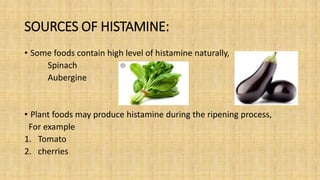
• Some foods contain high level of histamine naturally,
Spinach
Aubergine
• Plant foods may produce histamine during the ripening process,
For example
1. Tomato
2. cherries
CONTD..
• FERMENTED BEVERAGES
wine
beer, ale, lager, etc
• FRUITS
Citrus stone fruits dates
berries pine apple currants
• VEGETABLES
Pumpkin red bean
soya bean
SYNTHESIS OF HISTAMINE:
STORAGE AND RELEASE OF HISTAMINE:
• Histamine is mostly present in storage granules of mast cells and in
white blood cells (Leukocytes) .
• Non mast cell histamine is found in several tissues, including the
brain, where it functions as a neurotransmitter.
• Another important site of histamine storage and release is the
enterochromaffin-like (ECL) cell of the stomach.
• Histamine release occurs when allergens bind to mast cell- bound IgE
antibodies. Reduction of IgE Overproduction may lower the likelihood
of allergens finding sufficient free IgE to trigger a mast cell release of
histamine.
CLASSFICATION OF HISTAMINE:
HISTAMINERGIC AGONISTS
NON SELECTIVE
AGONISTS(H1+H2+H3) SELECTIVE H1 AGONISTS SELECTIVE H2 AGONISTS SELECTIVE H3 AGONISTS
 Histamine
 Betahistine
 2-methyl histamine
 2-pyridyl ethylamine
 2-thizolyl ethylamine
 Dimaprit
 Impromidine
 (R) α- Methylhistamine
 Imetit
CONTD..
H1 antagonists(conventional
anti histaminics)
HIGHLY SEDATIVE
Diphenhydramine
Dimenhydrinate
Promethazine
hydroxyzine
MODERATELY SEDATIVE
Pheniramine
Cyproheptadine
Meclozine
cinnarizine
MILDLY SEDATIVE
Chlorpheniramine
Dexchlorpheniramine
Tripolidine
clemastine
SECOND GENERATION
(NONSEDATING) ANTI HISTAMINICS
Fexofenadine
Loratidine
Desloratidine
Cetrizine
Levocetrizine
ebastine
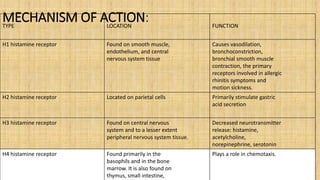
MECHANISM OF ACTION:TYPE LOCATION FUNCTION
H1 histamine receptor Found on smooth muscle,
endothelium, and central
nervous system tissue
Causes vasodilation,
bronchoconstriction,
bronchial smooth muscle
contraction, the primary
receptors involved in allergic
rhinitis symptoms and
motion sickness.
H2 histamine receptor Located on parietal cells Primarily stimulate gastric
acid secretion
H3 histamine receptor Found on central nervous
system and to a lesser extent
peripheral nervous system tissue.
Decreased neurotransmitter
release: histamine,
acetylcholine,
norepinephrine, serotonin
H4 histamine receptor Found primarily in the
basophils and in the bone
marrow. It is also found on
thymus, small intestine,
Plays a role in chemotaxis.
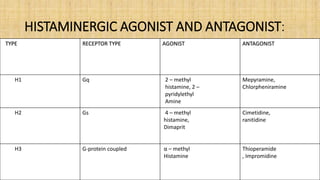
HISTAMINERGIC AGONIST AND ANTAGONIST:
TTYPE RECEPTOR TYPE AGONIST ANTAGONIST
H1 Gq 2 – methyl
histamine, 2 –
pyridylethyl
Amine
Mepyramine,
Chlorpheniramine
H2 Gs 4 – methyl
histamine,
Dimaprit
Cimetidine,
ranitidine
H3 G-protein coupled α – methyl
Histamine
Thioperamide
, Impromidine
PHARMACOLOGICAL ACTIONS OF HISTAMINE:
BLOOD VESSELS:
Dilation of small blood vessels, larger arteries and veins are
contracted mediated by H1.
HEART:
Heart rate and force of contraction are increased (H2) and negative
dromotropic (slowing of A-V Conduction ) (H1).
VISCERAL SMOOTH MUSCLES:
H1 mediated contraction & H2 mediated relaxation is also seen.
CONTD…
GLANDS:
Increased in gastric secretion mediated by increased cAMP generation through
H2 receptors.
SENSORY NERVE ENDINGS:
Itching when injected via i.v. Higher concentrations cause pain.
AUTONOMIC GANGLIA AND ADRENAL MEDULLA:
Stimulated and release adrenaline and cause rise in B.P.
CNS:
Cannot penetrate BBB. Intracerebroventricular administration cause rise in B.P.
Cardiac stimulation, Hypothermia, ADH release. These effects are both by H1 & H2
receptors.
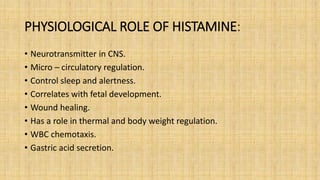
PHYSIOLOGICAL ROLE OF HISTAMINE:
• Neurotransmitter in CNS.
• Micro – circulatory regulation.
• Control sleep and alertness.
• Correlates with fetal development.
• Wound healing.
• Has a role in thermal and body weight regulation.
• WBC chemotaxis.
• Gastric acid secretion.
PATHOLOGICAL ROLE OF HISTAMINE:
 Cellular mediator of immediate hypersensitivity reaction and acute
inflammatory response.
 Anaphylaxis
 Seasonal allergies
 Duodenal ulcers
 Gastrinoma (Zollinger–Ellison Syndrome)
 Systemic mastocytosis.
AGONIST OF HISTAMINE:
NON SELECTIVE AGONISTS:
E.g Betahistine - Trade name :Serc
MOA:
 It is a full agonist on the H1 receptors located on blood vessels in the
inner ear. It gives rise to local vasodilation and increased permeability,
which helps to reverse the underlying problem of endolymphatic
hydrops.
 Betahistine seems to dilate the blood vessels within the inner ear
which can relieve pressure from excess fluid and act on the smooth
muscle.
SIDE EFFECTS:
• Headache
• Low level of gastric side effects
• Rash
• Itching
• Diarrhea
• Indigestion
• Fast heart beat
CONTRAINDICATIONS::
• Pheochromocytoma
• Bronchial asthma
• Peptic ulcer
• Gastroesophageal reflux disease
USES:
• Meniere’s disease
which is a disorder in the inner ear that causes vertigo and hearing
problem.
SELECTIVE H2 AGONISTS:
E.g Dimaprit, impromidine
MOA:
It is a highly potent and specific histamine h2 receptor agonist.
USES:
Used as a gastric acid secretion indicator.
SELECTIVE H3 AGONIST:
E.G (R) α – methyl histamine , imetit
MOA:
Drugs that bind to and activate histamine receptors.
USES:
It reduces the symptom of AR.
ANTAGONIST OF HISTAMINE:
1. HIGHLY SEDATIVE
E.g diphenhydramine, dimenhydrinate, promethazine ,hydroxyzine
MOA: DIPHENHYDRAMINE (BENADRYL)
• Diphenhydramine also acts as an intracellular sodium channel
blocker, which is responsible for its actions as a local
anesthetic.
It also crosses the blood–brain barrier and inversely agonizes
the H1 receptors centrally. Its effects on central H1 receptors
cause drowsiness.
SIDE EFFECTS:
• drowsiness
• Dizziness
• Constipation
• Stomach upset
• Blurred vision
CONTRAINDICATIONS:
• Overactive thyroid gland.
• Increased pressure in the eye.
• Closed angle glaucoma.
• High blood pressure.
• Stenosing peptic ulcer.
USES:
• Allergy
• Hay fever
• Common cold
2. MODERATELY SEDATIVE:
E.g , pheniramine, cyproheptadine, meclozine, cinnarizine
MOA: (PHENIRAMINE – T.N = AVIL)
• Antihistamines suppress the histamine-induced wheal(swelling) and
flare( vasodilation) response by blocking the binding of histamine to
its receptor on nerves ,vascular smooth muscle, glandular cells,
endothelium, and mast cells.
• They effectively exert competitive antagonism of histamine for h1
receptors.
SIDE EFFECTS:
• Drowsiness
• Bradycardia
• Sleep disorders
• People combining with cortisol in the long term should avoid pheniramine.
why?
(Ans) as it decreases the level of adrenaline..
so what happens?
Leads to loss of consciousness…………………………..
USES:
• Hay fever
• Runny nose
• Itching skin
• Skin rashes
• Also for meniere’s disease
• Travel sickness
MILDLY SEDATIVE:
E.g chlorpheniramine, dexchlorpheniramine, tripolidine , clemastine
MOA: CHLORPHENIRAMINE(CHLOR-TRIMETON)
• Chlorpheniramine acts primarily as a potent h1 antihistamine.
• It is specifically potent inverse agonist of the histamine h1 receptor.
SIDE EFFECTS:
• Drowsiness
• Confusion
• Constipation
• Dry mouth
USES:
• Runny nose
• Sneezing
• Itching
• Watery eyes
• Common cold
• SECOND GENERATION ANTI HISTAMINICS:
E.g fexofenadine, loratadine, cetirizine, levocetrizine,desloratadine
MOA: ( CETRIZINE) - ZYRTEC
• It blocks the a certain natural substance (histamine) that your body makes
during an allergic reaction.
SIDE EFFECTS:
• Dizziness
• Drowsiness
• Dry mouth
• Nausea
• constipation
USES:
• Watery eyes
• Running nose
• Sneezing
• urticaria
• Itching nose/eyes
CLINICAL USES of HISTAMINES:
• A diagnostic agent
• As a positive control injection during allergy skin testing.
• To assess non specific bronchial hyperactivity in asthmatics.
• Histamine aerosol has been used as in” BRONCHO – PROVOCATION
TEST” in pulmonary function laboratories.
• It is for patients with mild, atypical, non-specific symptoms of
bronchial asthma.
CLINICAL USES OF ANTIHISTAMINES:
ALLERGIC DISORDERS:
oThey effectively control certain immediate type of allergies like
itching, urticaria, seasonal hay fever, allergic conjunctivitis ,
angioedema of lips and eyelids etc..
PRURITIS:
oAntihistamines are first choice of drugs in idiopathic pruritus.
• Reduce production of secretion (inhibit mast cell degranulation)
Allergic conjuctivitis
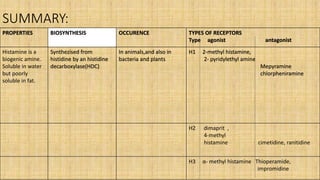
SUMMARY:
PROPERTIES BIOSYNTHESIS OCCURENCE TYPES OF RECEPTORS
Type agonist antagonist
Histamine is a
biogenic amine.
Soluble in water
but poorly
soluble in fat.
Synthezised from
histidine by an histidine
decarboxylase(HDC)
In animals,and also in
bacteria and plants
H1 2-methyl histamine,
2- pyridylethyl amine
Mepyramine
chlorpheniramine
H2 dimaprit ,
4-methyl
histamine cimetidine, ranitidine
H3 α- methyl histamine Thioperamide,
impromidine
JUST FOR KNOWLEDGE:
• Vitamin C is a natural antihistamine so supplementing 2000mg per
day can be beneficial..
• Natural antihistamine from food is quercetin are citrus fruits, onions,
garlic , apples, tea, tomatoes , berries..
• Avoid fermented foods such as cheese, wine, vinegar, soy sauce as
these contain naturally high levels of histamine...
“STAY HEALTHY BE HAPPY”
Histamine(autocoids)

Histamine(autocoids)

  • 1.
  • 2.
    CONTENT: INTRODUCTION CHEMISTRY SOURCES OF HISTAMINE BIOSYNTHESISOF HISTAMINE MECHANISM OF ACTION CLASSIFICATION PHYSIOLOGICAL ROLE PATHOLOGICAL ROLE AGONIST ANTAGONIST USES SUMMARY
  • 3.
    INTRODUCTION: • Histamine isnaturally occurring imidazole derivative. • It is a potent biogenic amine. • It is widely distributed in skin, GIT mucosa, lungs, brain, cerebrospinal fluid and bone marrow. • It is also distributed in plant and animal tissues. • It is also present in the venom of bees and wasps.
  • 4.
    CHEMISTRY: • IUPAC NAME:2-(1H-imidazol-5-yl)ethanamine • STRUCTURE:
  • 5.
    SOURCES OF HISTAMINE: •Some foods contain high level of histamine naturally, Spinach Aubergine • Plant foods may produce histamine during the ripening process, For example 1. Tomato 2. cherries
  • 6.
    CONTD.. • FERMENTED BEVERAGES wine beer,ale, lager, etc • FRUITS Citrus stone fruits dates berries pine apple currants • VEGETABLES Pumpkin red bean soya bean
  • 7.
  • 9.
    STORAGE AND RELEASEOF HISTAMINE: • Histamine is mostly present in storage granules of mast cells and in white blood cells (Leukocytes) . • Non mast cell histamine is found in several tissues, including the brain, where it functions as a neurotransmitter. • Another important site of histamine storage and release is the enterochromaffin-like (ECL) cell of the stomach. • Histamine release occurs when allergens bind to mast cell- bound IgE antibodies. Reduction of IgE Overproduction may lower the likelihood of allergens finding sufficient free IgE to trigger a mast cell release of histamine.
  • 10.
    CLASSFICATION OF HISTAMINE: HISTAMINERGICAGONISTS NON SELECTIVE AGONISTS(H1+H2+H3) SELECTIVE H1 AGONISTS SELECTIVE H2 AGONISTS SELECTIVE H3 AGONISTS  Histamine  Betahistine  2-methyl histamine  2-pyridyl ethylamine  2-thizolyl ethylamine  Dimaprit  Impromidine  (R) α- Methylhistamine  Imetit
  • 11.
    CONTD.. H1 antagonists(conventional anti histaminics) HIGHLYSEDATIVE Diphenhydramine Dimenhydrinate Promethazine hydroxyzine MODERATELY SEDATIVE Pheniramine Cyproheptadine Meclozine cinnarizine MILDLY SEDATIVE Chlorpheniramine Dexchlorpheniramine Tripolidine clemastine SECOND GENERATION (NONSEDATING) ANTI HISTAMINICS Fexofenadine Loratidine Desloratidine Cetrizine Levocetrizine ebastine
  • 12.
    MECHANISM OF ACTION:TYPELOCATION FUNCTION H1 histamine receptor Found on smooth muscle, endothelium, and central nervous system tissue Causes vasodilation, bronchoconstriction, bronchial smooth muscle contraction, the primary receptors involved in allergic rhinitis symptoms and motion sickness. H2 histamine receptor Located on parietal cells Primarily stimulate gastric acid secretion H3 histamine receptor Found on central nervous system and to a lesser extent peripheral nervous system tissue. Decreased neurotransmitter release: histamine, acetylcholine, norepinephrine, serotonin H4 histamine receptor Found primarily in the basophils and in the bone marrow. It is also found on thymus, small intestine, Plays a role in chemotaxis.
  • 13.
    HISTAMINERGIC AGONIST ANDANTAGONIST: TTYPE RECEPTOR TYPE AGONIST ANTAGONIST H1 Gq 2 – methyl histamine, 2 – pyridylethyl Amine Mepyramine, Chlorpheniramine H2 Gs 4 – methyl histamine, Dimaprit Cimetidine, ranitidine H3 G-protein coupled α – methyl Histamine Thioperamide , Impromidine
  • 14.
    PHARMACOLOGICAL ACTIONS OFHISTAMINE: BLOOD VESSELS: Dilation of small blood vessels, larger arteries and veins are contracted mediated by H1. HEART: Heart rate and force of contraction are increased (H2) and negative dromotropic (slowing of A-V Conduction ) (H1). VISCERAL SMOOTH MUSCLES: H1 mediated contraction & H2 mediated relaxation is also seen.
  • 15.
    CONTD… GLANDS: Increased in gastricsecretion mediated by increased cAMP generation through H2 receptors. SENSORY NERVE ENDINGS: Itching when injected via i.v. Higher concentrations cause pain. AUTONOMIC GANGLIA AND ADRENAL MEDULLA: Stimulated and release adrenaline and cause rise in B.P. CNS: Cannot penetrate BBB. Intracerebroventricular administration cause rise in B.P. Cardiac stimulation, Hypothermia, ADH release. These effects are both by H1 & H2 receptors.
  • 17.
    PHYSIOLOGICAL ROLE OFHISTAMINE: • Neurotransmitter in CNS. • Micro – circulatory regulation. • Control sleep and alertness. • Correlates with fetal development. • Wound healing. • Has a role in thermal and body weight regulation. • WBC chemotaxis. • Gastric acid secretion.
  • 18.
    PATHOLOGICAL ROLE OFHISTAMINE:  Cellular mediator of immediate hypersensitivity reaction and acute inflammatory response.  Anaphylaxis  Seasonal allergies  Duodenal ulcers  Gastrinoma (Zollinger–Ellison Syndrome)  Systemic mastocytosis.
  • 19.
    AGONIST OF HISTAMINE: NONSELECTIVE AGONISTS: E.g Betahistine - Trade name :Serc MOA:  It is a full agonist on the H1 receptors located on blood vessels in the inner ear. It gives rise to local vasodilation and increased permeability, which helps to reverse the underlying problem of endolymphatic hydrops.  Betahistine seems to dilate the blood vessels within the inner ear which can relieve pressure from excess fluid and act on the smooth muscle.
  • 20.
    SIDE EFFECTS: • Headache •Low level of gastric side effects • Rash • Itching • Diarrhea • Indigestion • Fast heart beat CONTRAINDICATIONS:: • Pheochromocytoma • Bronchial asthma • Peptic ulcer • Gastroesophageal reflux disease
  • 21.
    USES: • Meniere’s disease whichis a disorder in the inner ear that causes vertigo and hearing problem.
  • 22.
    SELECTIVE H2 AGONISTS: E.gDimaprit, impromidine MOA: It is a highly potent and specific histamine h2 receptor agonist. USES: Used as a gastric acid secretion indicator.
  • 23.
    SELECTIVE H3 AGONIST: E.G(R) α – methyl histamine , imetit MOA: Drugs that bind to and activate histamine receptors. USES: It reduces the symptom of AR.
  • 24.
    ANTAGONIST OF HISTAMINE: 1.HIGHLY SEDATIVE E.g diphenhydramine, dimenhydrinate, promethazine ,hydroxyzine MOA: DIPHENHYDRAMINE (BENADRYL) • Diphenhydramine also acts as an intracellular sodium channel blocker, which is responsible for its actions as a local anesthetic. It also crosses the blood–brain barrier and inversely agonizes the H1 receptors centrally. Its effects on central H1 receptors cause drowsiness.
  • 25.
    SIDE EFFECTS: • drowsiness •Dizziness • Constipation • Stomach upset • Blurred vision
  • 26.
    CONTRAINDICATIONS: • Overactive thyroidgland. • Increased pressure in the eye. • Closed angle glaucoma. • High blood pressure. • Stenosing peptic ulcer. USES: • Allergy • Hay fever • Common cold
  • 27.
    2. MODERATELY SEDATIVE: E.g, pheniramine, cyproheptadine, meclozine, cinnarizine MOA: (PHENIRAMINE – T.N = AVIL) • Antihistamines suppress the histamine-induced wheal(swelling) and flare( vasodilation) response by blocking the binding of histamine to its receptor on nerves ,vascular smooth muscle, glandular cells, endothelium, and mast cells. • They effectively exert competitive antagonism of histamine for h1 receptors.
  • 28.
    SIDE EFFECTS: • Drowsiness •Bradycardia • Sleep disorders • People combining with cortisol in the long term should avoid pheniramine. why? (Ans) as it decreases the level of adrenaline.. so what happens? Leads to loss of consciousness…………………………..
  • 29.
    USES: • Hay fever •Runny nose • Itching skin • Skin rashes • Also for meniere’s disease • Travel sickness
  • 30.
    MILDLY SEDATIVE: E.g chlorpheniramine,dexchlorpheniramine, tripolidine , clemastine MOA: CHLORPHENIRAMINE(CHLOR-TRIMETON) • Chlorpheniramine acts primarily as a potent h1 antihistamine. • It is specifically potent inverse agonist of the histamine h1 receptor. SIDE EFFECTS: • Drowsiness • Confusion • Constipation • Dry mouth
  • 31.
    USES: • Runny nose •Sneezing • Itching • Watery eyes • Common cold
  • 32.
    • SECOND GENERATIONANTI HISTAMINICS: E.g fexofenadine, loratadine, cetirizine, levocetrizine,desloratadine MOA: ( CETRIZINE) - ZYRTEC • It blocks the a certain natural substance (histamine) that your body makes during an allergic reaction. SIDE EFFECTS: • Dizziness • Drowsiness • Dry mouth • Nausea • constipation
  • 33.
    USES: • Watery eyes •Running nose • Sneezing • urticaria • Itching nose/eyes
  • 34.
    CLINICAL USES ofHISTAMINES: • A diagnostic agent • As a positive control injection during allergy skin testing. • To assess non specific bronchial hyperactivity in asthmatics. • Histamine aerosol has been used as in” BRONCHO – PROVOCATION TEST” in pulmonary function laboratories. • It is for patients with mild, atypical, non-specific symptoms of bronchial asthma.
  • 35.
    CLINICAL USES OFANTIHISTAMINES: ALLERGIC DISORDERS: oThey effectively control certain immediate type of allergies like itching, urticaria, seasonal hay fever, allergic conjunctivitis , angioedema of lips and eyelids etc.. PRURITIS: oAntihistamines are first choice of drugs in idiopathic pruritus. • Reduce production of secretion (inhibit mast cell degranulation)
  • 36.
  • 37.
    SUMMARY: PROPERTIES BIOSYNTHESIS OCCURENCETYPES OF RECEPTORS Type agonist antagonist Histamine is a biogenic amine. Soluble in water but poorly soluble in fat. Synthezised from histidine by an histidine decarboxylase(HDC) In animals,and also in bacteria and plants H1 2-methyl histamine, 2- pyridylethyl amine Mepyramine chlorpheniramine H2 dimaprit , 4-methyl histamine cimetidine, ranitidine H3 α- methyl histamine Thioperamide, impromidine
  • 38.
    JUST FOR KNOWLEDGE: •Vitamin C is a natural antihistamine so supplementing 2000mg per day can be beneficial.. • Natural antihistamine from food is quercetin are citrus fruits, onions, garlic , apples, tea, tomatoes , berries.. • Avoid fermented foods such as cheese, wine, vinegar, soy sauce as these contain naturally high levels of histamine... “STAY HEALTHY BE HAPPY”