PHIL 160 "Kuhn: Paradigms and Normal Science"
LEARNING OBJECTIVES: Overview of Kuhn’s model of science Kuhn’s description of the first mode: normal science What is a paradigm? What role does a paradigm play in normal science? PHIL 160
Assumption: Science makes steady progress Accretion (as in narrow inductivist view): body of knowledge like a snowball rolling down a hill. Popperian view: eliminate ever more false hypotheses. Either way, assumes scientists are always engaged in the same kind of activity. PHIL 160
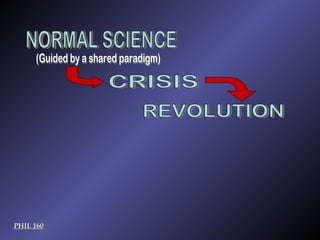
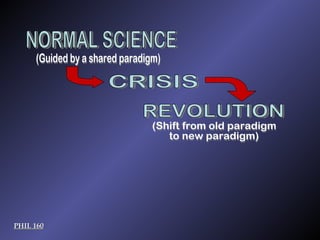
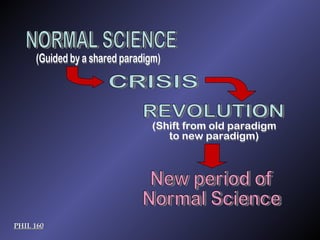
Kuhn: two distinct modes of science. Normal Science Periods of Scientific Revolution Need to understand how these modes differ from each other and how they are connected to each other. What processes move scientists from normal science to a revolution? PHIL 160
Key concept: Paradigms Narrow sense : a particular achievement which suggests a way to investigate the world (e.g., an experiment, a formula, etc.) Broad sense : a package of ideas and methods which make up a world view and a way of doing science PHIL 160
Key concept: Paradigms Paradigms are vital because they provide the framework (shared set of assumptions) for normal science. PHIL 160
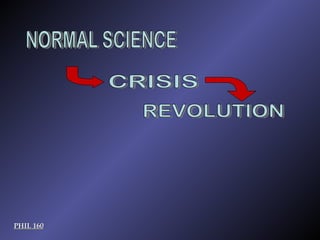
PHIL 160 NORMAL SCIENCE CRISIS REVOLUTION
PHIL 160 NORMAL SCIENCE CRISIS REVOLUTION (Guided by a shared paradigm)
PHIL 160 NORMAL SCIENCE CRISIS REVOLUTION (Shift from old paradigm to new paradigm) (Guided by a shared paradigm)
NORMAL SCIENCE CRISIS REVOLUTION New period of Normal Science (Shift from old paradigm to new paradigm) (Guided by a shared paradigm) PHIL 160
THEORY PHIL 160
THEORY •  What kind of stuff is in the world PHIL 160
THEORY •  What kind of stuff is in the world •  How that stuff evolves over time and interacts PHIL 160
THEORY PARADIGM •  What kind of stuff is in the world •  How that stuff evolves over time and interacts PHIL 160
THEORY PARADIGM •  Ideas about stuff •  What kind of stuff is in the world •  How that stuff evolves over time and interacts PHIL 160
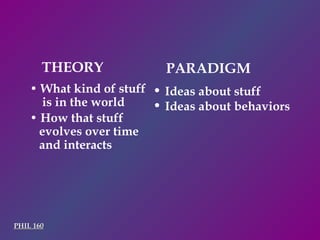
THEORY PARADIGM •  Ideas about stuff •  What kind of stuff is in the world •  Ideas about behaviors •  How that stuff evolves over time and interacts PHIL 160
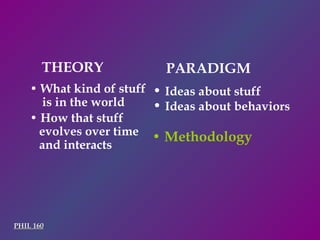
THEORY PARADIGM •  Methodology •  Ideas about stuff •  What kind of stuff is in the world •  Ideas about behaviors •  How that stuff evolves over time and interacts PHIL 160
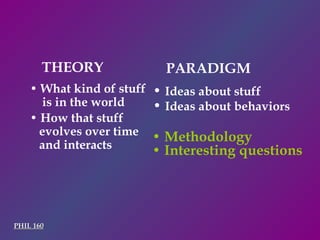
THEORY PARADIGM •  Methodology •  Interesting questions •  Ideas about stuff •  What kind of stuff is in the world •  Ideas about behaviors •  How that stuff evolves over time and interacts PHIL 160
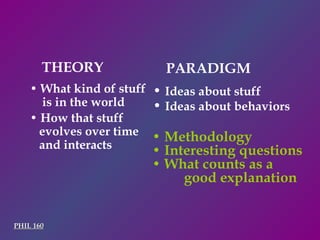
THEORY PARADIGM •  Methodology •  Interesting questions •  What counts as a  good explanation •  Ideas about stuff •  What kind of stuff is in the world •  Ideas about behaviors •  How that stuff evolves over time and interacts PHIL 160
In “Pre-Paradigm” period: No agreement about fundamentals End up debating fundamentals rather than figuring out how to explain, predict, control phenomena of interest Reads like philosophy (which Kuhn says is a bad thing if you’re trying to do science)! PHIL 160
With a shared paradigm, can do science: No more debate about fundamentals Energy focused on using tools from the paradigm to describe, model, or create new phenomena “ Puzzle-solving” PHIL 160
Example: Presocratic theories of matter All is fire All is water All is air Only atoms and empty space (Democritus) Infinitely many stuffs (Anaxagoras) Four-element system (Empedocles) Lots of choices, lots of debate. PHIL 160
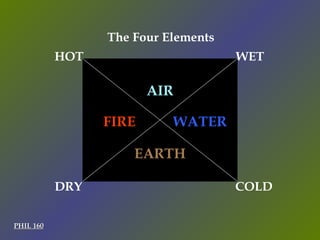
PHIL 160 The Four Elements HOT WET COLD DRY FIRE AIR WATER EARTH
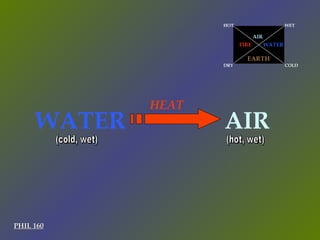
PHIL 160 AIR WATER HEAT (cold, wet) (hot, wet) HOT WET COLD DRY FIRE AIR WATER EARTH
 
 
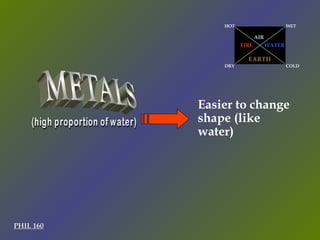
PHIL 160 (high proportion of water) METALS Easier to change shape (like water) HOT WET COLD DRY FIRE AIR WATER EARTH
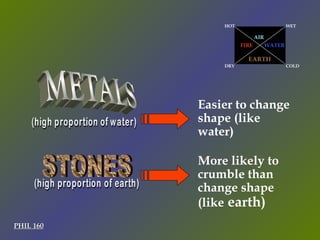
PHIL 160 Easier to change shape (like water) (high proportion of water) METALS STONES (high proportion of earth) More likely to crumble than change shape (like  earth) HOT WET COLD DRY FIRE AIR WATER EARTH
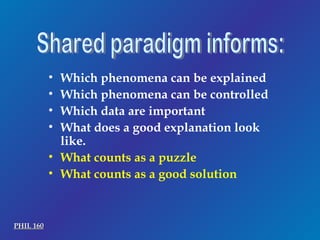
Shared paradigm informs: Which phenomena can be explained Which phenomena can be controlled Which data are important What does a good explanation look like. What counts as a puzzle What counts as a good solution PHIL 160
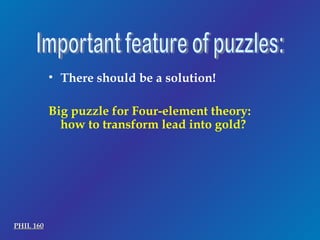
Important feature of puzzles: There should be a solution! Big puzzle for Four-element theory:  how to transform lead into gold? PHIL 160
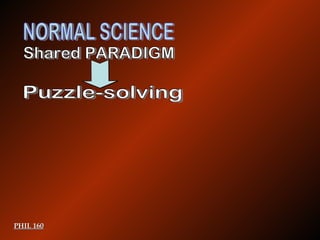
PHIL 160 NORMAL SCIENCE Shared PARADIGM
Puzzle-solving PHIL 160 NORMAL SCIENCE Shared PARADIGM
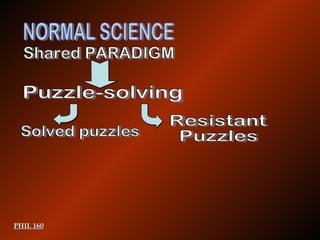
Resistant Puzzles PHIL 160 Puzzle-solving Solved puzzles NORMAL SCIENCE Shared PARADIGM
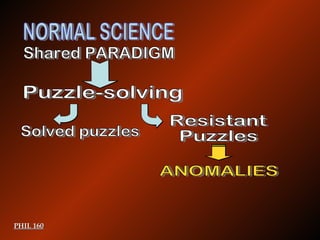
Resistant Puzzles PHIL 160 Puzzle-solving Solved puzzles ANOMALIES NORMAL SCIENCE Shared PARADIGM
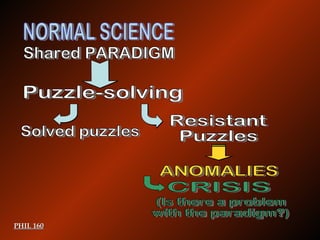
PHIL 160 Puzzle-solving Solved puzzles CRISIS (Is there a problem with the paradigm?) ANOMALIES Resistant Puzzles NORMAL SCIENCE Shared PARADIGM
LEARNING OBJECTIVES: Overview of Kuhn’s model of science Kuhn’s description of the first mode: normal science What is a paradigm? What role does a paradigm play in normal science? Difference between puzzles and problems? PHIL 160

Kuhn: Paradigms and Normal Science

  • 1.
    PHIL 160 "Kuhn:Paradigms and Normal Science"
  • 2.
    LEARNING OBJECTIVES: Overviewof Kuhn’s model of science Kuhn’s description of the first mode: normal science What is a paradigm? What role does a paradigm play in normal science? PHIL 160
  • 3.
    Assumption: Science makessteady progress Accretion (as in narrow inductivist view): body of knowledge like a snowball rolling down a hill. Popperian view: eliminate ever more false hypotheses. Either way, assumes scientists are always engaged in the same kind of activity. PHIL 160
  • 4.
    Kuhn: two distinctmodes of science. Normal Science Periods of Scientific Revolution Need to understand how these modes differ from each other and how they are connected to each other. What processes move scientists from normal science to a revolution? PHIL 160
  • 5.
    Key concept: ParadigmsNarrow sense : a particular achievement which suggests a way to investigate the world (e.g., an experiment, a formula, etc.) Broad sense : a package of ideas and methods which make up a world view and a way of doing science PHIL 160
  • 6.
    Key concept: ParadigmsParadigms are vital because they provide the framework (shared set of assumptions) for normal science. PHIL 160
  • 7.
    PHIL 160 NORMALSCIENCE CRISIS REVOLUTION
  • 8.
    PHIL 160 NORMALSCIENCE CRISIS REVOLUTION (Guided by a shared paradigm)
  • 9.
    PHIL 160 NORMALSCIENCE CRISIS REVOLUTION (Shift from old paradigm to new paradigm) (Guided by a shared paradigm)
  • 10.
    NORMAL SCIENCE CRISISREVOLUTION New period of Normal Science (Shift from old paradigm to new paradigm) (Guided by a shared paradigm) PHIL 160
  • 11.
  • 12.
    THEORY • What kind of stuff is in the world PHIL 160
  • 13.
    THEORY • What kind of stuff is in the world • How that stuff evolves over time and interacts PHIL 160
  • 14.
    THEORY PARADIGM • What kind of stuff is in the world • How that stuff evolves over time and interacts PHIL 160
  • 15.
    THEORY PARADIGM • Ideas about stuff • What kind of stuff is in the world • How that stuff evolves over time and interacts PHIL 160
  • 16.
    THEORY PARADIGM • Ideas about stuff • What kind of stuff is in the world • Ideas about behaviors • How that stuff evolves over time and interacts PHIL 160
  • 17.
    THEORY PARADIGM • Methodology • Ideas about stuff • What kind of stuff is in the world • Ideas about behaviors • How that stuff evolves over time and interacts PHIL 160
  • 18.
    THEORY PARADIGM • Methodology • Interesting questions • Ideas about stuff • What kind of stuff is in the world • Ideas about behaviors • How that stuff evolves over time and interacts PHIL 160
  • 19.
    THEORY PARADIGM • Methodology • Interesting questions • What counts as a good explanation • Ideas about stuff • What kind of stuff is in the world • Ideas about behaviors • How that stuff evolves over time and interacts PHIL 160
  • 20.
    In “Pre-Paradigm” period:No agreement about fundamentals End up debating fundamentals rather than figuring out how to explain, predict, control phenomena of interest Reads like philosophy (which Kuhn says is a bad thing if you’re trying to do science)! PHIL 160
  • 21.
    With a sharedparadigm, can do science: No more debate about fundamentals Energy focused on using tools from the paradigm to describe, model, or create new phenomena “ Puzzle-solving” PHIL 160
  • 22.
    Example: Presocratic theoriesof matter All is fire All is water All is air Only atoms and empty space (Democritus) Infinitely many stuffs (Anaxagoras) Four-element system (Empedocles) Lots of choices, lots of debate. PHIL 160
  • 23.
    PHIL 160 TheFour Elements HOT WET COLD DRY FIRE AIR WATER EARTH
  • 24.
    PHIL 160 AIRWATER HEAT (cold, wet) (hot, wet) HOT WET COLD DRY FIRE AIR WATER EARTH
  • 25.
  • 26.
  • 27.
    PHIL 160 (highproportion of water) METALS Easier to change shape (like water) HOT WET COLD DRY FIRE AIR WATER EARTH
  • 28.
    PHIL 160 Easierto change shape (like water) (high proportion of water) METALS STONES (high proportion of earth) More likely to crumble than change shape (like earth) HOT WET COLD DRY FIRE AIR WATER EARTH
  • 29.
    Shared paradigm informs:Which phenomena can be explained Which phenomena can be controlled Which data are important What does a good explanation look like. What counts as a puzzle What counts as a good solution PHIL 160
  • 30.
    Important feature ofpuzzles: There should be a solution! Big puzzle for Four-element theory: how to transform lead into gold? PHIL 160
  • 31.
    PHIL 160 NORMALSCIENCE Shared PARADIGM
  • 32.
    Puzzle-solving PHIL 160NORMAL SCIENCE Shared PARADIGM
  • 33.
    Resistant Puzzles PHIL160 Puzzle-solving Solved puzzles NORMAL SCIENCE Shared PARADIGM
  • 34.
    Resistant Puzzles PHIL160 Puzzle-solving Solved puzzles ANOMALIES NORMAL SCIENCE Shared PARADIGM
  • 35.
    PHIL 160 Puzzle-solvingSolved puzzles CRISIS (Is there a problem with the paradigm?) ANOMALIES Resistant Puzzles NORMAL SCIENCE Shared PARADIGM
  • 36.
    LEARNING OBJECTIVES: Overviewof Kuhn’s model of science Kuhn’s description of the first mode: normal science What is a paradigm? What role does a paradigm play in normal science? Difference between puzzles and problems? PHIL 160