
Sequencesand
Series
PreCalculus
Recall the following definitions:
A sequence is a function whose domain is the set of positive
integers or the set {1, 2, 3,...,n}.
A series represents the sum of the terms of a sequence. If a
sequence is finite, we will refer to the sum of the terms of
the sequence as the series associated with the sequence. If
the sequence has infinitely many terms, the sum is defined
more precisely in calculus.
Sequences and series
The sequence with nth term an is usually
denoted by {an}, and the associated series is
given by S = a1 + a2 + a3 + ··· + an.
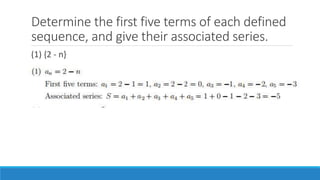
Determine the first five terms of each defined
sequence, and give their associated series.
(1) {2 - n}
(2) {1+2n + 3n2}
(3) {(-1)n}
(4) {1+2+3+ ··· + n}
Determine the first five terms of each defined
sequence, and give their associated series.
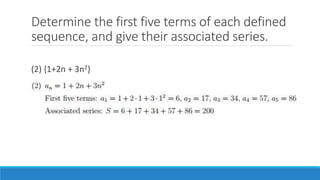
(2) {1+2n + 3n2}
(3) {(-1)n}
(4) {1+2+3+ ··· + n}
Determine the first five terms of each defined
sequence, and give their associated series.
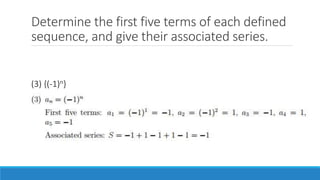
(3) {(-1)n}
(4) {1+2+3+ ··· + n}
Determine the first five terms of each defined
sequence, and give their associated series.
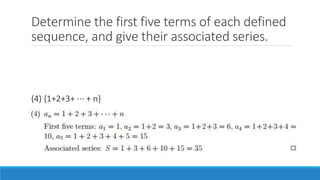
(4) {1+2+3+ ··· + n}
Arithmetic sequences and series
An arithmetic sequence is a sequence in which each term after the
first is obtained by adding a constant (called the common difference)
to the preceding term.
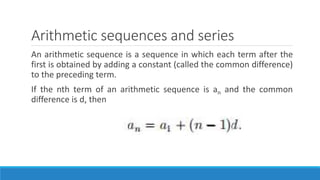
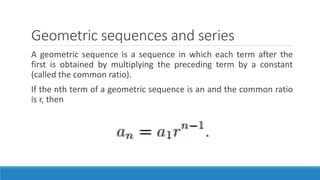
If the nth term of an arithmetic sequence is an and the common
difference is d, then
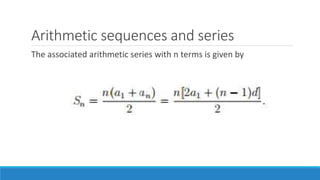
Arithmetic sequences and series
The associated arithmetic series with n terms is given by
Geometric sequences and series
A geometric sequence is a sequence in which each term after the
first is obtained by multiplying the preceding term by a constant
(called the common ratio).
If the nth term of a geometric sequence is an and the common ratio
is r, then
Geometric sequences and series
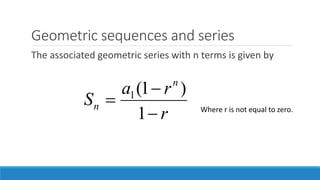
The associated geometric series with n terms is given by
r
ra
S
n
n



1
)1(1
Where r is not equal to zero.
Infinite geometric series
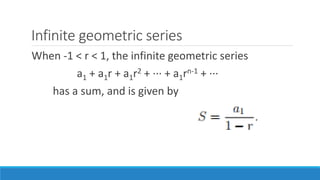
When -1 < r < 1, the infinite geometric series
a1 + a1r + a1r2 + ··· + a1rn-1 + ···
has a sum, and is given by
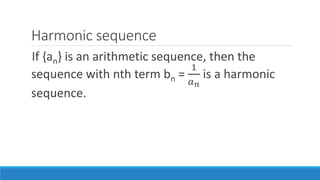
Harmonic sequence
If {an} is an arithmetic sequence, then the
sequence with nth term bn =
1
𝑎 𝑛
is a harmonic
sequence.
Seatwork
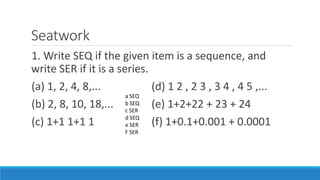
1. Write SEQ if the given item is a sequence, and
write SER if it is a series.
(a) 1, 2, 4, 8,... (d) 1 2 , 2 3 , 3 4 , 4 5 ,...
(b) 2, 8, 10, 18,... (e) 1+2+22 + 23 + 24
(c) 1+1 1+1 1 (f) 1+0.1+0.001 + 0.0001
a SEQ
b SEQ
c SER
d SEQ
e SER
F SER
Seatwork
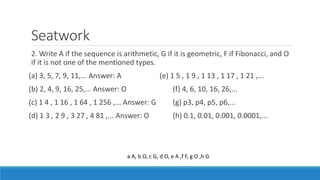
2. Write A if the sequence is arithmetic, G if it is geometric, F if Fibonacci, and O
if it is not one of the mentioned types.
(a) 3, 5, 7, 9, 11,... Answer: A (e) 1 5 , 1 9 , 1 13 , 1 17 , 1 21 ,...
(b) 2, 4, 9, 16, 25,... Answer: O (f) 4, 6, 10, 16, 26,...
(c) 1 4 , 1 16 , 1 64 , 1 256 ,... Answer: G (g) p3, p4, p5, p6,...
(d) 1 3 , 2 9 , 3 27 , 4 81 ,... Answer: O (h) 0.1, 0.01, 0.001, 0.0001,...
a A, b O, c G, d O, e A ,f F, g O ,h G
Seatwork
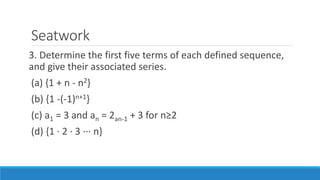
3. Determine the first five terms of each defined sequence,
and give their associated series.
(a) {1 + n - n2}
(b) {1 -(-1)n+1}
(c) a1 = 3 and an = 2an-1 + 3 for n≥2
(d) {1 · 2 · 3 ··· n}
Seatwork
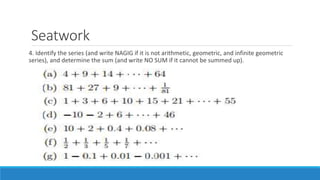
4. Identify the series (and write NAGIG if it is not arithmetic, geometric, and infinite geometric
series), and determine the sum (and write NO SUM if it cannot be summed up).
Reference:
Garces, Ian June L. et. al. (2016) Precalculus “Teaching Guide for
Senior High School, Commission on Higher Education
THANK YOU
www.slideshare.net/reycastro1
@reylkastro2
reylkastro

Sequences and series

  • 1.
  • 2.
    Recall the followingdefinitions: A sequence is a function whose domain is the set of positive integers or the set {1, 2, 3,...,n}. A series represents the sum of the terms of a sequence. If a sequence is finite, we will refer to the sum of the terms of the sequence as the series associated with the sequence. If the sequence has infinitely many terms, the sum is defined more precisely in calculus.
  • 3.
    Sequences and series Thesequence with nth term an is usually denoted by {an}, and the associated series is given by S = a1 + a2 + a3 + ··· + an.
  • 4.
    Determine the firstfive terms of each defined sequence, and give their associated series. (1) {2 - n} (2) {1+2n + 3n2} (3) {(-1)n} (4) {1+2+3+ ··· + n}
  • 5.
    Determine the firstfive terms of each defined sequence, and give their associated series. (2) {1+2n + 3n2} (3) {(-1)n} (4) {1+2+3+ ··· + n}
  • 6.
    Determine the firstfive terms of each defined sequence, and give their associated series. (3) {(-1)n} (4) {1+2+3+ ··· + n}
  • 7.
    Determine the firstfive terms of each defined sequence, and give their associated series. (4) {1+2+3+ ··· + n}
  • 8.
    Arithmetic sequences andseries An arithmetic sequence is a sequence in which each term after the first is obtained by adding a constant (called the common difference) to the preceding term. If the nth term of an arithmetic sequence is an and the common difference is d, then
  • 9.
    Arithmetic sequences andseries The associated arithmetic series with n terms is given by
  • 10.
    Geometric sequences andseries A geometric sequence is a sequence in which each term after the first is obtained by multiplying the preceding term by a constant (called the common ratio). If the nth term of a geometric sequence is an and the common ratio is r, then
  • 11.
    Geometric sequences andseries The associated geometric series with n terms is given by r ra S n n    1 )1(1 Where r is not equal to zero.
  • 12.
    Infinite geometric series When-1 < r < 1, the infinite geometric series a1 + a1r + a1r2 + ··· + a1rn-1 + ··· has a sum, and is given by
  • 13.
    Harmonic sequence If {an}is an arithmetic sequence, then the sequence with nth term bn = 1 𝑎 𝑛 is a harmonic sequence.
  • 14.
    Seatwork 1. Write SEQif the given item is a sequence, and write SER if it is a series. (a) 1, 2, 4, 8,... (d) 1 2 , 2 3 , 3 4 , 4 5 ,... (b) 2, 8, 10, 18,... (e) 1+2+22 + 23 + 24 (c) 1+1 1+1 1 (f) 1+0.1+0.001 + 0.0001 a SEQ b SEQ c SER d SEQ e SER F SER
  • 15.
    Seatwork 2. Write Aif the sequence is arithmetic, G if it is geometric, F if Fibonacci, and O if it is not one of the mentioned types. (a) 3, 5, 7, 9, 11,... Answer: A (e) 1 5 , 1 9 , 1 13 , 1 17 , 1 21 ,... (b) 2, 4, 9, 16, 25,... Answer: O (f) 4, 6, 10, 16, 26,... (c) 1 4 , 1 16 , 1 64 , 1 256 ,... Answer: G (g) p3, p4, p5, p6,... (d) 1 3 , 2 9 , 3 27 , 4 81 ,... Answer: O (h) 0.1, 0.01, 0.001, 0.0001,... a A, b O, c G, d O, e A ,f F, g O ,h G
  • 16.
    Seatwork 3. Determine thefirst five terms of each defined sequence, and give their associated series. (a) {1 + n - n2} (b) {1 -(-1)n+1} (c) a1 = 3 and an = 2an-1 + 3 for n≥2 (d) {1 · 2 · 3 ··· n}
  • 17.
    Seatwork 4. Identify theseries (and write NAGIG if it is not arithmetic, geometric, and infinite geometric series), and determine the sum (and write NO SUM if it cannot be summed up).
  • 18.
    Reference: Garces, Ian JuneL. et. al. (2016) Precalculus “Teaching Guide for Senior High School, Commission on Higher Education
  • 19.