DISCRETE MATHEMATICS
NAME-SURAJ KUMAR
REGD. NO.-210301160019
BY-SASI BHUSAN PADHI
Click to add text
TOPIC--
•Building of valid argument in propositional
logic
PROPOSITIONAL LOGIC---
• 1.1- introduction
• 1.2- proposition
• 1.3- compound statement
• 1.4- formal proposition
• 1.5- conditional statement
• 1.6 -Propositional equivalences
INTRODUCTION-
• Logic- used to distinguish between valid and invalid
mathematical arguments.
• Logic was developed by Aristotle
• Application in computer science – design computer circuit
,construction of computer program , verification of the
correctness of programs.
• Logic is system based on proposition
VALID ARGUMENT
• Defination of valid argument :
• - an argument of valid if whenever the hypotheses are all true , the
conclusion must also be true .
• - that is , when (P1^ P2 ^ ….^ Pn ) Q is a tautology .
• - the previous example had a wff representation of A^b – C WHICH
IS NOT A TAUTOLOGY
• EXAMPLES:-
• - IF GEORGE BUSH IS THE CURRENT PRESIDENT OF THE US , THEN
DICK CHENEY IS THE CURRENT VICE PRESENT
PROPOSITION-
• Proposition- is a declarative sentence either true or false, but not
both.
• EG-
• 1) tunku abdul rahman was the first prime prime minister of malaysia
–TRUE
• 2) 1+1=2 – TRUE
• 3) what time is it ? NOT PROPOSITION
• 4) read this carefully . NOT PROPOSITION
• 5) X+1=2 – NOT PROPOSITION
• LETTERS are used to denote propositions- p,q,r,s
COMPOUND STATEMENTS
• Many mathematical statement are constructed by
combining one or more propositions.
• EG- JOHN IS SMART OR HE STUDIES EVERY NIGHT
• One or more propositions can be combining to form a
single COMPOUND PROPOSITION using connectives (
logical operator)
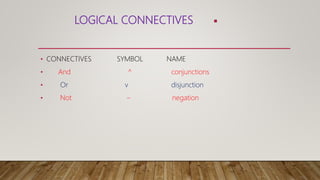
LOGICAL CONNECTIVES
• CONNECTIVES SYMBOL NAME
• And ^ conjunctions
• Or v disjunction
• Not ~ negation
TRUTH TABLE
• Can be used to show how logical operators can
be combine propositions to compound
propositions.
• Displays the truth values that correspond to all
possible value (2^n) of truth values for its
component statements variables.
• The truth value for proposition could be true (T)
OR false (F)
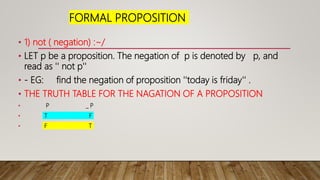
FORMAL PROPOSITION
• 1) not ( negation) :~/
• LET p be a proposition. The negation of p is denoted by p, and
read as '' not p''
• - EG: find the negation of proposition ''today is friday'' .
• THE TRUTH TABLE FOR THE NAGATION OF A PROPOSITION
• P _ P
• T F
• F T
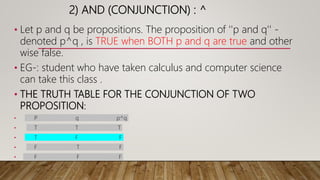
2) AND (CONJUNCTION) : ^
• Let p and q be propositions. The proposition of ''p and q'' -
denoted p^q , is TRUE when BOTH p and q are true and other
wise false.
• EG-: student who have taken calculus and computer science
can take this class .
• THE TRUTH TABLE FOR THE CONJUNCTION OF TWO
PROPOSITION:
• P q p^q
• T T T
• T F F
• F T F
• F F F
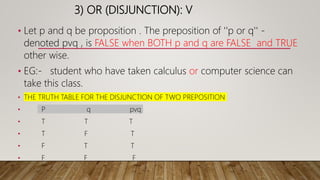
3) OR (DISJUNCTION): V
• Let p and q be proposition . The preposition of ''p or q'' -
denoted pvq , is FALSE when BOTH p and q are FALSE and TRUE
other wise.
• EG:- student who have taken calculus or computer science can
take this class.
• THE TRUTH TABLE FOR THE DISJUNCTION OF TWO PREPOSITION
• P q pvq
• T T T
• T F T
• F T T
• F F F
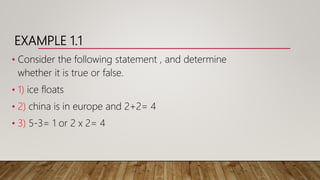
EXAMPLE 1.1
• Consider the following statement , and determine
whether it is true or false.
• 1) ice floats
• 2) china is in europe and 2+2= 4
• 3) 5-3= 1 or 2 x 2= 4
EX-2:
• Let p and q be the following propositions:
• P= it is below freezing
• Q= it is snowing
• Translate the following into logical notation , using p and q and logical
connectives.
• (a) it is below freezing and snowing
• (b) it is below freezing bit not snowing
• (c ) it is not below freezing and it is not snowing
• (d) it is either snowing or below freezing ( or both)
CONDITIONAL STATEMENTS
• 1) IMPLICATION
• Let p and q be a proposition . The implication p q is the
proposition that is false when p is true ,q is true , q is false.
Otherwise is TRUE
• P= hypothesis/ antecedent / premise
• Q= conclusion / consequence
• EXPRESS: ''if p , then q'' , ''q when p'',''p implies q''
• EG:- IF you earn an A in logic then I will give you present
THANK YOU

Discrete mathematics suraj ppt

  • 1.
    DISCRETE MATHEMATICS NAME-SURAJ KUMAR REGD.NO.-210301160019 BY-SASI BHUSAN PADHI Click to add text
  • 2.
    TOPIC-- •Building of validargument in propositional logic
  • 3.
    PROPOSITIONAL LOGIC--- • 1.1-introduction • 1.2- proposition • 1.3- compound statement • 1.4- formal proposition • 1.5- conditional statement • 1.6 -Propositional equivalences
  • 4.
    INTRODUCTION- • Logic- usedto distinguish between valid and invalid mathematical arguments. • Logic was developed by Aristotle • Application in computer science – design computer circuit ,construction of computer program , verification of the correctness of programs. • Logic is system based on proposition
  • 5.
    VALID ARGUMENT • Definationof valid argument : • - an argument of valid if whenever the hypotheses are all true , the conclusion must also be true . • - that is , when (P1^ P2 ^ ….^ Pn ) Q is a tautology . • - the previous example had a wff representation of A^b – C WHICH IS NOT A TAUTOLOGY • EXAMPLES:- • - IF GEORGE BUSH IS THE CURRENT PRESIDENT OF THE US , THEN DICK CHENEY IS THE CURRENT VICE PRESENT
  • 6.
    PROPOSITION- • Proposition- isa declarative sentence either true or false, but not both. • EG- • 1) tunku abdul rahman was the first prime prime minister of malaysia –TRUE • 2) 1+1=2 – TRUE • 3) what time is it ? NOT PROPOSITION • 4) read this carefully . NOT PROPOSITION • 5) X+1=2 – NOT PROPOSITION • LETTERS are used to denote propositions- p,q,r,s
  • 7.
    COMPOUND STATEMENTS • Manymathematical statement are constructed by combining one or more propositions. • EG- JOHN IS SMART OR HE STUDIES EVERY NIGHT • One or more propositions can be combining to form a single COMPOUND PROPOSITION using connectives ( logical operator)
  • 8.
    LOGICAL CONNECTIVES • CONNECTIVESSYMBOL NAME • And ^ conjunctions • Or v disjunction • Not ~ negation
  • 9.
    TRUTH TABLE • Canbe used to show how logical operators can be combine propositions to compound propositions. • Displays the truth values that correspond to all possible value (2^n) of truth values for its component statements variables. • The truth value for proposition could be true (T) OR false (F)
  • 10.
    FORMAL PROPOSITION • 1)not ( negation) :~/ • LET p be a proposition. The negation of p is denoted by p, and read as '' not p'' • - EG: find the negation of proposition ''today is friday'' . • THE TRUTH TABLE FOR THE NAGATION OF A PROPOSITION • P _ P • T F • F T
  • 11.
    2) AND (CONJUNCTION): ^ • Let p and q be propositions. The proposition of ''p and q'' - denoted p^q , is TRUE when BOTH p and q are true and other wise false. • EG-: student who have taken calculus and computer science can take this class . • THE TRUTH TABLE FOR THE CONJUNCTION OF TWO PROPOSITION: • P q p^q • T T T • T F F • F T F • F F F
  • 12.
    3) OR (DISJUNCTION):V • Let p and q be proposition . The preposition of ''p or q'' - denoted pvq , is FALSE when BOTH p and q are FALSE and TRUE other wise. • EG:- student who have taken calculus or computer science can take this class. • THE TRUTH TABLE FOR THE DISJUNCTION OF TWO PREPOSITION • P q pvq • T T T • T F T • F T T • F F F
  • 13.
    EXAMPLE 1.1 • Considerthe following statement , and determine whether it is true or false. • 1) ice floats • 2) china is in europe and 2+2= 4 • 3) 5-3= 1 or 2 x 2= 4
  • 14.
    EX-2: • Let pand q be the following propositions: • P= it is below freezing • Q= it is snowing • Translate the following into logical notation , using p and q and logical connectives. • (a) it is below freezing and snowing • (b) it is below freezing bit not snowing • (c ) it is not below freezing and it is not snowing • (d) it is either snowing or below freezing ( or both)
  • 15.
    CONDITIONAL STATEMENTS • 1)IMPLICATION • Let p and q be a proposition . The implication p q is the proposition that is false when p is true ,q is true , q is false. Otherwise is TRUE • P= hypothesis/ antecedent / premise • Q= conclusion / consequence • EXPRESS: ''if p , then q'' , ''q when p'',''p implies q'' • EG:- IF you earn an A in logic then I will give you present
  • 16.