MODULE OBJECTIVES
At theend of this module, challenge yourself to:
1.illustrate and symbolize propositions;
2.distinguish between simple and compound propositions;
3.determine the truth values of propositions;
4.illustrate the different forms of conditional propositions;
5.illustrate different types of tautologies and fallacies;
6.determine the validity of categorical syllogisms;
7.establish the validity and falsity of real-life arguments using
logical propositions, syllogisms, and fallacies; and
8.determine the validity of an argument.
3.
LESSONS IN THISMODULE
01
Truth Tables, Equivalent Statements,
and Tautologies
02
Logic Statement and Quantifiers
LOGICAL STATEMENTS AND
QUANTIFIERS
Aproposition (or statement) is a
declarative sentence which is either true
or false, but not both. The truth value of
the propositions is the truth and falsity of
the proposition.
6.
Proposition
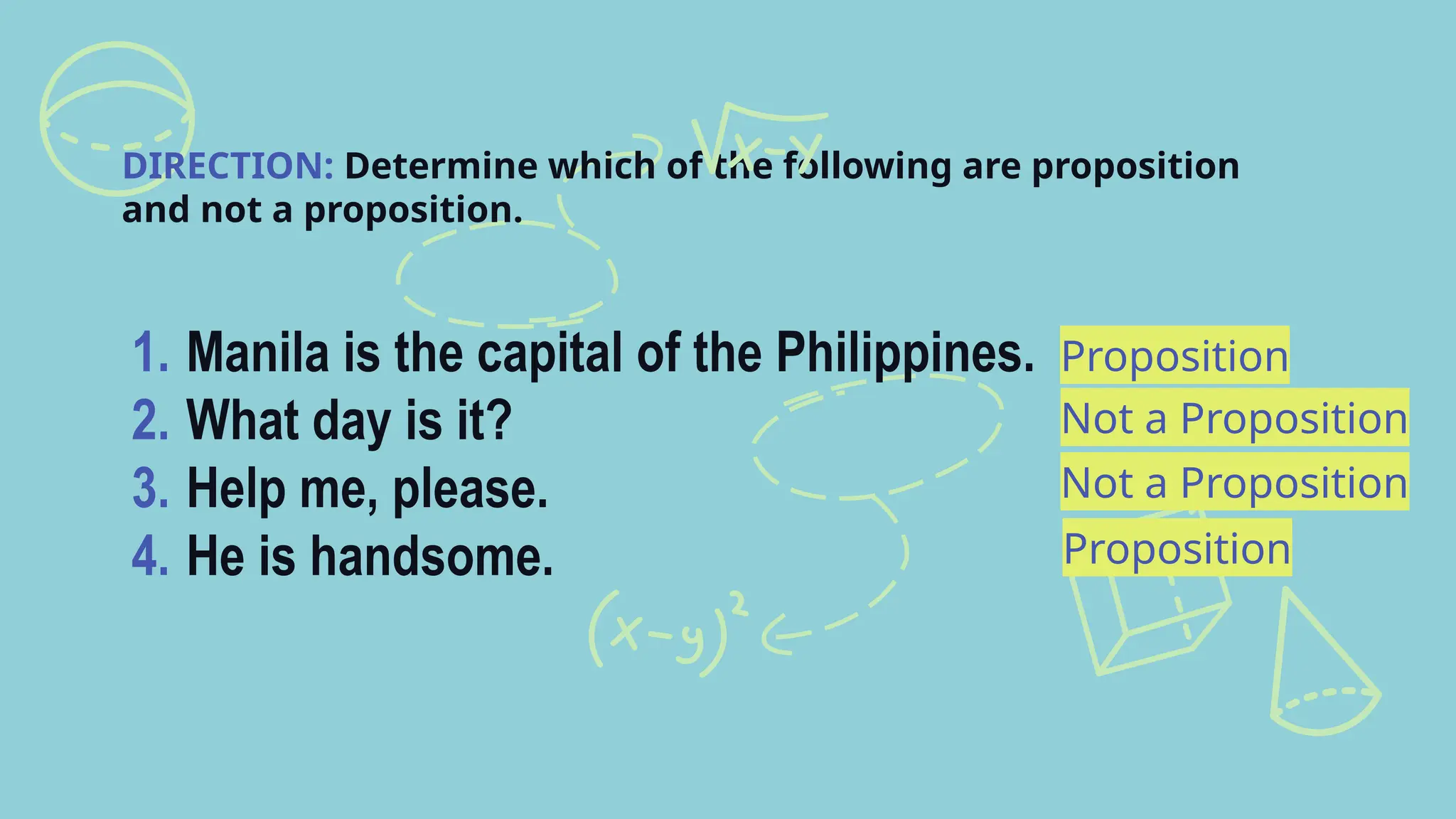
DIRECTION: Determine whichof the following are proposition
and not a proposition.
1. Manila is the capital of the Philippines.
2. What day is it?
3. Help me, please.
4. He is handsome.
Not a Proposition
Not a Proposition
Proposition
7.
LOGICAL STATEMENTS AND
QUANTIFIERS
Apropositional variable is a
variable which is used to
represent a proposition. A
formal propositional variable
written using propositional logic
notation, , , and are used to
represent propositions.
8.
LOGICAL STATEMENTS AND
QUANTIFIERS
Logicalconnectives are used to
combine simple propositions which
are referred as compound
propositions. A compound
proposition is a proposition
composed of two or more simple
propositions connected by logical
connectives "and," "or," "if then," "not,"
and "if and only if”. A proposition
which is not compound is said to be
simple (also called atomic).
9.
OPERATIONS ON PROPOSITIONS
Thereare three main logical connectives such as
conjunction, disjunction, and negation. The
following are briefly discussed in this section. Note
that T refers to true proposition and F refers to false
proposition.
10.
OPERATIONS ON PROPOSITIONS
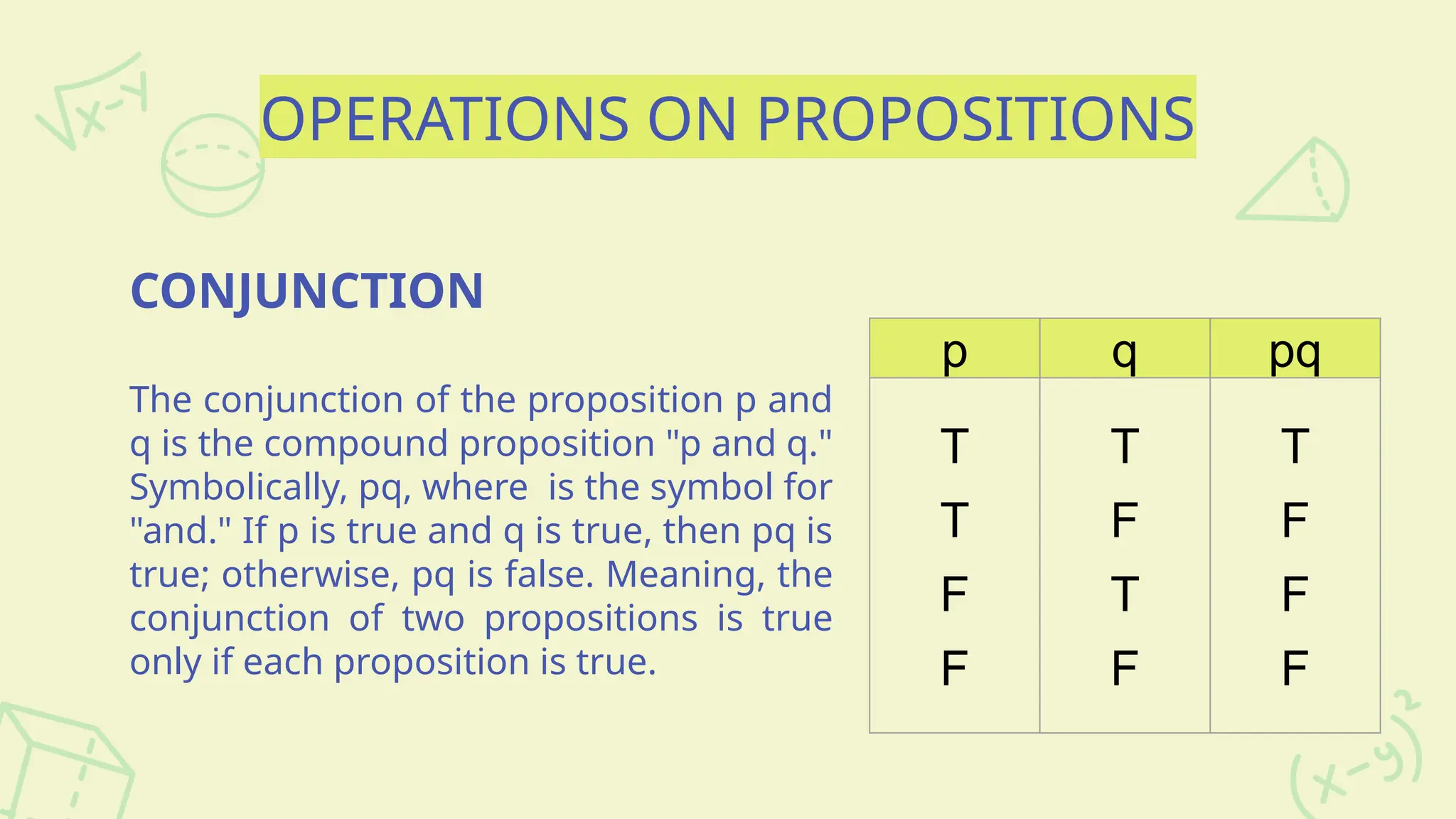
CONJUNCTION
Theconjunction of the proposition p and
q is the compound proposition "p and q."
Symbolically, pq, where is the symbol for
"and." If p is true and q is true, then pq is
true; otherwise, pq is false. Meaning, the
conjunction of two propositions is true
only if each proposition is true.
p q pq
T
T
F
F
T
F
T
F
T
F
F
F
11.
OPERATIONS ON PROPOSITIONS
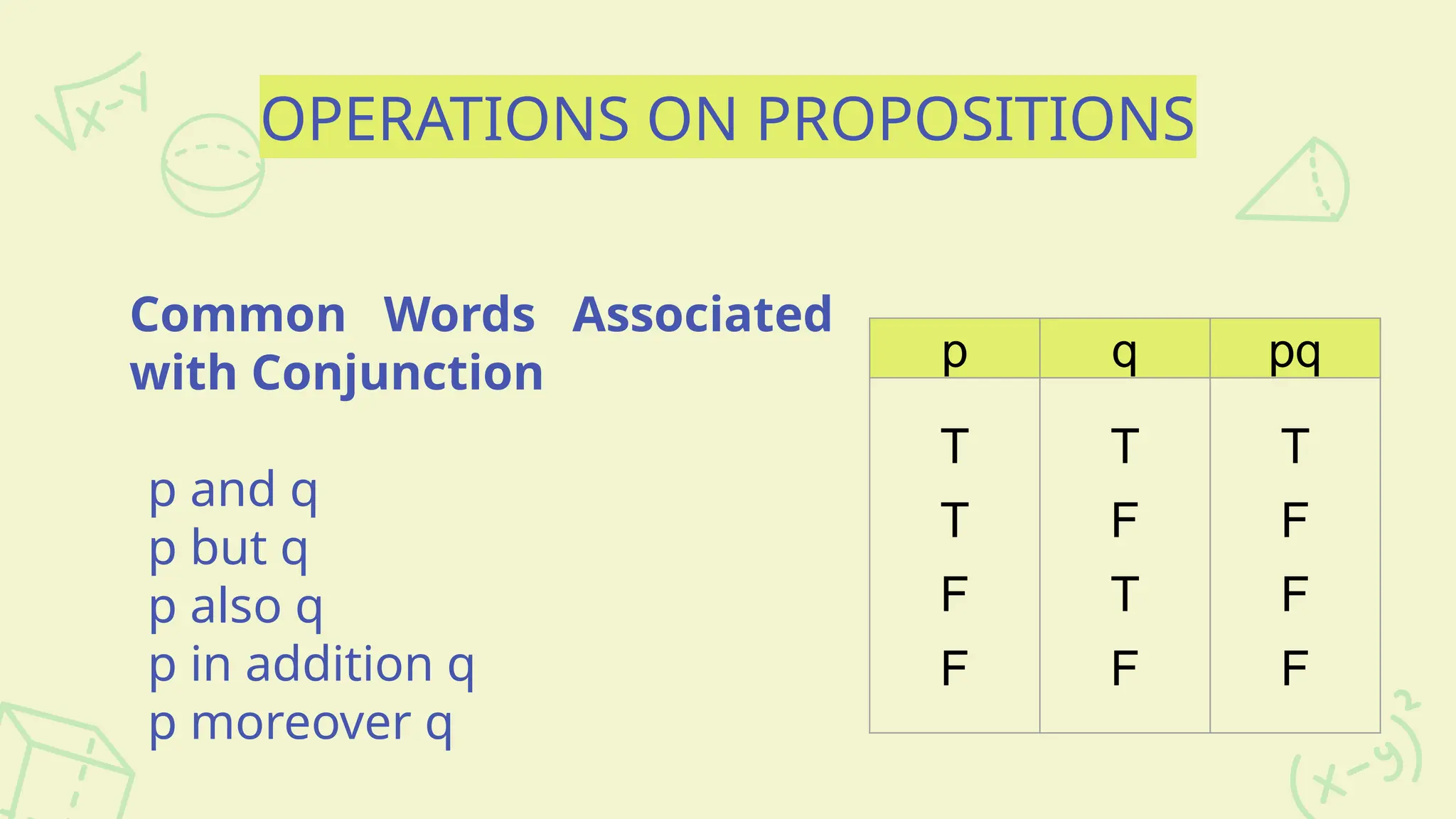
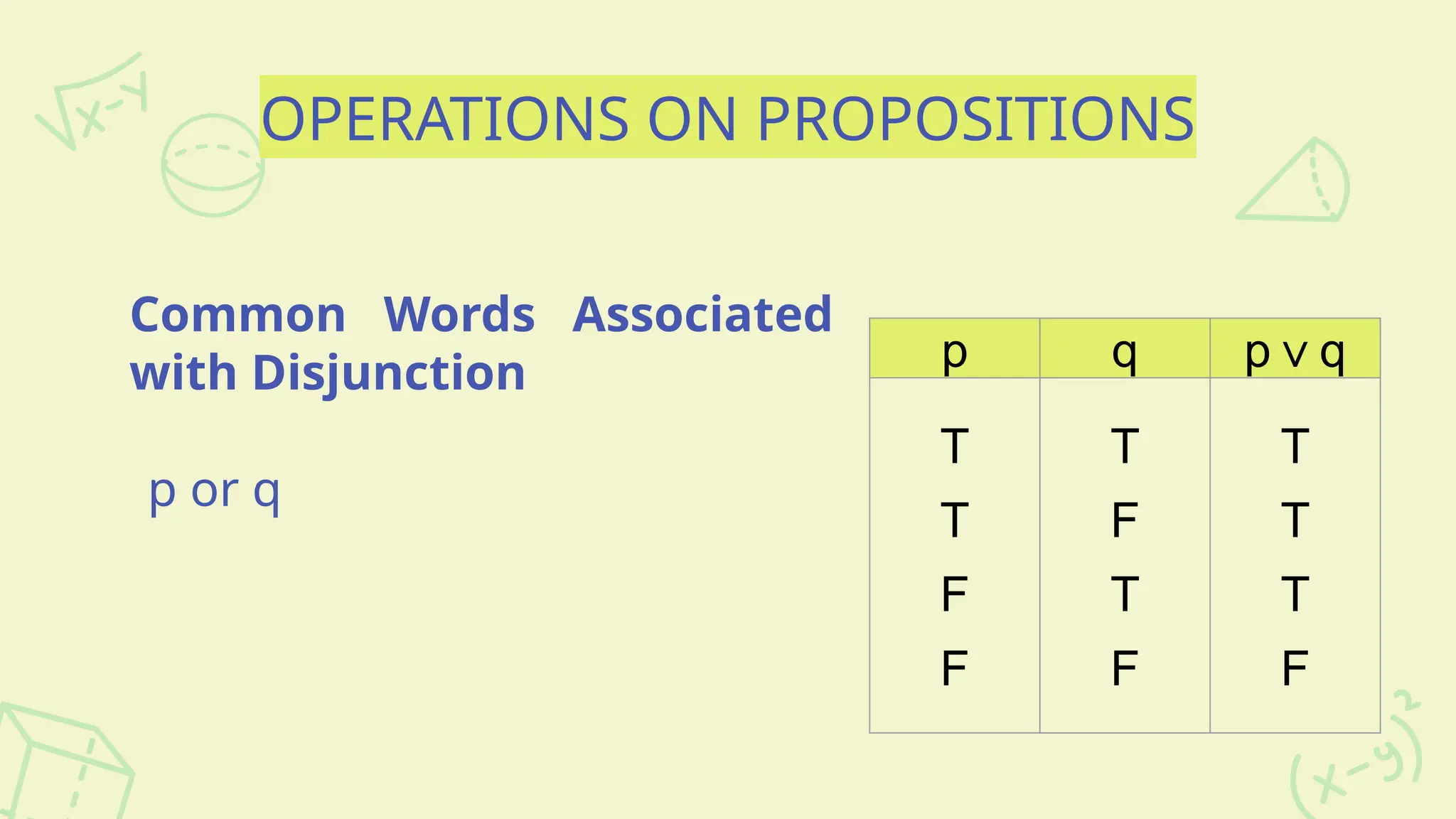
CommonWords Associated
with Conjunction
p and q
p but q
p also q
p in addition q
p moreover q
p q pq
T
T
F
F
T
F
T
F
T
F
F
F
12.
EXAMPLE
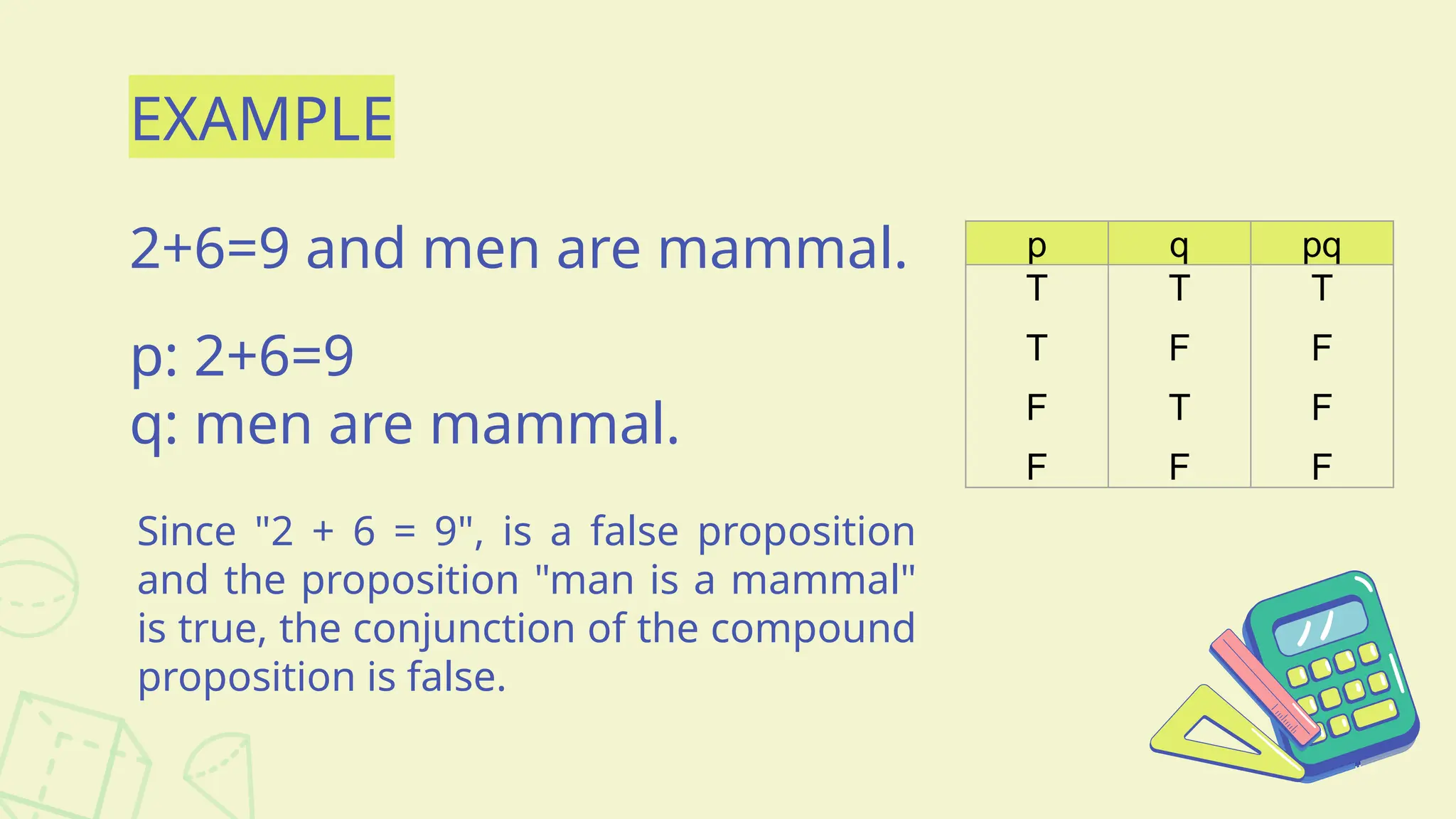
2+6=9 and menare mammal. p q pq
T
T
F
F
T
F
T
F
T
F
F
F
p: 2+6=9
q: men are mammal.
Since "2 + 6 = 9", is a false proposition
and the proposition "man is a mammal"
is true, the conjunction of the compound
proposition is false.
13.
EXAMPLE
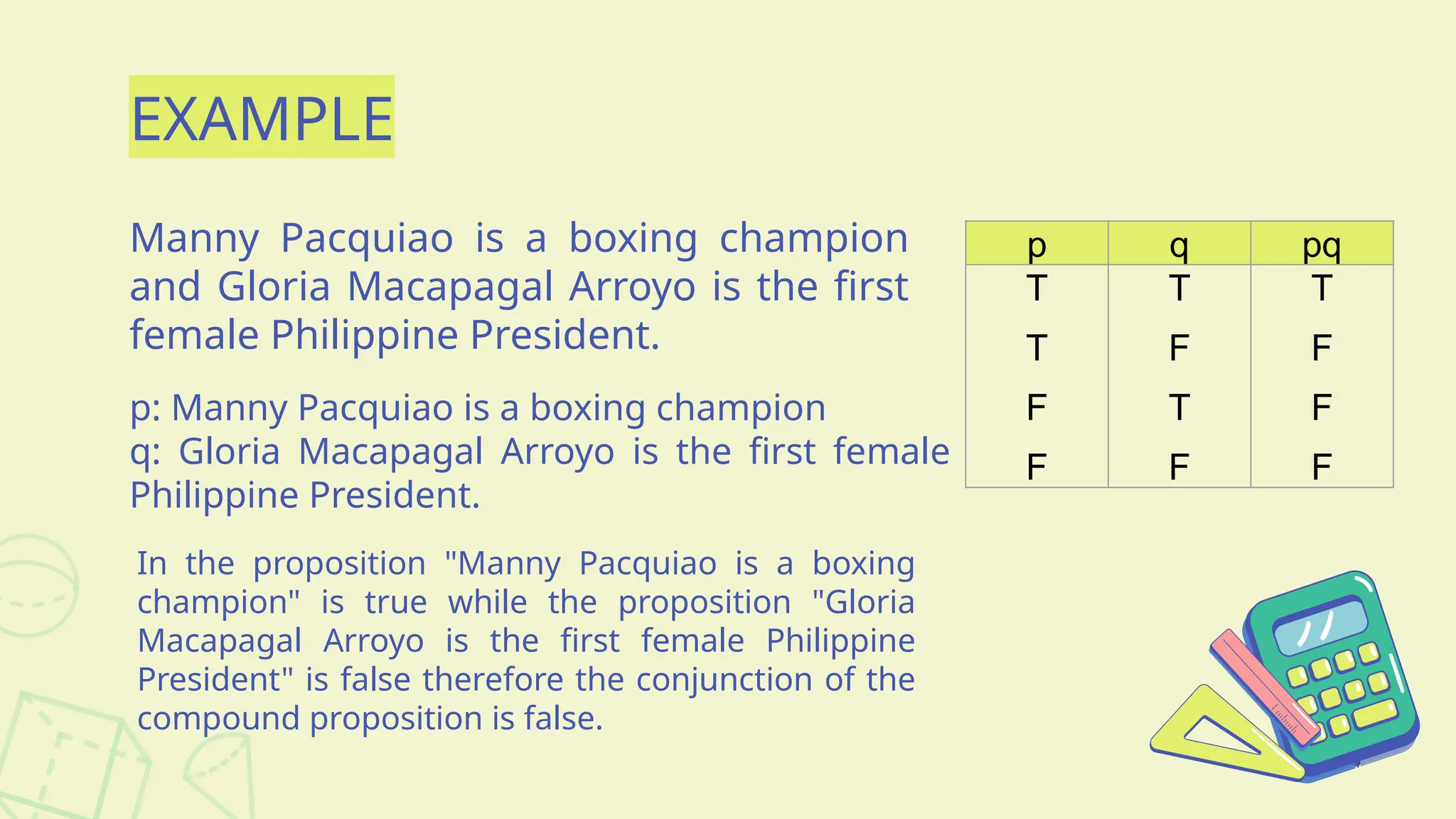
Manny Pacquiao isa boxing champion
and Gloria Macapagal Arroyo is the first
female Philippine President.
p q pq
T
T
F
F
T
F
T
F
T
F
F
F
p: Manny Pacquiao is a boxing champion
q: Gloria Macapagal Arroyo is the first female
Philippine President.
In the proposition "Manny Pacquiao is a boxing
champion" is true while the proposition "Gloria
Macapagal Arroyo is the first female Philippine
President" is false therefore the conjunction of the
compound proposition is false.
14.
EXAMPLE
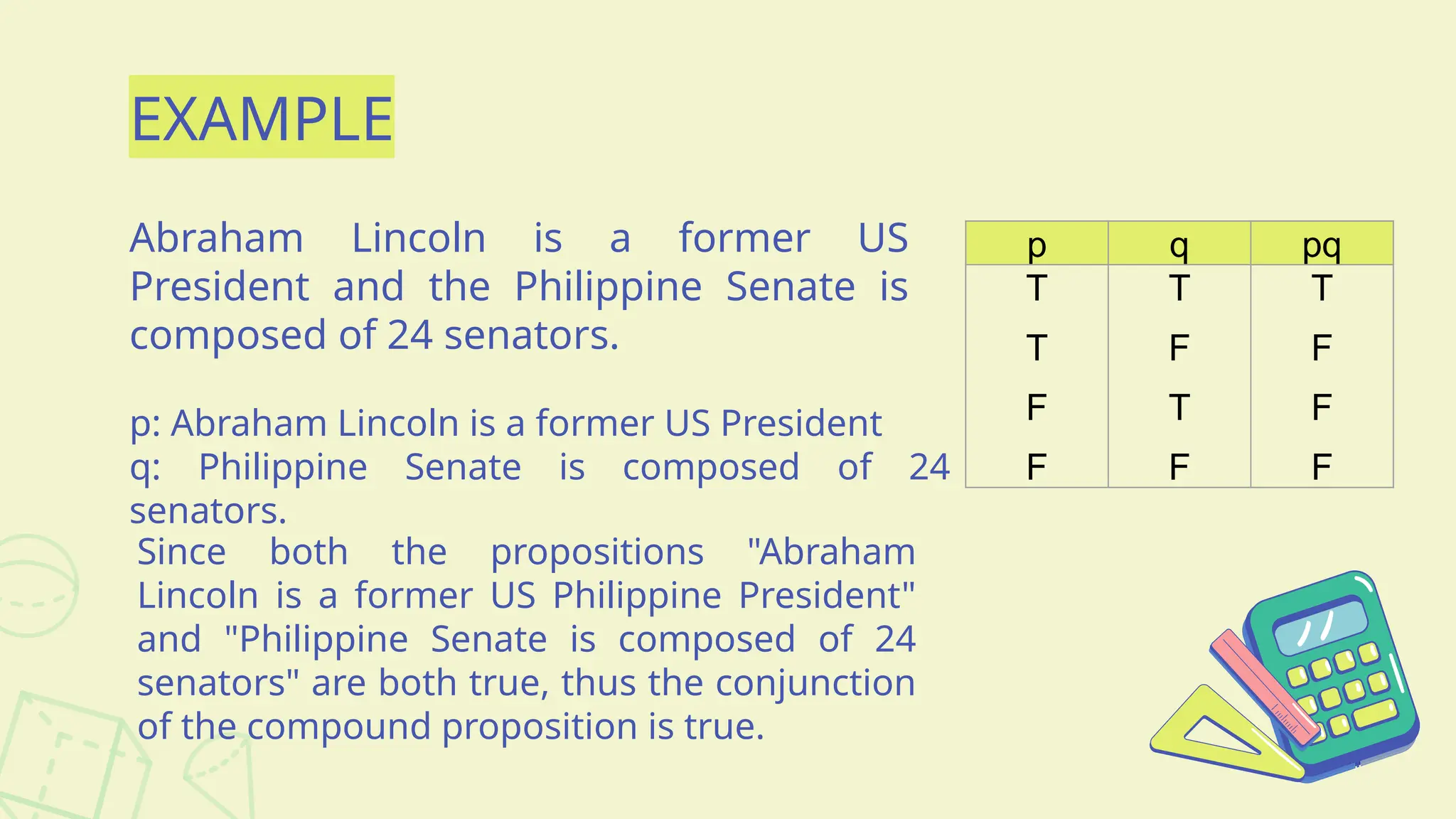
Abraham Lincoln isa former US
President and the Philippine Senate is
composed of 24 senators.
p q pq
T
T
F
F
T
F
T
F
T
F
F
F
p: Abraham Lincoln is a former US President
q: Philippine Senate is composed of 24
senators.
Since both the propositions "Abraham
Lincoln is a former US Philippine President"
and "Philippine Senate is composed of 24
senators" are both true, thus the conjunction
of the compound proposition is true.
15.
OPERATIONS ON PROPOSITIONS
DISJUNCTION
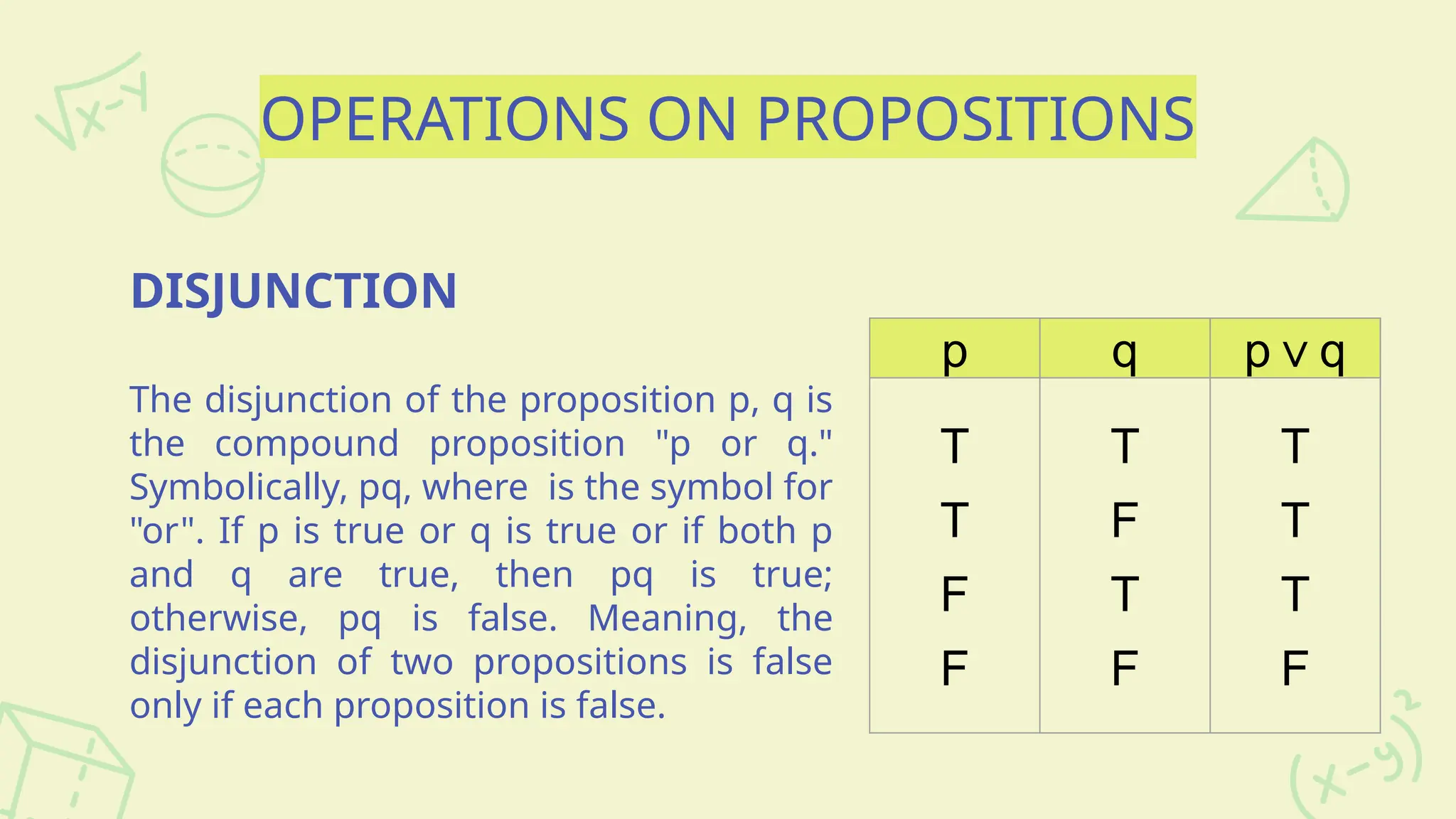
Thedisjunction of the proposition p, q is
the compound proposition "p or q."
Symbolically, pq, where is the symbol for
"or". If p is true or q is true or if both p
and q are true, then pq is true;
otherwise, pq is false. Meaning, the
disjunction of two propositions is false
only if each proposition is false.
p q p q
∨
T
T
F
F
T
F
T
F
T
T
T
F
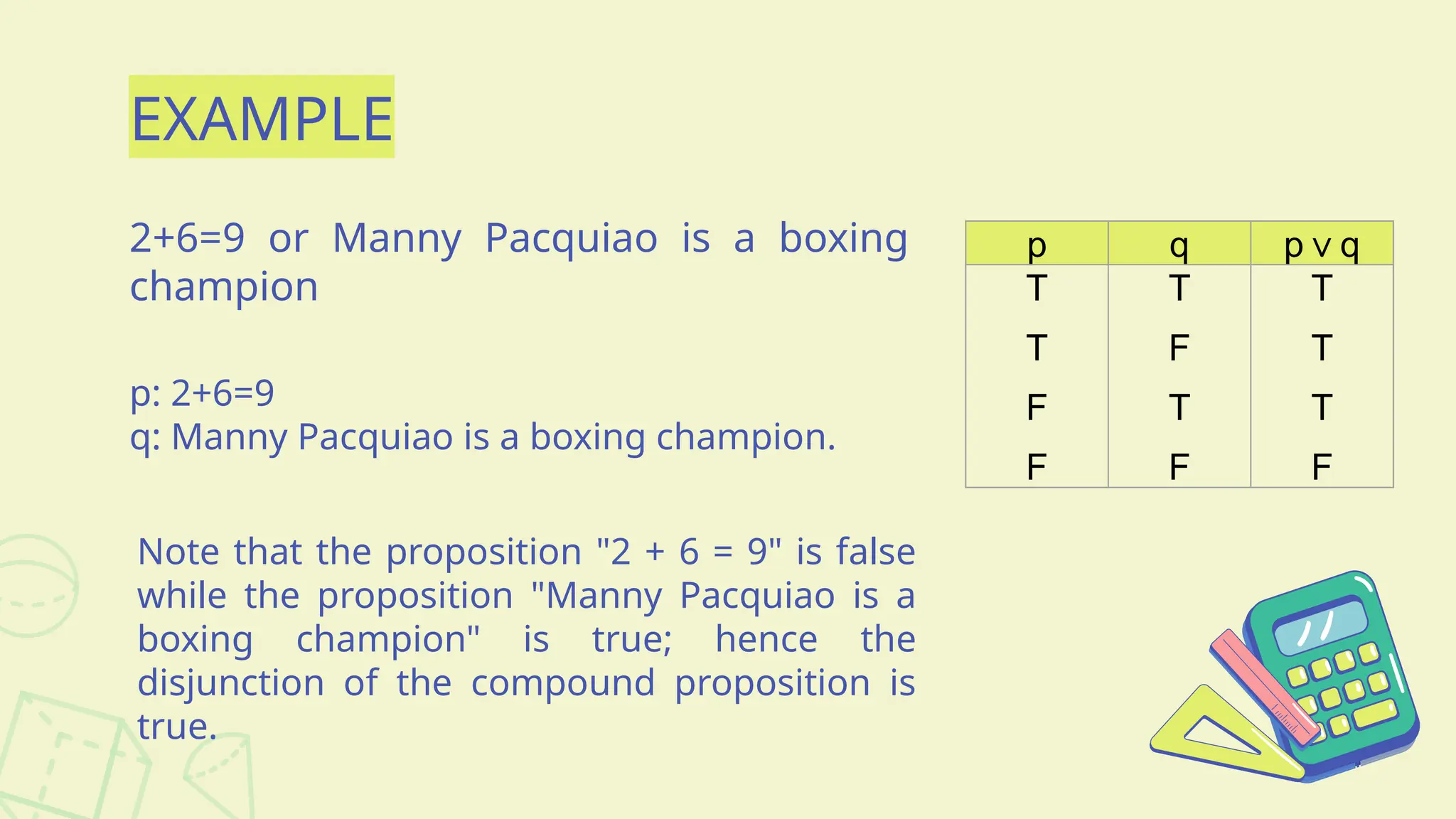
EXAMPLE
2+6=9 or MannyPacquiao is a boxing
champion
p q p q
∨
T
T
F
F
T
F
T
F
T
T
T
F
p: 2+6=9
q: Manny Pacquiao is a boxing champion.
Note that the proposition "2 + 6 = 9" is false
while the proposition "Manny Pacquiao is a
boxing champion" is true; hence the
disjunction of the compound proposition is
true.
18.
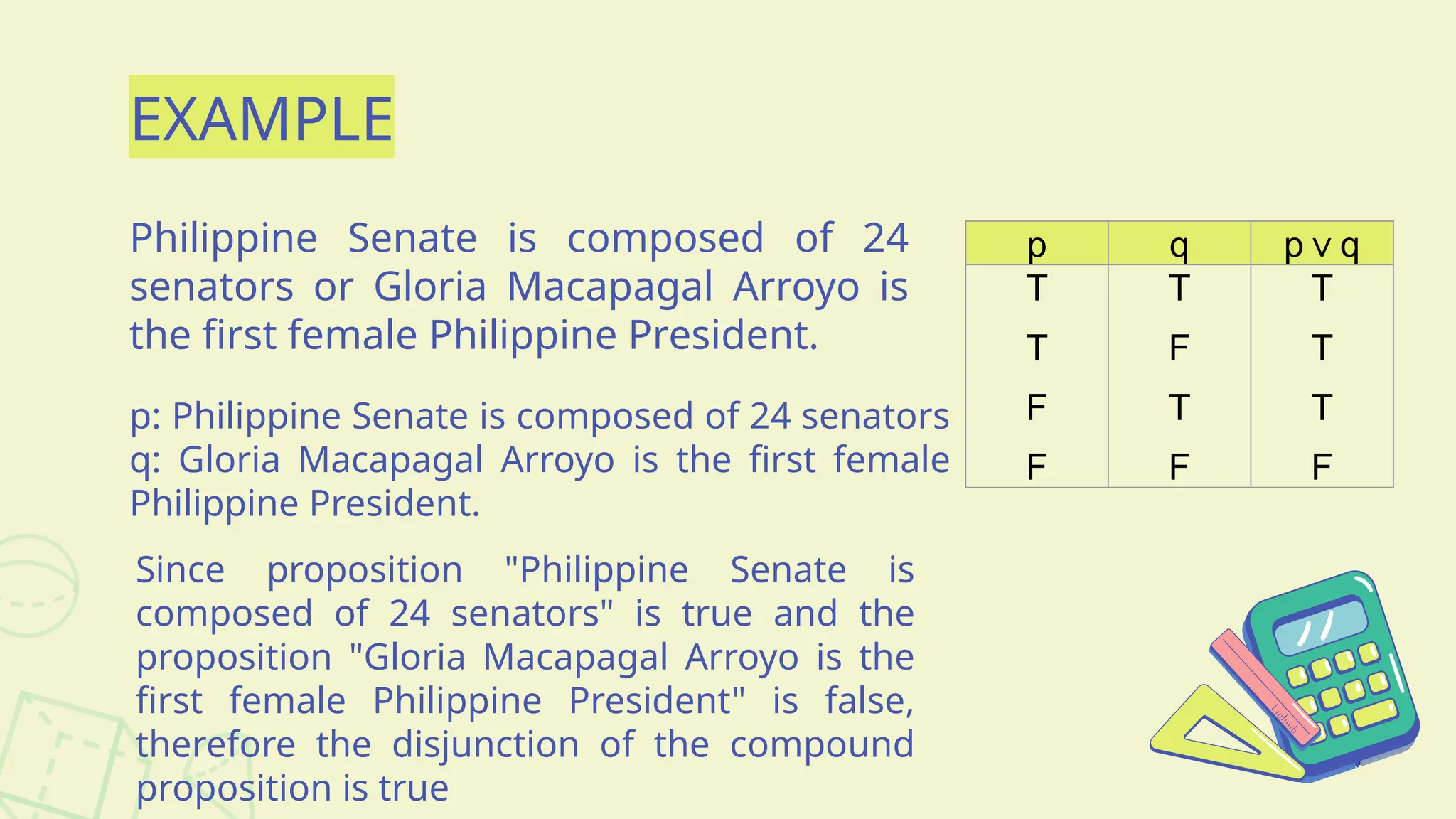
EXAMPLE
Philippine Senate iscomposed of 24
senators or Gloria Macapagal Arroyo is
the first female Philippine President.
p q p q
∨
T
T
F
F
T
F
T
F
T
T
T
F
p: Philippine Senate is composed of 24 senators
q: Gloria Macapagal Arroyo is the first female
Philippine President.
Since proposition "Philippine Senate is
composed of 24 senators" is true and the
proposition "Gloria Macapagal Arroyo is the
first female Philippine President" is false,
therefore the disjunction of the compound
proposition is true
19.
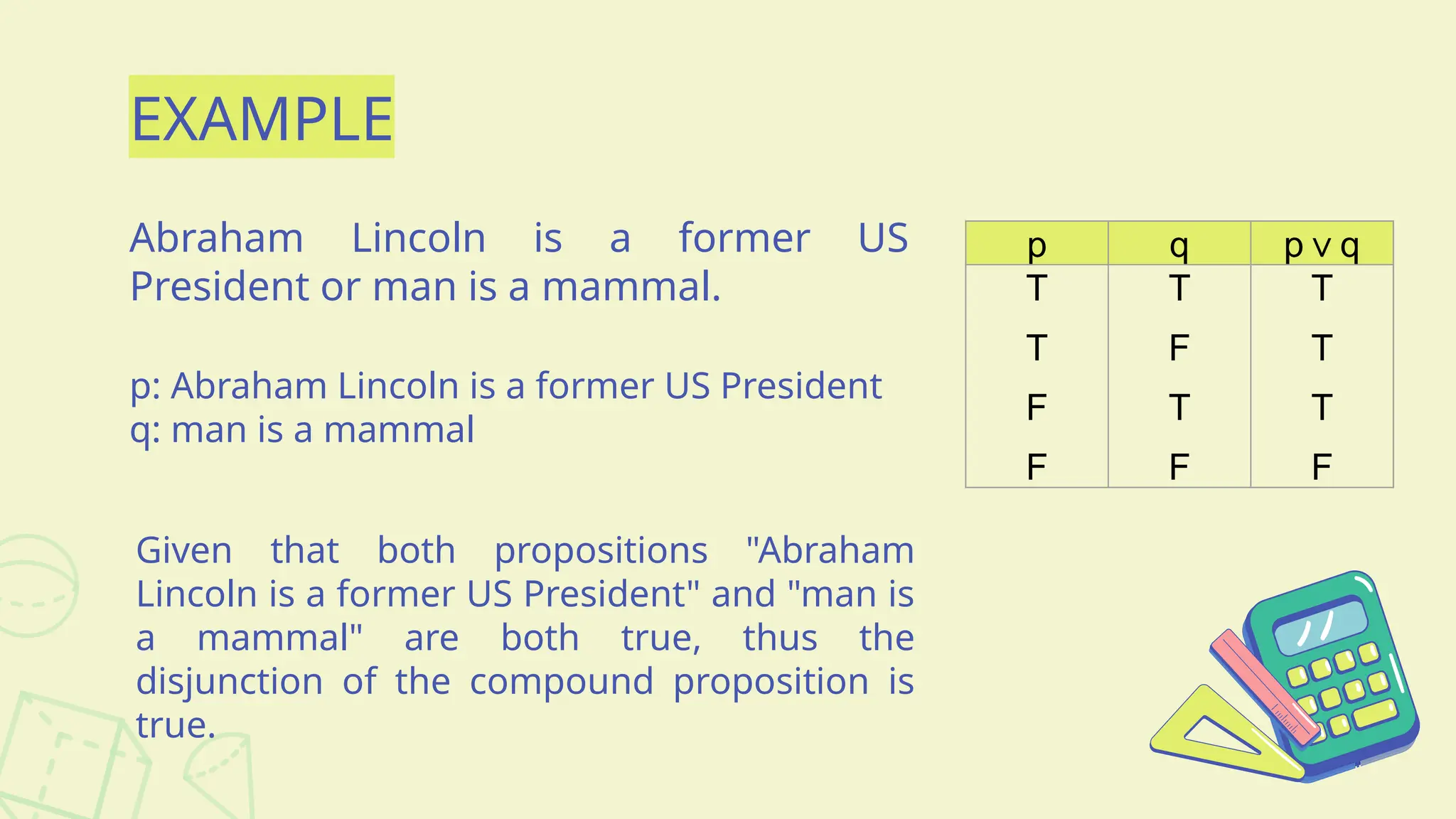
EXAMPLE
Abraham Lincoln isa former US
President or man is a mammal.
p q p q
∨
T
T
F
F
T
F
T
F
T
T
T
F
p: Abraham Lincoln is a former US President
q: man is a mammal
Given that both propositions "Abraham
Lincoln is a former US President" and "man is
a mammal" are both true, thus the
disjunction of the compound proposition is
true.
20.
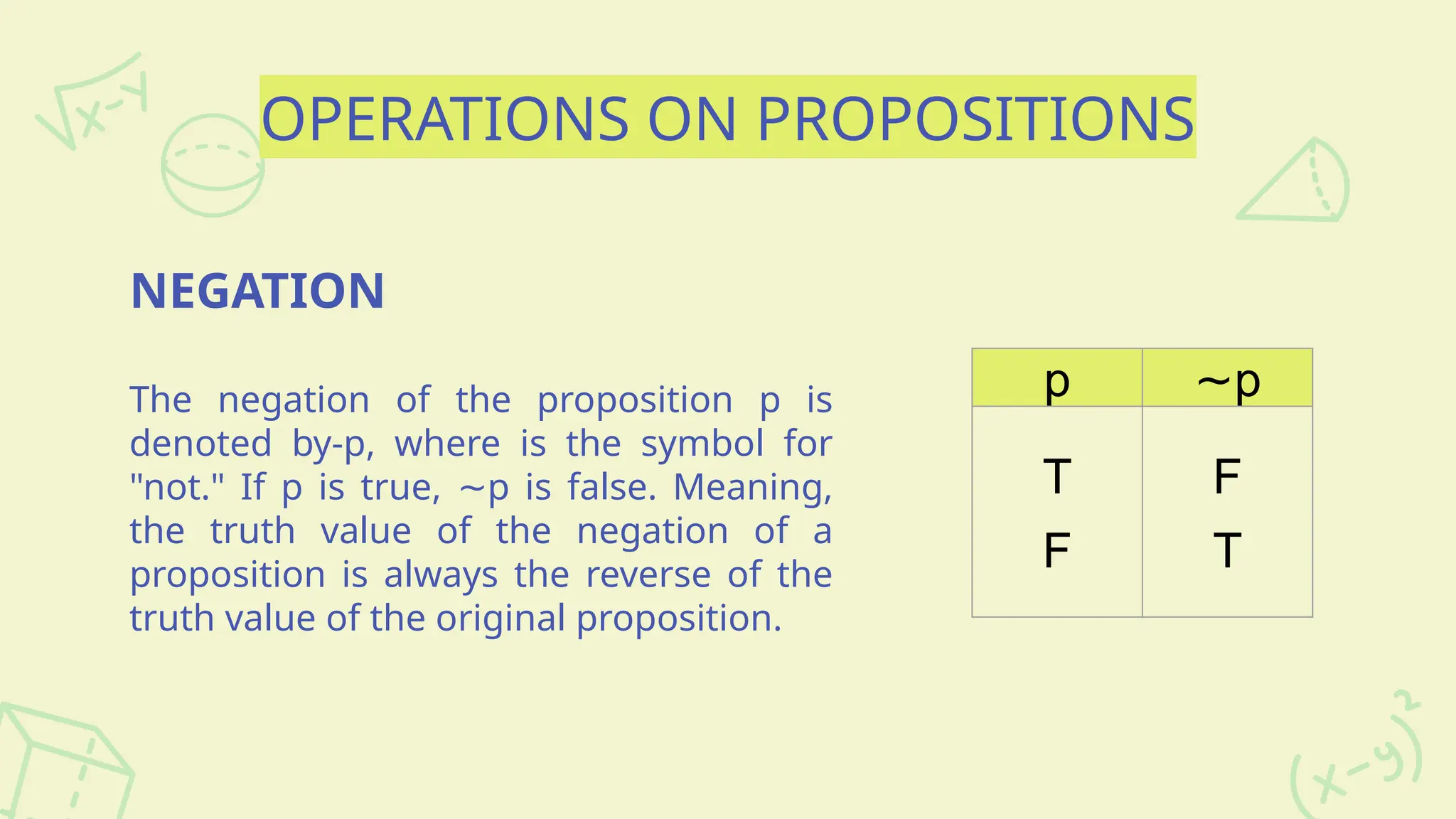
OPERATIONS ON PROPOSITIONS
NEGATION
Thenegation of the proposition p is
denoted by-p, where is the symbol for
"not." If p is true, p is false. Meaning,
∼
the truth value of the negation of a
proposition is always the reverse of the
truth value of the original proposition.
p ∼p
T
F
F
T
21.
OPERATIONS ON PROPOSITIONS
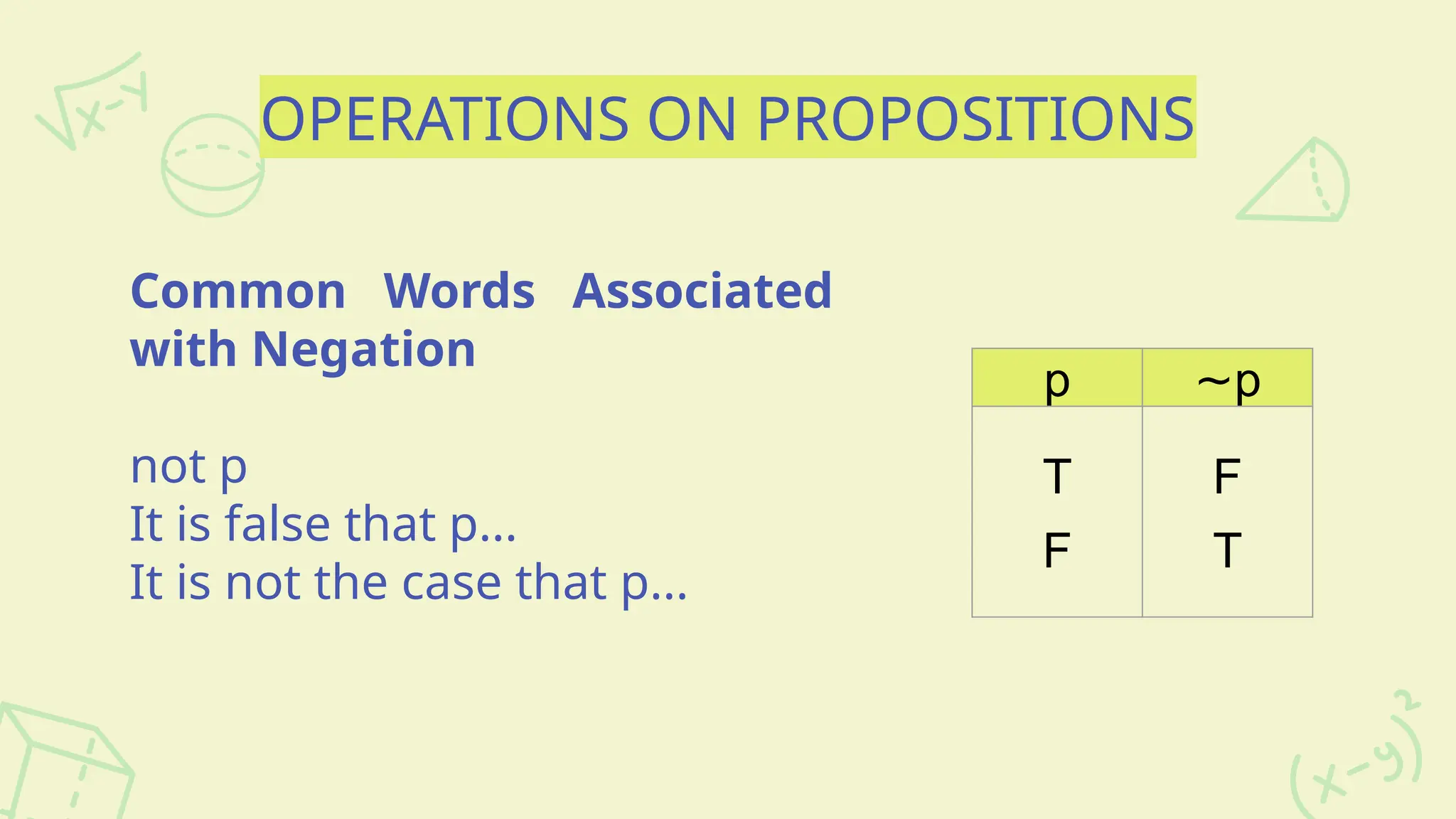
CommonWords Associated
with Negation
not p
It is false that p...
It is not the case that p...
p ∼p
T
F
F
T
22.
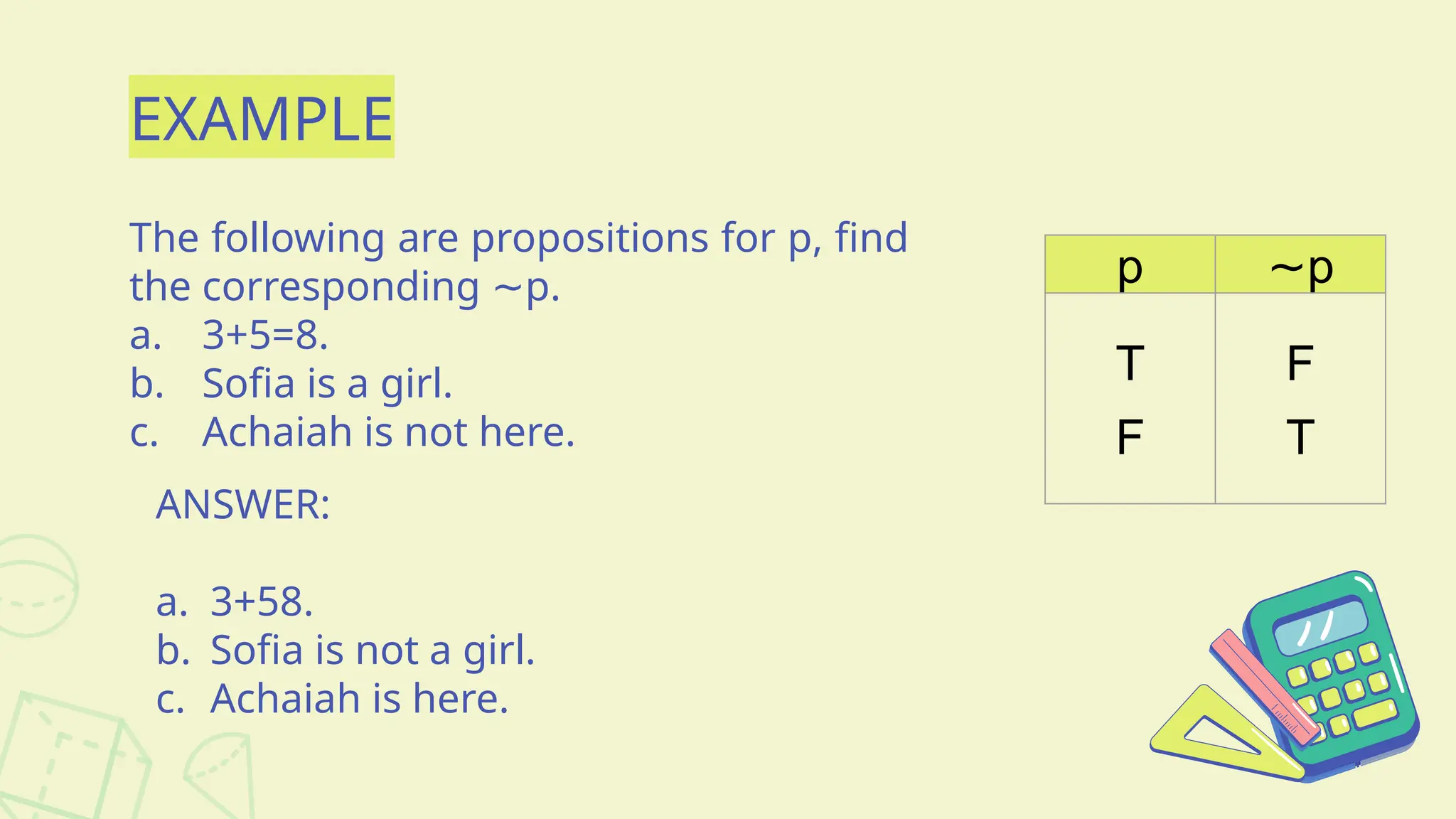
EXAMPLE
The following arepropositions for p, find
the corresponding p.
∼
a. 3+5=8.
b. Sofia is a girl.
c. Achaiah is not here.
ANSWER:
a. 3+58.
b. Sofia is not a girl.
c. Achaiah is here.
p ∼p
T
F
F
T
23.
OPERATIONS ON PROPOSITIONS
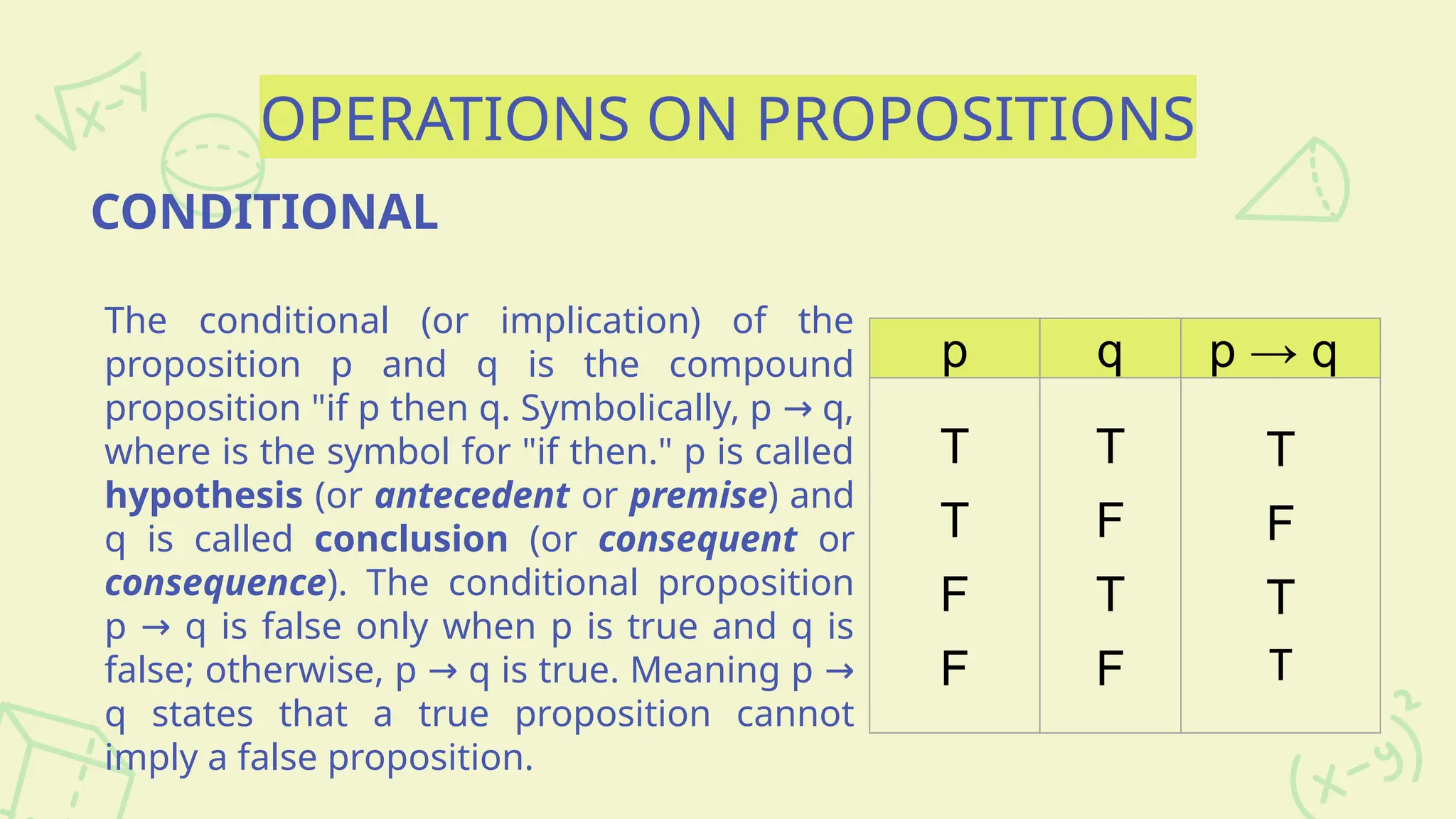
CONDITIONAL
Theconditional (or implication) of the
proposition p and q is the compound
proposition "if p then q. Symbolically, p q,
→
where is the symbol for "if then." p is called
hypothesis (or antecedent or premise) and
q is called conclusion (or consequent or
consequence). The conditional proposition
p q is false only when p is true and q is
→
false; otherwise, p q is true. Meaning p
→ →
q states that a true proposition cannot
imply a false proposition.
p q p → q
T
T
F
F
T
F
T
F
T
F
T
T
24.
OPERATIONS ON PROPOSITIONS
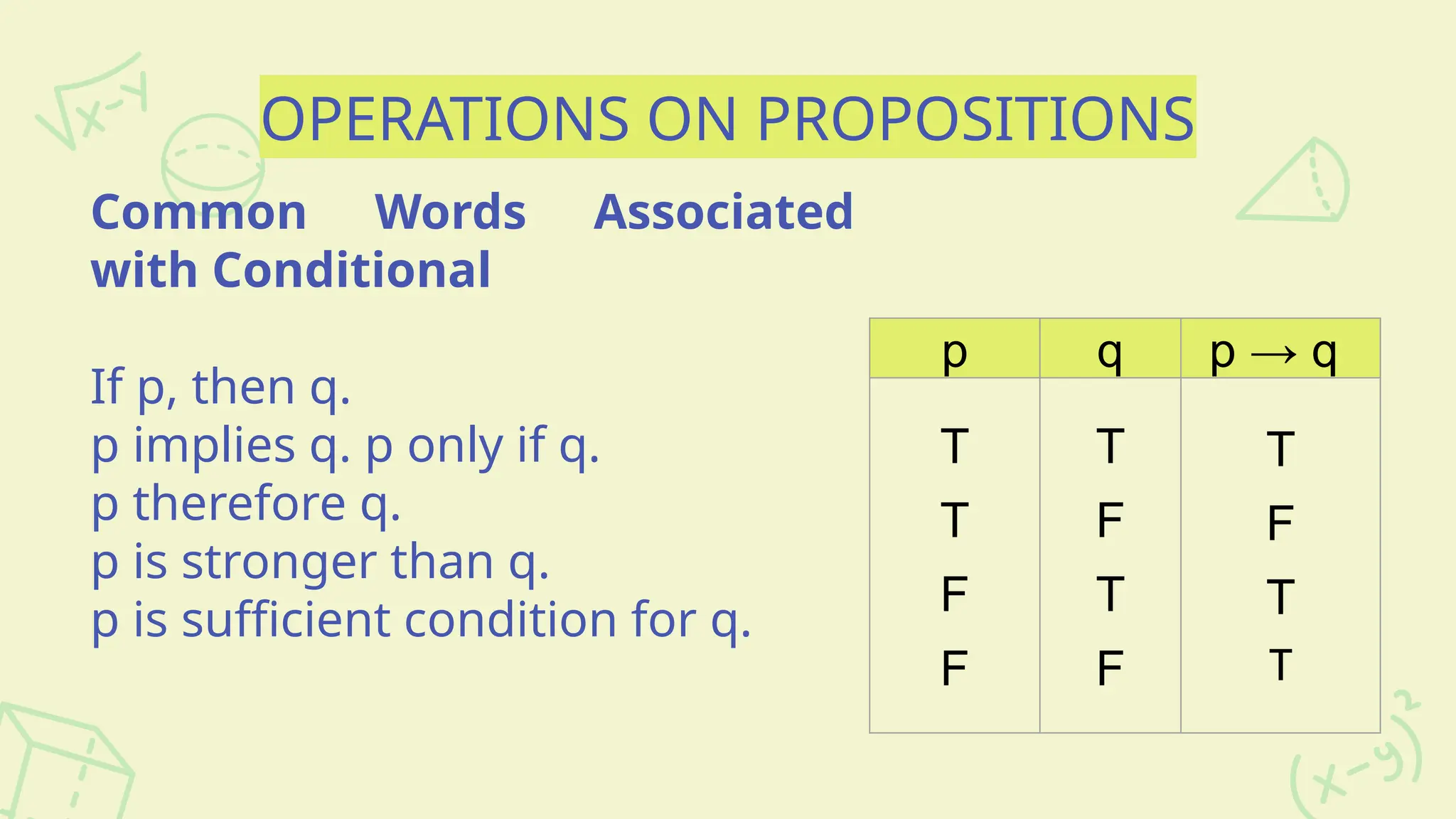
CommonWords Associated
with Conditional
If p, then q.
p implies q. p only if q.
p therefore q.
p is stronger than q.
p is sufficient condition for q.
p q p → q
T
T
F
F
T
F
T
F
T
F
T
T
25.
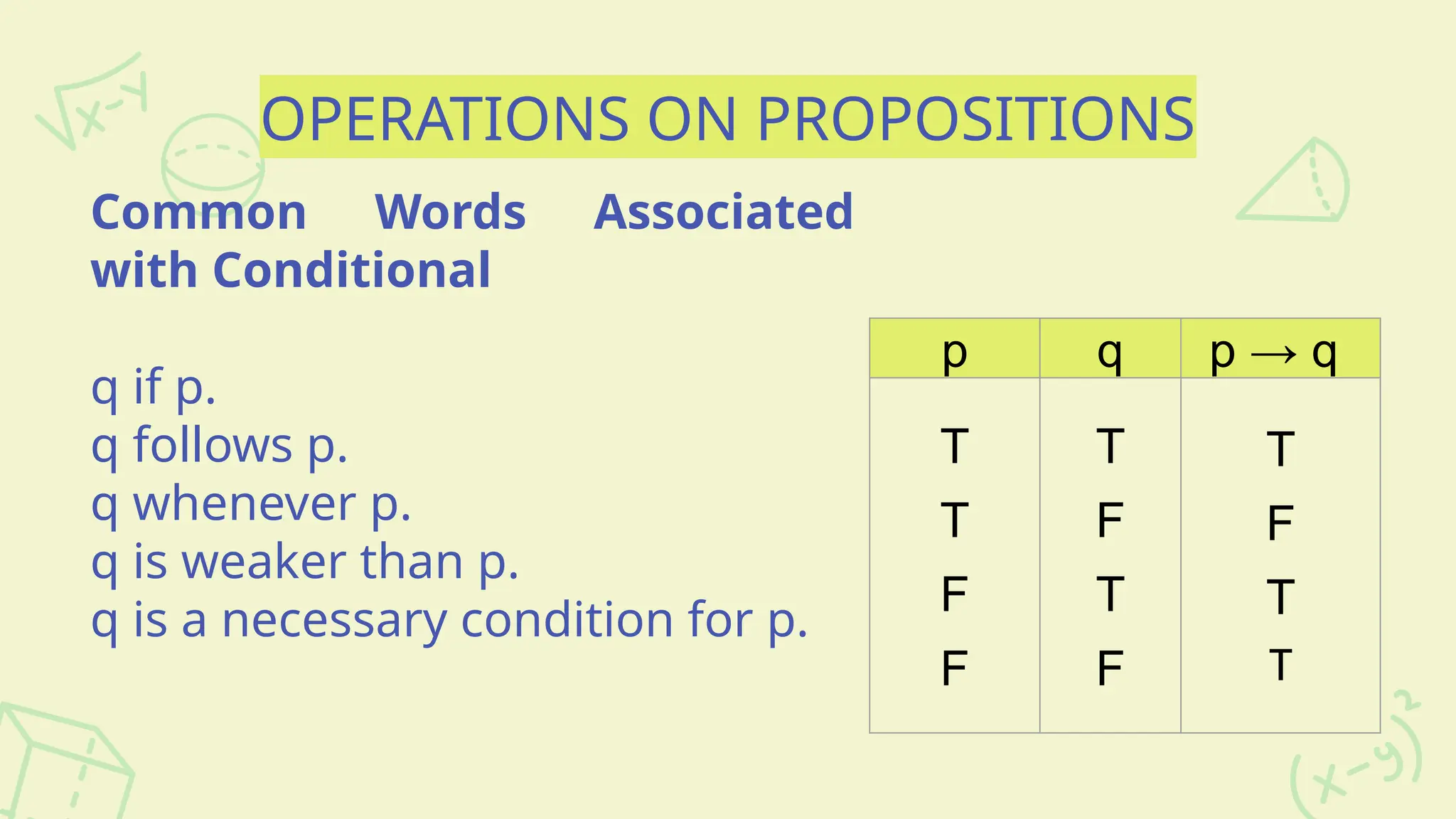
OPERATIONS ON PROPOSITIONS
CommonWords Associated
with Conditional
q if p.
q follows p.
q whenever p.
q is weaker than p.
q is a necessary condition for p.
p q p → q
T
T
F
F
T
F
T
F
T
F
T
T
26.
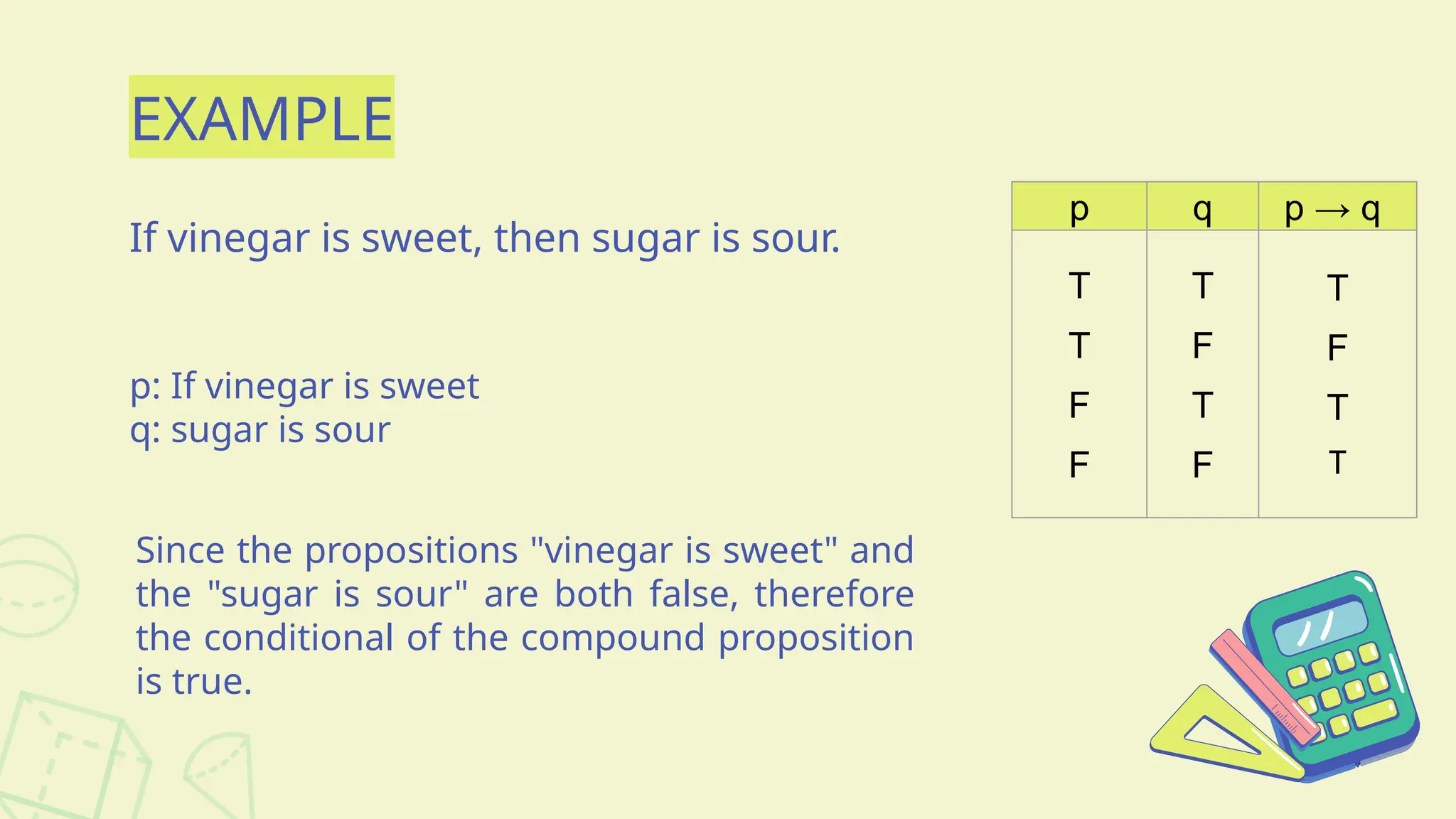
EXAMPLE
If vinegar issweet, then sugar is sour.
p: If vinegar is sweet
q: sugar is sour
Since the propositions "vinegar is sweet" and
the "sugar is sour" are both false, therefore
the conditional of the compound proposition
is true.
p q p → q
T
T
F
F
T
F
T
F
T
F
T
T
27.
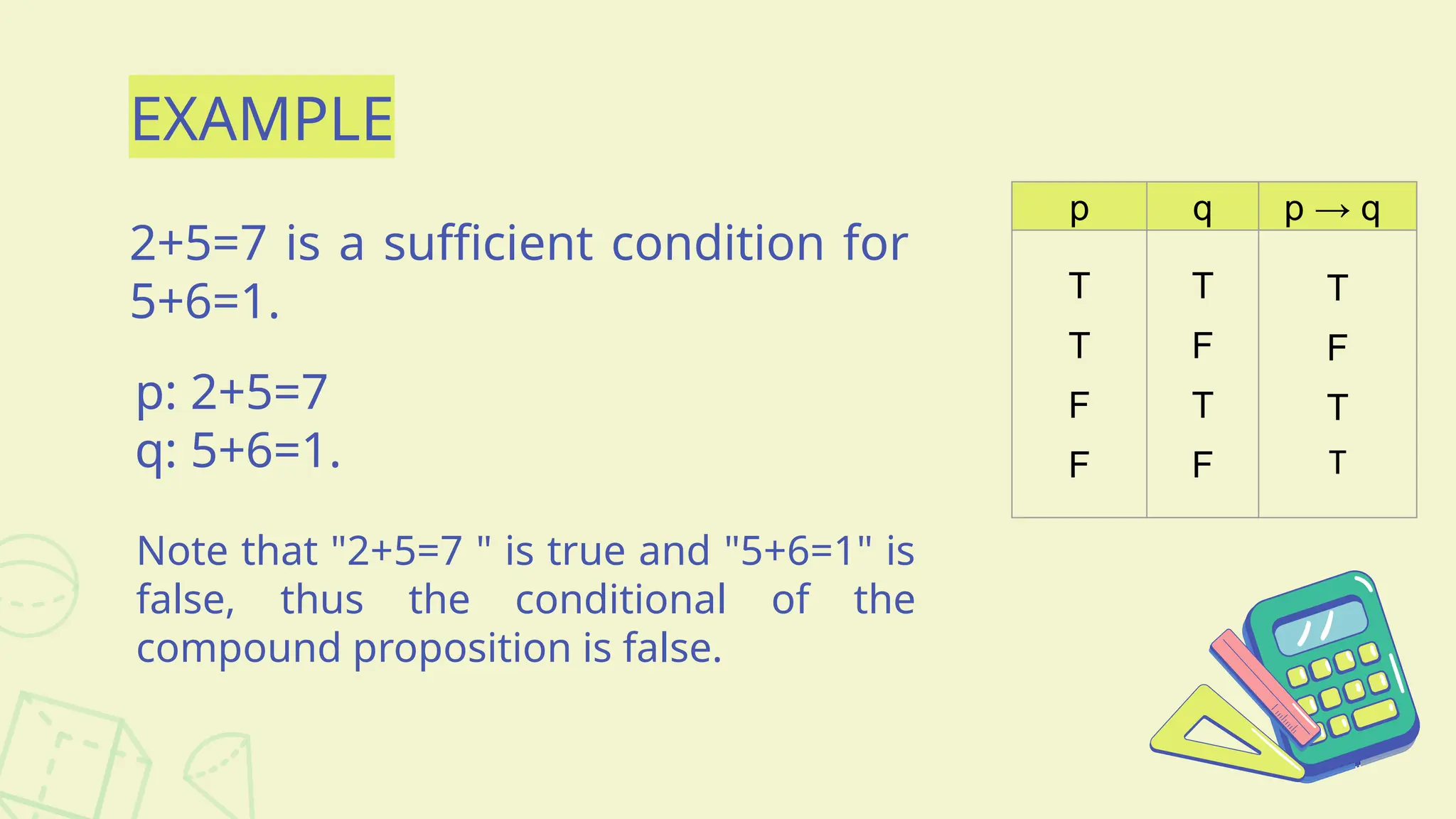
EXAMPLE
2+5=7 is asufficient condition for
5+6=1.
p: 2+5=7
q: 5+6=1.
Note that "2+5=7 " is true and "5+6=1" is
false, thus the conditional of the
compound proposition is false.
p q p → q
T
T
F
F
T
F
T
F
T
F
T
T
28.
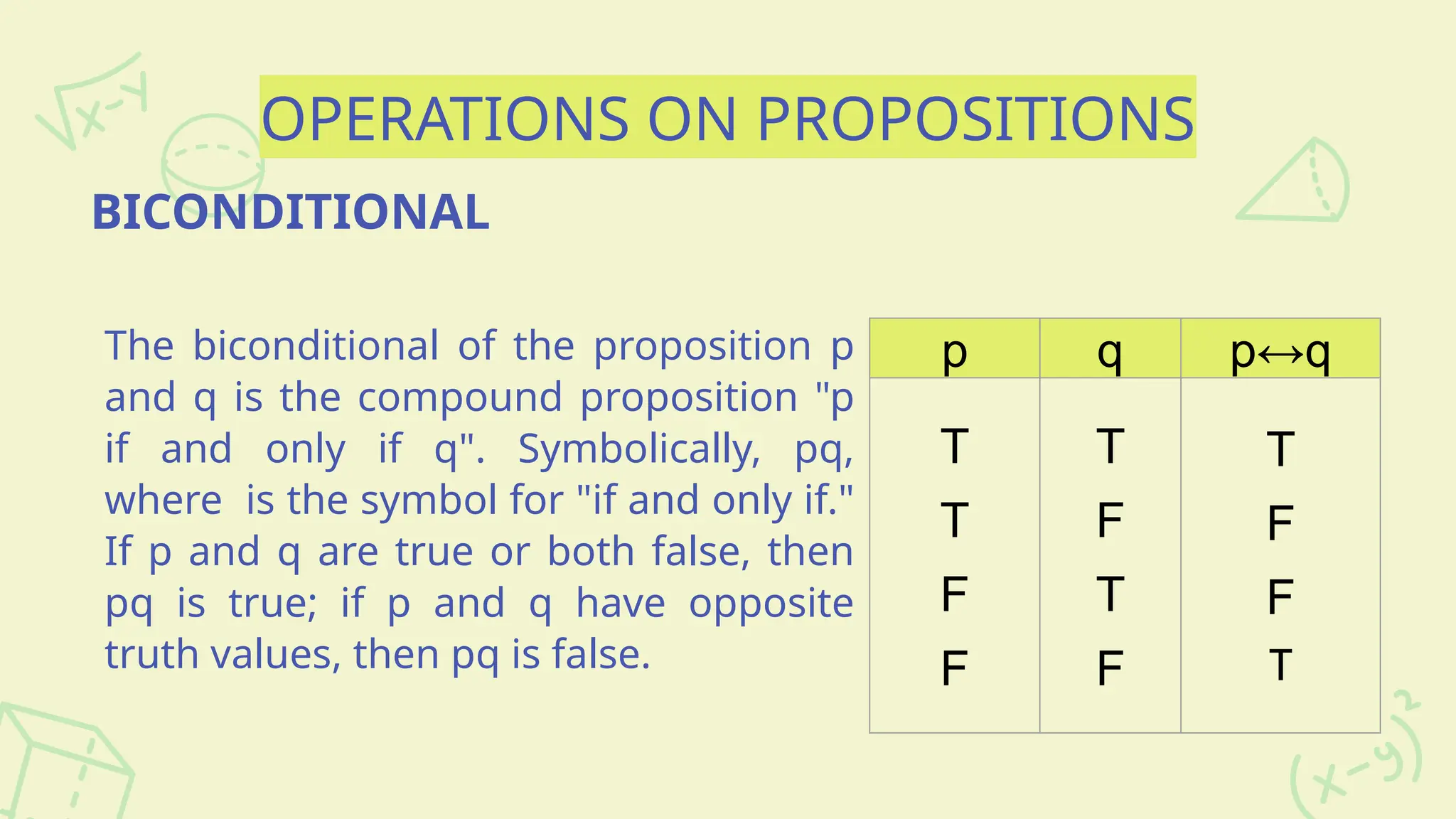
OPERATIONS ON PROPOSITIONS
BICONDITIONAL
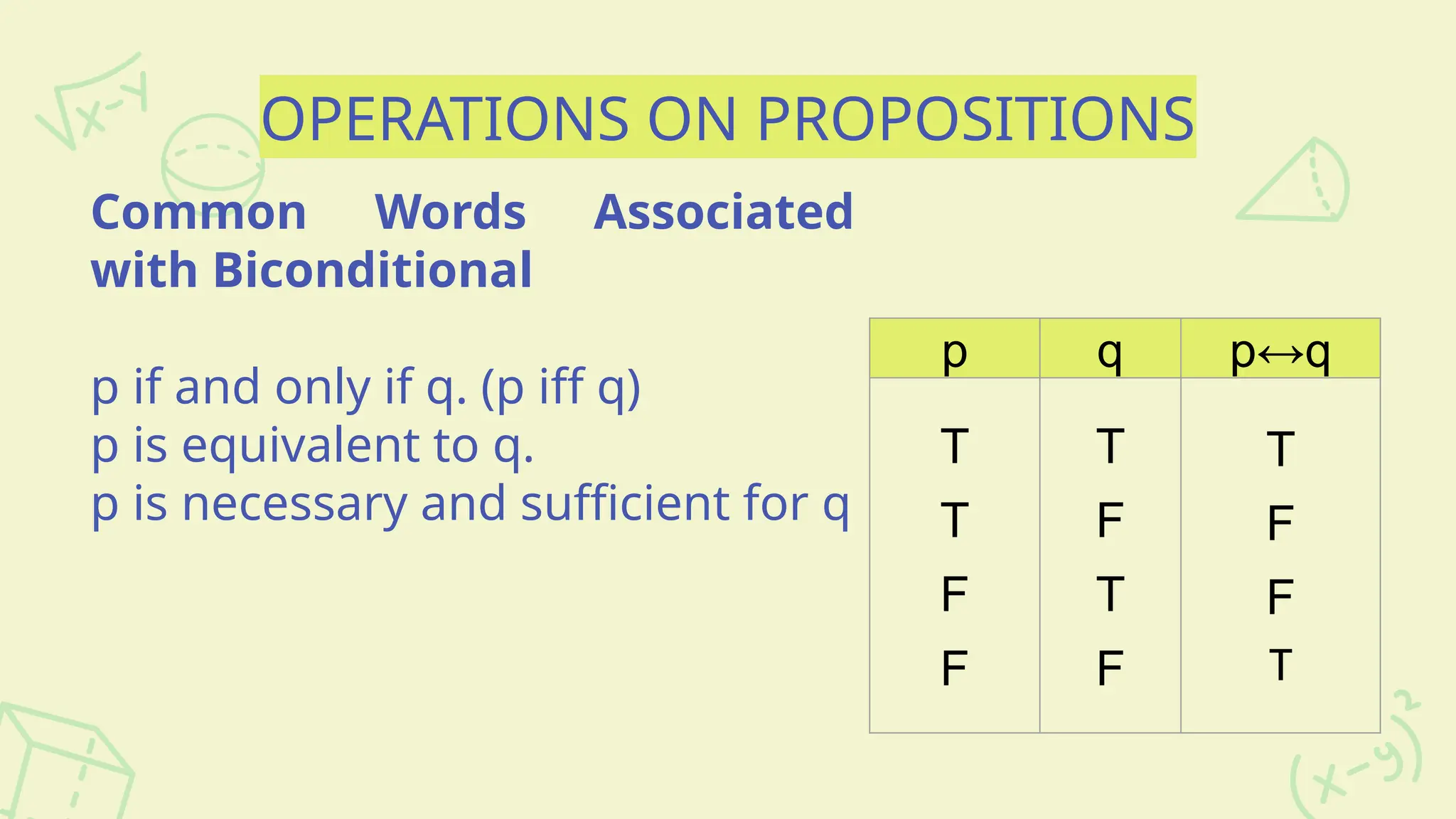
Thebiconditional of the proposition p
and q is the compound proposition "p
if and only if q". Symbolically, pq,
where is the symbol for "if and only if."
If p and q are true or both false, then
pq is true; if p and q have opposite
truth values, then pq is false.
p q p↔q
T
T
F
F
T
F
T
F
T
F
F
T
29.
OPERATIONS ON PROPOSITIONS
CommonWords Associated
with Biconditional
p if and only if q. (p iff q)
p is equivalent to q.
p is necessary and sufficient for q
p q p↔q
T
T
F
F
T
F
T
F
T
F
F
T
30.
EXAMPLE
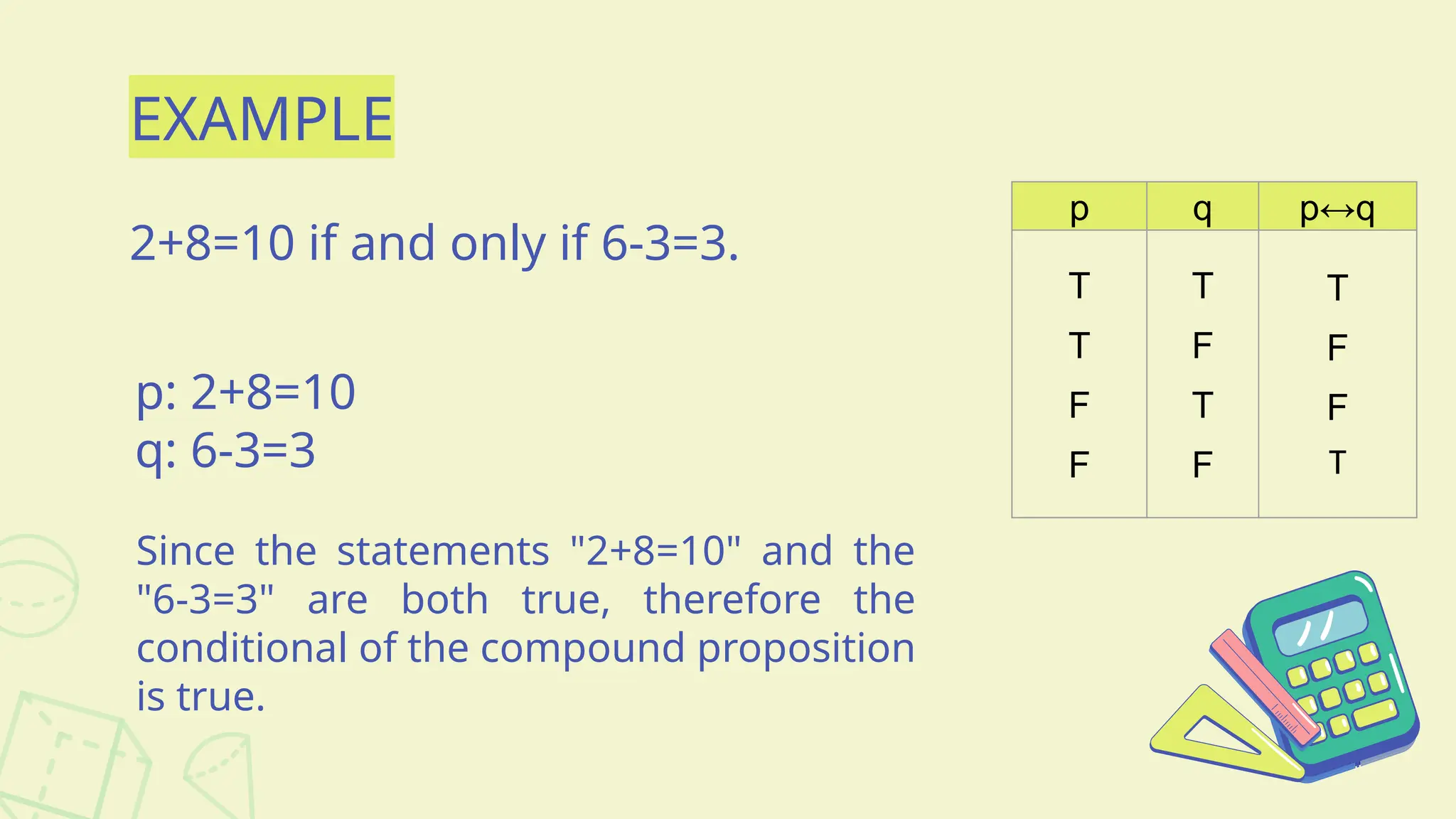
2+8=10 if andonly if 6-3=3.
p: 2+8=10
q: 6-3=3
Since the statements "2+8=10" and the
"6-3=3" are both true, therefore the
conditional of the compound proposition
is true.
p q p↔q
T
T
F
F
T
F
T
F
T
F
F
T
31.
EXAMPLE
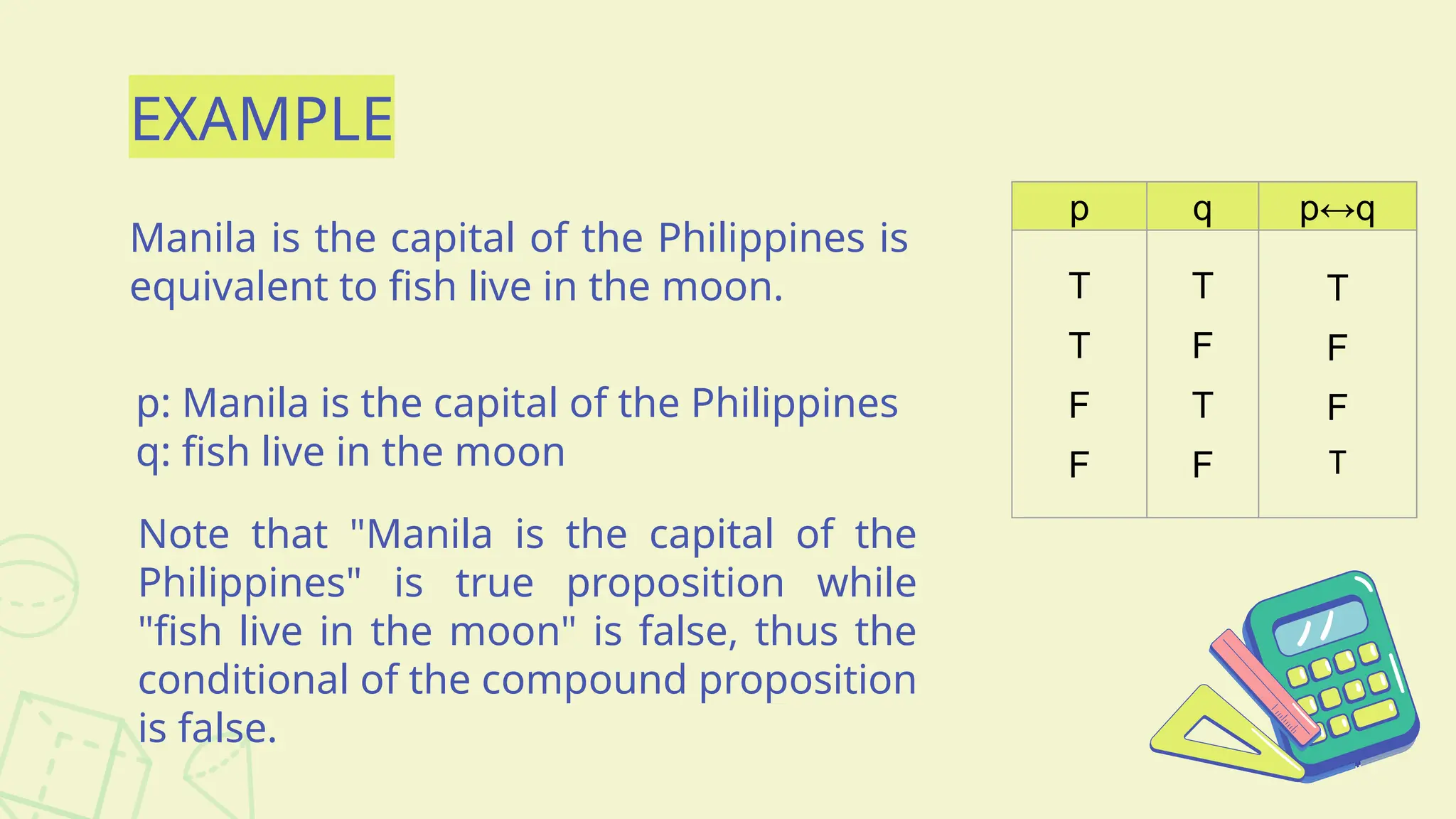
Manila is thecapital of the Philippines is
equivalent to fish live in the moon.
p: Manila is the capital of the Philippines
q: fish live in the moon
Note that "Manila is the capital of the
Philippines" is true proposition while
"fish live in the moon" is false, thus the
conditional of the compound proposition
is false.
p q p↔q
T
T
F
F
T
F
T
F
T
F
F
T
32.
EXAMPLE
8-2=5 is anecessary and sufficient for 4+2 =
7.
p: 8-2=5
q: 4+2 = 7
Given that "8 -2 = 5" and "4 + 2 = 7" are
both false, thus the conditional of the
compound proposition is true.
p q p↔q
T
T
F
F
T
F
T
F
T
F
F
T
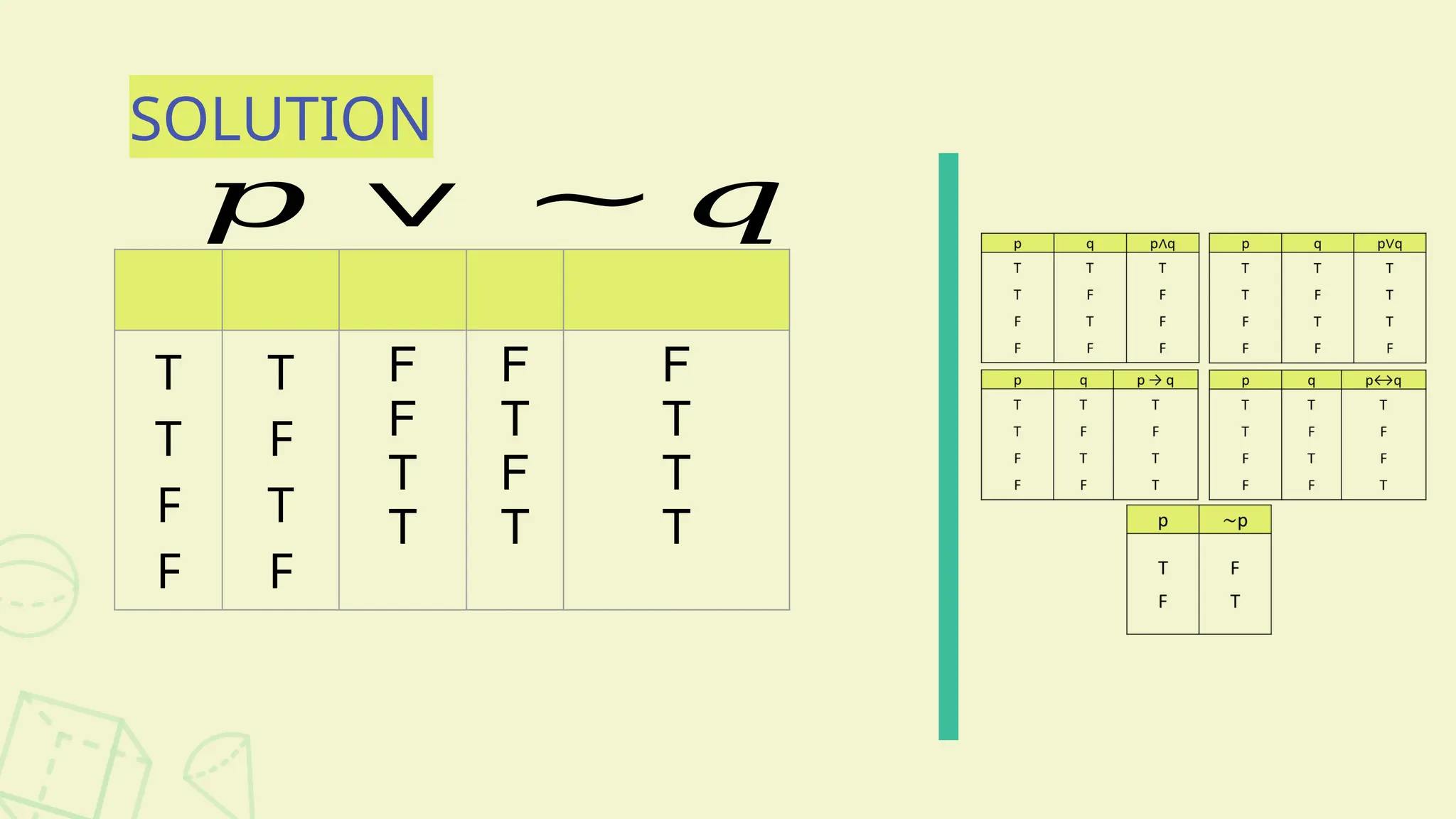
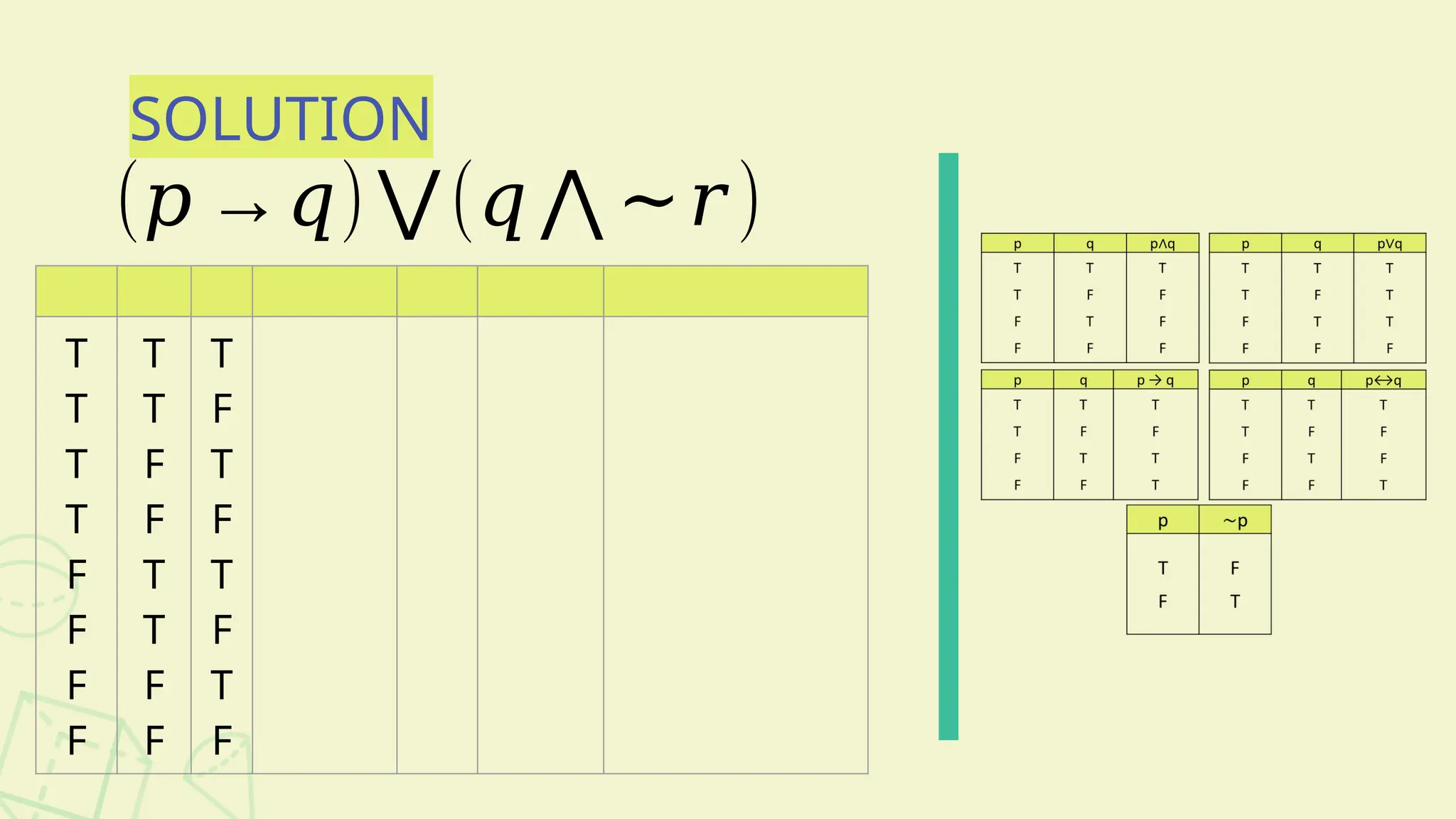
TRUTH TABLES
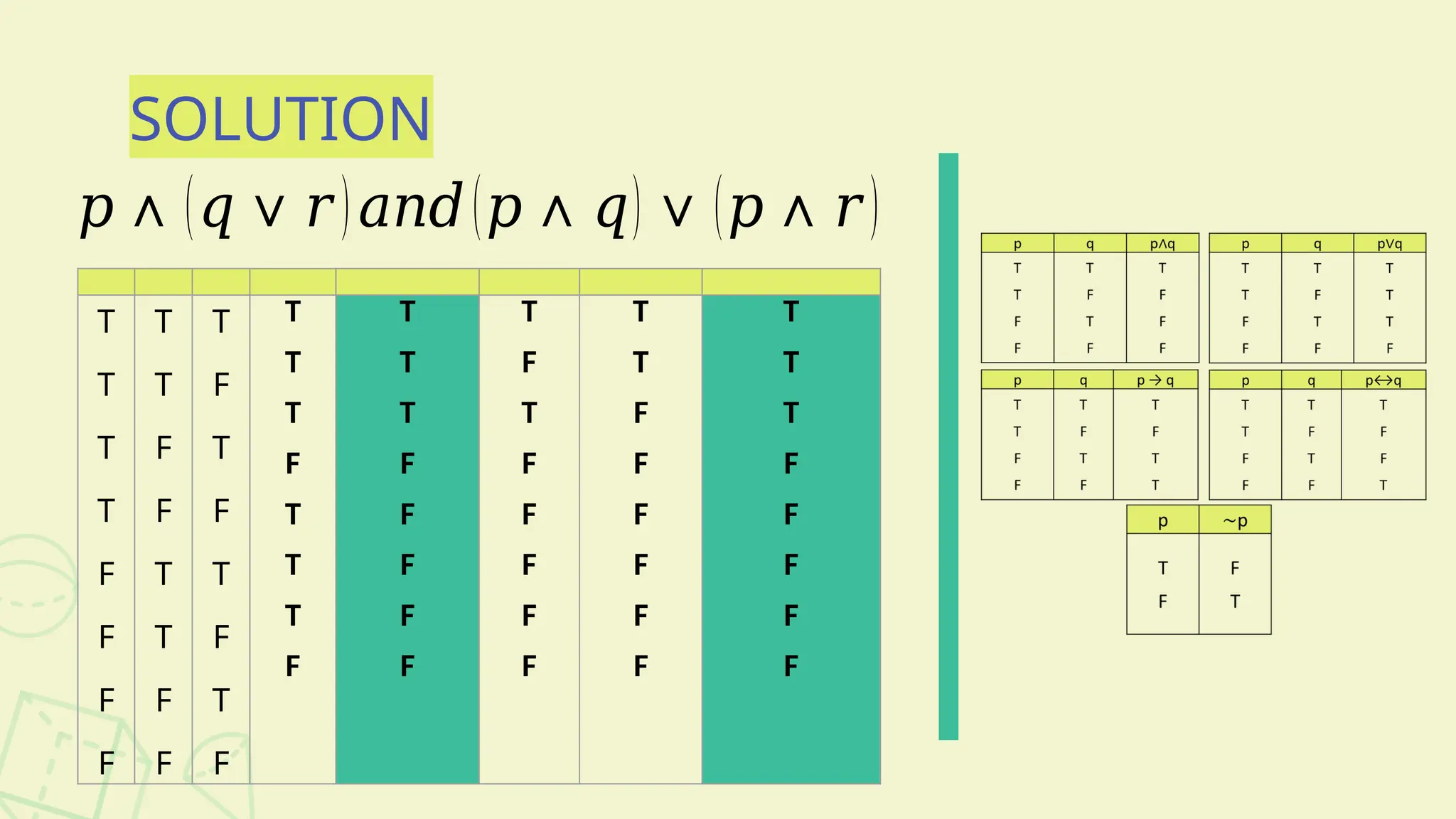
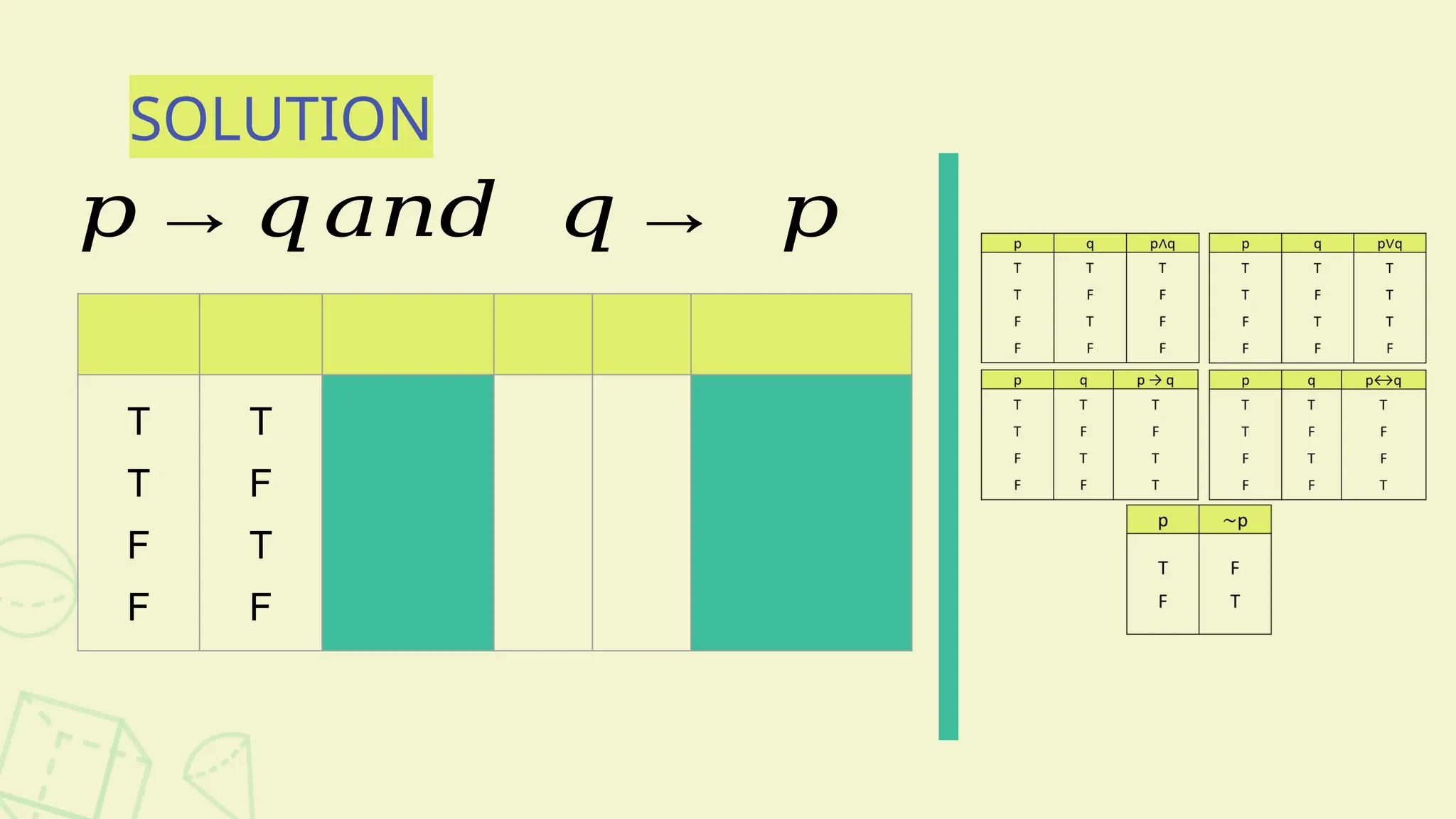
This sectionshows the construction of compound
propositions through truth tables which referred as
standard table form. Let us construct the truth table
for each of the following proposition:
a.
b.
c.
EQUIVALENT STATEMENTS
Two propositionsare said to be logically equivalent (or equivalent) if they
have the same truth value for every row of the truth table, that is is a
tautology. Symbolically,
EXAMPLE: Show that the following are equivalent.
TAUTOLOGIES
There are threeimportant classes of compound statements namely tautology,
contradiction, and contingency.
TAUTOLOGY. It is a compound statement that is true for all possible combinations
of the truth values of the propositional variables also called logically true.
CONTRADICTION. It is a compound statement that is false for all possible
combinations of the truth values of the propositional variables also called logically
false or absurdity.
CONTINGENCY. It is a compound statement that either be true or false, depending
on the truth values of the propositional variables are neither tautology nor a
contradiction.
43.
FALLACIES
Logical Fallacies refersto faulty reasoning in logic of an
argument. It is advantageous to know logical fallacies in order
to avoid them in an argument. There are different types of
fallacies that we might use to present our position. The
following are the list of common types of fallacies with their
corresponding examples.
44.
FALLACIES
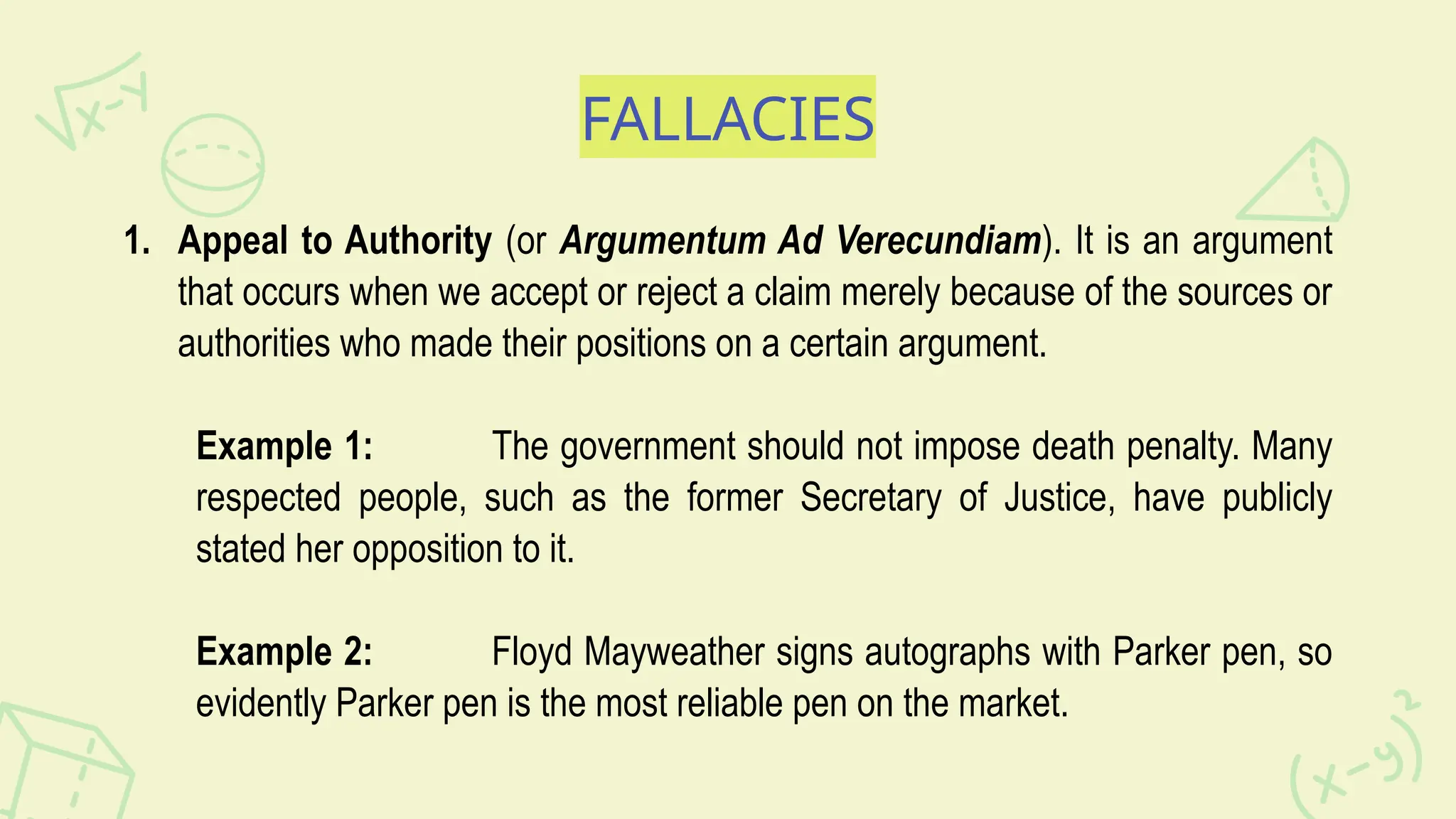
1. Appeal toAuthority (or Argumentum Ad Verecundiam). It is an argument
that occurs when we accept or reject a claim merely because of the sources or
authorities who made their positions on a certain argument.
Example 1: The government should not impose death penalty. Many
respected people, such as the former Secretary of Justice, have publicly
stated her opposition to it.
Example 2: Floyd Mayweather signs autographs with Parker pen, so
evidently Parker pen is the most reliable pen on the market.
45.
FALLACIES
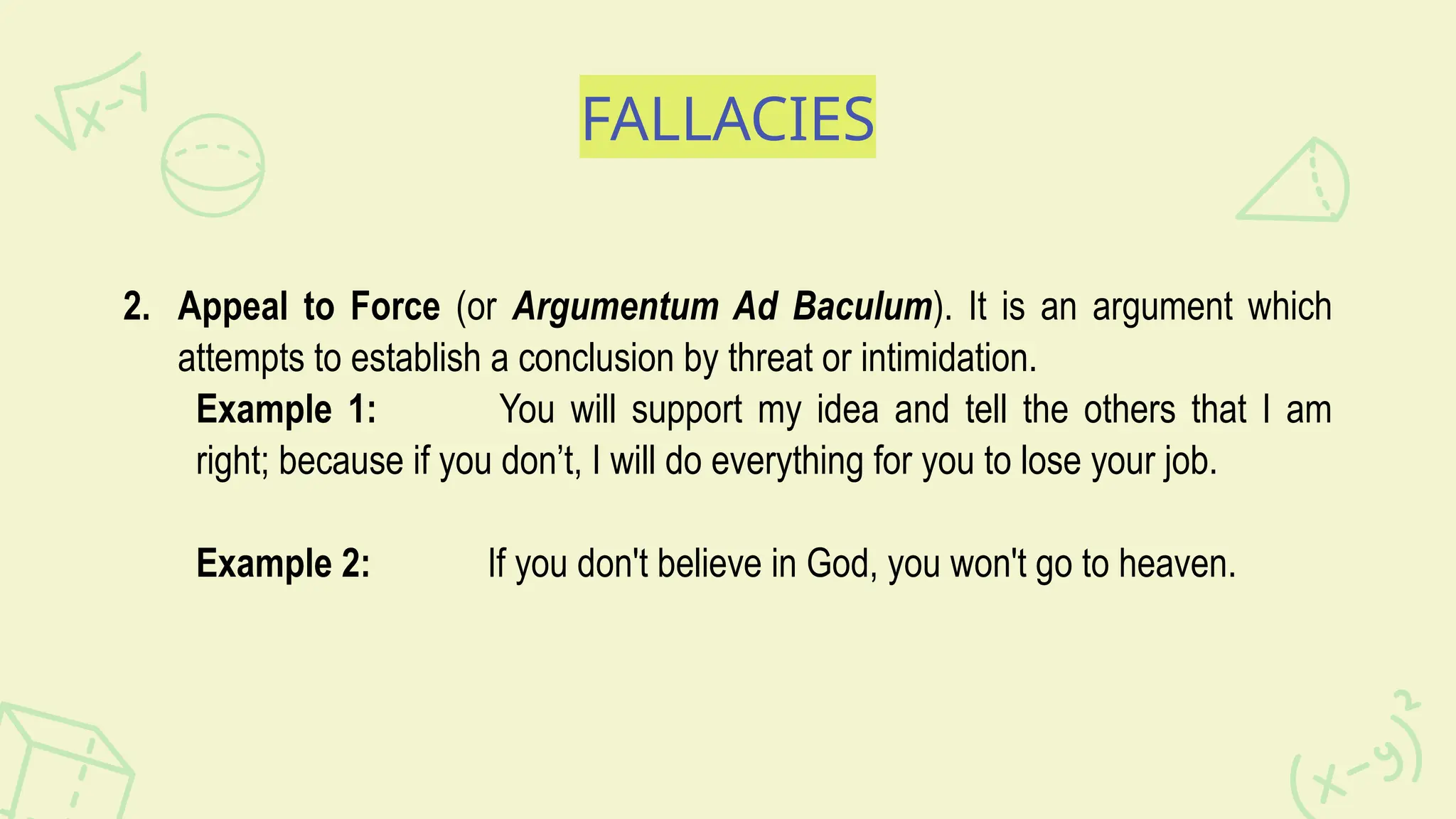
2. Appeal toForce (or Argumentum Ad Baculum). It is an argument which
attempts to establish a conclusion by threat or intimidation.
Example 1: You will support my idea and tell the others that I am
right; because if you don’t, I will do everything for you to lose your job.
Example 2: If you don't believe in God, you won't go to heaven.
46.
FALLACIES
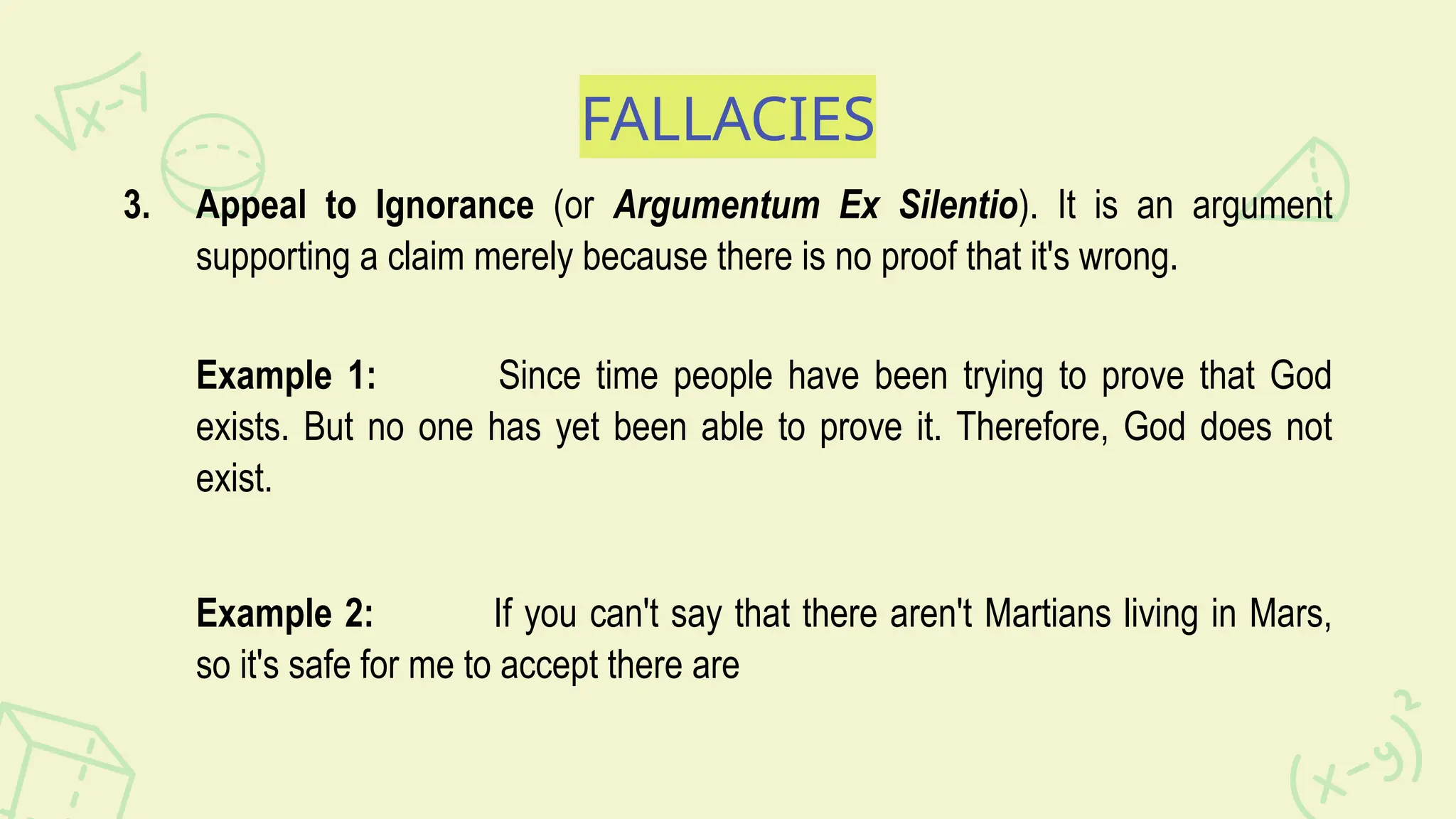
3. Appeal toIgnorance (or Argumentum Ex Silentio). It is an argument
supporting a claim merely because there is no proof that it's wrong.
Example 1: Since time people have been trying to prove that God
exists. But no one has yet been able to prove it. Therefore, God does not
exist.
Example 2: If you can't say that there aren't Martians living in Mars,
so it's safe for me to accept there are
47.
FALLACIES
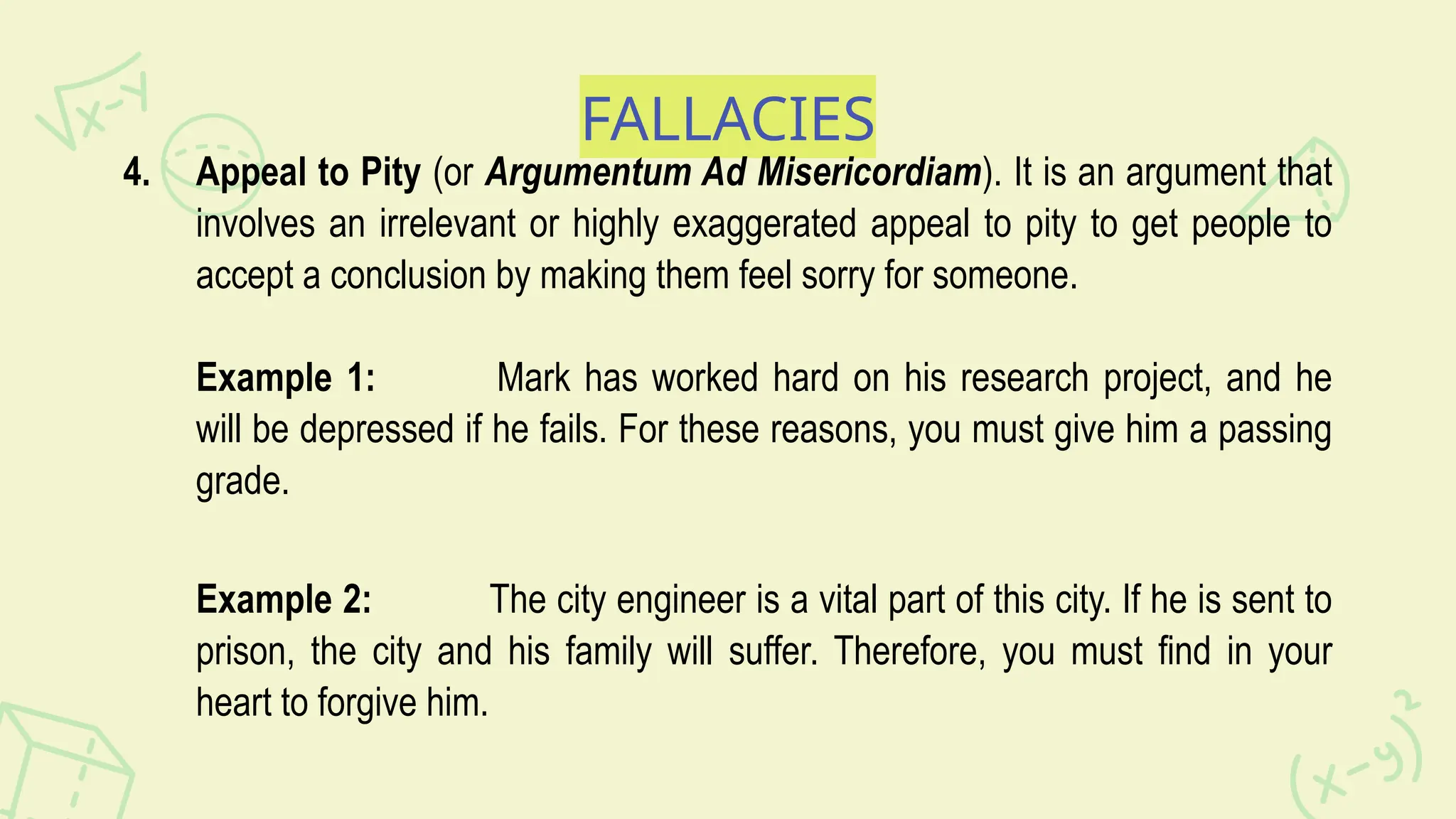
4. Appeal toPity (or Argumentum Ad Misericordiam). It is an argument that
involves an irrelevant or highly exaggerated appeal to pity to get people to
accept a conclusion by making them feel sorry for someone.
Example 1: Mark has worked hard on his research project, and he
will be depressed if he fails. For these reasons, you must give him a passing
grade.
Example 2: The city engineer is a vital part of this city. If he is sent to
prison, the city and his family will suffer. Therefore, you must find in your
heart to forgive him.
48.
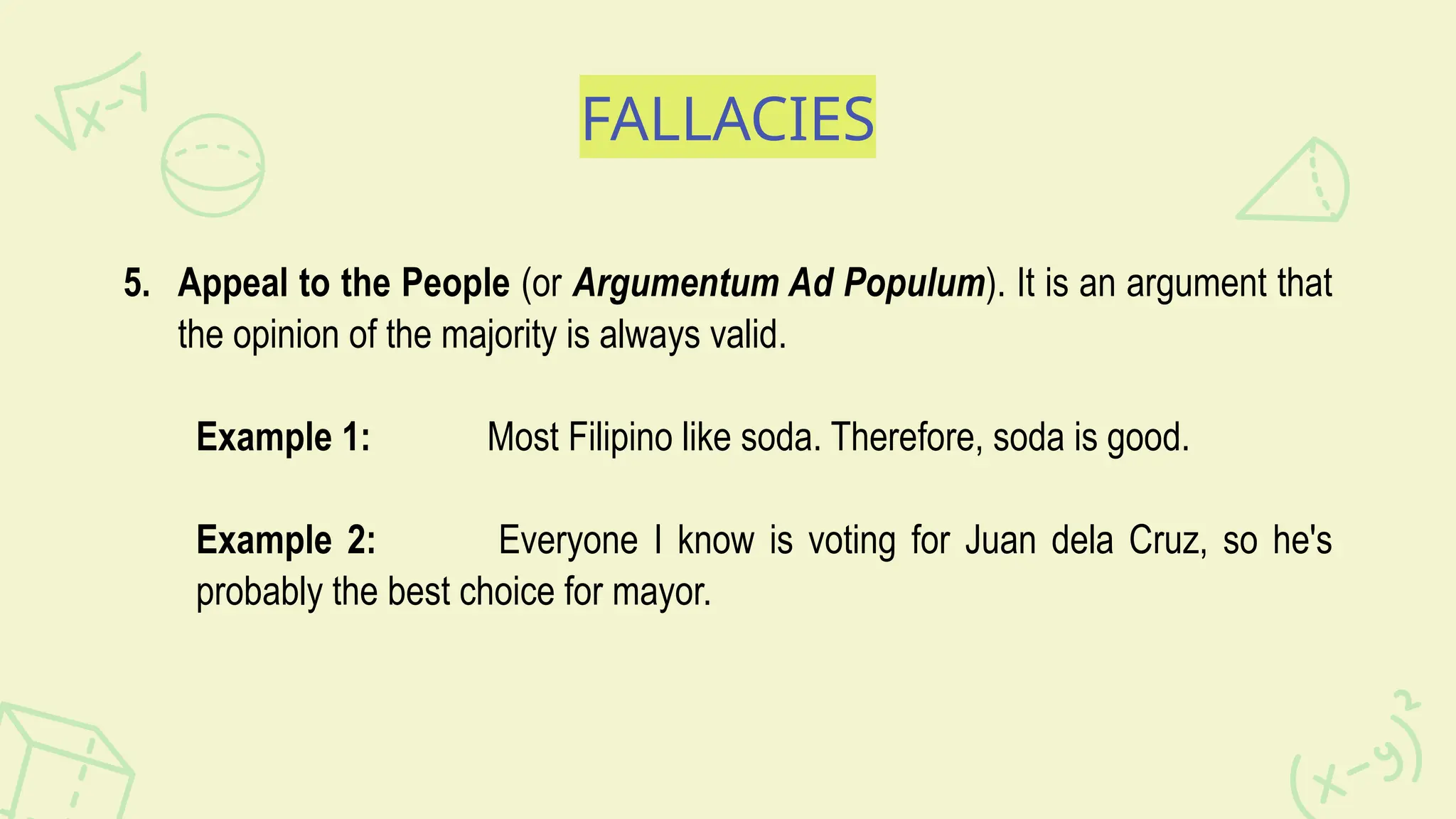
FALLACIES
5. Appeal tothe People (or Argumentum Ad Populum). It is an argument that
the opinion of the majority is always valid.
Example 1: Most Filipino like soda. Therefore, soda is good.
Example 2: Everyone I know is voting for Juan dela Cruz, so he's
probably the best choice for mayor.
49.
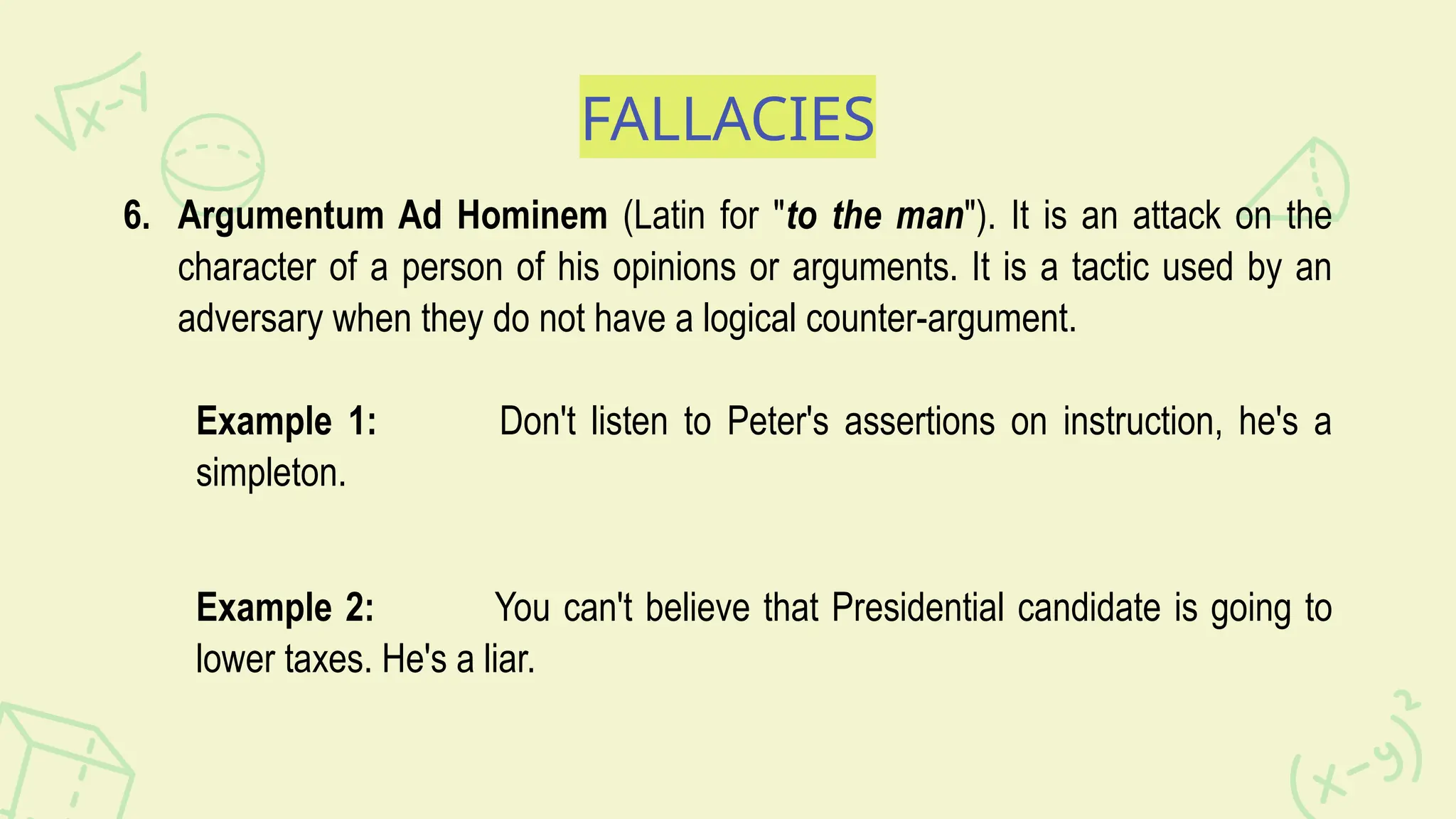
FALLACIES
6. Argumentum AdHominem (Latin for "to the man"). It is an attack on the
character of a person of his opinions or arguments. It is a tactic used by an
adversary when they do not have a logical counter-argument.
Example 1: Don't listen to Peter's assertions on instruction, he's a
simpleton.
Example 2: You can't believe that Presidential candidate is going to
lower taxes. He's a liar.
50.
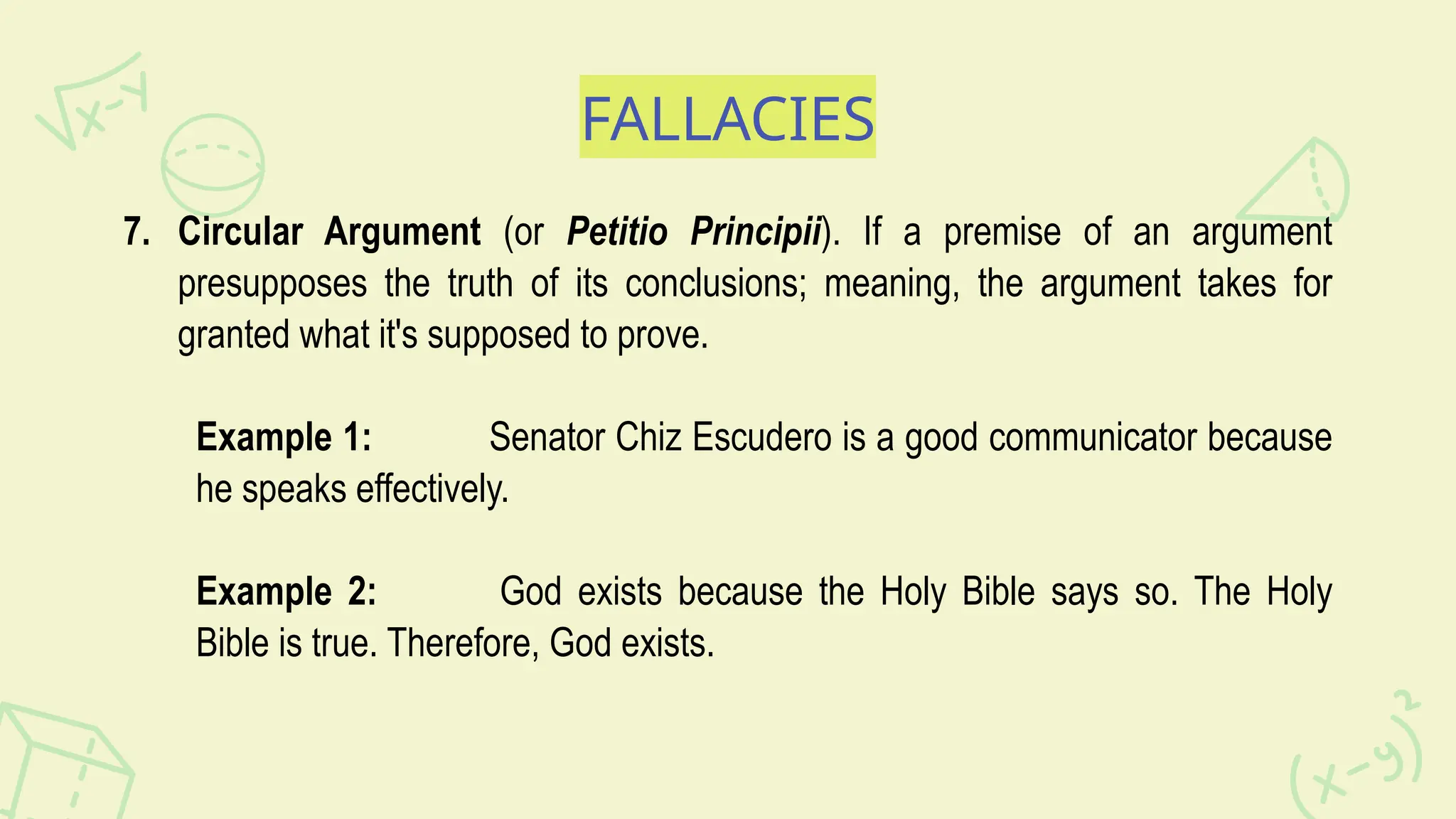
FALLACIES
7. Circular Argument(or Petitio Principii). If a premise of an argument
presupposes the truth of its conclusions; meaning, the argument takes for
granted what it's supposed to prove.
Example 1: Senator Chiz Escudero is a good communicator because
he speaks effectively.
Example 2: God exists because the Holy Bible says so. The Holy
Bible is true. Therefore, God exists.
51.
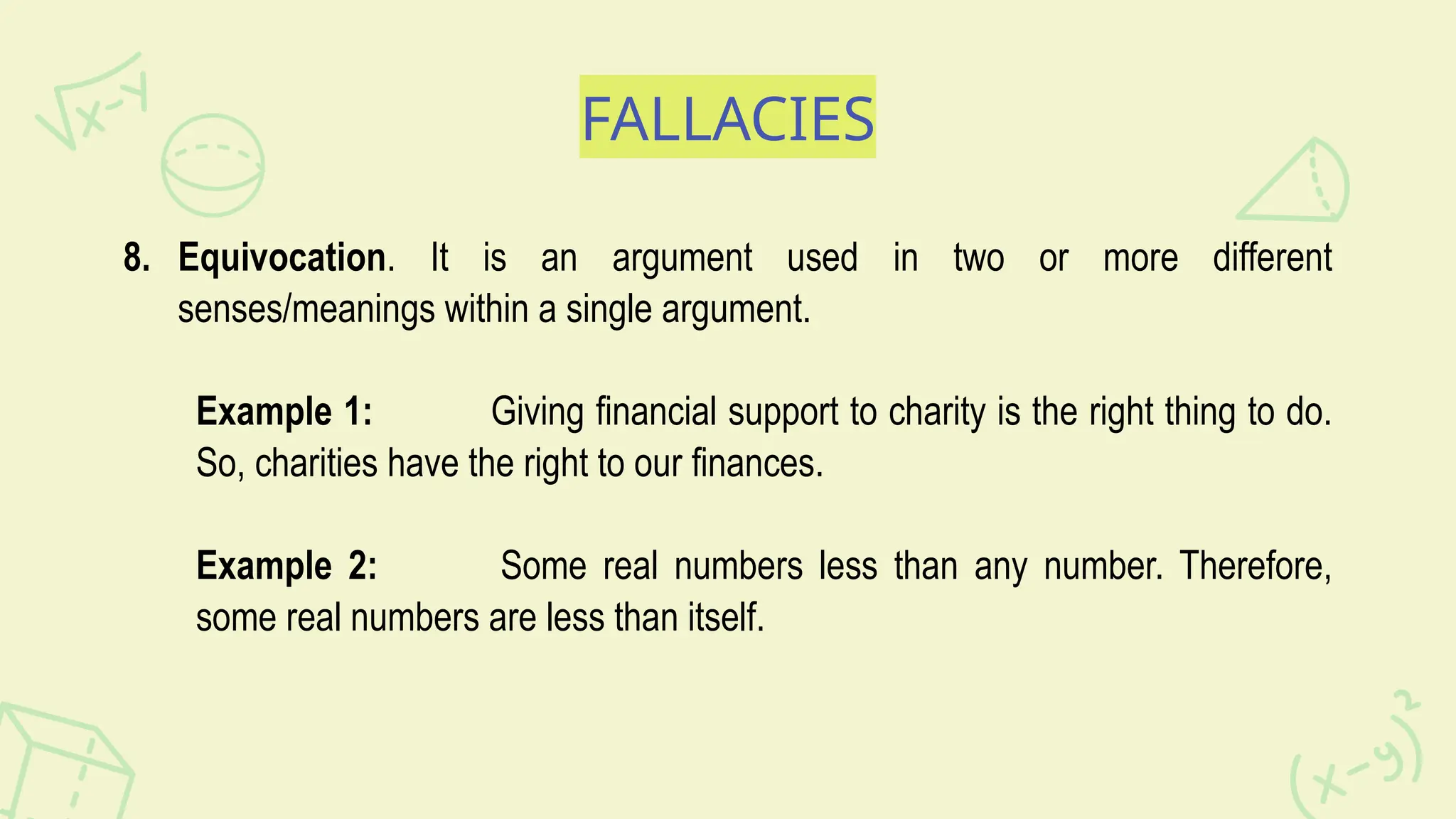
FALLACIES
8. Equivocation. Itis an argument used in two or more different
senses/meanings within a single argument.
Example 1: Giving financial support to charity is the right thing to do.
So, charities have the right to our finances.
Example 2: Some real numbers less than any number. Therefore,
some real numbers are less than itself.
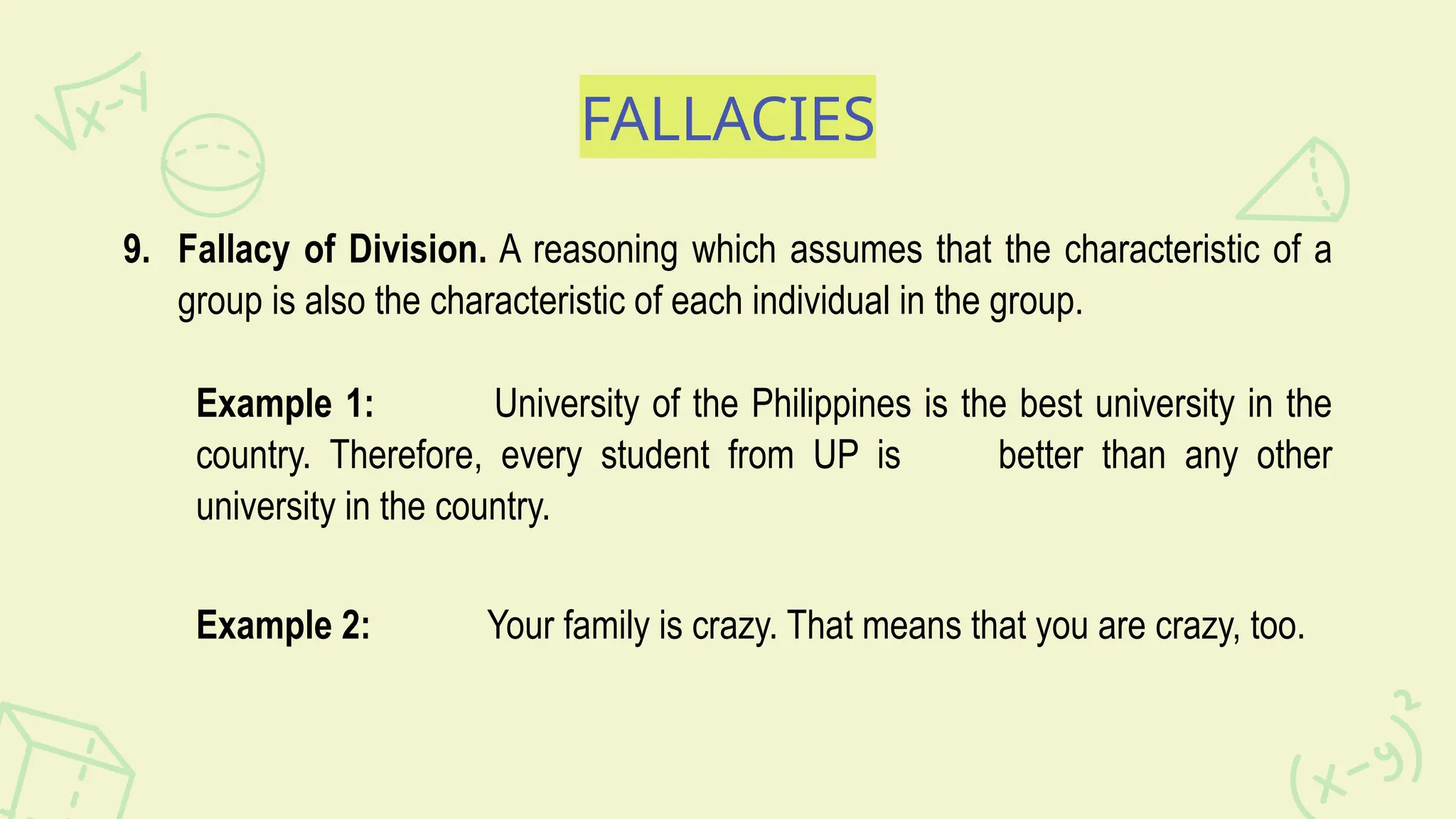
52.
FALLACIES
9. Fallacy ofDivision. A reasoning which assumes that the characteristic of a
group is also the characteristic of each individual in the group.
Example 1: University of the Philippines is the best university in the
country. Therefore, every student from UP is better than any other
university in the country.
Example 2: Your family is crazy. That means that you are crazy, too.
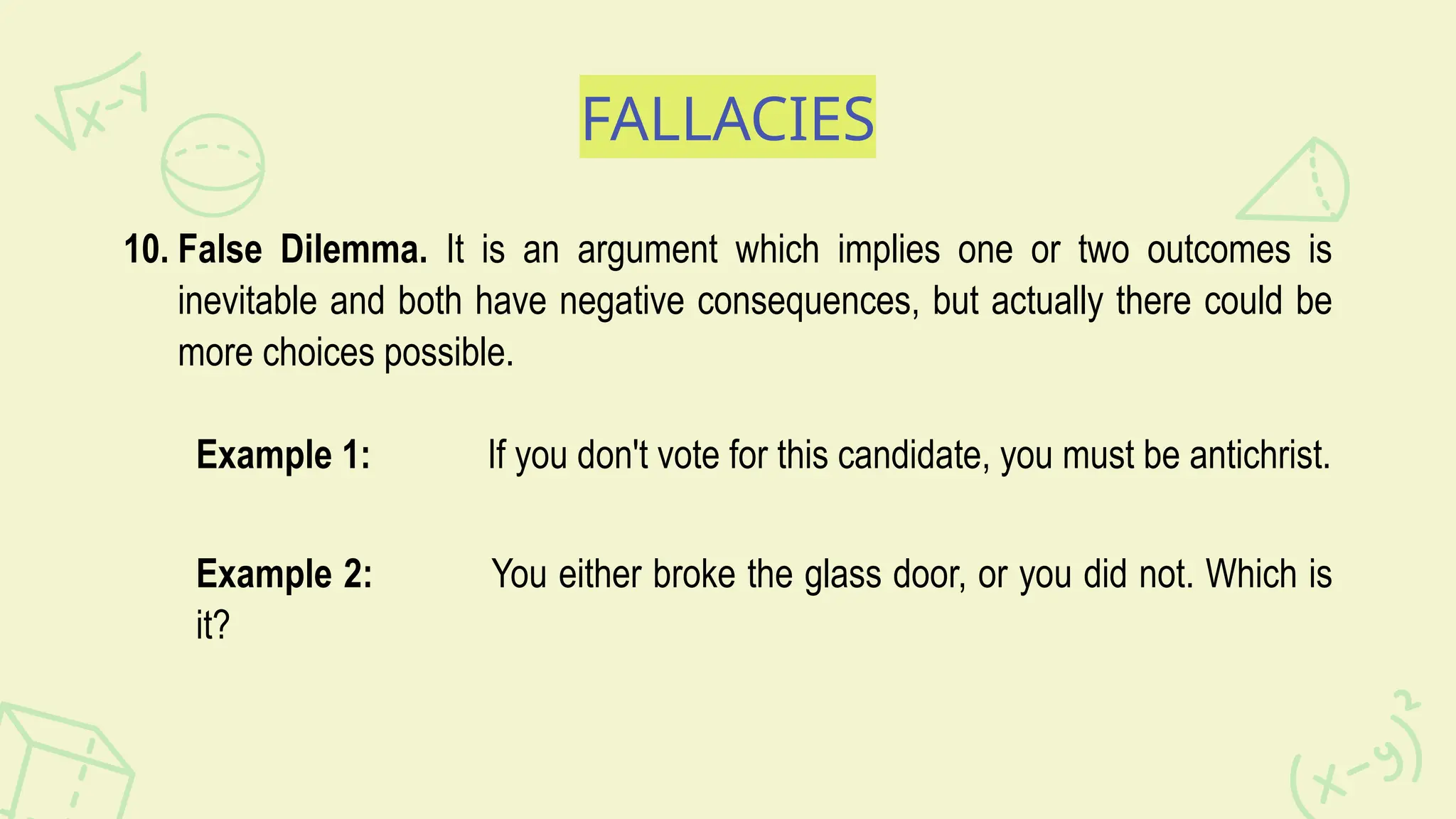
53.
FALLACIES
10. False Dilemma.It is an argument which implies one or two outcomes is
inevitable and both have negative consequences, but actually there could be
more choices possible.
Example 1: If you don't vote for this candidate, you must be antichrist.
Example 2: You either broke the glass door, or you did not. Which is
it?
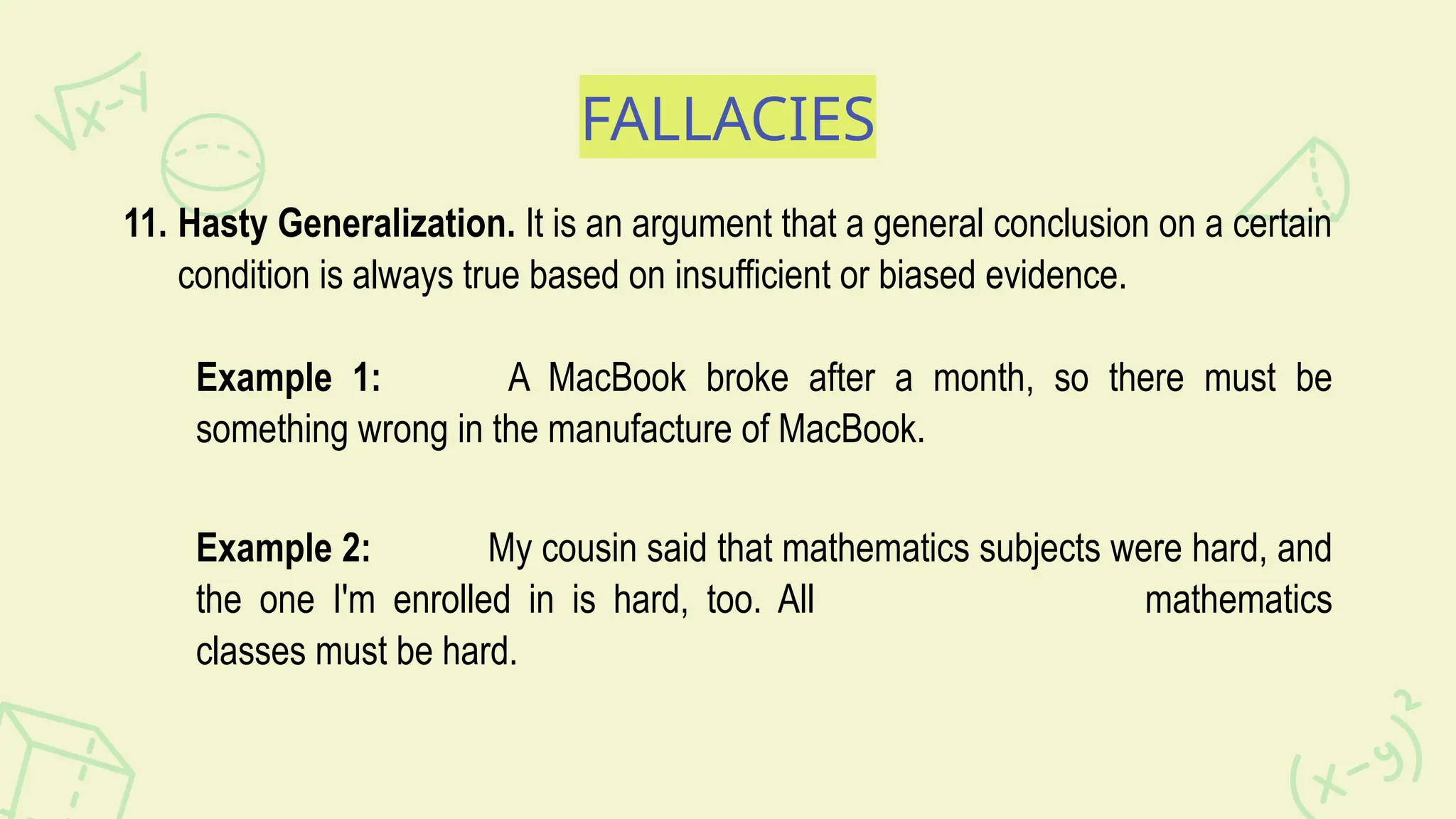
54.
FALLACIES
11. Hasty Generalization.It is an argument that a general conclusion on a certain
condition is always true based on insufficient or biased evidence.
Example 1: A MacBook broke after a month, so there must be
something wrong in the manufacture of MacBook.
Example 2: My cousin said that mathematics subjects were hard, and
the one I'm enrolled in is hard, too. All mathematics
classes must be hard.
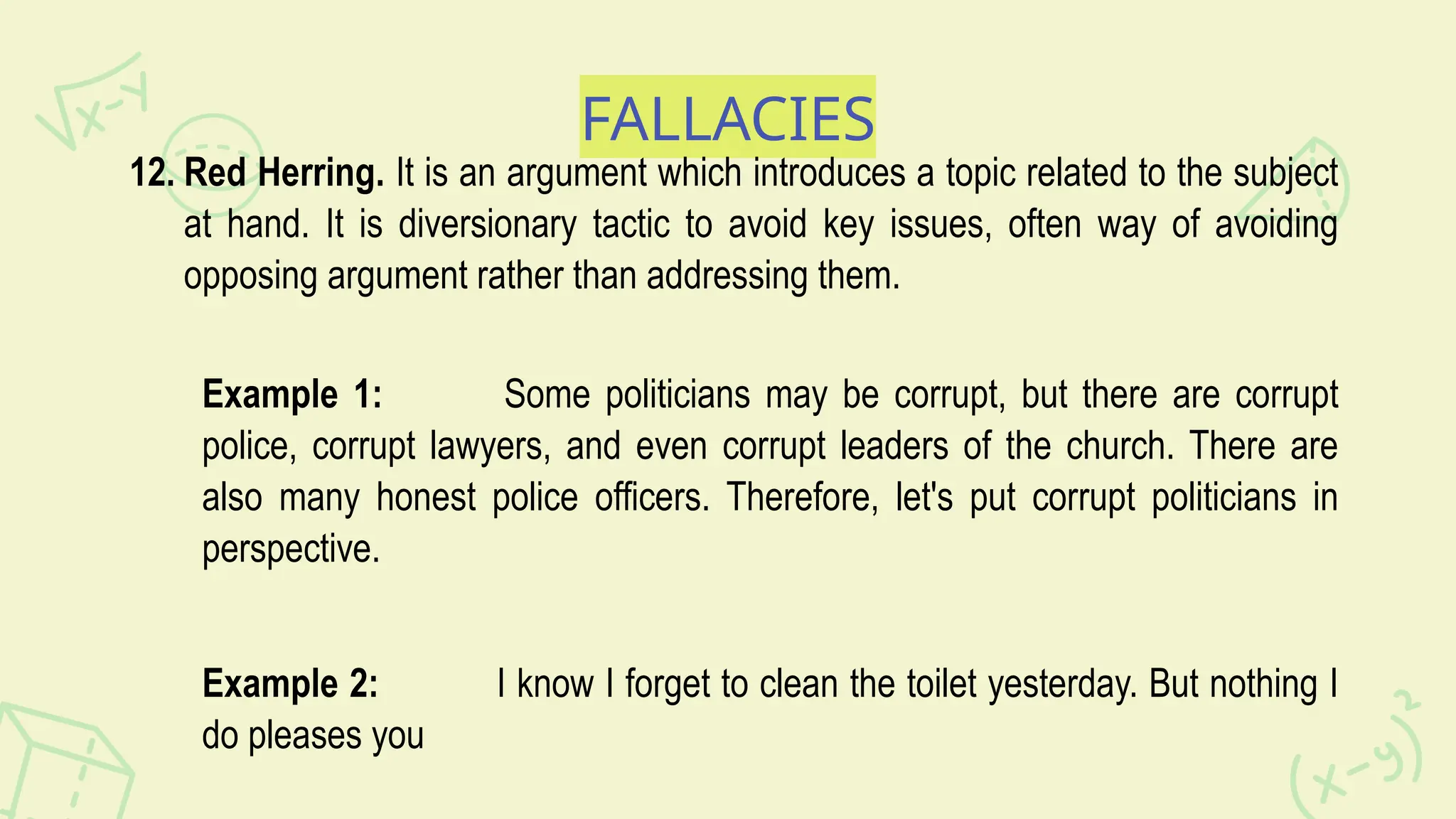
55.
FALLACIES
12. Red Herring.It is an argument which introduces a topic related to the subject
at hand. It is diversionary tactic to avoid key issues, often way of avoiding
opposing argument rather than addressing them.
Example 1: Some politicians may be corrupt, but there are corrupt
police, corrupt lawyers, and even corrupt leaders of the church. There are
also many honest police officers. Therefore, let's put corrupt politicians in
perspective.
Example 2: I know I forget to clean the toilet yesterday. But nothing I
do pleases you
56.
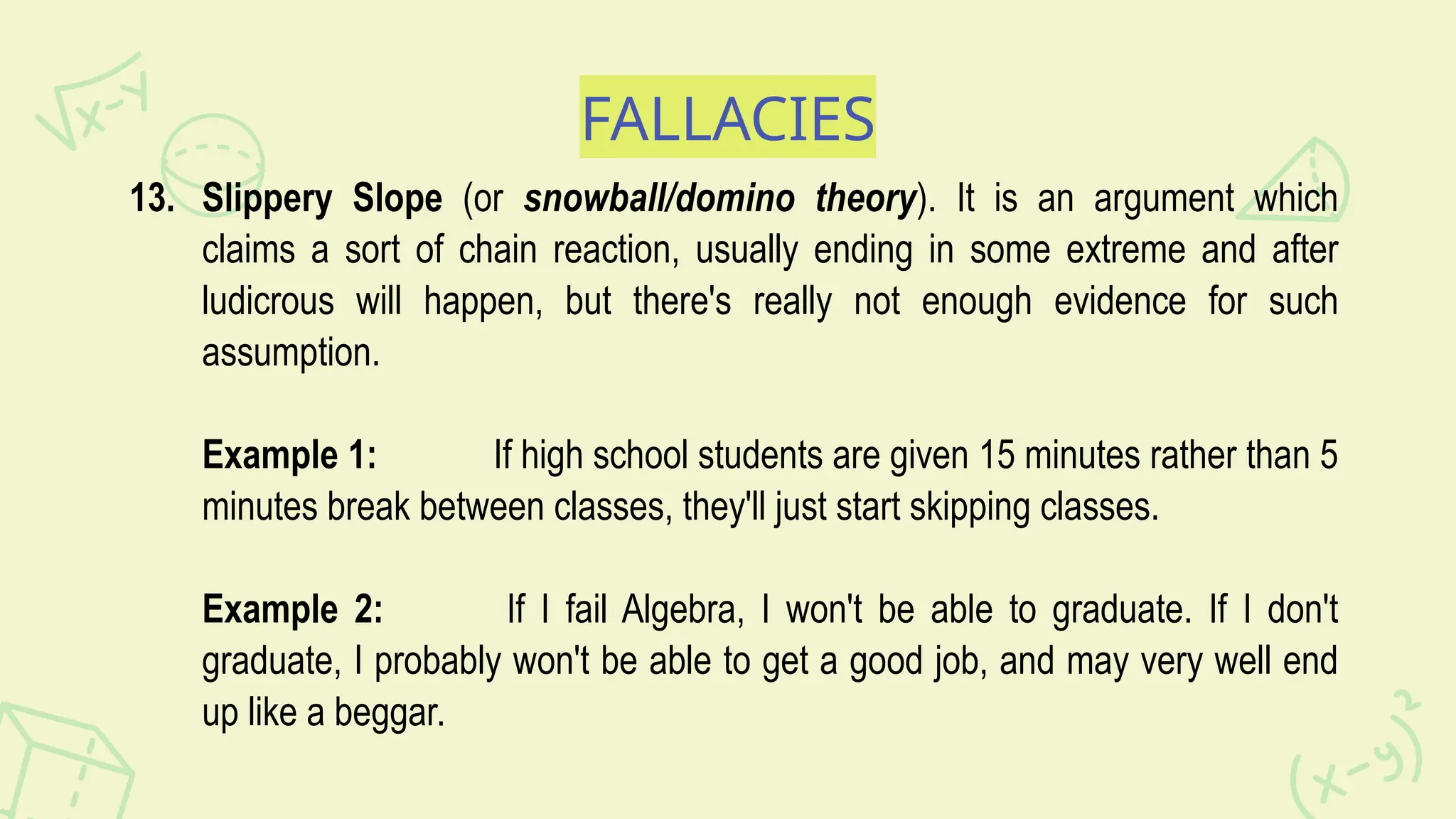
FALLACIES
13. Slippery Slope(or snowball/domino theory). It is an argument which
claims a sort of chain reaction, usually ending in some extreme and after
ludicrous will happen, but there's really not enough evidence for such
assumption.
Example 1: If high school students are given 15 minutes rather than 5
minutes break between classes, they'll just start skipping classes.
Example 2: If I fail Algebra, I won't be able to graduate. If I don't
graduate, I probably won't be able to get a good job, and may very well end
up like a beggar.
57.
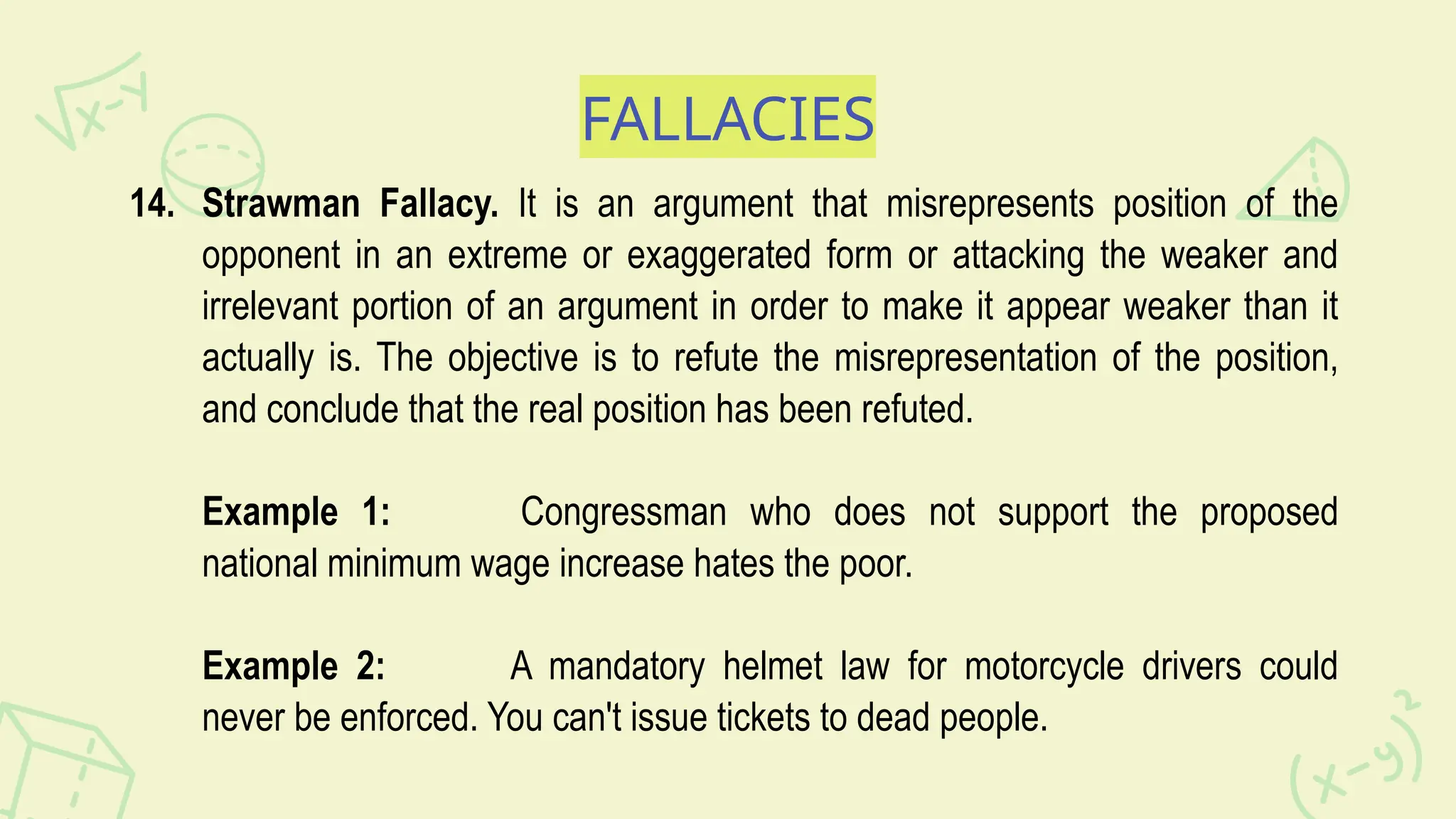
FALLACIES
14. Strawman Fallacy.It is an argument that misrepresents position of the
opponent in an extreme or exaggerated form or attacking the weaker and
irrelevant portion of an argument in order to make it appear weaker than it
actually is. The objective is to refute the misrepresentation of the position,
and conclude that the real position has been refuted.
Example 1: Congressman who does not support the proposed
national minimum wage increase hates the poor.
Example 2: A mandatory helmet law for motorcycle drivers could
never be enforced. You can't issue tickets to dead people.





![[DSC Europe 25] Branko Dzakula - From Defense to Attack: How AI Redefines Cyb...](https://cdn.slidesharecdn.com/ss_thumbnails/80bdzdxpr3ky2g0qvyk9-8-251211083048-ce5fc1ee-thumbnail.jpg?width=640&height=640&fit=bounds)


![[DSC Europe 25] Sara Polak - The Archaeology of Innovation: AI as the Next Cr...](https://cdn.slidesharecdn.com/ss_thumbnails/7ecbscdnt8mlcuqbd2ln-2-sara-polak-ai-creative-industries-251208152533-aa1fcf54-thumbnail.jpg?width=640&height=640&fit=bounds)

![[DSC Europe 25] Debmalya Biswas - Agentification: the art of transforming man...](https://cdn.slidesharecdn.com/ss_thumbnails/r5azlggvtqiaiiusrqdr-4-251212103249-5a12c89b-thumbnail.jpg?width=640&height=640&fit=bounds)


![[DSC Europe 25] Aleksandra Dragicevic - AI-Boosted Research in Healthcare: Fr...](https://cdn.slidesharecdn.com/ss_thumbnails/iqwngszurf2r7pi1lnnj-4-aleksandra-dragicevic-ad-dsc-europe-conference-20-251208151905-37c3238a-thumbnail.jpg?width=640&height=640&fit=bounds)
![[DSC Europe 25] Katherine Forrest - AI NOW: Understanding the Velocity of Cha...](https://cdn.slidesharecdn.com/ss_thumbnails/wvvbruqfrci0sfq9xwgb-4-251212104007-e5ad1987-thumbnail.jpg?width=640&height=640&fit=bounds)
![[DSC Europe 25] Jon Dajci - Bridging TradFi and DeFi: Building the Future of ...](https://cdn.slidesharecdn.com/ss_thumbnails/fqmhfvlbqhkihjvqvhmu-7-251211083849-6af7e325-thumbnail.jpg?width=640&height=640&fit=bounds)

![[DSC Europe 25] Jovan Bogicevic - Legacy to AI-Driven Defense: Transforming D...](https://cdn.slidesharecdn.com/ss_thumbnails/rsarluadt563hntyfc8q-3-251211083849-3e7bc4c0-thumbnail.jpg?width=640&height=640&fit=bounds)


