Notes
III. The Earth, Moon, Sun System
    A. Movements of the Earth
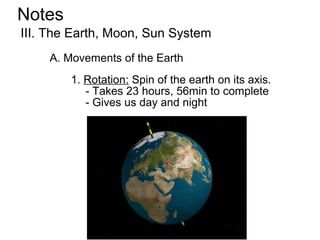
        1. Rotation: Spin of the earth on its axis.
           - Takes 23 hours, 56min to complete
           - Gives us day and night
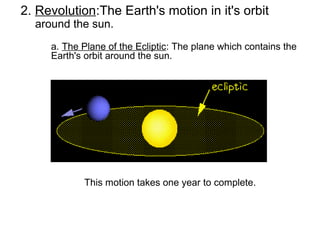
2. Revolution:The Earth's motion in it's orbit
  around the sun.
     a. The Plane of the Ecliptic: The plane which contains the
     Earth's orbit around the sun.


            This motion takes one year to complete.
b. The Earths Tilt: The earth does not rotate perpendicular
   to the plane of the ecliptic. It has a 23.5 degree tilt.


- The star closest to the north rotational axis is
 Polaris, the north star. The Earth's axis points in this
direction throughout the year.
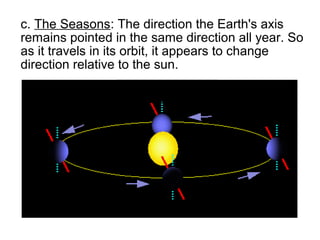
c. The Seasons: The direction the Earth's axis
remains pointed in the same direction all year. So
as it travels in its orbit, it appears to change
direction relative to the sun.


               This motion takes one year to complete.
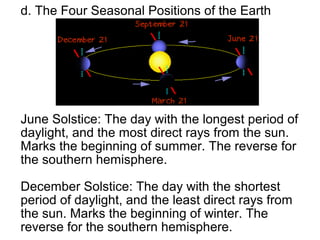
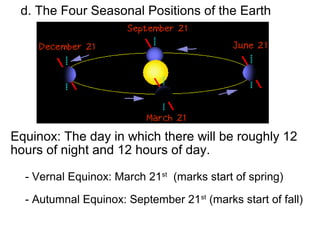
d. The Four Seasonal Positions of the Earth


June Solstice: The day with the longest period of
daylight, and the most direct rays from the sun.
Marks the beginning of summer. The reverse for
the southern hemisphere.

December Solstice: The day with the shortest
period of daylight, and the least direct rays from
the sun. Marks the beginning of winter. The
reverse for the southern hemisphere.
d. The Four Seasonal Positions of the Earth


Equinox: The day in which there will be roughly 12
hours of night and 12 hours of day.

  - Vernal Equinox: March 21st (marks start of spring)

  - Autumnal Equinox: September 21st (marks start of fall)
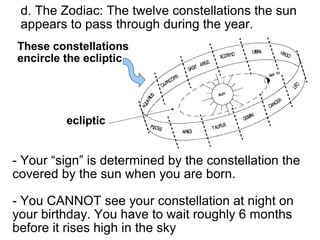
d. The Zodiac: The twelve constellations the sun
 appears to pass through during the year.
These constellations
encircle the ecliptic


         ecliptic


- Your “sign” is determined by the constellation the
covered by the sun when you are born.

- You CANNOT see your constellation at night on
your birthday. You have to wait roughly 6 months
before it rises high in the sky
- The twelve constellations of the Zodiac.


There are twelve constellations: Pisces, Aries, Taurus, Gemini, Cancer, Leo,
 Virgo, Libra, Scorpio, Sagittarius, Capricorn, Aquarius (this is the correct
order)
- Ancient peoples would often associate different traits to the planets, and as
the planets moved through the various constellations they predicted things that
would happen in your life.
Notes
 A. Movements of the Earth
             3. Procession: The wobble of the earth on
                            its axis
                - The earth maintains its 23.5 degree
                   angle but the direction the axis points
                   changes. Moving in a circle.
                - Think of a top spinning on its axis. The
                   vertical axis begins to wobble over
                   time.
                - This motion of the earth causes the
                   north star to change.
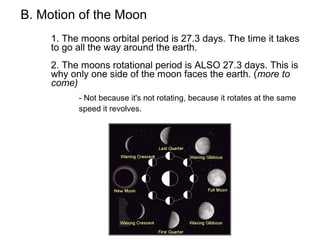
B. Motion of the Moon
     1. The moons orbital period is 27.3 days. The time it takes
     to go all the way around the earth.
     2. The moons rotational period is ALSO 27.3 days. This is
     why only one side of the moon faces the earth. (more to
     come)
           - Not because it's not rotating, because it rotates at the same
           speed it revolves.
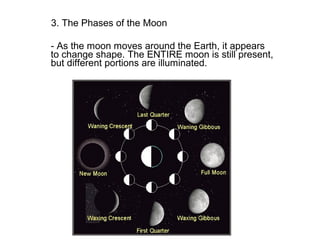
3. The Phases of the Moon

- As the moon moves around the Earth, it appears
to change shape. The ENTIRE moon is still present,
but different portions are illuminated.
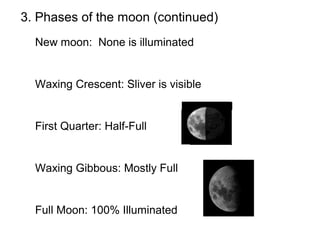
3. Phases of the moon (continued)
  New moon: None is illuminated


  Waxing Crescent: Sliver is visible


  First Quarter: Half-Full


  Waxing Gibbous: Mostly Full


  Full Moon: 100% Illuminated
3. Phases of the moon (continued)
  Waning Gibbous: Mostly Full


  Third Quarter: Half-Full


  Waning Crescent: Sliver visible
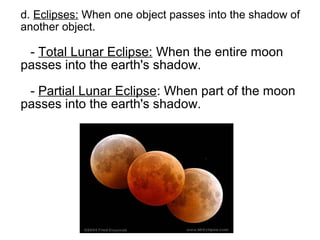
d. Eclipses: When one object passes into the shadow of
another object.

 - Total Lunar Eclipse: When the entire moon
passes into the earth's shadow.

 - Partial Lunar Eclipse: When part of the moon
passes into the earth's shadow.
d. Eclipses: When one object passes into the shadow of
another object.

 - Total Solar Eclipse: When the moon completely
covers the sun placing part of the earth in
shadow..

 - Annular Eclipse: When the moon overlays the
sun but does not block it out completely.

- Partial Solar Eclipse: When only part of the moon
passes over the face of the sun.
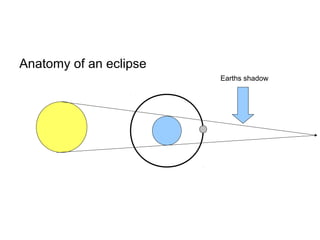
Anatomy of an eclipse
                        Earths shadow
Notes
 4. Effects of the Moon on the Earth
             a. Tidal bulging: The stretching of the Earth
                along the earth-moon line.
                - This effect happens whenever one
                   body moves around another body in
                   space.
                - This happens because the earth is
                   STRECHED by the gravity of the
                   moon, not because the moon is
                   pulling the anything towards it.
                - On earth this is noticed as high and
                   low tides in the oceans.
B. Motion of the Moon
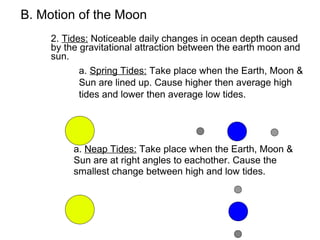
     2. Tides: Noticeable daily changes in ocean depth caused
     by the gravitational attraction between the earth moon and
     sun.
            a. Spring Tides: Take place when the Earth, Moon &
            Sun are lined up. Cause higher then average high
            tides and lower then average low tides.


          a. Neap Tides: Take place when the Earth, Moon &
          Sun are at right angles to eachother. Cause the
          smallest change between high and low tides.
3. Tidal Friction: Friction generated as an object rotates
through tidal bulges.


 a. Two Effects of Tidal Friction:
        - Causes the rotation of the bodies to
           gradually slow
        - Causes the bodies to move further
           apart.

 b. Eventually tidal forces stop both bodies from
 rotating relative to one another. So that only one
 side of each faces the other.
        - This is called Synchronous Rotation.
        - Because the gravity of the earth is much
           stronger then the gravity of the moon.
           The moon is already in a synchronous
           rotation with the earth.
4. Features of the Moon
  a. Maria: Large dark areas on the moons surface.
     - Large flat plains formed during an earlier volcanic period in
     the moons evolution. Lava filled in many of the old craters,
     leaving what appeared to be seas.


  b. Highlands: lighter coloured areas with elevations
  several kilometres above the Maria.

       a                                         b
4. Features of the Moon (continued)
  c. Craters: Circular depressions formed when objects
  impact the moon.

Earth moon sun notes

  • 1.
    Notes III. The Earth,Moon, Sun System A. Movements of the Earth 1. Rotation: Spin of the earth on its axis. - Takes 23 hours, 56min to complete - Gives us day and night
  • 2.
    2. Revolution:The Earth'smotion in it's orbit around the sun. a. The Plane of the Ecliptic: The plane which contains the Earth's orbit around the sun. This motion takes one year to complete.
  • 3.
    b. The EarthsTilt: The earth does not rotate perpendicular to the plane of the ecliptic. It has a 23.5 degree tilt. - The star closest to the north rotational axis is Polaris, the north star. The Earth's axis points in this direction throughout the year.
  • 4.
    c. The Seasons:The direction the Earth's axis remains pointed in the same direction all year. So as it travels in its orbit, it appears to change direction relative to the sun. This motion takes one year to complete.
  • 5.
    d. The FourSeasonal Positions of the Earth June Solstice: The day with the longest period of daylight, and the most direct rays from the sun. Marks the beginning of summer. The reverse for the southern hemisphere. December Solstice: The day with the shortest period of daylight, and the least direct rays from the sun. Marks the beginning of winter. The reverse for the southern hemisphere.
  • 6.
    d. The FourSeasonal Positions of the Earth Equinox: The day in which there will be roughly 12 hours of night and 12 hours of day. - Vernal Equinox: March 21st (marks start of spring) - Autumnal Equinox: September 21st (marks start of fall)
  • 7.
    d. The Zodiac:The twelve constellations the sun appears to pass through during the year. These constellations encircle the ecliptic ecliptic - Your “sign” is determined by the constellation the covered by the sun when you are born. - You CANNOT see your constellation at night on your birthday. You have to wait roughly 6 months before it rises high in the sky
  • 8.
    - The twelveconstellations of the Zodiac. There are twelve constellations: Pisces, Aries, Taurus, Gemini, Cancer, Leo, Virgo, Libra, Scorpio, Sagittarius, Capricorn, Aquarius (this is the correct order) - Ancient peoples would often associate different traits to the planets, and as the planets moved through the various constellations they predicted things that would happen in your life.
  • 9.
    Notes A. Movementsof the Earth 3. Procession: The wobble of the earth on its axis - The earth maintains its 23.5 degree angle but the direction the axis points changes. Moving in a circle. - Think of a top spinning on its axis. The vertical axis begins to wobble over time. - This motion of the earth causes the north star to change.
  • 10.
    B. Motion ofthe Moon 1. The moons orbital period is 27.3 days. The time it takes to go all the way around the earth. 2. The moons rotational period is ALSO 27.3 days. This is why only one side of the moon faces the earth. (more to come) - Not because it's not rotating, because it rotates at the same speed it revolves.
  • 11.
    3. The Phasesof the Moon - As the moon moves around the Earth, it appears to change shape. The ENTIRE moon is still present, but different portions are illuminated.
  • 12.
    3. Phases ofthe moon (continued) New moon: None is illuminated Waxing Crescent: Sliver is visible First Quarter: Half-Full Waxing Gibbous: Mostly Full Full Moon: 100% Illuminated
  • 13.
    3. Phases ofthe moon (continued) Waning Gibbous: Mostly Full Third Quarter: Half-Full Waning Crescent: Sliver visible
  • 14.
    d. Eclipses: Whenone object passes into the shadow of another object. - Total Lunar Eclipse: When the entire moon passes into the earth's shadow. - Partial Lunar Eclipse: When part of the moon passes into the earth's shadow.
  • 15.
    d. Eclipses: Whenone object passes into the shadow of another object. - Total Solar Eclipse: When the moon completely covers the sun placing part of the earth in shadow.. - Annular Eclipse: When the moon overlays the sun but does not block it out completely. - Partial Solar Eclipse: When only part of the moon passes over the face of the sun.
  • 16.
    Anatomy of aneclipse Earths shadow
  • 17.
    Notes 4. Effectsof the Moon on the Earth a. Tidal bulging: The stretching of the Earth along the earth-moon line. - This effect happens whenever one body moves around another body in space. - This happens because the earth is STRECHED by the gravity of the moon, not because the moon is pulling the anything towards it. - On earth this is noticed as high and low tides in the oceans.
  • 18.
    B. Motion ofthe Moon 2. Tides: Noticeable daily changes in ocean depth caused by the gravitational attraction between the earth moon and sun. a. Spring Tides: Take place when the Earth, Moon & Sun are lined up. Cause higher then average high tides and lower then average low tides. a. Neap Tides: Take place when the Earth, Moon & Sun are at right angles to eachother. Cause the smallest change between high and low tides.
  • 19.
    3. Tidal Friction:Friction generated as an object rotates through tidal bulges. a. Two Effects of Tidal Friction: - Causes the rotation of the bodies to gradually slow - Causes the bodies to move further apart. b. Eventually tidal forces stop both bodies from rotating relative to one another. So that only one side of each faces the other. - This is called Synchronous Rotation. - Because the gravity of the earth is much stronger then the gravity of the moon. The moon is already in a synchronous rotation with the earth.
  • 20.
    4. Features ofthe Moon a. Maria: Large dark areas on the moons surface. - Large flat plains formed during an earlier volcanic period in the moons evolution. Lava filled in many of the old craters, leaving what appeared to be seas. b. Highlands: lighter coloured areas with elevations several kilometres above the Maria. a b
  • 21.
    4. Features ofthe Moon (continued) c. Craters: Circular depressions formed when objects impact the moon.