III. The Solar System
     A. Solar System Inventory
          1. Planets
             a. Terrestrial Planets (Earth-like)

                - The First Four Planets: Mercury,
                Venus Earth and Mars

                - All are found within 1.5au of the
                Sun and have similar chemical
                properties.

Similarities    - All are low-mass, with
                atmospheres and rocky surfaces.

                - Have relatively long rotations (for
                their size) & short revolutions.
1. Terrestrial Planets Continued..
     Atmospheres – Mercury has almost none
                   Venus has the Densest
                  Earth is the only planet with Oxygen
                  Mars has a thin atmosphere of CO2
           .

     Rotations – Earth and Mars both take roughly 24 hours
                   Venus and Mercury take months to complete
                 one rotation. In fact Venus rotates very slowly
                 in the opposite direction of all other planets.
     Moons – Earth and Mars both have moons
               Mercury and Venus have none

     Distances from the Sun:
           Mercury: .4au               Earth: 1au
           Venus: .72au                Mars: 1.5au
b. Jovian Planets: (Jupiter-like)
- The Last Four Planets: Jupiter, Saturn, Uranus,
Neptune
- VERY widely spaced out (5au to 40au away)
- All are high mass, mostly consisting of hydrogen &
helium gases, with no rocky surface.
- Have relatively short rotations and long revolutions.
- All have large systems of rings and moons
     Distances from the Sun:
           Jupiter: 5 au           Uranus: 20au
           Saturn: 10au            Neptune: 30au
2. Jovian Planets Continued..
Atmospheres – Jupiter and Saturn are mostly Helium
           Uranus and Neptune have large amounts of
           methane.
Rotations – All have rotations that are shorter then one
earth day, but Uranus actually rotates sideways.
Moons – Have many moons made mostly of ice and
small amounts of rock.
     - Jupiter: 32+ moons, plus 4 of the largest
     - Saturn: Many moons. Largest is Titan
     - Uranus: The moons orbit at the same inclination
             as the planet rotates.
Why no Pluto?
   Recently scientists have discovered many objects of
   similar size and composition to Pluto (some even
   larger). So they came up with a definition for the
   word planet:
         a. Orbits a star
         b. Has sufficient gravity to pull itself into a spherical
         shape.
         c. Has cleared the area of its orbit of other debris
         d. Is not undergoing nuclear fusion.

Pluto has been therefore defined as a dwarf planet.
c. Terrestial Planets in Detail
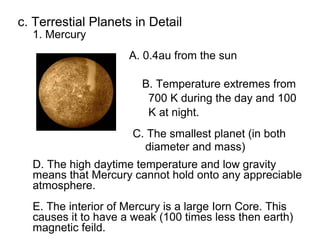
  1. Mercury
                     A. 0.4au from the sun

                        B. Temperature extremes from
                         700 K during the day and 100
                         K at night.
                      C. The smallest planet (in both
                        diameter and mass)
  D. The high daytime temperature and low gravity
  means that Mercury cannot hold onto any appreciable
  atmosphere.
  E. The interior of Mercury is a large Iorn Core. This
  causes it to have a weak (100 times less then earth)
  magnetic feild.
c. Terrestial Planets in Detail
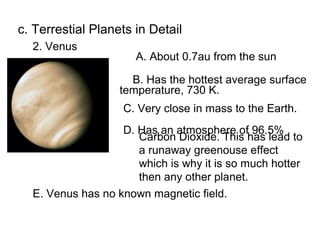
  2. Venus
                      A. About 0.7au from the sun

                     B. Has the hottest average surface
                   temperature, 730 K.
                   C. Very close in mass to the Earth.
                   D. Has an atmosphere of 96.5%
                      Carbon Dioxide. This has lead to
                      a runaway greenouse effect
                      which is why it is so much hotter
                      then any other planet.
  E. Venus has no known magnetic field.
c. Terrestial Planets in Detail
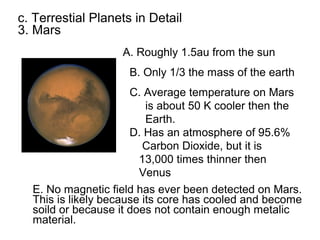
3. Mars
                   A. Roughly 1.5au from the sun
                     B. Only 1/3 the mass of the earth
                      C. Average temperature on Mars
                          is about 50 K cooler then the
                          Earth.
                      D. Has an atmosphere of 95.6%
                         Carbon Dioxide, but it is
                        13,000 times thinner then
                        Venus
  E. No magnetic field has ever been detected on Mars.
  This is likely because its core has cooled and become
  soild or because it does not contain enough metalic
  material.
d. The jovian planets
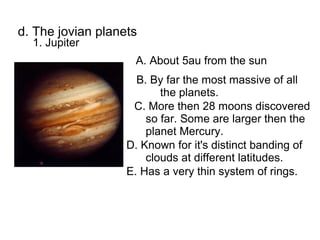
  1. Jupiter
                    A. About 5au from the sun
                     B. By far the most massive of all
                          the planets.
                    C. More then 28 moons discovered
                       so far. Some are larger then the
                       planet Mercury.
                   D. Known for it's distinct banding of
                       clouds at different latitudes.
                   E. Has a very thin system of rings.
d. The jovian planets
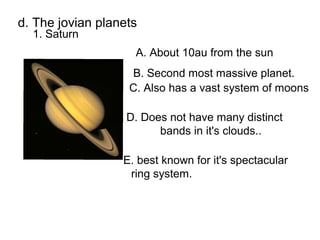
  1. Saturn
                    A. About 10au from the sun
                   B. Second most massive planet.
                   C. Also has a vast system of moons

                   D. Does not have many distinct
                         bands in it's clouds..

                  E. best known for it's spectacular
                   ring system.
d. The jovian planets
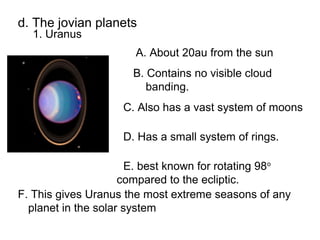
  1. Uranus
                      A. About 20au from the sun
                      B. Contains no visible cloud
                         banding.
                    C. Also has a vast system of moons

                    D. Has a small system of rings.

                       E. best known for rotating 98o
                     compared to the ecliptic.
F. This gives Uranus the most extreme seasons of any
  planet in the solar system
d. The jovian planets
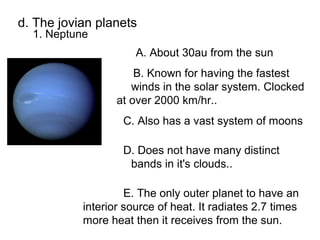
  1. Neptune
                      A. About 30au from the sun
                      B. Known for having the fastest
                     winds in the solar system. Clocked
                  at over 2000 km/hr..
                   C. Also has a vast system of moons

                   D. Does not have many distinct
                    bands in it's clouds..

                    E. The only outer planet to have an
           interior source of heat. It radiates 2.7 times
           more heat then it receives from the sun.
2. Solar System Debris
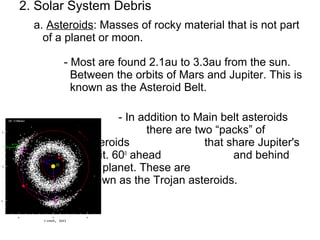
  a. Asteroids: Masses of rocky material that is not part
    of a planet or moon.

        - Most are found 2.1au to 3.3au from the sun.
          Between the orbits of Mars and Jupiter. This is
          known as the Asteroid Belt.

                    - In addition to Main belt asteroids
                          there are two “packs” of
            asteroids                 that share Jupiter's
            orbit. 60o ahead                and behind
            the planet. These are
            known as the Trojan asteroids.
2. Solar System Debris
  a. Comets: Masses of icy material that travel from the
    outermost reaches of the solar system to very close
    to the sun. VERY elliptical orbits.

        - Made mostly of frozen water, ammonia and
          some rocky material. Think of a dirty snowball.
          This is known as the nucleus of the comet.

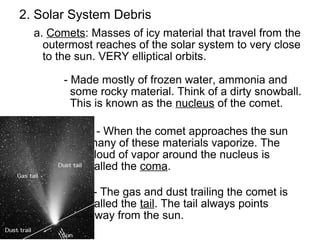
               - When the comet approaches the sun
             many of these materials vaporize. The
             cloud of vapor around the nucleus is
             called the coma.

              - The gas and dust trailing the comet is
             called the tail. The tail always points
             away from the sun.
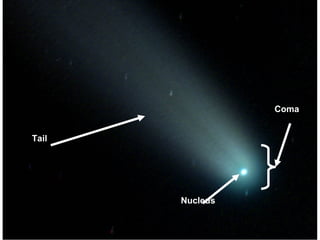
Anatomy of a comet


                            Coma


Tail


                  Nucleus

Solar system notes

  • 1.
    III. The SolarSystem A. Solar System Inventory 1. Planets a. Terrestrial Planets (Earth-like) - The First Four Planets: Mercury, Venus Earth and Mars - All are found within 1.5au of the Sun and have similar chemical properties. Similarities - All are low-mass, with atmospheres and rocky surfaces. - Have relatively long rotations (for their size) & short revolutions.
  • 2.
    1. Terrestrial PlanetsContinued.. Atmospheres – Mercury has almost none Venus has the Densest Earth is the only planet with Oxygen Mars has a thin atmosphere of CO2 . Rotations – Earth and Mars both take roughly 24 hours Venus and Mercury take months to complete one rotation. In fact Venus rotates very slowly in the opposite direction of all other planets. Moons – Earth and Mars both have moons Mercury and Venus have none Distances from the Sun: Mercury: .4au Earth: 1au Venus: .72au Mars: 1.5au
  • 3.
    b. Jovian Planets:(Jupiter-like) - The Last Four Planets: Jupiter, Saturn, Uranus, Neptune - VERY widely spaced out (5au to 40au away) - All are high mass, mostly consisting of hydrogen & helium gases, with no rocky surface. - Have relatively short rotations and long revolutions. - All have large systems of rings and moons Distances from the Sun: Jupiter: 5 au Uranus: 20au Saturn: 10au Neptune: 30au
  • 4.
    2. Jovian PlanetsContinued.. Atmospheres – Jupiter and Saturn are mostly Helium Uranus and Neptune have large amounts of methane. Rotations – All have rotations that are shorter then one earth day, but Uranus actually rotates sideways. Moons – Have many moons made mostly of ice and small amounts of rock. - Jupiter: 32+ moons, plus 4 of the largest - Saturn: Many moons. Largest is Titan - Uranus: The moons orbit at the same inclination as the planet rotates.
  • 5.
    Why no Pluto? Recently scientists have discovered many objects of similar size and composition to Pluto (some even larger). So they came up with a definition for the word planet: a. Orbits a star b. Has sufficient gravity to pull itself into a spherical shape. c. Has cleared the area of its orbit of other debris d. Is not undergoing nuclear fusion. Pluto has been therefore defined as a dwarf planet.
  • 6.
    c. Terrestial Planetsin Detail 1. Mercury A. 0.4au from the sun B. Temperature extremes from 700 K during the day and 100 K at night. C. The smallest planet (in both diameter and mass) D. The high daytime temperature and low gravity means that Mercury cannot hold onto any appreciable atmosphere. E. The interior of Mercury is a large Iorn Core. This causes it to have a weak (100 times less then earth) magnetic feild.
  • 7.
    c. Terrestial Planetsin Detail 2. Venus A. About 0.7au from the sun B. Has the hottest average surface temperature, 730 K. C. Very close in mass to the Earth. D. Has an atmosphere of 96.5% Carbon Dioxide. This has lead to a runaway greenouse effect which is why it is so much hotter then any other planet. E. Venus has no known magnetic field.
  • 8.
    c. Terrestial Planetsin Detail 3. Mars A. Roughly 1.5au from the sun B. Only 1/3 the mass of the earth C. Average temperature on Mars is about 50 K cooler then the Earth. D. Has an atmosphere of 95.6% Carbon Dioxide, but it is 13,000 times thinner then Venus E. No magnetic field has ever been detected on Mars. This is likely because its core has cooled and become soild or because it does not contain enough metalic material.
  • 9.
    d. The jovianplanets 1. Jupiter A. About 5au from the sun B. By far the most massive of all the planets. C. More then 28 moons discovered so far. Some are larger then the planet Mercury. D. Known for it's distinct banding of clouds at different latitudes. E. Has a very thin system of rings.
  • 10.
    d. The jovianplanets 1. Saturn A. About 10au from the sun B. Second most massive planet. C. Also has a vast system of moons D. Does not have many distinct bands in it's clouds.. E. best known for it's spectacular ring system.
  • 11.
    d. The jovianplanets 1. Uranus A. About 20au from the sun B. Contains no visible cloud banding. C. Also has a vast system of moons D. Has a small system of rings. E. best known for rotating 98o compared to the ecliptic. F. This gives Uranus the most extreme seasons of any planet in the solar system
  • 12.
    d. The jovianplanets 1. Neptune A. About 30au from the sun B. Known for having the fastest winds in the solar system. Clocked at over 2000 km/hr.. C. Also has a vast system of moons D. Does not have many distinct bands in it's clouds.. E. The only outer planet to have an interior source of heat. It radiates 2.7 times more heat then it receives from the sun.
  • 13.
    2. Solar SystemDebris a. Asteroids: Masses of rocky material that is not part of a planet or moon. - Most are found 2.1au to 3.3au from the sun. Between the orbits of Mars and Jupiter. This is known as the Asteroid Belt. - In addition to Main belt asteroids there are two “packs” of asteroids that share Jupiter's orbit. 60o ahead and behind the planet. These are known as the Trojan asteroids.
  • 14.
    2. Solar SystemDebris a. Comets: Masses of icy material that travel from the outermost reaches of the solar system to very close to the sun. VERY elliptical orbits. - Made mostly of frozen water, ammonia and some rocky material. Think of a dirty snowball. This is known as the nucleus of the comet. - When the comet approaches the sun many of these materials vaporize. The cloud of vapor around the nucleus is called the coma. - The gas and dust trailing the comet is called the tail. The tail always points away from the sun.
  • 15.
    Anatomy of acomet Coma Tail Nucleus