TOPIC:
The Black Hole
Theory
Miracle or science
Prepared By: Uzair Aman Khan
CONTENTS:
 Introduction
 Historical Background
 Structure Of Black Holes
 Types Of Black Holes
 Light Behavior Near Black Holes
 Facts About Black Holes
 Milky Way Galaxy
 Famous Black Holes
 Formation And Growth Of Black Holes
 Stephen William Hawking’s Theory
 How To Locate Black Holes
 Controversy About Black Holes
INTRODUCTION:
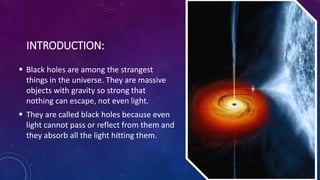
 Black holes are among the strangest
things in the universe. They are massive
objects with gravity so strong that
nothing can escape, not even light.
 They are called black holes because even
light cannot pass or reflect from them and
they absorb all the light hitting them.
HISTORICAL BACKGROUND:
 The idea of a body so massive that even light cannot escape from it was put
forwarded by a geologist John Michel in a letter written to Henry Cavendish in
1783 to the Royal Society.
 In 1939, American physist Robert Oppenheimer developed a possible
explanation for the these points of infinite density.
 These theories remained a mathematical curiosity until the first black hole
was found in 1964.
 In 2006, Stephen Hawking proposed that microscopic black holes are formed
in the huge explosion that gave birth to universes.
STRUCTURE OF BLACK HOLES:
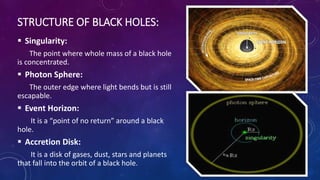
 Singularity:
The point where whole mass of a black hole
is concentrated.
 Photon Sphere:
The outer edge where light bends but is still
escapable.
 Event Horizon:
It is a “point of no return” around a black
hole.
 Accretion Disk:
It is a disk of gases, dust, stars and planets
that fall into the orbit of a black hole.
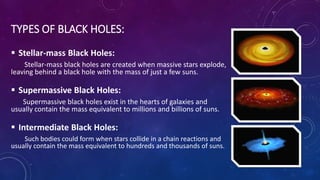
TYPES OF BLACK HOLES:
 Stellar-mass Black Holes:
Stellar-mass black holes are created when massive stars explode,
leaving behind a black hole with the mass of just a few suns.
 Supermassive Black Holes:
Supermassive black holes exist in the hearts of galaxies and
usually contain the mass equivalent to millions and billions of suns.
 Intermediate Black Holes:
Such bodies could form when stars collide in a chain reactions and
usually contain the mass equivalent to hundreds and thousands of suns.
THE FINITE SPEED OF LIGHT:
 As you all know (especially Contemporary people), That the speed of
light is a finite value in a vacuum.
 But when an object enters the event horizon of a black hole then it have
to move with speed more than light.
 In order to gain speed more than speed of light infinite amount of force
is needed.
 In all this universe there is no source of infinite force.
 Therefore, the fallen objects never return.
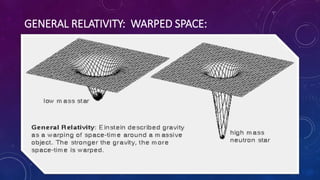
GENERAL RELATIVITY: WARPED SPACE:
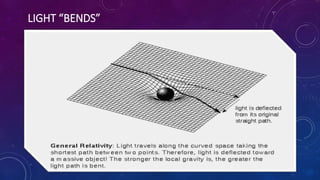
LIGHT “BENDS”
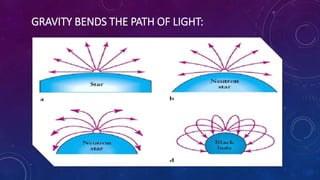
GRAVITY BENDS THE PATH OF LIGHT:
FACTS ABOUT BLACK HOLES:
 The massive gravitational influence of a black hole bends space time in the
near neighborhood.
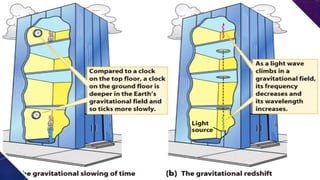
 The closer you get to a black hole, the slower time runs.
 Material that gets too close to a black hole gets sucked in and can never
escape.
 Black holes do not emit radiation on their own.
 They are detected by the radiation given off as material is heated in the
accretion disk.
 Their detection is also possible by the black hole’s gravitational effect on
other nearby objects or light passing by.
THE MILKY WAY GALAXY:
 The Milky Way Galaxy is our home galaxy in the universe.
 The Milky Way began forming around 12 billion years ago and is part of a group of about 50
galaxies called the Local Group which itself is part of a larger gathering of galaxies called the
Virgo Super cluster of galaxies.
 The Milky Way moves through space at a velocity of about 552 kilometers per second.
 100-400 billion stars are present in this galaxy.
 Its galactic center is located about 26,000 light-years from Earth.
 At the center of Milky Way Galaxy lies a super massive black hole named as Sagittarius A*.
 This black hole contains the mass of about 4.3 million suns.
 The Milky Way contains a few hundred million stellar black holes.
 The speed of stars, gases and dust in accretion disk of this black hole is 220 kilometers per
second.
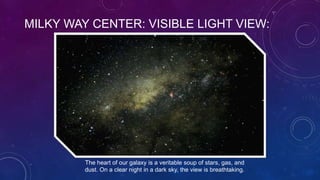
MILKY WAY CENTER: VISIBLE LIGHT VIEW:
The heart of our galaxy is a veritable soup of stars, gas, and
dust. On a clear night in a dark sky, the view is breathtaking.
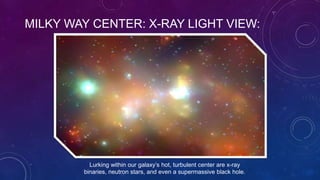
MILKY WAY CENTER: X-RAY LIGHT VIEW:
Lurking within our galaxy’s hot, turbulent center are x-ray
binaries, neutron stars, and even a supermassive black hole.
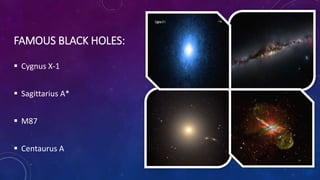
FAMOUS BLACK HOLES:
 Cygnus X-1
 Sagittarius A*
 M87
 Centaurus A
FORMATION AND GROWTH OF BLACK HOLES:
 When a star of mass more than 3 times
mass of the sun reaches to an end of its
life, it gets crushed in its own gravity
leaving behind a compact black hole.
 Once a black hole has formed, it can
continue to grow by absorbing additional
matter like gases and dust from
surrounding to become heavier and larger.
 Large black holes are formed by the
combination of small black holes and also
when small black holes absorb huge stars.
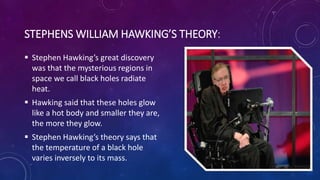
STEPHENS WILLIAM HAWKING’S THEORY:
 Stephen Hawking’s great discovery
was that the mysterious regions in
space we call black holes radiate
heat.
 Hawking said that these holes glow
like a hot body and smaller they are,
the more they glow.
 Stephen Hawking’s theory says that
the temperature of a black hole
varies inversely to its mass.
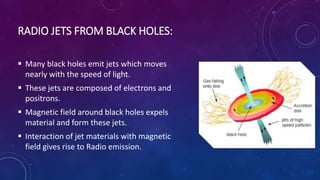
RADIO JETS FROM BLACK HOLES:
 Many black holes emit jets which moves
nearly with the speed of light.
 These jets are composed of electrons and
positrons.
 Magnetic field around black holes expels
material and form these jets.
 Interaction of jet materials with magnetic
field gives rise to Radio emission.
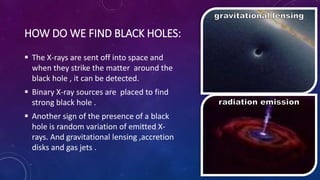
HOW DO WE FIND BLACK HOLES:
 The X-rays are sent off into space and
when they strike the matter around the
black hole , it can be detected.
 Binary X-ray sources are placed to find
strong black hole .
 Another sign of the presence of a black
hole is random variation of emitted X-
rays. And gravitational lensing ,accretion
disks and gas jets .
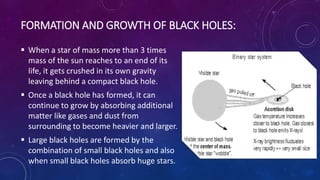
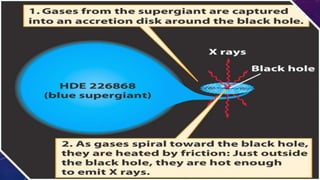
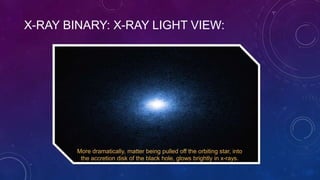
X-RAY BINARY: X-RAY LIGHT VIEW:
More dramatically, matter being pulled off the orbiting star, into
the accretion disk of the black hole, glows brightly in x-rays.
CONTROVERSY ABOUT BLACK HOLE:
 “There is no escape from a black hole in
classical theory,” Hawking told Nature.
 Quantum theory, however, “enables energy
and information to escape from a black hole”.
 A full explanation of the process, the physicist
admits, would require a theory that
successfully merges gravity with the other
fundamental forces of nature.
 But that is a goal that has eluded physicists for
nearly a century. “The correct treatment,”
Hawking says, “remains a mystery.”
The black hole theory

The black hole theory

  • 1.
    TOPIC: The Black Hole Theory Miracleor science Prepared By: Uzair Aman Khan
  • 2.
    CONTENTS:  Introduction  HistoricalBackground  Structure Of Black Holes  Types Of Black Holes  Light Behavior Near Black Holes  Facts About Black Holes  Milky Way Galaxy  Famous Black Holes  Formation And Growth Of Black Holes  Stephen William Hawking’s Theory  How To Locate Black Holes  Controversy About Black Holes
  • 3.
    INTRODUCTION:  Black holesare among the strangest things in the universe. They are massive objects with gravity so strong that nothing can escape, not even light.  They are called black holes because even light cannot pass or reflect from them and they absorb all the light hitting them.
  • 4.
    HISTORICAL BACKGROUND:  Theidea of a body so massive that even light cannot escape from it was put forwarded by a geologist John Michel in a letter written to Henry Cavendish in 1783 to the Royal Society.  In 1939, American physist Robert Oppenheimer developed a possible explanation for the these points of infinite density.  These theories remained a mathematical curiosity until the first black hole was found in 1964.  In 2006, Stephen Hawking proposed that microscopic black holes are formed in the huge explosion that gave birth to universes.
  • 5.
    STRUCTURE OF BLACKHOLES:  Singularity: The point where whole mass of a black hole is concentrated.  Photon Sphere: The outer edge where light bends but is still escapable.  Event Horizon: It is a “point of no return” around a black hole.  Accretion Disk: It is a disk of gases, dust, stars and planets that fall into the orbit of a black hole.
  • 6.
    TYPES OF BLACKHOLES:  Stellar-mass Black Holes: Stellar-mass black holes are created when massive stars explode, leaving behind a black hole with the mass of just a few suns.  Supermassive Black Holes: Supermassive black holes exist in the hearts of galaxies and usually contain the mass equivalent to millions and billions of suns.  Intermediate Black Holes: Such bodies could form when stars collide in a chain reactions and usually contain the mass equivalent to hundreds and thousands of suns.
  • 7.
    THE FINITE SPEEDOF LIGHT:  As you all know (especially Contemporary people), That the speed of light is a finite value in a vacuum.  But when an object enters the event horizon of a black hole then it have to move with speed more than light.  In order to gain speed more than speed of light infinite amount of force is needed.  In all this universe there is no source of infinite force.  Therefore, the fallen objects never return.
  • 9.
  • 10.
  • 11.
    GRAVITY BENDS THEPATH OF LIGHT:
  • 12.
    FACTS ABOUT BLACKHOLES:  The massive gravitational influence of a black hole bends space time in the near neighborhood.  The closer you get to a black hole, the slower time runs.  Material that gets too close to a black hole gets sucked in and can never escape.  Black holes do not emit radiation on their own.  They are detected by the radiation given off as material is heated in the accretion disk.  Their detection is also possible by the black hole’s gravitational effect on other nearby objects or light passing by.
  • 13.
    THE MILKY WAYGALAXY:  The Milky Way Galaxy is our home galaxy in the universe.  The Milky Way began forming around 12 billion years ago and is part of a group of about 50 galaxies called the Local Group which itself is part of a larger gathering of galaxies called the Virgo Super cluster of galaxies.  The Milky Way moves through space at a velocity of about 552 kilometers per second.  100-400 billion stars are present in this galaxy.  Its galactic center is located about 26,000 light-years from Earth.  At the center of Milky Way Galaxy lies a super massive black hole named as Sagittarius A*.  This black hole contains the mass of about 4.3 million suns.  The Milky Way contains a few hundred million stellar black holes.  The speed of stars, gases and dust in accretion disk of this black hole is 220 kilometers per second.
  • 14.
    MILKY WAY CENTER:VISIBLE LIGHT VIEW: The heart of our galaxy is a veritable soup of stars, gas, and dust. On a clear night in a dark sky, the view is breathtaking.
  • 15.
    MILKY WAY CENTER:X-RAY LIGHT VIEW: Lurking within our galaxy’s hot, turbulent center are x-ray binaries, neutron stars, and even a supermassive black hole.
  • 16.
    FAMOUS BLACK HOLES: Cygnus X-1  Sagittarius A*  M87  Centaurus A
  • 17.
    FORMATION AND GROWTHOF BLACK HOLES:  When a star of mass more than 3 times mass of the sun reaches to an end of its life, it gets crushed in its own gravity leaving behind a compact black hole.  Once a black hole has formed, it can continue to grow by absorbing additional matter like gases and dust from surrounding to become heavier and larger.  Large black holes are formed by the combination of small black holes and also when small black holes absorb huge stars.
  • 18.
    STEPHENS WILLIAM HAWKING’STHEORY:  Stephen Hawking’s great discovery was that the mysterious regions in space we call black holes radiate heat.  Hawking said that these holes glow like a hot body and smaller they are, the more they glow.  Stephen Hawking’s theory says that the temperature of a black hole varies inversely to its mass.
  • 19.
    RADIO JETS FROMBLACK HOLES:  Many black holes emit jets which moves nearly with the speed of light.  These jets are composed of electrons and positrons.  Magnetic field around black holes expels material and form these jets.  Interaction of jet materials with magnetic field gives rise to Radio emission.
  • 20.
    HOW DO WEFIND BLACK HOLES:  The X-rays are sent off into space and when they strike the matter around the black hole , it can be detected.  Binary X-ray sources are placed to find strong black hole .  Another sign of the presence of a black hole is random variation of emitted X- rays. And gravitational lensing ,accretion disks and gas jets .
  • 22.
    X-RAY BINARY: X-RAYLIGHT VIEW: More dramatically, matter being pulled off the orbiting star, into the accretion disk of the black hole, glows brightly in x-rays.
  • 23.
    CONTROVERSY ABOUT BLACKHOLE:  “There is no escape from a black hole in classical theory,” Hawking told Nature.  Quantum theory, however, “enables energy and information to escape from a black hole”.  A full explanation of the process, the physicist admits, would require a theory that successfully merges gravity with the other fundamental forces of nature.  But that is a goal that has eluded physicists for nearly a century. “The correct treatment,” Hawking says, “remains a mystery.”