Parabolas
More Properties of Parabolas
PRECALCULUS
More Properties of Parabolas
▪ Recall that, for any point on the parabola, its
distance from the focus is the same as its distance
from the directrix.
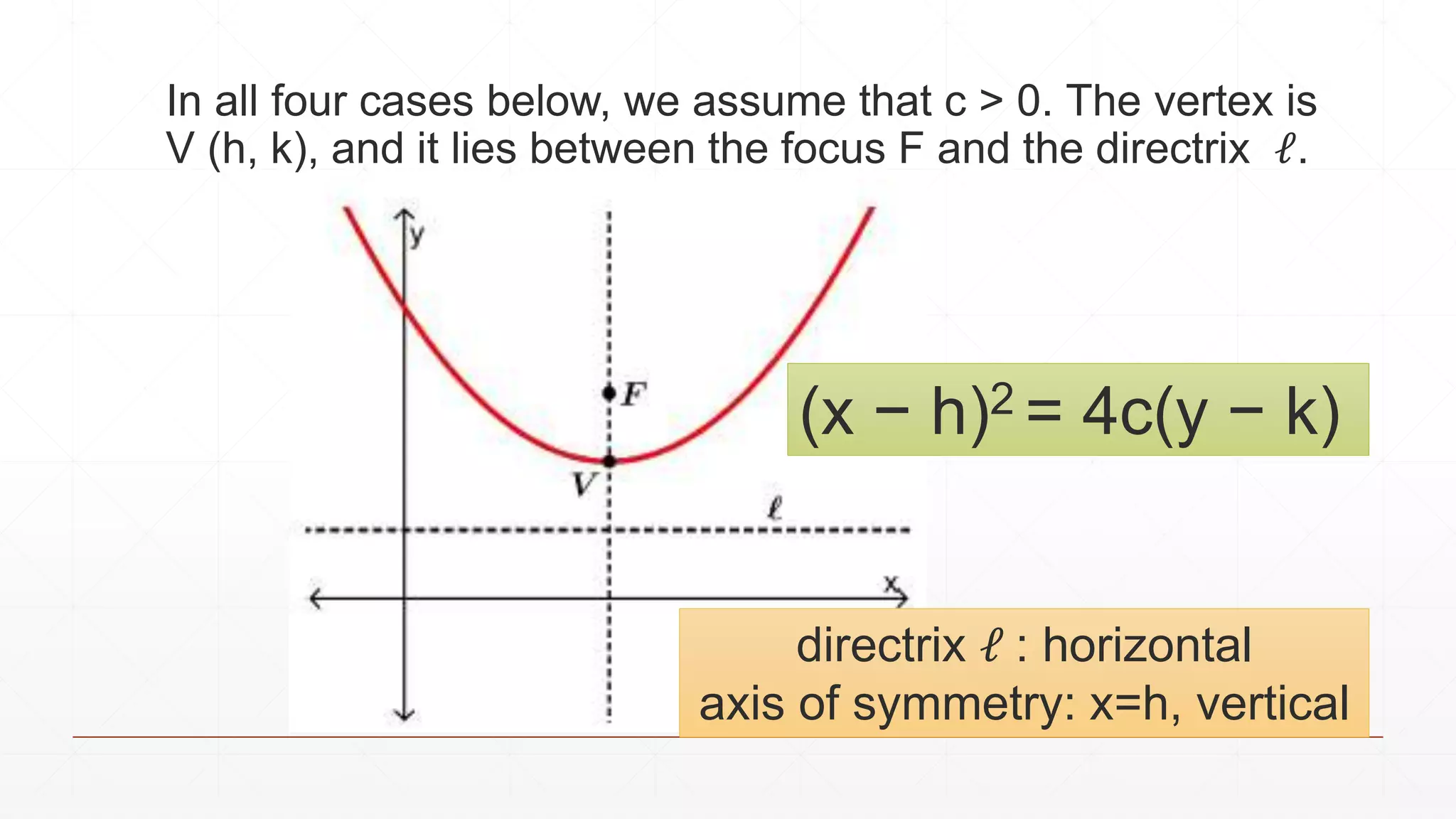
In all four cases below, we assume that c > 0. The vertex is
V (h, k), and it lies between the focus F and the directrix ℓ.
(x − h)2 = 4c(y − k)
directrix ℓ : horizontal
axis of symmetry: x=h, vertical
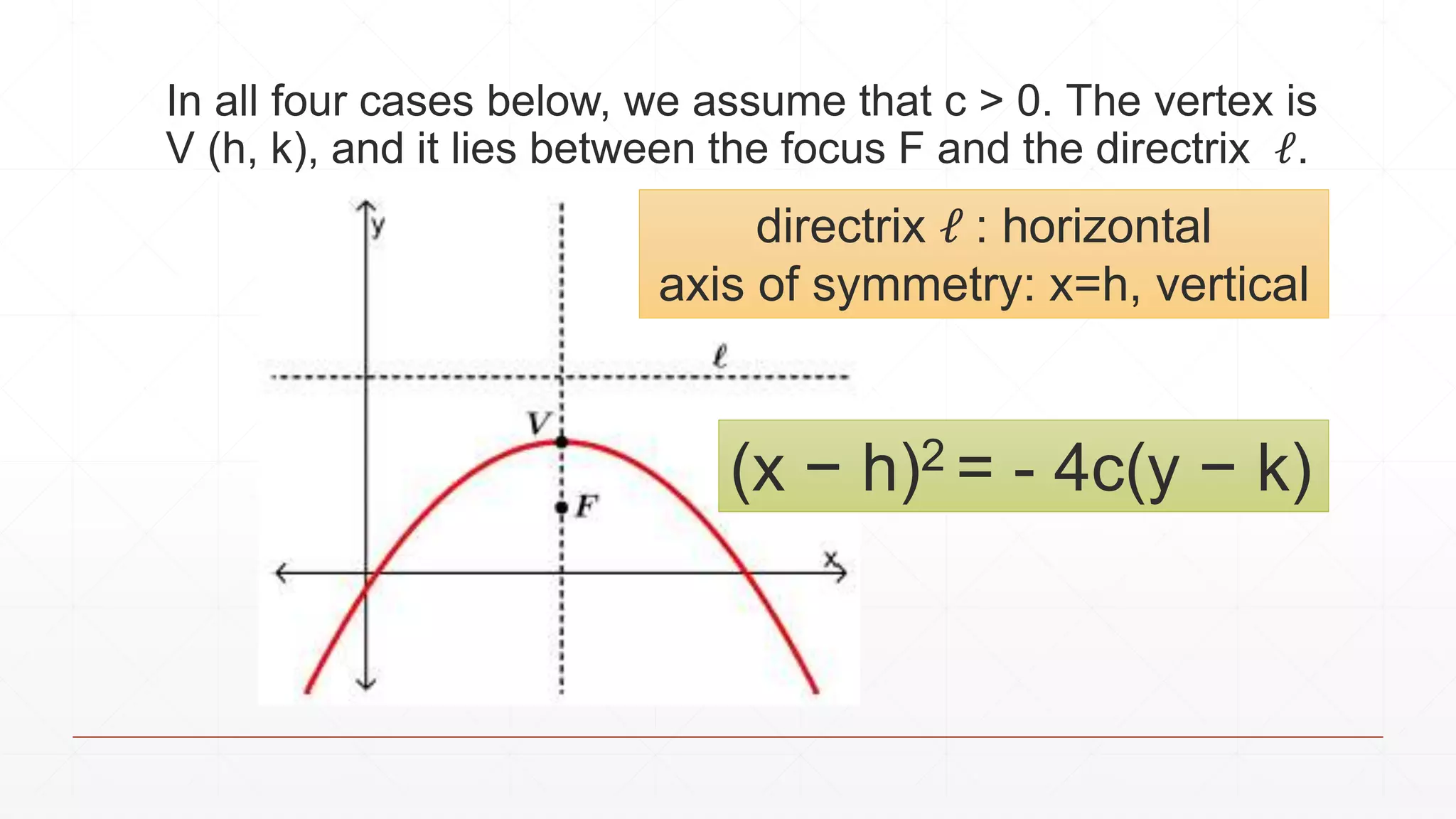
In all four cases below, we assume that c > 0. The vertex is
V (h, k), and it lies between the focus F and the directrix ℓ.
(x − h)2 = - 4c(y − k)
directrix ℓ : horizontal
axis of symmetry: x=h, vertical
In all four cases below, we assume that c > 0. The vertex is
V (h, k), and it lies between the focus F and the directrix ℓ.
(y − k)2 = 4c(x − h)
directrix ℓ : vertical
axis of symmetry: y=k, horizontal
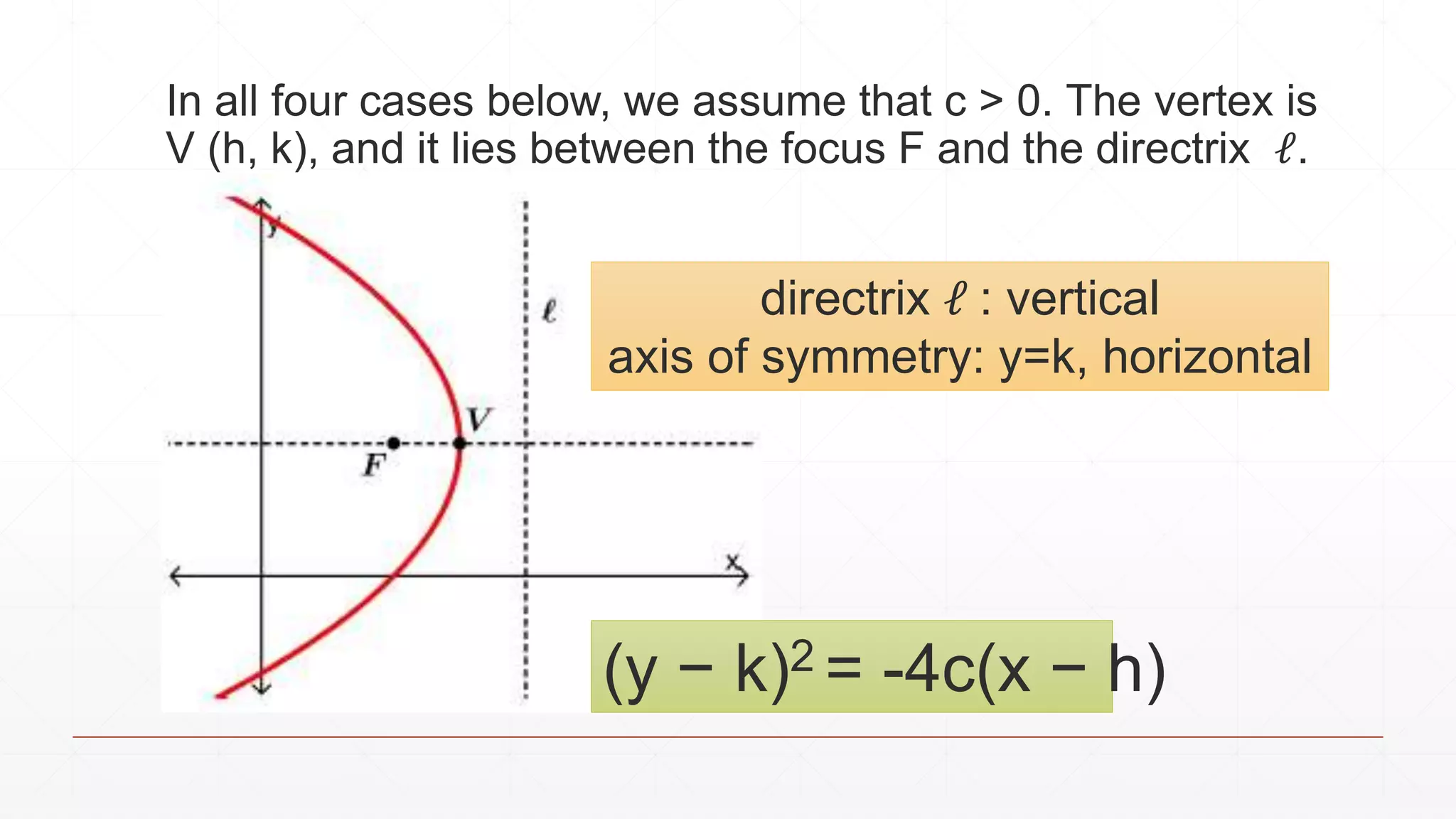
In all four cases below, we assume that c > 0. The vertex is
V (h, k), and it lies between the focus F and the directrix ℓ.
(y − k)2 = -4c(x − h)
directrix ℓ : vertical
axis of symmetry: y=k, horizontal
Let’s try!
▪ If the parabola opens to the right, with vertex at the origin, the
equation is (a) x2 = 4cy
(b) x2 = -4cy
(c) y2 = -4cx
(d) y2 = 4cx
Let’s try!
▪ If the parabola opens to the right, with vertex at the origin, the
equation is (a) x2 = 4cy
(b) x2 = -4cy
(c) y2 = -4cx
(d) y2 = 4cx
Let’s try!
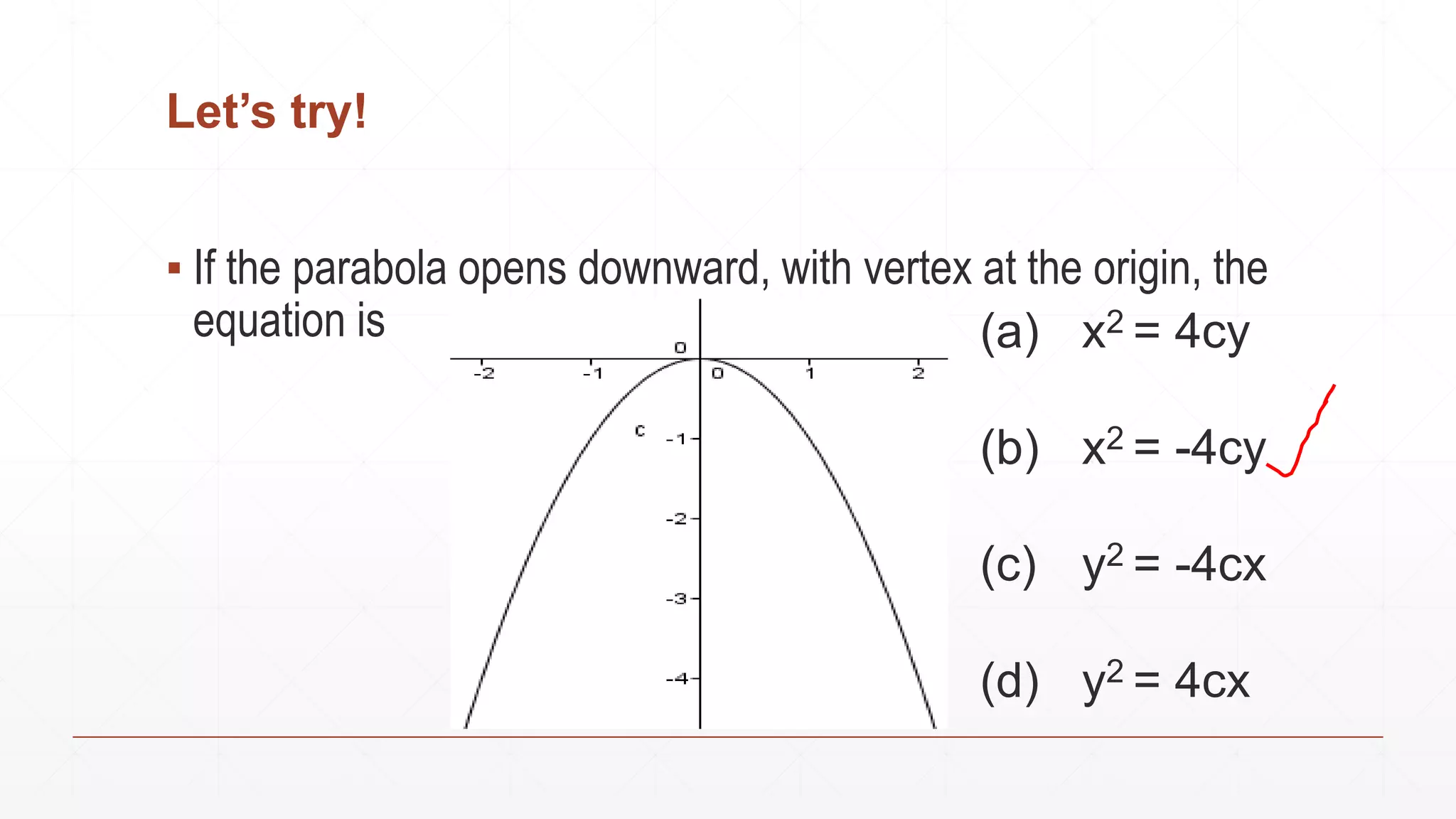
▪ If the parabola opens downward, with vertex at the origin, the
equation is (a) x2 = 4cy
(b) x2 = -4cy
(c) y2 = -4cx
(d) y2 = 4cx
Let’s try!
▪ If the parabola opens downward, with vertex at the origin, the
equation is (a) x2 = 4cy
(b) x2 = -4cy
(c) y2 = -4cx
(d) y2 = 4cx
Let’s try!
▪ If the parabola opens to the left, with vertex at the origin, the
equation is (a) x2 = 4cy
(b) x2 = -4cy
(c) y2 = -4cx
(d) y2 = 4cx
Let’s try!
▪ If the parabola opens to the left, with vertex at the origin, the
equation is (a) x2 = 4cy
(b) x2 = -4cy
(c) y2 = -4cx
(d) y2 = 4cx
Let’s try!
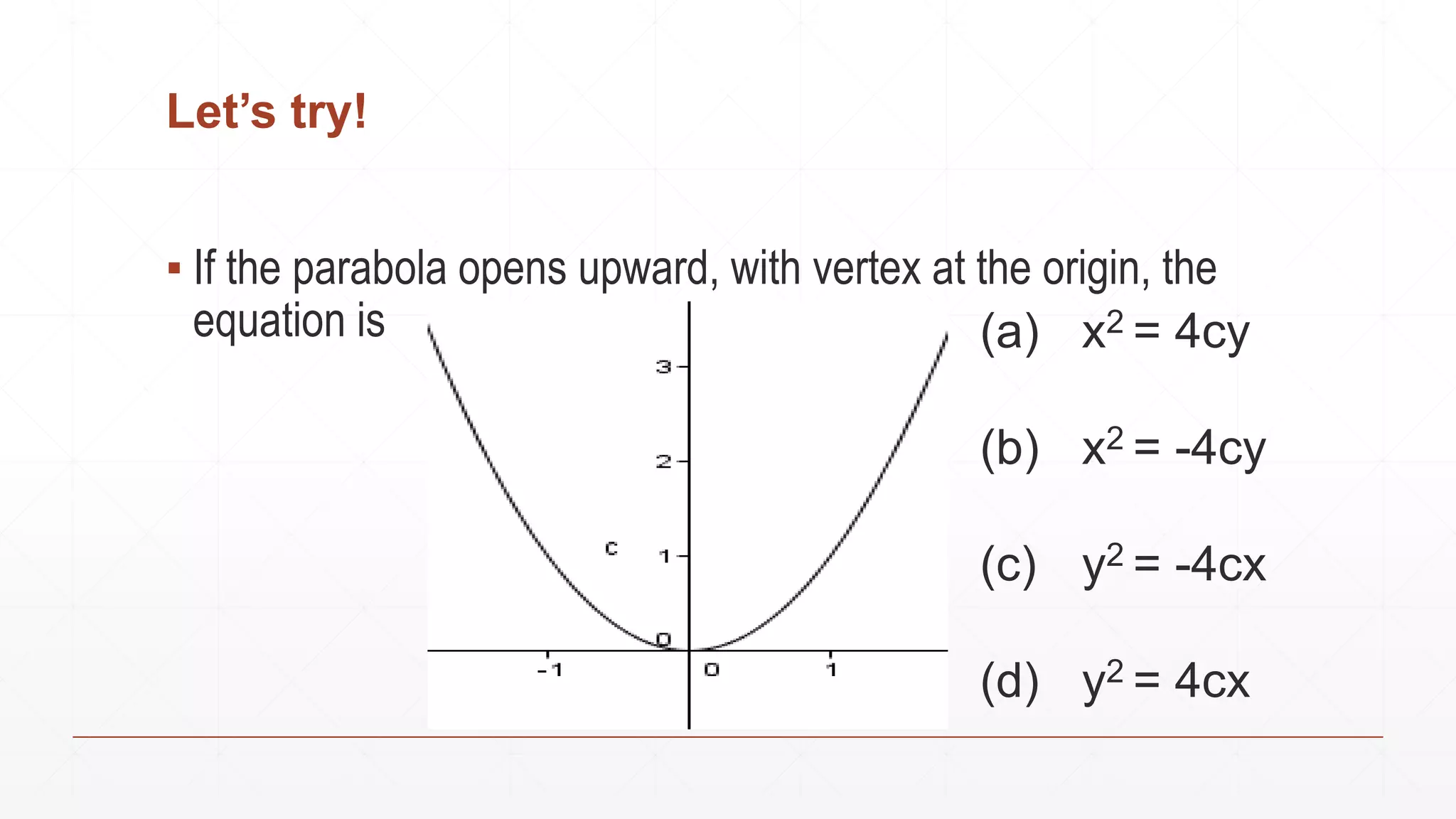
▪ If the parabola opens upward, with vertex at the origin, the
equation is (a) x2 = 4cy
(b) x2 = -4cy
(c) y2 = -4cx
(d) y2 = 4cx
Let’s try!
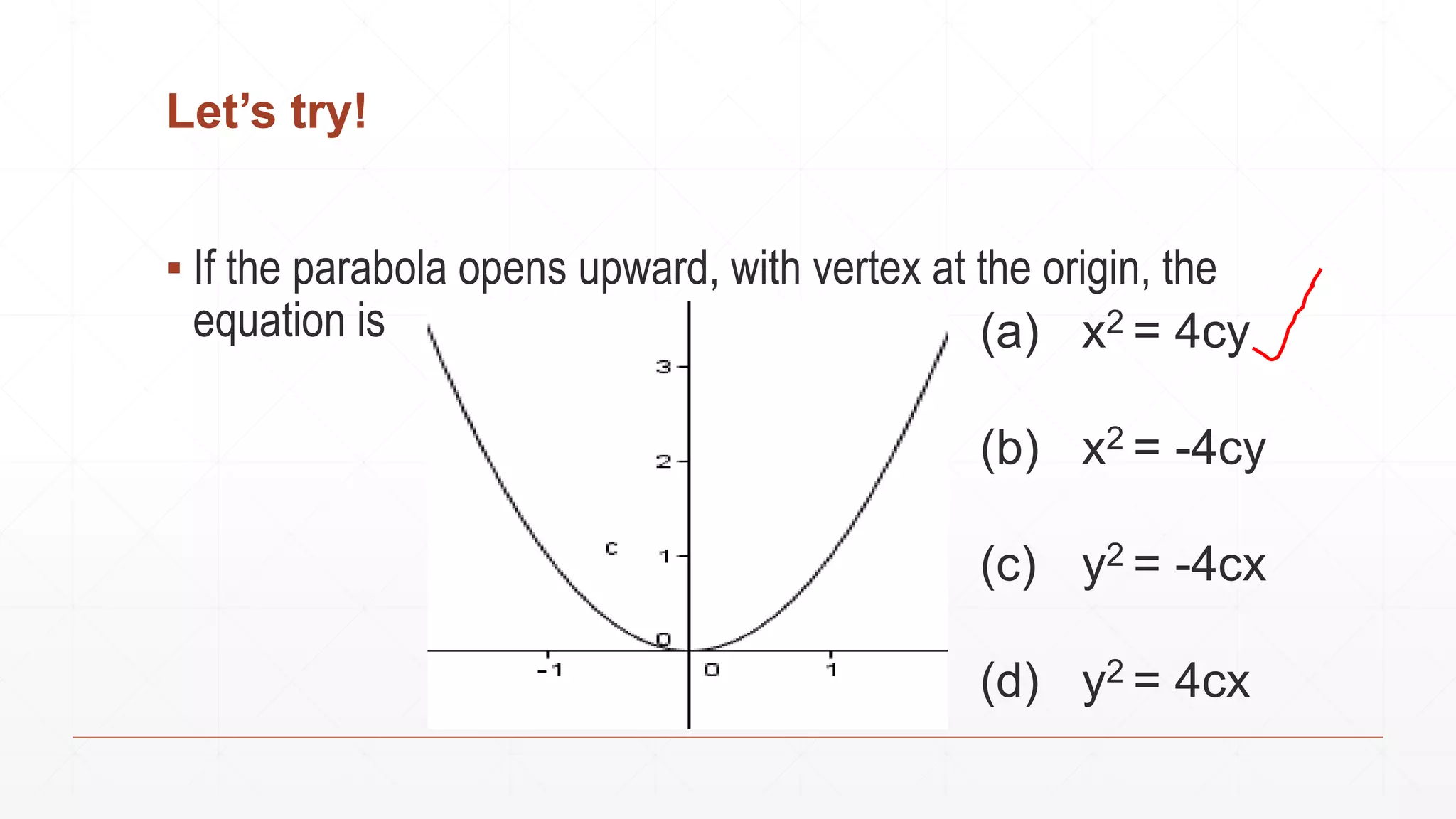
▪ If the parabola opens upward, with vertex at the origin, the
equation is (a) x2 = 4cy
(b) x2 = -4cy
(c) y2 = -4cx
(d) y2 = 4cx
Let’s try!
▪ If the parabola opens upward, with vertex (h,k), the equation
is (a) (x-h)2 = 4c(y-k)
(b) (x-h)2 = -4c(y-k)
(c) (y-k)2 = 4c(x-h)
(d) (y-k)2 = -4c(x-h)
Let’s try!
▪ If the parabola opens upward, with vertex (h,k), the equation
is (a) (x-h)2 = 4c(y-k)
(b) (x-h)2 = -4c(y-k)
(c) (y-k)2 = 4c(x-h)
(d) (y-k)2 = -4c(x-h)
Let’s try!
▪ If the parabola opens to the right, with vertex (h,k), is
(a) (x-h)2 = 4c(y-k)
(b) (x-h)2 = -4c(y-k)
(c) (y-k)2 = 4c(x-h)
(d) (y-k)2 = -4c(x-h)
Let’s try!
▪ If the parabola opens to the right, with vertex (h,k), is
(a) (x-h)2 = 4c(y-k)
(b) (x-h)2 = -4c(y-k)
(c) (y-k)2 = 4c(x-h)
(d) (y-k)2 = -4c(x-h)
Let’s try!
▪ If the parabola opens down, with vertex (h,k), the equation is
(a) (x-h)2 = 4c(y-k)
(b) (x-h)2 = -4c(y-k)
(c) (y-k)2 = 4c(x-h)
(d) (y-k)2 = -4c(x-h)
Let’s try!
▪ If the parabola opens down, with vertex (h,k), the equation is
(a) (x-h)2 = 4c(y-k)
(b) (x-h)2 = -4c(y-k)
(c) (y-k)2 = 4c(x-h)
(d) (y-k)2 = -4c(x-h)
Let’s try!
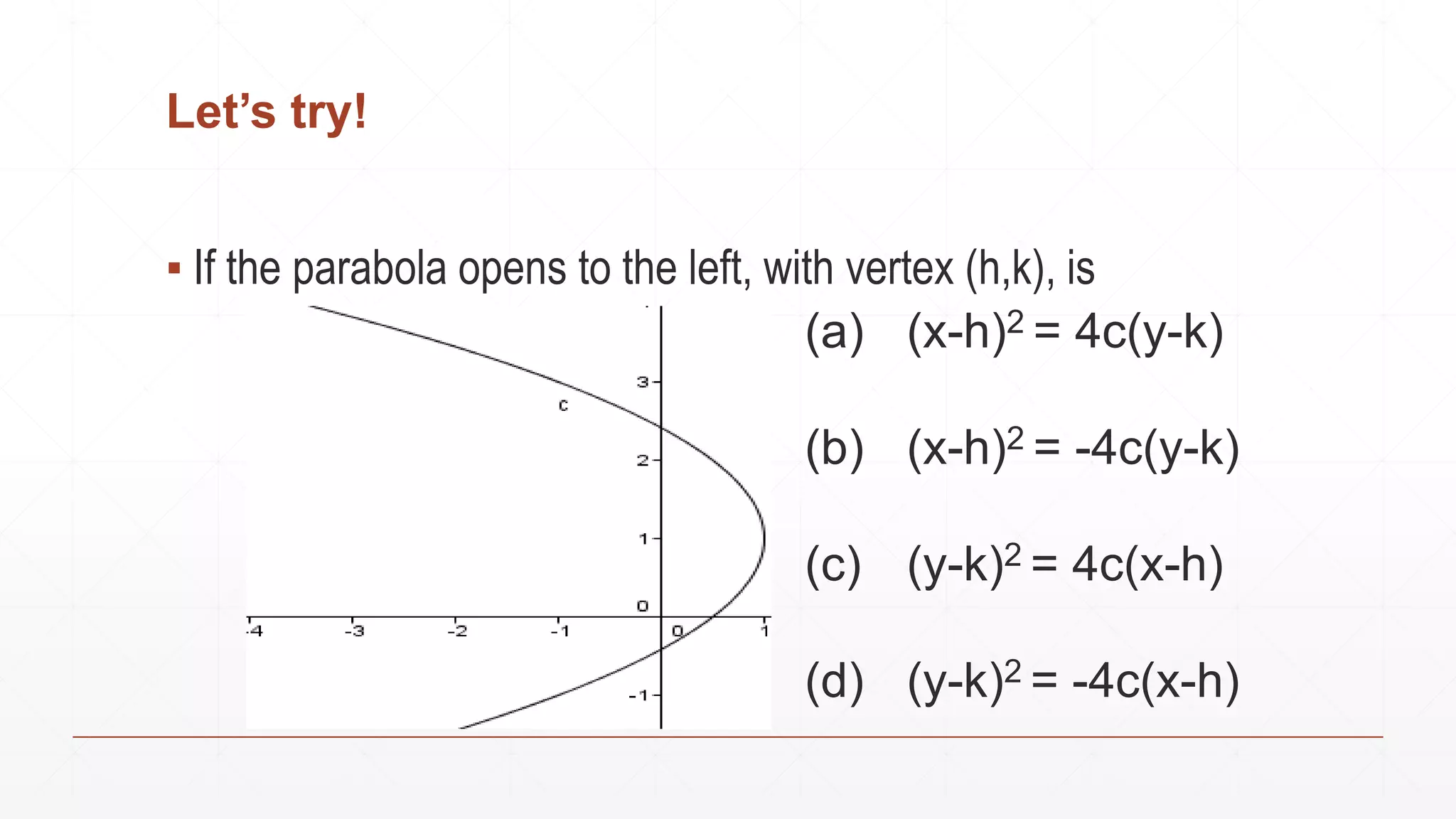
▪ If the parabola opens to the left, with vertex (h,k), is
(a) (x-h)2 = 4c(y-k)
(b) (x-h)2 = -4c(y-k)
(c) (y-k)2 = 4c(x-h)
(d) (y-k)2 = -4c(x-h)
Let’s try!
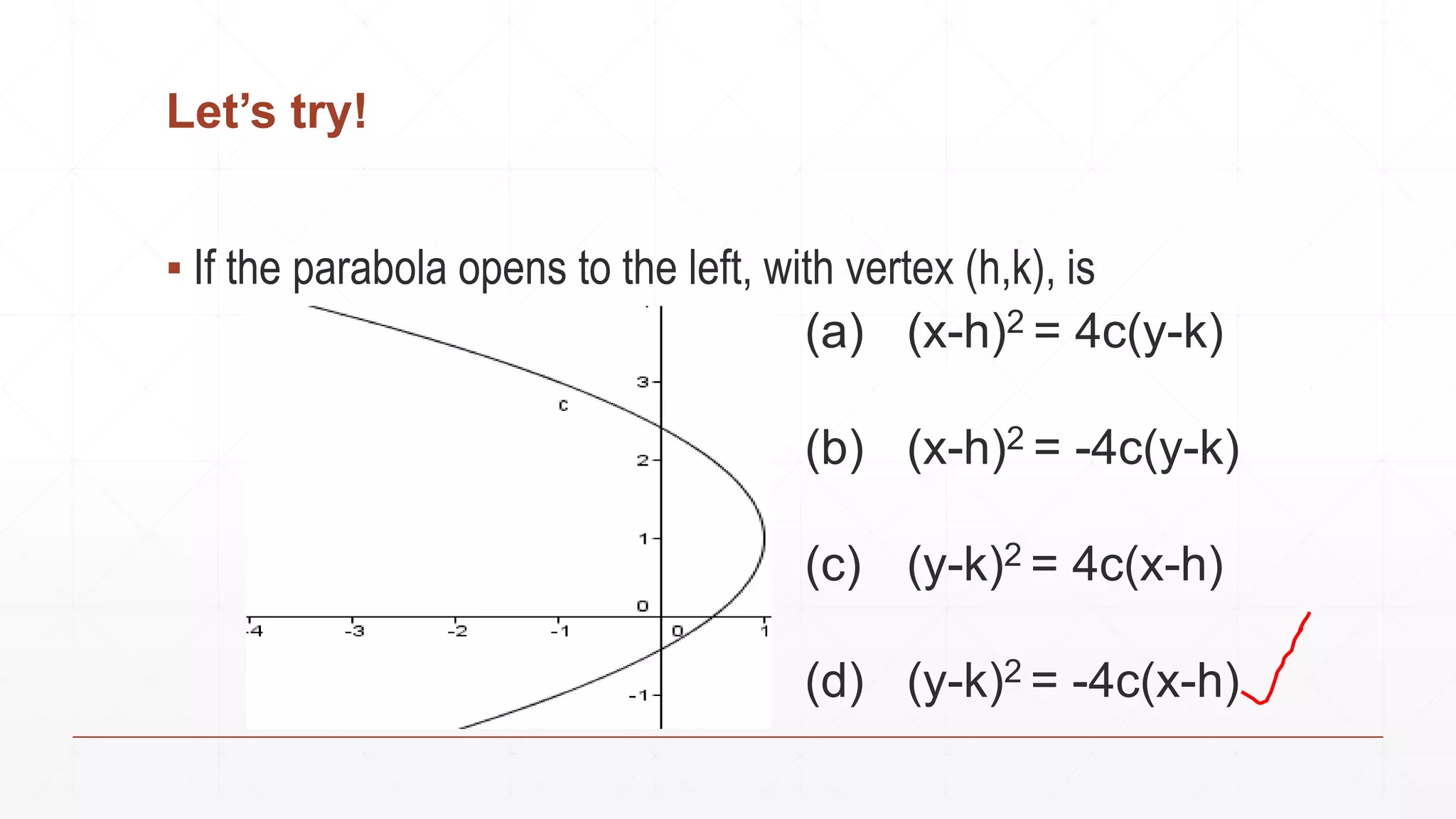
▪ If the parabola opens to the left, with vertex (h,k), is
(a) (x-h)2 = 4c(y-k)
(b) (x-h)2 = -4c(y-k)
(c) (y-k)2 = 4c(x-h)
(d) (y-k)2 = -4c(x-h)
Standard equation of a Parabola
▪ Example 1. The figure
shows the graph of
parabola, with only its
focus and vertex
indicated. Find its
standard equation. What
is its directrix and its axis
of symmetry?
Equation of the Parabola in General Form
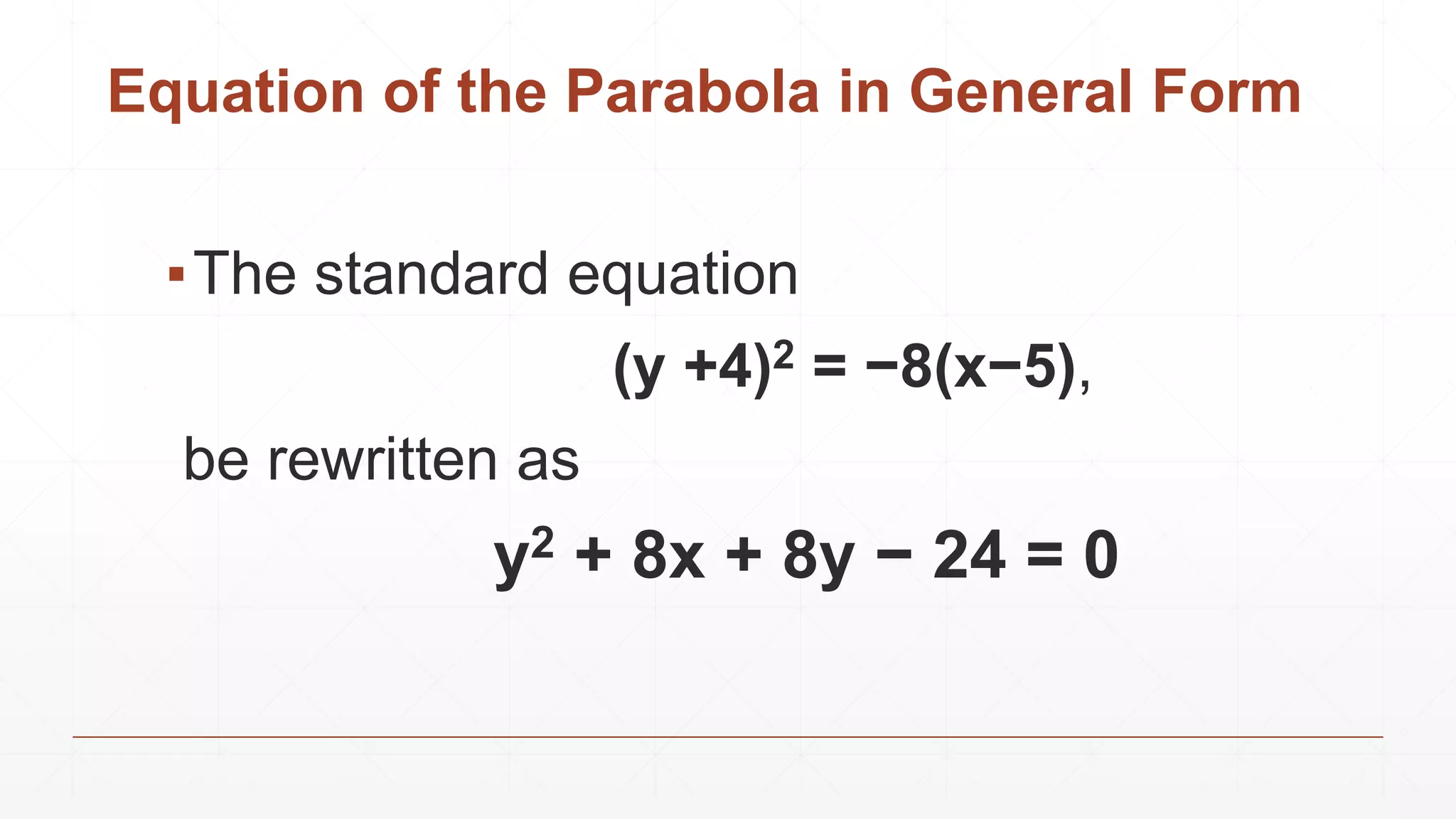
▪The standard equation
(y +4)2 = −8(x−5),
be rewritten as
y2 + 8x + 8y − 24 = 0
The general equation of parabola is given by
𝐴𝑥2
+ 𝐶𝑥 + 𝐷𝑦 + 𝐸 = 0
(A and C are nonzero)
or
𝐵𝑦2
+ 𝐶𝑥 + 𝐷𝑦 + 𝐸 = 0
(B and C are nonzero)
Equation of the Parabola in General Form
Let’s try!
▪ Example 2. Determine the vertex, focus, directrix, and
axis of symmetry of the parabola with the given
equation. Sketch the parabola, and include these
points and lines.
(a) y2 − 5x + 12y = −16
(b) 5x2 + 30x + 24y = 51
▪ Example 3. A parabola has focus F(7, 9) and directrix
y = 3. Find its standard equation.
Seatwork
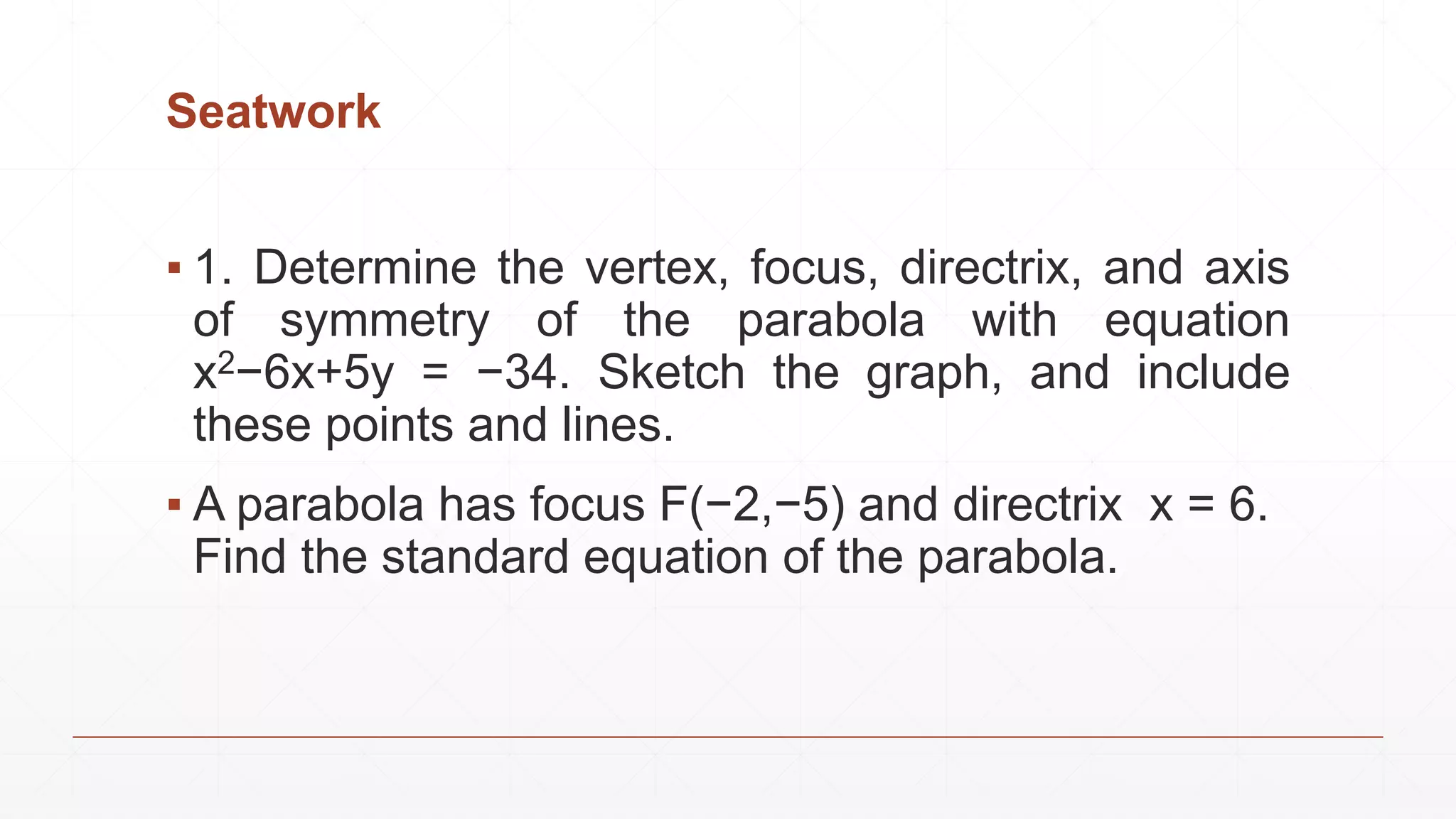
▪ 1. Determine the vertex, focus, directrix, and axis
of symmetry of the parabola with equation
x2−6x+5y = −34. Sketch the graph, and include
these points and lines.
▪ A parabola has focus F(−2,−5) and directrix x = 6.
Find the standard equation of the parabola.
THANK YOU
www.slideshare.net/reycastro1
@reylkastro2
reylkastro

Properties of Parabola

  • 1.
    Parabolas More Properties ofParabolas PRECALCULUS
  • 2.
    More Properties ofParabolas ▪ Recall that, for any point on the parabola, its distance from the focus is the same as its distance from the directrix.
  • 3.
    In all fourcases below, we assume that c > 0. The vertex is V (h, k), and it lies between the focus F and the directrix ℓ. (x − h)2 = 4c(y − k) directrix ℓ : horizontal axis of symmetry: x=h, vertical
  • 4.
    In all fourcases below, we assume that c > 0. The vertex is V (h, k), and it lies between the focus F and the directrix ℓ. (x − h)2 = - 4c(y − k) directrix ℓ : horizontal axis of symmetry: x=h, vertical
  • 5.
    In all fourcases below, we assume that c > 0. The vertex is V (h, k), and it lies between the focus F and the directrix ℓ. (y − k)2 = 4c(x − h) directrix ℓ : vertical axis of symmetry: y=k, horizontal
  • 6.
    In all fourcases below, we assume that c > 0. The vertex is V (h, k), and it lies between the focus F and the directrix ℓ. (y − k)2 = -4c(x − h) directrix ℓ : vertical axis of symmetry: y=k, horizontal
  • 7.
    Let’s try! ▪ Ifthe parabola opens to the right, with vertex at the origin, the equation is (a) x2 = 4cy (b) x2 = -4cy (c) y2 = -4cx (d) y2 = 4cx
  • 8.
    Let’s try! ▪ Ifthe parabola opens to the right, with vertex at the origin, the equation is (a) x2 = 4cy (b) x2 = -4cy (c) y2 = -4cx (d) y2 = 4cx
  • 9.
    Let’s try! ▪ Ifthe parabola opens downward, with vertex at the origin, the equation is (a) x2 = 4cy (b) x2 = -4cy (c) y2 = -4cx (d) y2 = 4cx
  • 10.
    Let’s try! ▪ Ifthe parabola opens downward, with vertex at the origin, the equation is (a) x2 = 4cy (b) x2 = -4cy (c) y2 = -4cx (d) y2 = 4cx
  • 11.
    Let’s try! ▪ Ifthe parabola opens to the left, with vertex at the origin, the equation is (a) x2 = 4cy (b) x2 = -4cy (c) y2 = -4cx (d) y2 = 4cx
  • 12.
    Let’s try! ▪ Ifthe parabola opens to the left, with vertex at the origin, the equation is (a) x2 = 4cy (b) x2 = -4cy (c) y2 = -4cx (d) y2 = 4cx
  • 13.
    Let’s try! ▪ Ifthe parabola opens upward, with vertex at the origin, the equation is (a) x2 = 4cy (b) x2 = -4cy (c) y2 = -4cx (d) y2 = 4cx
  • 14.
    Let’s try! ▪ Ifthe parabola opens upward, with vertex at the origin, the equation is (a) x2 = 4cy (b) x2 = -4cy (c) y2 = -4cx (d) y2 = 4cx
  • 15.
    Let’s try! ▪ Ifthe parabola opens upward, with vertex (h,k), the equation is (a) (x-h)2 = 4c(y-k) (b) (x-h)2 = -4c(y-k) (c) (y-k)2 = 4c(x-h) (d) (y-k)2 = -4c(x-h)
  • 16.
    Let’s try! ▪ Ifthe parabola opens upward, with vertex (h,k), the equation is (a) (x-h)2 = 4c(y-k) (b) (x-h)2 = -4c(y-k) (c) (y-k)2 = 4c(x-h) (d) (y-k)2 = -4c(x-h)
  • 17.
    Let’s try! ▪ Ifthe parabola opens to the right, with vertex (h,k), is (a) (x-h)2 = 4c(y-k) (b) (x-h)2 = -4c(y-k) (c) (y-k)2 = 4c(x-h) (d) (y-k)2 = -4c(x-h)
  • 18.
    Let’s try! ▪ Ifthe parabola opens to the right, with vertex (h,k), is (a) (x-h)2 = 4c(y-k) (b) (x-h)2 = -4c(y-k) (c) (y-k)2 = 4c(x-h) (d) (y-k)2 = -4c(x-h)
  • 19.
    Let’s try! ▪ Ifthe parabola opens down, with vertex (h,k), the equation is (a) (x-h)2 = 4c(y-k) (b) (x-h)2 = -4c(y-k) (c) (y-k)2 = 4c(x-h) (d) (y-k)2 = -4c(x-h)
  • 20.
    Let’s try! ▪ Ifthe parabola opens down, with vertex (h,k), the equation is (a) (x-h)2 = 4c(y-k) (b) (x-h)2 = -4c(y-k) (c) (y-k)2 = 4c(x-h) (d) (y-k)2 = -4c(x-h)
  • 21.
    Let’s try! ▪ Ifthe parabola opens to the left, with vertex (h,k), is (a) (x-h)2 = 4c(y-k) (b) (x-h)2 = -4c(y-k) (c) (y-k)2 = 4c(x-h) (d) (y-k)2 = -4c(x-h)
  • 22.
    Let’s try! ▪ Ifthe parabola opens to the left, with vertex (h,k), is (a) (x-h)2 = 4c(y-k) (b) (x-h)2 = -4c(y-k) (c) (y-k)2 = 4c(x-h) (d) (y-k)2 = -4c(x-h)
  • 23.
    Standard equation ofa Parabola ▪ Example 1. The figure shows the graph of parabola, with only its focus and vertex indicated. Find its standard equation. What is its directrix and its axis of symmetry?
  • 24.
    Equation of theParabola in General Form ▪The standard equation (y +4)2 = −8(x−5), be rewritten as y2 + 8x + 8y − 24 = 0
  • 25.
    The general equationof parabola is given by 𝐴𝑥2 + 𝐶𝑥 + 𝐷𝑦 + 𝐸 = 0 (A and C are nonzero) or 𝐵𝑦2 + 𝐶𝑥 + 𝐷𝑦 + 𝐸 = 0 (B and C are nonzero) Equation of the Parabola in General Form
  • 26.
    Let’s try! ▪ Example2. Determine the vertex, focus, directrix, and axis of symmetry of the parabola with the given equation. Sketch the parabola, and include these points and lines. (a) y2 − 5x + 12y = −16 (b) 5x2 + 30x + 24y = 51 ▪ Example 3. A parabola has focus F(7, 9) and directrix y = 3. Find its standard equation.
  • 27.
    Seatwork ▪ 1. Determinethe vertex, focus, directrix, and axis of symmetry of the parabola with equation x2−6x+5y = −34. Sketch the graph, and include these points and lines. ▪ A parabola has focus F(−2,−5) and directrix x = 6. Find the standard equation of the parabola.
  • 28.