PARABOLAS
OBJECTIVES:
1. define a parabola;
2. determine the standard form of
equation of a parabola; and
3. graph a parabola in a rectangular
coordinate system.
PARABOLA
- is the set of all points P, such that its
distances from a given point F and a given
line , are the same. The point F is called
the focus of the parabola, and is the
directrix of the parabola. The point V, the
point on the parabola that is closest to the
directrix, is the vertex.
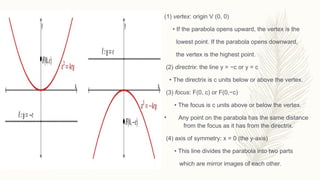
(1) vertex: origin V (0, 0)
• If the parabola opens upward, the vertex is the
lowest point. If the parabola opens downward,
the vertex is the highest point.
(2) directrix: the line y = −c or y = c
• The directrix is c units below or above the vertex.
(3) focus: F(0, c) or F(0,−c)
• The focus is c units above or below the vertex.
• Any point on the parabola has the same distance
from the focus as it has from the directrix.
(4) axis of symmetry: x = 0 (the y-axis)
• This line divides the parabola into two parts
which are mirror images of each other.
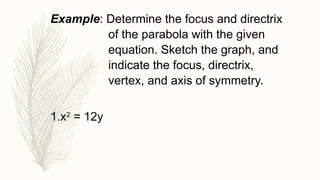
Example: Determine the focus and directrix
of the parabola with the given
equation. Sketch the graph, and
indicate the focus, directrix,
vertex, and axis of symmetry.
1.x2
= 12y
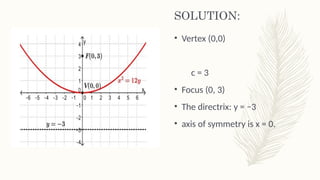
SOLUTION:
• Vertex (0,0)
c = 3
• Focus (0, 3)
• The directrix: y = −3
• axis of symmetry is x = 0.
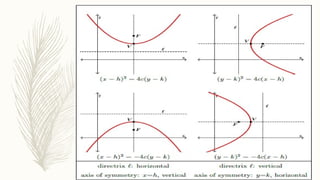
The following observations are worth noting.
 The equations are in terms of x − h and y − k: the vertex coordinates
are subtracted from the corresponding variable. Thus, replacing both
h and k with 0 would yield the case where the vertex is the origin.
For instance, this replacement applied to (x−h)2
= 4c(y−k) (parabola
opening upward) would yield x2
= 4cy, the first standard equation we
encountered (parabola opening upward, vertex at the origin).
 If the x-part is squared, the parabola is “vertical”; if the y-part is
squared, the parabola is “horizontal.” In a horizontal parabola, the
focus is on the left or right of the vertex, and the directrix is vertical.
 If the coefficient of the linear (non-squared) part is positive, the
parabola opens upward or to the right; if negative, downward or to
the left.
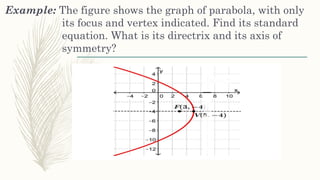
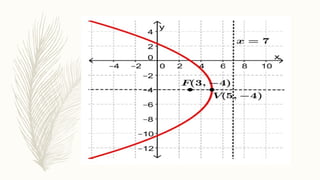
Example: The figure shows the graph of parabola, with only
its focus and vertex indicated. Find its standard
equation. What is its directrix and its axis of
symmetry?
Solution:
The vertex is V (5,−4) and the focus is F(3,−4). From
these, we deduce the following:
h = 5, k = −4, c = 2 (the distance of the focus from the
vertex). Since the parabola opens to the left, we use the
template (y − k)2
=−4c(x − h).
Our equation is (y + 4)2
= −8(x − 5).
Its directrix is c = 2 units to the right of V, which is x = 7.
Its axis is the horizontal line through V : y = −4.
Directions: Determine the vertex, focus,
directrix, and axis of symmetry of the
parabola with equation
Sketch the graph,
and include these points and lines.

POWERPOINT ON PRE-CALCULUS FOR DEMO.pptx

  • 1.
  • 2.
    OBJECTIVES: 1. define aparabola; 2. determine the standard form of equation of a parabola; and 3. graph a parabola in a rectangular coordinate system.
  • 3.
    PARABOLA - is theset of all points P, such that its distances from a given point F and a given line , are the same. The point F is called the focus of the parabola, and is the directrix of the parabola. The point V, the point on the parabola that is closest to the directrix, is the vertex.
  • 4.
    (1) vertex: originV (0, 0) • If the parabola opens upward, the vertex is the lowest point. If the parabola opens downward, the vertex is the highest point. (2) directrix: the line y = −c or y = c • The directrix is c units below or above the vertex. (3) focus: F(0, c) or F(0,−c) • The focus is c units above or below the vertex. • Any point on the parabola has the same distance from the focus as it has from the directrix. (4) axis of symmetry: x = 0 (the y-axis) • This line divides the parabola into two parts which are mirror images of each other.
  • 5.
    Example: Determine thefocus and directrix of the parabola with the given equation. Sketch the graph, and indicate the focus, directrix, vertex, and axis of symmetry. 1.x2 = 12y
  • 6.
    SOLUTION: • Vertex (0,0) c= 3 • Focus (0, 3) • The directrix: y = −3 • axis of symmetry is x = 0.
  • 8.
    The following observationsare worth noting.  The equations are in terms of x − h and y − k: the vertex coordinates are subtracted from the corresponding variable. Thus, replacing both h and k with 0 would yield the case where the vertex is the origin. For instance, this replacement applied to (x−h)2 = 4c(y−k) (parabola opening upward) would yield x2 = 4cy, the first standard equation we encountered (parabola opening upward, vertex at the origin).  If the x-part is squared, the parabola is “vertical”; if the y-part is squared, the parabola is “horizontal.” In a horizontal parabola, the focus is on the left or right of the vertex, and the directrix is vertical.  If the coefficient of the linear (non-squared) part is positive, the parabola opens upward or to the right; if negative, downward or to the left.
  • 9.
    Example: The figureshows the graph of parabola, with only its focus and vertex indicated. Find its standard equation. What is its directrix and its axis of symmetry?
  • 10.
    Solution: The vertex isV (5,−4) and the focus is F(3,−4). From these, we deduce the following: h = 5, k = −4, c = 2 (the distance of the focus from the vertex). Since the parabola opens to the left, we use the template (y − k)2 =−4c(x − h). Our equation is (y + 4)2 = −8(x − 5). Its directrix is c = 2 units to the right of V, which is x = 7. Its axis is the horizontal line through V : y = −4.
  • 12.
    Directions: Determine thevertex, focus, directrix, and axis of symmetry of the parabola with equation Sketch the graph, and include these points and lines.