METHODS OF PROOF AND
DISPROOF
BY,
Lakshmi R
Asst. Professor
Dept. of ISE
PROOF AND DISPROOF
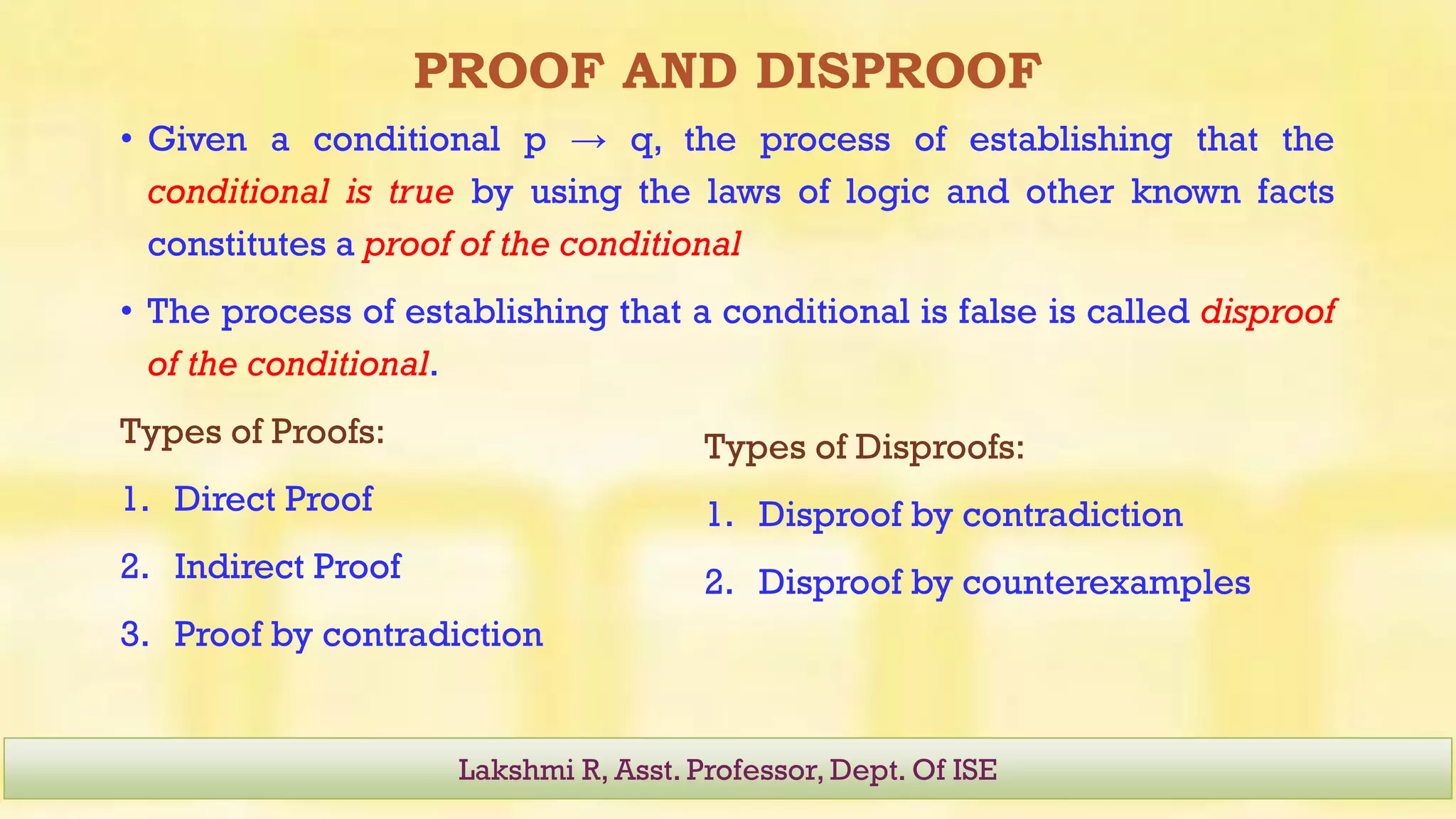
• Given a conditional p → q, the process of establishing that the
conditional is true by using the laws of logic and other known facts
constitutes a proof of the conditional
• The process of establishing that a conditional is false is called disproof
of the conditional.
Types of Proofs:
1. Direct Proof
2. Indirect Proof
3. Proof by contradiction
Lakshmi R, Asst. Professor, Dept. Of ISE
Types of Disproofs:
1. Disproof by contradiction
2. Disproof by counterexamples
PROOF
1. Direct Proof: Proving p → q true:
Step i: Hypothesis: Assume that p is true
Step ii: Analysis: Starting with hypothesis, apply
laws of logic and other facts and infer
that q is true
Step iii: Conclusion: p → q is true
Lakshmi R, Asst. Professor, Dept. Of ISE
PROOF
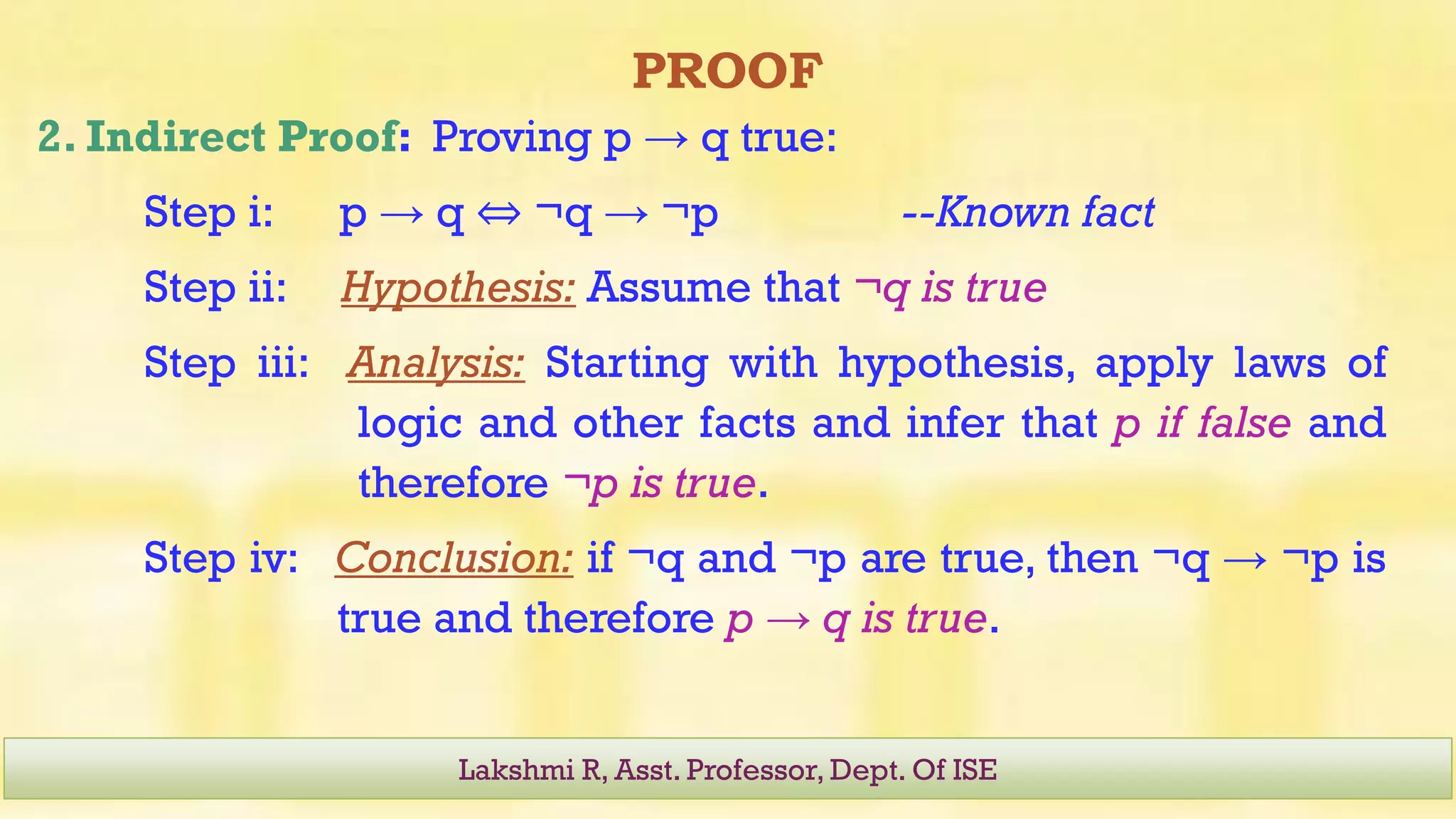
2. Indirect Proof: Proving p → q true:
Step i: p → q ⇔ ¬q → ¬p --Known fact
Step ii: Hypothesis: Assume that ¬q is true
Step iii: Analysis: Starting with hypothesis, apply laws of
logic and other facts and infer that p if false and
therefore ¬p is true.
Step iv: Conclusion: if ¬q and ¬p are true, then ¬q → ¬p is
true and therefore p → q is true.
Lakshmi R, Asst. Professor, Dept. Of ISE
PROOF
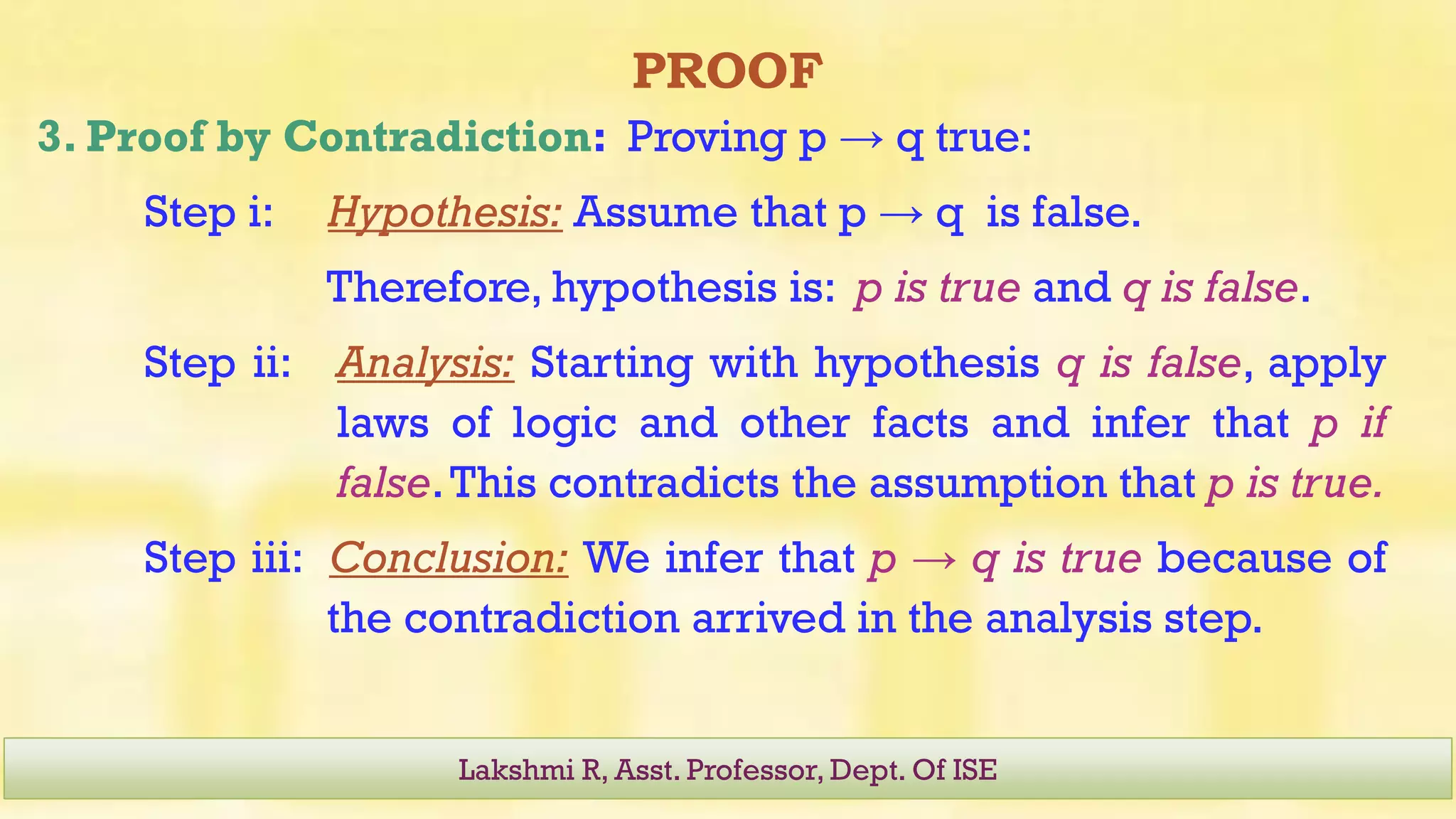
3. Proof by Contradiction: Proving p → q true:
Step i: Hypothesis: Assume that p → q is false.
Therefore, hypothesis is: p is true and q is false.
Step ii: Analysis: Starting with hypothesis q is false, apply
laws of logic and other facts and infer that p if
false.This contradicts the assumption that p is true.
Step iii: Conclusion: We infer that p → q is true because of
the contradiction arrived in the analysis step.
Lakshmi R, Asst. Professor, Dept. Of ISE
DISPROOF
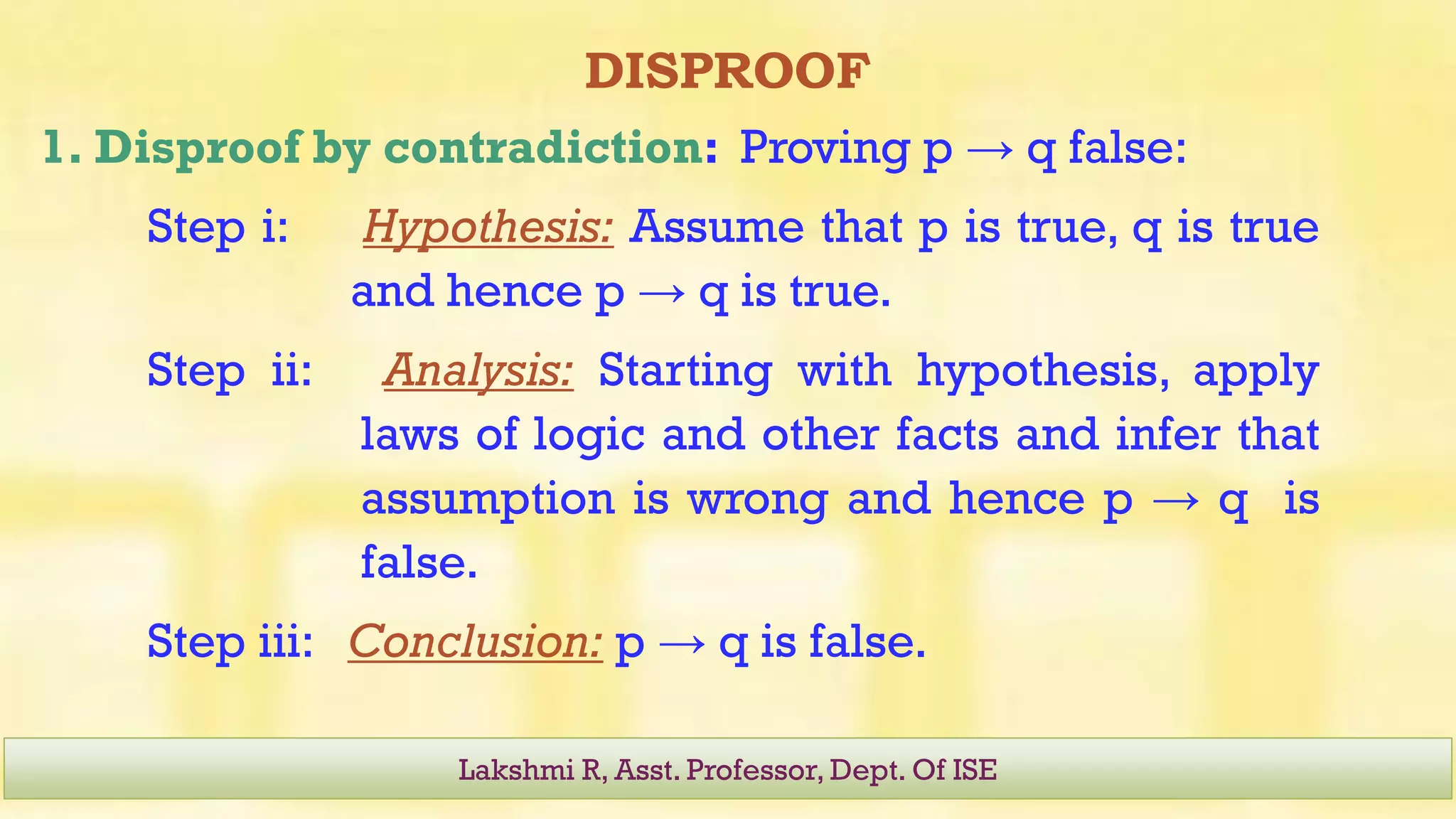
1. Disproof by contradiction: Proving p → q false:
Step i: Hypothesis: Assume that p is true, q is true
and hence p → q is true.
Step ii: Analysis: Starting with hypothesis, apply
laws of logic and other facts and infer that
assumption is wrong and hence p → q is
false.
Step iii: Conclusion: p → q is false.
Lakshmi R, Asst. Professor, Dept. Of ISE
DISPROOF
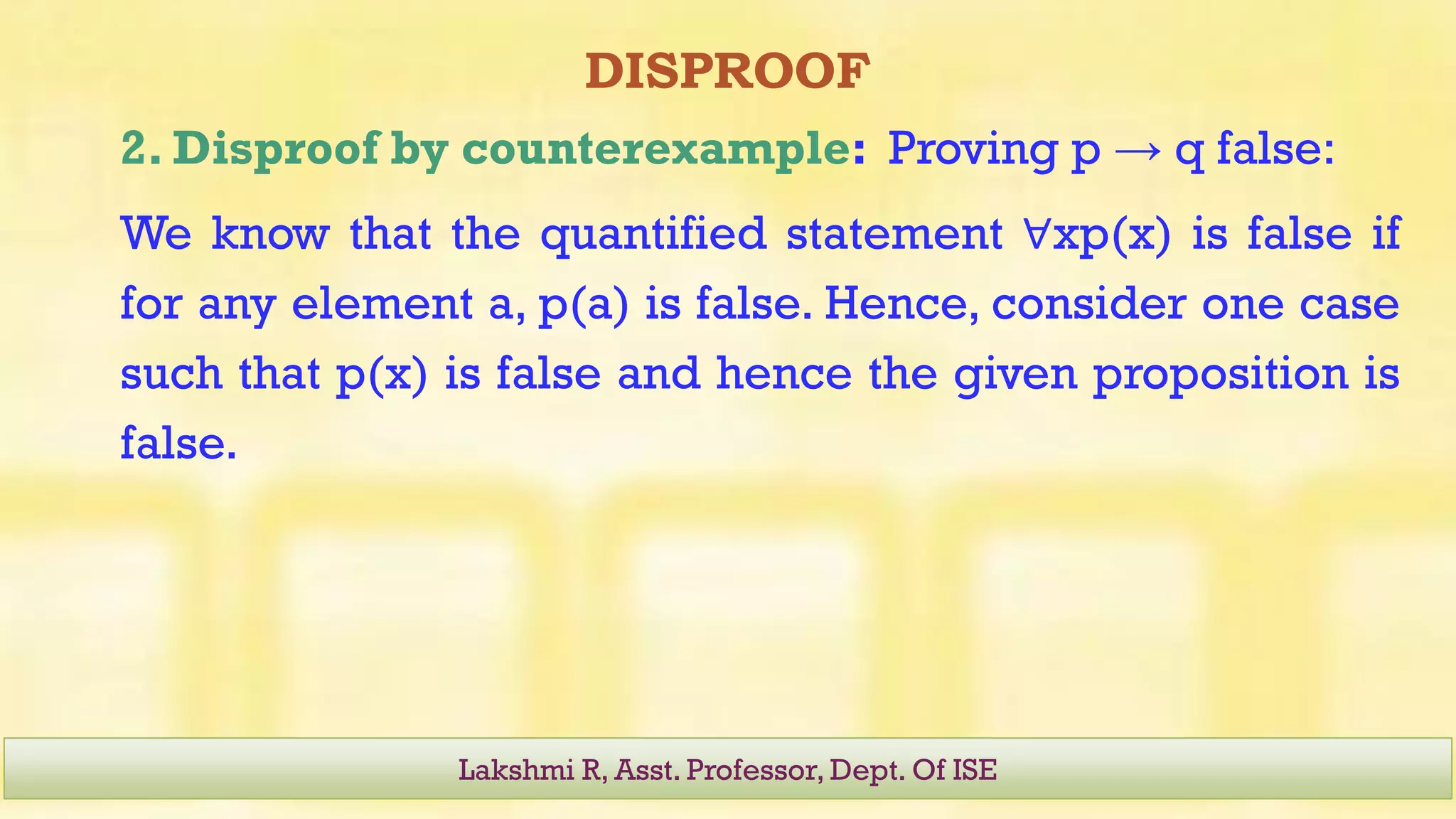
2. Disproof by counterexample: Proving p → q false:
We know that the quantified statement ∀xp(x) is false if
for any element a, p(a) is false. Hence, consider one case
such that p(x) is false and hence the given proposition is
false.
Lakshmi R, Asst. Professor, Dept. Of ISE
PROBLEM 1
Give direct proof for
“for all integers k and l, if k and l both are odd, then k + l is even and
k.l is odd”
Lakshmi R, Asst. Professor, Dept. Of ISE
Definition of Even and Odd number
Even – Multiple of 2.
Can be expressed as 2m, where, m is some integer.
Odd – Not a multiple of 2.
Can be expressed as 2n + 1, where, n is some
integer.
PROBLEM 1
Give direct proof for
“for all integers a and b, if a and b both are odd, then a + b is even and a.b is odd”
Lakshmi R, Asst. Professor, Dept. Of ISE
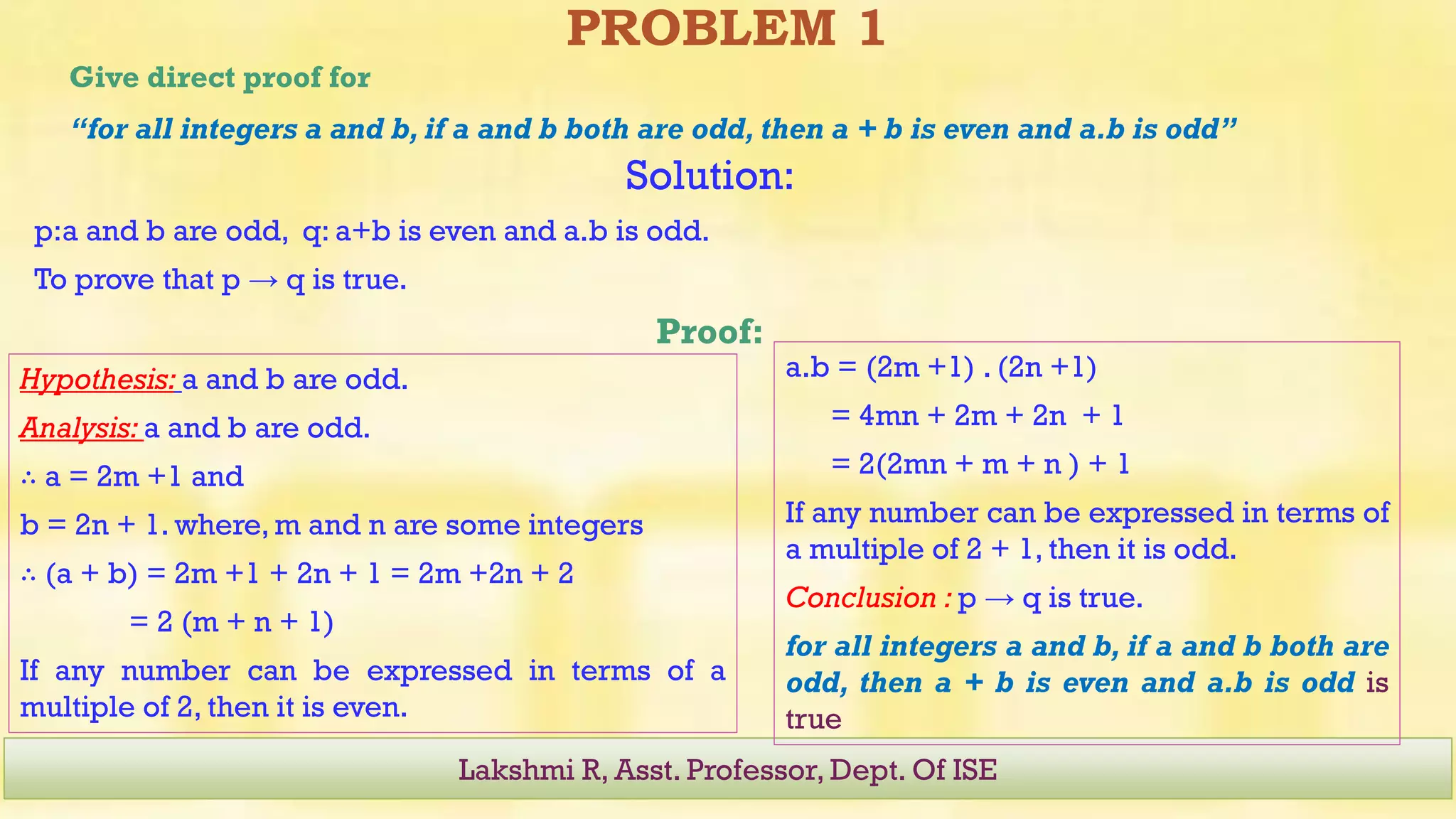
Solution:
p:a and b are odd, q: a+b is even and a.b is odd.
To prove that p → q is true.
Proof:
a.b = (2m +1) . (2n +1)
= 4mn + 2m + 2n + 1
= 2(2mn + m + n ) + 1
If any number can be expressed in terms of
a multiple of 2 + 1, then it is odd.
Conclusion : p → q is true.
for all integers a and b, if a and b both are
odd, then a + b is even and a.b is odd is
true
Hypothesis: a and b are odd.
Analysis: a and b are odd.
∴ a = 2m +1 and
b = 2n + 1. where, m and n are some integers
∴ (a + b) = 2m +1 + 2n + 1 = 2m +2n + 2
= 2 (m + n + 1)
If any number can be expressed in terms of a
multiple of 2, then it is even.
PROBLEM 2
Give indirect proof for “if n2 is odd, then n is odd”
Lakshmi R, Asst. Professor, Dept. Of ISE
Solution:
p: n2 is odd, q: n is odd.
To prove that ¬q → ¬p is true.
Proof:
n= 2k where, k is some integer
⇒ n2 = (2k)2 = 2.2(k)2
∴ n2 is not odd (n2 is even)
Or ¬p is true.
Conclusion: This proves the
contrapositive statement ¬q → ¬p
∴ if n2 is odd, then n is odd is true
Hypothesis: Assume ¬q is true
∴assume that n is even.
Analysis:
assume that n is even.
∴ n can be represented as a multiple of 2.
PROBLEM 3
Give proof by contradiction “for all real numbers x and y, if (x + y) ≥ 100,
then x ≥ 50 or y ≥ 50 ”
Lakshmi R, Asst. Professor, Dept. Of ISE
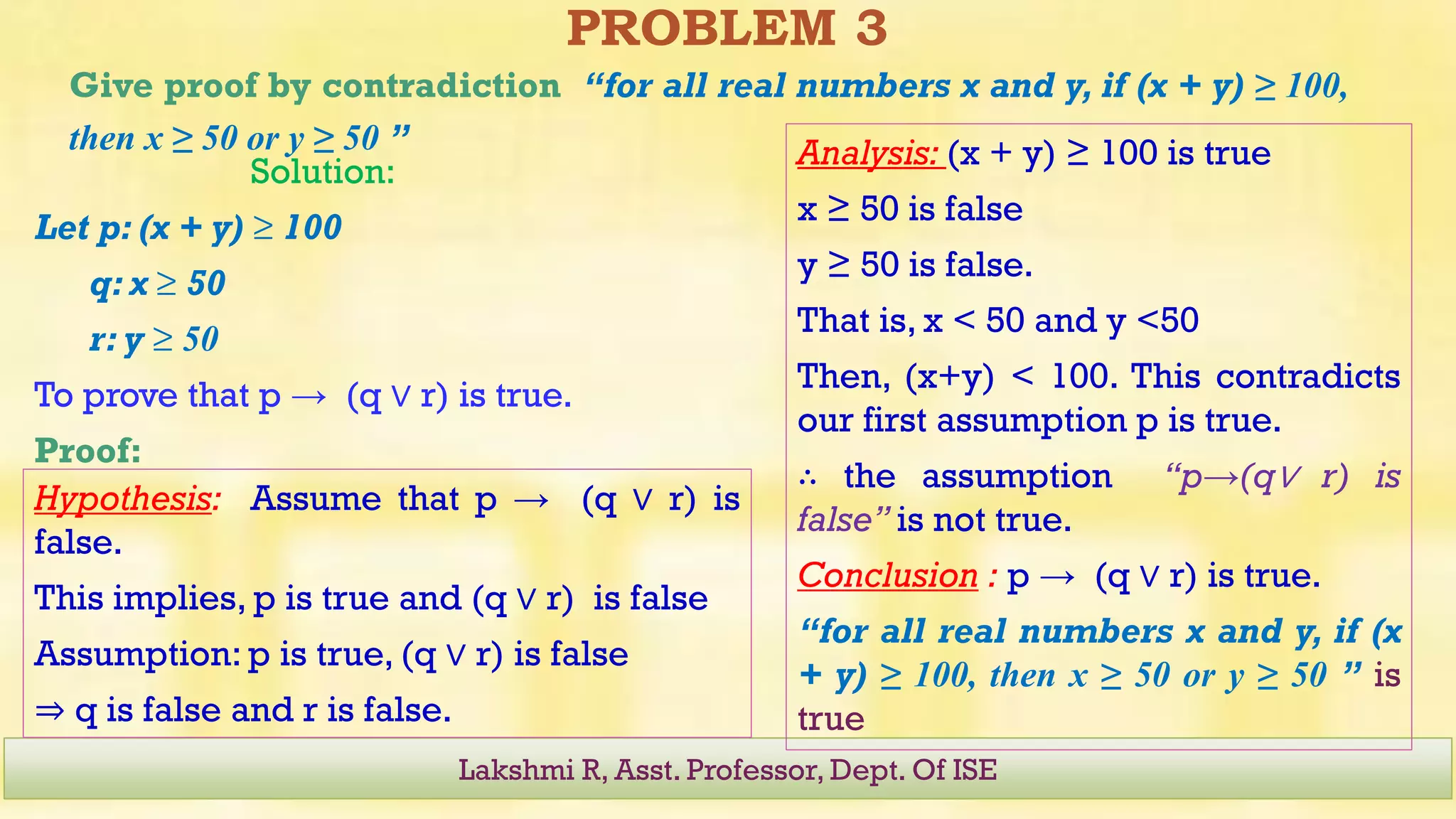
Solution:
Let p: (x + y) ≥ 100
q: x ≥ 50
r: y ≥ 50
To prove that p → (q ∨ r) is true.
Proof:
Analysis: (x + y) ≥ 100 is true
x ≥ 50 is false
y ≥ 50 is false.
That is, x < 50 and y <50
Then, (x+y) < 100. This contradicts
our first assumption p is true.
∴ the assumption “p→(q∨ r) is
false” is not true.
Conclusion : p → (q ∨ r) is true.
“for all real numbers x and y, if (x
+ y) ≥ 100, then x ≥ 50 or y ≥ 50 ” is
true
Hypothesis: Assume that p → (q ∨ r) is
false.
This implies, p is true and (q ∨ r) is false
Assumption: p is true, (q ∨ r) is false
⇒ q is false and r is false.
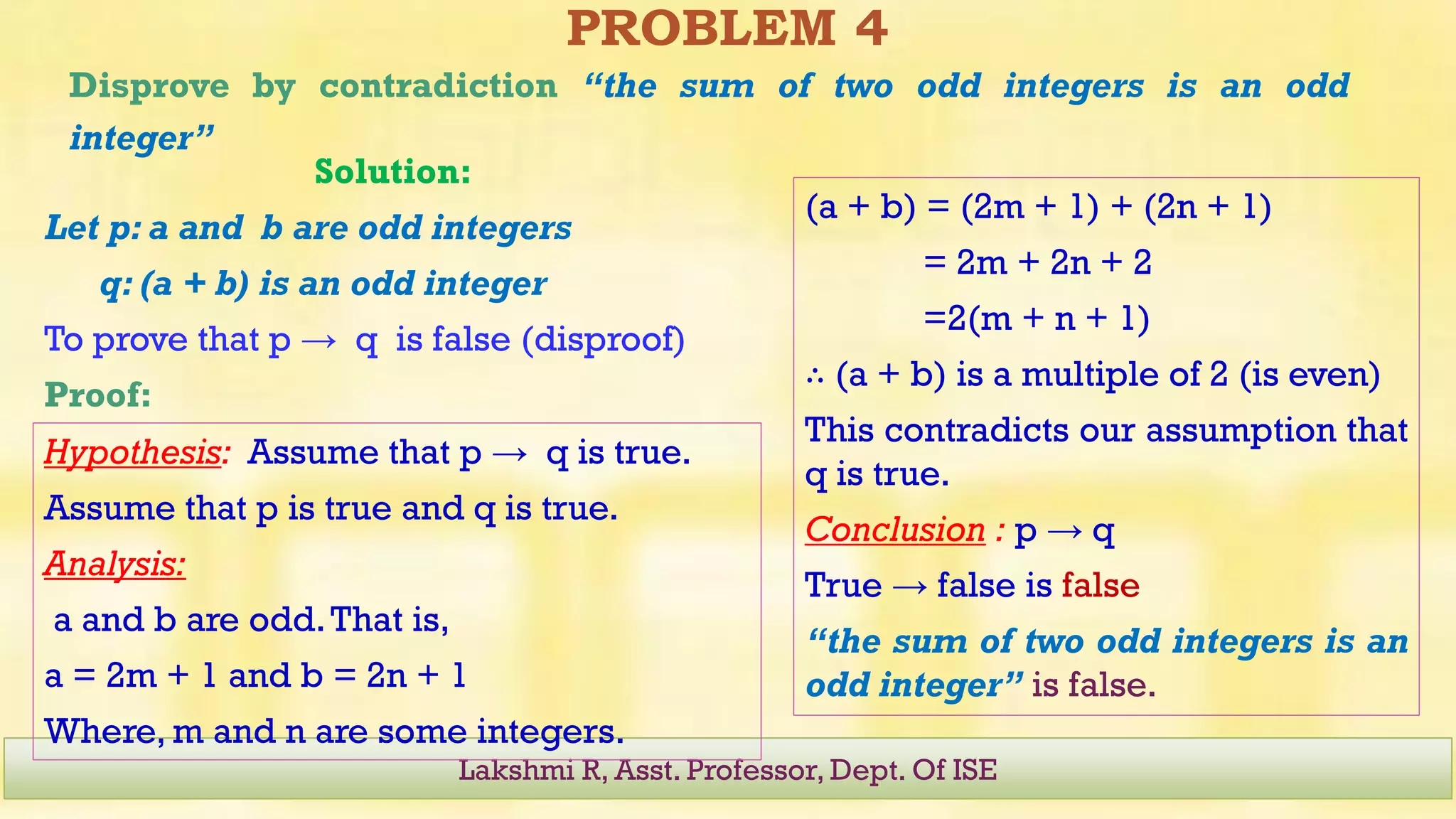
PROBLEM 4
Disprove by contradiction “the sum of two odd integers is an odd
integer”
Lakshmi R, Asst. Professor, Dept. Of ISE
Solution:
Let p: a and b are odd integers
q: (a + b) is an odd integer
To prove that p → q is false (disproof)
Proof:
(a + b) = (2m + 1) + (2n + 1)
= 2m + 2n + 2
=2(m + n + 1)
∴ (a + b) is a multiple of 2 (is even)
This contradicts our assumption that
q is true.
Conclusion : p → q
True → false is false
“the sum of two odd integers is an
odd integer” is false.
Hypothesis: Assume that p → q is true.
Assume that p is true and q is true.
Analysis:
a and b are odd.That is,
a = 2m + 1 and b = 2n + 1
Where, m and n are some integers.
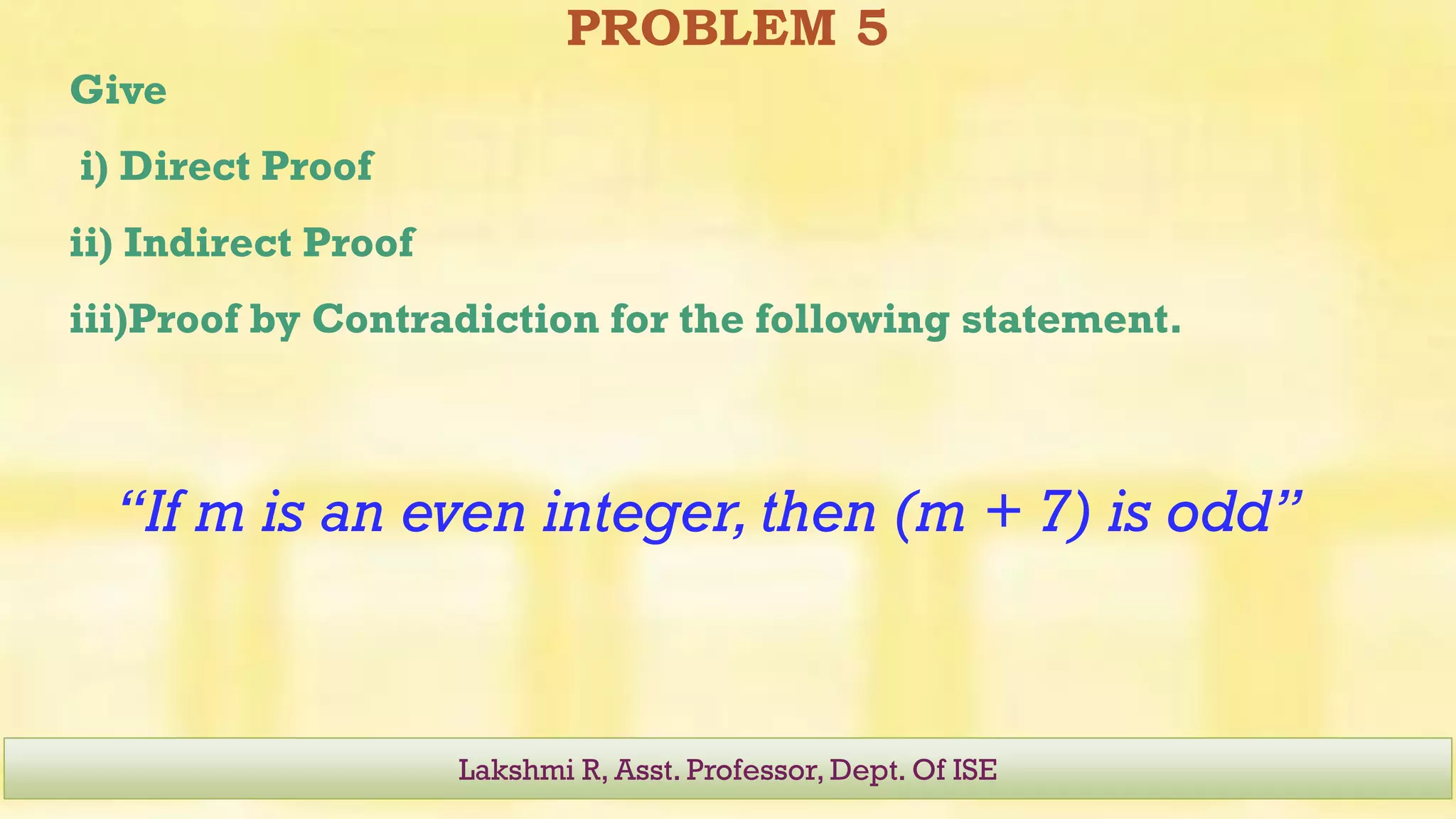
PROBLEM 5
Give
i) Direct Proof
ii) Indirect Proof
iii)Proof by Contradiction for the following statement.
“If m is an even integer, then (m + 7) is odd”
Lakshmi R, Asst. Professor, Dept. Of ISE

Proofs and disproofs

  • 1.
    METHODS OF PROOFAND DISPROOF BY, Lakshmi R Asst. Professor Dept. of ISE
  • 2.
    PROOF AND DISPROOF •Given a conditional p → q, the process of establishing that the conditional is true by using the laws of logic and other known facts constitutes a proof of the conditional • The process of establishing that a conditional is false is called disproof of the conditional. Types of Proofs: 1. Direct Proof 2. Indirect Proof 3. Proof by contradiction Lakshmi R, Asst. Professor, Dept. Of ISE Types of Disproofs: 1. Disproof by contradiction 2. Disproof by counterexamples
  • 3.
    PROOF 1. Direct Proof:Proving p → q true: Step i: Hypothesis: Assume that p is true Step ii: Analysis: Starting with hypothesis, apply laws of logic and other facts and infer that q is true Step iii: Conclusion: p → q is true Lakshmi R, Asst. Professor, Dept. Of ISE
  • 4.
    PROOF 2. Indirect Proof:Proving p → q true: Step i: p → q ⇔ ¬q → ¬p --Known fact Step ii: Hypothesis: Assume that ¬q is true Step iii: Analysis: Starting with hypothesis, apply laws of logic and other facts and infer that p if false and therefore ¬p is true. Step iv: Conclusion: if ¬q and ¬p are true, then ¬q → ¬p is true and therefore p → q is true. Lakshmi R, Asst. Professor, Dept. Of ISE
  • 5.
    PROOF 3. Proof byContradiction: Proving p → q true: Step i: Hypothesis: Assume that p → q is false. Therefore, hypothesis is: p is true and q is false. Step ii: Analysis: Starting with hypothesis q is false, apply laws of logic and other facts and infer that p if false.This contradicts the assumption that p is true. Step iii: Conclusion: We infer that p → q is true because of the contradiction arrived in the analysis step. Lakshmi R, Asst. Professor, Dept. Of ISE
  • 6.
    DISPROOF 1. Disproof bycontradiction: Proving p → q false: Step i: Hypothesis: Assume that p is true, q is true and hence p → q is true. Step ii: Analysis: Starting with hypothesis, apply laws of logic and other facts and infer that assumption is wrong and hence p → q is false. Step iii: Conclusion: p → q is false. Lakshmi R, Asst. Professor, Dept. Of ISE
  • 7.
    DISPROOF 2. Disproof bycounterexample: Proving p → q false: We know that the quantified statement ∀xp(x) is false if for any element a, p(a) is false. Hence, consider one case such that p(x) is false and hence the given proposition is false. Lakshmi R, Asst. Professor, Dept. Of ISE
  • 8.
    PROBLEM 1 Give directproof for “for all integers k and l, if k and l both are odd, then k + l is even and k.l is odd” Lakshmi R, Asst. Professor, Dept. Of ISE Definition of Even and Odd number Even – Multiple of 2. Can be expressed as 2m, where, m is some integer. Odd – Not a multiple of 2. Can be expressed as 2n + 1, where, n is some integer.
  • 9.
    PROBLEM 1 Give directproof for “for all integers a and b, if a and b both are odd, then a + b is even and a.b is odd” Lakshmi R, Asst. Professor, Dept. Of ISE Solution: p:a and b are odd, q: a+b is even and a.b is odd. To prove that p → q is true. Proof: a.b = (2m +1) . (2n +1) = 4mn + 2m + 2n + 1 = 2(2mn + m + n ) + 1 If any number can be expressed in terms of a multiple of 2 + 1, then it is odd. Conclusion : p → q is true. for all integers a and b, if a and b both are odd, then a + b is even and a.b is odd is true Hypothesis: a and b are odd. Analysis: a and b are odd. ∴ a = 2m +1 and b = 2n + 1. where, m and n are some integers ∴ (a + b) = 2m +1 + 2n + 1 = 2m +2n + 2 = 2 (m + n + 1) If any number can be expressed in terms of a multiple of 2, then it is even.
  • 10.
    PROBLEM 2 Give indirectproof for “if n2 is odd, then n is odd” Lakshmi R, Asst. Professor, Dept. Of ISE Solution: p: n2 is odd, q: n is odd. To prove that ¬q → ¬p is true. Proof: n= 2k where, k is some integer ⇒ n2 = (2k)2 = 2.2(k)2 ∴ n2 is not odd (n2 is even) Or ¬p is true. Conclusion: This proves the contrapositive statement ¬q → ¬p ∴ if n2 is odd, then n is odd is true Hypothesis: Assume ¬q is true ∴assume that n is even. Analysis: assume that n is even. ∴ n can be represented as a multiple of 2.
  • 11.
    PROBLEM 3 Give proofby contradiction “for all real numbers x and y, if (x + y) ≥ 100, then x ≥ 50 or y ≥ 50 ” Lakshmi R, Asst. Professor, Dept. Of ISE Solution: Let p: (x + y) ≥ 100 q: x ≥ 50 r: y ≥ 50 To prove that p → (q ∨ r) is true. Proof: Analysis: (x + y) ≥ 100 is true x ≥ 50 is false y ≥ 50 is false. That is, x < 50 and y <50 Then, (x+y) < 100. This contradicts our first assumption p is true. ∴ the assumption “p→(q∨ r) is false” is not true. Conclusion : p → (q ∨ r) is true. “for all real numbers x and y, if (x + y) ≥ 100, then x ≥ 50 or y ≥ 50 ” is true Hypothesis: Assume that p → (q ∨ r) is false. This implies, p is true and (q ∨ r) is false Assumption: p is true, (q ∨ r) is false ⇒ q is false and r is false.
  • 12.
    PROBLEM 4 Disprove bycontradiction “the sum of two odd integers is an odd integer” Lakshmi R, Asst. Professor, Dept. Of ISE Solution: Let p: a and b are odd integers q: (a + b) is an odd integer To prove that p → q is false (disproof) Proof: (a + b) = (2m + 1) + (2n + 1) = 2m + 2n + 2 =2(m + n + 1) ∴ (a + b) is a multiple of 2 (is even) This contradicts our assumption that q is true. Conclusion : p → q True → false is false “the sum of two odd integers is an odd integer” is false. Hypothesis: Assume that p → q is true. Assume that p is true and q is true. Analysis: a and b are odd.That is, a = 2m + 1 and b = 2n + 1 Where, m and n are some integers.
  • 13.
    PROBLEM 5 Give i) DirectProof ii) Indirect Proof iii)Proof by Contradiction for the following statement. “If m is an even integer, then (m + 7) is odd” Lakshmi R, Asst. Professor, Dept. Of ISE