Writing Proofs
General Mathematics
Lesson Objectives
At the end of the lesson, the students must be
able to:
• illustrate the different methods of proof and
disproof; and
• justify mathematical and real-life statements
using the different methods of proof and
disproof.
Direct Proof
Suppose you want to prove that P Q. You need
to assume P and then use the rules of inference
axioms, definitions, and logical equivalences
to prove Q.
Sample of Direct Proof
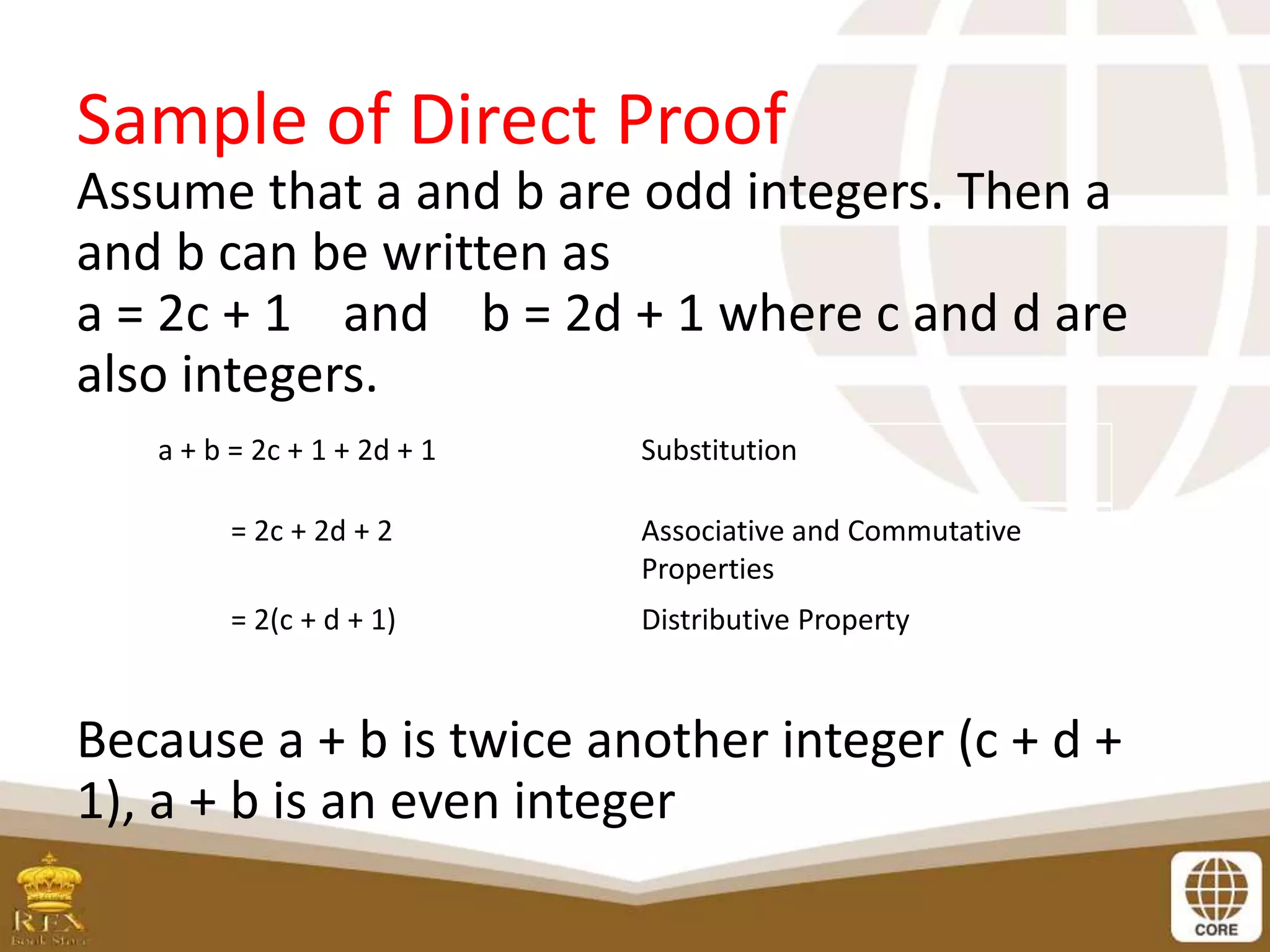
Assume that a and b are odd integers. Then a
and b can be written as
a = 2c + 1 and b = 2d + 1 where c and d are
also integers.
Because a + b is twice another integer (c + d +
1), a + b is an even integer
a + b = 2c + 1 + 2d + 1 Substitution
= 2c + 2d + 2 Associative and Commutative
Properties
= 2(c + d + 1) Distributive Property
Indirect Proof
The two methods of indirect proof are proof of
the contrapositive and proof by contradiction.
Proof of the contrapositive means that you have
to prove the contrapositive of the given
conditional propositions.
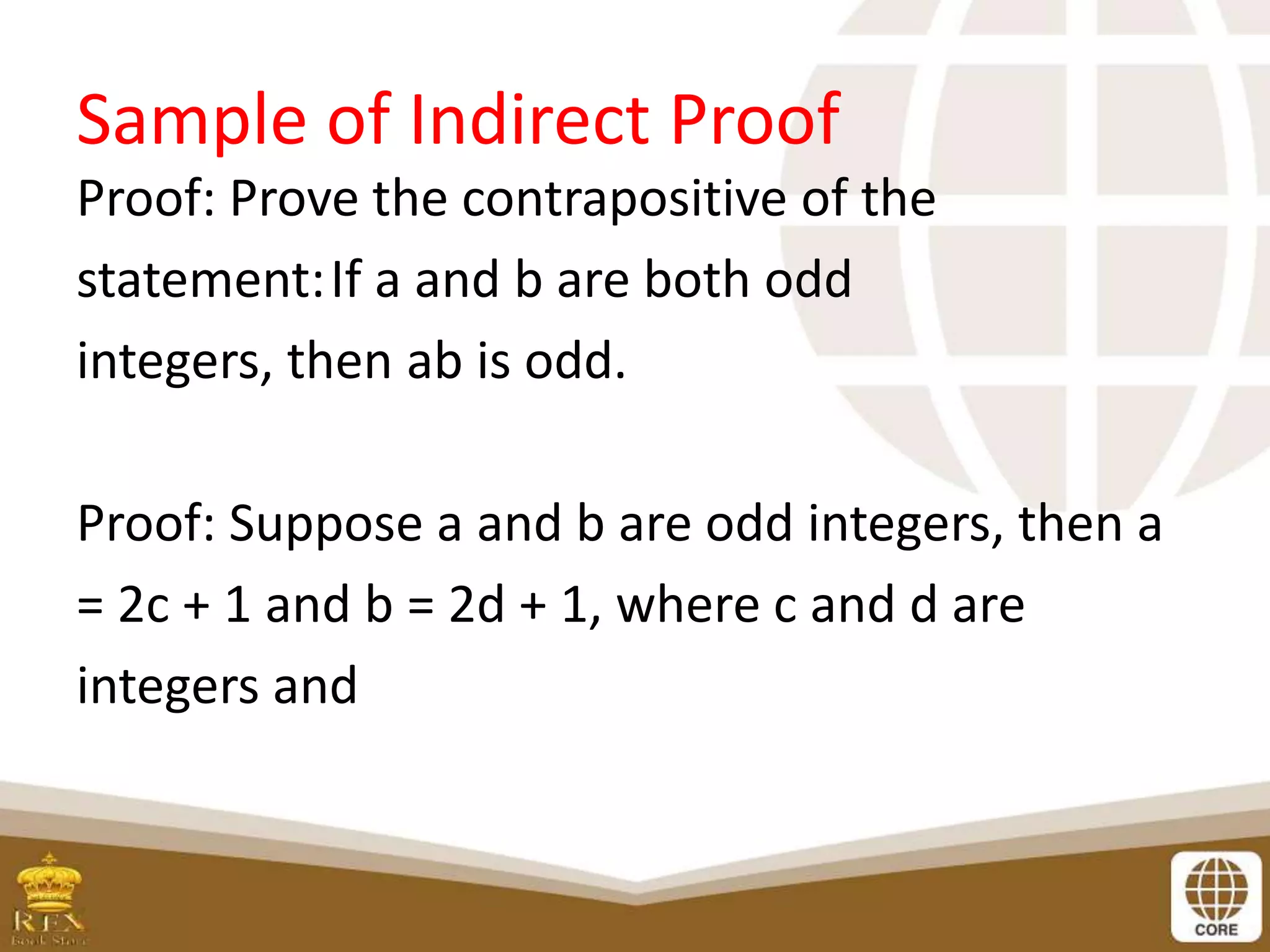
Sample of Indirect Proof
Proof: Prove the contrapositive of the
statement:If a and b are both odd
integers, then ab is odd.
Proof: Suppose a and b are odd integers, then a
= 2c + 1 and b = 2d + 1, where c and d are
integers and
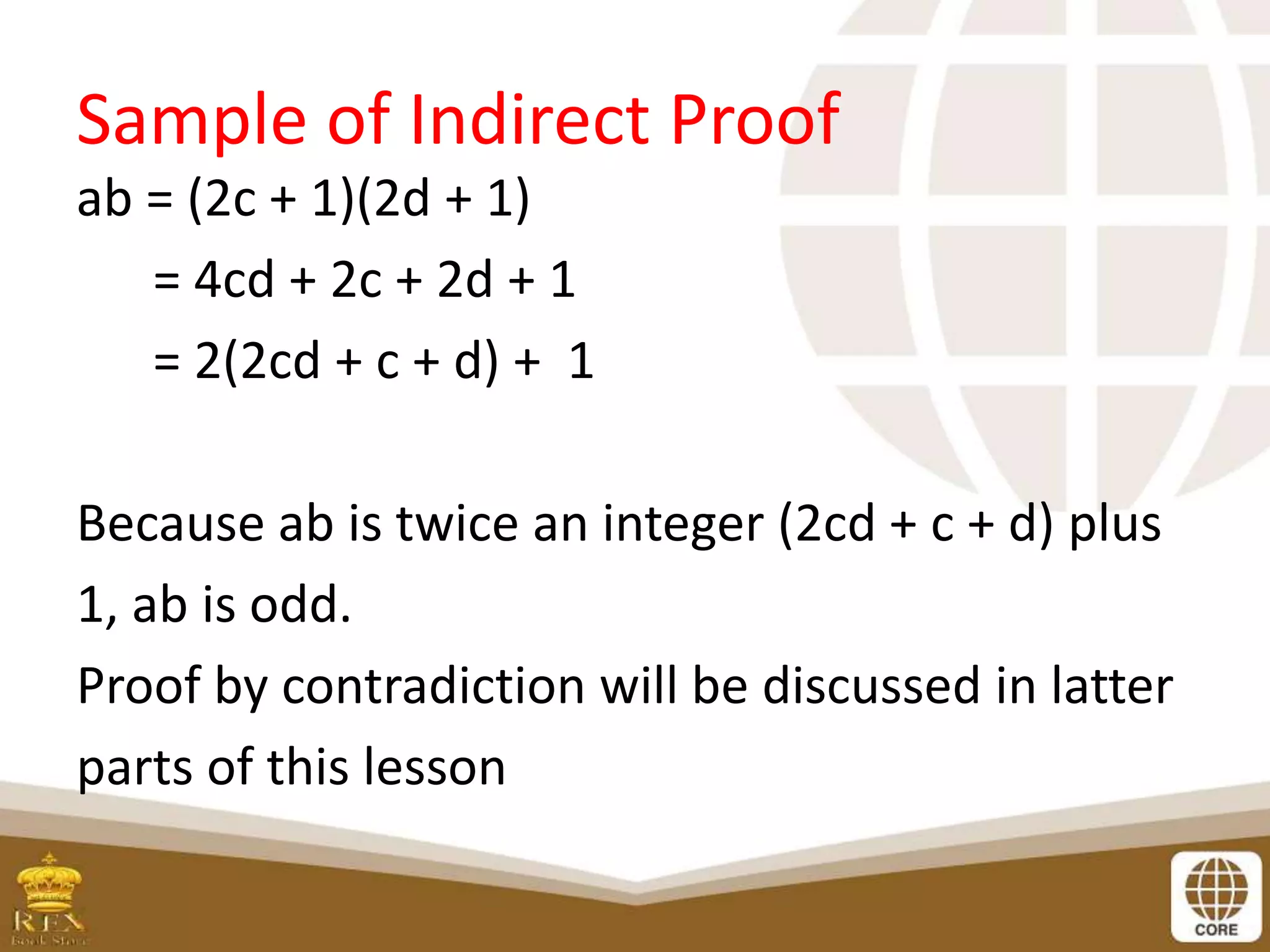
Sample of Indirect Proof
ab = (2c + 1)(2d + 1)
= 4cd + 2c + 2d + 1
= 2(2cd + c + d) + 1
Because ab is twice an integer (2cd + c + d) plus
1, ab is odd.
Proof by contradiction will be discussed in latter
parts of this lesson
Exercise A
A B
1. P ∨ T ≡ T a. Commutative Law
2. P ∨ P ≡ P b. De Morgan's Law
3. P ∨ Q ≡ Q ∨ P c. Implication Law
4. ~P ∨ ~Q ≡ ~(P ∧ Q) d. Negation Law
5. (P Q) ≡ ~P ∨ Q e. Domination Law
6. ~P ∧ P ≡ F f. Identity Law
7. (P ∧ Q) ∨ F ≡ P ∧ Q g. Idempotent Law
Match Column A to Column B.
Exercise B
Complete the following and explain the logical
equivalences used.
1. a. A ~B
b. C D
c. B ∧ A /∴ ~C
2. a. (A ~B) ∧ (B C)
b. C A
c. ~D B /∴ D

13_Writing_Proofs.pptx

  • 1.
  • 2.
    Lesson Objectives At theend of the lesson, the students must be able to: • illustrate the different methods of proof and disproof; and • justify mathematical and real-life statements using the different methods of proof and disproof.
  • 3.
    Direct Proof Suppose youwant to prove that P Q. You need to assume P and then use the rules of inference axioms, definitions, and logical equivalences to prove Q.
  • 4.
    Sample of DirectProof Assume that a and b are odd integers. Then a and b can be written as a = 2c + 1 and b = 2d + 1 where c and d are also integers. Because a + b is twice another integer (c + d + 1), a + b is an even integer a + b = 2c + 1 + 2d + 1 Substitution = 2c + 2d + 2 Associative and Commutative Properties = 2(c + d + 1) Distributive Property
  • 5.
    Indirect Proof The twomethods of indirect proof are proof of the contrapositive and proof by contradiction. Proof of the contrapositive means that you have to prove the contrapositive of the given conditional propositions.
  • 6.
    Sample of IndirectProof Proof: Prove the contrapositive of the statement:If a and b are both odd integers, then ab is odd. Proof: Suppose a and b are odd integers, then a = 2c + 1 and b = 2d + 1, where c and d are integers and
  • 7.
    Sample of IndirectProof ab = (2c + 1)(2d + 1) = 4cd + 2c + 2d + 1 = 2(2cd + c + d) + 1 Because ab is twice an integer (2cd + c + d) plus 1, ab is odd. Proof by contradiction will be discussed in latter parts of this lesson
  • 8.
    Exercise A A B 1.P ∨ T ≡ T a. Commutative Law 2. P ∨ P ≡ P b. De Morgan's Law 3. P ∨ Q ≡ Q ∨ P c. Implication Law 4. ~P ∨ ~Q ≡ ~(P ∧ Q) d. Negation Law 5. (P Q) ≡ ~P ∨ Q e. Domination Law 6. ~P ∧ P ≡ F f. Identity Law 7. (P ∧ Q) ∨ F ≡ P ∧ Q g. Idempotent Law Match Column A to Column B.
  • 9.
    Exercise B Complete thefollowing and explain the logical equivalences used. 1. a. A ~B b. C D c. B ∧ A /∴ ~C 2. a. (A ~B) ∧ (B C) b. C A c. ~D B /∴ D