Download as PDF, PPTX


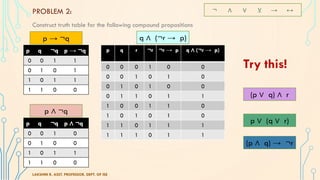
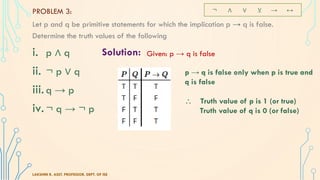
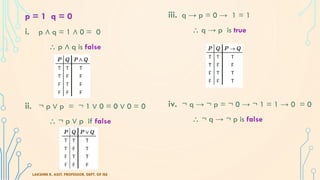
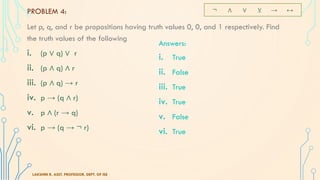
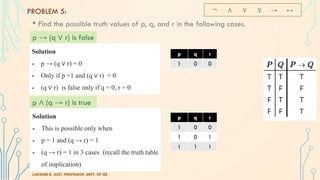
![• If a proposition q has truth value 1, determine all truth value assignments for the
primitive propositions p, q, r, and s for which the truth value of the following
proposition is 1
LAKSHMI R, ASST. PROFESSOR, DEPT. OF ISE
PROBLEM 6: ¬ ∧ ∨ ⊻ → ↔
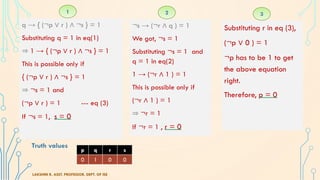
[ q → { (¬p ∨ r ) ∧ ¬s } ] ∧ {¬s → (¬r ∧ q ) }
[ q → { (¬p ∨ r ) ∧ ¬s } ] ∧ {¬s → (¬r ∧ q ) }
1 1
q → { (¬p ∨ r ) ∧ ¬s } = 1
---- eq(1)
¬s → (¬r ∧ q ) = 1 ---- eq(2)
Given, q = 1. Substitute this.](https://image.slidesharecdn.com/fundamentalsoflogic-1-200917083003/85/Fundamentals-of-logic-1-15-320.jpg)
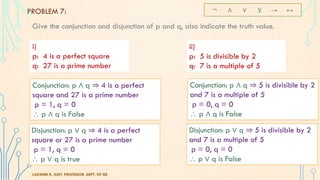
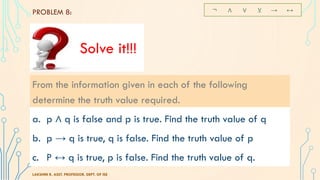
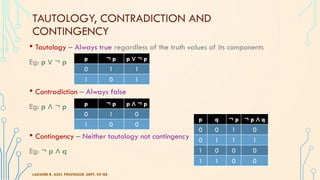
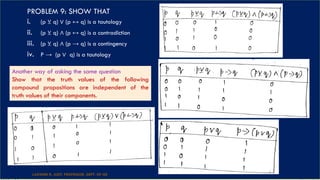

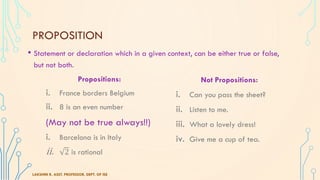
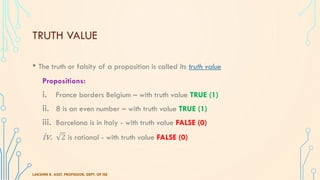
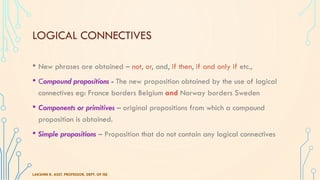
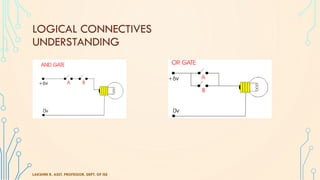
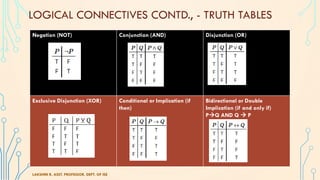
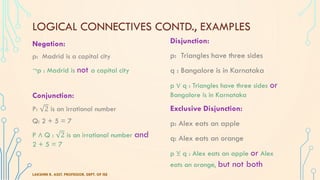
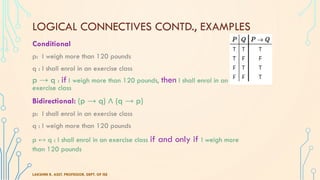
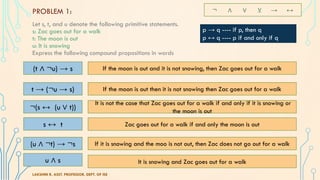
The document discusses fundamentals of logic including propositions, truth values, logical connectives, and examples. It defines a proposition as a statement that can be either true or false, but not both. Truth values are defined as the truth or falsity of a proposition. Logical connectives like negation, conjunction, disjunction are introduced to form compound propositions from simple propositions. Several examples are given to illustrate logical connectives and truth tables are used to determine truth values of compound propositions. Problems involving determining truth values and identifying tautologies, contradictions and contingencies are also presented.


