BMLT 117 CELL STRUCTURE
GROUP ASSIGNMENT-GROUP 2
PRESENTATION ON PROKARYOTES AND
EUKARYOTES.
PROKARYOTES
Prokaryotes are organisms whose cells lack a true
nucleus and membrane bound organelles.
Prokaryotes are classified into two distinct groups;
1.the bacteria(Escherichia coli, Cyanobacteria and
Streptococcus)
2.the archaeans( Thermosphaera aggregans,
Ignisphaera aggregans and Metallosphaera sedula
).
CELL STRUCTURE OF PROKARYOTES
Prokaryotes are extremely small organisms and have a relatively
simple structure. They are surrounded by plasma membrane, but have
no internal bound organelles within their cytoplasm.
The absence of a nucleus and other membrane-bound organelles
differentiates prokaryotes from the other class of organisms called
Eukaryotes
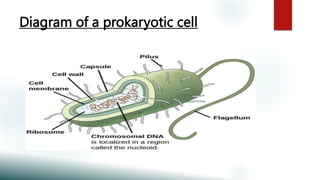
Most prokaryotes carry a small amount of genetic material in the form
of a single molecule or chromosome of circular DNA. The DNA in
prokaryotes is contained in a central area of the cell called the
nucleoid, which is surrounded by a nuclear membrane.
CHARACTERISTICS OF PROKARYOTES
 Prokaryotes are exclusively unicellular organisms.
 Prokaryotes do not have nucleus, instead their DNA
occupies an irregular-shaped area(nucleoid)
 Prokaryotes do not have membrane-bound
organelles.
 Most prokaryotes are extremophiles
Diagram of a prokaryotic cell
MODE OF REPRODUCTION IN PROKARYOTES
Prokaryotes reproduce either sexually or asexually in a
bacteria cell, sexual reproduction occurs via three
different methods; conjugation, transformation and
transduction.
Asexual reproduction in prokaryotes is only through
binary fission. Binary fission is the process by which a
bacteria cell split into two identical daughter cell.
ECONOMIC IMPORTANCE OF
PROKARYOTES
Prokaryotes are economically
important as these micro organisms
are used by humans for many
purposes. The beneficial uses of
prokaryotes include the production
of traditional foods such as yoghurt,
cheese and vinegar.
EUKARYOTES
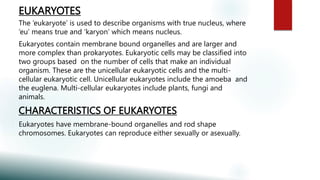
The ‘eukaryote’ is used to describe organisms with true nucleus, where
‘eu’ means true and ‘karyon’ which means nucleus.
Eukaryotes contain membrane bound organelles and are larger and
more complex than prokaryotes. Eukaryotic cells may be classified into
two groups based on the number of cells that make an individual
organism. These are the unicellular eukaryotic cells and the multi-
cellular eukaryotic cell. Unicellular eukaryotes include the amoeba and
the euglena. Multi-cellular eukaryotes include plants, fungi and
animals.
CHARACTERISTICS OF EUKARYOTES
Eukaryotes have membrane-bound organelles and rod shape
chromosomes. Eukaryotes can reproduce either sexually or asexually.
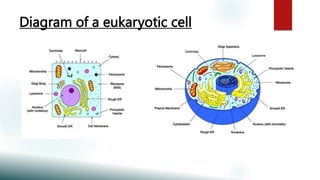
Diagram of a eukaryotic cell
MODE OF REPRODUCTION IN EUKARYOTES.
 Eukaryotes can reproduce both asexually, through
mitosis and sexually, through meiosis and gamete
fusion.
Similarities between the prokaryotes and the
eukaryotes
 They both have a cytoplasm.
 They both contain ribosomes
 They both have cell membrane.
 They both contain DNA as the nuclear material.
DIFFEEMCES BETWEEN PROKARYOTES AND
EUKARYOTES.
 There is the absence of nuclear membrane in
the prokaryotes but eukaryotes have a nuclear
membrane.
 Prokaryotes have no membrane bound
organelles but there’s the presence of
membrane bound organelles in the
eukaryotes.
 Genetic material in the prokaryotes are made
up of a single circular DNA whiles in the
eukaryotes, genetic material is organised into
many chromosomes.
 Prokaryotes have a small ribosome and
eukaryotes have a large ribosome.
 Prokaryotes are simple small in size but
eukaryotes are complex and larger.

Prokaryotic and eukaryotic cell.pptx

  • 1.
    BMLT 117 CELLSTRUCTURE GROUP ASSIGNMENT-GROUP 2 PRESENTATION ON PROKARYOTES AND EUKARYOTES.
  • 2.
    PROKARYOTES Prokaryotes are organismswhose cells lack a true nucleus and membrane bound organelles. Prokaryotes are classified into two distinct groups; 1.the bacteria(Escherichia coli, Cyanobacteria and Streptococcus) 2.the archaeans( Thermosphaera aggregans, Ignisphaera aggregans and Metallosphaera sedula ).
  • 3.
    CELL STRUCTURE OFPROKARYOTES Prokaryotes are extremely small organisms and have a relatively simple structure. They are surrounded by plasma membrane, but have no internal bound organelles within their cytoplasm. The absence of a nucleus and other membrane-bound organelles differentiates prokaryotes from the other class of organisms called Eukaryotes Most prokaryotes carry a small amount of genetic material in the form of a single molecule or chromosome of circular DNA. The DNA in prokaryotes is contained in a central area of the cell called the nucleoid, which is surrounded by a nuclear membrane.
  • 4.
    CHARACTERISTICS OF PROKARYOTES Prokaryotes are exclusively unicellular organisms.  Prokaryotes do not have nucleus, instead their DNA occupies an irregular-shaped area(nucleoid)  Prokaryotes do not have membrane-bound organelles.  Most prokaryotes are extremophiles
  • 5.
    Diagram of aprokaryotic cell
  • 6.
    MODE OF REPRODUCTIONIN PROKARYOTES Prokaryotes reproduce either sexually or asexually in a bacteria cell, sexual reproduction occurs via three different methods; conjugation, transformation and transduction. Asexual reproduction in prokaryotes is only through binary fission. Binary fission is the process by which a bacteria cell split into two identical daughter cell.
  • 7.
    ECONOMIC IMPORTANCE OF PROKARYOTES Prokaryotesare economically important as these micro organisms are used by humans for many purposes. The beneficial uses of prokaryotes include the production of traditional foods such as yoghurt, cheese and vinegar.
  • 8.
    EUKARYOTES The ‘eukaryote’ isused to describe organisms with true nucleus, where ‘eu’ means true and ‘karyon’ which means nucleus. Eukaryotes contain membrane bound organelles and are larger and more complex than prokaryotes. Eukaryotic cells may be classified into two groups based on the number of cells that make an individual organism. These are the unicellular eukaryotic cells and the multi- cellular eukaryotic cell. Unicellular eukaryotes include the amoeba and the euglena. Multi-cellular eukaryotes include plants, fungi and animals. CHARACTERISTICS OF EUKARYOTES Eukaryotes have membrane-bound organelles and rod shape chromosomes. Eukaryotes can reproduce either sexually or asexually.
  • 9.
    Diagram of aeukaryotic cell
  • 10.
    MODE OF REPRODUCTIONIN EUKARYOTES.  Eukaryotes can reproduce both asexually, through mitosis and sexually, through meiosis and gamete fusion.
  • 11.
    Similarities between theprokaryotes and the eukaryotes  They both have a cytoplasm.  They both contain ribosomes  They both have cell membrane.  They both contain DNA as the nuclear material. DIFFEEMCES BETWEEN PROKARYOTES AND EUKARYOTES.  There is the absence of nuclear membrane in the prokaryotes but eukaryotes have a nuclear membrane.
  • 12.
     Prokaryotes haveno membrane bound organelles but there’s the presence of membrane bound organelles in the eukaryotes.  Genetic material in the prokaryotes are made up of a single circular DNA whiles in the eukaryotes, genetic material is organised into many chromosomes.  Prokaryotes have a small ribosome and eukaryotes have a large ribosome.  Prokaryotes are simple small in size but eukaryotes are complex and larger.