SCIENCE 7
Second QUARTER- lc 3
Matatag curriculum
PROKARYOTIC VS.
EUKARYOTIC CELLS
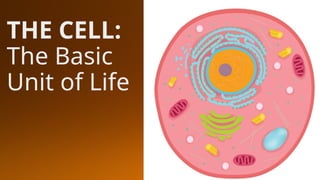
THE CELL:
The Basic
Unit of Life
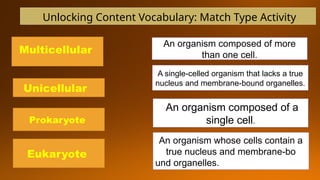
Unlocking Content Vocabulary: Match Type Activity
Unicellular
Prokaryote
Eukaryote
An organism composed of a
single cell.
A single-celled organism that lacks a true
nucleus and membrane-bound organelles.
An organism whose cells contain a
true nucleus and membrane-bo
und organelles.
Multicellular
An organism composed of more
than one cell.
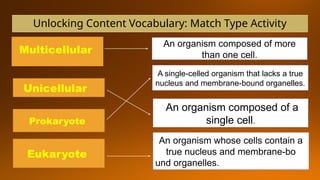
Unlocking Content Vocabulary: Match Type Activity
Unicellular
Prokaryote
Eukaryote
An organism composed of a
single cell.
A single-celled organism that lacks a true
nucleus and membrane-bound organelles.
An organism whose cells contain a
true nucleus and membrane-bo
und organelles.
Multicellular
An organism composed of more
than one cell.
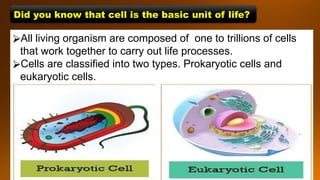
⮚All living organism are composed of one to trillions of cells
that work together to carry out life processes.
⮚Cells are classified into two types. Prokaryotic cells and
eukaryotic cells.
Did you know that cell is the basic unit of life?
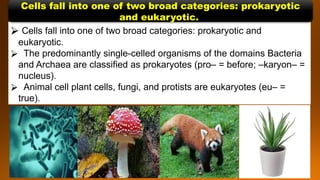
⮚ Cells fall into one of two broad categories: prokaryotic and
eukaryotic.
⮚ The predominantly single-celled organisms of the domains Bacteria
and Archaea are classified as prokaryotes (pro– = before; –karyon– =
nucleus).
⮚ Animal cell plant cells, fungi, and protists are eukaryotes (eu– =
true).
Cells fall into one of two broad categories: prokaryotic
and eukaryotic.
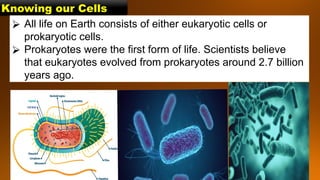
Knowing our Cells
⮚ All life on Earth consists of either eukaryotic cells or
prokaryotic cells.
⮚ Prokaryotes were the first form of life. Scientists believe
that eukaryotes evolved from prokaryotes around 2.7 billion
years ago.
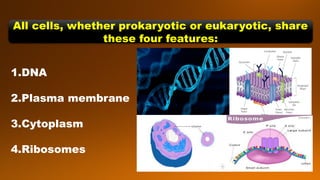
All cells, whether prokaryotic or eukaryotic, share
these four features:
1.DNA
2.Plasma membrane
3.Cytoplasm
4.Ribosomes
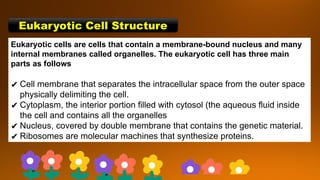
Eukaryotic Cell Structure
Eukaryotic cells are cells that contain a membrane-bound nucleus and many
internal membranes called organelles. The eukaryotic cell has three main
parts as follows
✔ Cell membrane that separates the intracellular space from the outer space
physically delimiting the cell.
✔ Cytoplasm, the interior portion filled with cytosol (the aqueous fluid inside
the cell and contains all the organelles
✔ Nucleus, covered by double membrane that contains the genetic material.
✔ Ribosomes are molecular machines that synthesize proteins.
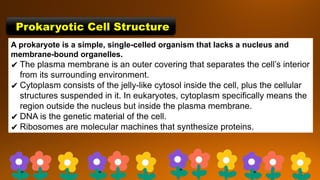
Prokaryotic Cell Structure
A prokaryote is a simple, single-celled organism that lacks a nucleus and
membrane-bound organelles.
✔ The plasma membrane is an outer covering that separates the cell’s interior
from its surrounding environment.
✔ Cytoplasm consists of the jelly-like cytosol inside the cell, plus the cellular
structures suspended in it. In eukaryotes, cytoplasm specifically means the
region outside the nucleus but inside the plasma membrane.
✔ DNA is the genetic material of the cell.
✔ Ribosomes are molecular machines that synthesize proteins.
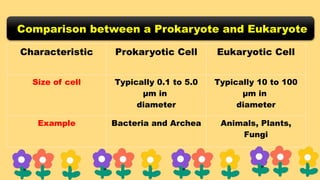
Comparison between a Prokaryote and Eukaryote
Characteristic Prokaryotic Cell Eukaryotic Cell
Size of cell Typically 0.1 to 5.0
μm in
diameter
Typically 10 to 100
μm in
diameter
Example Bacteria and Archea Animals, Plants,
Fungi
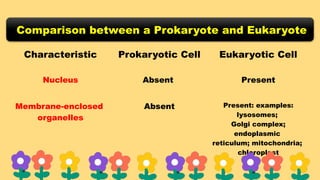
Comparison between a Prokaryote and Eukaryote
Characteristic Prokaryotic Cell Eukaryotic Cell
Nucleus Absent Present
Membrane-enclosed
organelles
Absent Present: examples:
lysosomes;
Golgi complex;
endoplasmic
reticulum; mitochondria;
chloroplast
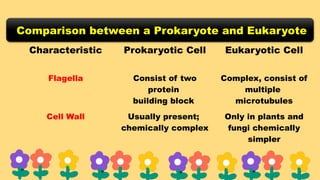
Comparison between a Prokaryote and Eukaryote
Characteristic Prokaryotic Cell Eukaryotic Cell
Flagella Consist of two
protein
building block
Complex, consist of
multiple
microtubules
Cell Wall Usually present;
chemically complex
Only in plants and
fungi chemically
simpler
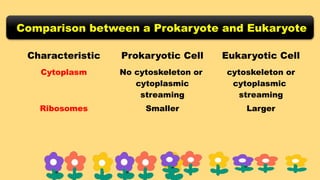
Comparison between a Prokaryote and Eukaryote
Characteristic Prokaryotic Cell Eukaryotic Cell
Cytoplasm No cytoskeleton or
cytoplasmic
streaming
cytoskeleton or
cytoplasmic
streaming
Ribosomes Smaller Larger
Comparison between a Prokaryote and Eukaryote
Characteristic Prokaryotic Cell Eukaryotic Cell
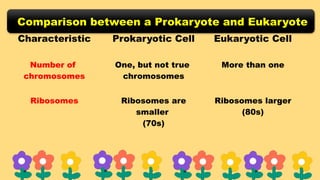
Number of
chromosomes
One, but not true
chromosomes
More than one
Ribosomes Ribosomes are
smaller
(70s)
Ribosomes larger
(80s)
EXAMPLES OF
UNICELLULAR
ORGANISMS
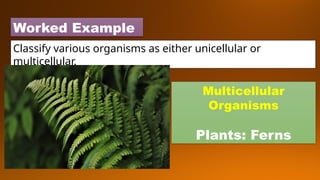
Worked Example
Classify various organisms as either unicellular or
multicellular.
Multicellular
Organisms
Plants: Ferns
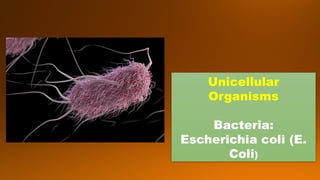
Unicellular
Organisms
Bacteria:
Escherichia coli (E.
Coli)
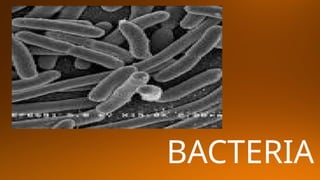
BACTERIA
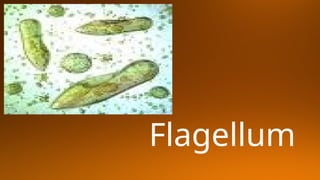
Flagellum
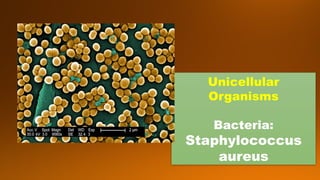
Unicellular
Organisms
Bacteria:
Staphylococcus
aureus
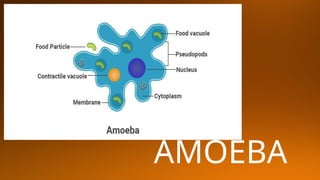
AMOEBA
Unicellular
Organisms
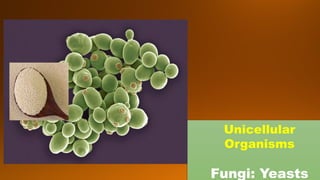
Fungi: Yeasts
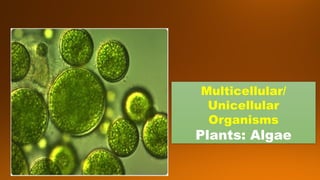
Multicellular/
Unicellular
Organisms
Plants: Algae
Learners’ Takeaways
KWL Chart: Using the
graphic organizer, the
students will answer the L
column or what they have
learned about the given
term.
Reflection on Learning
Reflection - Remember: Using the graphic organizer,
reflect on your learning by creating
Reflection – Remembering by answering the
questions.
E. EVALUATING LEARNING
1. Which of the following is an example of a
unicellular organism?
a) Amoeba
b) Oak Tree
c) Frog
d) Mushroom
E. EVALUATING LEARNING
2. Which of these organisms has no true
nucleus?
a) Bacteria
b) Archaea
c) Protists
d) All of the above
E. EVALUATING LEARNING
3. Which characteristic best distinguishes a
multicellular organism from a unicellular
organism?
A.The presence of organelles
B.The ability to reproduce
C.The number of cells
D.The complexity of the cell structure
E. EVALUATING LEARNING
4. Which of the following is a key difference between
unicellular and multicellular organisms?
a) Unicellular organisms have specialized cells, while
multicellular organisms do not.
b) Unicellular organisms have a more complex internal
structure than multicellular organisms.
c) Unicellular organisms can perform all essential life
functions within a single cell, while multicellular
organisms cannot.
d) Unicellular organisms are more diverse and adaptable
than multicellular organisms.
E. EVALUATING LEARNING
5. Which of these organisms would be
classified as a multicellular eukaryote?
a) Escherichia coli (E. coli)
b) Paramecium
c) Maple tree
d) Halobacterium
E. EVALUATING LEARNING
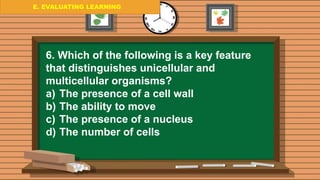
6. Which of the following is a key feature
that distinguishes unicellular and
multicellular organisms?
a) The presence of a cell wall
b) The ability to move
c) The presence of a nucleus
d) The number of cells
E. EVALUATING LEARNING
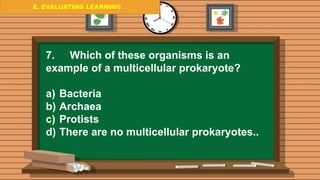
7. Which of these organisms is an
example of a multicellular prokaryote?
a) Bacteria
b) Archaea
c) Protists
d) There are no multicellular prokaryotes..
E. EVALUATING LEARNING
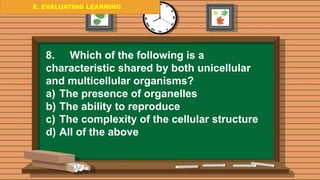
8. Which of the following is a
characteristic shared by both unicellular
and multicellular organisms?
a) The presence of organelles
b) The ability to reproduce
c) The complexity of the cellular structure
d) All of the above
E. EVALUATING LEARNING
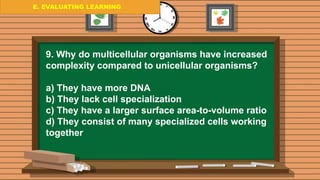
9. Why do multicellular organisms have increased
complexity compared to unicellular organisms?
a) They have more DNA
b) They lack cell specialization
c) They have a larger surface area-to-volume ratio
d) They consist of many specialized cells working
together
E. EVALUATING LEARNING
10. What is the primary advantage of unicellular
organisms?
a) Ability to perform specialized functions
b) Adaptability to different environments
c) Larger size
d) Ability to reproduce asexually
E. EVALUATING LEARNING
Answer Key:
1. a
2. d
3. c
4. c
5. c
6. d
7. d
8. d
9. d
10. d
Prokaryotic and Eukaryotic Cells.pptx...

  • 1.
    SCIENCE 7 Second QUARTER-lc 3 Matatag curriculum PROKARYOTIC VS. EUKARYOTIC CELLS
  • 2.
  • 3.
    Unlocking Content Vocabulary:Match Type Activity Unicellular Prokaryote Eukaryote An organism composed of a single cell. A single-celled organism that lacks a true nucleus and membrane-bound organelles. An organism whose cells contain a true nucleus and membrane-bo und organelles. Multicellular An organism composed of more than one cell.
  • 4.
    Unlocking Content Vocabulary:Match Type Activity Unicellular Prokaryote Eukaryote An organism composed of a single cell. A single-celled organism that lacks a true nucleus and membrane-bound organelles. An organism whose cells contain a true nucleus and membrane-bo und organelles. Multicellular An organism composed of more than one cell.
  • 5.
    ⮚All living organismare composed of one to trillions of cells that work together to carry out life processes. ⮚Cells are classified into two types. Prokaryotic cells and eukaryotic cells. Did you know that cell is the basic unit of life?
  • 6.
    ⮚ Cells fallinto one of two broad categories: prokaryotic and eukaryotic. ⮚ The predominantly single-celled organisms of the domains Bacteria and Archaea are classified as prokaryotes (pro– = before; –karyon– = nucleus). ⮚ Animal cell plant cells, fungi, and protists are eukaryotes (eu– = true). Cells fall into one of two broad categories: prokaryotic and eukaryotic.
  • 7.
    Knowing our Cells ⮚All life on Earth consists of either eukaryotic cells or prokaryotic cells. ⮚ Prokaryotes were the first form of life. Scientists believe that eukaryotes evolved from prokaryotes around 2.7 billion years ago.
  • 8.
    All cells, whetherprokaryotic or eukaryotic, share these four features: 1.DNA 2.Plasma membrane 3.Cytoplasm 4.Ribosomes
  • 9.
    Eukaryotic Cell Structure Eukaryoticcells are cells that contain a membrane-bound nucleus and many internal membranes called organelles. The eukaryotic cell has three main parts as follows ✔ Cell membrane that separates the intracellular space from the outer space physically delimiting the cell. ✔ Cytoplasm, the interior portion filled with cytosol (the aqueous fluid inside the cell and contains all the organelles ✔ Nucleus, covered by double membrane that contains the genetic material. ✔ Ribosomes are molecular machines that synthesize proteins.
  • 10.
    Prokaryotic Cell Structure Aprokaryote is a simple, single-celled organism that lacks a nucleus and membrane-bound organelles. ✔ The plasma membrane is an outer covering that separates the cell’s interior from its surrounding environment. ✔ Cytoplasm consists of the jelly-like cytosol inside the cell, plus the cellular structures suspended in it. In eukaryotes, cytoplasm specifically means the region outside the nucleus but inside the plasma membrane. ✔ DNA is the genetic material of the cell. ✔ Ribosomes are molecular machines that synthesize proteins.
  • 11.
    Comparison between aProkaryote and Eukaryote Characteristic Prokaryotic Cell Eukaryotic Cell Size of cell Typically 0.1 to 5.0 μm in diameter Typically 10 to 100 μm in diameter Example Bacteria and Archea Animals, Plants, Fungi
  • 12.
    Comparison between aProkaryote and Eukaryote Characteristic Prokaryotic Cell Eukaryotic Cell Nucleus Absent Present Membrane-enclosed organelles Absent Present: examples: lysosomes; Golgi complex; endoplasmic reticulum; mitochondria; chloroplast
  • 13.
    Comparison between aProkaryote and Eukaryote Characteristic Prokaryotic Cell Eukaryotic Cell Flagella Consist of two protein building block Complex, consist of multiple microtubules Cell Wall Usually present; chemically complex Only in plants and fungi chemically simpler
  • 14.
    Comparison between aProkaryote and Eukaryote Characteristic Prokaryotic Cell Eukaryotic Cell Cytoplasm No cytoskeleton or cytoplasmic streaming cytoskeleton or cytoplasmic streaming Ribosomes Smaller Larger
  • 15.
    Comparison between aProkaryote and Eukaryote Characteristic Prokaryotic Cell Eukaryotic Cell Number of chromosomes One, but not true chromosomes More than one Ribosomes Ribosomes are smaller (70s) Ribosomes larger (80s)
  • 16.
  • 17.
    Worked Example Classify variousorganisms as either unicellular or multicellular. Multicellular Organisms Plants: Ferns
  • 18.
  • 19.
  • 20.
  • 21.
  • 22.
  • 23.
  • 24.
  • 25.
    Learners’ Takeaways KWL Chart:Using the graphic organizer, the students will answer the L column or what they have learned about the given term.
  • 26.
    Reflection on Learning Reflection- Remember: Using the graphic organizer, reflect on your learning by creating Reflection – Remembering by answering the questions.
  • 28.
    E. EVALUATING LEARNING E.EVALUATING LEARNING 1. Which of the following is an example of a unicellular organism? a) Amoeba b) Oak Tree c) Frog d) Mushroom
  • 29.
    E. EVALUATING LEARNING E.EVALUATING LEARNING E. EVALUATING LEARNING 2. Which of these organisms has no true nucleus? a) Bacteria b) Archaea c) Protists d) All of the above
  • 30.
    E. EVALUATING LEARNING E.EVALUATING LEARNING E. EVALUATING LEARNING 3. Which characteristic best distinguishes a multicellular organism from a unicellular organism? A.The presence of organelles B.The ability to reproduce C.The number of cells D.The complexity of the cell structure
  • 31.
    E. EVALUATING LEARNING E.EVALUATING LEARNING E. EVALUATING LEARNING 4. Which of the following is a key difference between unicellular and multicellular organisms? a) Unicellular organisms have specialized cells, while multicellular organisms do not. b) Unicellular organisms have a more complex internal structure than multicellular organisms. c) Unicellular organisms can perform all essential life functions within a single cell, while multicellular organisms cannot. d) Unicellular organisms are more diverse and adaptable than multicellular organisms.
  • 32.
    E. EVALUATING LEARNING E.EVALUATING LEARNING E. EVALUATING LEARNING 5. Which of these organisms would be classified as a multicellular eukaryote? a) Escherichia coli (E. coli) b) Paramecium c) Maple tree d) Halobacterium
  • 33.
    E. EVALUATING LEARNING E.EVALUATING LEARNING E. EVALUATING LEARNING 6. Which of the following is a key feature that distinguishes unicellular and multicellular organisms? a) The presence of a cell wall b) The ability to move c) The presence of a nucleus d) The number of cells
  • 34.
    E. EVALUATING LEARNING E.EVALUATING LEARNING E. EVALUATING LEARNING 7. Which of these organisms is an example of a multicellular prokaryote? a) Bacteria b) Archaea c) Protists d) There are no multicellular prokaryotes..
  • 35.
    E. EVALUATING LEARNING E.EVALUATING LEARNING E. EVALUATING LEARNING 8. Which of the following is a characteristic shared by both unicellular and multicellular organisms? a) The presence of organelles b) The ability to reproduce c) The complexity of the cellular structure d) All of the above
  • 36.
    E. EVALUATING LEARNING E.EVALUATING LEARNING E. EVALUATING LEARNING 9. Why do multicellular organisms have increased complexity compared to unicellular organisms? a) They have more DNA b) They lack cell specialization c) They have a larger surface area-to-volume ratio d) They consist of many specialized cells working together
  • 37.
    E. EVALUATING LEARNING E.EVALUATING LEARNING E. EVALUATING LEARNING 10. What is the primary advantage of unicellular organisms? a) Ability to perform specialized functions b) Adaptability to different environments c) Larger size d) Ability to reproduce asexually
  • 39.
    E. EVALUATING LEARNING E.EVALUATING LEARNING E. EVALUATING LEARNING Answer Key: 1. a 2. d 3. c 4. c 5. c 6. d 7. d 8. d 9. d 10. d