1
Last Week Review-ProjectT&D
Orienting Employees
Training & Development Process
Make Learning Meaningful & Motivate Learners
Need Analysis, Instruction Design, Validation,
Implement, Evaluate
Various Training Methods
PROJECTTEAM WORK
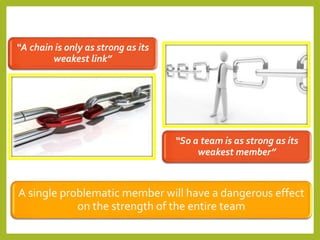
“A chain is only as strong as its
weakest link”
“So a team is as strong as its
weakest member”
A single problematic member will have a dangerous effect
on the strength of the entire team
Salient topics
Project Team and Teamwork
Stages of Team Development
Issues in Teamwork
Remedies of Issues
Conclusion
Team andTeamwork
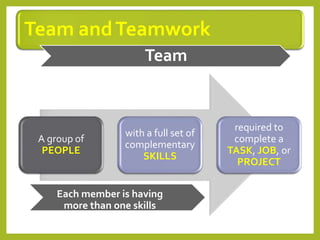
Team
A group of
PEOPLE
with a full set of
complementary
SKILLS
required to
complete a
TASK, JOB, or
PROJECT
Each member is having
more than one skills
Team andTeamwork
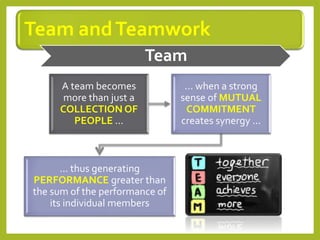
Team
A team becomes
more than just a
COLLECTION OF
PEOPLE ...
... when a strong
sense of MUTUAL
COMMITMENT
creates synergy ...
... thus generating
PERFORMANCE greater than
the sum of the performance of
its individual members
Team andTeamwork
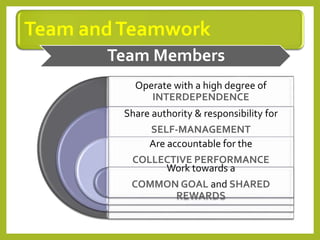
Team Members
Operate with a high degree of
INTERDEPENDENCE
Share authority & responsibility for
SELF-MANAGEMENT
Are accountable for the
COLLECTIVE PERFORMANCE
Work towards a
COMMON GOAL and SHARED
REWARDS
Team andTeamwork
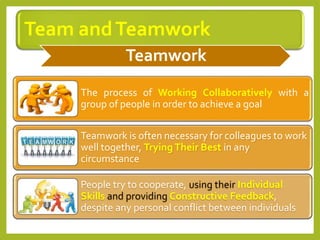
Teamwork
The process of Working Collaboratively with a
group of people in order to achieve a goal
Teamwork is often necessary for colleagues to work
well together, Trying Their Best in any
circumstance
People try to cooperate, using their Individual
Skills and providing Constructive Feedback,
despite any personal conflict between individuals
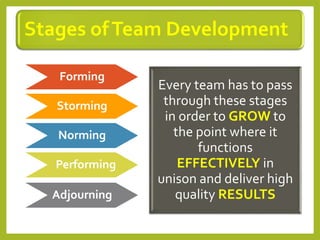
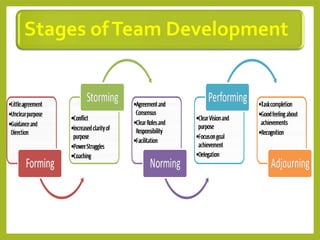
Stages ofTeam Development
Forming
Storming
Norming
Performing
Adjourning
Every team has to pass
through these stages
in order to GROW to
the point where it
functions
EFFECTIVELY in
unison and deliver high
quality RESULTS
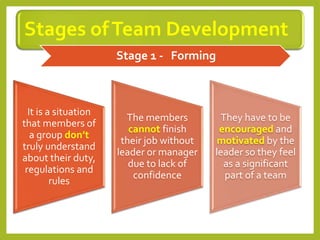
Stages ofTeam Development
It is a situation
that members of
a group don’t
truly understand
about their duty,
regulations and
rules
The members
cannot finish
their job without
leader or manager
due to lack of
confidence
They have to be
encouraged and
motivated by the
leader so they feel
as a significant
part of a team
Stage 1 - Forming
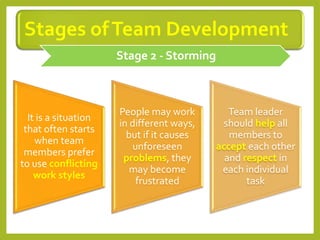
Stages ofTeam Development
It is a situation
that often starts
when team
members prefer
to use conflicting
work styles
People may work
in different ways,
but if it causes
unforeseen
problems, they
may become
frustrated
Team leader
should help all
members to
accept each other
and respect in
each individual
task
Stage 2 - Storming
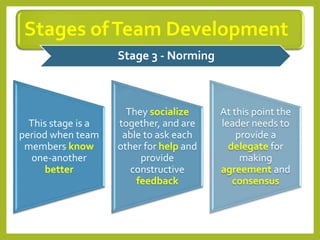
Stages ofTeam Development
This stage is a
period when team
members know
one-another
better
They socialize
together, and are
able to ask each
other for help and
provide
constructive
feedback
At this point the
leader needs to
provide a
delegate for
making
agreement and
consensus
Stage 3 - Norming
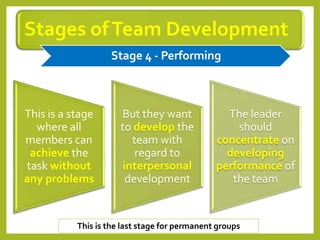
Stages ofTeam Development
This is a stage
where all
members can
achieve the
task without
any problems
But they want
to develop the
team with
regard to
interpersonal
development
The leader
should
concentrate on
developing
performance of
the team
Stage 4 - Performing
This is the last stage for permanent groups
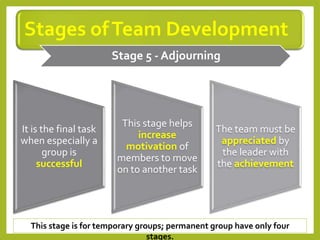
Stages ofTeam Development
It is the final task
when especially a
group is
successful
This stage helps
increase
motivation of
members to move
on to another task
The team must be
appreciated by
the leader with
the achievement
Stage 5 - Adjourning
This stage is for temporary groups; permanent group have only four
stages.
Stages ofTeam Development
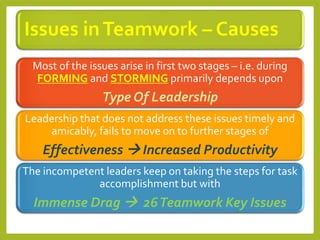
Issues inTeamwork – Causes
Most of the issues arise in first two stages – i.e. during
FORMING and STORMING primarily depends upon
Type Of Leadership
Leadership that does not address these issues timely and
amicably, fails to move on to further stages of
Effectiveness  Increased Productivity
The incompetent leaders keep on taking the steps for task
accomplishment but with
Immense Drag  26Teamwork Key Issues
ProjectTeam Issues
1. Absence of team identity
2. Difficulty in decision making
3. Poor mutual coordination and communication
4. Inability to resolve conflicts
5. Lack of participation and creativity
6. Lack of group thinking
7. Ineffective leadership style
8. Inability to prioritize and focus on tasks
9. Non-Understanding of equality, justice and liberty
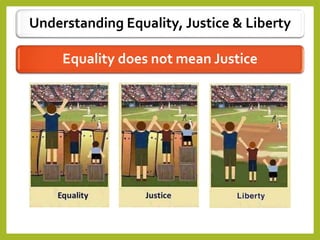
Understanding Equality, Justice & Liberty
Equality does not mean Justice
26Teamwork Key Issues
10. Failure to listen, comprehend and reply
11. Distance between offices and inaccessibility
12. Cultural differences and ethnocentricity
13. Dominating personalities, attitude and ego
14. Authority, seniority or hierarchy problems
15. Poor verbal and written expression
16. Gender biasness – both for males and females
17. In-adequate knowledge but argumentative nature
18. Exceeding deadlines
26Teamwork Key Issues
19. Self-centeredness and half-heartedness
20. Uncooperativeness and stubbornness
21. Mistrust
22. Risk and rewards, success and failures
23. Lack of professional skills
24. Slow progress and negative results
25. Lack of celebrations
26. Decline in motivation
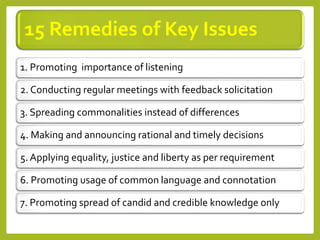
15 Remedies of Key Issues
1. Promoting importance of listening
2. Conducting regular meetings with feedback solicitation
3. Spreading commonalities instead of differences
4. Making and announcing rational and timely decisions
5. Applying equality, justice and liberty as per requirement
6. Promoting usage of common language and connotation
7. Promoting spread of candid and credible knowledge only
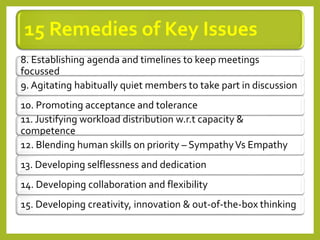
15 Remedies of Key Issues
8. Establishing agenda and timelines to keep meetings
focussed
9. Agitating habitually quiet members to take part in discussion
10. Promoting acceptance and tolerance
11. Justifying workload distribution w.r.t capacity &
competence
12. Blending human skills on priority – SympathyVs Empathy
13. Developing selflessness and dedication
14. Developing collaboration and flexibility
15. Developing creativity, innovation & out-of-the-box thinking
Various Roles in Project Team
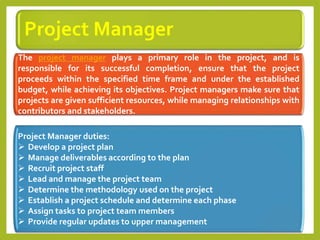
Project Manager
The project manager plays a primary role in the project, and is
responsible for its successful completion, ensure that the project
proceeds within the specified time frame and under the established
budget, while achieving its objectives. Project managers make sure that
projects are given sufficient resources, while managing relationships with
contributors and stakeholders.
Project Manager duties:
 Develop a project plan
 Manage deliverables according to the plan
 Recruit project staff
 Lead and manage the project team
 Determine the methodology used on the project
 Establish a project schedule and determine each phase
 Assign tasks to project team members
 Provide regular updates to upper management
ProjectTeam Member
Project team members are the individuals who actively work on
one or more phases of the project. They may be in-house staff
or external consultants, working on the project on a full-time or
part-time basis. Team member roles can vary according to each
project.
Project team member duties:
Contributing to overall project objectives
Completing individual deliverables
Providing expertise
Working with users to establish and meet business needs
Documenting the process
Project Sponsor
The project sponsor is the driver of the project. They are typically
members of senior management – those with a stake in the project’s
outcome. Project sponsors work closely with the project manager. They
legitimize the project’s objectives and participate in high-level project
planning. In addition, they often help resolve conflicts and remove
obstacles that occur throughout the project, and they sign off on
approvals needed to advance each phase.
Project sponsor duties:
Make key business decisions for the project
Approve the project budget
Ensure availability of resources
Communicate the project’s goals
Executive Sponsor
The executive sponsor is ideally a high-ranking member of
management. He or she is the visible POC of the project with
the management team and is the ultimate decision-maker,
with final approval on all phases, deliverables and scope
changes.
Executive sponsor duties typically include:
Carry ultimate responsibility for the project
Approve all changes to the project scope
Provide additional funds for scope changes
Approve project deliverables
Steering Committee Member
The steering committee comprises of management
representatives and other high-level stakeholders (people or
groups who have a stake, or an interest in the outcome of the
project) and oversees the entire project lifecycle, providing
guidance on the overall strategic direction. They serve as the
'leadership' support for the project, resolve issues escalated
by the Project Manager, and decide on all requests to change
key project elements, such as deliverables, schedule, and
budget (through the Change Control Board.)
Project Client
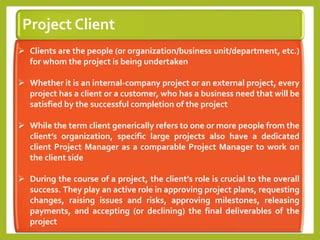
 Clients are the people (or organization/business unit/department, etc.)
for whom the project is being undertaken
 Whether it is an internal-company project or an external project, every
project has a client or a customer, who has a business need that will be
satisfied by the successful completion of the project
 While the term client generically refers to one or more people from the
client’s organization, specific large projects also have a dedicated
client Project Manager as a comparable Project Manager to work on
the client side
 During the course of a project, the client’s role is crucial to the overall
success. They play an active role in approving project plans, requesting
changes, raising issues and risks, approving milestones, releasing
payments, and accepting (or declining) the final deliverables of the
project
Thank You
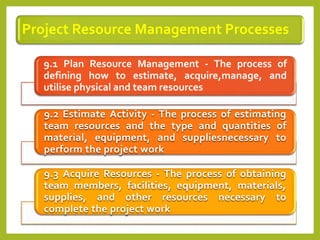
Project Resource Management Processes
9.1 Plan Resource Management - The process of
defining how to estimate, acquire,manage, and
utilise physical and team resources
9.2 Estimate Activity - The process of estimating
team resources and the type and quantities of
material, equipment, and suppliesnecessary to
perform the project work
9.3 Acquire Resources - The process of obtaining
team members, facilities, equipment, materials,
supplies, and other resources necessary to
complete the project work
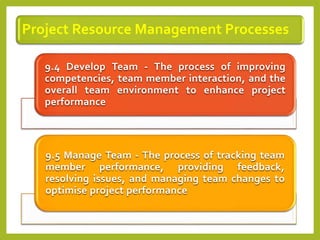
Project Resource Management Processes
9.4 Develop Team - The process of improving
competencies, team member interaction, and the
overall team environment to enhance project
performance
9.5 Manage Team - The process of tracking team
member performance, providing feedback,
resolving issues, and managing team changes to
optimise project performance
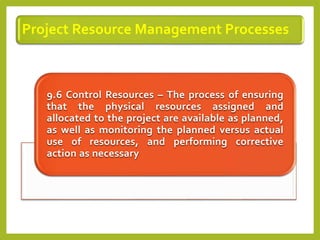
Project Resource Management Processes
9.6 Control Resources – The process of ensuring
that the physical resources assigned and
allocated to the project are available as planned,
as well as monitoring the planned versus actual
use of resources, and performing corrective
action as necessary

Project Teamwork

  • 1.
  • 2.
    Last Week Review-ProjectT&D OrientingEmployees Training & Development Process Make Learning Meaningful & Motivate Learners Need Analysis, Instruction Design, Validation, Implement, Evaluate Various Training Methods
  • 3.
  • 4.
    “A chain isonly as strong as its weakest link” “So a team is as strong as its weakest member” A single problematic member will have a dangerous effect on the strength of the entire team
  • 5.
    Salient topics Project Teamand Teamwork Stages of Team Development Issues in Teamwork Remedies of Issues Conclusion
  • 6.
    Team andTeamwork Team A groupof PEOPLE with a full set of complementary SKILLS required to complete a TASK, JOB, or PROJECT Each member is having more than one skills
  • 7.
    Team andTeamwork Team A teambecomes more than just a COLLECTION OF PEOPLE ... ... when a strong sense of MUTUAL COMMITMENT creates synergy ... ... thus generating PERFORMANCE greater than the sum of the performance of its individual members
  • 8.
    Team andTeamwork Team Members Operatewith a high degree of INTERDEPENDENCE Share authority & responsibility for SELF-MANAGEMENT Are accountable for the COLLECTIVE PERFORMANCE Work towards a COMMON GOAL and SHARED REWARDS
  • 9.
    Team andTeamwork Teamwork The processof Working Collaboratively with a group of people in order to achieve a goal Teamwork is often necessary for colleagues to work well together, Trying Their Best in any circumstance People try to cooperate, using their Individual Skills and providing Constructive Feedback, despite any personal conflict between individuals
  • 10.
    Stages ofTeam Development Forming Storming Norming Performing Adjourning Everyteam has to pass through these stages in order to GROW to the point where it functions EFFECTIVELY in unison and deliver high quality RESULTS
  • 11.
    Stages ofTeam Development Itis a situation that members of a group don’t truly understand about their duty, regulations and rules The members cannot finish their job without leader or manager due to lack of confidence They have to be encouraged and motivated by the leader so they feel as a significant part of a team Stage 1 - Forming
  • 12.
    Stages ofTeam Development Itis a situation that often starts when team members prefer to use conflicting work styles People may work in different ways, but if it causes unforeseen problems, they may become frustrated Team leader should help all members to accept each other and respect in each individual task Stage 2 - Storming
  • 13.
    Stages ofTeam Development Thisstage is a period when team members know one-another better They socialize together, and are able to ask each other for help and provide constructive feedback At this point the leader needs to provide a delegate for making agreement and consensus Stage 3 - Norming
  • 14.
    Stages ofTeam Development Thisis a stage where all members can achieve the task without any problems But they want to develop the team with regard to interpersonal development The leader should concentrate on developing performance of the team Stage 4 - Performing This is the last stage for permanent groups
  • 15.
    Stages ofTeam Development Itis the final task when especially a group is successful This stage helps increase motivation of members to move on to another task The team must be appreciated by the leader with the achievement Stage 5 - Adjourning This stage is for temporary groups; permanent group have only four stages.
  • 16.
  • 17.
    Issues inTeamwork –Causes Most of the issues arise in first two stages – i.e. during FORMING and STORMING primarily depends upon Type Of Leadership Leadership that does not address these issues timely and amicably, fails to move on to further stages of Effectiveness  Increased Productivity The incompetent leaders keep on taking the steps for task accomplishment but with Immense Drag  26Teamwork Key Issues
  • 18.
    ProjectTeam Issues 1. Absenceof team identity 2. Difficulty in decision making 3. Poor mutual coordination and communication 4. Inability to resolve conflicts 5. Lack of participation and creativity 6. Lack of group thinking 7. Ineffective leadership style 8. Inability to prioritize and focus on tasks 9. Non-Understanding of equality, justice and liberty
  • 19.
    Understanding Equality, Justice& Liberty Equality does not mean Justice
  • 20.
    26Teamwork Key Issues 10.Failure to listen, comprehend and reply 11. Distance between offices and inaccessibility 12. Cultural differences and ethnocentricity 13. Dominating personalities, attitude and ego 14. Authority, seniority or hierarchy problems 15. Poor verbal and written expression 16. Gender biasness – both for males and females 17. In-adequate knowledge but argumentative nature 18. Exceeding deadlines
  • 21.
    26Teamwork Key Issues 19.Self-centeredness and half-heartedness 20. Uncooperativeness and stubbornness 21. Mistrust 22. Risk and rewards, success and failures 23. Lack of professional skills 24. Slow progress and negative results 25. Lack of celebrations 26. Decline in motivation
  • 22.
    15 Remedies ofKey Issues 1. Promoting importance of listening 2. Conducting regular meetings with feedback solicitation 3. Spreading commonalities instead of differences 4. Making and announcing rational and timely decisions 5. Applying equality, justice and liberty as per requirement 6. Promoting usage of common language and connotation 7. Promoting spread of candid and credible knowledge only
  • 23.
    15 Remedies ofKey Issues 8. Establishing agenda and timelines to keep meetings focussed 9. Agitating habitually quiet members to take part in discussion 10. Promoting acceptance and tolerance 11. Justifying workload distribution w.r.t capacity & competence 12. Blending human skills on priority – SympathyVs Empathy 13. Developing selflessness and dedication 14. Developing collaboration and flexibility 15. Developing creativity, innovation & out-of-the-box thinking
  • 24.
    Various Roles inProject Team
  • 25.
    Project Manager The projectmanager plays a primary role in the project, and is responsible for its successful completion, ensure that the project proceeds within the specified time frame and under the established budget, while achieving its objectives. Project managers make sure that projects are given sufficient resources, while managing relationships with contributors and stakeholders. Project Manager duties:  Develop a project plan  Manage deliverables according to the plan  Recruit project staff  Lead and manage the project team  Determine the methodology used on the project  Establish a project schedule and determine each phase  Assign tasks to project team members  Provide regular updates to upper management
  • 26.
    ProjectTeam Member Project teammembers are the individuals who actively work on one or more phases of the project. They may be in-house staff or external consultants, working on the project on a full-time or part-time basis. Team member roles can vary according to each project. Project team member duties: Contributing to overall project objectives Completing individual deliverables Providing expertise Working with users to establish and meet business needs Documenting the process
  • 27.
    Project Sponsor The projectsponsor is the driver of the project. They are typically members of senior management – those with a stake in the project’s outcome. Project sponsors work closely with the project manager. They legitimize the project’s objectives and participate in high-level project planning. In addition, they often help resolve conflicts and remove obstacles that occur throughout the project, and they sign off on approvals needed to advance each phase. Project sponsor duties: Make key business decisions for the project Approve the project budget Ensure availability of resources Communicate the project’s goals
  • 28.
    Executive Sponsor The executivesponsor is ideally a high-ranking member of management. He or she is the visible POC of the project with the management team and is the ultimate decision-maker, with final approval on all phases, deliverables and scope changes. Executive sponsor duties typically include: Carry ultimate responsibility for the project Approve all changes to the project scope Provide additional funds for scope changes Approve project deliverables
  • 29.
    Steering Committee Member Thesteering committee comprises of management representatives and other high-level stakeholders (people or groups who have a stake, or an interest in the outcome of the project) and oversees the entire project lifecycle, providing guidance on the overall strategic direction. They serve as the 'leadership' support for the project, resolve issues escalated by the Project Manager, and decide on all requests to change key project elements, such as deliverables, schedule, and budget (through the Change Control Board.)
  • 30.
    Project Client  Clientsare the people (or organization/business unit/department, etc.) for whom the project is being undertaken  Whether it is an internal-company project or an external project, every project has a client or a customer, who has a business need that will be satisfied by the successful completion of the project  While the term client generically refers to one or more people from the client’s organization, specific large projects also have a dedicated client Project Manager as a comparable Project Manager to work on the client side  During the course of a project, the client’s role is crucial to the overall success. They play an active role in approving project plans, requesting changes, raising issues and risks, approving milestones, releasing payments, and accepting (or declining) the final deliverables of the project
  • 31.
  • 32.
    Project Resource ManagementProcesses 9.1 Plan Resource Management - The process of defining how to estimate, acquire,manage, and utilise physical and team resources 9.2 Estimate Activity - The process of estimating team resources and the type and quantities of material, equipment, and suppliesnecessary to perform the project work 9.3 Acquire Resources - The process of obtaining team members, facilities, equipment, materials, supplies, and other resources necessary to complete the project work
  • 33.
    Project Resource ManagementProcesses 9.4 Develop Team - The process of improving competencies, team member interaction, and the overall team environment to enhance project performance 9.5 Manage Team - The process of tracking team member performance, providing feedback, resolving issues, and managing team changes to optimise project performance
  • 34.
    Project Resource ManagementProcesses 9.6 Control Resources – The process of ensuring that the physical resources assigned and allocated to the project are available as planned, as well as monitoring the planned versus actual use of resources, and performing corrective action as necessary

Editor's Notes

  • #4 The incidence of both lower incomes due to economic crisis and persistent high food prices has proved to be a devastating combination for the world’s most vulnerable populations.