Project Sustainability
Australian Flexible learning
Framework – E-Learning innovation
TNQ TAFE
2009
Learning = Connecting,
collaborating and creating
Background to this Project
 AFLF – e-learning innovations Funding
opportunities are available each year
 advertised 7th
February 2009 Australian
newspaper and AFLF website
 Applications closed 5th
March 2009
 21 funded Qld e-learning innovation Projects
at a cost of $925,200
 TNQ Project Sustainability funded for
$20,000 and TNQ TAFE in kind $20,000.
Aims of the Project
Aims
 Reflect on personal and organisational e-learning
competency. What is possible now, what needs to
be learned and why?
 Refine resources, learning and assessment
strategies for a sustainability competency unit for an
e-learning context.
 Re- invigorate a professional learning approach for
TNQ project participants that aligns with
collaborative workplace action learning projects.
 Review the capacity of TNQ TAFE to provide timely
and varied support for e-learning competency
development for project participants.
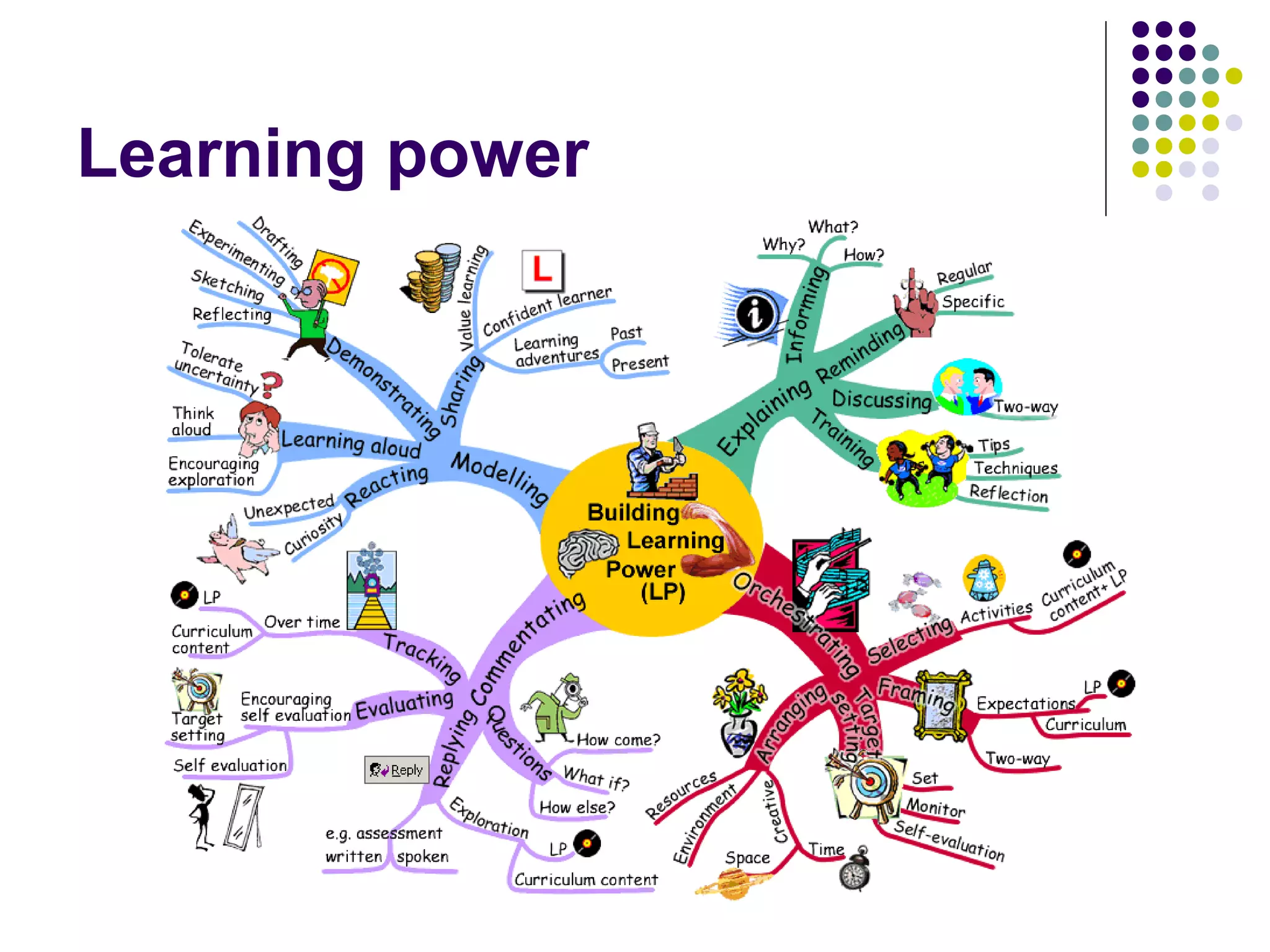
Learning power
Project Learning strategies
 Reflect and Research– professional development, e-learning,
sustainability delivery and current competence. Group
workshops, blogs, del.icio.us, online resources and project
website, announcements and individual learning plans
 Refine – learning design and assessment and resources and
learning plans. Project teams, technology support, mentors.
 Re-invigorate – sustainability resources and learning and
assessment design and identify issues in this PD learning model
against the RIPPLES model
 Review – what was achieved, enablers and barriers for this
Professional Development Model.
How do we get it right?
Professional development
Approach – Action learning
Methodologies for the TNQ Project
Sustainability PD process
 The 4 R’s aligned with varied learning
approaches
 Reflect and Research
 Refine
 Re-Invigorate
 Review
 Use RIPPLES model to inform the
development of an effective workplace
project based PD Model for TNQ TAFE
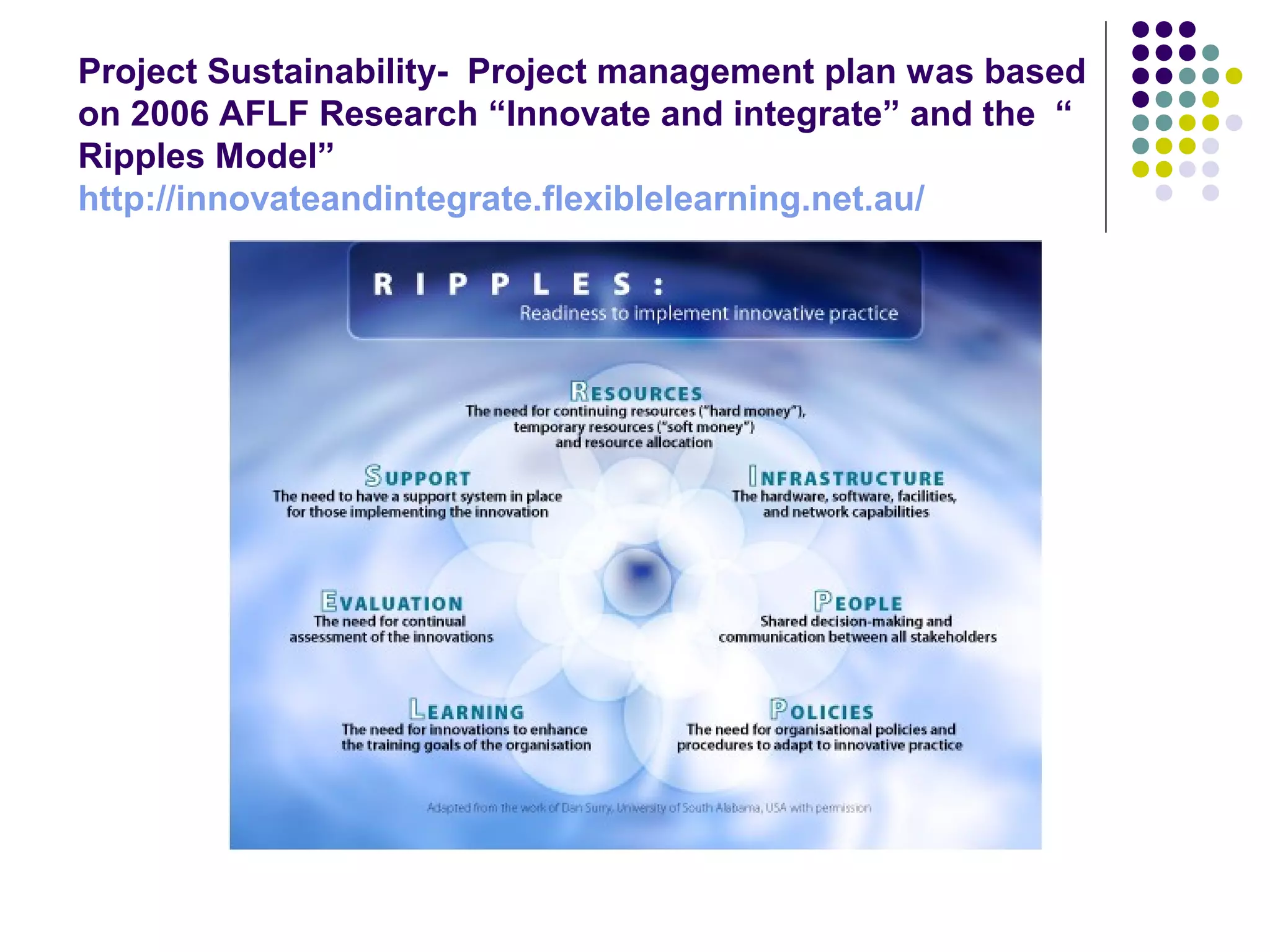
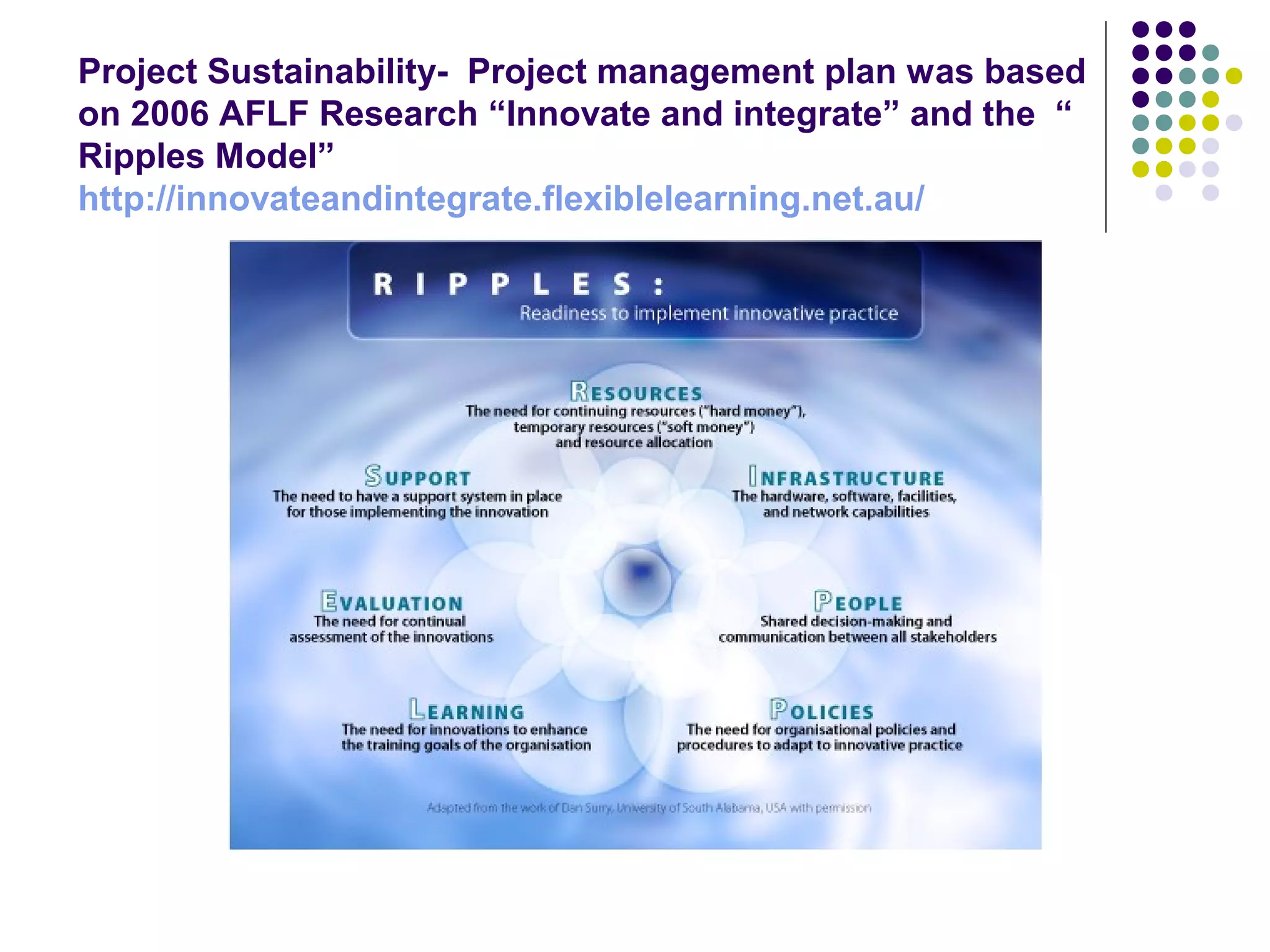
Project Sustainability- Project management plan was based
on 2006 AFLF Research “Innovate and integrate” and the “
Ripples Model”
http://innovateandintegrate.flexiblelearning.net.au/
Who is involved?
 Project developer, manager and
facilitator
 Colleen Hodgins
 Participants (TNQ)
 Jason VanBallegooyen – (sustainability co-
ordinator TNQ)
 Kim Forde - (sustainability)
 Angela Lauder - (Tourism, business and
sustainability teacher)
 Anita Plos – (Tourism, events management
teacher)
 Robin West – (management teacher)
 Shirley Lynn (ISPDU program designer)
 Paulette Threadingham (ISPDU project
officer)
 Project coach/support
 Tara Walsh (Diploma of e-learning student)
 Technical Support
 Gerry Green – Learning technologies Manager
 John Burns - Learning technologies Officer
 Stakeholders
 Jo Pyne – TNQ TAFE Institute director
 Danny Lovern TNQ TAFE Finance Manager
 Sue Jones – B.E.S.T Faculty Manager
 Sandie McCoy - B.E.S.T Education Manager
 Alicia Contreras - B.E.S.T Administration
Manager
 Arra Kirley - B.E.S.T Administration officer
 Alex Scull - B.E.S.T Administration officer
* BEST – Business, environment sustainability and
tourism faculty
Phase 1- Reflect
We reflected on…
 Individual learning plans for
the project – own skills and
knowledge
 Aims of the project
 Sustainability competency unit
resources and strategies –
what we have what we need
 On actions outcomes/timelines
and responsibilities
 Project risk factors
 New Technology use in
learning
 Using my.tafe
 RIPPLES model
 Learning philosophies
 Collaboration and project
success
 VGC Blended learning unit
qualification
 Communication and
connecting in work-based
projects
 Unpacking sustainability
Competency units and
assessment
Phase 2 - Refine
Refine
 What do we have?
 How do we refine?
 Who can help?
 What will it achieve?
 Communication
strategies
 Sharing our learning
 My.tafe use
 Possible learning
strategies
 Searching, sharing
resources for an e-
learning context
 support strategies
across the Project team
 assessment and
learning facilitation
interaction in blended
learning
Phase 3 - Re-invigorate
Re-Invigorate
 Focused on e- learning
strategies and resource
use
 Assessments for an e-
learning context
 Our enthusiasm to
learn new things
 Our use of my.tafe LMS
 Our use of support staff
 Our personal learning
models for successful
Professional
development
 Sustainability resource
design moving from
face to face to e-
learning use
 E-learning facilitation
strategies
Review
 The project aims
 Project planning
development and
evaluation processes
for AFLF projects
 Individual contributions
 Enablers
 Barriers
 Support mechanisms
 The PD approach and
model
 Technology use
 Where to from here?
Our Project Summary
 We aimed to build on the AFLF
Embedding e-learning innovation research conducted in
and investigate support models to overcome the
key barriers to e-learning implementation identified
in this research.
 Significant barriers impacting on personal and
organisational development of e-learning for
enhanced VET delivery.
 The key ones being time and alignment with work priorities,
management support and a lack of an organisational
strategic e-learning focus.
Project Sustainability- Project management plan was based
on 2006 AFLF Research “Innovate and integrate” and the “
Ripples Model”
http://innovateandintegrate.flexiblelearning.net.au/
Future e-learning empowerment
for TNQ staff ……
 Resources
 Research, relevance,
responsibility
 Infrastructure
 Induction, information,
immersion
 People
 Purpose, participatory,
personalised, pronto
 Policies
 Publicised, promoted and
pushed
 Learning
 Local, lateral, listening and
looking
 Evaluation
 Essential, easy, embedded,
educative
 Support
 Sourced, sufficient, staged
and sustainable.
Project Sustainability
 A website has been developed that captures key activities and
learning from this project and is available. The website for this
project is located in the TNQ TAFE LMS my.tafe platform.
 Access this site here
http://my.tafe.qld.gov.au/tqaccess/logon.aspx
 The username and password is xtnqsuss
 Colleen Hodgins – Project Manager/Facilitator
colleenhodgins@deta.qld.gov.au
 0419740583

Project sustainability 2009 ppt

  • 1.
    Project Sustainability Australian Flexiblelearning Framework – E-Learning innovation TNQ TAFE 2009
  • 2.
  • 3.
    Background to thisProject  AFLF – e-learning innovations Funding opportunities are available each year  advertised 7th February 2009 Australian newspaper and AFLF website  Applications closed 5th March 2009  21 funded Qld e-learning innovation Projects at a cost of $925,200  TNQ Project Sustainability funded for $20,000 and TNQ TAFE in kind $20,000.
  • 4.
    Aims of theProject
  • 5.
    Aims  Reflect onpersonal and organisational e-learning competency. What is possible now, what needs to be learned and why?  Refine resources, learning and assessment strategies for a sustainability competency unit for an e-learning context.  Re- invigorate a professional learning approach for TNQ project participants that aligns with collaborative workplace action learning projects.  Review the capacity of TNQ TAFE to provide timely and varied support for e-learning competency development for project participants.
  • 6.
  • 7.
    Project Learning strategies Reflect and Research– professional development, e-learning, sustainability delivery and current competence. Group workshops, blogs, del.icio.us, online resources and project website, announcements and individual learning plans  Refine – learning design and assessment and resources and learning plans. Project teams, technology support, mentors.  Re-invigorate – sustainability resources and learning and assessment design and identify issues in this PD learning model against the RIPPLES model  Review – what was achieved, enablers and barriers for this Professional Development Model.
  • 8.
    How do weget it right?
  • 9.
  • 10.
    Methodologies for theTNQ Project Sustainability PD process  The 4 R’s aligned with varied learning approaches  Reflect and Research  Refine  Re-Invigorate  Review  Use RIPPLES model to inform the development of an effective workplace project based PD Model for TNQ TAFE
  • 11.
    Project Sustainability- Projectmanagement plan was based on 2006 AFLF Research “Innovate and integrate” and the “ Ripples Model” http://innovateandintegrate.flexiblelearning.net.au/
  • 12.
    Who is involved? Project developer, manager and facilitator  Colleen Hodgins  Participants (TNQ)  Jason VanBallegooyen – (sustainability co- ordinator TNQ)  Kim Forde - (sustainability)  Angela Lauder - (Tourism, business and sustainability teacher)  Anita Plos – (Tourism, events management teacher)  Robin West – (management teacher)  Shirley Lynn (ISPDU program designer)  Paulette Threadingham (ISPDU project officer)  Project coach/support  Tara Walsh (Diploma of e-learning student)  Technical Support  Gerry Green – Learning technologies Manager  John Burns - Learning technologies Officer  Stakeholders  Jo Pyne – TNQ TAFE Institute director  Danny Lovern TNQ TAFE Finance Manager  Sue Jones – B.E.S.T Faculty Manager  Sandie McCoy - B.E.S.T Education Manager  Alicia Contreras - B.E.S.T Administration Manager  Arra Kirley - B.E.S.T Administration officer  Alex Scull - B.E.S.T Administration officer * BEST – Business, environment sustainability and tourism faculty
  • 13.
  • 14.
    We reflected on… Individual learning plans for the project – own skills and knowledge  Aims of the project  Sustainability competency unit resources and strategies – what we have what we need  On actions outcomes/timelines and responsibilities  Project risk factors  New Technology use in learning  Using my.tafe  RIPPLES model  Learning philosophies  Collaboration and project success  VGC Blended learning unit qualification  Communication and connecting in work-based projects  Unpacking sustainability Competency units and assessment
  • 15.
    Phase 2 -Refine
  • 16.
    Refine  What dowe have?  How do we refine?  Who can help?  What will it achieve?  Communication strategies  Sharing our learning  My.tafe use  Possible learning strategies  Searching, sharing resources for an e- learning context  support strategies across the Project team  assessment and learning facilitation interaction in blended learning
  • 17.
    Phase 3 -Re-invigorate
  • 18.
    Re-Invigorate  Focused one- learning strategies and resource use  Assessments for an e- learning context  Our enthusiasm to learn new things  Our use of my.tafe LMS  Our use of support staff  Our personal learning models for successful Professional development  Sustainability resource design moving from face to face to e- learning use  E-learning facilitation strategies
  • 20.
    Review  The projectaims  Project planning development and evaluation processes for AFLF projects  Individual contributions  Enablers  Barriers  Support mechanisms  The PD approach and model  Technology use  Where to from here?
  • 21.
    Our Project Summary We aimed to build on the AFLF Embedding e-learning innovation research conducted in and investigate support models to overcome the key barriers to e-learning implementation identified in this research.  Significant barriers impacting on personal and organisational development of e-learning for enhanced VET delivery.  The key ones being time and alignment with work priorities, management support and a lack of an organisational strategic e-learning focus.
  • 22.
    Project Sustainability- Projectmanagement plan was based on 2006 AFLF Research “Innovate and integrate” and the “ Ripples Model” http://innovateandintegrate.flexiblelearning.net.au/
  • 23.
    Future e-learning empowerment forTNQ staff ……  Resources  Research, relevance, responsibility  Infrastructure  Induction, information, immersion  People  Purpose, participatory, personalised, pronto  Policies  Publicised, promoted and pushed  Learning  Local, lateral, listening and looking  Evaluation  Essential, easy, embedded, educative  Support  Sourced, sufficient, staged and sustainable.
  • 24.
    Project Sustainability  Awebsite has been developed that captures key activities and learning from this project and is available. The website for this project is located in the TNQ TAFE LMS my.tafe platform.  Access this site here http://my.tafe.qld.gov.au/tqaccess/logon.aspx  The username and password is xtnqsuss  Colleen Hodgins – Project Manager/Facilitator colleenhodgins@deta.qld.gov.au  0419740583